D epartment of M edicine
Con ne c ti ng T e c h n o lo g y , Ed uca t i o n a n d D i s cove ry w ith H um anis m in Me dicine
Vol. 14 Issue 2 Oct 2025
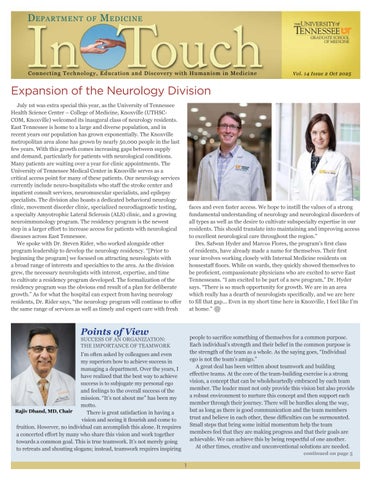
Expansion of the Neurology Division July 1st was extra special this year, as the University of Tennessee Health Science Center – College of Medicine, Knoxville (UTHSCCOM, Knoxville) welcomed its inaugural class of neurology residents. East Tennessee is home to a large and diverse population, and in recent years our population has grown exponentially. The Knoxville metropolitan area alone has grown by nearly 50,000 people in the last few years. With this growth comes increasing gaps between supply and demand, particularly for patients with neurological conditions. Many patients are waiting over a year for clinic appointments. The University of Tennessee Medical Center in Knoxville serves as a critical access point for many of these patients. Our neurology services currently include neuro-hospitalists who staff the stroke center and inpatient consult services, neuromuscular specialists, and epilepsy specialists. The division also boasts a dedicated behavioral neurology clinic, movement disorder clinic, specialized neurodiagnostic testing, a specialty Amyotrophic Lateral Sclerosis (ALS) clinic, and a growing neuroimmunology program. The residency program is the newest step in a larger effort to increase access for patients with neurological diseases across East Tennessee. We spoke with Dr. Steven Rider, who worked alongside other program leadership to develop the neurology residency. “[Prior to beginning the program] we focused on attracting neurologists with a broad range of interests and specialties to the area. As the division grew, the necessary neurologists with interest, expertise, and time to cultivate a residency program developed. The formalization of the residency program was the obvious end result of a plan for deliberate growth.” As for what the hospital can expect from having neurology residents, Dr. Rider says, “the neurology program will continue to offer the same range of services as well as timely and expert care with fresh
faces and even faster access. We hope to instill the values of a strong fundamental understanding of neurology and neurological disorders of all types as well as the desire to cultivate subspecialty expertise in our residents. This should translate into maintaining and improving access to excellent neurological care throughout the region.” Drs. Safwan Hyder and Marcos Flores, the program’s first class of residents, have already made a name for themselves. Their first year involves working closely with Internal Medicine residents on housestaff floors. While on wards, they quickly showed themselves to be proficient, compassionate physicians who are excited to serve East Tennesseans. “I am excited to be part of a new program,” Dr. Hyder says. “There is so much opportunity for growth. We are in an area which really has a dearth of neurologists specifically, and we are here to fill that gap... Even in my short time here in Knoxville, I feel like I’m at home.”
Points of View
people to sacrifice something of themselves for a common purpose. Each individual’s strength and their belief in the common purpose is the strength of the team as a whole. As the saying goes, “Individual ego is not the team’s amigo.” A great deal has been written about teamwork and building effective teams. At the core of the team-building exercise is a strong vision, a concept that can be wholeheartedly embraced by each team member. The leader must not only provide this vision but also provide a robust environment to nurture this concept and then support each member through their journey. There will be hurdles along the way, but as long as there is good communication and the team members trust and believe in each other, these difficulties can be surmounted. Small steps that bring some initial momentum help the team members feel that they are making progress and that their goals are achievable. We can achieve this by being respectful of one another. At other times, creative and unconventional solutions are needed.
SUCCESS OF AN ORGANIZATION: THE IMPORTANCE OF TEAMWORK
I’m often asked by colleagues and even my superiors how to achieve success in managing a department. Over the years, I have realized that the best way to achieve success is to subjugate my personal ego and feelings to the overall success of the mission. “It’s not about me” has been my motto. Rajiv Dhand, MD, Chair There is great satisfaction in having a vision and seeing it flourish and come to fruition. However, no individual can accomplish this alone. It requires a concerted effort by many who share this vision and work together towards a common goal. This is true teamwork. It’s not merely going to retreats and shouting slogans; instead, teamwork requires inspiring
continued on page 5
1
Expansion of the Psychiatry Division: Highlighting Addiction Medicine Dr. Ryan Alexander completed his medical school training at Lincoln Memorial University DeBusk College of Osteopathic Medicine and an internship year with UTGSM in Knoxville. He then pursued residency in preventative medicine and public health at Griffin Hospital-Yale School of Medicine. He later received his Master of Public Health (MPH) degree with Yale School of Public Health and completed a fellowship in addiction medicine at Yale School of Medicine before moving back to Knoxville, TN. He now works jointly with our Department of Medicine and the Helen Ross McNabb Center. He was drawn to addiction medicine by happenstance after he took a moonlighting job for a substance use treatment center and found himself intrigued by its complexity. Working with these patients helped change his perspective of addiction by understanding it as a disease for which treatment options are available that can change the trajectory of a patient’s life. He continues to find joy by providing direct patient care as well as teaching medical students and residents. In addition, he actively engages in research and has had several publications. Dr. Alexander is hoping to expand available resources for substance use treatment to match our community’s need. He notes, “Drug overdose deaths are the leading cause of death of young people. Furthermore, substance use is the leading cause of incarceration, the leading cause of foster placement, as well as a major contributor to crime, homelessness, and unemployment. As long as it is harder for people to get treatment than it is to get drugs then we will continue to deal with all of these issues. I hope we can make treatment access easier so we can improve our community together.”
Improved Access to Care: Integrating Pharmacists in the Internal Medicine Resident Clinic “Call Lindsey when prescribing GLP-1s.” “Talk with Lindsey if you have a patient who needs Hep C treatment.” These are just two of several reminders that have been added to the resident clinic bulletin board since the addition of the Clinical Pharmacist Team to the internal medicine resident clinic. Several days a week, Lindsey Pitt, PharmD, BCPS and her pharmacy resident sit in the hallway of the clinic, discussing medication options and offering help for patients struggling with coverage of their medications. Their team has been an invaluable addition to the clinic and community by completing prior authorizations as well as educating residents on the ins and outs of the patient experiences with medications. Every week, the team sees our patients with insulin dependent diabetes to manage glucose monitors, insulin pumps, and sliding scale regimens. This has filled a major health gap for our patients. Her expertise with hepatitis treatment has allowed us to start treating patients with Hepatitis C in our clinic. This has greatly reduced the amount of people in this vulnerable population who are lost to follow up. If all this were not enough, Lindsey envisions more for her team. She sees a future where she works full time for the clinic so that her skills and expertise could be available any time she is needed. Our clinic has thrived with the addition of Lindsey and the pharmacy team and we look forward to what they can do for the program and the people of Knoxville in the future!
Voices…“Disparities in Rural Medicine Across Appalachia” In 2024, a University of Tennessee Medical Center study led by Dr. Paul Terry analyzed 250 questionnaires to highlight the impact of social determinants of health (SDH). SDH are non-medical factors such as housing, education, food security, and transportation that often shape health outcomes more than medical care itself. The University of Tennessee serves a broad patient population, including many in Appalachia, where these barriers are especially pronounced. Residents of Appalachia face a disproportionate burden of poverty, limited transportation, and low health literacy, which frequently delay or prevent care. Survey findings pointed to low household income, obesity, sedentary lifestyles, and unreliable transportation as key barriers. Dr. Terry noted that “patients without a primary care physician often show lower vaccine uptake, and those with transportation challenges are far less likely to keep appointments for routine checkups.” For providers like Dr. Blake Lowe, the only pediatrician in a rural East Tennessee county, these barriers are not theoretical, they shape his practice daily. He sees how gaps in access lead to fragmented or delayed care, pushing families into emergency departments or urgent care centers. This cycle strains limited regional resources, drives up costs, and rarely improves outcomes. While similar challenges affect rural communities nationwide, the high overlap of barriers in Appalachia makes the region unique. Addressing them requires more than clinical care; it demands system-wide approaches that meet patients where they are. Dr. Terry’s work provides the data to guide such efforts, aiming to bridge gaps between health care and the realities of daily life. 2
2025 – 2026 IM Resident Chiefs The Internal Medicine Residency Program would like to introduce the new chief residents for the 2025-2026 academic year: (L-R) Maria Brandel, DO, Jesse Woodall, DO, Ty Gaylor, DO, & Anna Harrison, MD. ICU chief: Dr. Jesse Woodall has been appointed the 2025-2026 ICU Chief Resident! “I am honored to serve as the ICU Chief Resident for 2025–2026. East Tennessee has always been home for me, with my family still residing in Farragut. After completing my undergraduate studies at the University of Tennessee, I attended William Carey University in Mississippi for medical school and was grateful to return to UTMC for residency. As ICU Chief, my priority is to strengthen critical care education within our residency program. Given our program’s strong emphasis on ICU training, I believe mastering both the knowledge and procedural skills required for success in critical care is essential. This year, I am working to organize procedure workshops and enhance ACLS training to help residents feel more confident during their ICU rotations. Looking ahead, I plan to pursue a fellowship in pulmonary and critical care medicine. I have particular interests in ECMO and advanced bronchoscopy and look forward to further developing my skills in these areas.”
Clinic Chief: Dr. Anna Harrison has been appointed the 2025-2026 Internal Medicine Clinic Chief Resident! She grew up in a small town on the Eastern Shore of Maryland called St. Michaels. Dr. Harrison attended Herbert Wertheim College of Medicine FIU in Miami, FL. Her primary goals for the year include improving the overall experience for residents in the resident clinic as well as streamlining the learning / teaching in the clinic setting. Dr. Harrison hopes to work on hypertension quality improvement project over the next year to include medication reconciliation and education for better patient outcomes. After residency, she will return home to the suburbs of Maryland to reunite with her fiancé, family, and friends and work as a Primary Care Physician! Inpatient Medicine Chief: Dr. Ty Gaylor has been appointed the 2025-2026 Hospital Medicine Chief Resident! He grew up around Oak Ridge and Norris, TN areas and attended medical school at Lincoln Memorial University DeBusk College of Osteopathic Medicine. He is
hoping to “continue improving the overall experience on House Staff Medicine teams for both residents and medical students with an emphasis on evidence-based practice, safe transitions of care, and efficient documentation practices.” He plans on pursuing a career as an academic hospitalist by starting out as an instructor fourth year chief resident then applying to become an Assistant Professor of Internal Medicine. Operations & Recruitment Chief: Dr. Maria Brandel has been appointed the 2025-2026 Wellness Chief Resident! She grew up in Minneapolis, Minnesota and attended medical school at LMU-DCOM. Her primary focus is on resident events and wellness as well as ensuring the next class of residents fit well with the current team dynamics. Looking ahead to graduation, she hopes to stay here in Knoxville after residency. She truly loves medicine and can see herself happy working in either the inpatient or outpatient settings. Just waiting to see what the future holds.
Comings and Goings Internal Medicine Graduates
C. Scott Simmons, MD – University of Alabama at Birmingham – Heersink School of Medicine, Birmingham, AL. Plans to begin a Radiology/Oncology Residency in July of 2026 at MD Anderson, University of Texas.
Steve Ferlita, DO: Cardiovascular Disease Fellow at UTHSC – College of Medicine, Knoxville, TN
New Neurology Residents
Safwan Hyder, MD – Georgetown University – School of Medicine, Washington, D.C.
INCOMING
New Internal Medicine Residents
Amirbehzad Bagheri, MD (PGY-2) – Mashhad Univ of Medical Sciences, Iran. PGY1 Year at the University of Pittsburgh Medical Center McKeesport in Pittsburgh, PA. Abigail Benton, DO – University of North Texas – Health Science Center at Fort Worth, TX Addison Bond, MD – University of Tennessee Health Science Center – College of Medicine, Memphis, TN Anisha Dash, MD – East Tennessee State University – James H. Quillen College of Medicine, Johnson City, TN Ryan Ferguson, DO – Lincoln Memorial University – DeBusk College of Osteopathic Medicine, Harrogate, TN Taylor Gray, DO – Lincoln Memorial University – DeBusk College of Osteopathic Medicine, Harrogate, TN Brock Hodges, DO – Lincoln Memorial University – DeBusk College of Osteopathic Medicine, Harrogate, TN Rami Jadallah, MD – Jordan University of Science and Technology – Faculty of Medicine Keaton Kaye, MD – University of Tennessee Health Science Center – College of Medicine, Memphis, TN Subin Paul, MD – University of South Florida – Health Morsani College of Medicine, Tampa, FL Ricky Rana, MD – Creighton University School of Medicine, Omaha, NE Kristen Scott, DO – Lincoln Memorial University – DeBusk College of Osteopathic Medicine, Harrogate, TN Vikrant Singh, MD – Sri Guru Ram Das – Institute of Medical Sciences & Research, Amritsar, India Jared Smith, DO – West Virginia School of Osteopathic Medicine, Lewisburg, WV
New Transitional Year Residents
Matt Bounds, MD – University of Tennessee Health Science Center – College of Medicine, Memphis, TN. Plans to begin a Radiology Residency in July of 2026. Kelsie Cherry, DO – Lincoln Memorial University – DeBusk College of Osteopathic Medicine, Harrogate, TN. Plans to begin a Radiology Residency in July of 2026. Kelsey Holland, MD – University of Tennessee Health Science Center – College of Medicine, Memphis, TN. Plans to begin a Radiology Residency in July of 2026.
GRADUATING
Kennedy Sabharwal, MD – University of Kentucky – College of Medicine, Lexington, KY. Plans to begin a Dermatology Residency in July of 2026.
Marcos Flores Valdes, DO – University of Medicine & Health Sciences – School of Medicine, Caribbean - Basseterre, St. Kitts & Nevis
New Cardiovascular Disease Fellows
Kavi Dayaram, DO: Primary Care Physician at Faculty Internal Medicine, Knoxville, TN
Pavani Gingrich, MD: Hospitalist in Tacoma, Washington Erin Hamric, DO: Hospitalist for UTH, Knoxville, TN Andrew Hartley, DO: Primary Care Physician at Graves Gilbert Clinic, Bowling Green, KY Jonathan Hartranft, DO: General Internist with MCV Physicians & Assistant Clinical Professor of Medicine at Commonwealth University, Richmond, VA
Amal Benchakroun, MD: Ross University - School of Medicine, Barbados, Caribbean, followed by Internal Medicine Residency at the University of Miami – HCA Florida JFK Medical Center, Atlantis, FL.
Jared Odom, DO: Hospitalist for Team Health at Bristol Regional Medical Center, Bristol, TN
Steve Ferlita, DO: Western University of Health Sciences – College of Osteopathic Medicine of the Pacific, Pomona, CA, followed by Internal Medicine Residency at the University of Tennessee Graduate School of Medicine, Knoxville, TN.
Logan Shaver, DO: Hematology Hospitalist at the University of Alabama at Birmingham – Heersink School of Medicine – Hematology / Oncology Division, Birmingham, AL
Jackson Mosley, MD: University of Arkansas for Medical Sciences – College of Medicine, Little Rock, AR, followed by Internal Medicine Residency at the University of Arkansas for Medical Siences, Little Rock, AR.
New Interventional Cardiology Fellow
Sandeep Kancharla, MD: Texas A&M Health Science Center – College of Medicine, Bryan, TX. Followed by an Internal Medicine Residency and Cardiovascular Disease Fellowship at the University of Mississippi Medical Center, Jackson, MS.
New Pulmonary/Critical Care Fellows
Ali Akram, MBBS: Quaid-e-Azam Medical College in Pakistan followed by the Wellspan York Hospital in York, PA. He worked as an Open ICU Nocturnist at the Cayuga Medical Center in Ithaca, NY. Mohamed Mohamed, MBBS: Alfaisal University - College of Medicine in Saudi Arabia followed by an Internal Medicine Residency at the University of Maryland Medical Center – Midtown Campus, Baltimore, MD. Mandvi Pandey, MBBS: Indian Institute of Medical Science & Research in India followed by an Internal Medicine Residency at Texas Health Resources HEB Denton in Bedford, TX. Christy Smith, MD: Edward Via College of Osteopathic Medicine – Virginia Campus in Blackburg, VA followed by an Internal Medicine Residency at the University of Tennessee Graduate School of Medicine, Knoxville, TN.
New Hematology/Oncology Fellows
Tosha Hedin, MD: Morehouse School of Medicine, Atlanta, GA, followed by Internal Medicine Residency at HCA Florida Healthcare / USF Morsani College of Medicine – Brandon Hospital in Tampa FL. Meaghan Standrige, MD: University of South Carolina – School of Medicine, Greenville, SC, followed by Internal Medicine Residency at the Medical College of Georgia, Augusta, GA.
Jeffrey Peeke, MD – Loma Linda University – School of Medicine, Loma Linda, CA. Plans to begin a Radiology Residency in July of 2026.
Travis Moodie, MD: Hospitalist for StatCare in Knoxville, TN
Kirk Reeves, DO: Hospitalist for StatCare in Knoxville, TN
Christy Smith, DO: Pulmonary & Critical Care Medicine Fellow at UTHSC – College of Medicine, Knoxville, TN Emma Zibas, MD: Hospitalist for StatCare in Knoxville, TN
Transitional Year Graduates
Reza Ayoubi, MD: Radiology Resident in Savannah, GA Aaron Faacks, MD: Radiology Resident in Worcester, PA Khashayar Fattah, MD: Radiation Oncology Resident at MD Anderson, University of Texas, Houston, TX Manal Hassan, DO: Dermatology Resident at the University of Iowa Nicolas Mascia, MD: Radiology Resident at UTHSC – College of Medicine, Knoxville, TN Sean Walsh, MD: Radiology Resident at UTHSC – College of Medicine, Knoxville, TN
Cardiovascular Disease Fellowship Graduates
Tyler Coombes, MD: Assistant Professor & Attending Physician with University Cardiology, UTMC, Knoxville, TN Nikhil Jain, MD: General, Non-Invasive Cardiologist at the Cardiovascular Institute of San Diego, CA Laylan Shali, MD: Private Practice Physician at Virginia Heart, in Dulles, VA
Interventional Cardiology Fellowship Graduate
Muhammad Khan, MBBS: Assistant Professor & Attending Physician at Creighton University in Omaha, NE
Pulmonary/Critical Care Fellowship Graduates Syed Hussain, MBBS: Attending Physician at Wellspan Chambersburg Hospital in Chambersburg, PA Akesh Thomas, MBBS: Attending Physician at Blount Memorial / Prisma Health in Maryville, TN Samuel Treat, MD: Attending Physician at Prisma Health in Greenville, SC
Hematology/Oncology Fellowship Transition J. Evan Davidson, MD: Attending Physician with University Cancer Specialists, UTMC - Knoxville, TN
3
Faculty & Resident Awards and Honors Rawson Recipients
Clinic Star of the Year
The Rawson Award for excellent teaching and clinical skills was given to Dr. Christy Smith, DO (PGY-3) and Dr. Ty Gaylor, DO (PGY-2), at the 2025 Department of Medicine Residents’ Awards Dinner. This award is given in memory of Freeman Rawson, MD, who joined the Department of Medicine in 1956 as one of our first teaching faculty and was known for his compassion and expertise. Dr. Rawson passed away in 2003.
The UT Internal Medicine Center presented the Clinic Star of the Year Award to Johnathan Hartranft, DO at the 2025 Department of Medicine Residents’ Awards Dinner. Congratulations to Dr. Hartranft on his well-deserved award!
Medical Student Teaching Awards The medical students who rotated through the UT Graduate School of Medicine across multiple departments voted to select the resident with the best teaching ability and Dr. Ty Gaylor won this award! Special thank you to Dr. Travis Moodie as well for his role as the Medical Student Liasion. These residents were acknowledged at the 2025 Department of Medicine Residents’ Awards Dinner.
Jim Neutens Award for Best Teaching Division of the Year In 2018, the Department of Medicine created the Jim Neutens Award for Best Teaching Division of the Year in honor of Dr. Jim Neutens, who retired in 2018 after many years of service as the Dean of the Graduate School of Medicine. Graduating internal medicine residents select the department that made the most impact upon them during three years of residency training. Continuing the break from tradition and for the first time, this honor went to the Division of Internal Medicine!
11th Annual Department of Medicine Research Awards On June 17th, 2025, the Department of Medicine held the 11th Annual Residents’ and Fellows’ Research Contest. A faculty committee reviewed the research papers submitted by Department of Medicine residents and fellows and selected the top three to present at the Research Awards. The audience voted to select the placement of the winners. Dr. Benjamin Fogelson won first place with “An Increase in Mean Aortic Valve Gradients the Day After Transcatheter Aortic Valve Implantation: The Effects of Evolving Anesthesia Technique.” Dr. Jesse Woodall won second place with “Evaluation of time to therapeutic PTT and overall outcomes of patients presenting with pulmonary emboli and treated with heparin infusion with or without heparin bolus.” Finally, Dr. Stefan Weston won third place with “Plasma Cystatin C Versus Plasma Creatinine in Critically Ill Patients with Acute Kidney Injury Secondary to Rhabdomyolysis: A Prospective Study.” 4
Outstanding Academic Achievement Award: This new award was introduced during the 2025 – 2026 academic year and is open to all residents, fellows, and medical students within the Department of Medicine. This distinction honors exemplary performance in scholarly activities, including research grants, peer-reviewed publications, and other academic accolades during the academic year. Please extend your congratulations to Dr. Khashayar Fattah, who not accomplished a lot over the short time on our campus as a Transitional Year Resident. Dr. Fattah attended and participated in multiple conferences with original research abstracts including The American College of Radiation Oncology & The American Society of Radiation Oncology. He was also selected as the recipient for the James D. Cox Research Award in addition to the 2025 ROI Innovation Award with a funding amount of over $50,000 to continue his research endeavors.
New Staff We’re excited to share that Cheryl Teague has transferred into the role of Administrative Program Support in the Department of Medicine as of June 2025. Cheryl brings a wealth of experience to this position. She’s been a part of the Department of Medicine team since March 2021, previously serving as an Administrative Specialist in the Cardiovascular Disease, Interventional Cardiology, and Pulmonary/Critical Care Disease Fellowships. Before joining UTHSC, Cheryl worked as Office Manager at Appalachian Heart Center and held administrative roles at Appalachian Regional Healthcare and UK Gill Heart Appalachian Heart Center. Her career began in public service as a Family Support Specialist with the Cabinet for Health & Family Services. Please join us in congratulating Cheryl on this exciting next step in her journey.
New Faculty We are pleased to welcome Vicky Wenzlawsh as the new Administrative Specialist for the Cardiology, Interventional Cardiology, and Pulmonary / Critical Care Fellowship Programs in the Department of Medicine. Everybody has a story as to why they work in any given profession for an extended period of time. Some will go through different paths of professions before they find their passion. I found my passion as a coordinator in Graduate Medical Education that started about 15 years ago. I have worked with residents and fellows in several specialties. I find it to be very rewarding helping people navigate through the administrative areas of their new career field, and everyone I meet has a story of their own. Helping others is something I have always enjoyed doing. I look forward to the challenge that lies ahead as a coordinator to the fellows in Cardiology/ Pulmonary Critical Care and Interventional Cardiology. I also enjoy cross-stitching, knitting, crocheting, gardening and spending time with my family.
We are thrilled to welcome Dr. Samuel Purkey, a board-certified Internal Medicine physician and fellowshiptrained gastroenterologist with advanced endoscopy training. Dr. Purkey completed his residency at the University of Tennessee, where he served as Chief Resident, and recently finished his Gastroenterology Fellowship at Allegheny Health Network. He brings a strong record of clinical excellence, award-winning research, and national conference presentations. Beyond his clinical and academic work, Dr. Purkey has a strong history of service—including medical missions, mentorship, and community clinic involvement—which reflects his commitment to patient-centered care and medical education. We are excited to welcome Dr. Purkey and look forward to the skill, compassion, and expertise he brings to our team.
Points of View continued from page 1 I’m reminded of a team-building exercise where one member of a pair was asked to make a fist with their hand, and the other member of the pair was tasked with unclenching the fist. While many other participants were trying to unclench their partner’s fists by force, I simply asked my partner to please unclench their fist, and that was all that was needed! Trust and good communication can work wonders! As physicians, we are all too familiar with the importance of functioning in a team. Each patient’s care requires a complex set of steps and procedures, with individuals at various levels of training and expertise working together towards a successful outcome. We expend a great deal of energy in this exercise to achieve the best outcome. Achieving the desired result as a team enhances motivation and builds morale far more than can be achieved by individual success. In the Department of Medicine, we have been fortunate to have extremely dedicated and loyal team members who are united in making this a better place to work. The team-building exercise needs to continue so that we can achieve even greater heights clinically and academically. Indeed, we have a strong foundation to build on!
CME OPPORTUNITIES
Hybrid attendance: half joining via Zoom or Microsoft Teams • • • •
Cardiology Conferences, held weekly on Wednesdays in the Medicine Conference Room for 0.75 hour CME credit. Medicine Grand Rounds, held on the 2nd and 4th Tuesdays of each month in the Medicine Conference Room for 1.00 hour CME credit. Ethics Case Rounds, held on the 4th Thursday of the month at noon in Wood Auditorium and are available for 1.00 hour CME credit. Pulm/HTN Conferences, held on the 2nd Monday of the month at noon in different locations and are available for 1.00 hour CME credit.
5
Ethics Case Rounds: “When Patient’s Decisions are Influenced by Others at End of Life” Ethics Case Rounds are monthly, hospital-wide discussions of morally distressing cases. Cases are de-identified to protect patient confidentiality. “Brittany” was a 42 y/o lady who was admitted with stage IV breast cancer that had metastasized to the lungs. She lived with her husband, “Jared”, and their two young sons. Unfortunately, her prognosis was very poor; she was not expected to survive to discharge. Her symptoms – dyspnea, pain, and anxiety – had been very difficult to control. Jared was frequently at bedside, and Brittany seemed to look to him for both support and guidance. He was very outspoken about advocating for aggressive measures. He felt opioids had hastened Brittany’s decline, and that her pain could be controlled with Tylenol alone. He had been heard cautioning her, “remember what we discussed” when she asked for medications. She often retracted her request after his input. Brittany was invited to talk at a time when Jared was away from the hospital, and she agreed. She said she hoped to have more time with her children and that she wanted her symptoms controlled, including having something stronger than Tylenol for pain. However, after that conversation, she called Jared, and when the nurse brought her pain meds, she declined them. Brittany’s condition deteriorated further. She was extremely dyspneic with markedly increased oxygen and pressor requirements. Jared told the team that he and Brittany would like to transfer to another hospital for a higher level of care. Brittany, though no longer able to speak, nodded in agreement. Relationships are complex. Many people have preferences that they would be willing to compromise to benefit a loved one (for healthy or unhealthy reasons). Moreover, some people who have a long-standing habit of deferring to others find exerting their own preferences uncomfortable. While we do need to respect the patient’s wishes, “the patient’s wishes” may not be straightforward. Recommendations when family members appear to be unduly influencing patient choices include a) attempting to have private discussions about patients’ values and preferences, including patients’ feelings about their relationships, b) attempting to understand and empathize with family members’ concerns, c) de-escalating conflict as much as possible, and setting medically-appropriate limits, if needed. An interdisciplinary team meeting was held. Her providers agreed that despite maximal medical intervention, Brittany was dying. In her fragile state, neither intubation, cardiopulmonary resuscitation, nor transfer would reverse the dying process, and would likely cause harm. After a great deal of discussion, the providers collectively agreed that neither intubation, CPR, nor transfer were appropriate to offer. The attending physician met with Jared and explained clearly and kindly that Brittany was dying. She explained that intubation, CPR, and transfer would not help her live longer and that that she would now be DNR/I status. She also explained that the team had a responsibility to manage Brittany’s pain, whether or not she was on comfort measures per se. Other ICU interventions (e.g., vasopressors) would continue if they wished. Jared seemed to have difficulty processing the news that Brittany was dying. At length, he expressed understanding of the team’s decisions. He was not ready to transition to comfort measures at that time, but said he would think about it. Nursing staff worked to manage Brittany’s pain and air hunger. Brittany died the next morning with Jared at her side. He thanked the team for caring for her, and said he wished he had taken her home with hospice care earlier. Comments on this case may be sent to amendola@utmck.edu References • Mehter HM, McCannon JB, Clark JA, Wiener RS. Physician Approaches to Conflict with Families Surrounding End-of-Life Decision-making in the Intensive Care Unit. A Qualitative Study. Ann Am Thorac Soc. 2018 Feb;15(2):241-249. • Reader TW, Dayal R, Brett SJ. At the end: A vignette-based investigation of strategies for managing end-of-life decisions in the intensive care unit. J Intensive Care Soc. 2021 Nov;22(4):305-311.
In Touch Vol. 14 Issue 2: October 2025 Publisher Rajiv Dhand, MD, Chair, Department of Medicine Editor Annette Mendola, PhD Administrative Director Jenny Roark Contributors Jenny Roark Rajiv Dhand, MD Annette Mendola, PhD Cassandra Mosley Erin Hamric, DO Logan Shaver, DO Ty Gaylor, DO Mary Ellen Johnson Philip Akins, DO Isaac Daffron, MD Ann Ramberg, DO Addison Bond, MD Taylor Gray, DO Design J Squared Graphics In Touch is produced by the University of Tennessee Graduate School of Medicine, Department of Medicine. The mission of the newsletter is to build pride in the Department of Medicine by communicating the accessible, collaborative and human aspects of the department while highlighting pertinent achievements and activities. Contact Us In Touch University of Tennessee Graduate School of Medicine Department of Medicine 1924 Alcoa Highway, U-114 Knoxville, TN 37920 Telephone: 865-305-9341 E-mail: InTouchNewsletter@utmck.edu Web: http://gsm.utmck.edu/ internalmed/main.cfm
Presentations, Publications, Awards
The University of Tennessee is an EEO/AA/Title VI/Title IX/Section 504/ADA/ADEA institution in the provision of its education and employment programs and services.
Thank You For Your Support
Disclaimer: quotes/ interviews are edited for length and clarity
Department of Medicine faculty, residents, and fellows share their knowledge and experience by publishing and presenting across the world. For a list of our most recent accomplishments, visit http://gsm.utmck.edu/internalmed/scholars.cfm.
For information about philanthropic giving to the UT Graduate School of Medicine, Department of Medicine, please contact the Development Office at 865-305-6611 or development@utmck.edu. If you would like more information about any of the topics in this issue of In Touch, please contact the Department of Medicine at 865-305-9341 or visit http://gsm.utmck.edu/internalmed/main.cfm. We look forward to your input. Thank you.
Stay In Touch! Alumni, please update your contact information by completing the simple form at http://gsm.utmck.edu/internalmed/alumni.cfm or by calling the Department of Medicine at 865-305-9341. Thank you!
6