


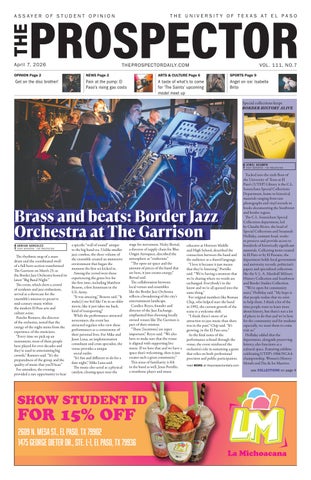
The rhythmic snap of a snare drum and the coordinated swell of a full horn section transformed The Garrison on March 25, as the Border Jazz Orchestra hosted its latest “Big Band Night.”
The event, which drew a crowd of residents and jazz enthusiasts, served as a showcase for the ensemble’s mission to preserve mid-century music within the modern El Paso arts and culture scene.
Pancho Romero, the director of the orchestra, noted that the energy of the night stems from the experience of the musicians.
“Every time we pick up an instrument, most of these people have played for over decades and they’re used to entertaining big crowds,” Romero said. “It’s the preparedness of the group and the quality of music that you’ll hear.”
For attendees, the evening provided a rare opportunity to hear
a specific “wall of sound” unique to the big band era. Unlike smaller jazz combos, the sheer volume of the ensemble created an immersive environment that began the moment the first set kicked in.
Among the crowd were those experiencing the genre live for the first time, including Matthew Beason, a first lieutenant in the U.S. Army.
“It was amazing,” Beason said. “It make[s] me feel like I’m in an older movie, like it just takes me back, kind of transporting.“
While the performance attracted newcomers, the event has attracted regulars who view these performances as a cornerstone of their personal lives. For Mike and Janet Luna, an implementation consultant and crisis specialist, the venue provides a unique social outlet.
“It’s fun and different to do for a date night,” Mike Luna said.
The music also acted as a physical catalyst, clearing space near the
stage for movement. Nicky Bernal, a director of supply chain for Blue Origin Aerospace, described the atmosphere as “exuberant.”
“The open-air space and the amount of pieces of the band that are here, it just creates energy,” Bernal said.
The collaboration between local venues and ensembles like the Border Jazz Orchestra reflects a broadening of the city’s entertainment landscape.
Candice Reyes, founder and director of the Jazz Exchange, emphasized that choosing locally owned venues like The Garrison is part of their mission.
“These [locations] are super important,” Reyes said. “We also have to make sure that the venue is aligned with supporting live music. If we have that and we have a space that’s welcoming, then it just creates such a great community.”
This sense of familiarity is felt in the band as well. Jesus Portillo, a trombone player and music
educator at Horizon Middle and High School, described the connection between the band and the audience as a shared language.
“I love it because it just means that they’re listening,” Portillo said. “We’re having a moment that we’re sharing where no words are exchanged. Everybody’s in the know and we’re all queued into the same thing.”
For original members like Roman Chip, who helped start the band in 1992, the current growth of the scene is a welcome shift.
“I think there’s more of an attraction to jazz music than there was in the past,” Chip said. “It’s growing, in the El Paso area.”
As the final notes of the performance echoed through the venue, the event reinforced the orchestra’s role in sustaining a genre that relies on both professional precision and public participation.


Tucked into the sixth floor of the University of Texas at El Paso’s (UTEP) Library is the C.L. Sonnichsen Special Collections Department, home to historical materials ranging from rare photographs and vinyl records to books documenting the Southwest and border region.
The C.L. Sonnichsen Special Collections department, led by Claudia Rivers, the head of Special Collections and Susannah Holliday, assistant head, works to preserve and provide access to hundreds of historically significant materials. Collecting items created in El Paso or by El Pasoans, the department holds local government and university records, politician‘s papers and specialized collections like the S. L. A. Marshall Military History Collection and Southwest and Border Studies Collection.
“We’re open for community users,” Holliday said. “My hope is that people realize that we exist to help them. I think a lot of the time people want to learn more about history, but there’s not a lot of places to do that and we’re here for the community and for students especially, we want them to come visit us.”
Holliday added that the department, alongside preserving history, also functions as a cultural space. Featuring exhibits celebrating UTEP’s 1966 NCAA championship, Women’s History Month and Dia de los Muertos. read MORE at theprospectordaily.com
see COLLECTIONS on page 4

Ximena Cordero, editor-in-chief

“I need to tell you about the disc theory,” my basically big brother Kristian told me.
“I’m sorry, the what?” I didn’t know what in the world the disc theory was and my vacation brain prevented me from inferring. So, I asked what it was.
He didn’t explain anything until I got back into town from the holidays.
In essence, the disc theory works like a record player for your mind. The disc itself is an attitude that everyone wants to have. That attitude then gets inserted into the player, which in this case is your mind. So as the disc plays, it’s the person putting their attitude into action.
Maybe it’s worth becoming a part of the Comm Theory curriculum. Kristian laid down a simple, yet effective premise, now came the time to carry it out. But that last part always proves to be the hardest in any task, especially now.
Last year, when I wrote my first
I am so excited to start this new position. I’ve officially been promoted to the position of “Office Unc.” That being aside from Sofia Sierra, the EIC of Minero Magazine, who started the summer before me, and Kristian Hernandez, the actual Unc of the office.
As of Spring 2026, I’m the person currently on staff who has worked at The Prospector for the longest amount of time. I’ve been here for almost three years, which is decently long in terms of college student media.
The thought of that alone is crazy to me. I came in at 17 as a guest contributor in Fall 2023 and I felt like a newborn baby in the office compared to everyone else. I was the youngest and had the least experience in this sea of studentjournalists at The Prospector. Turns out I was more like Boss Baby of the office rather than a newborn.
I remember sitting alone at the
corner of the conference table at my first budget, just observing how the editors ran the office. Everyone had their place in the newsroom, and they were all genuinely perfect at what they did in my eyes.
I wanted to be like them. I fell in love with the idea of learning more and challenging myself to improve, even if it was just by taking photos for my college’s newspaper.
The very first issue that I was a part of, none of my photos made it to print and my name was misspelled in the staff list. Of course, that bummed me out. On the next issue, my photo made the front cover with four other pictures of mine inside the paper. My name was spelled as “Izaiah,” but you know what… I didn’t care; I was so proud of the job that I did.
Whether it was because my photos were just that breathtaking or because the editors literally had no other options is up for debate, but it really did spark something in me.
If my class life or my depressed,
lame, chud freshman life had nothing else in it to look forward to, I knew I had one thing: taking photos for The Prospector and Minero.
Oh, I was determined. When my freshman year ended, I jumped straight from a contributor to the photo editor of The Prospector in Summer 2024, got dethroned by SalmaPaola Baca in Fall 2024… rightfully so though… and instead became the photo editor at Minero and helped produce an awardwinning magazine.
That next semester, I won back the title at The Prospector (I am sorry Salma) and I’ve since then held the position on lock for four semesters.
Being the photo editor is such an interesting experience. I’ve shot literally everything and anything you can think of and I’ve had one hell of a fun time doing
introduction piece, I was in a very similar, yet different position in my life.
I was 18 going on 19 and recently promoted to an editor position by former EIC Avery EscamillaWendell. At the same time, I was scared of using Adobe Premiere Pro, had never hosted a podcast in my life, and was just a month out from a situation that seems too petty to call heartbreak.
But I felt secure in myself.
A feeling that took months of hard work to get to.
“Read this card and keep it with you,” my uncle Aldo said to me.
He had taken notice of my moppy attitude. I was a senior in high school, and my self image wasn’t all too high. A couple of weeks before I had competed at a UIL speech and debate event.
At the time, that event felt like the Super Bowl.
Why? Simple, because at that time I wanted nothing more than to win a speech award from an out of town tournament and this was probably going to be my last chance
to get it. Getting that was the only thing I hadn’t accomplished in the activity.
So, with that want, I went over to Dallas, and flopped. To my speech and debate peeps you know what I mean when I say I took two sixes. For everyone else, out of three judges, two gave me last.
For the final weeks of my senior year, I felt that the years I had put into the activity were only good enough for last place.
Then I read the card.
The Pyramid of Success…
Hard work . Dedication. Patience
And at the very top…
A little bit of faith.
That card remains in my wallet today. It also made me reconsider what success was.
Flash forward to a year later, I had spent almost an entire semester at The Prospector, went to my first collegiate nationals and won a number of awards, broadcasted on ESPN+ and had a banner of me put up on campus – with no one drawing a mustache on it...yet. read MORE at theprospectordaily.com

Aylin Montanez
Vanessa Orozco
Dustin Perez
Adriana Quinones
Aziel
Ximena Cordero, editor-in-chief
ADRIAN GONZALEZ
STAFF REPORTER THE PROSPECTOR
For the thousands of students who commute to the University of Texas at El Paso (UTEP) daily, the walk from the Sun Bowl parking garage is getting increasingly expensive before they even step onto campus.
As of early April 2026, the average price for a gallon of regular unleaded gasoline in El Paso has reached $4.08. According to the American Automobilbe Association of Texas (AAA Texas), this figure is the highest among the 27 largest metropolitan areas in the state.
Since the onset of the U.S.-Israeli conflict with Iran on February 28, local prices have skyrocketed from an average of $3.12 per gallon to a 31% increase in just over a month.
The rapid spike is directly tied to the geography of the ongoing war. The Strait of Hormuz, a narrow waterway that handles approximately 20% of the world’s total oil consumption, is currently the center of a global supply disruption.
When conflict threatens this primary transit chokepoint, global crude prices surge instantly. International oil prices have climbed significantly since the war began, and these fluctuations
trickle down to local stations in the Borderland faster than in many other Texas regions.
The impact isn‘t limited to passenger vehicles. The cost of diesel has topped $5.39 per gallon in El Paso.
Because almost all food in the region arrives via longhaul trucking, these increased transportation costs are being passed directly to consumers through rising grocery bills as shipping surcharges are added to produce and household staples.
At UTEP, a campus that recently saw a record spring enrollment of nearly 25,000 students, the financial strain is creating a “commuter tax” on education.
Gilberto Sandat, a senior computer science major, described the trend as “crazy high.”
“More is going to gas than it used to, like 20 [dollars] more,” Sandat said.
For freshman engineering major Saul Galvan, the shift has changed his weekly budget.
Galvan recalled that at the beginning of the semester, he would spend between $21 to $23 for a full tank of gas. With the rising costs, his total has gone up to $40.
While he described the situation as “pretty ridiculous,” he expressed
The BTS concert is getting closer, and fans are growing in excitement. Preparations have started, and local businesses from the border region are preparing to receive the ARMY (BTS fandom name) from all around.
Last year, the Sun Bowl Stadium hosted another world-renowned British band, Coldplay, and the event generated a significant economic impact, bringing in more than $37 million. Now, nearly a year later, both El Paso and Juárez are once again preparing to receive visitors from across the country.
Laura González, a BTS fan and manager of @btsxelpaso on Instagram, has been tracking local initiatives aimed at welcoming fans and helping them make the most of their visit.
“As soon as fans [ARMY] in El Paso and Cd. Juárez saw that El Paso was one of the tour stops for BTS’ Arirang Tour, they began to mobilize. In preparation for BTS’ arrival, many groups have organized events and projects,” González said. These projects include building webpages so that those who are traveling know about El Paso, what to do in the city, where to eat and even concert day checklists and guidelines for when going to the Sun Bowl.
“Watching groups create events
and projects has also been exciting! You get to see everyone’s creativity, from projects and events to planning outfits,” Gonzalez said.
Local businesses are embracing the BTS spirit. Dainty Gem
Jewelry Studio hosted a giveaway featuring a personalized BTS charm bracelet. Meanwhile, shops like The Fabz Shop and K-Pop Fantasy Events are bringing fans together by organizing a BTS rave party, creating spaces for fans to connect.
Priscilla Marquez, jewelry and fashion designer from Dainty Gem by NinaLu Designs experienced firsthand the impact of concerts in the local El Paso economy.
“Events like the Coldplay concert and now BTS have a powerful impact on the local business scene in both El Paso and Juárez. They bring in a new level of energy, visibility, and opportunity not just for large venues, but for small, locally owned businesses as well.”
Marquez said.
While visitors come to enjoy the BTS concert, it also gives them an opportunity to see and learn about the border’s culture.
“What’s especially meaningful is how these events encourage people to explore the city beyond the concert itself.“
read MORE at theprospectordaily.com
a sensible view of how events in the Middle East affect the U.S.
While global geopolitics remain out of local control, AAA Texas suggests several ways for drivers to stretch their fuel.
Reducing highway speeds from 75 mph to 65 mph can improve fuel economy by up to 15% while removing unnecessary weight from a vehicle can further decrease consumption.
Maintaining properly inflated tires can increase efficiency by up to 3% and avoiding long periods of idling prevents unnecessary fuel burn.
Additionally, using digital tools like the AAA Mobile App or GasBuddy can help students find the lowest prices along their specific commute rather than settling for the nearest station.
As the Iran conflict continues, the national average for regular gas has officially exceeded $4.10 per gallon for the first time in years.
For the UTEP community, the road to graduation is becoming more expensive by the mile.



COLLECTIONS on cover
Students, faculty and community members are welcome to explore these exhibits, use materials within the reading room and engage with the region’s history through original documents.
“Archives are a great place for cultural preservation. Every place in the U.S. is unique, right? But I think the border has a lot of misinformation about it, and don’t know anything about the border or about the southwest,” Holliday said. “I think it humanizes history.”
Among its remarkable holdings are permanent and rotating exhibits, rare books and artifacts. On the library’s fourth floor, visitors can view Jose Cisneros’s original illustrations for his book “Riders Across the Centuries: Horsemen of the Spanish Borderlands,” according
to the special collections department website.
Even seemingly mundane items can hold unexpected value; Rivers explained that collections of grocery receipts from now abandoned towns or railroad crossing photos that might initially be considered boring, were later found to be crucial for researchers.
“We have a collection from Valentine of grocery store receipts. Because there’s not very much from Valentine, we also have a collection of photos of every level railroad crossing grade in El Paso,” Rivers said. “I went, this is the most boring collection. No one’s going to ever want to use this collection, but people have. You can’t keep everything, so you do have to appraise what you think its research value is, and it can be complicated to do that.”
While the special collections department considers what to preserve based on potential research value, their work continues beyond storing and digitizing old documents. For both Rivers and Holliday, the preservation of these historical materials is about keeping the region’s history alive and meaningful. Every photo, record or artifact ensures that future generations can study, reflect and learn from the past.
“The classic thing is that those who don’t learn from the mistakes of the past are doomed to repeat them. And that’s one of the things we’ve been seeing a lot lately. It’s good to see how thing’s change, but in a way, they still stay the same, and hopefully we can learn from these mistakes,” Rivers said.
By safeguarding these materials, the C.L. Sonnichsen Special Collections Department allows students, researchers and the public not just to view history but connect with it, understand it and carry its lessons forward.
jnocampo@miners.utep.edu
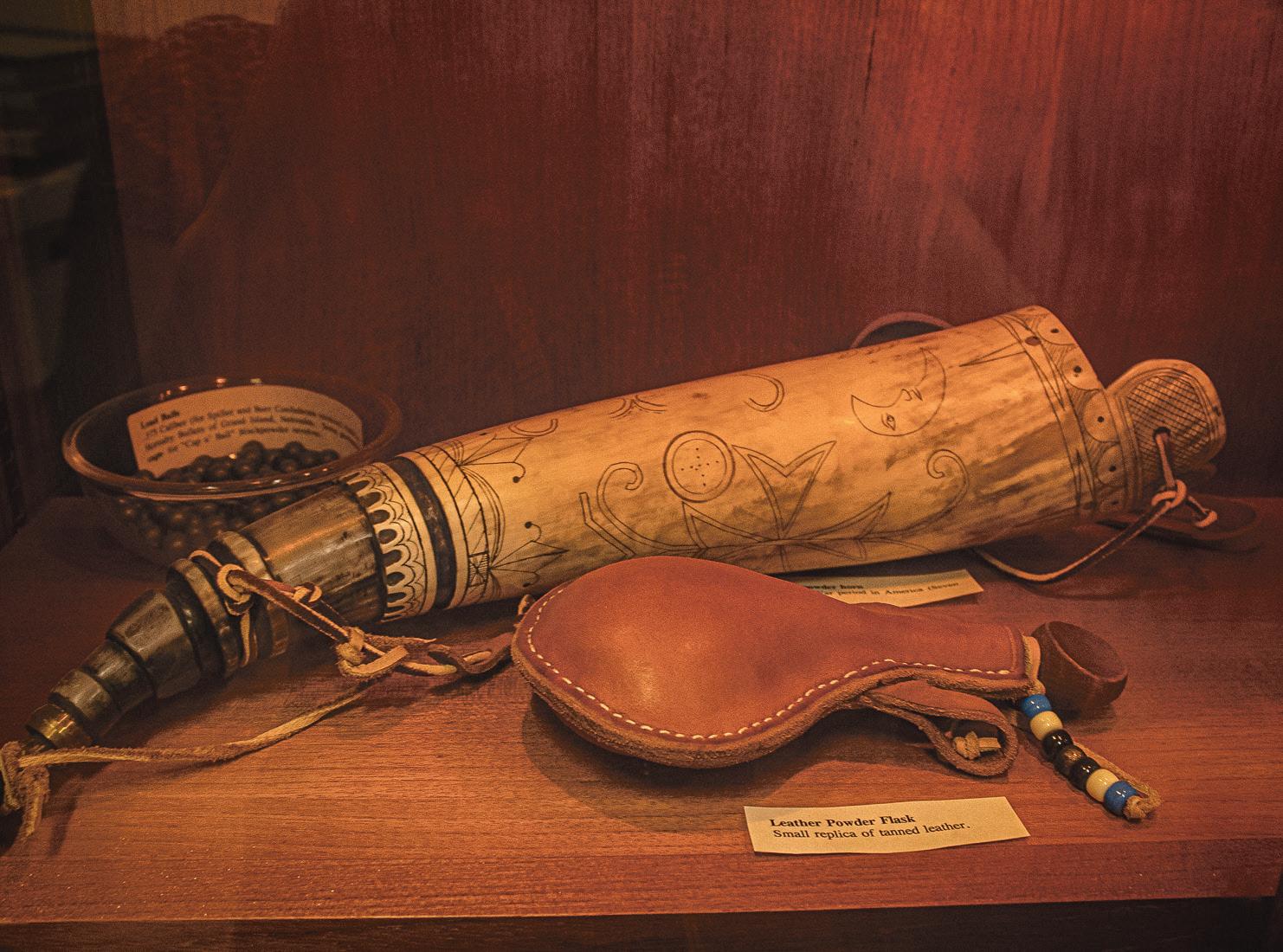
The “C. L. Sonnichsen Special Collections” named after former UTEP English professor and historian C.L. Sonnichsen includes a mix of rare books, arts and collections. The gallery located on the sixth fl oor of the UTEP Library has received multiple awards since its opening, such as the 2019 THRAB Award, March 24, 2026. Photo by Lesly Chavez/The Prospector
ADRIAN GONZALEZ B Y
STAFF REPORTER THE PROSPECTOR
Editor’s Note: This story is part three of a three-part series covering ICE operations in El Paso.
Along the concrete banks of the Rio Grande and within the white-tented corridors of Camp East Montana, the nation’s largest immigration detention facility, the definition of border security in 2026 depends entirely on who is wearing the badge or holding the microphone.
For agents of U.S. Customs and Border Protection (CBP) and U.S. Immigration and Customs Enforcement (ICE), the mission is fueled by a 2026 mandate to end “catch and release.”
This “zero-release” environment is supported by a February 2026 ruling from the Fifth Circuit Court of Appeals, which affirmed the administration’s authority to detain immigrants indefinitely without a set bond.
However, the expansion has come at a human cost.
The most high-profile case occurred on Jan. 3, 2026, when Geraldo Lunas Campos, a 55-yearold Cuban immigrant, died at Camp East Montana.
Officials initially cited a “medical emergency,” but the El Paso County Medical Examiner later ruled the death a homicide caused by “asphyxia due to neck and torso compression” during physical restraint by guards.
The ruling has intensified calls
for independent oversight and raised questions about use-offorce protocols inside the rapidly expanded facility. According to The Texas Tribune, ICE’s Office of Detention Oversight posted an online report documenting that office performed a congressionally mandated inspection over three days, Feb. 10-12, at Camp East Montana in El Paso.
The report documented 49 deficiencies, with the highest number involving the use of force and restraints, accounting for 22 violations of detention standards. It was the first inspection released by that office since the detention center was quickly built and opened last summer.
U.S. Rep. Veronica Escobar, D-Texas, has emerged as one of the most vocal critics, calling for the $1.24 billion facility be shut down.
“DHS is operating with absolutely no regard for transparency, truthfulness, or regard for human life,” Escobar said in a statement.
The facility’s troubles escalated in March 2026 with a measles outbreak. At least 14 cases were confirmed and 112 individuals were placed in isolation according to NBC News.
While ICE reported no active infections as of March 9, visitations remain suspended as medical staff monitor the situation.
read MORE at theprospectordaily.com

ADRIAN GONZALEZ B Y
The wooden floors of Memorial Gym echoed with more than just basketball drills on April 1, as the University of Texas at El Paso (UTEP) community gathered for a 20thanniversary screening of “Glory Road.”
The event served as a bridge between Hollywood and history, celebrating both the 2006 film and the 60th anniversary of the 1966 Texas Western national championship.
The evening’s guest of honor was Schin Kerr, the actor who portrayed David “Big Daddy” Lattin in the film. For Kerr, a former professional basketball player, being back in the very facility where the historic team practiced was a heavy experience.
“I was scared because I got to actually see and be a part of and be in the actual place where such a storied team was at,” Kerr said. “For me to come back here, it was like, man, it was a blessing.”
University President Heather Wilson took the floor to emphasize that the legacy

of the 1966 team extended far beyond the basketball court, serving as a catalyst for civil rights in higher education.
Wilson noted that while the 1954 Brown v. Board of Education decision desegregated K-12 schools, the fight for university access continued in El Paso. Wilson recounted the story of Thelma Joyce White, a UTEP valedictorian who was initially denied admission and described the 1966 team as the culmination of a decade of progress.
“In the fall of 1955, the first four

Black students were admitted to Texas Western College,” Wilson said. “Don Haskins built on those strengths and put together a team... they faced the University of Kentucky and Don Haskins started his best five players.”
Wilson highlighted the lasting impact of that championship game on the sport.
“Because of that win, it changed college athletics forever because now... coaches watched that game and started recruiting
athletes for their talent and not because of the color of their skin,” Wilson said. “That is something that will last forever.”
Kerr revealed deep personal ties to the story, noting that his father and uncle were freshmen at Colorado State when the Miners won the title.

Because of NCAA rules at the time, freshmen were ineligible to play, but they witnessed the cultural shift firsthand. Kerr recalled his father’s blunt



advice when he got the role: “You better not mess up.”
Filming the movie required grueling 15-hour days, particularly during the game sequences. Kerr looked back fondly on the direction he received for the championship game against Kentucky, where he was told to “dunk the basket down along with it” to send a message.
“As a basketball person, I was very proud I was able to actually go [and] dunk on somebody,” Kerr said.
Beyond the athletics, Kerr emphasized that the film’s 20-year milestone and the team’s 60-year legacy remain vital to American history.
“It’s important for us to have this... that our history is told, and told politely,” Kerr said. “To see the ripple effects of just what that team would do, and to be able to change their minds... we all have something in common.”
The sentiment was shared by UTEP alum Alfredo Montes, 67, who grew up with the story of the 1966 team.
read MORE at theprospectordaily.com



Local fashion host, Xavier Morales, is debuting a runway fashion show at just 19 years young, called “The Saints,” which tells the story about an immigrant family in the early 40s.
The show and fashion pieces are inspired by that time and era, with influence of the flash mob and mafia era, giving nods to the gang and mob aesthetic. The theme for the show is expected to have a cocktail theme.
The fashion pieces used for the
only his father, but his family’s story of how they had migrated to the United States, thanking God for being able to get him to where he is now.
“The Saints” will not only be a blend of runway fashion, but also with theater, Morales is expecting to have a play after the models finish their runway.
“At the end of the show, there’s going to be a little play at the end,” Morales said. “Basically, just to promote the next parts of the storyline. I’m really excited for that.”
shoots, it’s really cool. I don’t really see that too often.”
First time model, Sandra Perry, is excited to debut for “The Saints,” finding it exciting but nervewracking as well.
“This is actually my first time modeling, so we’ll see how this goes,” Perry said. “It’s been really good, they were really sweet. I expect it to be good, obviously I’m gonna have nerves and all that, but it’s cool.”

show are used from the local thrift shop, ‘Pineapple Vintage’ and ‘Fun Funky Fab.’
“They have a lot of vintage clothing and a lot of vintage pieces,” Morales said. “It generally helped me grow with my themes and a lot

Marcos Ugues, who’s been a model for half a year, has been part of ‘”The Saints” process for a couple of months, finding it different from past experiences.
“It is cool, I like it, it’s different,” Ugues said. “I really like the aspect of the storytelling with him. I feel like most of the time with fashion shows, it’s mostly just the clothes. It’s still a creative outlet, but I feel like with this, it takes a step further and incorporates a story behind it”.
With “The Saints” blending fashion and theater, some can find it equal without the story as well. Four-year model, Abigail Mary McLeod, has been part of the process for “The Saints” for about four months, finding it different but similar to her past experiences in modeling.

The 2026 Oscars premiered on March 15 on ABC, with former television host and comedian, Conan O’ Brien hosting the award ceremony, reprising his role to host from last year on March 2, 2025.
The ceremony gave many wins to many films, even marking historic wins for some of their nominees.
El Paso at the time, where he was then murdered so that they could take over. But he also had found inspiration from his own family’s stories, which helped him fictionalized route.
A longtime friend of Morales’ and a model for a year and a half, Jalen Morrissey, agreed about how innovative the storytelling is for “The Saints.”














Actress Amy Madigan was the first win of the night, winning Best Performance by an Actress in a Supporting Role for her performance as Aunt Gladys in the horror film, “Weapons.” It was her second Oscar nomination and her first win, joining Ruth Gordon in winning an Oscar for a horror film in that category, Gordon winning in 1969 for “Rosemary’s Baby.”
Actress Jessie Buckley won her first Oscar, winning Best Performance by an Actress in a Leading Role for her performance as Agnes in the drama film, “Hamnet.” Buckley had been nominated for an Oscar prior in 2022.
develop more to the story, taking a
“The whole theme is basically the whole killing of the father,” Morales said. “My dad was murdered in Chihuahua, Mexico. He was killed by police. The homage pays to my father.”

Morales wanted to honor not

“What has really stood out to me is that there’s an actual story and he’s been trying to put together a very cohesive story,” Morrissey said.
“With the pieces he’s choosing, the styling and the story and photo















Madigan and Buckley weren’t the only stars who had their first wins that night, as many other nominees had their first wins and even their nominations.
Casting Director, Cassandra Kulukundis achieved her first ever nomination and win for a brandnew category, winning the first ever Oscar for Best Casting, for “One Battle After Another.”
“One Battle After Another,” took home six wins, including Best Supporting Actor, Best Achievement in Directing, Best Achievement in Film Editing, Best Adapted Screenplay, and Best Motion Picture of the Year, marking not only the film’s achievements, but also Director, Paul Thomas Anderson’s first Oscar wins in his career.
University of Texas at El Paso (UTEP) senior, Oscar Dominguez Jr., was glad to see “One Battle After Another” taking home the awards, saying how it left a mark for El Paso since it was being filmed here.
“It was really great to see ‘One Battle [After Another]’ winning best picture,” Dominguez said. “That means a lot for us here in El Paso. So, it‘s rich. It‘s really cool to see that.”
“One Battle After Another” was not the only film that made history. “Sinners” won four Oscars that night, winning Best Achievement in Cinematography, Best Achievement in Music Written for Motion Pictures, Best Original Screenplay and Best Performance by an Actor in a Leading Role. Actor Michael B. Jordan won his first Oscar and nomination for his performance as the twin brothers ‘Smoke’ and ‘Stack’ for the film.
JEWEL OCAMPO B Y
Before thri ing became trendy, si ing through the racks of Goodwill or Savers was something many kept private, a budget friendly necessity, rather than a lifestyle choice. Today, that has changed and despite concerns about increasing costs and reselling culture, it’s a shi that’s been widely embraced.
As in uencers and resellers buy out entire racks, some argue that the growing popularity has had unintended



before buying and more than half (58%) look to second-hand shops before anywhere else, potentially pushing out more price conscious shoppers reliant on these stores.
Still, some see this shi in a more positive light. Marlene Nieto, a junior at the University of Texas at El Paso (UTEP), said thri ing has not only become more accepted, but a stage for curating personal style and nding quality pieces.
expensive and with a quality that doesn’t match.”
Other students echoed similar statements, pointing to both a ordability and individuality as key reasons they shop secondhand. Kyara Molinar, a freshman at UTEP, said thri ing helped her discover her personal style, adding that she prefers vintage nds over modern-day fashion trends.
Country Girls with Pearls, said that when she was younger, shopping at thri stores had been something she felt embarrassed to admit.
“I remember I wouldn’t say that I would go to a thri store to my friends because I was embarrassed,” Valle said. “I think now they know that they could nd so many awesome things at even higher quality.”



resale report,







“When it came to the newer clothes, it really wasn’t my style. I like vintage jackets, and I never really liked modern clothing, per se,” Molinar said. “It wasn’t until I started going to thri stores, I saw what I like speci cally. So that’s where I usually shop.”











“I feel like before 2018, thri ing was associated more with families of low income. I want to say [there has been a] mostly good impact, given the rise of fast fashion and how clothing eventually becomes really una ordable,” Nieto said. “Sometimes you can nd something that is higher in quality with a better price, rather than having to go to the mall and nd something









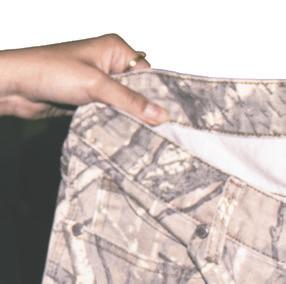

Valle also pointed out that in her own store, and the ones she herself visits, she noticed more higher income shoppers, and younger customers browsing the shelves, some even shopping speci cally to resell items.
Overall, despite the in ux of resellers, Valle said she doesn’t see them becoming a major inconvenience for everyday shoppers. For those willing to be patient, deals are still out there. “I think they’ve gotten so much more popular that it’s not really much of a factor anymore. I think there’s no problem with nding things, you might not nd it right away, but you’ll eventually nd it.” Valle said.
While concerns linger and prices rise in just about every part of daily life, most shoppers seem to agree that the tradeo s are worth it.

Shoppers aren’t the only ones noticing the shi in how people view thri stores; the changes to these businesses are just as visible behind the scenes. Terrie Valle, boutique




Escaping fast fashion, discovering personal styles and maybe making a little cash o unwanted clothing in the process.


“I have seen people maybe a little higher of income and I think they see the value there,” Valle said. “ e newer stu maybe doesn’t last as long, so even though they’re in a higher income bracket, they still want their stu to last.”








Genio is an app for students with notetaking accommodations that records and transcribes lectures, lets users customize notes, build study skills, and access tools that support academic success.
Students interested in using Genio must be registered with CASS and approved for this accommodation.
CASS IS AT YOUR FINGERTIPS WITH
CASS ONLINE PORTAL



EDITOR-IN-CHIEF
A 10-minute walk from the Santa Fe Bridge, the first brick building of Ciudad Juárez with years of history stands with a model airplane above the front entrance.
In 1882, the building was a luxurious hotel, the first with hot water and receptionists that spoke five languages. Through the years it evolved from a casino to a bar, restaurants, shops and even the place where Mexican singer Juan Gabriel sang at the start of his career.
That building, the San Luis Contemporáneo, is evolving once more into an art space.
Miguel Vargas Gallardo is the executive and creative director of San Luis Contemporáneos which he co-runs with his wife Haydee Alonso, an assistant professor of instruction in the Chicano Studies Department at The University of Texas at El Paso (UTEP). Vargas Gallardo said that the art space is aiming to be a meeting point for the artistic scene of both sides of the U.SMexico border.
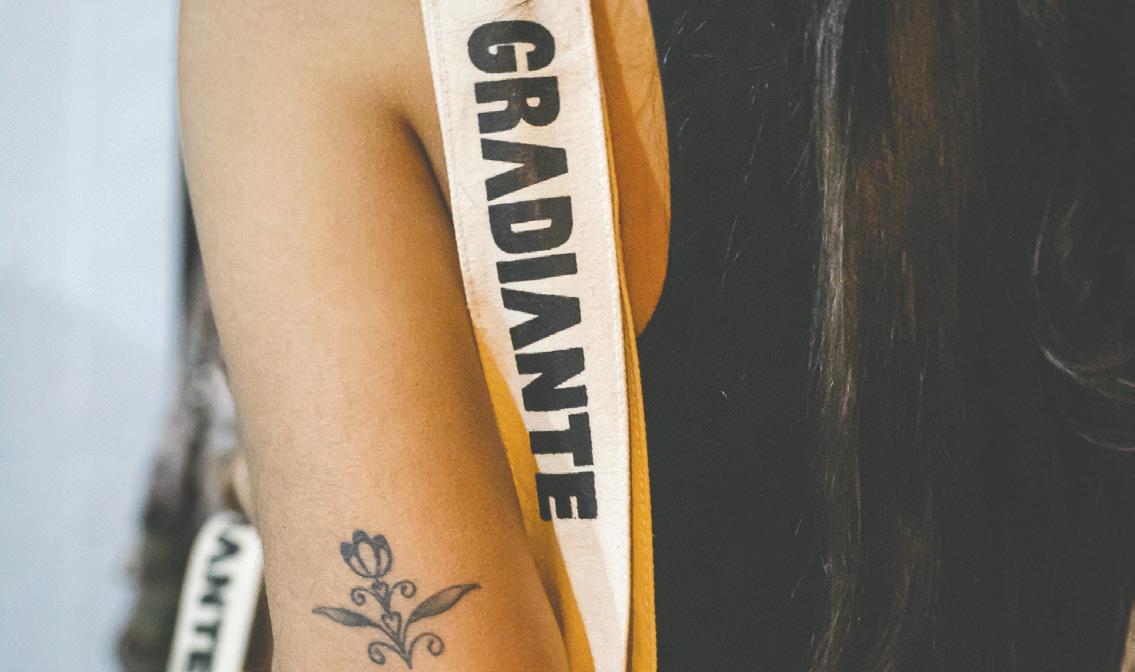
There, the idea for GRADIANTE, a cross-border collaboration bringing together art students from UTEP and the Universidad Autónoma de Ciudad Juárez (UACJ) to
create art pieces for an exhibition was born.
“Nos dimos cuenta que las escenas en el mundo del arte había mucha desconexión, como que no sabían lo que estaban haciendo sus contrapartes del otro lado de la frontera,” Vargas Gallardo said.
“Cada quien estaba trabajando en lo suyo y como que crecían con la idea de ser autosuficientes en vez de ver pues la frontera como una oportunidad de expansión, más que como una limitante.”
GRADIANTE was a result of conversation between Vargas Gallardo and Alonso, who saw that students from the sister cities were not interacting with one another.
“This was like early last year.
Around this time, March or April, there wasn’t a lot of communication with the universities’ art students, and I think vice versa,” Alonso said. “We wanted to do this transnational collaboration with emerging talents.”
With funding secured through a grant from the Patronato de Arte Contemporáneo de México and the Mellon Foundation, 16 students were nominated by their professors, selected and then paired with another student from the opposite university.
When the artists first met, they had a chance to present their work and then participated in a “speeddating” activity to see who they
were interested in pairing up with.
Marina Chavez Lopez, a junior studio art student at UTEP paired up with Alma Reta from the UACJ.
“It was kind of crazy, but it was fun,” Chavez Lopez said. “We discussed for five minutes trying to get as much information from the other person, write it down and then also talk and discuss our ideas, what we wanted to learn and what we wanted to do.”
Pamela Chavez, a printmaking major with a minor in referencing, describes the experience of getting nominated and selected as unexpected but exciting.
“It came out really unexpected, but it was exciting to be able to work in Juárez, or with Juárez because that’s actually where I started my printmaking career. It was exciting,” Chavez said.
For Andrea López Vargas, the connection with her partner, Lusia Arroyo, was immediate.
“De volada dije ‘Ay es que siento que esta chava y yo tenemos como que ideas muy similares,’ queríamos hacer algo de la frontera,” López Vargas said. “También ambos hacíamos escultura, entonces como que teníamos muchas cosas en común.”
The students had to work across cities and at times facing logistical challenges.
“Hardest part was meeting because he can’t cross over,”
Chavez said. “So, I would be the one having to go over there to his house and spend a couple hours there. We would have to be staying up at night, talking and discussing the project.”
The distance did not stop the duos, as they adapted to the circumstances.
“Dejaban la cámara prendida con la videollamada y cada quien se ponía a trabajar y pues ya estaban platicando ahí mientras trabajaban, entonces como que cada quien encontró una solución a este problemita de la distancia,” Vargas Gallardo said.
The works created through the project reflected both personal experience and broadened social themes relevant to the border. Some teams even incorporated audio and multimedia elements.
Chavez Lopez and her
partner focused on their shared border experiences and created an art piece that created a fake childhood where they grew up together.
López Vargas and Arroyo made their piece about women working in maquiladoras.
“Queríamos hablar sobre las mujeres, la feminidad y también sobre las personas que son y lo bajamos a nuestro proyecto,” Arroyo said.
Their work combined embroidery on industrial materials, interviews with women who worked in maquiladoras and audio elements. Their goal was to transfer femineity through embroidery to harder materials in environments dominated by masculinity.

Kristian Hernandez, editor
Editor’sNote:Thisispart threeofathree-part-series coveringlocalfigureskating and Isabella Brito.
Under bright arena lights, every detail of a figure skater becomes visible. Before a skater’s routine begins, their performance is

already in motion. Each detail, from a pre-show costume design to the choice of moves while on the ice, comes together to sculpt the visual artistry of a program.
Costuming, the choice of clothing that a skater wears plays a significant role in shaping a performance. Across the different event categories that a skater can compete in, costuming works alongside choreography and music to tell a story on the ice.



“We always match the costume towards the music. Colors, what type of rhinestones, if there’s any accessories or props being used, it all depends on the music and choreography that goes with it,”
UTEP sophomore and local figure skater Isabella Brito said. “For example, if you wanted a slow, emotional song, we’d pair darker colors with that.”
Skaters can build a clearer connection between the

judges and audience by aligning each element of their performance with a specific tone that they are trying to reach. Some costumes can even go beyond basic designs, becoming a direct part of the story.
Brito showcased a program that featured her in an angel costume, in which the outfit included a flowing white skirt, silver rhinestone detailing and a full-sized wing set, transforming her into an ethereal figure out on the rink.
“It [the angel costume] brought the judges some sense of visuality,” Brito said.

“We’re trying to tell a story, and some stories can get twisted in different ways because of costuming. We’re trying to really get the judges to grasp what we’re trying to tell out there.”
in how a performance is scored. In different event categories like Spotlight, Character and Artistic, judges tend to score costumes more heavily. A skater’s outfit can help dramatize different movements and bring attention to key movements.
“They judge hard on costumes because that’s a part of the event,” Brito said. “They judge on costume space, how it flows on the ice and how you work with it, also how it correlates with the music.”
With some judges leaning toward more traditional styles and others favoring modern performances, skaters often find themselves balancing both presentation and creativity in their routines.

Costuming can also impact the way a skater feels, allowing them to be more confident, which brings a vibrant energy to show the audience.
For Brito, she enjoys a stylish look that speaks with a sparkle.

“I love glitter, sparkles, and rhinestones, and I know it boosts my confidence,” Brito said. “The saying ‘look good, feel good, do good’ is what I really like to portray on ice.”
The smallest details matter in a performance. Hair, makeup, posture and facial expressions all play a role in conveying a skater’s energy. Whether it’s subtle hand gestures or a smile at just the right moment, these little things communicate to a bigger picture.
“It can either make or break you. If I have a fun song and my face is blank, it’s not going to do anything for the audience or judges,” Brito said. “Every single performance that I’ve had, I always smile and I have no idea [during the performance] because I’m so concentrated.”
A skater’s movements are a language within itself, conveying an unspoken story in style.
Aside from aesthetics, costuming also plays a role


Signature elements like a split jump, a spread eagle or carefully timed hand gestures enhance the music and draws the audience into the story.
Brito explained that choreography is built around the song’s tempo and lyrics, where even transitions between moves are used to keep the story flowing.
“We can add a super big hand gesture, a pretty glide forward, good legs, good hands,” Brito said. “It depends on the beat of the music and the tempo of everything. If a singer is soft spoken, we really try to execute their words clearly for our movements.”
As figure skating continues to evolve, its athletes continue to find new ways to express their individuality through these details. Costumes can be experimental, movements can be unique, and accessories can be the final touch to one’s personal style. For Brito, her expression shows up in every performance, where no detail is an accident as her burning passion melts the ice.









In an exclusive sit-down interview on March 30, 2026, University of Texas at El Paso (UTEP) Vice President and Director of Athletics Jim Senter characterized the current state of college sports as “the most disruptive, transformative time” ever in his 35-year career.
Facing a polarized response from the Miner community regarding win-loss records, Senter framed the department’s financial strategy as a mechanical necessity rather than a choice.
As UTEP Athletics prepares for its transition into the Mountain West Conference this July, Senter was blunt about the high cost of staying competitive in the modern era of Name, Image, and Likeness (NIL) and Revenue Sharing (Rev Share).
“The win-loss records in football, men’s and women’s basketball are nowhere near where we want them to be,” Senter admitted in a followup address to “Miner Nation.”
“But we understand that we need to provide [the coaching staff ] with the tools to be successful. I believe we have a resource challenge, not a head coaching issue.”
Senter compared the current
recruiting landscape to a high-stakes “arms race” where student-athletes no longer choose schools based solely on traditional recruitment.
“You don’t really out recruit people anymore unless you’re recruiting student athletes who are not getting paid NIL,” Senter said.
“When it comes down to recruiting transfer student athletes... for the most part, that’s about money.”
To illustrate the point, Senter utilized a car-buying analogy.
“Envision for a second... you have a $30,000 budget and I have a $100,000 budget,” Senter said.
“Who do you think is most likely going to win the car race? I am,
because I have a bigger budget to buy the fastest car... if coaching is more transactional... we need to spend more money if we’re going to buy a faster car.”
According to university records, UTEP has invested heavily in its personnel to remain in that race. Football Head Ccoach Scotty Walden earned $800,000 in 2025, though he recently donated 10% of his salary back to the school‘s Rev Share pool. Men’s basketball Head Ccoach Joe Golding’s contract totals $712,000 annually.
Senter clarified that while UTEP’s basketball budget is among the highest in its current conference, those funds are utilized for “general operating expenses,” noting that team travel and recruiting costs are higher due to El Paso‘s “isolated location.”
The primary hurdle remains the Rev Share pool. While NCAA Division I institutions can now provide student-athletes up to $20.5 million annually, UTEP’s current resources are a fraction of that.
Last year, fundraising produced $1.1 million for recruiting and retention. Senter anticipates that number jumping to $3.45 million for the 2026-27 year, utilizing $2.3 million from the department budget to supplement donor gifts, but warned this must grow to match Mountain West peers.
Addressing questions about the record $12 million raised in fiscal year 2025, Senter explained that $8 million was dedicated to the “Climb Higher” initiative to cover conference exit fees.
“Essentially, our donors helped us keep the lights on the past two years!” Senter wrote.
Senter challenged the community to increase its investment. “Many of them who are calling themselves fans don’t buy tickets and aren‘t donors right now,” Senter said.
“They’re fans. Great. But you’re not helping me change the equation.”
He emphasized that unlike professional sports, the college market is in a state of constant flux.
“In professional sports, they have salary caps. And they get to draft their players... It’s an open market. It’s like every day [there] is free agency here in the college market.”
As the July 1 move to the Mountain West approaches, Senter’s vision for the next five years is clear: competing in the top third of the new league.
“There is no money tree in the backyard for us to pull money off of,” Senter said. “It’s going to take everybody... to look for ways to be creative and drive more revenue to be able to have a chance against these competitors.”


Students attending the University of Texas at El Paso (UTEP) often struggle to find a balance between their extracurriculars and studies. However, there are many exceptions who not only stuck a balance between their pursuits and hobbies, but find many aspects of their two worlds alike. One of these exceptions includes Roxanne Keel. Keel is a junior who is currently in her third year as part of the UTEP’s rifle team as well as a research assistant for Dr. Hirschi’s
biology lab.
Her interests began at a very early age, growing up in the Houston area with her father who served in the military, four younger brothers and having a natural curiosity for how things function.
“Growing up, I’ve always been
interested in how things work the way they do,” Keel said. “So, I think learning more about science really helped influence that.”
Living alongside her four brothers, Liam for his dedication and work ethic, Austin for his analytic and critical thinking, and a pair of twins who live life to the fullest.
Even though Keel grew up as the oldest, she often looked up to her younger brothers with aspects of her siblings shaping her personality and as a person.