The ice is a stage and University of Texas at El Paso (UTEP) sophomore, Isabella Brito, has swept across it with pure passion. Ever since she first stepped onto the rink in January 2021, Brito has committed herself to figure skating, finding an icy love in a fiery city. What started as a new interest has turned into a five-year adventure that has taken her across the country.
She began skating at 15, after doing 12 years of dance. The early discipline from being a dancer since the age of three carried over into figure skating. She poured her heart into every practice, and in just five years, she reached platinum, which is the highest level at her facility.
“I was in shock that she started in January [2021], and the coaches were already speaking about competing,” Brito’s mother, Marina Gutierrez
ARTS & CULTURE Page 11
‘Slow Emergences,’ an honor to culture and transformation
FIGURE SKATING CARVED WITH PASSION
SPORTS Page 13
Black excellence, borderland pride and the UTEP legacy
said. “I would tell Isabella, ‘you just started skating, you need to learn how to skate first.’ Her very first performance was in her fourth month, and she got all gold.”
Brito’s interest in figure skating wasn’t immediate. As a child, she had a figure-skating-themed toy from a fast-food meal and remembers telling her mom about how much better she thought dance was compared to skating.
After seeing “Ice Princess” a Disney movie about a teenager who becomes a champion
figure skater, Brito grew curious. “That [Ice Princess] sparked my interest, so I told my mom if she could find any facilities around here for figure skating, and we found out there was one... and she took me,” Brito said. “Obviously at first, I was super bad at it, but ever since that day, I fell in love with it.
I thought it was a new form of expression rather than dance.”
Her first competition win was only the beginning. She has travelled to compete in places such as Dallas, Chicago, Alaska, Boston, California
and Tacoma, Wash. With every competition, Brito has left with at least one gold medal, proving that she brings a competitive spirit that stands out in her performances.
“It’s just awesome to see her do what she loves and actually goes to compete. She’s very competitive, she goes in there and starts doing her thing,” Gutierrez said. “One of her instructors, who was coaching her with ribbon, rhythmic and gymnastics, was actually crying.
He got extremely emotional because Isabella was doing excellent on that [California] performance, and with all the training that it took, he was just crying from joy.”
As her success in the sport grew, Brito realized that figure skating demands mental strength, rather than just physical strength.
“A lot of people perceive figure skating as something easy, when in reality, it’s not,” Brito said. “It’s such a mental battle with yourself. Its not even a ‘Can you do it physically?’ because most people can. It’s the mental part that makes everyone drift away from it.”
For Brito, the mental battle is a part of what fueled her growth. Progress did not come without
frustration and long practice hours of repetition of routines, but no matter what, she pushes through.
“She falls, gets up, continues with the program,” Gutierrez said. “She never gives up.”
Through 12 years of practicing different forms of dance, primarily tap, pointe and ballet, Brito had a foundation of discipline to glide upon. With dance, she became a natural performer, loving to put on a show and to entertain people.
“Seeing her medals and her performances, it’s just so awesome,” Gutierrez said. “Since the very beginning, when I saw that she really was getting into the sport, I knew that she was going to be doing bigger competitions.”
Rather than replacing dance, performing on ice has become an extension of her craft, leading Brito to explore a new realm of performance that is different from her roots of dance.
“It’s more of an artistic thing for me. It’s something to express your emotions, to your body. Sometimes when I’m performing, I’m not really thinking about the technical stuff, ” Brito said. It’s more artistic because I’m able to put my heart out there for other people to kind of see and visualize what I’m thinking or what I’m feeling.”
PHOTO EDITOR THE PROSPECTOR
IZIAH MORENO B Y
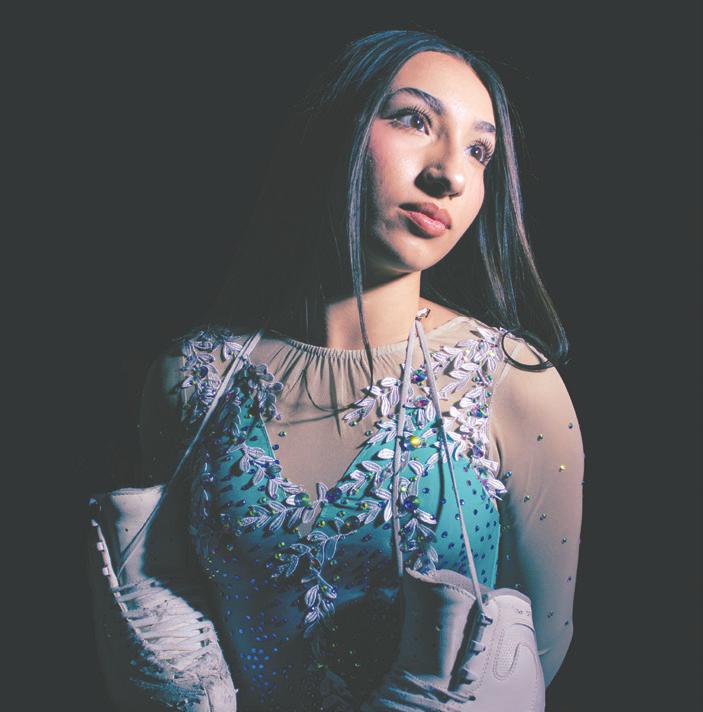
With her beginnings starting in ballet to a full transition into figure skating, UTEP Sophomore, Isabella Brito, practiced and honed in her skills, reaching a platinum level status in just five years. Photo by Nate Flores /
Opinion
Ximena Cordero, editor-in-chief
To be cringe is to be free
ABBY PEDROZA B Y
A&C EDITOR THE PROSPECTOR
For most of my life, I have felt like the outcast of every group I have been a part of. Embarrassingly enough, it all started back in elementary school when my mother was told by my second-grade teacher and family friend that I had no friends in my class.
People thought I was bossy and weird, and my teacher had to tell my mom how often I was being outcasted from our designated “playtime.” That was the beginning of me realizing how different I was from my peers.
At least now I had an idea as to why no one liked me, but that broke my 7-year-old’s heart entirely. Something that has followed me throughout my life since that day has now been the lack of social skills. I wasn’t allowed to hang out with my friends outside of school, so I never had the ability to learn to socialize with people outside of that. Even to this day, I get so
nervous about building a friendship with someone.
Maybe it was also the fact that I was so easily malleable in the sense that I was easily influenced to do certain things and act in a certain way. That made
a common factor in all of my (failed) friendships, and it was the fact people found me to be very easily pressured into doing things, even subconsciously. Middle school was even worse
because of this, especially when it’s the environment where kids begin to grow and find their identity. I ended up losing sight of who I truly was instead. I never had the ability to uncover the person I am at heart like my peers were starting to do.
I had always felt trapped inside of my own body because of the people I would surround myself with. It wasn’t until one day in seventh grade when I told my “best friend” that I was feeling left out and ignored, that I had the epiphany of realizing my self-worth. Even after telling her about that, it ironically got worse!
That was the start of my selfdiscovery, I found myself finding better people I could call friends and I finally found my true self. High school and yearbook were the main reasons I built so many relationships with people that I still have to this day.
read MORE at theprospectordaily.com
Letting go of what I knew best
Second semester in, and I’ve reflected.
I am currently writing this on Feb. 26 at two in the morning. When my mom reads this paper, she probably won’t be happy, but luckily for me, this issue comes out on my birthday (Cheers to 19!), so she can’t really get mad at me. Since kindergarten, I was not a perfect student. Shy, A-B honor roll, but I was also very close to getting C’s. I had a best friend who everybody compared me to and she was clearly the smarter one. I was not the worst, but I was not the best either. I grew insecure and academic validation was my life. I have always doubted and compared myself to others. It was natural for me to grow envious of others because they were more involved than I was or they had five points higher than I did on a test. I joined so many clubs to show I was better than everyone. I didn’t do anything for the right reasons. I carried this till my senior year of
high school, making me quite a sour person.
I got into the University of Texas at Austin (UT). I could say UT was overrated, but it was my dream school. My mom cried when I
announced my acceptance and I cried because I knew my decision was not to go. It wasn’t about the tuition or about a better school waiting for me; it was because I was too intimidated to go. I won’t lie, it was hard to look at someone wearing a Longhorn
hat, or going through Instagram stories and seeing people pose in front of the infamous UT tower, even some of my family knew I wanted to go there, to see their shock when there was a University of Texas at El Paso (UTEP) flag at my graduation party.
I became bitter, and that was not a great start to my first semester. My first semester was not ideal. I was thrown into a harsh journalism class, and I had to take on the role of our Multimedia editor, Sebastian Perez-Nevarro, for a whole semester. I can tell you with confidence that you will not see me as a multimedia editor anytime soon.
During finals week, I got two hours of sleep every day. For my last final, I studied for six hours straight because I had only realized two weeks prior that I missed about 20 readings, 10 documentaries, read MORE at theprospectordaily.com
‘Don’t
BRISA SILVA B Y
be so dramatic’
CONTRIBUTOR THE PROSPECTOR
While it is generally justified for men to hurl insults and even fight at sports games, it is considered hysterical and immature for women to cry and scream during a concert. Male fans exist and are embraced, yet it’s only female fan enthusiasm that is heavily stigmatized.
The intense mocking of women who manifest their passion as fans highlights the double standard. Due to society’s attitudes towards them, some have chosen to abstain.
Convinced that she will be made fun of for it, UTEP junior student, Mia Arenas, prefers not to share her fanaticism with others.
“I’ve had friends in the past who have made me feel embarrassed because I’m a big fan of an artist that they don’t like or understand, so they find it easier to judge,” Arenas said.
She believes that it can be difficult to find a safe space where a girl can openly “stan” an artist and express excitement for their music.
“I’ve had older family members, like my grandma, refer to me as being crazy for liking someone who sings songs from a different genre — like reggaeton — than what she’s used to. Then I feel like I have to defend my artist choices to her,” Arenas said.
Fangirls are constantly subjected to rigid, negative social labels, and the music industry has only further entrenched the problem.
The industry often does not take artists with a predominantly female fan base seriously because of the assumption that they are solely famous for their appearance rather than their talent.
When it comes to sports, men’s interests are rarely questioned, whereas women are expected to prove that they are real aficionados and not “posers.” Even when they do, it’s not enough to gain respect, according to Camila Azuara, a UTEP junior and soccer enthusiast.
“One thing I have experienced is being ‘quizzed’ about teams or players when I’m wearing a jersey, like I have to prove I actually understand the sport,” Azuara said.
“This reflects a kind of misogyny in sports culture where male fans are assumed to be knowledgeable and passionate, while female fans are often reduced to only caring about appearances or treated like they don’t belong.”
Hypermasculinity is highly associated with athletics. A female professional player is therefore perceived as unfeminine, as is a female supporter who goes all out for her favorite team.
Over half of women and nonbinary fans have experienced sexist behavior or language at soccer games, according to a 2024 survey by the anti-discrimination charity Kick It Out.
read MORE at theprospectordaily.com
Photo by Iziah Moreno/The Prospector
Photo by Iziah Moreno/The Prospector
Conversations around fangirls have posed questions about how often women’s hobbies are ridiculed while men’s are seen as reasonable.
Photo by Aylin Montanez/The Prospector
Ximena Cordero, editor-in-chief
Reshaping the field: Women in engineering
BRISA SILVA B Y
Many people associate the word “engineer” with men, reflecting gender stereotypes in the field. In addition to the technical demands of the profession, women who are engineering often face systemic barriers linked to those expectations.
According to a workplace equity survey by the Pew Research Center, 78% of women in STEM who work in male dominated spaces report experiencing gender discrimination.
Andrea Zepeda, a senior engineering innovation and leadership major, said she has already faced some of the systemic disadvantages of studying something traditionally considered only for men. She has been repeatedly asked if she is truly “up for it” and told that she doesn’t belong in the industry.
While gender biases are ubiquitous, Zepeda said that living in a largely Hispanic community where machismo is embedded in the culture has prompted a more dismissive attitude toward female engineering students.
“I think because of being in a Hispanic-serving institute where there’s a very rich Latino culture that we come from, it’s kind of expected for women to stay home and take care of children,” Zepeda said. “I think a lot of times that gets translated into our education and work.”
Although there have been some bumps in Zepeda’s journey, she
feels that she has finally found her footing and is thankful for her professors, who have constantly taken an interest in seeing all students prosper, as well as her female peers, who, she said, have each other’s backs. Remarks attempting to belittle her ambitions have been unable to penetrate her mind due to the self-confidence she has gained from such support.
Zepeda still believes that while female success may not be as embraced, their work and contributions will always make an impact.
“Male engineers know we‘re capable; sometimes we doubt it, but ultimately a lot of them know, and it’s more of [them] choosing not to accept it,” Zepeda said. “I think women in engineering shouldn‘t stop publishing things and shouldn’t stop making all these discoveries.”
Zepeda is currently working with two other students to create a series of exhibits, including an energy-powered windmill and a recycler bike, for the courtyard of the Alamito STREAM (Science, Technology, Reading, Engineering, Art, and Math) center in Segundo Barrio. The team is building the project around what the center does, which is to teach individuals of all ages about STREAM.
[STREAM] is being used in their everyday life. We’re trying to kickstart that experimentation and that new clarity for curiosity.”
Zepeda and Desiree De La Rosa, a junior studying engineering innovation and leadership, believe that a great engineer always puts people first, and
career in engineering. She said that if she had chosen a different major, she would have let herself down.
Although she does not regret the decision, she admits that she used to compare herself to male students and found it hard to believe in herself and her abilities.
following in the footsteps of female engineering pioneers who adhered to this core value.
“I always had that mentality that men were always smarter than women just because during hard classes I would see how they would get it super fast, and for me it would take me more time,” De La Rosa said. “That would always make me feel dumb and not capable.”
De La Rosa broke that negative cycle with her unwavering determination to realize her goal of developing new ideas, designs and projects.
since we were able to see the device actually helping our customer and how we were able to design something from scratch that actually made an impact,” De La Rosa said.
She hopes that her story as a woman in engineering will prevent others from making the same mistake of questioning their own potential.
“Trust yourself; do not let anyone define who you are and how capable you are of making big changes; always speak up and be you,” De La Rosa said.
For Zepeda, getting to finally feel proud to be a woman and show her femininity in a room full of male engineers was liberating.
“The purpose of the center and this project is to really inspire students to consider studying in a STREAM field,” Zepeda said.
“For them to be aware of how
“I like to be able to see the impact you can make as an engineer, and how you are able to actually make a difference in the world by helping others, seeing just an idea and a design coming true and for it to benefit others,” De La Rosa said.
De La Rosa loved math and solving problems, so she knew early on that she wanted to pursue a
Last semester, she was able to put her knowledge into practice when she and other students collaborated with Early Child Intervention to create an assistive device for a young girl with fetal alcohol syndrome and cerebral palsy. They were able to identify the child’s needs and create a customized solution. The team presented a walker that stimulates the child’s intellectual senses and provides stability and mobility.
The fact that an actual person would be using their product was something De La Rosa and her team always kept in mind. The project’s effectiveness was measured by its ability to make the child’s life easier and more comfortable.
“It was an emotional success
“Be unapologetically yourself. If you like pink, wear pink. If you like dresses, wear dresses. Don’t yield to the stereotypes and expectations of engineering,” Zepeda said. “Don’t let it change your perspective or who you are.”
As they prepare to finish their degrees and participate in more projects, Zepeda and De La Rosa say they hope their experiences will encourage young girls who dream of pursuing engineering.
They acknowledge that genderbased misconceptions will continue to arise along the way, but they will never let that be a reason to give up.
Silva is a contributor at The Prospector and may be reached at bmsilva3@miners.utep.edu
Brisa
Desiree De La Rosa’s resilience has pushed her past selfdoubt, and powers her forward with new ideas, designs and projects. Photo by Dustin Perez/The Prospector
Women’s health awareness on gynecological conditions
VIVIEN NOE C. B Y
STAFF REPORTER THE PROSPECTOR
Even though women are almost 50% of the human population, they are underrepresented in healthcare, leading many women to being misdiagnosed, or having their symptoms be disregarded according to a Northwell Health article.
This is common especially for gynecological conditions such
pelvic pain are often overlooked.
Some common misconceptions of endometriosis are that it causes infertility, underestimating period pain or that it can be cured through pregnancy or a hysterectomy. Dr. Reddy explains what Endometriosis really is.
“Endometriosis is a chronic condition of the female genital tract, but it can affect other
abdomen causing chronic pain, debilitating issues with menstrual cycles, including heavy periods, painful periods that can also go on to lead to scarring of the pelvic organs, which can then lead to infertility.”
Common misinformation regarding PCOS includes the beliefs that it only affects overweight women, requires
ultrasound, the ovaries look what we call polycystic appearing, which is lots of little cysts, and the volume of the ovary is actually enlarged. You only need two out of those three criteria. If you have irregular menstrual cycles and evidence of hyperandrogenism, you’re pretty much working on a diagnosis for PCOS.”
Because of how little education there is about these illnesses, patients often think their symptoms are normal. In the case of endometriosis, there are different types and stages, which might lead to it being diagnosed later.
“For endometriosis, it can take a long time, about average, anywhere from seven to 10 years. So that’s a very long time. It’s unfortunate, because that means that women have to suffer for long periods of time and may have progressive disease during that time, which [we are] talking about different stages. So, you can have different stages of this, endometriosis spread, PCOS a little bit shorter, about two to four years to the diagnosis,”
Dr. Reddy said.
Many women are taught that periods should be painful, but the difference of normal pain compared to an underlying condition can be so subjective and different between individuals; leading to women minimizing their own symptoms.
“You’re supposed to have ‘pain’ during a menstrual cycle, and I mean that in quotations, and not that you’re supposed to have severe menstrual cramps,” Dr. Reddy said. “So, there’s different degrees, and people sometimes don’t recognize or ask questions. Say, you are leaving school because you have so much pain and you’re missing three to four days. That’s not normal and normalizing that kind of pain would not be the direction we would want to go.”
Dr. Reddy would encourage every woman to prioritize self-care, regular checkups and to listen to their own bodies.
“Women tend to be caregivers. They tend to be a lot of different roles, and the people that they don’t take care of the most is themselves, so often, minimizing their symptoms,” Dr. Reddy said.
To make sure women receive prompt care, there are issues that need be addressed and conditions that should be improved to reduce healthcare barriers.
“I would say education, access to the correct information, regular care, so that people can address any current issues or new issues right away,” Dr. Reddy said.
Bringing awareness to such issues is of high relevance so that more people can be educated on women’s health, and more people can receive the help they need to live healthy.
Vivien Noe C. is a staff reporter at The Prospector and may be reached at vgnoe@miners.utep.edu
IllustrationbyTori Adler/TheProspector
Crockett and Talarico make stops in El Paso
VANESSA OROZCO
Despite close polling, only one will lead the Democratic ticket in November’s general election. Both candidates are making stops across Texas to connect with voters on issues they say matter most to young people and working families.
Jasmine Crockett and James Talarico visited El Paso to engage with borderland voters ahead of the March 3 election.
Crockett’s focus is on the economy, immigration and education
Congresswoman Crockett has served as the U.S. representative for Texas’ 30th Congressional District for three years. In early 2025, she was appointed ranking member of a subcommittee on the House Judiciary Committee.
Crockett earned a Bachelor of Arts in business administration from Rhodes College and a Juris Doctor from the University of Houston Law. She began her career as a public defender before practicing personal injury law and previously represented Texas’ 100th District in the Texas House from 2021 to 2023.
Crockett pointed to tariffs and federal investment decisions as key factors when addressing inflation and rising costs.
“The first step would be rolling back the tariffs so that hopefully our country can get back on track,”
Crockett said.
She argued that reduced federal investments in science and STEM program have also hurt students and recent graduates.
“The investments that we historically were making related to science and STEM in general, pulling back those dollars was a mistake,” Crockett said. “We need to put them back in.”
Crockett added that she has worked on legislation aimed at easing financial pressure for college graduates.
“I’ve worked on some bills that are all about making sure we can defer [student] loans for a certain amount of time,” Crockett said.
“So, hopefully we give them [college students] a few extra dollars in their pocket, so they can participate in the marketplace and start to actually buy homes.”
Immigration was another central topic during her remarks.
Crockett emphasized that Democrats support border security while also advocating for efficiency and accountability within the immigration system.
“I want to be clear that Democrats also care about border security,” Crockett said.
She said the federal government should provide more resources to caseworkers and immigration judges so they can speed up processing these cases.
“If someone does not have a real
case but is using our systems and our inefficiencies against us, then we can go ahead and get them out, because they potentially present a danger,” Crockett said. “It is important that we understand the root causes of migration and that we are doing it in an orderly fashion, so that then the cartels and gangs do not take advantage of the fact that we’re being overrun.”
Crockett also raised concerns about immigration enforcement practices, arguing that agencies must be held accountable.
“I’m actually currently working on finalizing a bill which would require federal officers to cooperate with local law enforcement if they want to run parallel investigations,” Crockett said, referencing proposed legislation following the death of Renee Good.
“What‘s happening right now is not immigration enforcement,” Crockett said. “We have got to clean house and actually get back to doing the work the agency’s actual commitment was, to enforce deportation orders, not go around terrorizing communities.”
Crockett connected immigration enforcement fears and supply shortages to rising housing costs.
“The tariffs have detrimentally impacted us because that increased the cost of lumber,” Crockett said.
She added that labor shortages and fear among workers have slowed housing production.
“When you start to slow down the production of homes, time is money,” Crockett said. “That ends up driving up the cost.”
She also cited a nationwide transformer shortage as another factor affecting housing development, saying she has introduced a bill to increase supply.
Talarico stresses education and economic fairness
James Talarico has served in the
Texas House since 2018 and is a former public-school teacher and presbyterian seminary from Austin. He earned a Bachelor of Arts in government from the University of Texas at Austin and a Master of Education in education policy from Harvard University. He previously led the Central Texas branch of Reasoning Minds, a nonprofit organization.
read MORE at theprospectordaily.com
Both of the Democratic Candidates running for Texas Senate, James Talerico and Jasmine Crocket, visited El Paso on the weekend of February 21-22, giving El Pasoans the opportunity to hear them speak.
Photos by Sadie Briones/The Prospector
Health fair expands access to free care
With over 130 programs and community organizations gathered across the University of Texas at El Paso (UTEP) on Feb. 25, the Health, Outreach, Prevention and Education (HOPE+) fair returned to the university for the second time. The fair transformed the campus into a one-stop hub for free health screenings, immunizations and social services from 8 a.m. to 1 p.m. in hopes of expanding care across El Paso.
The UTEP HOPE+ initiative partnered with agencies from across the region to provide numerous services and educational resources.
Led by a five-person faculty team, including Silvia Chavez-Baray, Ph.D., the fair acts as both a hands-on learning opportunity for students and a way to give back to the community.
“All the learning doesn’t come from the books, and you need to learn from the community, in the community, so we invite the students to provide services,” Chavez-Baray said. “It’s a win-win for the community. Win with the services that the students provide, and the students win because they are practicing and they are learning,” Chavez said.
organ models designed to teach attendees about disease prevention and early detection.
One of the biggest goals of the health fair, according to collegiate senator from the College of Health Science, and undergraduate research assistant for the hope initiative, Grecia Ortega, is the breakdown of barriers to healthcare access and literacy.
“We had a lot of health education to help increase health literacy, to help participants become aware of the resources that are out there for them,” Ortega said. “Health fairs are really important because it’s a form of preventative care, it allows people to seek care and start acting now as opposed to when the illness evolves or becomes a terminal illness or chronic condition.”
Financial concerns and insurance according to Ortega, were largely at the top of that barrier list, epecially among students transitioning to being on their own.
According to organizations at the fair, language barriers, education and sensitive documentation status all contribute to the need for events like this one.
wider community.
“What we do is we look for the agencies that the community needs, the services that the community needs. So we do the outreach of the communities, the agencies. We go to the community,” Chavez-Baray said. Organizers invited other universities, local agencies and mobile clinics to participate. Even showcasing UTEP services like the Wellness Center or the Counseling Center and traveling when and wherever possible, with the hope to reduce the logistical and financial burdens that often prevent residents from seeking care.
“Honestly, it’s what I’m very passionate about as a public health major, that’s all we do,” Ortega said. “We try to do it. We try to see how there’s ways to improve a community’s health before it gets to chronic conditions.”
Walking across the campus, Ortega’s words echoed from booth to booth by organizations who said their goal, much like Ortega’s, was to see an increase in the community’s welfare, awareness and accessibility.
Plenty of UTEP and Texas Tech nursing students did just that, setting up booths for blood pressure and interactive inflatable
They worked to achieve their goal of accessibility by bringing free and easy to navigate services like health screenings, dental consultations, immunizations, sexually transmitted infections (STI) testing, bloodwork and even haircuts and food pantries to the
Jewel Ocamp is a staff reporter at The Prospector and may be reached at jnocampo@miners.utep.edu
UTEP students educated the El Paso community on diseases and prevention at the HOPE+ Health Fair. Photo by Ximena Cordero / The Prospector
From flower bars to pressed petals
JEWEL OCAMPO B Y
STAFF REPORTER THE PROSPECTOR
In a city with dozens of small, local businesses, entrepreneurs like Monica Martinez of Blossom Bar and Crystal Lee of the handmade jewelry shop, Daizy Baby, success is about more than profits. It’s the joy of sharing their craft, meeting new people and doing what they love every day.
Blossom Bar
Reaching its first anniversary in March, Martinez owner of the Blossom Bar pop-up shop, said her business began in an organic way.
After struggling to find a flower bar service in El Paso for her friend’s bridal party, Martinez decided to create one herself, starting with just a couple of metal buckets, a table and cloth.
“She wanted it to be floral themed, like love is in bloom, something like that. So we were looking at trends and ideas to do, and she wanted a flower bar,” Martinez said. “It’s like a party favor, and your guest leaves with a bouquet that they get to make and pick themselves.”
Learning everything she’d need to make her friend’s party a unique experience; Martinez went down a rabbit hole searching for how to set up a ‘flower bar’ experience.
“We wanted it to feel like a luxurious, actual experience. So we started researching to see what we could do, and we decided to do a wood cart. We got it built in Juarez, we let him know [about] our designs, and he measured it for the buckets we used. And then I did a lot of [shopping from] Amazon and Hobby Lobby.” Martinez said. Martinez found herself drawn to chatting with the guests, arranging flowers and watching people light up as they built their own bouquets. Turning a fun DIY project into the spark Martinez needed to build her own unique business.
“From that first event, I fell in love, like, I felt the spark or the connection,” Martinez said. “My husband is the one who actually
pushed me. He was like, hey, ‘you said there‘s no one really doing it here. Why don‘t you start it?’”
With the support of her husband and close friends who helped her build the cart and assist at events, what started as a creative side hustle
her full-time job, marriage and motherhood.
“I think my biggest struggle right now is juggling all of the aspects of my life and still running a business,”
Martinez said. “I want to keep my glass full in every relationship that I
different. Before, in the beginning, just for fun, I would make, like, clay charms and different things like that,” Lee said. “And I was thinking about, well, what can I do to make myself different and stand out, but also something that everyone of art.
“Preserving the flowers into jewelry was something different, and it‘s really great, because you get to actually find the different meanings from the flowers. Then for them, it creates a story, and they really connect with it. So, for me, I really just loved creating something that people would connect with,” Lee said.
For Lee, her family were some of her first supporters toward her endeavor to bring something new to the people of El Paso. Her mother, who is an entrepreneur herself, having run her own business acted as a mentor, attending all her markets and helping where she can.
Then, in 2023, Daizy Baby officially transformed from a side gig beside her work at her family’s restaurant to her full-time job.
“I’ve been very blessed and lucky with a lot of people supporting me and wearing my jewelry and telling me that, ‘Oh my gosh, they received so many compliments’ that it‘s a staple, and they‘re building their collection, and overall for me, and I‘m really glad that people like and love my little creations,” Lee said.
Putting everything she earned right back into her business, Lee added that some of her biggest
Daizy Baby is owned by Crystal Lee who started the business during the pandemic and has now been able to grow it into her full-time job. Photo courtesy of Crystal Lee.
Monica Martinez is the owner of Blossom Bar, which was started after she did not see a similar service offered in El Paso for her friend’s wedding. Photo courtesy of Monica Martinez.
Crystal Lee uses natural materials
flowers to create the jewlery for her business.
Photo courtesy of Crystal Lee.
Arts & Culture
Abby Pedroza, editor
From El Paso to Netflix: Valeria Contreras chosen for NALIP’s Directors’ Incubator
Valeria Contreras, an awardwinning filmmaker and assistant professor at the University of Texas at El Paso (UTEP), has been selected as one of five directors for the National Association of Latino Independent Producers (NALIP) Directors Incubator, earning $35,000 in funding and mentorship from Netflix to bring her original film “Oranges” to life.
Contreras grew up in El Paso, always showing an interest in the
arts. She started out illustrating educational comic books for young children and went on to found “Valdor Comics.” She later studied in New York City, earning her master’s in film from Columbia University.
“When I was super young, I would watch T.V. and I’d be excited to watch cartoons, I was inspired every time I would watch them, especially seeing the stories and seeing the different characters,” Contreras said. “I started developing cartoons and comics
of my own when I was young and worked on educational graphic novels that taught kids about the environment or about different artists, but I really wanted to be able to gain experience doing live action films and being able to know what it is to be on set. So that initial interest led me eventually to my journey of wanting to go to film school.”
Inspired by her hometown’s values and history, Contreras has written films like “Homesick.” A film about a couple separated because of the COVID-19 pandemic and forced to be on different sides of the border. “Oranges” tells the history of the El Paso-Juarez streetcar by showing the story of two sisters the day before one of them moves away.
“A lot of my work experience was in politics and local government, and I think what I was really interested in was bringing together politics in the sense of storytelling. It’s important to be able to use
the ways in which an organization, like the NALIP and Netflix could really support a story told alongside the U.S. Mexico border in El Paso, Texas, I think, to me, that’s a huge win.” Contreras said.
Contreras feels proud to represent her community in the film world and portray the stories of those who live between borders, being both Mexican and American, for every audience to see.
“It’s a true privilege to be able to experience that sort of melting of cultures, and being able to bring that into the work, and elevate it as something to be proud of, to be able to explore and define in a time where others want to define the region completely differently.” Contreras said.
Contreras’ mission is that her stories – those she tells through film and her own personal story as a Latina woman in the film industry – will inspire more people from the border to share their art, and to believe in the power of their voices.
“It means a lot to have the privilege to be able to be in spaces where one can be considered a leader. I feel there’s a sense of responsibility to not only use one’s voice to take up that space, but also to elevate others when given the opportunity to do so,” Contreras said. “Being able to be in those
spaces is a tremendous privilege, but it’s not lost on me the amount of responsibility, duty and interest, to be able to open the door and bring others along to.”
As she steps into this new chapter, Contreras is excited for her newest challenge, transitioning from shorts to a full feature, and is hoping to achieve this goal through collaboration and hard work.
“‘Oranges’ is a proof of concept, short film for a feature screenplay that I developed through the El Paso Community Foundation border residency,” Contreras said. “I’m going to keep developing the screenplay, and hopefully be able to make that transition, not just making shorts, but eventually making a feature. Whether it’s ‘Oranges,’ as a writer, director, or other films.”
If this were a film, it would only be the opening scene. For Contreras, this milestone is not an ending, but the beginning of a vision rooted in border stories, resilience, and community.
Vivien Noe C. is a staff reporter at The Prospector and can be
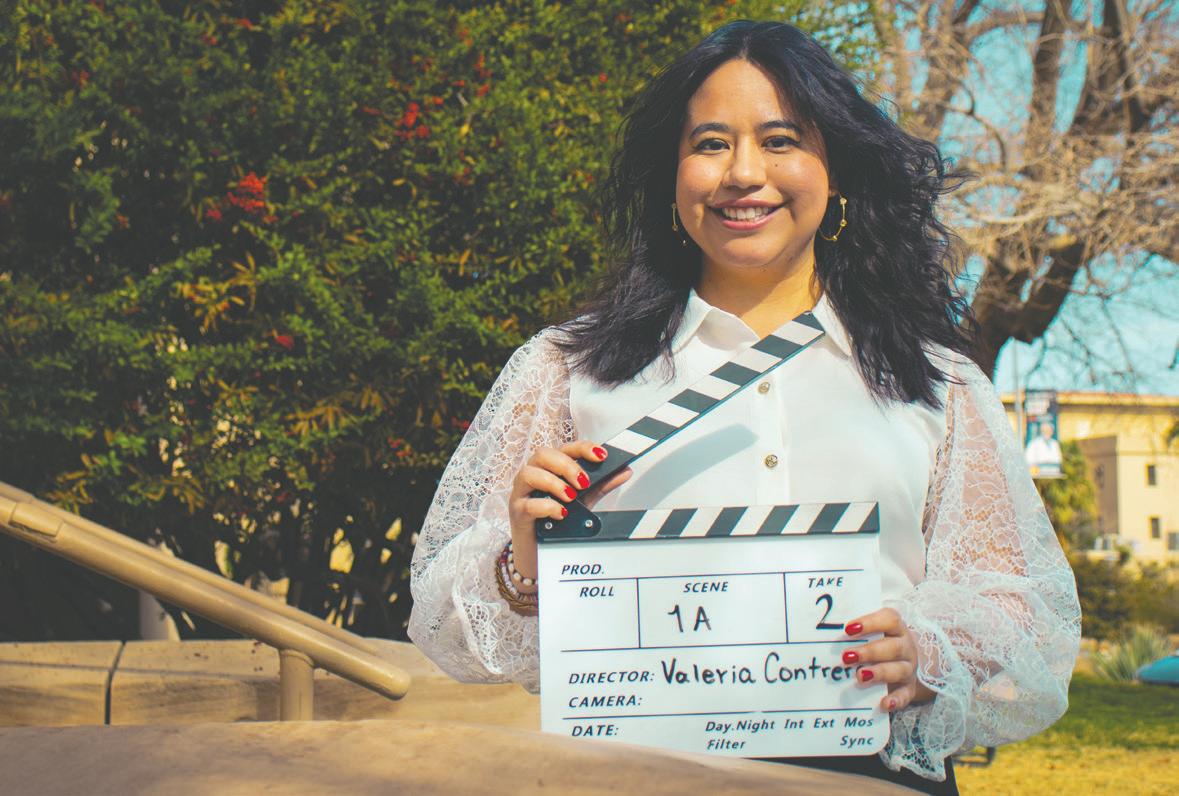
Aiming to uplift and inspire fellow creatives, Vanessa Contreras hopes to help others believe in their art as she represents the El Paso filmmaking community. Photos by Nate Flores/The Prospector
Dorothy got swept up in a tornado again, but this time, she landed in El Paso for the opening night of the North American tour of the famous Broadway show, “The Wiz”. The cast performed from Feb. 18 to 22 at the Plaza Theater, bringing this modern classic to the border.
The production is directed by Schele Williams, and features performances by acclaimed musical theatre stars, including Alan Mingo Jr., Sheherazade, Kyla Jade and many more. The audience was excited to experience Broadway magic and be transported into the World of Oz. Chloe Uribe, who had never heard of “The Wiz” before, was in the audience ready to be surprised.
“I am excited because I know absolutely nothing about it, which is what is intriguing to me, especially since this past year we had ‘Wicked’ come out, so that’s really interesting,” Uribe said. “I had this conversation with my mom that apparently, they had
made a movie out of this with Michael Jackson, to which I had no idea about. So, I’m excited. I’m coming in without like comparing it to anything, just fully here to see the show.”
For others, it wasn’t their first time easing down the yellow brick road. Celine Hallman, an audience member grew up as a huge fan of “The Wiz,” and was sitting in front row as she reminisced in stories from her childhood.
“So far, everything is good. It reminds me of when I was younger, and I love it,” Hallman said. “It’s very nostalgic.”
“The Wiz” follows the story of Dorothy, a girl who didn’t know where she belonged, but everything changed after she gets swept in a tornado and landed in the World of Oz. In her search to go back home to Kansas, she ends up making friends, killing witches and finding herself. Beyond being a fun retelling of the original “The Wizard of Oz,” everything from the scenic design, the colorful costumes and dancing styles is also a celebration of African American culture.
“Oh, man, it’s beautiful. I am just in awe. I’m looking at everything, the makeup, the dances. Everything is amazing,” Hallman said.
People in El Paso were excited to welcome Broadway to their city. Luiz and Denise Romero, a couple attending the show, arrived in true Emerald City fashion, dressed in Glinda and Scarecrow costumes. Guests of all ages lined up to take photos with them.
“We rarely get an opportunity to have ‘The Wiz.’ So, we used to go to a lot of concerts. And I thought it would be nice to dress up.” Denise Romero said.
As “The Wiz” continues its North American tour, El Paso audiences hope the Yellow Brick Road leads back to their city again one day.
Vivien Noe C. is a staff reporter at The Prospector and can be reached at vgnoe@miners.utep.edu
Genio is an app for students with notetaking accommodations that records and transcribes lectures, lets users customize notes, build study skills, and access tools that support academic success.
Students interested in using Genio must be registered with CASS and approved for this accommodation.
CASS IS AT YOUR FINGERTIPS
“The Wiz,” a twist on the original ‘Wizard of Oz’ celebrating the Black community, made its way to El Paso at The Plaza Theatre. The Opening night on Feb.18 called for theater fans all over the city to gather. Photo by Sadie Briones/The Prospector
‘Slow Emergences,’ an honor to culture and transformation
LESLY CHAVEZ B Y
CONTRIBUTOR THE PROSPECTOR
The University of Texas at El Paso’s (UTEP) Department of Theatre and Dance kicked off the semester with their spring 2026 production “Slow Emergences: Moving Through Crises, Dance as Opportunity” an 80-minute show centered in a collective reflection on crises and radical imagination to support long-term livability and transformation.
UTEP dance professor, Rayven Leticia Armijo, said the planning of this production began back in fall 2025, where Sandra Paola Lopez Ramirez, Andrea Saucedo Estala, Dr. Tawanda Chabikwa, UTEP Dance Director Melissa Melpignano and Armijo each choreographed one of the five
“The ‘slow emergence’ of my piece was that ‘Lluvia’ is a celebration of the contributions of my mother, Carol, a pioneer in Chicano folklorico, and how her work keeps transforming and celebrating life even after her death,” Armijo said. “Chicano and indigenous cultures have gone through non-linear changes, and we embrace this change in this piece, yet we maintain the essence of Folklorico and complex space we have as Chicanos.”
The show opened on Feb. 19 and lasted until Feb. 22. The crew was composed of students, faculty and alumni. Some pieces were made in collaboration with foreign artists, such as Omar Joel Camargo Sandoval from Juárez, Chihuahua, a visual artist who did a
Sandoval while he created a live Sumi-e painting was truly one of the most authentic and unique experiences I’ve ever had as a performer,” senior performer
Evelyn Estela said. “He did so much more than just a panting onstage, he guided us through the cultural and historical roots of Sumi-e and helped us understand its meditative foundation by visually presenting presence and intentionality.”
The show concluded with Melpignano’s healthcare-focused piece “Carrying Change,” where UTEP professors Elizabeth Camacho, Janise Tinsman and Amelia Rau performed among the theater and dance students on stage.
“At first I was a little skeptical about how this dance was going to play out, as I was really nervous about how they would feel being on stage as it is something they’re not used to,” sophomore performer Mia Arras said.
“This performance helped me realize that everyone
is equally nervous or excited, everyone is human, and we all go through the same experiences in some way no matter the outcome.”
The event brought communities together through cultural representation, awareness to topics that affect our current environment, and celebrating identity through the emerging changes we experience day by day.
El Paso’s Downtown Arts District gains award-winning momentum
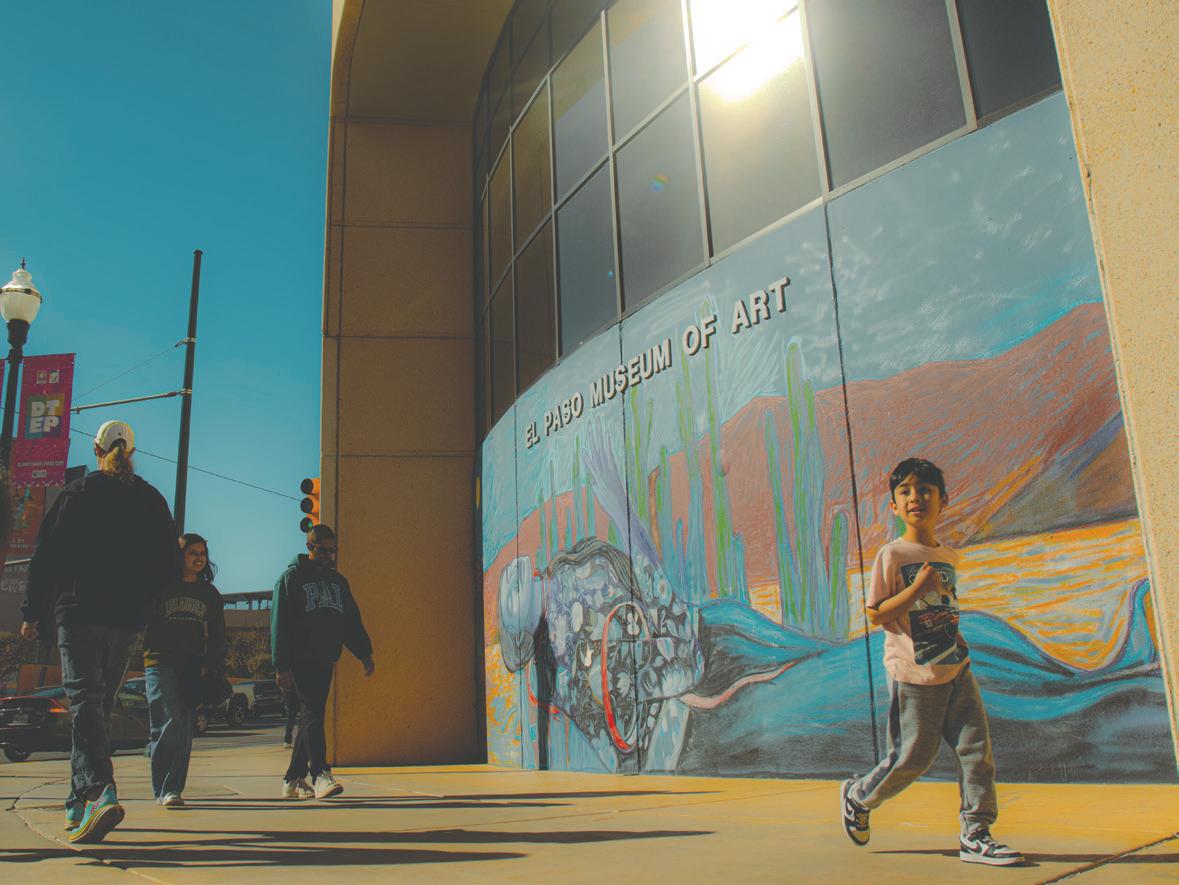
Every year, USA Today presents the 10 Best Readers’ Choice Awards, including one for Best Art District in the country. Voting for this year’s ranking began in late January with 20 nominations. On Feb. 25, it was officially announced that El Paso’s Downtown Art District made the top 10, finishing in fourth place. The district was nominated because of its Spanish colonial revival architecture, heritageinspired murals reflecting Mexican American history, art decor and exhibits at the El Paso Museum of Art, according to the competition’s website.
Notable pieces include Artur Bordalo’s mountain lion made of recycled trash on the side
of the One San Jacinto Plaza Building, Roberto Davidoff’s multi-panel artistic glass window in the El Paso Clock Tower and Stephen Ingle’s three six-foot steel piñatas underneath the Durango Street Bridge.
The nomination thrilled The University of Texas at El Paso (UTEP) art students, who believe it as well-deserved recognition.
Senior drawing major, Daphne Gonzalez, said downtown’s creative space stands out because of its binational influences.
“El Paso has shown artwork that evolves with the city’s border identity, and that’s something other cities don’t share,” Gonzalez said. “We see themes of migration, labor, resilience and mixed heritage.”
Much of the public art reflects the cultural fusion of Ciudad Juárez
and El Paso, the “sister cities,” she said. Gonzalez called it “full of heart and soul” and hopes the recognition boosts national and local appreciation for the district.
“El Paso deserves more recognition even from our own community,” Gonzalez said. “Before college, I wasn’t aware of the art culture El Paso thoughtfully cultivates.”
Senior art studio major, Julian Bañuelos, described the district as a rich and colorful storyteller of the city’s history.
“Our culture is a pivotal foundation to the art created here,” Bañuelos said. “It carries stories of not only individuals but also a community. [The murals] make it easy for these stories to be told.”
read MORE at theprospectordaily.com
As the opening piece of the show “Slow Emergences,” “Shapeshifters” was a dance that embodied research methodology for improvised performance to honor the riparian ecosystem of the Rio Grande valley offers. Photos by Lesly Chavez/The Prospector
Lesly Chavez is a contributor at The Prospector and may be reached at lmchavez33@miners. utep.edu and social media @pics.by.lesly
From canvas to camera: Frida Kahlo’s life in 241 photos
JEWEL OCAMPO B Y
The El Paso Museum of Art was alive with music and movement on Feb. 14 as it reopened its doors after a five-month closure. Guests gathered to celebrate the museum’s grand reopening and debut of its newest “Frida Kahlo: Sus Fotos,” exhibit. With vendors lining the hall and a lively performance by the Ballet Folklorico Tonatiuh in the lobby, the museum was once again filled with a crowd.
After being closed for a $3.5 million infrastructure overhaul designed to better preserve and protect the museum’s collection, the reopening ran from 10 a.m. to 3 p.m. The museum welcomed visitors back into the newly upgraded gallery spaces with activities, photobooths and dancing which added to the celebratory atmosphere.
The traveling exhibit, curated roughly 15 years ago, is made up of selected photographs from Kahlo’s personal archive. Many of which were taken by herself and her family, even acting as inspiration for her paintings.
Out of the nearly 3,000 images, curators selected 241 photographs for the exhibit now on display through May 17, offering guests an intimate look at Kahlo’s life. Her story captures moments from her childhood, travels,
relationships and health struggles, a story that resonated with guests like Elizabeth Hernandez.
“When she was in bed, she had that accident on the bus, and she could not walk. She didn’t even give up. She said, ‘I’m going to paint. Keep on painting.’ And she was right there with her portraits and everything, and she took out something positive about that,” Hernandez said.
Michael Reyes, the senior curator of the El Paso Museum of Art, described Kahlo as one of the most iconic artists of the 20th century.
“I like to say it’s a love letter to the city, to the greater communities of El Paso and Ciudad Juárez, and that we serve them. This is their cultural heritage, and we’re so grateful to be here and having it safe, kept and presented in a proper manner,”
Reyes said .
Reyes added that the exhibition was designed to present a fuller portrait of Kahlo beyond her paintings. Acting as part of a photographic biography where guests can begin to understand the complexities of her life, her politics, family, relationships, celebrations and triumphs in every sense. Whether or not they’re able to travel to visit her art works hanging in other museums.
After surviving childhood illness and a bus accident, Kahlo was left with chronic pain and lifelong
medical complications. While still bedridden during her recovery, Kahlo would begin painting the self-portraits that would later become some of her most recognized works.
The self-portraits and surrealist works Kahlo would become famous for were often deeply personal and rooted in her identity. Depicting pain, love and her cultural heritage while drawing inspiration from her lived experiences, relationships and personal struggles.
“A lot of her work depicts her identity and who she was and what she was going through. I think a lot of people can relate to that,” Reyes said.
Reyes pointed to one of his favorite Kahlo paintings, “The Two Fridas” as an example. The painting portrays two versions of Kahlo, their connected hearts symbolizing her German and Mexican roots.
Although Kahlo is frequently labeled as a surrealist painter, it was a term she rejected, insisting she painted her own reality rather than dreams. A perspective that Reyes echoed, describing Kahlo’s work as grounded in her lived experience, even when presented through symbolic and dreamlike imagery.
“Historians and art historians, critics, you know, they can go bat to bat of what it meant. Sometimes we’ll never know, but that’s the beauty of art, right? We kind of
interpret it in our own right, and we take it as we see it,” Reyes said.
Reyes described Kahlo’s paintings as warm and deeply captivating, requiring viewers to study every detail. Her photographs had a similar effect, inviting guests to see and learn about her and her world beyond the paintings.
Something that was reflected in visitors like Adriana Maciel who recognized some of the places in Kahlo’s photographs and even sharing the artist’s birthday.
“I think it tells us a little bit more about her, not too much on her work… more than her life, not into
her work. So, that’s why, we do enjoy it,” Maciel said.
More visitors made their way upstairs and into the main exhibit, pausing frame by frame to read the plaques, studying her photographs as they would her paintings.
Jewel Ocampo is a staff reporter and may be reached at Jnocampo@miners.utep.edu
With the goal to showcase Frida Kahlo beyond her paintings, the traveling exhibit made its debut on Feb. 14 hosting an opening ceremony with food vendors and live performances from Ballet Folklorico Tonatiuh. Photo by Nate Flores/The Prospector
Kristian Hernandez, editor
Black excellence, borderland pride and the UTEP legacy
Black excellence has long defined the University of Texas at El Paso (UTEP) Athletics, from recordbreaking Olympians to modern student-athletes navigating leadership, identity and community on campus.
The legacy began long before UTEP carried its current name. As Texas Western College (TWC), the university helped reshape the national sports landscape, creating a foundation where Black athletes not only competed, but changed history. Today, that tradition continues through student-athletes who carry both opportunity and responsibility on their shoulders.
In 1966, TWC stunned the nation by winning the NCAA men’s basketball championship with the first all-Black starting lineup in a title game. The victory, later immortalized in the film
“Glory Road” was more than a trophy: it was a cultural shift. At a time of deep segregation in college athletics, the Miners proved excellence could not be confined by prejudice.
Just two years later, the world witnessed another showstopping moment tied to the program.
At the 1968 Mexico City Olympics, former TWC track standout jumper Bob Beamon soared 29 feet, two and a half inches in the long jump, shattering the world record by nearly two feet. His leap, widely known as “the Leap of the Century,” stood as the world record for 23 years and remains one of the most iconic moments in Olympic history.
Beamon’s achievement cemented UTEP’s reputation as a global track and field powerhouse. The Miners would go on to win multiple NCAA championships in and cross country, producing Olympians and All-Americans from around the world.
But, excellence at UTEP is not only measured in medals.
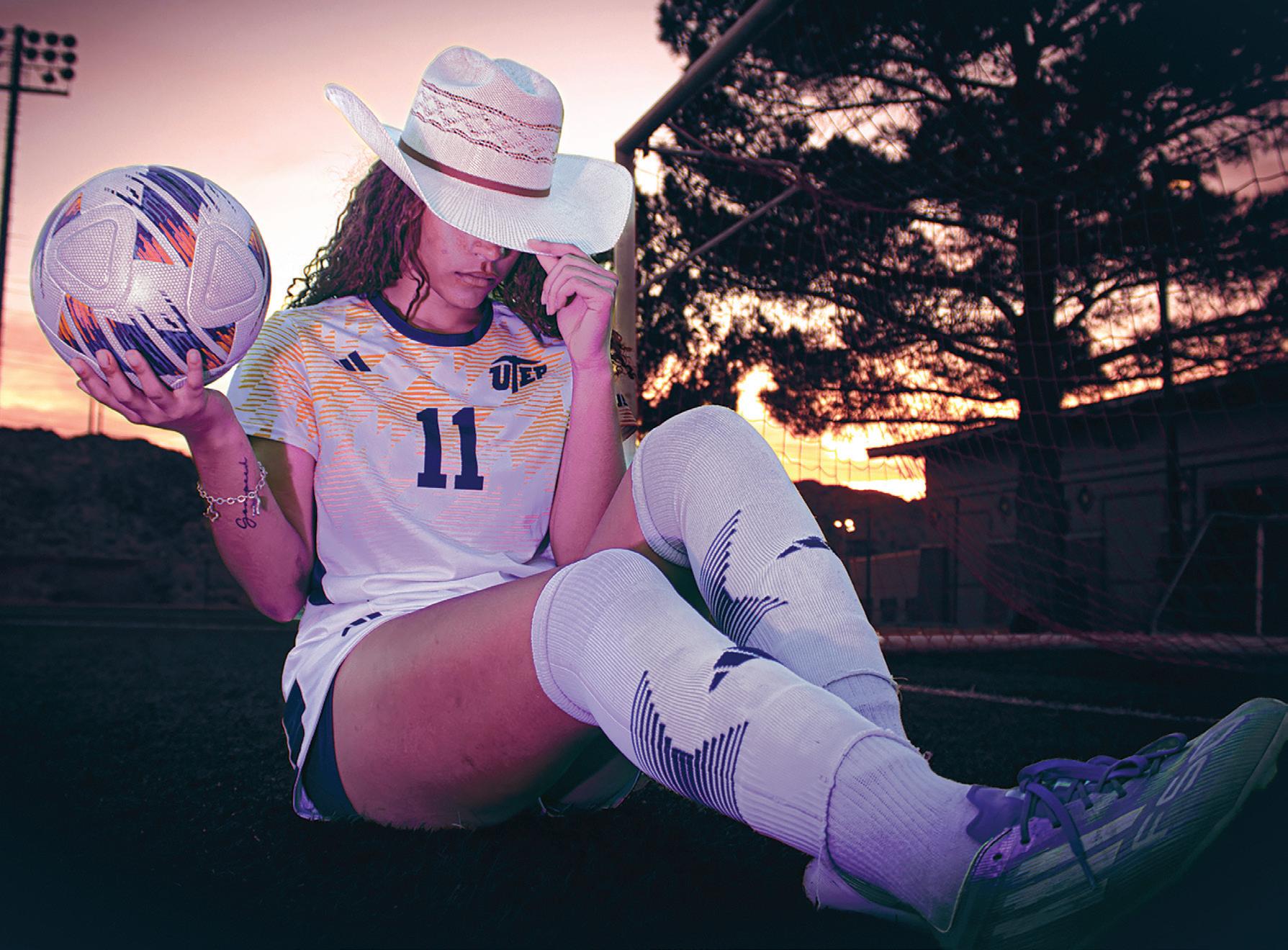
For women’s soccer forward Kialie Hudson, a rising senior and transfer student, Black excellence in sports carries a deeply personal meaning.
“When I think of Black excellence in the context of sports,” Hudson said, “I think of a hard-working athlete. I think sometimes there’s such a high bar you feel like you have to reach just to prove that you’re just as good.”
Hudson’s journey reflects both resilience and reflection. Originally from Houston, she transferred to UTEP after three years at Davidson College, seeking a better fit athletically and personally. She describes her experience at UTEP as community-centered: something she felt almost immediately upon her arrival.
“Your success, whether academically or in your sport, is very much community-based,”
Hudson said. “People care here.”
Her perspective also includes navigating spaces where representation is limited. As a Black athlete competing in predominantly white soccer environments, she has felt the pressure to outperform simply to earn equal recognition.
“It can feel like you have to do the extra yard just to get recognized the same,” Hudson said. “And that can be frustrating.”
Despite those challenges, she approaches leadership with intention. Though she does not define leadership by a formal title, she believes it is built through relationships, trust and consistency.
“If someone can talk to you about the simple things,” Hudson said.
“Then when times get rough, they have someone they can go to.”
Her perspective reflects the broader evolution of UTEP Athletics. Located along the U.S.-Mexico border, the university draws from a culturally rich and multicultural community, an environment Hudson said makes inclusion feel more natural.
“I’ve never felt excluded specifically because of my race here,” Hudson said. “It helps that UTEP is already such a diverse school.”
Still, Hudson said conversations about race and representation should not be dismissed.
“Maybe take a moment and think about the extra miles someone may have had to do to get to that spot,” Hudson said. “Sometimes it’s more of a mental battle than an out loud one.”
That mental resilience connects generations of Miner athletes. From Beamon’s gravity-defying leap to today’s student-athletes balancing sport, academics and identity, the trend is clear: excellence requires both performance and perseverance in all aspects.
Hudson, who is expected to graduate in Fall 2026, said she hopes to leave a legacy rooted in connection and compassion.
“I want to leave a legacy of loving your neighbors and helping others,” Hudson said. “You can be competitive and still care.”
From Texas Western’s groundbreaking championship to Olympic triumphs and currentday leadership, Black excellence at UTEP is not confined to a single moment. It continutes to evolve across decades and disciplines. The story of Black excellence at UTEP is still being written. Each season, each meet, each match adds another chapter. As new generations of Miners step onto the field, track or court, they do so standing on a legacy that proves excellence is not only achieved, it is sustained.
Originally from Houston, Kialie Hudson describes the UTEP community as one where diversity is visible and felt from the people on her sport here. Photo by Lesly Chavez/The Prospector
For Hudson, Black excellence in sports means reaching higher standards to prove your resilience and gain recognition of others. Photo by Lesly Chavez/The Prospector
CONTRIBUTOR THE PROSPECTOR MELINA HOLGUIN B Y
As part of Black excellence, Kialie Hudson says that to excel on a sport, you must approach leadership with intention through trust and consistency. Photo by Lesly Chavez/The Prospector
Melina Holguin is a contributor
‘Did we just become best friends?’
For four years, distance runners, freshman Isabella Campa, and sophmore Andrea Castillo, were the primary obstacles to each other’s competitiveness.
In the high-stakes world of El Paso distance running, they weren‘t just competitors; they were the “targets” on each other’s back, pushing one another to run faster.
Campa, an alumna from Franklin High School, and Castillo, an alumna from El Paso High, spent their teenage years as rivals.
If someone had told their tenthgrade selves that they would eventually be teammates at The University of Texas at El Paso’s (UTEP) Track & Field team, they wouldn’t have believed you.
“I really didn‘t talk to her that much in high school... it was never like‚ we’re friends,’ you know, based on that rivalry,” Castillo said.
Today, that fierce competition has undergone a transformation.
The two athletes are no longer looking for ways to pass one another; they are looking for ways to push each other as teammates.
Coming from rival programs, their initial views of one another were shaped by the intensity of the starting line.
Campa recalls looking at Castillo from afar as a “powerhouse” who always kept a calm poker face.
“My first impression of Andrea was like, ‘oh my gosh, she seems so serious,’” Campa said. “She seems like she knows exactly what she needs to do, super prepared. And she definitely still is, but now that I’ve gotten to know her, I also know she’s super kind, super caring and funny.”
Castillo saw a similar intensity in Campa when she arrived at UTEP as a freshman.
“She was super serious…obviously she was new, her personality wasn’t completely out yet,” Castillo said.
“But once I got to know her, she’s a big cloud of fun.”
In an era of the transfer portal, where many athletes switch schools frequently, both runners felt a calling to represent their hometown of El Paso.
“It’s my home school,” Castillo said. “It’d be amazing to come to a school here and represent El Paso… people show out, for the people from El Paso. So, I think it’s always [what I] wanted to do.”
read MORE at
ADRIAN GONZALEZ B Y
An unlikely friendship, Andrea Catillo and Isabella Campa, once rivals in high school, have now found themselves teammates in college. Photo by Sadie Briones/The Prospector
Although competing in highschool and otherwise not knowing each other, Andrea Castillo and Isabella Campa have formed a friendship outside of their sport. Photo by Sadie Briones/The Prospector
Prospector picks: Praise Djoma
twice in a row, with multiple other achievements under her belt so far.
After a dominant sophomore season, University of Texas at El Paso (UTEP) junior long jumper and triple jumper Praise Djoma has already claimed All-Conference USA first-team honors in the triple jump and third-team honors in the long jump. Now entering her 2026 season, the junior jumper has been named Conference USA’s (C-USA) Women’s field athlete of the week
Louisiana State University (LSU) transfer Praise Djoma has quickly become a cornerstone for UTEP Track and Field program under head coach Francesca Green. Djoma has also had a leagueleading record of 6.16 meters in the long jump, making her ranked number one in C-USA for the long jump and also ranked number three for her personal record (PR) of 12.28 meters in the triple jump. Djoma says her path to collegiate success was very abrupt. On her very last day of high school, her coach suggested that she continue
Praise Djoma made her decision to pursue track & field late in her high school career after her coach said she has the talent to do so.
Track and Field. Her teammates and coach supported her decision to continue pursuing the sport, prompting Djoma to start her career in Louisiana.
“He [high school coach] saw me, and he was like ‘I think you can do track’,” Djoma said. “My father wasn’t interested, but I just had to believe in it. I love it, I love the track family, and that is how I joined.”
After showing soaring talent in high school, winning the Nigerian U18 and African U18 championships, Djoma began jumping for LSU in 2024. She also had success in LSU, placing fourth at the LSU Battle on the Bayou, Djoma decided to transfer to UTEP and is seeing quick improvement.
“When I came in, it was shaky, I had to adapt and stay,” Djoma said. “I was jumping 19 feet at LSU, and now I am jumping 20-something [20.15]. So, it’s progress, and I thank God.”
Transferring to UTEP, the mentorship stood out to Djoma more than it did at LSU.
At just
Photo by Kristian Hernandez/ The Prospector
Alysa Liu soars at the 2026 Winter Olympics with three medals earned throughout the event. Even with her decision to retire shortly after the 2022 Beijing Winter Olympics, Liu decided to pursue figure skating on her own terms in 2024.
20 years old, Liu won gold in the women’s team event and the womens single free skating along with a bronze medal in the women’s single short program. Illustration by Dustin Perez/The Prospector