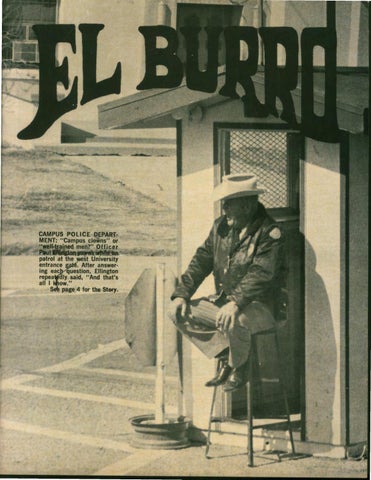
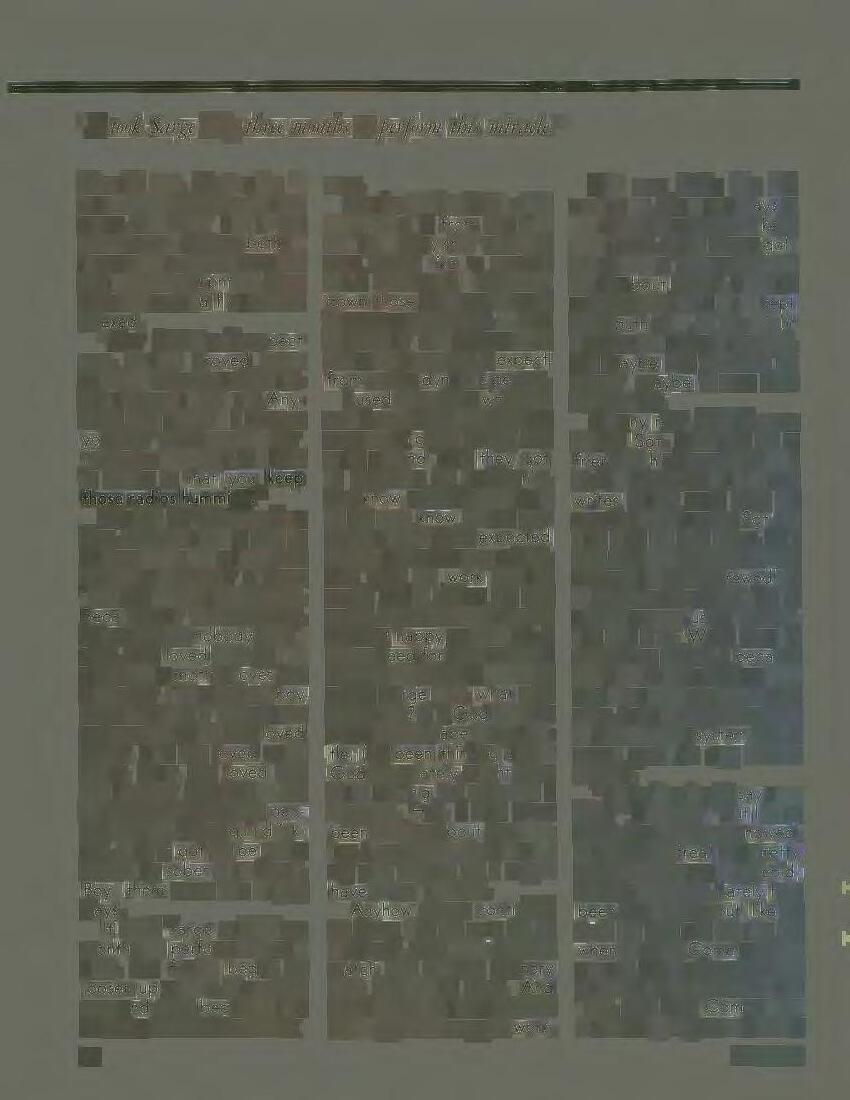
CAMPUS POLICE DEPARTMENT: "Campus clowns" or '_Jtell- ained men?" Officer Pk!lllll'oan.t-..imltlfte"OII patrol at the west University entrance gate. After answering eac~ question, Ellington repeat,clly said, "And that's all I kl,ow."
Set! page 4 for the Story.
u. t. el paso
editor-in-chief: henry de la garza jr.
managing editor: richard concha
associate editors: kelly la rue / terry acosta
art editor: sherrill mundy
humour editor: charles snodgrass mayfield
poetry editor: raymond swiesford
writing staff: elsie hayden / leah rubalcaba / elbert hutchinson / laura lawson / patrick velarde
dark room foreman: justin zatovich
dark room staff: karin elliott/ olga quintana
quality control : stella perez/ martha me cracken
mother superior and special advisor: ethel v. boone
EL BURRO , the University of Texas at El Paso variety magazine is published by Student Publications , El Paso , Texas 79902. Reproduction in whole or in part of any article without prior written permission from the Editor is prohibited Advertising rates furnished upon request. Opinions expressed in this magazine are not necessarily th ose of the University of Texas at El Paso or its students. Letters to the Editor , unsolicited manuscripts , photographs , art , etc. , may be delivered to the EL BURRO office, 202 Union W We reserve all rights to accept (and edit) any material submitted for publication in EL BURRO.
Editorial
There is a growing need for two definite improvements in our city government. One is a city public information officer and the other is a community relations program. The next city administration should consider the possibility of creating the position of a public information officer Local governments are recognizing the unique importance of providing information to their citizens - swiftly , accurately and fully. El Paso's city fathers should recognize it also.
The informal definition of public relations is, "Do something right, and get caught at it." With that definition in mind, the next city administration should create the position of PIO and assign the following responsibilities to it:
• to develop widespread knowledge and understanding of the city's programs, needs, resources and accomplishments,
• to overcome voter apathy by stimulating interest and support,
• to open channels of communi-
cation through exchange of ideas, and
• to establish and reinforce feelings of citizen pride in the city
The city of Dayton, Ohio, (population approximately 250 ,000) has become a leader in its use of public relations to inform and involve its citizenry. El Paso's population is larger and so its need for a PIO is greater. At the present time, the Executive Assistant to the Mayor is taking up some of his time performing as a PIO. If El Paso wants to be a big city, then it must be willing to think big as well. The position of Executive Assistant was not created by voters in 1968 for the purpose of being a PIO
If the need for a city public information officer is great, then the need for a community relations program is even greater.
Mayor Peter de Wetter once remarked that through his area council meetings City Hall is becoming more aware of "legitimate citizen complaints." The paper
mill created by, and the average attendances of, the area meetings validate the mayor's observation. The area council meetings, far and away, have been the best effort by any city administration in reaching the citizenry. However, a bolder and more personal alternative is available.
In his book, "Violence in the City," Dr. Blair Justice states, "Community violence , like cancer, is foreshadowed by danger signals. Common signals of trouble include a high unemployment rate in the ghetto, police a buse and slum housing." The problems of high unemployment, police abuse and slum housing can and have been voiced in area council meetings. However, a knowledge of J::iow a community accepts its environment and its problems is needed . Dr. Justice brings this out when he further states, ". . . it is not enough to know the number of substandard houses in a certain section of the city. More essential is how the people there accept
living in slums, whether they can envision a better life for themselves It is not enough to know what the unemployment rate is. More crucial are the expectations of the idle people and the degree of frustration and anger they may have from finding no work, or work that has no future It is also not enough to know whether people say police mistreat ghetto dwellers More important is the way with which any abuse is accepted." Unless a city administration has a "personal feel" of the community and its problems, it cannot , in the true sense, act in the better interests of the community's citizenry. A community relations program offers the best possible means to attaining a "personal feel."
As an aside , a community relations program would not only bring the city and community much , much closer , but a vast job market would be created by it. Yes, more jobs in El Paso .
A city public information ofMARCH, 1971
ficer , and a massive and intensive community relations progr a m are two things which mayoralty candidates for the March 27 election should consider and voice opinions on. And , they are two things voters should consider when studying the plateforms of the mayoralty candidates
When all else fails
It is unfortunate that the University cannot seem to fill the new resident dorms, Kelly Hall and Barry Hall. The situation has reached the point where some administration officials want to strictly enforce the parietal rule and close down the old dorms so that dorm students, who would otherwise move into the old dorms, would have to move into the new resident dorms.
Well, there are other alternatives open to the University, and we would like to suggest two possible choices .
Firstly, since the new resident dorms are presently only about half full-the bottom halves, that
is-the University could rent or lease the upper halves to NASA as warehouse space for the stora ge of moon rocks . The way students are avoiding moving into the new resident dorms , quarantine conditions could be easily simulated.
A second possibility would be to find the fellow who convinced the University that it really needed the new resident dorms, and make him personally rent the remaining vacant rooms in both dorms. Then again, we understand that the res ponsible fellow is over 21 and immune to the parietal rule.
Really now ...
We learned with some displeasure that the Ad Hoc committee-to study student services fee allocations-completely cut off El Burro off of next year's budget. We, of course, are somewhat disturbed by this recommendation and would have preferred that the committee members cancel their El Burro subscriptions instead.
Indepth
Campus Police Department
"Campus Clowns" or "Well-Trained Men?"
"The campus police force is a joke - a handful of clowns. Give a man a Stetson hat and a badge and he automatically becomes LBJ. A uniform helps prestige, but, rather , what is needed is a well trained corps of men "
- Letter to the Editor Prospector March 17, 1967
"If a policeman wants to command respect, then he must look the part."
- James Theodore Petzold new U .T. El Paso Campus Police Chief July 27, 1967
It has been almost four years since overwhelming student dissatisfaction and pressure forced the resignation of then U T. El Paso campus police Chief W . G . Jones. Student complaints varied from "no prior uniform training" to "a lack of an educated attitude on the part of the campus police force. " Chief Jones retired in the summer of 196 7, and James Theodore Petzold replaced Jones on July 15 of the same year. After assuming his new position , Petzold publicly pledged that his police force would not become a "Gestapo" and that all students would "be given all possible considerations" in matters that concern the department.
So, wh a t changes have occurred in the Uni versit y's police force in the past four years since Petzold's a rrival? Is the quality of the force improved? Is the force professional? And , is the force free of "bugs? "
Perhaps the best place to begin an a n alysis of the force is at the top-Chief James T. Petzold.
ROOM AT THE TOP
"When I read of the opening for police chief at U T. El Paso , I immediatel y a pplied for the job. I figured my age and m y experience as a law enforcement officer would be suitable for the job."
-Chief Petzold
Chief Petzold came to his position at the age of 29. Prior to bec oming chief, Pet zo ld was emplo yed as a night dispatcher for three months with the El Paso County Sheriff' s Department And prior to being a night di spatcher, he was employed with the Texas D ep a rtment of Public Safety for eight years as a patrolman. Petzold ' s responsibilities as DPS patrolm a n included traffic control and mot or vehicl e inspection . Nowhere in Petzold 's background is there any mention of any supervisory or criminal investigation experience. The chief readily admits to his lack of supervisory experience,
and insists, "The onl y thing to criminal in vestigation is asking questions. If you ask enough questions , you'll find your man. " Chief Petzold did not speculate as to just what questions should be asked.
An insight into Chief Petzold ' s knowledge of the law outside of public safety was revealed when El Burro questioned the chief about a recent marijuana bust executed by his department on the campus . El Burro: Chief, what happened on the afternoon of January 28, 1971, at 2:57 p.m., on the west Union lawn?
Chief: I instructed officer Paul Ellington to tell the two boys sitting on the lawn that I wanted to see them in my office. El Burro: Why did you want to see them?
Chief: They were seen smoking marijuana.
El Burro: Were they brought in?
Chief: Yes.
El Burro: Where were they brought in?
Chief: They were placed in the investigation room.
El Burro: Was a guard placed at the door of the investigation room?
Chief: Yes.
El Burro: Were the boys free to leave at will?
Chief: No.
El Burro: Are you aware of the Supreme Court ruling that if a person is detained and is not free to leave at will, that he
((STOP HERE"
What if someone didn't stop? How quickly could this officer react? Shouldn't he be standing outside of the guard shack? Does the officer "command respect" from inside the guard shack1 Changes are needed!!
must be read his rights? Are you aware of this, chief?
Chief: (pause) Wait a minute. (The chief then began fumbling through his • wallet and pulled out a small, rectangular, blue card. On one side of the card was an exact verbatim wording of the "Rights" and on the other side were the rules for administering the "Rights" as established by the Supreme Court. The chief slowly read and reread both sides of the card. He then paused again.) By golly, you know, I think you're right. When questioned later, officer Ellington substantiated the chief's statements. Ellington, however, could not remember if a guard was placed at the door. Ellington was asked several questions concerning the marijuana incident. Ellington, after answering each question, repeatedly said, "And that's all I know."
RESIGNATIONS, SOUR GRAPES
A rather sour note within the police force has been the recent resignations of two personnel who had a combined 51 years of criminal investigation and law enforcement experience between them.
On January 7, 1971, Arthur E. Weiss resigned from his position as Sgt. Investigator. As Sgt. Investigator, Weiss was in charge of all criminal investigation on the cam-
MARCH, 1971
pus. Prior to assuming this position, Weiss had been employed with the El Paso County Sheriff's Department for 11 years, six of which were spent as a criminal investigator. Weiss also has some 20 years active and 10 years reserve duty with the U.S. Army in the field of intelligence and criminal investigation. He has also attended several FBI Courses in criminal investigation. Weiss is well regarded by local law enforcement agencies as being "very qualified." In fact, Weiss was a recent candidate for Constable-Precinct 1 for the county of El Paso.
On February 1, 1971, officer Kenneth Oefelein resigned after 3 ½ years with the campus police Oefelein, far and away the most popular campus police officer with students, had 21 years experience in law enforcement. He has attended seven FBI courses, three of which were in supervision training. From the time that Oefelein arrived to the time of his departure from the University, he was stationed at the east University check point gate. Prior to joining the campus police , Oefelein retired from the Freeport, Ill., city police department with the rank of Police Lt
El Burro asked Chief Petzold why these two men resigned. "Kenneth Oefelein ' s wife wanted to return to
Freeport. She once expressed this desire to me on the telephone. Besides, Kenneth wanted to apply for the vacant position of sheriff in Freeport," said Petzold. "As for Weiss, there were personal differences. I tried to offer Weiss some advice on criminal investigation, on how I felt some things should have been done, and he didn't accept it very well.
This was something which had been growing for sometime, " Petzold explained.
El Burro then asked if replacements for Oefelein and Weiss had been found. "Yes, " replied Petzold, " Tom McKay will replace Arthur Weiss. " Tom McKay is an El Paso policeman with 13 years experience in law enforcement. The chief was asked if McKay would be accepting a cut in pay as a Sgt. Investigator for the University. "Yes, " replied Petzold. "Tom earned more money as a city policeman. The job of Sgt. Investigator pays $514 monthly, " explained the chief. El Burro then asked Chief Petzold why a man would want to take the job if it pays less "Well, " answered the chief, "Tom told me that he wants to continue his education. Tom wants to finish working on his masters." El Burro thought perhaps the job had something to do with it.
Mrs.
Wanda Gladish replied,
"Well, he's a student, too, you know."
FULL TIME CHIEF, PART TIME STUDENT
". a free-flowing lin e of communication between himself ( the student ) and this office will exist as long as I am police chief. It so unds like a cliche. I know , but, believe me, it ( the door ) will be open. Come and try me out ."
- Chief Petzold
One recent afternoon, a student walked into the ca mpu s poli ce office. Walking up to the Chief ' s secret a ry, Mrs. Wanda Gladish , the student asked , " I need to see the chief about something. " " I'm sorry," r eplied Mrs Gladish, " he ' s in class " " In class, " answered the student, " wh a t's he doing there ?" Mrs. Gl a di sh replied, " Well, he ' s a student, too, you know ."
Chief Petzold has be en enrolled at U.T. El Paso sin ce the fi rst summer session of 196 7. Since then , he h as enrolled for as man y as nin e class hours a semester. R ec ently, the administration told Chief Petzold to enroll for no more than six h ours a semester. Whatever amount Pet zo ld enrolls for, it is in a ddition to hi s full time duties as chief. The chief a dmits this , and says, "I som etimes sh ow up at the Universit y late a t ni g ht. " The chief expects to possibl y gr a duate in August of this year with a B. A . in ph ysical education. El Burro as ked the chief in what way a ph ysi ca l education degree might help him in hi s job. " It sounds unu su a l, " repli ed the chief, "I must a dmit. But, the position of campu s police chief r equires that a person have a degree ." The chief was then asked if he had any plans to leave U T. El Pas o after graduation. "No, " replied the chief. " I like law enforcement , and I want
to stay in it. Of course, I'm normal. If I should be offered a good position with good pay elsewhere , then I would h a ve to carefull y consid er it ." The chief presently earns in the neighborhood of $800 a m o nthand he just put in for a raise this year.
CHANGES NEEDED!
"If you feel you h a ve a legitimate compl a int a gainst us , come in here and raise cain , and , b y goll y, if we feel you ' re right a fter that , then things will change !"
-Chief Petzold
U .T. El Paso' s stud ent popul a tion has grown b y a pproxim a tel y 4000 students since Chief P etzold ass umed hi s duti es in th e summ er of 1967. This in cre ase is equal t o more than 1/3 of the Uni versit y's present enrollment of 11 ,500. When the University's enrollm ent is co mbined with its number of fa cu lt y, a dmin is tra ti o n a nd staff m emb ers-the end r esult , in essen ce, is th a t U. T El Paso is a community, o r a sm a ll soc iet y A nd each citiz en of this co mmunit y-be he a student o r a st a ff m emb er-is entitled to prot ec ti on a nd the best possible la w enfor cem ent ava il a ble. The re aso n is simpl e, h av ing over 12 ,000 pe ople on a sm a ll a re a the size of the ca mpu s can cr eat e so m e problems-as can occ ur in a n y communit y. " Wh a t p ro blems ?" you ' r e prob a bl y asking
DRUGS U T El P aso h as, a nd has had for so me tim e, a drug problem- at the present time it is ve ry sev ere a nd sini ster So severe is th e drug problem on o ur ca mpu s th a t three m o nth s ago the C h a n ce ll o r 's office sent a sp ec ial in ves ti ga to r to the campus to " clean it up ."
A SSAULTS . On th e ni g ht o( J anuary 20 , 197 1, a Uni ve r sit y ja n it or was se ri o usl y beat en up b y uni de n tified persons. Th e in cid ent occ urr ed in th e rear entranc e t o o n e of t h e U ni versit y's new dqrms w hi ch h ouses ove r 500 students. Th e ja n itor was taken t o the h ospital in criti ca l condition .
THEFT. R eturn in g fr om t he last Christm as h olid ays, a d o rm reside n t found his roo m r a n sac ked and h is exp en sive ster eo st olen . Th e wi n dows a nd d oo r sh owed n o signs of h aving be en ta mp er ed wi th , t h e t hi ef must h ave h a d a m aster key.
In 196 7, the p ro bl ems were less sever e- n o cl earl y d efin ed p ark in g rule s, t oo m a n y ca rs p a rk ed on th e imm edi a t e ca mpu s, a n d a dec isio n was n ee d ed on wh ether or n ot U .T. El P aso would be co m e a p ed estrian ca mpu s. The probl ems of 197 1 a re far m o r e se ri o u s, co nfu sin g a n d compli cat ed P erh a p s, if th e list of u nsolve d crim es co ntin ues t o grow on t h e ca mpu s, a ch a n ge will be needed! P erh a ps??? Did we say , " P erh a ps ?"
Th en aga in , p erh a p s t h ings aren't so b ad a ft er a ll Th e n ew Sgt. Investi gato r w ill b e a bl e to finis h wo rkin g on his m ast ers , th e ch ief gradua t es in A u gust a n d, h opefull y, his P. E . dip lom a w ill h elp him to bett er int er p ret a n d r em ember Supreme C~m rt ru lin gs a nd crim inal law, and, las t , b ut n o t le ast , th er e h aven't been a n y furth er r esi g n a tions-l ately. A nd , th er e' s a n ind icat ion t h at a ch a n ge m ay eventu a ll y come. After 3 ½ years in the chi ef's pos ition, P etzo ld fin al ly go t a badge for his uniform t o d istin gu ish him from t h e oth er m en o n th e fo r ce. It h ad t o ev entuall y happen
CARLOS MORTON
MARXIST EXCHANGE
BETWEEN A STERLING SILVER SPOON AND FIRST GENERATION IRISH LINEN
LINEN: Psssst! Hey, you.
SPOON: Are you speaking to me, sir?
LINEN: Yah, you-It's none of my business, Mack, but your underside is a bit dull.
SPOON: I beg your pardon.
LINEN: That dumb spade maid kft a big dad of polish on your underside.
SPOON: Oh, my goodness, what shall I do?
LINEN: I don't know, bull, but you better think of something fast; here come the guests.
SPOON: Oh, woe! What if the First Lady should sit here! Can you read the placard?
LINEN: It's turned the other way, besides I can't read. Say you look pretty fancy, how long you been around here anyway?
SPOON: Ever since the war?
LINEN: First or Second?
SPOON: Revolutionary. There must be some way I can get rid of this artocious stain: Could I possibly ask a great favor of you?
LINEN: Shh! Here comes somebody.
SPOON: Who was it?
LINEN: Why, It looked like that old has been, Johnson.
SPOON: Andrew?
LINEN: No, the one who just retired.
SPOON: I have been dipped in these affairs for so long-one often forgets.
LINEN: Say, what was that favor you wanted, anyway?
SPOON: Oh, kind sir, I would appreciate it if you would reach up and clean the smear off my
MARCH , 1971
underside?
LINEN: Are you kidding me? Then I'd be soiled; what if Nixon should want to wipe himself with me?
SPOON: Yes, but at least he can switch you over and use you again. He can only sip his soup with me.
LINEN: Oh, so you're a soup spoon!
SPOON: A STERLING SILVER soup spoon! My dear man, was that not quite apparent?
LINEN: Look here, buster, us Irish Linens have just begun to bust in on the BiG scene, why should I soil my chances? Besides, I don't see why they just don't use one spoon for the whole dinner and be done with it.
SPOON: Oh, you people are impossible.
LINEN: Here comes somebody else! I think he's going to sit here.
SPOON: Oh, dear, who is it?
LINEN: Pheewww! He's in the next seat over. Looks like a Rockefeller.
SPOON: Nelson, Winthrop or John I, II, or III?
LINEN: Does it make any difference? And something else I've been wondering about-Do you think we're reverting back into feudalism with Percy-Rockefeller, Eisenhower-Nixon weddings?
SPOON: We will not have any impertinence on the part of you people! Now, I order you to remove this stain from me.
LINEN: I'm afraid your stain is
more than skin deep; your soul is also soiled with the blood of three men
SPOON: You people are terribly poetic and terribly brash and someday you are going to overstep
LINEN: Holy Moses, I just knew it was going to be him!
SPOON: What are you babbling about; who is it?
LINEN: It's him, Spiro.
SPOON: That barbarian.
LINEN: Bet they're having Greek Salad.
SPOON: I thoroughly deplore the riff-raff they're letting in these days.
LINEN: Don't worry-he's just the House Greek, even tho it carries a title. Still want that stain removed?
SPOON: No, I am sure that he will not notice.
LINEN: Well, here comes the soup, see you around, Mack.
SPOON: Surely, friend.
LINEN: Yah, so long. (They wait, spoon shuts eyes waiting to be picked up) Hey, what's the matter, everybody else is starting in on their soup . . .
SPOON: You don't suppose he's ...
LINEN: N ah, not with his . . .
(They turn slowly around and look upward in disbelief as the audience imagines the newly elected vice-president ea ting, drinking soup the way they do in Greek Restaurants) slow blackout
Markings
Death, and then ...
What is this thing called dying? Is it li ke a light-once you turn off the switch total darkness comes and nothing else? Or is it like a wormfirst the dormant stage comes and from this process a beautiful butterfly emerges?
Several researchers have refused to close their eyes to the mysteries of death and have probed into its dark shadows. The conclusions of their results will be left to the interpretation of the readers. One thing that most of the scientists who have researched death agree on is that there exists a " second body " These people acknowledge the existance of an "aura" which surrounds our bodies. This aura is described as being a misty wraith-l i ke rad iation wh i ch surrounds the bodies of perhaps all living organisms. It i s iridescent and colorful.
In 1946 group experiments were conducted by R. DeWitt M i ller in an effort t o see
if the average person was able to see these auras. The results were positive. If you wish to experiment yourself , the following method is suggested:
In a dim light and before a dark background touch the fingertips of one hand to the other then separate the hands so that there is approximately one-half-inch between the fingertips. You should be able to see faint streamers of gray i sh m i st between your fingert i ps. Now move the hands apart and you will observe that the streamers w i 11 separate and become misty extensions of t he fingers . The aura can best be seen out of the corner of the eye . All available evidence sho w s the aura is connected to our physical body by an e lastic cord. This cord is broken at the moment of death . The researcher ' s report also illustrated this aura leaves
the body at the mom e nt of death There a r e many i ncidents which i l lustrate th i s. One such case is summar ized from a report made b y D r . James H. Hyslop , the n p rofessor of log i c and et hi cs at Columbia University.
Louisa M. A l cott , M rs . A lcott and the i r fam il y phy sician were gathered a r o und Louisa's dying si ster. Dea t h finally came to the g i r l. A s they all w atched , a dim a nd fain t ly g lo wi ng mi st a rose from t he b o dy , sw ift ly c o a lesced , and floated aw ay. The d octo r o ffered no explanation for t he m i st other t han tha t there w a s a worldo ld belief t ha t so m ething leaves t he body at th e moment of death .
Several W o r ld Wa r II nurses cla i med to have seen the same m i st lea v e the body of d y ing so ld i ers. They fa i led to repor t it t o t he p hy sici a ns for fear of being cons id e red a li tt le odd.
Experiment s o f a nother nat ure have a ls o been conduct-
ed. Dr. Duncan MacDougall constructed a scale so fine that a single cigarette could be weighted. By 1906 he was ready to begin his experiment. His experiments were to be conducted at the Massachusetts General Hospital. The res u Its demonstrated that· people lose a measurable amount of weight at the moment of death and that this loss is sudden and is unexplainable by the laws of science. His experiment technique was as follows:
A Ii g ht framework was built on a delicately balanced beam type scales. This framework held a bed and a dying patient. Every weight was taken into consideration. The bed and patient were weighed. The weight of the air exhausted from the patient's lungs and evaporation were also taken into account.
The doctor carefully chose his patients suffering from diseases which end in profound exhaustion so that no muscular movement was 1nMARCH, 1971
volved, preventing agitation of the scales.
The first man chosen for this experiment was a man dying of tuberculosis. He was under observation for three hours and forty minutes before dying. The patient lost weight at a rate of one ounce every hour due to evaporation of moisture in respiration and sweat.
At the end of three hours and forty minutes he died and suddenly, coincident with death, the beam dropped with an audible stroke , hitting against the lower limiting bar and remaining there with no rebound.
Dr. MacDougall repeated his experiment several times and in every case he found a distinct sudden drop of weight at the instant of death. He ruled out two cases as inconclusive, one because of interference by persons opposed to his work and the other because the patient died too soon after being placed on the bed to
allow the scales to be critically adjusted.
Dr. MacDougall's experiments showed that a person lost from ¾ of an ounce at the moment of death to as much as 3 ounces. As of now, no one has provided a satisfactory scientific answer for the loss.
All of the important experiments and investigations that were made during the first quarter of this century have been all but abandoned, not only in the United States , but also in England and elsewhere.
However , man's curse called "the need to know" will drive dedicated men and women to search for the answer. Such men and women believe that there is a large number of truths and forces about which man knows next to nothing - or nothing at all.
-Elsie Hayden
Markings
Who are the Poor?
EDITOR'S NOTE: JACK ELLWANGER IS 27 YEAS OLD , AND DESCRIBES HIMSELF AS A "SPORTS WRITER THAT WENT WRONG ." ELLWANGER ENTERED FOOTHILLS COLLEGE AFTER LEAVING THE SERVICE LATER HE TRANSFERRED TO THE UNIVERSITY OF THE AMERICAS IN MEXICO AFTER LEARNING OF THE KING ASSASINATION AND THEN OF ROBERT KENNEDY ' S ANNOUNCEMENT FOR THE PRESIDENCY , ELLWANGER LEFT SCHOOL TO JOIN BOBBY ' S CAMPAIGN AFTER BOBBY'S DEATH , ELLWANGER JOINED THE POOR PEOPLE S CAMPAIGN , AND IS PRESENTLY WRITING A BOOK ON THE POLITICS AND LIFE IN EAST SAN JOSE.
By Jack Ellwanger
Being poor is a lot of misery, so why do these people want to be like that? Why don't they do something about their wretched condition?
Well, where does one begin? Maybe an attempt at understanding could begin with the poor folks's ethnic background; that it didn't afford them the opportunity to learn the lessons tradition teaches those who are not poor. The poor's parents and their parents were taught not to worry about having material possessions. Their social relationships were limited , they associated with their immediate family and were allowed only glimpses of the non-poor. From generation to generation the legacy of accepting their position was their primer.
Originally in this country there was a non-poor to provide the necessities of life for these poor. Gradually as the poor became more in number the social contract with the provider became laxer Now in many parts of the country that contract is a memory. The poor are with their larger circle of peers, but with-
out the provider. Most of all they are without the lessons of selfproviding Why do the poor stay poor? In contempt people like to answer , "because he's stupid " But, what about the son of the provider who was bathed in the tradition of "getting ahead" , and learning "how to act". He knew from an early age there were personal virtues he should attain to. The son of the poor was encouraged to appreciate the simplicities of life and nature, for that was all he would ever have He was taught not to talk that foolishness about getting ahead that the good Lord would take care of everything. Is the poor man's son stupid because he can't read without moving his lips, farming the sounds of words with his mouth, can't finish a paragraph without daydreaming because it takes so much effort and time? His parents probably couldn't read, his teacher probably had to abandon reading drills for the sake of maintaining their classroom attention by gimmicks and his classmates probably argued it was a waste of time to learn how to read "cause my daddy's right that that's not going to get you anyplace". Is he stupid because his grammar is terrible and his vocabulary is small? Is it really small? Is he stupid because he can't readily react properly; because his frame of reference is limited to family and other poor, and harbors no exposure to th.e
cultural arts
Now in this country there is rampant poverty and its persistent existence nags those who are not of it. Those who don't know it personally, draw their rationale for the question from their own cultural heritage , which is void of the poor's legacy of acceptance. Their reasoning has its derivation in that heritage of competition, and the busy routine of acquiring behavioral traits which led one to the top Consequently they have not only been socially separated from the poor, but have developed a certain contempt for the poor Now that there are so many of the poor, a threat is posed.
The dialogue of the poor is different because its background is different . Its dialect doesn't measure by the standards which prompt the question By any standards the poor are now a huge social force which has to be reckoned with. Therefore , it ' s time to recognize the poor
Who are the poor?
He's the Indian tucked away on the reservation, hidden from the sightseeing vacationer and from the city-hall reporter's beat. The Bureau of Indian Affairs took his tomahawk awa'J/, from him to hold it over his head in the name of "welfare."
You can't trust him with a bottle of fire water. He's a savage. He lives in a tent, a hut , shanty, an abandoned automobile or in a chicken coop. They
live in clusters on predominantly barren land , virtuallu deprived of their sacred self-subsistence tradition.
Most of his people who need to w ork - about half of themcan't find jobs ; those who can are usually emploued in temporary or seasonal jobs. If they try to collectively bargain about the mi serable wages , "green card" holders can legally be brought in by the big farmer to break str i ke Indian families on the reservat i on who need an income earn $1 ,500 annually on the average. They are approximatelu 500 ,000 in n u mber , living on 200 reservations in 21 states . Individual life ex pectancy is 43 5 uear s, and compared to all other Americans , he is six times more likely to d i e from tuberculosis and l i kely to catch a severe case of pneu monia. His odds are 3-2 against completing at least eight grades i n school , and if he gets that far he has a 50-50 chance of finishing high school . A good reason for this poor rate is that many Indians cannot speak English , their cultural background creates a great canyon of fear about striking up friendships with English-speaking classmates
At the risk of understating: Incl u ding many other intimidating factors , the overall effect is a discourag i ng one for the Indian.
The Severalty Act of 1887 decided the Indian was headed for extinction, in fact, "dying off rapidly" , and deprived him of a MARCH , 1971
hunting or cattle-raising potential. Also, to the Indian who once grooved their community culture in union , the white man has systematically destroyed that set of values and replaced them with the Anglo-Saxon's rich old Christian trait of suspecting one's brother. He is now in a subservient role and at the mercy of the American System's whims. He may be poor and down right now , but beware Mr. Have, he's got plentyum soul power.
Who are the poor?
He's a "spick" in Spanish Harlem , a "beaner" in Dallas, a "Chicano" in Oakland. He came to the land of opportunity on a banana boat from Honduras or on a migrant worker's truck from Sonora. During the Second World War he was needed here as a laborer; today when the crops are right he's needed again. When he isn't needed in the fields or to substitute in the kitchen he faces returning to the conditions at home that made him vulnerable to the employer ' s luring in the first place. Usually , if the law will let him, he stays; without a job or a grasp of the language he becomes a member of the society.
He was born in Colorado or New Mexico on parcels of land granted to his ancestors by the Spanish government and recognized by the U S -Mexico's Guadalupe Hidalgo Treaty But, just as the U.S waged war on Mexico (Manifest Destiny") to gain more land , she ignored the treaty
and took those land parcels He now has no land nor dignity in the white man's system
He's a problem, sadly an ignored one.
He finds comfort with those of like economic means, he joins the ranks of the poor. His alienation is even more greatly magnified by his totally different cultural background. He is invisible , wandering through the long minutes , even longer hours of a foreign society with faint hope for economic salvation.
Watch out for him, he carries a blade.
Who are the poor?
He is white and without a piece of land to do the only thing he knows, farm . He is white and dying on his nine children in "milltown" where he has worked five months out of the year in the mill for 29 years until two years ago when they told him he w a sn't needed anymore His family of seven lives in cold-waterflat of three rooms and he earns $1,000 a year .
He saw daylight for only minutes each day of the 32 years he worked in the mine, and since it closed down he doesn' t earn anything but he gets all the sun he can take.
In sprawling , prosperous Huntsville , Alabama, he is "poor white trash" who can't shower, change clothes or count on his next meal On beautiful Washington D.C., he scrounges the garbage cans of the alleys.
There are 25 million of these
poor white scattered all around the country, living rather isolated from those who keep up with the Joneses. Better keep your eye on this one 'cause the machine is taking away his job almost as fast as his family is growing, and besides he's been economically, educationally and culturally deprived, he may not go along with ... the system.
Who are the 1Joor?
He is a black man void of his natural cultural heritage-his native tongue and mother have been taken from him, he was thrown at the mercy of an exploiting, foreign culture. He is a Negro who has to "act right" when he goes for a job he hasn't been prepared for, and he goes home empty-handed again to face a hungry family.
He is an Afro-American dropout who condemns "White America" because it has robbed his folk of living their own life.
Black poor make up onefourth to one-fifth of the American poverty group, even though his people are but ten per cent of the total U.S. population. Their dollar buys only five-sixths of the goods that the poor white dollar buys, because of discriminatory selling practices.
Poor black families average half a person larger than poor white families. Poor black in this country on the whole receive only five per cent of the total annual income in the United States. They are chronically under-employed. His job opportunity is the same whether he has completed eight years of elementary schooling or a high school graduate. Each pupil in a black urban school is appropriated 79 per cent of that spent per pupil in white urban schools. Almost half of his teachers are uncertified. In black ghettos the Afro-American can plan on a shorter Zif e as long as he lives with poor sanitation conditions and communicable diseases. Each year to each black urban community rats cause $4 million worth of damage, not counting the uncalculable damage from rat bites and other diseases. He has to go to overcrowded hospitals or get turned away from white medical centers which still practice racial discrimination. Economically, the poor black person is two decades behind the average white citizen. Beware of this one, he's pissed
off.
What is poverty? It's empty eyes of a hungry child. It's angry passivity, hopelessness, and plain ol' hatred of a growin' -up kid who is busy building a strong character which can't be trusted. Don't give him a job 'cause he's incompetent. He never thought he was something special, that there were worlds for only him to conquer. He was conditioned not to question, to arrive for new learning, to impetuously display new knowledge. His childhood was mostly void of hope, now whatever dreams he had have been drowned in a vacuum of disparity.
Why can't he get a job like anyone else? Maybe because of antiquated management procedure. The Man isn't going to protect his producer's security just because of a little misery. The Boss doesn't think about the West Virginia disabled miner as testimony to the ruthless tactics of strip mining operation which, among its list of victims, frequently strikes its workers with silicosis - a lung ailment induced by inhalation of coal dust. Why don't they do something about their horrendous situation? In the urban areas, to give one why, usury has played a key role in keeping the needy, needy. The poor doesn't have the ethnic background to say no to a fast dollar, to say no to a fast seller. Madison Avenue tells him there are certain things he needs to be happy; that he has to be desired by others because of his material possessions; that he has to get them by buying. Usury, the good ol' poverty advocate, shows him how to get the money quick for that buying.
This is a divided America in which more than 40 million poor people have been deprived of opportunity to improve their lot . They have been relegated to the fringes of our productive society.
To these poor people the problem of their poverty is an everyday thing which they, because of their lack of education, have difficulty articulating in terms which are usually attached to national crisis affairs They talk of how their subservient nature is taken for granted; not in those words, but in words that let you know that people who have money expect these poor people to think they are less competent as
human beings. They talk about protecting their babies from rats as a matter-of-fact thing.
Culturally these people are divided from the American society, and today hordes of them are in our nation's capital to demonstrate the crisis They came with American Dream, with the "One America" dream of the murdered Dr. Martin Luther King , Jr ., with the dream of their children studying tomorrow the words of Thomas Jefferson , of using George Washington Carver's microscope, of spiritually growing with their forefather's mythology, and of eating eggs for breakfast and of watching a tree grow that they planted. They came to ask for our cities' salvation, for war money to be spent on civic projects which help better communities and provide jobs for the desperate. They are here presenting real questions concerning the futility of the American Way of Life if so many families are socially, educationally, and economically prohibited from• helping themselves.
Back home the poor man's dignity is socially invisible. His disparity walks the streets unseen, he smothers his hopelessness with his hidden toil in the diminishing fields when he can , and when he can't he shudders his pride into the arms of his understanding wife.
At Resurrection City, before the tear gas and bulldozers wiped it out, he was baring his emotions for the world to see. He was shouting that dignity in song. He is still here shouting that dignity in song, committed to show that an urgent American committee is needed right now to battle these overgrown forces dividing the country. They are fervently devoted to non-violence , and with a violent mind they are touchable testimony to the hidden hunger and quiet misery that runs deep and rampant in this land of plenty.
The poor are the doctors out to cure the chronic illness in this country
Hmmm , America , how you feelin' today?
O~do 8 0
Why can't an elephant ride a bicycle?
He doesn't have a thumb to ring the bell.
How do you stop a herd of elephants from charging?
Take away their credit cards!
What did Tarzan say when he saw the elephants coming?
"Here come the elephants!"
What did Jane say?
"Here come the plums!" (She was colorblind!)
What did Tarzan say when he saw the elephants coming down the path wearing sunglasses?
Nothing! He couldn't recognize them!
How can you tell when there's an elephant in your refrigerator?
You can see his footprints in the cheesecake!
One way to catch elephants: Hide in the grass and make a noise like a peanut!
How can you get an elephant out of a box of Jello?
Follow the directions on the
MARCH , 1971
back of the package!
What time is it when an elephant sits on a fence?
Time to buy a new fence!
What's the difference between an elephant and a flea?
An elephant can have fleas but a flea can't have elephants!
What's gray and stamps out jungle fires?
Smokey, the Elephant!
Why does an elephant lie on his back?
To trip low-flying canaries!
What's Smokey the Elephant's middle name?
THE!
What's the difference between an elephant and an Aggie?
An elephant has peanuts in his breath.
Did you hear about the Aggie who was so lazy he married a pregnant woman?
What do you find between elephant's toes?
Slow running natives!
Did you hear about the Aggie
who hit the floor and missed?
What's the similarity between a plum and an elephant?
They're both purple, except for the elephant!
How do you fit six elephants in your car?
Three in the back; three in the front!
Why don't many elephants go to college?
Because they don't finish high school!
Why don't elephants laugh?
With all these sickening elephant jokes going around, how can they?!
Why do ducks have webbed feet?
To stamp out for est fires!
Why do elephants have flat feet?
To stamp out burning ducks!
What's the difference between a plum and an elephant?
Their color!
What did one elephant say to the other?
Nothing! Elephants can't talk!
Why do elephants have white tusks?
They use the Crest formula!
What's gray and white and red all over?
An embarrassed elephant!
What do elephants- have that no other animal has?
Baby elephants!
What's gray and lights up?
An electric elephant!
Why do elephants have long toenails?
To pick their trunks!
Towards a Biography of Ruben Salazar
*By Philip D. Ortego EDITOR'S NOTE
*Professor Crtego who has written extensively on Chicanos and the Chicano Movement, is the offic ial biographer ol Ruben Salazar. •
I suppose there are always apprehensions when one considers the magnitude of undertaking a biography of anyone's life. But those apprehensions are magnified many fold when the biography concerns a person like Ruben Salazar , a man who before his untimely and unfortunate death had already become a rallying symbol of the Chicano Movement.
It's a sad commentary that death has elevated Ruben Salazar to the position of martyr to la causa. For in reality we would rather have Ruben Salazar alive and well and writing. There are so few Chicano writers and journalists that the void created by Ruben's death is extremely hard to fill. But we're concerned not with the void but with Ruben Salazar. There is little doubt that martyrs are the symbolic manifestation of a society which has failed to achieve the ends of its constituents by reason and the democratic proc-
ess. One has only to look at the record of the last decade to see where Amrican society has failed to inculcate in its institutionalized members respect for the individual and for his societal rights. Surely there was no need for the deaths of John F . Kennedy , Martin Luther King, and Robert F. Kennedy. Yet they met sudden and violent ends, not at the hands of radicals but at the hands of reactionaries or their willing and unwitting emisaries. To espouse the cause of los de abajo becomes risky business in America.
However , in trying to assess the life of a man we are inclined to ask: Who was he? Why did he do the things he did? What motivated him? What drove him on? Often times at great risk and peril to himself. In the case of Ruben Salazar, we know that at the moment of his death (many Chicanos have called it "murder") he was reporting the events of the Chicano Moratorium , August 29 , in Los Angeles , and that his death was in no way due to any overt or aggressive be-
havior on his part. That the Chicano Moratorium had turned violent that day was due principally to police overreaction to a liquor incident in the area and in no way connected with the moratorium per se. The Chicanos were peaceful in their protest about the alarming high rate of Chicanos in Vietnam, a war they are fighting for the preservation of "liberties" in southwest Asia while being denied those same liberties at home , many feel.
Ruben Salazar went into the Silver Dollar Cafe to make a call, and while in the premises he was killed by a tear gas projectile designed for piercing walls and for o v ercoming barricated malefactors. The tear gas projectile , a small missile or cannon shell , actually , is almost 10 inches long and lethal on contact w ith a human body . "It w as ," as Salazar's paper , the Los Angeles Times , put it , "the w rong w eapon at the w rong time " But the subsequent police explanation insists that the Sil v er Dollar w as "under barricade status ,; at the time. But w hy onl y
the Silver Dollar Cafe? And why Ruben Salazar?
The facts may never really be known, for an inquest into Salazar's death absolved the police of culpability. And although there is more than ample indication of police misjudgment, no one in the Los Angeles police department bears the blame for the death of Ruben Salazar. Was it simply a cruel and jesting accident of fate?
Ruben's mother finds th e circumstances surrounding her son's death incongruous. It must be more than just some monstrously absurd joke. For the Salazar household was one in which reason prevailed, and above all the dignity of the individual was paramount.
With a catch in her voice , Ruben's mother talks reluctantly ab o u t the death of her son . her second and on 1y male child who struggled in infancy to survive the rigors of life in Juarez, Mexica before the Salazars mo~ed to El Paso in late 1927 when Ruben was just 8 months old. One cannot help but be moved by the great strength with which Ruben's mother recounts the days of her son's life. Her eyes grow sad , and her feaMARcH, 1971
tures take on the lines of a grief-striken mother as she ventures into the labyrinth of her son's demise. "Above all," she whispers tremulously in Spanish , "we taught him to respect the dignity of people." And it was the dignity of Chicanos which concerned Ruben Salazar.
Ruben's mother is a slim woman of medium height, and her face still retains the essential beauty of the Hispanic woman. Her voice is soft, her smile infectuous, and her laughter flows from within her like a cascading waterfall. The wonder is that she can still smile and laugh. But she insists that life is for the living. Though when she ponders that fateful day of August 29, she grows solemn. In our first conversation, she remarked that though she had attended many funerals, she had never known what it was to touch a cadaver. Not out of fear, just reluctance. But in those last moments before Ruben's coffin was closed for interral, she reached out with a mother's heart for her son's hand for the last time, straightened his tie, and kissed him goodbye. ''That deothly pall still remains with me," she
said , restraining a torment of emotion.
There was a great deal of the mother in her son. Perhaps more than the father-but such speculations are di ff i cu 1t to substantiate. For a man is the sum total of his life. And Ruben was a complex man of many talents and abilities. How and why he became who he was is the biographer's task.
As a writer I felt a certain kinship with Ruben Salazar. We were both concerned over the same things a propos of Chicanos. And perhaps only another Chicano writer with the same interests can find his way through the days and years of Ruben Salazar's life. For we really see only the tip of the iceberg in Salazar's columns on Chicanos for the Los Angeles Times.
This past January, Ruben would have been 44. In an age of medical technology such as ours, 44 is too young an age at which to die. A man should live out his natural life surrounded by a passel of grandchildren. But in our time, men perish early from the dread disease of violence-in a century that historians of the future may surely call the most violent of all.
Kelly
La Rue
'What cMight Have "Been
Another sergeant , ugh. They came and went with the seasons. They'd yell, plead, bribe and spy on us. They'd make recommendations to the site commander and they'd make excuses to him. After they'd tried everything in the book they were quietly transferred out , and it would start all over again. We had the worst site in the system and we were proud of it. Only one other site came even close to the outage time we had and we intended to keep it that way.
The Pentagon wanted a telephone communications network hooking them up with Europe. But , like always, they expected the individual to operate like a cog in a machine. However, all of Europe had to come through us and we were sure showing that bunch of inhuman brass that there was a human element involved. Or so we thought. They never
caught on. The sergeants were afraid to admit that they couldn't handle us, so everything was blamed bu+ us. Okay , big deal, it was even more fun sabotaging their precious system right under their noses The army establishment had actually defeated itself.
But we hadn't figured on on anyone like Sergeant Edwald.
He would stand with his feet far apart and firmly planted; his eyes were bright and constantly moving. But they could stop on someone and hold that unlucky individual with almost physical force. There was nothing comical about this man, or at least not yet , for the very air around him seemed to crackle when he moved. He was a dynamo. Even when he was still he seemed in motion.
When he came on site he took over with an energy that
dazzled us. We were caught completely by surprise. Nothing in our unwritten manual covered a situation like this. We'd been in the army long enough to know that such people as Edwald do not exist except on the outside. But here he was , uniform and all Edwald was obviously no dummy and he sure gave the impression of kno w ing exactly what had been go i ng on before. We'd always told one another that we didn't care w hat happened , that we'd all go down togethe r. As it turned out , w hen that Court Martial seemed imm inently close , we began caring. So we follo w ed in his wake, to avoid that intimidating state of his as much as the Court Martial board "Our business is keeping these radios on the air." he told us . "My bus i ness i s seeing that it is done. Your business is doing it. Don't w orry about the other guy. I'll do
rrwe all knew our electronics. We always had."
that. Don't worry about the next site. The Pentagon will do that. Your problems are my prob lems. So keep me informed about my problems and everything will be hunkydory. Okay?"
Mmm. We did quit sabotaging the equipment. We were afraid to. Besides it just wasn't fun anymore. We still took an awful long time to find and replace bad units. It was too bad the units were repaired off site because we could have really screwed things up with our repairs. We used to plug an occasional unit into the wall outlet just to give depot a hard time , but that stopped too.
Of course our outage time was reduced drastically. And not a darned thing we could do about it. Anyway , Sarge told us that from now on we co ul d start deciding what work schedules we wanted. A sophisticated bunch like us sa w right through such a simple move. So we figured we'd start whittling away at him For a long time we'd wanted twelve hours shifts with ten days on and five days off. Before that'd too much break time for subhu-
MARCH, 1971
mans , but whataya know , he got it approved. Well, our morale shot up. Not only did the world seem like a more pleasant place to work in but also we didn't want to lose this privilege. There was less drinking and fighting in the barracks and less trouble with the townspeople.
"Gentlemen, all I want is the best site in the system And for that those radios must be humming 86,400 seconds a day. You keep those radios humming and you may have anything you want , anything! This is not a bribe I do not bribe. But I do give a man who does a man 't job the respect and privileges he deserves. And I know that you can do a man's job."
You could learn to like a guy like that, and we w ere learning. We all knew our electronics , we always had . Now w e began applying our knowledge. Our outage time began nosediving. and the Site Commander began smiling.
The privileges rolled in. A three day pass? No sweat. A leave? Sure. Borrow site tools? Just bring 'em back
intact. Use the jeep? Don't be gone long. Don't like weekly inspections? 0 k a y , every two months.
We were beginning to enjoy this. All we had to do was keep those radios on the air and nobody hassled us back at the barracks. That's the trouble with the army , I realized one day. There's so much system that they've gotten their priorities mixed up . Most army guys think that it's more important to follow a certain system than to get the job done. But Sarge turned that around. He used only enough system to get the job done , then he drops the rest of the system . At any rate , he certainly got us interested in our work. A couple of the guys even si gned up for an electronics correspondence course. Without even thinking about it I began polishing my boots, it just seemed the thing to do. So did the other guys. Haircuts too.
Going to work wasn't such a drag now. We kne w that we wouldn't be put on detail if we tried to relax in the barracks after w ork. And w e had that five day break to look
ult took Sarge only three months to perform this miracle. ''
forward too. Actually it wasn't that bad at work anymore. You know, I think my conscience had been bothering me when we were sabotaging that equipment. Now it was clear and I was more relaxed.
"Men, I trust and respect you. You've proved yourselves to be responsible individuals (yes, individuals). Anything you ask for I assume you need, so if I possibly can , I will give it to you. All I ask in return is that you keep those radios humming!"
We did. 86 ,400 seconds a day. There wasn't a site in Europe with such a long record of zero outage, and we intended to keep it that way. Because man, now we cared. We cared like nobody's business. We loved that equipment like a mother loves her first child, like a school boy loves his first girl , like a farmer loves the earth. We loved Sarge, and we loved each other. Man, we loved the whole world. We had to be the happiest group of people on earth. I even quit drinking. Hell it got to be more fun being sober than drunk. Boy, them were the happy days.
It took Sarge only three months to perform this miracle. He finally began to loosen up a little. He smiled now and even began to join in some of the barracks hu -
mor.
He also took to driving the truck to and from the site during the day shift, and that man drove like a maniac He'd take our 21h ton truck down those back roads as if it were a sports car. It was frightening, but I guess that it was what you could expect from such a dynamic person.
I used to wonder what the world would be like if there were more guys like Sgt. Edwald around, and they got in positions of leadership. You know, a leader that really let you know where you stand and what he expected of you and gave you a definite goal to work toward could really shape up the world. Hell if the whole world were as happy as us there'd be no need for armies. And I used to try to figure out what made Sarge tick, what was the secret? Did God put him on earth to shape it up a little, (I'd been thinking about God some lately, might even start going to ch u r ch I thought). Hell, I had even been thinking about re-enlisting. I'm glad my time wasn ' t up any sooner or I might have done just that.
Anyhow Sarge continued to drive like he was being ch as ed. We continued to watch the blurred scenery with frightened eyes. And the Site commander started whistling on the way to work.
Billy was kinda the ki d among us. He was always a little uptight and sort of kept to himself. He'd never gotten as enthusiastic as the rest of us about Sarge. But had a friend of his in Italy kept his mouth shut, things might have continued along okay. Or maybe I'm just kidding myself, maybe it was destined to be.
At any rate, he had mentioned Sgt . Edwald to a friend of his down in Italy in his last letter. And his friend writes b a ck a n d says he sounds like the same Sgt. he had had at site Lima. This Sgt. was transferred out because he was so screwed up that no one could stand him and the guys just quit working for him. We'd heard something like this because for a while Lima had an outage time that almost rivaled ours In fact they were now the worst in the system . We ' d never gotten any details though.
"I wasn't going to say anything," Billy says, "but I think Sarge has you guys snowed. He used to treat me pretty good but he was always colder than with you. Lately he ' s been singling me out, like he tries to get me to slip up when the Site Commander is around. He'll ask me difficult questions and give me hard jobs. The Site Commander must really figure me for a
dud. But the last week or so he's even been getting perI II sona.
Bill was pretty inexperienced with girls and stuff, but the only one who cared was Bill. I recalled some of the things Sarge had said to Bill. I had figured it was affectionate kidding. Someone as sensitive as Bill might take it as goading though ...
"In fact I think he's a nogood-son 'vabitching-phony!'' He stared at us for a second and then hurried out.
Strong words, especially from Bill. We agreed that Sarge was just kidding Bill and one of us oughta set old Sarge straight.
But Bill's talking about it brought it out into the open and encouraged him to act on his suspicions. Now he gave Sarge the cold shoulder. The glow that had been amongst us was permanently diminished and in its wake was a longing.
Someone spoke to Sarge, I don't remember who , and Sarge quit ribbing Bill. But he seemed to really resent Bill's cold shoulder. An open animosity bu i It up between those two, like fast. You could cut the atmosphere between with knife. Like, I was afraid to walk between them, it might be contagious or something. I tried to loosen things up with jokes and stuff but, shoot, you know, nothing MARCH, 1971
helped. We juggled the schedule so as to keep them apart but there was a limit to what we could do.
I even tried praying but my heart wasn't in it. Heck there's probably no one up there anyway. Besides my grandmother says he won't help if you doubt.
A man like Sarge, 40 years old, getting uptight about a 20 year old kid like Bill. It just didn't make sense. A lot of Sargeants are like that, but Edwald? I just couldn't get it.
Billy really got to talking down about Sarge. We put up with it even though it made us uncomfortable because we still liked Bill and besides, well, we just weren't as sure about things as we once would have been. But finally he comes up with a real juicer.
"You know those units we've been getting back from depot marked 'No Repair Necessary'. Well guess who sent them all in?''
Oh brother!
Jansen spoke up, "Well, Billy, don't be so quick to tear him down. He never claimed to be a repairman. He's a leader, and a good one too." Jansen was always quick when he had to be, I silently thanked him. Prematurely though.
"Maybe he never claimed to be a good repairman, but he's supposed to be and he's
always acted like he was. Heck, you know what I mean, giving unneeded advice and stuff when the problem has been obvious. So lately he's taken to trying to repair the equipment but all he does is turn dials and then replace units until the alarm light goes off. And it takes him half an hour or more to find one simple trouble. If our standby equipment ever drops out, then man, there goes our record!"
"So he wants to learn "
"So let him learn, my point is he's pretending that he already knows it all , if he was so great then he could admit that he doesn't know couldn't he? He's afraid, He's afraid to tell us. He's afraid we might find out what he really is! Inside he's still 13 years old and its finally beginning to show! He doesn't really give a damn about us or the site! He just wants to be looked up to " Billy was yelling now, "because he's a twobit-phony that couldn't make it any other way, he's just got a good front. Remember Lima, I've got more details on it "
Jensen stood up with his fists clenched , "WELL WE DON'T WANT TO HEAR ABOUT IT! NOW GET OUT BEFORE I CRAM MY FIST DOWN YOUR THROAT!"
Billy backed out scared and Jansen sat down and put
uwe w eren}t sabotaging the equipment . }}
his face in his hands.
I went to my bunk and laid down. I thought about Sarge's driving, Bill , us guys, Lima, everything. But I just couldn't come to any conclusions, or was I just afraid to God! I swear I would have given anything to have those days of less than a month before back. Anything!
Things just got stickier and stickier out at the site. I started drinking again and that helped some, nice to be back at the bottle, don't know why I ever quit. Now Bill was avoiding everyone and Sarge and Bill took to exchanging sharp words. nothing really big if you didn't know what was going on, but I did. All of us did. It made me sick with fear that Billy might be right. I began to root for Sarge to prove Bi 11 was wrong. But I knew I knew. We all did.
I had checked with Brown, the Company Clerk as to where Sarge was before he came here. I wasn't going to say anything, but ...
"J ,, w ansen . . . e were playing gin and sharing a bottle.
"Yeh?"
"Sarge was the guy at Lima.''
II I k I I now.
"That's what Bill said."
''M II m.
"There's getting to be an
awful lot of units coming back and his driving ain't getting no better."
"Bill says Sarge was responsible for those outages."
II M II m.
"Sarge says he can't trust Bill with the equipment."
"Yeh, and the other day Sarge pushed Bill up gains+ the wall."
"Bill ask for it?"
"Yeh, but Sarge asked for it first."
"Right. You know Jansen, it's all falling apart before our eyes. I mean Sarge used to look ten foot tall to me, but actually he's shorter than you."
"Yeh."
And the other guys saw too. Like even the Site Commander quit whistling. Not because he knew about Sarge but because his whistling suddenly seemed out of place. Besides our outage time was climbing. We weren't s a bot a g in g the equipment , don't get me wrong. But we just couldn't care anymore. Hell, if Edwald's a phony , then maybe everybody is, maybe even Jesus was, maybe even
But Sarge would not acknowledge our changing attitude or assume any blame for his mistakes. But now his stance looked silly , posed if you will. And his stare embarrassed me , for his sake .
His eyes reminded me o f a frightened deer.
Four-and-a-half mon t hs he'd been here. Same as Lima.
Yesterday Brown came i n and told me that Edwald had been in to see the Company Commander. The ou t ages were our fault he had said . He had tried to shape us up , he had tried hard. But w e were beyond help and c o uld he please be transferred . I felt very numb and empty after Brown left . I a lmost felt good. I laid down and thought about it a l l. I thoug ht about Edwald, and Bill , t he guys, the site , what had been . . . what might have been . I knew now that it was really finished. That it was never going to come bac k .. . that I couldn't hope anymore. Then I huddled aga i nst the wall and cried.
Loving
Sin ce I h ave said t h e inevitab le too many ti m es for too many peop le , it will be better not to say or th i nk or to uch , b ut to send th e si ngle rose , with f ell ows h ip , a n ony m o usly, co llect.
- RI CHARD
Stream of Conscience
Rumpled • 1n my pack ...
Rumpled in my pack I found a dis, patch dated June 4, written while watching the returns from the Califor, nia rimary Was in upstate New York enro ute to exploring New England, and it was about my hopes for the P oor P eop le's campaign. After Bobby was shot I got back on the highway for Boston, Providence, Hartford and made it back to New York and St. P atrick's Cathedral. My last ride was with a truck driver who said he didn't care who did it, or why , he was just glad some body did
Wanted t o go up to H arlem first, but time was short. Finding the end of the lin e of those going to the church took some time , it was about 30 blocks long. Running , standing 25 abreast, I was in kind of a daze the whole time. But, the reflections are vivid.
Every one seemed to be dazed, some loo ked like they had been there fo rev er, others had no place else to go. Wheth er it was a baby on the back or a 35, pound pack, the New Yark Cit y street swelter has always been part of you N obod y was talking about the heat, th ough Nob ody knew why they were th ere. There was no place else to go. Hawkers prowled the ranks , "allright getcher autographpitcher ofhim ."
Opened the P ost. Jimmy Breslin said Bobby said he was going to chase Hu, bert's ass all over the county
Started talking to a girl, we couldn't help it. The mob rushed for the next block, it now stretched more th an 20 bl oc ks in back of us. She was hanging on tight and talking about South Afri, ca, "Bobby had guts." Pe ople reached to get cups of water from kids hanging over the railings or from the R ed Cro ss mobile, about half and half they stop,
MARCH, 1971
ped or jogged to the next holding up point. Most of the cops looked bored. Tw o ladies were talking with mixed pride and confusion abo ut a woman they knew who once got a piece of his shirt.
Th e sun was long gone an d it was still hot. M any Puert o Ri ca ns an d about half as many bla ck were among us. There w as no place else to be. "But , tons Kennedybuttons buttonshere we, mournbobby " The church was getting near and the anxiety was waist high and raising fast, many who had fainted and dragged away were re appea ring with renewed di gnit y. It inf ec t ed th e rest of us Little kids were engrosse d in the faces of the grown up kids who had no place else to go. At the stopping points people did less and less shifting from foot to foot. Th e chur ch was on ly two blocks away. It was getting quiet N obody was looking at anybody else and it was goi n g to get worse N o big runs anymore, not even a scamper, just a little shuffling a bit forward once in awhile.
There was no more pretending yo u were not here. Women with covered heads were sobbing, and men were grit, ting their teeth . Children were not looking up quizzically an d their eyes were tightening Th at woman ove r there remembered when he visited the co-op she was working with in Missi , ssippi. A guy in a silky suit said we had to get together a ft er this, except for that he was blank, and ten blocks back he had been so anxious to talk . The pavement was caving in, or erup ting, it was hard to tell. W as that camelot, look magazine or an old brick ch urch Was he really in there d ea d in a coffin. It was a long way from Indiana, and it
was still hot. I asked her if she wanted to go up t o H arl em with me t omorrow. We were in the ch ur ch and I was alone. I saw the TV cameras an d my fists clinched, then all I saw was an audaucio usl y colored cloth hugging an early Ameri ca n treasure chest and I felt my cheekbones climb to the t op of my head. I reach ed out to it sharply and stopped just on t op of it. Opened my hand and it frapp ed softly on top of the stars. A guy standing vigil turned to me just as I was about to an , noun ce to the wo rld that we had all co me to slay the prince. But, my mouth couldn't open. He opened his. His eyes did not flinch' but he could not ma~e the words so he turned back to the box. I went over t o a pew to sit and for the first time tried to understand that the whole thing was real. M aybe tomorrow I'll find him dead somewhere. There were hundreds kneeling and I was wondering who they were talking t o, so I left quickly
On almost every block in Spanish Harl em there was a shrine to Bobby Th ere were pictures of Martin and Bobby, "tengo un sueii.o," was chalked, globes on the streets with big Puerto Ricos and Harl ems in the cente r and a big ad joining sphere of Latin America and smaller ones of China and Africa and Rus sia. Fresh chal k marks had them all on fire.
Yesterday, almost three years later , an old woman, a chicana, a Mexican Ameri ca n woman let me in her house in East San J ose, California. Ther e was a picture of Bobby on the wall, she quietly and quickly moved her eyes to it and moved her lip s to herself.
- J ack Ellwanger
BOOKS
THE SEVENTH FLOP
Webster's Seventh New Collegiate Dictionary by Merriam Webster. 1223 pages G.&.C. Merriam. $12.50
"Good literature continually read for pleasure must let us hope (and) do some good to the reader . . ."
-Alfred Edward Housman
Overly long, wordy and lacking plot. In a word, boring. This is the best that can be said about Webster's Seventh New Collegiate Dictionary. Interest is lost almost immediately and never regained. Although not i m p o s s i b l e, it would be a formidable task indeed to read this book from cover to cover.
Mr. Webster must have had a very strict English teacher because his writing reads like something out of a textbook and is utterly without imagination. His grammar and punctuation are flawless and his vocabulary is incredible but his word choice is sterile and boring, boring, boring! Another astounding twist to this book is the staggering amount
of mispelled words. Not just minor mistakes such as kat, but words that actually have letters turned upside down. It would appear that the typesetter was trying to correct Mr. Webster and it must be admitted that his version of spelling is usually more logical. However, this cannot justify such confusion and distracting additions.
There are a few high spots such as on page 557 and page 795, but they are clinical and transitory. Also, too much attempt has been made to satisfy everyone. Every facet of human existence is covered. But in order to do this Mr. Webster has had to be most abrupt and no attempt has been made to build suspence or present
them in a believable context. It seems incredible that anyone would go to the trouble of writing such a book. But it is even more unbelievable that as experienced publishing house as G.&C. Merriam would actually publish this symantic mish-mash. In this day of fiery rhetoric, violent confrontation and terrorist bombings people are simply not going to sit up nights with this kind of readmg.
The stilted writing and unimaginative structure may appeal to a few eggheads who would derive pleasure from impressing people with quotes, but this is about as far as the market could possibly go.
-Kelly La Rue
. . . ANOTHER
WINNER
City Directory by Mountain B ell. 408 pages. The Mountain St ates Te l e phone and Telegra p h Co m p an y. Will deliver fr ee upon request. A vailable in pap er back onl y.
" - the number y ou h av e dialed is not a working number .. . " -anonymous
Following in the footsteps of Mr. Webster, Mr. Bell has turned out a real winner. Once a g a in a tremendous amount of w ork has resulted in a verbiag e stew.
Mr. Bell shows less education than Mr. Webster but at th e same time is likely to have a slightl y broader base of app ea l b ecause he has put more ch ar a ct ers in his book. It is a truism that you can have too m uch of a good thing , and Mr. Bell h as gone all out to prove it. On page 10 the reader is introduc ed to over 200 new charac t ers a nd this situation continu es for the next 277 pages. Ther e are , actually too many ch aracters for the average re ader to keep track of. And what m akes it more difficult is
ARCH , 1971
his seeming aversion to building up a character so that the reader can have a sense of identit y with him. In a book the quality of the character portrayal is much more important than the quantity of characters.
At the end of this astonishing spiel Mr. Bell has included a map to help orient the reader to the story. But it is often too vague to really be of much assistance and besides no city could possibly be laid out in such a fashion. It is too divorced from reality for any intelligent person to accept, even in fun.
At th i s p o i n t Mr. Bell switches to yellow pa per and attempts to liven up his story with drawings. While the writ-
ing is a little more varied and the ch a r act er s somewhat stronger the same criticism as before applies. There are, however a few promising spots in this section such as page 227 or 405 , but the y are lost in the senseless dribble that makes up most of Mr. Bell's masterpiece.
The book has no esthetic or utilitarian purpose and anything in it will be forgotten as soon as it is read. It is not at all surprising that the distributor is having to give this book away .
- Kelly La Rue
The Last Lob
By Coincidence . . .
This picture was taken in the later part o f 1967 and was published in the 1968 Flowsheet , and recently in El Burro. A further insight into Chief James Petzold's knowledge of th e law outside of public safety is vividly offered by the picture's own inside story In the picture, then County Judge Colbert Coldwell is swearing-in members of the campus police department. Pet zold, who is standing in the center of the picture , organized the entire swearing-in. It later was discovered that the much publicized swearing-in was , and still is , illegal under the laws of the state of Texas The illegal swearing-in is a widely shared joke among members of the campus police department-and the El Burro Staff.
by Ken Fernandez
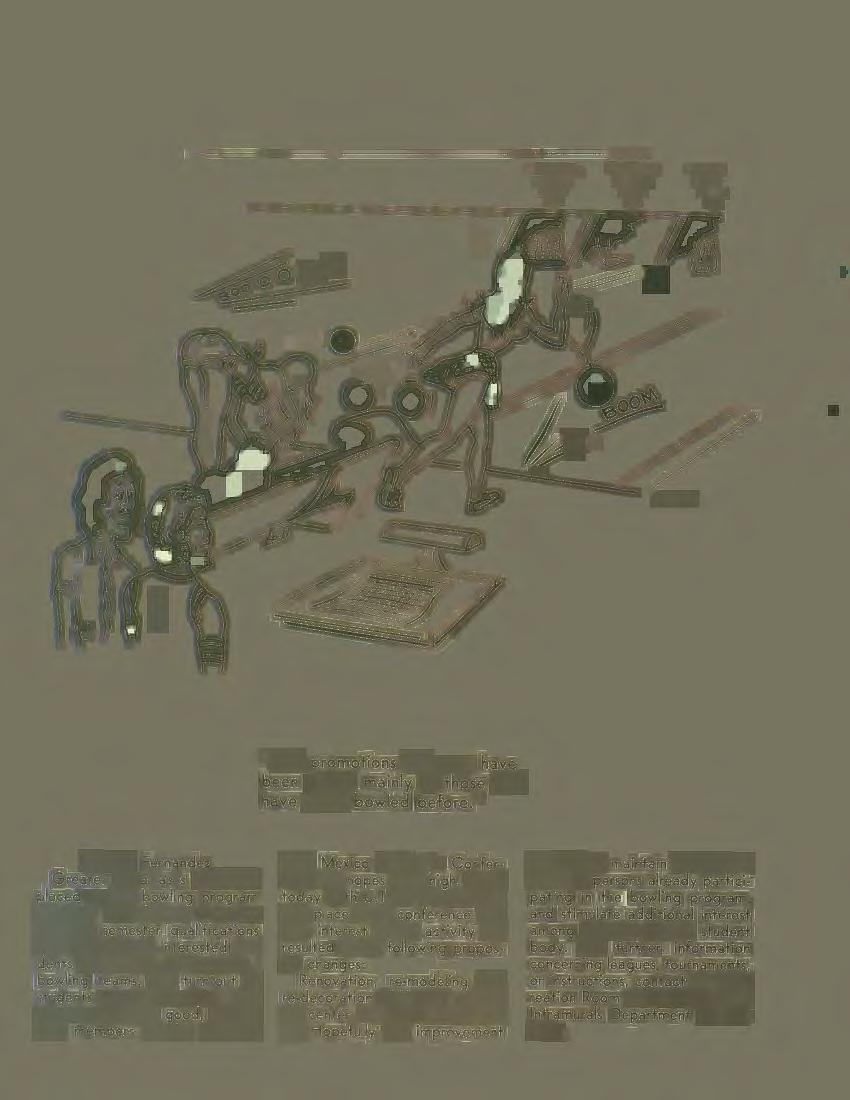
Greater emphasis has been placed on the bowling program this year , and there is a reason Last fall semester qualifications were held for all interested students for the men's and women's bowling teams. The turn-out of students was tremendous, the scores were very good, and as new members of the Western
"Our promotions this year have been aimed mainly at those who have never bowled before."
New Mexico Athletic Conference the hopes were high. As of today both U T.E.P. teams are in first place in the conference . The high interest in this activity has resulted in the following proposed changes: Renovation, re-modeling and re-decoration of U.T.E . P.' s bowling center. This soon will be reality. Hopefully , this improvement
will help to maintain the high interest of persons already participating in the bowling program, and stimulate additional interest among the rest of the student body. For further information concerning leagues, tournaments, or instructions, contact The Recreation Room at 747-5505 or the lntramurals Department at 7475103.