
UTC Art_Spring 26_Newsletter

Page 1


Dear Friends of the UTC Department of Art,

Welcome to the second issue of our Department of Art newsletter! I am excited to share stories of our community of students, faculty, and alumni.

In this issue, you’ll learn more about:

• The Art Collective, a dynamic student organization that fosters collaboration, creativity, and campus-wide engagement;

• Recent projects and accomplishments by our faculty and students. This includes Christina Vogel’s new body of work developed in the Bretske Hall painting studio and Lindsay Godin’s Photography I class project created in partnership with the Hunter Museum of American Art;

• Our faculty exhibition at the Institute of Contemporary Art, a showcase that celebrates the innovative research and studio practices of our professors;

• Changes to our programs, like the revision of the Design curriculum and the launch of our new BFA Studio sequence, designed to provide deeper support and interdisciplinary flexibility for our majors as they pursue their creative and professional goals;

• And an Alumni Highlight of Alea Coble (BA Studio Art, 2019) who recently defended their MA thesis as well as reflections from three Design alumni who continue to impact the UTC campus through their work.

Thank you for joining us in supporting the work and growth of our community by reading what we are up to. I hope you enjoy this issue and continue to stay connected with us as the Department of Art at UTC thrives.

Warmly,

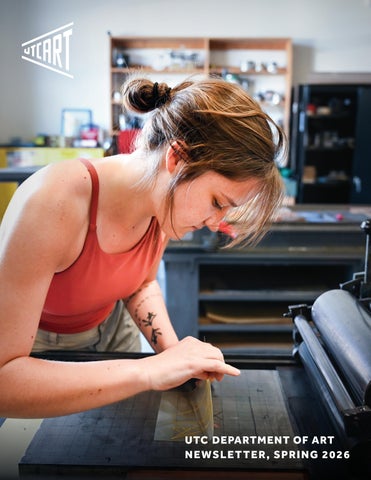
cover image: Annalise Bennett in Prof. Matt Greenwell’s Analog Design Studio. Photograph by Angela Foster.

Student Spotlight

The UTC Art Collective: Building Community Through Creativity at UTC

We get asked all the time by prospective students and students across campus if there are ways for non-art majors to get involved in the Department. The answer is yes! The Art Collective (TAC) is a student organization dedicated to fostering creativity across campus. The group provides opportunities to engage in activities such as artwork critiques, art-making workshops, and art markets. TAC connects students across our majors, offering a platform to showcase their work and develop skills outside of the classroom. The organization’s mission is to make art accessible, meaningful, and an integral part of campus life. Membership is open to all UTC students, with no required dues, reflecting the organization’s commitment to making art available to anyone with a creative spirit.

The organization is led by an executive board composed of Co-Presidents

Lauren Cheung (BA Studio Art) and Nik Hudson (BFA Painting and Drawing), Secretary John Montague (BFA Painting and Drawing), Public Relations Manager Millie Trammel (BFA Painting and Drawing) and Treasurer Crow Haworth (BFA Painting and Drawing). These students guide the club’s activities, ensuring that events and collaborations are managed effectively.

This year, TAC has planned a full calendar of activities. Highlights include a cyanotype workshop (fall semester), pop-up markets that showcase student makers (fall semester), and even curating an exhibition at the Honors College (this March). TAC also benefits from the support of faculty advisor Rowan Buffington, who serves as a resource and ensures alignment with UTC’s values. All funds raised by the organization are used to support programming and strengthen its role in the campus arts community. TAC welcomes students from every discipline to participate in the club and contribute to maintaining a vibrant creative culture at UTC.

THE ORGANIZATION’S MISSION IS TO MAKE ART ACCESSIBLE, MEANINGFUL, AND AN INTEGRAL PART OF CAMPUS LIFE.

H Students in a printmaking workshop hosted by the UTC Art Collective.

courtesy of the Art Collective.

Photograph

H G Students sharing the sun for a cyanotype workshop hosted by the UTC Art Collective. Photographs courtesy of the Art Collective.

Faculty Focus

University-supported Experiential Learning

Students enrolled in all sections of Photography I during Fall 2025 partnered with the Hunter Museum of American Art for a collaborative project that connected classroom learning with the local arts community.

Lindsay Godin, Lecturer of Photography and Media Art sought funding from the Office for Undergraduate Research and Creative Endeavor (URaCE) and the Walker Center for Teaching and Learning’s High-Impact Practices (HIP) Mini-Grant to engage students with selected works from the Hunter’s permanent collection and create original black and white analog photographs inspired by their chosen artwork. This project is a perfect fit for these grants, as URaCE expands undergraduate research opportunities for students across all disciplines and levels, fostering a culture of inquiry that connects UTC to Chattanooga and beyond. The Walker Center’s High-Impact Practice (HIP) grants similarly support active, hands-on learning strategies shown by the Association of American Colleges and Universities to boost student engagement and success.

The project began with a guided tour of the museum, where students explored a range of ten influential pieces. Using these as creative prompts, they produced individual photographs that reflected their interpretations and artistic responses.

The collaboration culminated in a public exhibition at the Apothecary Gallery (our student-facing galleries at the Carriage House), where students displayed their final prints, framed and matted alongside written exhibition label statements. The show highlighted both technical skill and thoughtful engagement with the museum’s collection.

Funding from the HIP Mini-Grant provided sustainable exhibition materials that will support future student showcases and photography events, such as UTC’s annual “Photo Night”, sponsored by the Department of Communication.

This partnership offered a valuable opportunity for students to connect with a professional art institution, gain exhibition experience, and contribute to UTC’s growing culture of creative collaboration.

H Students at the Hunter Museum of American Art for Prof. Lindsay Godin’s Photo I course. Photographs by Angela Foster.
F Students install and open their exhibition at the Apothecary Gallery. Photographs courtesy of Prof. Godin.

Taking Over the Studio

Last summer, our faculty and BFA Painting and Drawing / Sculpture studios underwent a major renovation when the 801 McCallie building received a new roof and updated systems. This project was a major undertaking of facilities, and we are grateful for the investment in the studio research of our faculty and students. While the project was happening over the summer to minimize impact to students, faculty developed creative ways to respond to the construction.

Painting and Drawing Professor Christina Vogel moved her studio temporarily from 801 McCallie to the Bretske Painting and Drawing classroom. Those of you who have studied here within the last decade know this room well. It has the best light on campus (perfect for painting!) and an excellent view of Chamberlain Plaza, making it a stop on any tour of the Department,

regardless of if you plan on studying in the Painting and Drawing program. With support in part from a Summer 2025 CAS Writing and Creating Retreat, Christina used the space as an opportunity to make two large paintings that responded to the studio itself, installing elaborate still life setups and painting from them. She describes this new work: “I have been making portraits and staged still lifes that mark time and reflect direct encounters within the site of the studio. They are paintings about painting, referencing not only the act of making but also my relationship to the rich history of the medium as I consider my place within its continuum. Through all my work, I prioritize slowing down and looking closely, considering the space between seeing and describing, interpretation and invention.”

She brought plants, books, fabrics, and personal items together with objects from the Breske still life closet to create dynamic compositions from which to paint. In addition to these two large pieces, she created numerous small paintings and hosted studio visits with other artists and arts professionals. These paintings will be included in an exhibition at the Wiregrass Museum of Art in Dothan, Alabama later this spring.

H Prof. Christina Vogel’s temporary studio in Bretske Hall. Photograph courtesy of Christina Vogel.

UTC Faculty Exhibition.
Photograph by Angela Foster.

Faculty Exhibition at the ICA

Our fall exhibition of faculty artwork at the ICA was an opportunity to connect students to the work of their professors. Faculty included in the Fall 2025 Faculty Exhibition included:

MARK BRADLEY-SHOUP

KATIE BROBST

ROWAN BUFFINGTON

BRETT CALLERO

CHELSEA COUCH

MATT GREENWELL

LINDSAY GODIN

KATIE HARGRAVE

AMBER HICKEY

MELISSA HOESMAN

BECKY NASADOWSKI

CARRIE PENDERGRASS

JÚLIA PONTÉS

BART PUSHAW

TED ROSS

HEATH SCHULTZ

ERICA SCOGGINS

ANGIE TO CHRISTINA VOGEL

SHANE WARD

New Initiatives

From Graphic Design to Design Research and Practice: Evolving How We Teach Design at UTC

This year, we are unveiling a number of significant evolutions in our curriculum. The first is a change in the BFA design concentration. Formerly known as Graphic Design, a name change to Design Research and Practice better reflects the program’s expanded vision of what it means to study and practice design in a contemporary context.

Many perceive graphic design programs as prioritizing vocational preparation, while UTC’s program positions design as both a strategy for communication and a tool for critical inquiry. Students in the program question how images and language function in culture, how design shapes (and is shaped by) society, and how thoughtful design contributes to meaningful change. Our philosophical and pedagogical approach to the curriculum mirrors the diverse ways designers engage with the world through research, theory, and experimentation. Recent curriculum revisions better support what our alumni say are the strengths of our program (see sidebar at right).

Aligning with other upper-division studio concentrations, the curriculum introduces a four-course Design Studio sequence (I through IV)— encouraging more open-ended experimentation without sacrificing

structure and continuity throughout the program. Courses like Survey of Design Practice and Politics and Ethics of Design deepen students’ understanding of the historical and theoretical contexts that inform design practice and study. A new course centered on building research skills in design will be introduced into the BFA sequence during the 2027–28 academic year. The program changes also provide greater flexibility for students to explore interdisciplinary studio research in other concentrations. We are excited to encourage cross-pollination of ideas and methods across the department, as the ability to work with a wide range of media as well as with interdisciplinary teams is increasingly a valuable skill for today’s designers.

Professors Matt Greenwell and Becky Nasadowski note: “Through an expansive view of design, our students develop a creative practice rooted in curiosity, reflexivity, and conviction.” By reframing design as a field of research, reflection, and cultural engagement, the program prepares students to adapt to an ever-changing creative landscape—encouraging them to think critically about the work that design does in the world.

“The support I was shown from the faculty and staff alike was instrumental in my personal artistic development. I was always encouraged, but not without appropriate and motivating criticism. We were in it together, a team just trying to find the best way to represent our visions through rigorous and thoughtful discussion.”

“UTC offered a unique educational balance, consisting of an openness [and] support towards experimentation and interdisciplinary practices, balanced with a solid understanding of contemporary professional norms and expectations. I felt this gave me an edge of being able to navigate fluidly throughout a broad range of design disciplines in both personal practice and professional settings.”

NOAH MARLOWE, BFA 2021

E Senior Design students critique Amber Bassford’s work during a spring 2025 studio. Photograph courtesy of Becky Nasadowski.

Studio BFA Sequence goes Interdisciplinary

We have also revised the Junior and Senior Studio sequence for three BFA concentrations: Photography and Media Art, Painting and Drawing, and Sculpture. Beginning Fall 2025, all students in these concentrations now enroll in shared studio courses each semester, fostering interdisciplinary collaboration and allowing students to work with a broader range of faculty and peers.

This new structure was successfully launched in Fall 2025 with faculty Christina Vogel (Painting and Drawing Professor), Phillip Lewis (Photography and Media Art Professor), and Shane Ward (Sculpture Assistant Professor).

In Spring 2026, the courses are being led by Júlia Pontés, Erica Scoggins, Shane Ward, and Lindsay Godin. Students will be able to meet as a large group with all juniors or all seniors together for shared critiques and studio visits, and students will have more voices to learn from than those in their concentration area. It is our hope that this interdisciplinary approach mirrors contemporary artistic practice. We’re excited about the creative exchange this model encourages and the expanded opportunities it brings to our BFA students.

G Fall 2025 and Spring 2026 interdisciplinary BFA studio faculty. Photograph by Katie Hargrave.

“Shane is a great instructor that provided fantastic feedback throughout the class. Shane has set us up for what the world has for us once we graduate. He’s encouraged us to submit to at least three things (open calls, residencies, grants, etc.) before the end of the semester. Along with providing us with a lot of professional resources like statements/CV workshops, his input on professional presentation has been super helpful.”

OLIVER ITO, BFA 2026

E Oliver Ito talks about their work in Prof. Shane Ward’s Senior Studio course. Photograph by Angela Foster

Alumni Features

From Classroom to Campus: UTC Design Graduates in Action

The Department of Art at UT Chattanooga is proud to see its Design alumni shaping the visual landscape of our campus in meaningful ways. From creative roles in university departments to impactful design projects that enrich student life, these former students are bringing their professional expertise back to the place where their artistic journeys began. Their presence on campus not only highlights the strength of UTC’s Design program but also serves as an inspiring reminder of how education and creativity can come full circle.

JESSICA LOWE

(CLASS OF 2016)

“As the senior graphic designer for UTC’s Advancement division, I support Alumni Affairs, Fundraising, Annual Giving, and Stewardship/Events through visual storytelling. I create pieces that help inspire donor contributions for scholarships, professorships, student success programs, and capital projects like the new College of Nursing building. Since I began in 2022, the work I’ve produced in collaboration with our team has helped generate over $100 million for UTC.

In this role, I have the opportunity to work across a wide range of media, from print and digital design

to photography and video. One day I may be designing a donor proposal booklet or campaign graphics, and the next I’m creating homecoming swag, t-shirt designs, or event materials. That range keeps the work creative, fast-paced, and meaningful.

UTC’s Art Department prepared me for this role by teaching me to think critically about design, communicate clearly, give and receive feedback, and how to work collaboratively. Opportunities provided by faculty led directly to my past and current design roles and helped shape my professional path. The Art Department is a special place. My advice to students is simple: enjoy your studio time, build your professional network, and say yes to opportunities like internships— you never know where they’ll lead.”

AMY DEVAN BARKER (CLASS OF 2017)

“I am the ‘Graphics Media Manager’ for the Division of Marketing and Communications on campus. A large part of my job is designing recruitment materials for each marketing cycle. The goal is to communicate our value as an institution to prospective students across the country and in our own city. Another aspect of my

E Jessica Lowe
Photograph by Angela Foster

role is evaluating designs from across campus to make sure they meet our general brand standard. I also collaborate with our video team to create animations, edit video, and make cuts for social media. My favorite project I’ve designed is the vinyl wraps on our four electric Mocs Express shuttles. Two of them feature a uniform stripe pattern and two have a more playful take on the stripes.

The main ways in which the BFA program equipped me for a career in design is through critical thinking and exploration. In the program, we spent more time thinking, researching, writing, reading, and talking than we did designing. The result? Independence. I left the program a baby designer— undeveloped, and full of potential. It was my choice to grow from there and I know I have. You can’t become better unless you want to be better. That’s the inspiration and the ability the BFA program gave me. I happen to be working in graphic design still, but these skills will serve me wherever I find myself.”

OMAR YASIN

(CLASS OF 2024)

“After earning my BFA in Design, I began working on freelance projects focused on website design and brand development. Shortly after, I joined the Gary W. Rollins College of Business as a Marketing and Communications Coordinator, where I help manage the college’s website, design print and digital materials, and assist in branding for five academic departments, seven centers, and more than ten student organizations.

One of my most impactful projects has been a total rebrand to ensure the college’s identity reflects its core values and aligns seamlessly with the university’s overall brand. As part of this initiative, I developed cohesive templates for all academic departments, created distinct branding systems for each of our centers, designed a brand guide to help student clubs and organizations maintain consistency across their communications, and introduced new merchandise to strengthen the college’s visual identity and connection with students.

This role has allowed me to merge creativity with strategy using design as a ‘second brain’ to build a unified brand system for a business college. In addition to design, I also manage the college’s social media presence, to help with engagement and strengthen relationships with students, alumni, and donors.

Pursuing this degree has positioned me on the right path toward my long-term goal of becoming a brand manager. Beyond my professional work, I continue to explore personal creative projects centered on cultural identity and Middle Eastern heritage, including my current study of Arabic typography, a fulfilling challenge.”

H Amy Devan Barker
Photograph by Angela Foster
E Omar Yasin Photograph by Angela Foster

Alea Coble Blends Art and Writing in their MA Thesis

The Department of Art proudly recognizes Alea Coble, an alum of BA Studio Art program (2019), who recently defended their Master’s thesis in Creative Writing titled You Have the Body: An Anti-Testimony. Their work bridges visual and literary rhetorical study through creative criticism. Drawing from their academic background, Alea’s studio practice includes zine making, photography, performance, and drawing as methodologies for activating cultural creative research beyond the academy to explore the political edges of bodily autonomy.

Alea’s thesis is composed of two parts: a craft essay titled “Shapes of Refusal: The Anti-Testimony and Realizing Hope through Form,” and a manuscript of hybrid poetic forms titled “You have the Body.” Through this project, they reimagine the idea of admissible evidence. They pivot from the lens of legal documentation to the emotional and embodied truths of survivors of sexual assault, whose voices are often constrained or erased by the US justice system. Alea examines how form, pattern, and re-orientation can create new possibilities for storytelling. Their concept of the “anti-testimony” proposes a new literary form that resists

H from top to bottom:

He Started Leaving Voicemails, 2024

alea iacta est vol 1, 2025

Alaina’s Collection, 2025

Photographs courtesy of Alea Coble.

the expectation for linear narrative and instead embraces fracture, opacity, and transformation as spaces for healing and resistance.

Alea’s creative practice reflects their engagement with both art and writing, where visual thinking and poetic language merge. Their continued exploration of zine culture and experimental form demonstrates how art-making can inform narrative innovation, offering readers new ways to encounter difficult truths. They also participate in zine making activities across campus, including in History professor Susan Eckelmann’s Zine festival which occurred in November.

ALEA’S PRACTICE REFLECTS WHERE VISUAL THINKING AND POETIC LANGUAGE MERGE.

A New VIP Group Coming Soon...

The Department of Art is working behind the scenes to create a new and exciting initiative that will strengthen the role of art, creativity, and visual culture at the University of Tennessee at Chattanooga and involve the community of alumni, supporters, and community members like you. We’ll be rolling this initiative out in the newsletter first, so spread the word for folks to update their information via alumni.utc.edu/update in order to receive information first. Expect to hear more soon!

Support UTC Art Students Through Giving!

Envision empowering the next generation of artists, innovators, and critical thinkers right here at the University of Tennessee at Chattanooga.

A contribution to the UTC Department of Art is more than a donation; it is a meaningful investment in creativity, opportunity, and student achievement.

The impact of your support:

• Advance artistic development. Contributions to the Friends of the Cress Gallery directly enable student exhibitions and public programming.

• Enhance experiential learning. Gifts to the Art Gift Fund support studio supplies, exhibition materials, and creative tools. Your generosity ensures students can explore, experiment, and excel.

Support UTC Art by visiting UTC’s secure giving portal.

give.utc.edu/art

Turn static files into dynamic content formats.
Create a flipbook