Wildfire and Water Security: Post-Fire Erosion and Sedimentation Threaten Utah’s Reservoirs Quinn Olpin1, Kendall Becker1,2, Scott Hotaling1,2, Aish Chandrasekaran3, Patrick Belmont2 1
Utah State University (USU) Climate Adaptation Intern Program 2 USU Department of Watershed Sciences 3 USU Department of Environment and Society
As an arid state with limited water, Utah relies heavily on reservoir storage to maintain its water supply throughout the year. This vital water storage, however, is increasingly at risk due to contemporary wildfires. Utah’s landscapes and rivers evolved with and benefit from natural wildfire. However, extensive fire suppression since the 1930s enabled human settlement to expand into fire-prone areas, and many dams and reservoirs were constructed during this period of unnaturally low fire risk (Murphy et al., 2018). Today, fuel buildup due to fire suppression and longer, hotter fire seasons due to climate change are stoking more severe wildfires despite continued suppression efforts (McGinty & McGinty, 2009). Wildfires pose a risk to water storage because after vegetation burns, erosion typically increases. Eroded soil can be carried by rivers and deposited into reservoirs where it accumulates as sediment, reduces water storage capacity, clogs dam outlets, and degrades water quality. In the United States, most reservoirs were not designed to accommodate large inflows of sediment. Thus, wildfires pose a growing challenge to water storage because they can substantially increase sedimentation rates. And, with longer, hotter fire seasons in the western United States and Utah, increased risk to reservoir storage from wildfires is expected in the coming decades. Here, we provide an overview of Utah’s water storage, the process of sedimentation in reservoirs after wildfire, and the ways Utah can manage these issues. 1
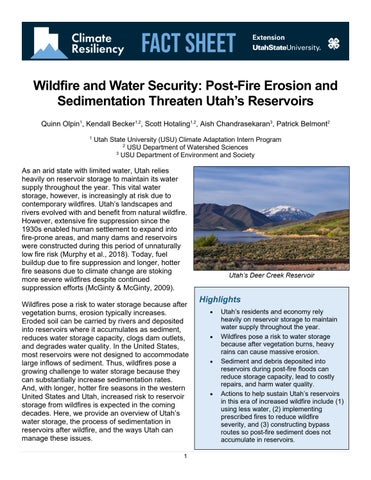
Utah’s Deer Creek Reservoir
Highlights •
•
•
•
Utah’s residents and economy rely heavily on reservoir storage to maintain water supply throughout the year. Wildfires pose a risk to water storage because after vegetation burns, heavy rains can cause massive erosion. Sediment and debris deposited into reservoirs during post-fire floods can reduce storage capacity, lead to costly repairs, and harm water quality. Actions to help sustain Utah’s reservoirs in this era of increased wildfire include (1) using less water, (2) implementing prescribed fires to reduce wildfire severity, and (3) constructing bypass routes so post-fire sediment does not accumulate in reservoirs.