What to Do Now That You’ve Trapped a Nuisance Wild Animal Cory Farnsworth and Nicki Frey, Ph.D.
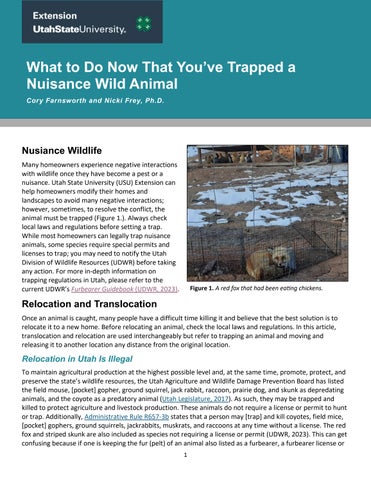
Nusiance Wildlife Many homeowners experience negative interactions with wildlife once they have become a pest or a nuisance. Utah State University (USU) Extension can help homeowners modify their homes and landscapes to avoid many negative interactions; however, sometimes, to resolve the conflict, the animal must be trapped (Figure 1.). Always check local laws and regulations before setting a trap. While most homeowners can legally trap nuisance animals, some species require special permits and licenses to trap; you may need to notify the Utah Division of Wildlife Resources (UDWR) before taking any action. For more in-depth information on trapping regulations in Utah, please refer to the current UDWR’s Furbearer Guidebook (UDWR, 2023).
Figure 1. A red fox that had been eating chickens.
Relocation and Translocation Once an animal is caught, many people have a difficult time killing it and believe that the best solution is to relocate it to a new home. Before relocating an animal, check the local laws and regulations. In this article, translocation and relocation are used interchangeably but refer to trapping an animal and moving and releasing it to another location any distance from the original location.
Relocation in Utah Is Illegal To maintain agricultural production at the highest possible level and, at the same time, promote, protect, and preserve the state’s wildlife resources, the Utah Agriculture and Wildlife Damage Prevention Board has listed the field mouse, [pocket] gopher, ground squirrel, jack rabbit, raccoon, prairie dog, and skunk as depredating animals, and the coyote as a predatory animal (Utah Legislature, 2017). As such, they may be trapped and killed to protect agriculture and livestock production. These animals do not require a license or permit to hunt or trap. Additionally, Administrative Rule R657-3b states that a person may [trap] and kill coyotes, field mice, [pocket] gophers, ground squirrels, jackrabbits, muskrats, and raccoons at any time without a license. The red fox and striped skunk are also included as species not requiring a license or permit (UDWR, 2023). This can get confusing because if one is keeping the fur (pelt) of an animal also listed as a furbearer, a furbearer license or 1