What Are Equine-Assisted Services? A Practical Guide for Families and Communities Makenna Pahlke, USU Extension Equine-Assisted Services
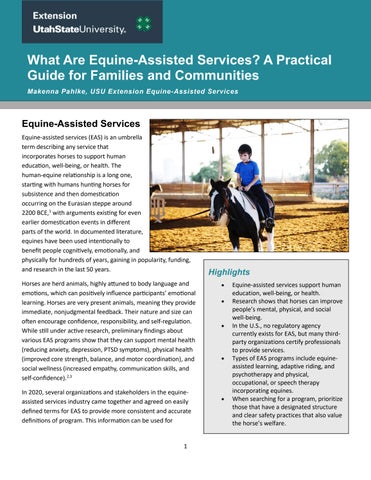
Equine-Assisted Services Equine-assisted services (EAS) is an umbrella term describing any service that incorporates horses to support human education, well-being, or health. The human-equine relationship is a long one, starting with humans hunting horses for subsistence and then domestication occurring on the Eurasian steppe around 2200 BCE,1 with arguments existing for even earlier domestication events in different parts of the world. In documented literature, equines have been used intentionally to benefit people cognitively, emotionally, and physically for hundreds of years, gaining in popularity, funding, and research in the last 50 years. Horses are herd animals, highly attuned to body language and emotions, which can positively influence participants’ emotional learning. Horses are very present animals, meaning they provide immediate, nonjudgmental feedback. Their nature and size can often encourage confidence, responsibility, and self-regulation. While still under active research, preliminary findings about various EAS programs show that they can support mental health (reducing anxiety, depression, PTSD symptoms), physical health (improved core strength, balance, and motor coordination), and social wellness (increased empathy, communication skills, and self-confidence).2,3 In 2020, several organizations and stakeholders in the equineassisted services industry came together and agreed on easily defined terms for EAS to provide more consistent and accurate definitions of program. This information can be used for 1
Highlights • •
•
•
•
Equine-assisted services support human education, well-being, or health. Research shows that horses can improve people’s mental, physical, and social well-being. In the U.S., no regulatory agency currently exists for EAS, but many thirdparty organizations certify professionals to provide services. Types of EAS programs include equineassisted learning, adaptive riding, and psychotherapy and physical, occupational, or speech therapy incorporating equines. When searching for a program, prioritize those that have a designated structure and clear safety practices that also value the horse’s welfare.