Utah Florist Preferences for Local Cut Flowers
Kynda Curtis, Professor & USU Extension Specialist, Department of Applied Economics
Melanie Stock, Assistant Professor & USU Extension Specialist, Department of Plants, Soils, and Climate
Cut Flower Production and Markets
Cut flower production is a small, rapidly growing, and dynamic industry in Utah. Other states are also experiencing tremendous growth and looking to Utah, particularly Utah State University (USU) Extension programs, to meet grower needs. Cut flower farms are primarily new businesses, often small urban farms. Others are adding cut flowers to diversify existing crops (alfalfa, fresh produce, etc.). The number of flower farms expanded from less than 20 in 2018 to just over 135 in 2022. The Utah Cut Flower Farm Association (UCFFA) started in 2019 and currently has 140 members. Last August, USU Extension and the UCFFA hosted the first annual Utah Flower Day at Wheeler Farm (Salt Lake City, Utah) with just over 500 attendees, demonstrating the substantial interest in local cut flower farming.
This industry is also important to the Utah economy. A study conducted in 2021 to measure the cut flower industry impact on the Utah economy (Ward & Stock, 2022) found that the average revenue per acre was $64,000, with a low of $7,000/acre and a high of $200,000/acre. This range in income correlated with the number of years in business. Through personal
communication, most farms report doubling their income each year in business. An economic model was used, Impact Analysis for Planning (IMPLAN), along with a conservative estimate of 25 acres of production across the state. The impacts assessed ranged between $3 million and $13.7 million in total output (sales); between $221,000 and $1.3 million in state tax revenue; and between $1.1 million and $5.8 million in labor income.
Most cut flower farms are run by women, often in their 30s, and new to farming, thus representing a new and underserved demographic in agriculture. Until recently, the average farm size was a quarter acre, but now closer to one-half acre, as 2022 saw much farm expansion. Cut flower farmers are highly entrepreneurial. They predominantly sell their products direct to consumers (farmer’s markets, CSAs/subscriptions, through Instagram, you-pick, etc.), wholesale to florists, and through events (arrangements for weddings, funerals, and other events). Farms also tend to offer educational experiences, such as classes on farming, floral arrangements, and agritourism-type events. As farms mature, they often move more into wholesale markets, which require high quality and large volumes.
1 June 2023 Applied Economics/2023-04pr
In 2022, an estimated 40 acres were devoted to cut flower production in Utah. While this amount of farmland is small compared to other crops, the net returns are far greater than any other crop in Utah, except cannabis, which only a few can grow. Growers currently market their flowers through several outlets and are generally on their own to find/develop markets for their products. Each market has different needs in terms of varieties, colors, quantities, delivery, pricing, etc., and the disadvantages and advantages of each are not yet well understood. Also, little is known about the willingness of florists and consumers to pay premiums for locally grown cut flowers, especially in the Intermountain West. This fact sheet provides crucial information on wholesale florist needs and preferences for local cut flowers. The information here will enhance the ability of current and potential cut flower growers to properly assess the profit potential of their decisions and assist with the long-term sustainability of their farming operations.
Overview of Florist Surveys
In the fall of 2021 and 2022, online surveys (via Qualtrics) of florists in Utah and surrounding communities were conducted by the UCFFA to better understand their needs, preferences, and hurdles to sourcing cut flowers locally. An email directory of florists was assembled based on internet searches for florist businesses across Utah and nearby communities. Survey questions (20 in 2021 and 24 in 2022) included:
• Florist business details (years in business, business location, primary products and markets, annual flower expenditures, etc.)
• Current usage of local flowers.
• Interest in sourcing flowers locally.
• Perceived barriers and hurdles to local sourcing.
• Flower variety, color, and delivery preferences.
• Quality and quantity needs.
• Willingness to pay prices above normal wholesale.
Additional questions regarding market capacity and seasonality needs were added in 2022. The survey
was tested with UCFFA member growers and florists before distribution to florists via email request.
The survey was completed by 42 florists in 2021 and 60 florists in 2022. In 2021, 44% of the respondent florists had been in business 5 years or fewer; this dropped to 28% in 2022. Their primary clientele were weddings and daily florals, with funerals coming in at a strong third. In 2021, 68% sourced their flowers through wholesale channels; this dropped to 66% in 2022. Also, local flower usage increased from 11% to 16% across the 2 years. In 2021, 71% felt their 2021 sales reached pre-pandemic levels (74% for 2022). The florists indicated that flower quality, flower selection, and delivery schedule were their primary challenges in sourcing from wholesale providers.
Florist Preferences for Local Cut Flowers
Table 1 provides an overview of 2021 and 2022 survey results for the local cut flower sourcing questions. Current cut flower sourcing increased between the 2021 and 2022 surveys. Florists sourcing more than 50% of their flowers from local growers increased from 9.1% to 16%. Those sourcing 11%–50% of their flowers locally increased from 41% to 42%. The number of growers florists sourced from increased. Those sourcing from more than 10 growers rose by 4%, and those sourcing from 6–10 growers rose by 14.5%.
2
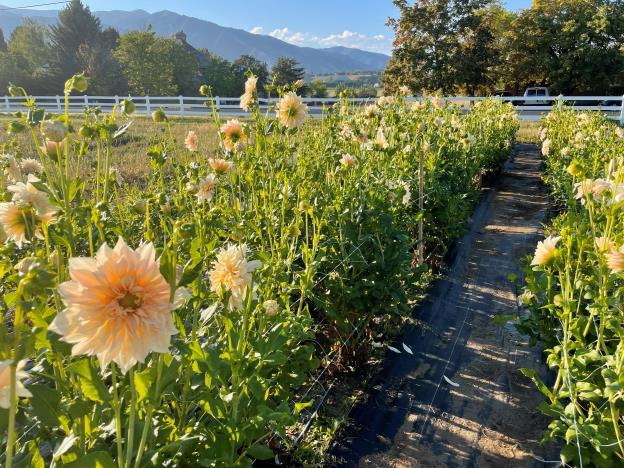
A field of local dahlias; ‘Café au Lait’ is pictured here.
Table 1.
Local Sourcing Statistics, 2021 and 2022 Florist Surveys
What percentage of the flowers you used this year were sourced from local growers?
What percentage of your flowers would you like to source locally next year?
If you sourced flowers locally this year, from approximately how many growers did you source?
What do you feel are the benefits of sourcing flowers locally?
Would you be willing to pay more for locally sourced cut flowers? If so, what percentage over wholesale pricing?
What barriers do you currently face in sourcing local flowers?
What is the minimum number of bunches per flower you need weekly from a local grower to meet your quantity goals?
Has the availability of local flowers benefited your floral business?
3
Question Response choice Difference 2022 (N = 60) 2021 (N = 42)
None 10% or less 11% to 25% 26% to 50% 51% to 75% More than 75% 2.49% -10.55% 9.90% -8.87% 3.51% 3.51% 16.13% 25.81% 25.81% 16.13% 8.06% 8.06% 13.64% 36.36% 15.91% 25.00% 4.55% 4.55%
None 10% or less 11% to 25% 26% to 50% 51% to 75% More than 75% 1.67% 2.08% 0.00% 2.92% -6.67% 0.00% 1.67% 8.33% 16.67% 30.00% 18.33% 25.00% 0.00% 6.25% 16.67% 27.08% 25.00% 25.00%
2 or less 3 to 5 6 to 10 More than 10 Cut flower coop -22.63% -7.42% 14.83% 4.35% NA 26.09% 41.30% 17.39% 4.35% 10.87% 48.72% 48.72% 2.56% 0.00% NA
Quality: vase life Quality: event-ready Unique selection Reliable supply Support local economy Sustainable production 1.12% 1.54% 1.73% -2.45% 1.12% -3.00% 21.74% 15.46% 20.29% 5.80% 21.74% 14.01% 20.62% 13.92% 18.56% 8.25% 20.62% 17.01%
No Less than 5% 6% to 10% 11% to 20% More than 40% -10.71% 4.76% 3.27% 3.62% -0.92% 23.33% 36.67% 26.67% 10.00% 3.34% 34.04% 31.91% 23.40% 6.38% 4.26%
Don’t know growers Communication time Pricing Lack of inventory Lack of types/varieties Delivery capabilities Other -1.59% -2.90% 0.10% 4.38% -2.15% 2.01% 0.14% 13.79% 11.72% 12.41% 22.07% 18.62% 15.86% 5.52% 15.38% 14.62% 12.31% 17.69% 20.77% 13.85% 5.38%
1 or less 2 to 5 6 to 10 11 to 15 16 to 20 21 to 30 More than 30 -12.21% 2.95% 13.30% -6.23% -1.26% 4.71% -2.07% 3.70% 37.04% 31.48% 7.41% 5.56% 9.26% 4.75% 15.91% 34.09% 18.18% 13.64% 6.82% 4.55% 6.82%
No Yes Unsure 5.66% -10.13% 4.47% 5.66% 67.92% 26.42% 0.00% 78.05% 21.95%
In the next year, 25% of florists indicated that they would like to source more than 75% of their flowers locally, and another 54% would like to source at least some of their flowers (less than 50%) from local growers. Overall, the number of florists willing to pay a premium for local flowers increased between 2021 and 2022 (those not willing decreased from 34% to 23%). The florists willing to pay premiums from 11%–20% increased from 6% to 10%. Flower quality in terms of vase life and unique selection were the primary reasons florists sourced locally. Lack of inventory (quantity) and lack of the varieties or flowers needed were the main hurdles florists noted in sourcing locally. However, the vast majority (68% in 2022 and 78% in 2021) of respondents felt that the availability of local flowers had benefited their business.

flowers annually, while 30% spent more than $60,000 annually. Figure 1 illustrates the flower types/varieties that florists would like to source locally. The larger words indicate higher preferences, with dahlia in greatest demand, and delphinium, garden roses, lisianthus, ranunculus, snapdragon, scabiosa, zinnia, and seasonal flowers (e.g., tulip, sunflowers) also in demand Figure 2 shows the flower colors that florists have difficulty finding wholesale, with blue, white, brown, coral, and gray the most difficult to find.

In 2022, additional survey questions found that florists (52%) would primarily need only one flower delivery a week, but 30% would likely need two deliveries weekly (see Table 2). Close to half of the florists would need flowers all year long, and another 43% would need them all summer long. A third of florists (32%) spent $30,000 or less on

4
Figure 2. Colors Difficult to Obtain Wholesale
Figure 1. Flower Types Needed
Lisianthus locally grown in a high tunnel (note pastel colors).
Florist Preferences, 2022 Florist Survey
How many flower deliveries would you need weekly from a local grower?
What time of year are you most likely to need cut flowers from a local grower?
What are your typical annual cut flower expenditures?
Table 3 shows the color trends expected by florists (i.e., the colors needed most), which include white and blush florals, followed by salmon, burgundy, peach/champagne, and pastel blues and lavenders. Colors trends change each year. The reduced emphasis on white and increased emphasis on gray in 2023 shown here illustrate trends Greenery can be expensive for florists to purchase from wholesale markets, and eucalyptus is in high demand. However, many indicated popular greenery options more readily grown in Utah, such as thornless raspberry or blackberry foliage, viburnum, honeysuckle, and ferns.

5
Table 2.
Question Response choice 2022 (N = 60)
1 or less 2 3 4 5 or more 51.72% 29.31% 12.07% 3.45% 3.45%
1 or 2 summer months All summer long All year long Other 3.45% 43.10% 48.28% 5.17%
Less than $10,000 $10,001 to $20,000 $20,001 to $30,000 $30,001 to $40,000 $40,001 to $50,000 $50,001 to $65,000 More than $65,000 10% 22% 14% 12% 4% 8% 30%
Figure 3. Next Year’s Color Trends (Number of Responses)
Conclusions
Cut flower production has been immensely profitable for small growers thus far. These growers can use small plots of land to turn a profitable business. The farms provide important and interesting work for growers and their families and assist in developing important connections and support networks for other cut flower farmers. In turn, their farms have increased family income, leading to improved quality of life and standard of living, which is especially important in rural areas. The income also leads to increased spending in the local area, which benefits their communities in terms of business expenditures, jobs, social services, etc. (Albrecht, 2014). As growers look to enter and expand their businesses, market information will be vital to their planning and long-term sustainability. It will be important to understand the needs, hurdles, and capacity of these markets to ensure continued profitability of Utah farmers, especially as the number of farmers and acres in cut flower production grows over time. The results discussed here show a strong and growing demand for local cut flowers in the Utah wholesale florist market.
References
Albrecht, D. (2014). Rethinking rural: Global community and economic development in the small town West. Washington State University Press.
Ward, R., & Stock, M. (2022). The value of cut flowers to Utah’s economy [Presentation] Utah State University Extension.
https://www.youtube.com/watch?v=iofT_OVfZIY&list=PLMnDQoXFVBEbhN_ZJ5fGZts81Dd2Xftjm&index=25.
Photo Credit
All photos were provided by the USU Small Farms Lab.
In its programs and activities, including in admissions and employment, Utah State University does not discriminate or tolerate discrimination, including harassment, based on race, color, religion, sex, national origin, age, genetic information, sexual orientation, gender identity or expression, disability, status as a protected veteran, or any other status protected by University policy, Title IX, or any other federal, state, or local law. Utah State University is an equal opportunity employer and does not discriminate or tolerate discrimination including harassment in employment including in hiring, promotion, transfer, or termination based on race, color, religion, sex, national origin, age, genetic information, sexual orientation, gender identity or expression, disability, status as a protected veteran, or any other status protected by University policy or any other federal, state, or local law. Utah State University does not discriminate in its housing offerings and will treat all persons fairly and equally without regard to race, color, religion, sex, familial status, disability, national origin, source of income, sexual orientation, or gender identity. Additionally, the University endeavors to provide reasonable accommodations when necessary and to ensure equal access to qualified persons with disabilities. The following individuals have been designated to handle inquiries regarding the application of Title IX and its implementing regulations and/or USU’s non-discrimination policies: Executive Director of the Office of Equity, Matt Pinner, JD, matthew.pinner@usu.edu, Title IX Coordinator, Hilary Renshaw, hilary.renshaw@usu.edu, Old Main Rm. 161, 435-7971266. For further information regarding non-discrimination, please visit equity.usu.edu, or contact: U.S. Department of Education, Office of Assistant Secretary for Civil Rights, 800-421-3481, ocr@ed.gov or U.S. Department of Education, Denver Regional Office, 303-844-5695 ocr.denver@ed.gov. Issued in furtherance of Cooperative Extension work, acts of May 8 and June 30, 1914, in cooperation with the U.S. Department of Agriculture, Kenneth L. White, Vice President for Extension and Agriculture, Utah State University.
June 2023
Utah State University Extension
Peer-Reviewed Fact Sheet
6
