Tube-Feeding a Calf Cheyenne Reid, Reganne Briggs, Melanie Heaton, Rebekah Esplin, and David Secrist
Why Tube-Feed? •
• •
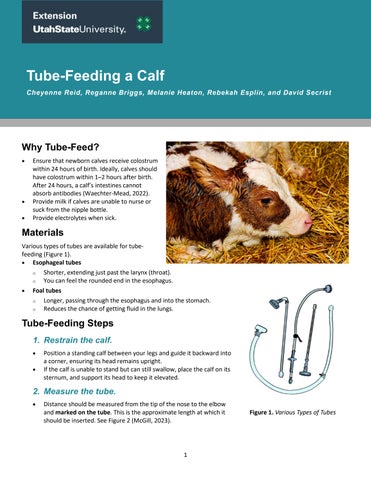
Ensure that newborn calves receive colostrum within 24 hours of birth. Ideally, calves should have colostrum within 1–2 hours after birth. After 24 hours, a calf’s intestines cannot absorb antibodies (Waechter-Mead, 2022). Provide milk if calves are unable to nurse or suck from the nipple bottle. Provide electrolytes when sick.
Materials Various types of tubes are available for tubefeeding (Figure 1). • Esophageal tubes o Shorter, extending just past the larynx (throat). o You can feel the rounded end in the esophagus. • Foal tubes o Longer, passing through the esophagus and into the stomach. o Reduces the chance of getting fluid in the lungs.
Tube-Feeding Steps 1. Restrain the calf. • •
Position a standing calf between your legs and guide it backward into a corner, ensuring its head remains upright. If the calf is unable to stand but can still swallow, place the calf on its sternum, and support its head to keep it elevated.
2. Measure the tube. •
Distance should be measured from the tip of the nose to the elbow and marked on the tube. This is the approximate length at which it should be inserted. See Figure 2 (McGill, 2023).
1
Figure 1. Various Types of Tubes