

Target Consumers for Locally Grown Fruit in Utah
Kynda Curtis, Professor and USU Extension Specialist, Department of Applied Economics
Makaylie Langford, USU Extension Intern, Department of Applied Economics
Tammy King, Program Assistant, Department of Applied Economics
Introduction
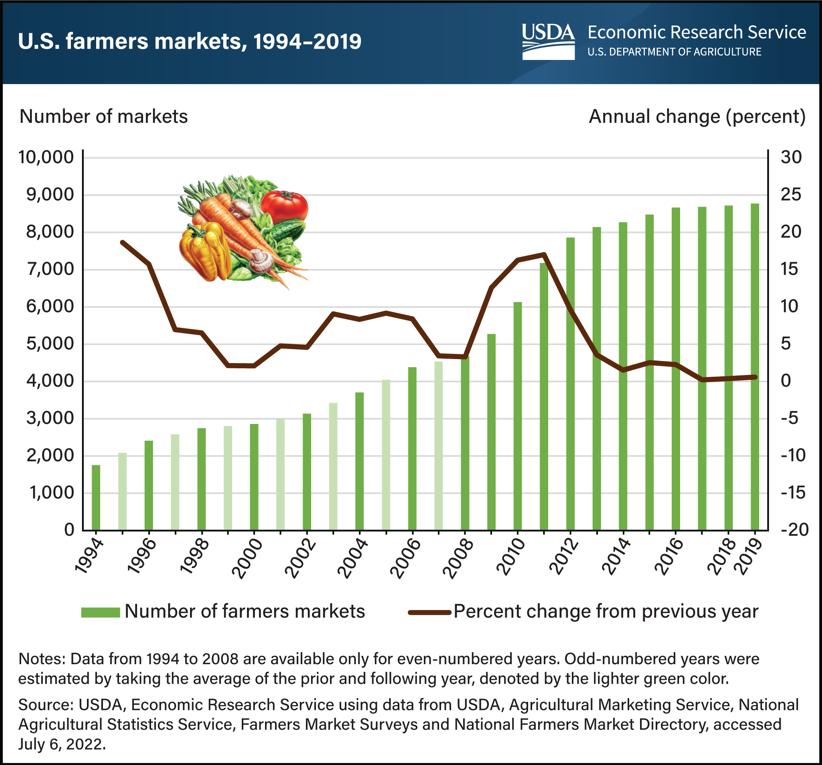
Consumer demand for locally grown foods, meaning foods produced in the state or within 400 miles (Agricultural Marketing Service [AMS], 2023), has increased dramatically over the last three decades. Consumer interest in local foods is well demonstrated by the large growth in the number of farmers markets in the U.S. (see Figure 1). Research shows that there are consumer groups (market segments) willing to pay premiums for locally grown foods, especially those carrying labels of assurance, such as “Utah’s Own,” “Nevada Grown,” etc. (Capelli et al., 2022). Consumer preferences for locally grown foods is often attributed to perceptions that local foods are fresher, more flavorful, and of higher quality, and purchasing local supports farmers and the community (Klavinski, 2013; McCurdy, 2022). Additionally, health and nutritional concerns support beliefs that locally grown produce, especially fruit, picked at peak ripeness, has higher concentrations of essential nutrients and vitamins.
Keys to Reaching Target Consumers
1. Emphasize health and quality. Highlight the health benefits, superior taste, and safety of local and specialty-labeled products.
2. Promote local and organic. Focus on organic and locally produced foods, stressing their positive impact on local farmers and communities.
3. Educate consumers. Provide information on labeling programs, nutritional facts, and ingredient lists, appealing to their tendency to review such details and educate themselves.
4. Provide convenient access. Ensure easy access to these products through farmers markets, local stores, and subscription services or community-supported agriculture (CSA) programs. These direct-to-consumer outlets also appeal to their sense of community and supporting farmers.
5. Market to young families. As this demographic was willing to pay more, tailor messages that resonate with this audience, including convenience, family health, and sustainability.
6. Emphasize lifestyle connection. Connect product benefits to their active, health-conscious lifestyles, emphasizing fresh, minimally processed foods without additives.


This fact sheet describes target consumers for locally grown fruits and fruit products in Utah. The data examined here comes from an online survey (via Qualtrics) of Utah consumers conducted in 2023 (Langford et al., 2024) To better understand consumers who value locally grown products, or those willing to pay premiums, study consumers were divided into three groups, including those with a high willingness to pay (WTP) for locally grown fruits, those with an average WTP, and finally those with a low WTP.
Here, we compare the high WTP group with the low WTP group, outlining the distinction between them in terms of their demographics, purchasing patterns and shopping habits, as well as their lifestyle and attitudes. Consumers in the high WTP group are willing to pay $6 or more for a 1-pound package of locally labeled (Utah’s Own) strawberries, a price twice the amount of a non-labeled package. Consumers in the low WTP group are those willing to pay $3 or less for the same package, or essentially no premium for the local product. Of the 384 Utah consumers who participated in the study, 116 fell in the high WTP group and 69 in the low WTP group.
Demographics
Demographic information was collected from all survey respondents. As shown in Table 1, consumers willing to pay premiums (high WTP group) tend to be younger, unmarried adults with children in the household. They are more likely to work full time, have a higher annual household income, and are highly educated. These results mirror studies documenting demographic groups that generally consume more fruits and vegetables (Langford & Curtis, 2024), specifically, smaller families, such as single parents with children, and those with high income and education levels. Often, parents are willing to pay more for fresh produce and healthy foods for their children, and those with higher income and educational levels are willing to pay more to improve their diet quality and overall health.
• Age: A larger proportion of the high WTP group is in the 18–54 age range, with a notable 43% between 35 and 54 years old. Only 17% of the high WTP group are over 55 years old, compared to 29% of the low WTP group.
• Marital status: The high WTP group is evenly split between married and single respondents but has significantly more single respondents than the low WTP group.
• Gender: The high WTP group has a higher percentage of males (34%) compared to the low WTP group (26%). However, females do make up 64% of the high WTP group, and thus, outnumber males.
• Children in household: The high WTP group is evenly split on children under 18 in the household or not, but 13% more of those in the high WTP group have children.
• Employment status: The high WTP group has 53% employed full-time and 14% part-time. The low WTP group has only 34% employed full-time, with 20% retired compared to 10% in the high WTP group.
• Education: The high WTP group has a higher proportion with graduate degrees (17%) and a significant number with a high school education (41%).
• Household income: The high WTP group generally has a higher annual income, as fewer respondents in this group have an annual income under $40,000.
Table 1. Respondent Demographics Characteristic
level
school graduate/GED
Employment status Retired
Annual household income (2022) Less than $39,999
$40,000 to $59,999
$60,000 to $79,999
$80,000 to $99,999
and more
Purchasing Patterns and Shopping Habits
While most respondents reported they were the primary grocery shopper (68%) for their household, there are several notable differences in purchasing patterns and shopping habits between the two groups (see Table 2).
Namely, the high WTP group purchases fruit more often from direct-to-consumer outlets such as farmers markets, purchases fruit more frequently, is less price-sensitive, and consumes foods with specialty labels more often. They are more familiar with food labeling programs and inspect food labels more often.
• Shopping locations: Grocery stores are the primary shopping location and the most popular location to purchase fresh fruit for both groups. More than half of the high WTP group also reported purchasing fresh fruit from farmers markets, farm stands or stores, and local

farms or orchards. In addition, the high WTP group purchased fruit directly from farmers more frequently than the low WTP group
• Frequency of purchase: Although at least 75% of the respondents reported eating apples, strawberries, and bananas regularly, the high WTP group purchases fresh fruits more frequently than the low WTP group.
• Purchase considerations: The high WTP group places more emphasis on product taste, freshness, and local origin, but less on price than the low WTP group. The high WTP group is also more likely to consider specialty characteristics, such as locally grown, organic, non-GMO, etc.
• Preferences for specialty labeled foods: The high WTP group consumes foods with specialty labels more frequently, with 48% reporting weekly consumption of specialty foods as compared to 42% in the low WTP group.
• Familiarity with labeling programs: The high WTP consumers are similarly more familiar with various labeling programs and review nutritional information and front labels more frequently.
• Local food perceptions: While perceptions of locally grown foods were similar between the two groups, the high WTP group felt that local products taste better, are safer, and purchasing locally supports farmers (see Table 2).
Table 2. Agreement With Statements About Local Products
Local products are fresher than non-local products.
Local products are safer than non-local products.
Local fruit tastes better than non-local fruit.
Local products are too expensive.
The selection of local fruit isn’t good 2.9 2.9
Local products are not important to me.
Note. The rating scale is 1 to 5, strongly disagree to strongly agree.
Lifestyle and Attitudes
Survey respondents were asked to rate their agreement with statements about their lifestyle and attitudes (see Table 3). Patterns were similar across both groups, but the high WTP group agreed more with all statements The statements with the largest difference between groups included food safety concerns, the importance of physical activity, and dietary and food preferences.
• Food safety concerns: The high WTP group is more concerned about food safety. The difference in the agreements ratings for this statement are the largest between the two groups. For the high WTP group, 76% agreed or strongly agreed they were concerned with food safety compared to 57% of the low WTP group.
• Physical activity: The high WTP group values physical activity more. For the high WTP group, 70% agreed or strongly agreed that exercise is an important part of their routine, compared to 54% of the low WTP group.
• Diet and food preferences: The high WTP group is more likely to follow a vegetarian or vegan diet, eat fresh produce daily, avoid processed foods and food additives, and are more likely to purchase food from local farmers. They also eat out more frequently at local sourcing restaurants and report slightly higher food allergies and restrictions.
• Participation in agritourism activities: Respondents were asked about their participation in farm-based or agritourism activities, and for every activity listed, a higher proportion of the high WTP group had participated in the activity than the low WTP group.
I follow a vegetarian or vegan diet.
I
I
I avoid eating food products with additives.
Physical activity/exercise is important
I grow/raise my own food.
I buy food from local farmers when available
I am concerned about food origin.

I am concerned about food safety 3.97
I eat out frequently.
I have food allergies/restrictions.
Note. The rating scale is 1 to 5, strongly disagree to strongly agree.
Conclusions
The target market (high WTP) for locally grown fruits in Utah includes younger consumers, especially those between 18 and 34 years of age, with children in their household. They are also highly educated, employed full-time, with a higher household income. Consumers who are willing to pay more for locally grown food (high WTP group) highly value product attributes, such as freshness, taste, and local origin. They are less pricesensitive (compared to the low WTP group) and prioritize the quality and community impact of local products in their purchasing decisions. They also value other specialty foods, such as organic and non-GMO foods and review product nutritional information more often. Marketing strategies should emphasize health benefits, local and organic attributes, and align with their active, health-conscious lifestyles
Acknowledgments
This material is based upon work that is supported by the National Institute of Food and Agriculture, U.S. Department of Agriculture, under award number 2020-38640-31523 through the Western Sustainable Agriculture Research and Education program under project number SW21-923. USDA is an equal opportunity
Table 3. Agreement With Statements About Consumer Lifestyle/Attitudes
employer and service provider. Any opinions, findings, conclusions, or recommendations expressed in this publication are those of the author(s) and do not necessarily reflect the view of the U.S. Department of Agriculture.
References
Agricultural Marketing Service (AMS). (2023). USDA local and regional food systems resource guide. U.S. Department of Agriculture (USDA). https://www.ams.usda.gov/sites/default/files/media/LocalandRegionalFoodSystemResourceGuide.pdf
Cappelli, L., D’Ascenzo, F., Ruggieri, R., & Gorelova, I. (2022). Is buying local food a sustainable practice? A scoping review of consumers’ preference for local food. Sustainability, 14(2), 772. https://doi.org/10.3390/su14020772
Klavinski, R. (2013, April 13). 7 benefits of eating local foods [Fact sheet]. Michigan State University Extension. https://www.canr.msu.edu/news/7_benefits_of_eating_local_foods
Langford, M., & Curtis, K. (2024). Fruit consumption indicators: Who consumes more fruit in Utah? [Fact sheet]. Utah State University (USU) Extension https://digitalcommons.usu.edu/extension_curall/2428/
Langford, M., Curtis, K., & Pignatari, M. (2024). Consumer perceptions and preferences for Utah fresh and packaged fruit [Fact sheet]. USU Extension https://digitalcommons.usu.edu/extension_curall/2426/
McCurdy, M. (2022, May 17). Health benefits of eating locally [Fact sheet]. University of New Hampshire Extension. https://extension.unh.edu/blog/2022/05/health-benefits-eating-locally
In its programs and activities, including in admissions and employment, Utah State University does not discriminate or tolerate discrimination, including harassment, based on race, color, religion, sex, national origin, age, genetic information, sexual orientation, gender identity or expression, disability, status as a protected veteran, or any other status protected by University policy, Title IX, or any other federal, state, or local law. Utah State University is an equal opportunity employer and does not discriminate or tolerate discrimination including harassment in employment including in hiring, promotion, transfer, or termination based on race, color, religion, sex, national origin, age, genetic information, sexual orientation, gender identity or expression, disability, status as a protected veteran, or any other status protected by University policy or any other federal, state, or local law. Utah State University does not discriminate in its housing offerings and will treat all persons fairly and equally without regard to race, color, religion, sex, familial status, disability, national origin, source of income, sexual orientation, or gender identity Additionally, the University endeavors to provide reasonable accommodations when necessary and to ensure equal access to qualified persons with disabilities. The following office has been designated to handle inquiries regarding the application of Title IX and its implementing regulations and/or USU’s non-discrimination policies: The Office of Equity in Distance Education, Room 400, Logan, Utah, titleix@usu.edu, 435-797-1266. For further information regarding non-discrimination, please visit equity.usu.edu, or contact: U.S. Department of Education, Office of Assistant Secretary for Civil Rights, 800-421-3481, ocr@ed.gov or U.S. Department of Education, Denver Regional Office, 303-844-5695 ocr.denver@ed.gov. Issued in furtherance of Cooperative Extension work, acts of May 8 and June 30, 1914, in cooperation with the U.S. Department of Agriculture, Kenneth L. White, Vice President for Extension and Agriculture, Utah State University.
September 2024
Utah State University Extension Peer-reviewed fact sheet