Sunflower Cut Flower Production in Utah Calee Garn, Alison Bingham, Melanie Stock, and Claudia Nischwitz
Overview
A good rule of thumb for growing cut flowers in Utah is, if you see it growing along the roadside as a weed, find its cousin, cultivate it, and sell it. Indeed, sunflowers are an excellent low-maintenance, high-return cut flower for Utah’s climate. The cultivars are categorized as either those that produce multiple, branching stems or a single stem, which are most common for cut flowers. New cultivars are released often, and blooms range in color from traditional orange to white petals with dark centers, burgundy, lemon yellow, and many more. This crop has lower water requirements than many other cut flowers and should be grown in full sun, making it an excellent, low-input crop in Utah. Sunflowers thrive in the field, and high tunnels may also be used for season extension. Onfarm trials showed that seedlings survive below freezing, with temperatures as low as 28 °F before frost damage occurred, making sunflowers a great candidate for Utah’s unpredictable springs.
Single Stem and Branching Types
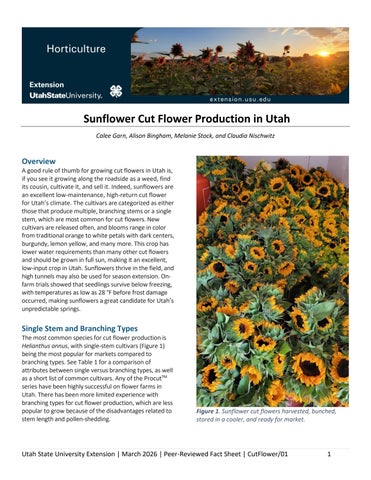
The most common species for cut flower production is Helianthus annus, with single-stem cultivars (Figure 1) being the most popular for markets compared to branching types. See Table 1 for a comparison of attributes between single versus branching types, as well as a short list of common cultivars. Any of the ProcutTM series have been highly successful on flower farms in Utah. There has been more limited experience with branching types for cut flower production, which are less popular to grow because of the disadvantages related to stem length and pollen-shedding.
Figure 1. Sunflower cut flowers harvested, bunched, stored in a cooler, and ready for market.
Utah State University Extension | March 2026 | Peer-Reviewed Fact Sheet | CutFlower/01
1