Utah IPM Program and Utah Plant Pest Diagnostic Laboratory
ENT-245-25PR
July 2025
Potential Impact of Dotted Paropsine Beetle and Other Leaf Beetles on Eucalyptus in Utah Marion Murray, IPM Specialist • Victoria Xiong, Horticulture Assistant Professor, Kane County • Megan Kast, IPM Associate
Quick Facts
• Dotted paropsine leaf beetle (DPLB) is an invasive eucalyptus pest native to Australia. Its first U.S. detection was in California in 2022. • DPLB feeds on several eucalyptus species, with blue gum as its primary host. • Feeding damage includes semicircular notches on leaf edges, defoliation of young leaves, and dieback of shoot tips. • DPLB poses a threat to eucalyptus plantings across the western U.S. and to cut foliage producers in Utah.
E
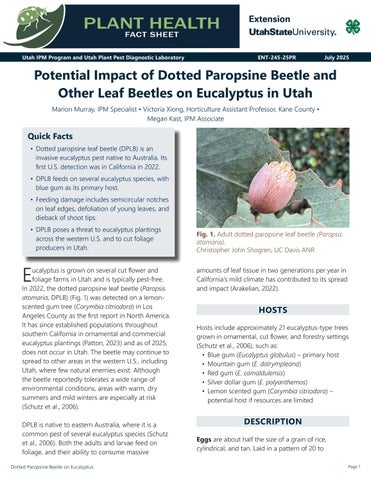
ucalyptus is grown on several cut flower and foliage farms in Utah and is typically pest-free. In 2022, the dotted paropsine leaf beetle (Paropsis atomaria, DPLB) (Fig. 1) was detected on a lemonscented gum tree (Corymbia citriodora) in Los Angeles County as the first report in North America. It has since established populations throughout southern California in ornamental and commercial eucalyptus plantings (Patton, 2023) and as of 2025, does not occur in Utah. The beetle may continue to spread to other areas in the western U.S., including Utah, where few natural enemies exist. Although the beetle reportedly tolerates a wide range of environmental conditions, areas with warm, dry summers and mild winters are especially at risk (Schutz et al., 2006). DPLB is native to eastern Australia, where it is a common pest of several eucalyptus species (Schutz et al., 2006). Both the adults and larvae feed on foliage, and their ability to consume massive Dotted Paropsine Beetle on Eucalyptus
Fig. 1. Adult dotted paropsine leaf beetle (Paropsis atomaria). Christopher John Shogren, UC Davis ANR amounts of leaf tissue in two generations per year in California’s mild climate has contributed to its spread and impact (Arakelian, 2022).
HOSTS Hosts include approximately 21 eucalyptus-type trees grown in ornamental, cut flower, and forestry settings (Schutz et al., 2006), such as: • Blue gum (Eucalyptus globulus) – primary host • Mountain gum (E. dalrympleana) • Red gum (E. camaldulensis) • Silver dollar gum (E. polyanthemos) • Lemon scented gum (Corymbia citriodora) – potential host if resources are limited
DESCRIPTION Eggs are about half the size of a grain of rice, cylindrical, and tan. Laid in a pattern of 20 to Page 1