Post-Wildfire Erosion and Sedimentation: An Escalating Threat for Utah’s Fisheries Colton James1, Kendall Becker1,2, Scott Hotaling1,2, Aish Chandrasekaran3, Alex Fielder3, Timothy E. Walsworth 2,4, Patrick Belmont2 1
Utah State University (USU) Climate Adaptation Intern Program 2 USU Department of Watershed Sciences 3 USU Department of Environment and Society 4 USU Ecology Center
Wildfires are a natural part of the western U.S. landscape and provide many benefits in terms of nutrient cycling and habitat rejuvenation. Utah’s fish populations evolved with wildfire as a common disturbance. However, the increasing size and severity of wildfires, combined with Utah’s heavily engineered and fragmented stream networks, pose a contemporary risk to fish populations. When wildfires are followed by heavy rainfall, soil erosion can deliver large amounts of sediment to streams and rivers. Fish living in affected watersheds, and especially those with barriers to migration, can face respiratory distress and loss of spawning habitat post-fire.
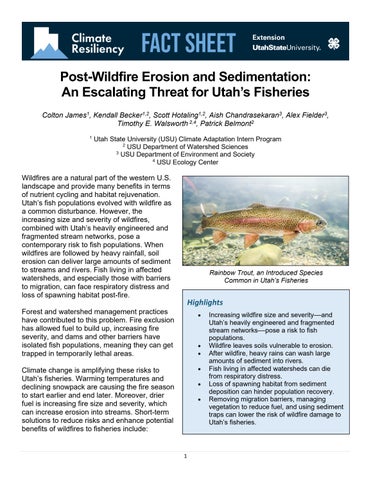
Rainbow Trout, an Introduced Species Common in Utah’s Fisheries
Highlights
Forest and watershed management practices have contributed to this problem. Fire exclusion has allowed fuel to build up, increasing fire severity, and dams and other barriers have isolated fish populations, meaning they can get trapped in temporarily lethal areas.
•
• • •
Climate change is amplifying these risks to Utah’s fisheries. Warming temperatures and declining snowpack are causing the fire season to start earlier and end later. Moreover, drier fuel is increasing fire size and severity, which can increase erosion into streams. Short-term solutions to reduce risks and enhance potential benefits of wildfires to fisheries include:
• •
1
Increasing wildfire size and severity––and Utah’s heavily engineered and fragmented stream networks––pose a risk to fish populations. Wildfire leaves soils vulnerable to erosion. After wildfire, heavy rains can wash large amounts of sediment into rivers. Fish living in affected watersheds can die from respiratory distress. Loss of spawning habitat from sediment deposition can hinder population recovery. Removing migration barriers, managing vegetation to reduce fuel, and using sediment traps can lower the risk of wildfire damage to Utah’s fisheries.