Geothermal Energy in Utah: Massive Potential to Meet Growing Electricity Needs Emily LaBonty1, Kendall Becker1,2, Logan Mitchell3, Jennifer Bodine3, Scott Hotaling1,2 Utah State University (USU) Climate Adaptation Intern Program 2 USU Department of Watershed Sciences 3 Utah Clean Energy
1
In 2024, Utah generated over 35 million megawatt-hours (MWh) of electricity with 78% of the state’s electricity mix coming from two fossil fuels: coal (45%) and natural gas (33%; U.S. Energy Information Administration [EIA], 2025a,b). Fossil fuels are useful because they are a readily dispatchable energy source, meaning they can be burned as needed and provide a reliable source of power to meet fluctuating customer demand (U.S. Department of Energy [DOE], 2019). However, generating electricity from fossil fuels contributes to climate change and local air pollution by emitting greenhouse gases— carbon dioxide and methane—as well as other pollutants (Ask MIT Climate, 2023; Spath & Mann, 2000; U.S. Environmental Protection Agency, 2023).
Highlights •
Geothermal energy, heat from within the Earth, is a renewable energy source that can provide flexible, baseload electricity––like coal or natural gas––but without the climate-warming and polluting effects.
•
Utah has an estimated 49,000 MW of geothermal energy potential, which, if fully developed, could generate about 390 million MWh of electricity each year, almost 12 times the electricity Utah consumed in 2023.
•
95% of Utah’s geothermal resources are accessible through enhanced geothermal systems (EGS), which fracture bedrock and pump water into the new pathways to bring heat to the surface.
An alternative, renewable energy source that can provide dispatchable energy but has few to no climate-warming and polluting impacts is geothermal energy, heat from within the Earth (U.S. DOE, 2019). The Earth’s internal heat is constantly available, so geothermal power plants can run on demand or continuously. This allows geothermal energy to provide operating characteristics similar to coal and gas with the potential to function as a primary source of dispatchable, baseload electricity (U.S. DOE, 2019).
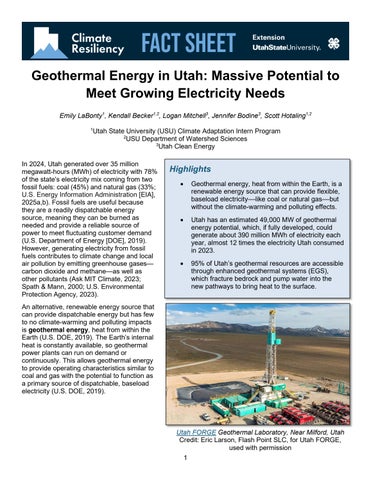
Utah FORGE Geothermal Laboratory, Near Milford, Utah Credit: Eric Larson, Flash Point SLC, for Utah FORGE, used with permission 1