EMERGENCY ACTION PLAN
HOME, FAMILY, PETS, and LIVESTOCK



This document is an emergency family action plan designed to help your entire household prepare for emergencies. It aligns with the Youth Emergency Preparedness and Animal Project Safety Program available through Utah State University (USU). It can be taught by FFA teachers, 4-H leaders, Extension faculty/staff, and afterschool program educators. The Emergency Action Plan is intended for youth to bring home, lead their families in completing the sections, and guide them in preparing for and practicing emergency preparedness.
Every person in the family is important and contributes to overall safety. While parents and guardians may focus on immediate needs during a crisis, youth can be important partners in safety when they know the plan. Assigning specific emergency roles and practicing them empowers young family members to step in and help.
Working together to fill out this plan, families create an important document that will help keep every family member, including animals and livestock, safe and secure. This plan helps you to consider essential “what-if” scenarios, such as:
• What if a family member is at work or school when an emergency happens?
• How would you evacuate pets or livestock safely?
By addressing these situations now, you will be better prepared to react quickly and safely later. Being prepared reduces stress and helps create better outcomes for everyone involved. Using the Emergency Action Plan for Family, Home, Livestock, and Pets will help to ensure your family, home, and animals are ready for emergencies. Families should regularly update the plan and practice using it together.
• Read together: Review the roles on the following pages as a family. Discuss what each role means and why it’s important.
• Assign roles: Assign a specific person to each role. You can also assign backup assignments in case someone isn’t home during an emergency.
• Practice: Walk through different emergency scenarios as a family, such as a fire, a flood, or a winter storm. Have each person perform their role during the practice drill. This helps you identify any weak points in your plan and ensures everyone is prepared to act when it matters most.
Name:
• Helps to gather important documents.
• Protects documents during an evacuation.
small livestock and pets)
Name:
• Knows where the animal go-bag is stored.
• Makes sure the go-bag is stocked.
• Helps to secure and comfort animals during an emergency. Prepares animals for evacuation if needed.
Name:
• Manages human and animal supply kits.
• Creates an inventory list and manages inventory.
• Ensures items such as food, water, and first aid supplies are not expired.
Name:
• Knows the Emergency Action Plan’s location.
• Grabs the Emergency Action Plan during evacuation.
• Is the main point of contact for family members.
• Ensures everyone arrives at the meeting places.
(for large livestock)
Name:
• Ensures that necessary transportation is available. Knows how to access trailers, trucks, and crates needed for livestock.
• Prepares the animals for transport.
Name:
• Manages the emergency map and keeps it updated. Knows and understands the map.
• Can locate shut-off valves. Knows the location of important items on map.
Name:
• Listens for weather alerts.
• Makes sure the weather alert radio has working batteries.
• Watches the weather alert apps for news.
Name:
• Secures the home physically before evacuation.
• Secures all doors, windows, and gates.
• Secures all animal pens, coops, and gates if needed.
Name:
• Is responsible for ensuring a clean water supply for humans and animals.
• Knows where the backup water is stored.
• Manages hygiene items and waste disposal.
Name:
• Ensures there is feed available for livestock and pets. This includes on-site or at an evacuation site.
• Ensures that the feed is protected from elements and pests.
• As a family, review the checklist together.
• Check off items you already have.
• Circle what needs to be gathered or purchased.
• Find a location to store your “go-bags” and other essential emergency items.
Food storage for 7 days for each person.
One gallon of water a day per person for 7 days.
Supplies for food preparation: manual can opener, pocket knife or small knife, mess kit per person, or plastic utensils, paper plates, and paper towels.
National Oceanic and Atmospheric Administration (NOAA) weather alert radio, weather, and emergency apps.
Flashlight with batteries or solar lights.
First aid kit and first aid instruction manual.
Dust mask or respirator, one per person.
Sanitation and hygiene items for family: antibacterial wipes, hand sanitizer or soap, garbage bags with plastic ties, feminine items, toothbrushes, toothpaste, and deodorant.
Wrench or pliers for utility shutoff.
Backup battery pack for charging cell phones or a solar panel, with attachments for charging cell phones or a battery pack.
Emergency cash supply.
Important documentation.
Fire extinguishers for homes, vehicles, and outbuildings.
Sandbags and plastic sheeting for flooding.
Infant supplies.
Blanket or sleeping bag per person.
Prescription and nonprescription medication.
Small activities for children, such as games, paper, and pencils.
48-hour emergency evacuation go-bags for each member of the household.
Change of clothes and shoes.
• As a family, review the checklist together.
• Check off items you already have.
• Circle what needs to be gathered or purchased.
• Find a location to store your “go-bags” and other essential emergency items.
Important documents: vet records and vaccination records.
Prescription and nonprescription medications that are needed for pets and livestock.
First aid kit for animals and first aid instruction manual.
Feed for 7 days.
Feeding items needed: feed scoops, feeders, feed pans or bowls, and buckets.
48-hour emergency evacuation go-bags or totes for pets & livestock.
Sanitation supplies: garbage bags, buckets, shovels, bedding, puppy pad liners, disinfectant.
Equipment to move pets and livestock safely.
Weather-proof “In Case of Emergency” signs for pens and gates with contact information.
Emergency Action Plan with information on pets and livestock, completed with information on identification, supply, and equipment inventory, and feed requirements.
Family Member Name:
Home/School/Work: Address:
Work Contact #:
Cell Contact #: Birthdate:
Family Member Name: Home/School/Work: Address:
Work Contact #:
Cell Contact #:
Birthdate:
Family Member Name:
Home/School/Work: Address:
Work Contact #:
Cell Contact #: Birthdate:
Family Member Name: Home/School/Work: Address:
Work Contact #:
Cell Contact #: Birthdate:
Family Member Name: Home/School/Work: Address:
Work Contact #: Cell Contact #: Birthdate:
Family Member Name: Home/School/Work: Address:
Work Contact #:
Cell Contact #: Birthdate:
Family Member Name: Home/School/Work: Address:
Work Contact #: Cell Contact #: Birthdate:
Family Member Name: Home/School/Work: Address:
Work Contact #:
Cell Contact #: Birthdate:
• Fill in all your local emergency contacts.
• Use the blank boxes for any other emergency contact relevant to you area and situation.
Organization Name
Lost and Found Animal Facebook Page
Local Lost and Found Animal Website
Faith-Based Organization Emergency Contact
Local Hospital
Local Clinic/Doctor’s Office
Local Urgent Care Clinic
Veterinarian
Veterinarian Urgent Care Clinic
Contact
Plumbing/Heater Technician
Out-of-Town Contact
Friend/Neighbor
Family
This is a structured plan designed to ensure all family members can check in and share status updates during an emergency efficiently.
• Appoint the communications captain as the primary contact, who then contacts the next row on the communication tree and so on.
• Ensure all family members are included and any other essential contacts.
• Fill out the tree and practice before an emergency.
Communications Captain:
• Record a primary meeting place, both local and out-of-town, where every family member can meet in case of separation or evacuation.
• If you have livestock, make prior arrangements with an alternate landowner or facility for an emergency evacuation location, and record those details below.
Neighborhood Meeting Place Out-of-Town Meeting Place
Address: Contact #:
Address: Contact #:
Emergency Livestock Evacuation Meeting Place
Address or GPS Location:
Name of Landowner:
Landowner Contact #:
• Use this section to record the primary and any secondary locations where your livestock or large animals are housed.
• Note any special instructions needed for responders to safely access or handle the animals.
Location Type (check one): Home Property Boarding Facility
Address or GPS Coordinates:
Instructions for Access/Locating:
Instructions for Animal Handling:
Secondary/Alternate Livestock Location
Location Type (check one): Home Property Boarding Facility
Address or GPS Coordinates:
Instructions for Access/Locating:
Instructions for Animal Handling:
• Record any medical needs for people in your household.
• This chart will be used to make sure all supplies and medications can be gathered, and any emergency responders can be informed if necessary.
• Maintain a current record of all pet and livestock medications, medical needs, and special care requirements.
• This record can help anyone care for your animals in an emergency
Fill in the charts so your family or others know how to care for your pets or livestock in case of emergency.
Animal Identification and Identifiers
(tag/collar ID/name or microchip)
Name of Feed Instructions for Feeding
Fill in the charts so that everyone can identify, count, and find all your pets and livestock in an emergency.
Animal Identification
Type of Animal Location of Animal
Attach or insert pet or livestock photos in the boxes below, with appropriate identifiers listed on the line below the box.
• Use this to keep an inventory of tools, carriers, trailers, fencing, etc., for emergency resources.
• Know where and how much equipment is available to help take care of your family and animals in an emergency.
• Use the blank boxes for anything already not listed that you might need or have.
Equipment Available How Many Available Location Stored
Portable Water Tanks/Storage Containers
Generators
Small Livestock Carriers
Pet Carriers
Water Buckets
Feeders or Food
Dishes
Feed Storage Containers
Waste Disposal
• Step 1: Draw the layout. Start by drawing a simple map of your house, yard, and where your animals live.
• Step 2: Mark the essentials. Now, use symbols or different colors to mark the following important spots on your map.
▪ Emergency supplies: the location of the human and animal first aid kits.
▪ Go-bags: where the family’s “evacuation kit” (go-bags) for humans and animals is stored.
▪ Fire extinguishers: mark the spots where fire extinguishers are located.
▪ Utilities: the main shut-off valves for water, gas, and electricity.
▪ Animal shelters: the exact location of all animal pens, coops, or shelters.
▪ Water source: the location of the main water supply for the animals.
▪ Chemical, gas, or propane storage: mark where any flammable materials are stored
• Step 3: Show the exit routes. Use arrows to show the best ways to get out of the house and yard. Draw a line from the house to your outside meeting spot.
• Step 4: Mark the meeting places. Mark the location of your family’s designated emergency meeting places, both a close one (like a neighbor’s yard) and a distant one (like a local park).
• Step 5: Repeat layout for livestock. Draw a map of the area where livestock are kept, if separate from a residential dwelling.
• Step 6: Keep it safe! Keep this emergency plan in a well-known and safe area in the house.
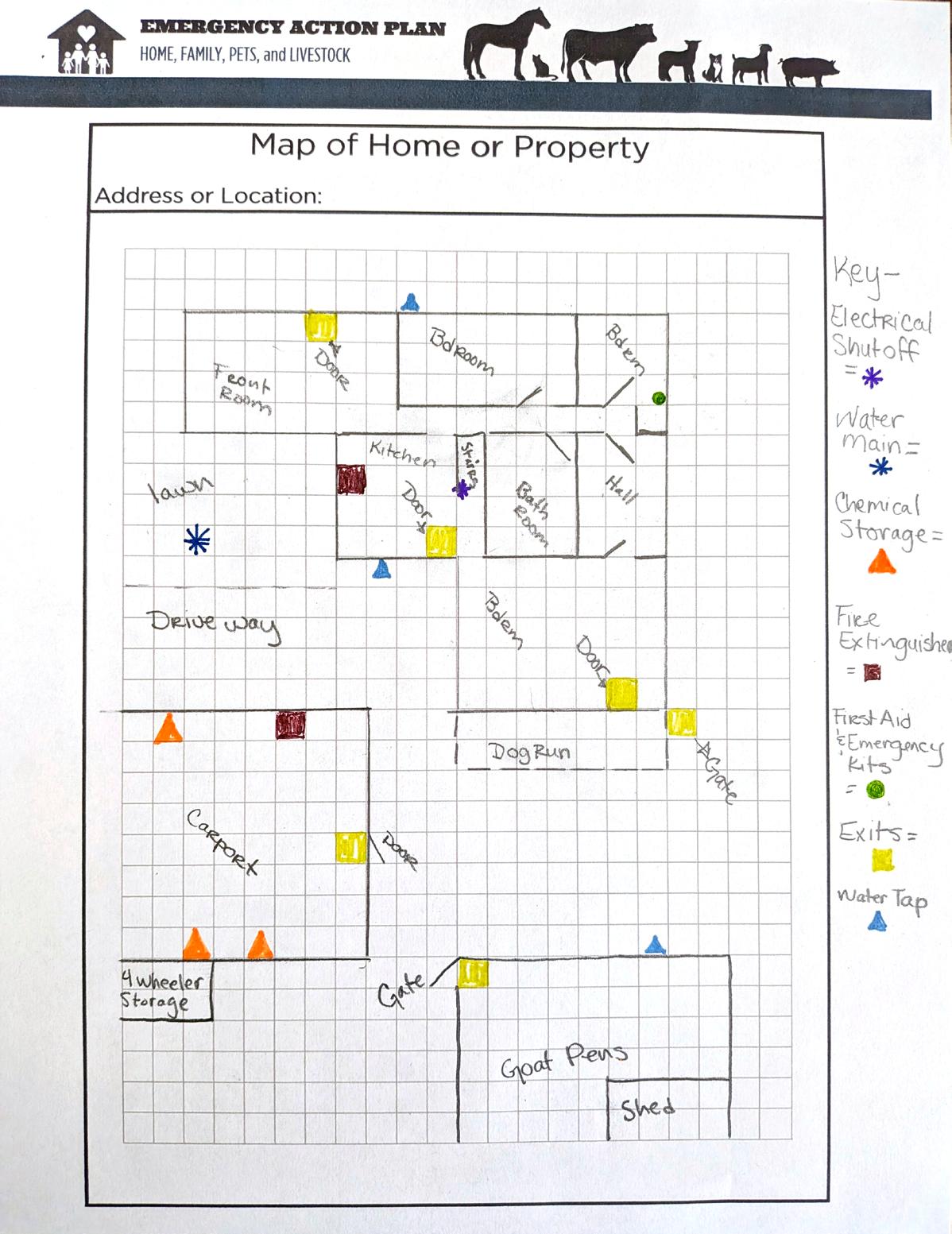

Address or Location:
Address or Location:
• Practice mock disaster drills, write down when you practiced, what you practiced, how it went, and what can be improved.
• Document the results and what should be updated and revised.
Date of Practice
Type of Emergency Practice What Went Well Needed Improvements or Updates
• Be Ready Utah (https://www.ready.gov/kit)
• Centers for Disease Control (CDC) (https://www.cdc.gov/healthy-pets/emergency-preparedness/ index.html)
• Northeast Veterinary Clinic (https://nevc.com/patient-education/keep-them-safe/large-animalsand-livestock-in-disasters/)
• Ready.gov (https://www.ready.gov/pets)
Centers for Disease Control and Prevention. (2024, April 9). Build a pet disaster preparedness kit. Healthy Pets, Healthy People. Retrieved September 9, 2025, from https://www.cdc.gov/healthypets/emergency-preparedness/preparedness-kit.html
Federal Emergency Management Agency. (n.d.). Build a kit. Ready.gov. Retrieved September 9, 2025, from https://www.ready.gov/kit
Northeast Veterinary Clinic. (n.d.). Large animals and livestock in disasters. Retrieved September 9, 2025, from https://nevc.com/patient-education/keep-them-safe/large-animals-and-livestock-indisasters/
Oregon Department of Agriculture. (n.d.). Create an emergency plan for your animals. Retrieved September 9, 2025, from https://www.oregon.gov/oda/animal-health-feeds-livestock-id/ emergency-preparedness/disaster-preparedness-animal-owners/Pages/Emergency-Plan.aspx
The authors did not use generative AI in creating this content, and it is solely the work of the authors.
This educational material was supported by the High Plains Intermountain Center for Agricultural Health and Safety, Centers for Disease Control and Prevention/National Institute for Occupational Safety and Health (CDC/NIOSH) Grant No. U54OH008085. Its content is solely the responsibility of the authors and does not necessarily represent the official views of CDC/NIOSH, Utah State Extension, or the Utah Agricultural Experiment Station.
Kristin Black
Farm Safety Project Assistant
Michael Pate
Applied Sciences, Technology, & Education (ASTE)
Professor | Agricultural Systems Technology, Agricultural Safety and Health
Callie Adams
Home and Community Department
USU Extension Associate Professor | 4-H Youth Development | Home and Community | Garfield County
In its programs and activities, including in admissions and employment, Utah State University does not discriminate or tolerate discrimination, including harassment, based on race, color, religion, sex, national origin, age, genetic information, sexual orientation, gender identity or expression, disability, status as a protected veteran, or any other status protected by University policy, Title IX, or any other federal, state, or local law. Utah State University is an equal opportunity employer and does not discriminate or tolerate discrimination including harassment in employment including in hiring, promotion, transfer, or termination based on race, color, religion, sex, national origin, age, genetic information, sexual orientation, gender identity or expression, disability, status as a protected veteran, or any other status protected by University policy or any other federal, state, or local law. Utah State University does not discriminate in its housing offerings and will treat all persons fairly and equally without regard to race, color, religion, sex, familial status, disability, national origin, source of income, sexual orientation, or gender identity. Additionally, the University endeavors to provide reasonable accommodations when necessary and to ensure equal access to qualified persons with disabilities. The following office has been designated to handle inquiries regarding the application of Title IX and its implementing regulations and/or USU’s non-discrimination policies: The Office of Equity in Distance Education, Room 400, Logan, Utah, titleix@usu.edu, 435-797-1266. For further information regarding non-discrimination, please visit equity.usu.edu, or contact: U.S. Department of Education, Office of Assistant Secretary for Civil Rights, 800-421-3481, ocr@ed.gov or U.S. Department of Education, Denver Regional Office, 303-844-5695 ocr.denver@ed.gov. Issued in furtherance of Cooperative Extension work, acts of May 8 and June 30, 1914, in cooperation with the U.S. Department of Agriculture, Justen Smith, Interim Vice President for Extension, Utah State University.