


Daniel Findlay, Rita Hagevik, and Kathy Cabe Trundle
In the United States, many houses have roofs that allow water to flow down the sides, being directed into a rain gutter and then a downspout. Traditionally, this water is dumped into the ground, a ditch, or the street as it flows back into the ground or into a sewer system. By attaching a rain barrel to the downspout, the rain that falls on the roof is instead collected, allowing for local water use and preventing flooding or runoff pollution. Once the water is collected in the barrel, gravity or a small pump is used to disperse the water into another container like a watering can or a sprinkler or watering system. Uses for the water are near limitless. It can be used to nurture plants and animals, but it is not potable, and you should not drink it.
• Only 1% of water on earth is drinkable.
• Ten countries share 60% of the world’s renewable water resources.
• Of treated water in U.S. houses, 70% is also being used outdoors.
• Collecting water reduces stress on local water treatment facilities.
• Less than 1/8 inch of rainwater on a roof can fill a 60-gallon rain barrel.
• Sixty gallons of rainwater can cover about 100 square feet of soil with 1 inch of water.
• About 40% of domestic water is used outdoors.
• A rain barrel can provide approximately 1,700 gallons of water for use per year.
• Plants prefer unchlorinated water, so rainwater is better for plants.
• There are many ways to collect rainwater, but using a rain barrel is one of the easiest.
Consider the following:
• Which downspout do you want to connect to the barrel?
• How high will it be off the ground?
• How can I keep it from leaking?
o Choose which port you want to use for the spigot. The lower port is best used with a garden hose, and the upper port is better for use with a watering can.
o Attach the spigot to the rain barrel. Place one of the washers on the end of the spigot and slide the spigot into the hole. Reach into the barrel and place the second washer over the threaded end. Thread the nut on the end of the spigot hand tight.
o Take the black L-shaped elbow (overflow fitting) and screw it into the pre-threaded hole on the top right-hand side of the barrel.
o Remove the elbow and runoff pipe from the end of the downspout. If you are using a Save the Rain Diverterë , follow the directions regarding the diverter.
o Draw a line on the downspout 9 inches above the top of the barrel.
o Move the barrel away, and then use a saw and cut the downspout at the line.
o Squeeze or crimp the downspout end so the elbow will fit over it.
o Attach the elbow to the downspout and move the barrel back against the house so that the end of the elbow is over the center of the lid.
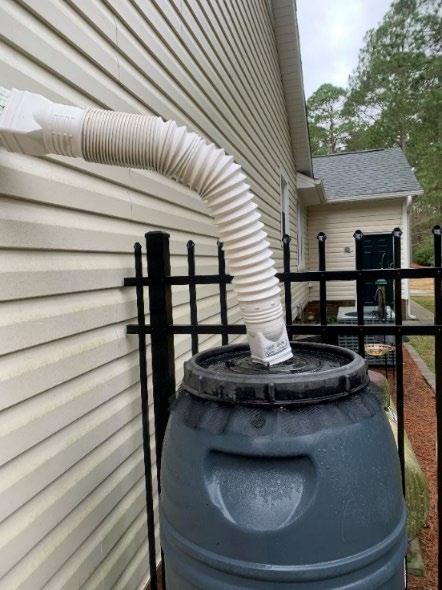
o Optionally, use flexible gutter material and waterproof sealer to direct the water into the barrel.
o Rainwater will now flow out of the elbow and down onto the cover of your rain barrel and drain into the barrel.

To install the diverter, use either a hacksaw or metal scissors to cut a 9-inch section out of your downspout, with the lower cut being 2 inches above the top of your barrel. Replace the section with the diverter. Use the tabs on each to hold the diverter in place. The downspout fits into the top end of the diverter, and the bottom end of the diverter fits inside the lower section of the downspout. Use needle nose pliers to crimp the downspout to fit if necessary.
It may seem that the obvious place to put the spigot is at the bottom of the barrel. However, this may not be the best. You cannot place a watering can beneath unless you raise the barrel off the ground with blocks The lower spigot works well with a short hose because barrels are gravity-fed. A barrel with a higher spigot allows you to use it with a watering can. When the water falls below the lower spigot level, you can remove the lid and dunk the watering can inside the barrel to access the water.
Make sure the overflow pipe in your water barrel is pointed away from a building’s foundation. Attach a ¾ inch inner diameter flex tube or hose to direct water away from your foundation.
The easiest way to place the spigot is to lay the barrel on its side on a table or bench to get it closer to waist height. It is ideal to have a helper. Place the spigot and one washer on the port and push the neck into the hole. Ask your helper to hold the spigot in place as you reach into the barrel and put the washer and nut onto the neck and hand tighten. If you do not have a helper, turn the barrel so the spigot is face down on the table this; will hold it in place while you reach in and tighten washer and nut onto the spigot neck.
If you would like you can link water barrels to increase holding capacity using a piece of ¾-inch hose. Unscrew the upper plug (on the second barrel) and replace it with a second elbow. Attach one end of your hose to the overflow fitting (on barrel one), then attach the other end to the new elbow on the second barrel. Attach your overflow hose to the second elbow (on barrel two). Keeping barrels close together will give the best results.
• Clean barrels at least once a year to stop clogs, debris, sediment, and algal growth from building up.
• Use a mesh screen over any openings in the barrel to prevent infestation and to keep out debris.
• Make sure to store the rain barrel in winter if you have belowfreezing conditions, as ice may damage the plastic and cause it to split and leak.
• Rain barrels installed on blocks can provide height for gravity flow purposes. Remember that water is heavy, and filled rain barrels can weigh around 500 pounds, so provide a sturdy foundation.

• To prevent insects from seeping into the barrel, drape a Teflon window screen over the barrel before screwing on the lid.
• If odor or insects become an issue, Clorox may be used to help. Use approximately ¼ cup to harmlessly disinfect the water of a full rain barrel (55 to 60 gallons).
• Be sure to screw the lid on tightly to prevent children or animals from falling into the barrel.
• Do not use the barrel to drink water or store drinking water.
Rainwater Collection, Utah State University Extension
Rain Barrels in Utah, Utah State University Extension
The Great American Rain Barrel
Smart Foodscapes (usu.edu/smart-foodscapes)
Learn more by scanning the QR code.


USDA – National Institute of Food and Agriculture (NIFA) – Sustainable Agricultural Systems (SAS) Grant #2021-69012-35952
Photos were provided by the authors. Depositphotos provided the banner photo.
In its programs and activities, including in admissions and employment, Utah State University does not discriminate or tolerate discrimination, including harassment, based on race, color, religion, sex, national origin, age, genetic information, sexual orientation, gender identity or expression, disability, status as a protected veteran, or any other status protected by University policy, Title IX, or any other federal, state, or local law. Utah State University is an equal opportunity employer and does not discriminate or tolerate discrimination including harassment in employment including in hiring, promotion, transfer, or termination based on race, color, religion, sex, national origin, age, genetic information, sexual orientation, gender identity or expression, disability, status as a protected veteran, or any other status protected by University policy or any other federal, state, or local law. Utah State University does not discriminate in its housing offerings and will treat all persons fairly and equally without regard to race, color, religion, sex, familial status, disability, national origin, source of income, sexual orientation, or gender identity. Additionally, the University endeavors to provide reasonable accommodations when necessary and to ensure equal access to qualified persons with disabilities. The following office has been designated to handle inquiries regarding the application of Title IX and its implementing regulations and/or USU’s non-discrimination policies: The Office of Equity in Distance Education, Room 400, Logan, Utah, titleix@usu.edu, 435-797-1266. For further information regarding non-discrimination, please visit equity.usu.edu, or contact: U.S. Department of Education, Office of Assistant Secretary for Civil Rights, 800-421-3481, ocr@ed.gov or U.S. Department of Education, Denver Regional Office, 303-844-5695 ocr.denver@ed.gov. Issued in furtherance of Cooperative Extension work, acts of May 8 and June 30, 1914, in cooperation with the U.S. Department of Agriculture, Kenneth L. White, Vice President for Extension and Agriculture, Utah State University.
June 2024, Utah State University Extension