
Kaitlin U. Campbell, Rita Hagevik, and Kathy Cabe Trundle
Citizen science, also called community-based science or participatory science, provides a way for anyone to gather data, along with scientists, around a scientific question or phenomenon. Four common features of citizen science projects are: (1) any member of the public can participate, (2) participants use a consistent protocol so data can be combined and of high quality, (3) data collected are widely available, and (4) data can be accessed and used by scientists, the community, and other stakeholders to inform conclusions and make decisions.

"Never doubt that a small group of thoughtful, committed citizens can change the world Indeed, it is the only thing that ever has."
- Margaret Mead


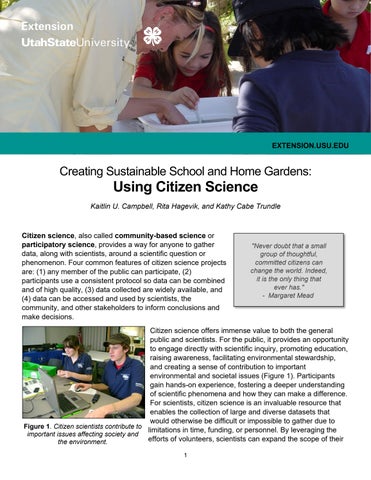
Citizen science offers immense value to both the general public and scientists. For the public, it provides an opportunity to engage directly with scientific inquiry, promoting education, raising awareness, facilitating environmental stewardship, and creating a sense of contribution to important environmental and societal issues (Figure 1). Participants gain hands-on experience, fostering a deeper understanding of scientific phenomena and how they can make a difference For scientists, citizen science is an invaluable resource that enables the collection of large and diverse datasets that would otherwise be difficult or impossible to gather due to limitations in time, funding, or personnel. By leveraging the efforts of volunteers, scientists can expand the scope of their
research, uncover new patterns, produce impactful results that benefit society at large, and share their passion with the public.
1. Improve science literacy and critical thinking through hands-on experiences in observation, data collection, and analysis.
2. Align explicitly with science standards for easy curricula integration.
3. Provide education materials for straightforward adoption and implementation.
4. Encourage outdoor and garden-based activities, promoting movement and engagement outside the classroom.
5. Provide access to real-world datasets that can be used across disciplines (e.g., science, mathematics, social studies, etc.)
6. Incorporate technology into the classroom.
7. Engage students in real scientific inquiry, fostering a deeper understanding of research processes, which can be done for multiple years
8. Create community and encourage local to global comparisons.
9. Promote environmental stewardship and awareness among students.
10. Offer opportunities for students to collaborate with scientists and see direct impacts of their contributions.
11. Allow students to work on long-term and geographically diverse projects, offering global perspectives.
The following projects lend themselves particularly well to garden-based learning and pollinator conservation, connecting with the Science Standards related to biodiversity, distributions, phenology (i.e., relationship between climate and cyclic biologic events like plants budding or birds migrating), taxonomy (i.e., classification or grouping of like organisms), lifecycles, and environmental impacts.
iNaturalist
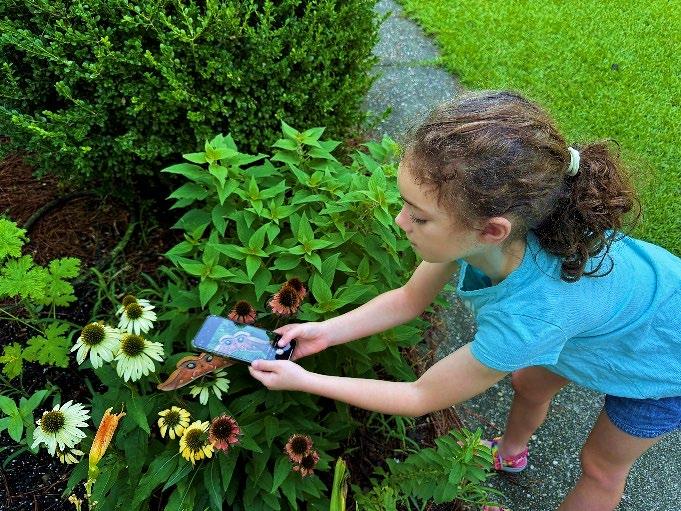
iNaturalist is one of the longest running and most extensive projects focused on distributions of living things. Users contribute images, following these steps. Step 1: Submit photos of organisms documented in the wild (animals, plants, fungi, and even microbes) with their location information (Figure 2)
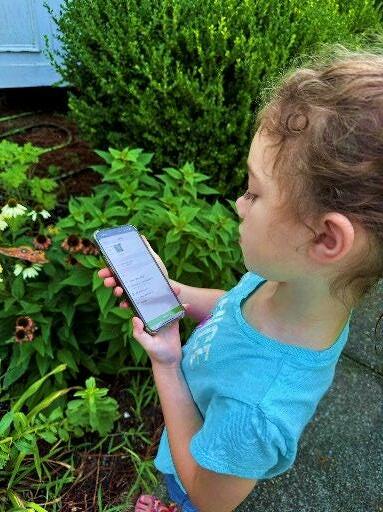
Step 2: The program (app or website) then suggests and tags the photo with preliminary identifications using artificial intelligence (AI)
Step 3: The photo is further verified by scientists and other iNaturalist community members until it reaches “research grade” and can be used by researchers, educators, and the general public everywhere as a verified observation. Over 250 million observations are available to access on iNaturalist.
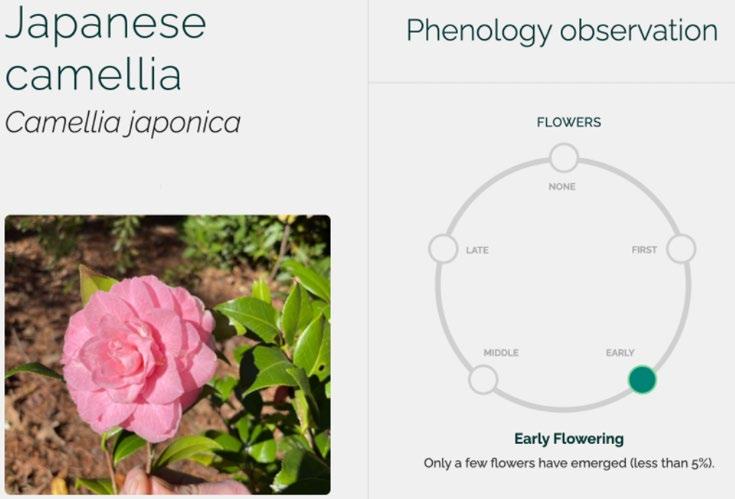
Budburst focuses on phenology, climate change, human impacts on the environment, plant-pollinator interactions, and plant lifecycles. For phenology observations, data collection is simply reporting stages of plant development (flowers, fruits, seeds) (Figure 3). Further projects related to pollinators and monarch butterflies are also available.
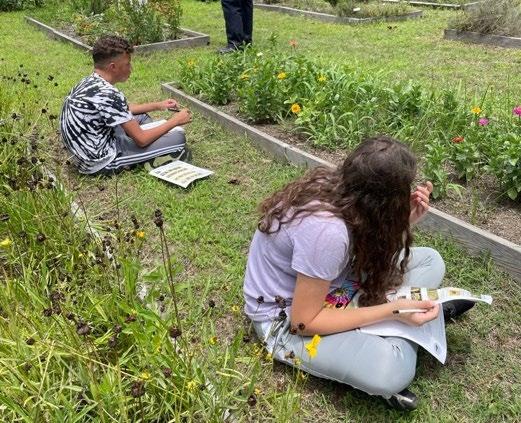
The Great Sunflower Project is the citizen science hub for gathering data on pollinator communities, the number of floral visitations, and diversity of pollinators (e.g., bees, wasps, butterflies, flies, beetles, etc.). The information spans the U.S. and beyond and provides scientists and the public with answers to questions related to spatial and temporal variations of pollinators and their activities. Using a simple data sheet, participants observe flowers for at least 5 minutes and report any pollinators that visit the flowers (Figure 4).

Join the fun! Consider participating in the citizen science community and involving your family or students. Take the first step in helping change our understanding of the wonderful world around us.
• How to Find a Citizen Science Opportunity, USAGov Contact Center
• SciStarter
• CitSci
• Citizen Science Projects, National Geographic Resources for Educators
• Teacher Learning for Effective School-Based Citizen Science
• Budburst
• iNaturalist
• Citizen Science 15 Lessons That Bring Biology to Life, 6–12 by Nancy Trautmann, Jennifer Fee, and Terry M. Tomasek (2013, National Science Teachers Association (NSTA) Press) Additional Pollinator Projects
• Journey North: Document wildlife migrations (birds and monarch butterflies).
• Monarch Watch: Tag monarch butterflies on their migration and Monarch Waystation Program
• Bumble Bee Watch: Photograph bumblebees and submit observations.
• Beescape: Use iNaturalist data to discover the quality of your landscape for supporting bees and other pollinators.
• Utah Pollinator Habitat Program: Enhance and expand existing landscape resources for pollinators in Utah.
• Follow appropriate safety guidelines whenever you are teaching in an outdoor environment, observing pollinators, or handling plants.
• Review and abide by any community guidelines for the projects.
• Follow school policies about creating accounts on external websites and apply anonymity settings (e.g., location services, personally identifiable information, and usernames) that are appropriate for children, while keeping in mind that geolocations are a key part of many projects. Some projects have a setting that obscures the location to public users. Additionally, some projects have age restrictions for accounts, and teachers may need to create a group account for the classroom to use under surveillance.
• Watch out for copyright violations; investigate suspicious images posted by individuals in the class. Ensure students are posting appropriate images, no images of themselves or others, and no personally identifiable items (e.g., license plates). Manage the quality of the data for accuracy and appropriateness.
Smart Foodscapes (usu.edu/smart-foodscapes) Scan the QR code to learn more.
USDA – National Institute of Food and Agriculture (NIFA) – Sustainable Agricultural Systems (SAS) Grant #2021-69012-35952
Kaitlin U. Campbell provided images for Figures 2 and 4 and captured the Figure 3 image from the Budburst app. Utah State University Extension provided all other images.
In its programs and activities, including in admissions and employment, Utah State University does not discriminate or tolerate discrimination, including harassment, based on race, color, religion, sex, national origin, age, genetic information, sexual orientation, gender identity or expression, disability, status as a protected veteran, or any other status protected by University policy, Title IX, or any other federal, state, or local law. Utah State University is an equal opportunity employer and does not discriminate or tolerate discrimination including harassment in employment including in hiring, promotion, transfer, or termination based on race, color, religion, sex, national origin, age, genetic information, sexual orientation, gender identity or expression, disability, status as a protected veteran, or any other status protected by University policy or any other federal, state, or local law. Utah State University does not discriminate in its housing offerings and will treat all persons fairly and equally without regard to race, color, religion, sex, familial status, disability, national origin, source of income, sexual orientation, or gender identity Additionally, the University endeavors to provide reasonable accommodations when necessary and to ensure equal access to qualified persons with disabilities. The following office has been designated to handle inquiries regarding the application of Title IX and its implementing regulations and/or USU’s non-discrimination policies: The Office of Equity in Distance Education, Room 400, Logan, Utah, titleix@usu.edu, 435-797-1266. For further information regarding non-discrimination, please visit equity.usu.edu, or contact: U.S. Department of Education, Office of Assistant Secretary for Civil Rights, 800-421-3481, ocr@ed.gov or U.S. Department of Education, Denver Regional Office, 303-844-5695 ocr.denver@ed.gov. Issued in furtherance of Cooperative Extension work, acts of May 8 and June 30, 1914, in cooperation with the U.S. Department of Agriculture, Kenneth L. White, Vice President for Extension and Agriculture, Utah State University.
September 2025
Utah State University Extension