
County-Level View of Irrigation Trends in Utah and the West
Matt Yost, Britta Schumacher, LuRee Johnson, Emily Burchfield, and Burdette Barker
1


• Growers report a diversity of information sources, with neighbors and university as top used sources.
• The most commonly cited barriers to water efficiency improvements were “low priority” and “inability to finance.”
• Irrigation productivity (crop yield ÷ irrigation water applied) differs by crop, county, year, and other categories
As water demand and scarcity increase simultaneously over the coming decades, water managers and growers will need to optimize water use on their irrigated lands. These challenges have been especially noticeable as the Western U.S. faces a prolonged “megadrought” and growers prepare for potential, or declared, water shortages and cuts. For agriculture to persist in the West, we must effectively use increasingly limited and contested water supplies, while providing growers with economically viable livelihood options and limiting negative environmental consequences (Borsato et al., 2020; Rosa et al., 2019).
Understanding how growers maintain high yields in arid, water stressed places while conserving water is of key importance for the future of U.S. agriculture in the West. Tracking irrigation changes as they relate to farm(er) characteristics is difficult because of the lack of long term, spatially and temporally consistent datasets describing water use across irrigated operations. Data from irrigation surveys of the U.S. Department of Agriculture (USDA) National Agricultural Statistics Service (NASS, 2021), which provide the most detailed and comprehensive data on irrigation behaviors and water use in the U S , are only released to the public at state scales While these analyses are useful for understanding broad trends and relationships in irrigation technology adoption, their scope makes it difficult to develop irrigation and water conservation research, education, or management initiatives that are targeted to growers’ specific needs beyond on farm technology.
• Irrigation does not always respond dynamically to drought.
• “Condition of the crop” was the top cited method for irrigation scheduling and signals large opportunities to improve irrigation scheduling with advanced tools such as soil sensors
Highlights
2

We analyzed confidential FRIS and IWMS datasets from NASS to visualize irrigation and agricultural production changes. Where possible (when count ≥ 6) these farm level data are aggregated to the county scale, the finest resolution at which these U.S. farm level data can be shared based on USDA restrictions. Using county level data allows us to visualize, understand, and interpret the spatial and temporal complexities of regional and national agricultural trends.
We explored water use management and trends in irrigated agriculture in the U S West using operator level USDA NASS Farm and Ranch Irrigation Survey (FRIS)/Irrigation and Water Management Survey (IWMS) data aggregated for the first time to the county instead of state scale. Our hope is that this study will guide water managers in developing regional conservation programs, inform extension and research initiatives related to irrigation, promote grower informed water conservation education, and provide researchers with key information regarding if, how, and why growers consider water conservation in irrigation decision making.
We synthesized and merged data from the 2003, 2008, and 2013 FRIS and the 2018 IWMS into a single dataset of surveyed operators of irrigated farms.

was merged and cleaned, we calculated irrigation productivity (IP), or the water used per crop unit harvested, by dividing the estimated average yield (in pounds/acre) by the estimated average water used (acre feet) in any county year. In other words, it was the yield divided by irrigation or water diversion
FRIS and IWMS data is collected at the farmer level and tabulated, reported, and publicly available at the state scale. We purchased access to these data at the farm operator level and securely accessed these data
Theamount.IPdata and several other questions contained in the merged NASS surveys were used to answer the following eight questions. In many cases, we examined trends both by year (2003, 2008, 2013, and 2018) and across the four survey years. For most of the results below, we discuss trends across all four survey years for simplicity. Many of the trends did vary by year. Additional data, displayed in supplemental figures, are provided in the Appendix. For more details on the study, please visit the 2022 Journal of Environmental Management article, "Water in the West" by Schumacher, Yost, Burchfield, and Allen
Methods
Afterremotely.thedataset
in corn silage was the most variable across crops and years (data not shown) Corn silage irrigation productivity varied from a median of 4,000 pounds/acre foot in Arizona in 2008 to 13,030 pounds/acre foot in Montana in 2013. Median irrigation productivity was the most consistent in alfalfa, where the least in state difference was 50 pounds/acre foot in Nevada between 2008 and 2013. Because influential environmental and irrigation management factors could not be accounted for, use these trends in irrigation productivity, which reflect temporal and spatial trends in crop yield and water applied, with caution.
3
In 2018, irrigation productivity, or the water used per crop unit harvested, was highly variable across Western counties. In alfalfa, irrigation productivity in 142 counties ranged from 2,350 pounds/acre foot in Lincoln, Nevada, to 16,220 pounds/acre foot in Bannock, Idaho (Figure 1A). This range was not as great in Utah, where it was between 2,000 and 3,750 pounds/acre foot in many counties, with data up to over 5,000 pounds/acre foot in Wayne County. It was not clear why Wayne County was greater than other counties.
1. How does irrigation productivity vary?
In hay, irrigation productivity in 80 counties ranged from 1,300 pounds/acre foot in Cassia, Idaho, to 12,880 pounds/acre foot in Stanislaus, California (Figure 1B). Only five Utah counties had data for hay, and the range was large from an average of 1,750 pounds/acre foot in Cache and Rich counties up to an average of 5,000 pounds/acre foot in Sanpete County.


Figures 1A (left) and 1B (right). Average Irrigation Productivity for Alfalfa (A) and Hay (B) (county maps based on NASS irrigation survey data from 2018)
In 2018, growers had the greatest irrigation productivity in northeastern Colorado and in southern Montana in alfalfa (Figure 1A) and in California’s Central Valley in hay (Figure 1B). Over the entire study period (2003 2018), counties in eastern Colorado (Figure 1A), California’s Central Valley, western Montana and Oregon, southern Idaho, and western Montana utilized water most efficiently in corn grain, hay, wheat, and alfalfa, Irrigationrespectively.productivity
In 2013, the U.S. West faced an intensifying drought (Swain et al., 2014); in California, for instance, statewide accumulated precipitation throughout the calendar year was 34% less than average, causing water agencies to announce a total halt on agricultural water distribution to irrigators in 2014 (California Department of Water Resources, 2014; U.S. Bureau of Reclamation, 2014). In many counties across the 11 western most states, this drought posed unprecedented challenges to water availability and, therefore, agricultural productivity. In contrast, 2018 was an average to below average rainfall year across the region (National Centers for Environmental Information, 2019). Interestingly, the difference in water applied by growers between an extreme drought and a more average year is not entirely consistent with our expectation that irrigators would apply more water in response to extreme drought. In 48%, 58%, 55%, 62%, and 42% of counties reporting water
Trends in irrigation productivity were variable across space, time, and crops (see full datasets and summaries). For instance, in alfalfa irrigation, productivity has doubled in Socorro, New Mexico, since 2003; in Rio Grande, Colorado, however, irrigation productivity in 2018 was a third of what it was in 2003. This high variability points to the need for county and crop specific data and water management guidelines.
Though there is county level variability, in general, irrigated yields in alfalfa, hay, wheat, corn silage, and corn grain have increased slightly from 2003 to 2018 across the West. As measured by irrigation productivity, efficiency in production across years is greatest in corn silage, followed by corn grain, alfalfa, wheat, and other hay (Figure 2)
4
3. Do farmers adjust irrigation due to drought?
2. Has irrigation productivity changed over time?
Figure 2. Estimated Average Irrigation Productivity by Crop (based on irrigation survey data between 2003 2018)

Figure 3. Differences in Water Applied to Alfalfa (county map based on NASS survey data, 2013 2018)

4. Which information sources are used the most?
Mitigating(2013)
Western U S drought effects with irrigation water is feasible, but it is only as effective as water availability and water turns allow. Of the 104 counties with reportable alfalfa data in both years, 50 reported more water applied in 2013 than in 2018, with the remaining 54 counties reporting less. Thus, about half irrigated above or below 2013 levels, potentially due to limited water available for diversion or the turn based system of irrigation in agriculture. This suggests a diverse and often limited ability to adapt irrigation management to drought in this region.
Figure 4. Primary Irrigation Information Sources (county map based on 2003–2018 survey data, with legend categories listed in order from most to least common, top to bottom, and parentheses showing the number of counties cited)
The proportion of responses indicates that irrigators’ information sources vary at the state and county levels. For instance, in some states, information from irrigation equipment dealers is more important than that from extension agents, but in New Mexico, irrigation equipment dealers are consistently less utilized than other information sources. In Washington, very few irrigators source their information from government specialists, but in some Arizona and New Mexico counties, over 30% of irrigators rely on these sources when making irrigation decisions for their crops. The large diversity and variability in preferred irrigation information sources highlights the need for more public and private organization coordination to provide enhanced irrigation information. Finally, these data point to the importance of farmer networks and the need to further develop and use these networks to advance water optimization.
5
applied to alfalfa (Figure 3), corn grain, corn silage, hay, and wheat, respectively, growers applied more water in 2013 than in 2018. The trend across the West was consistent with the trend in Utah. Of 14 Utah counties with data, six reported greater water applications in an average water year (2018) compared to a dry year
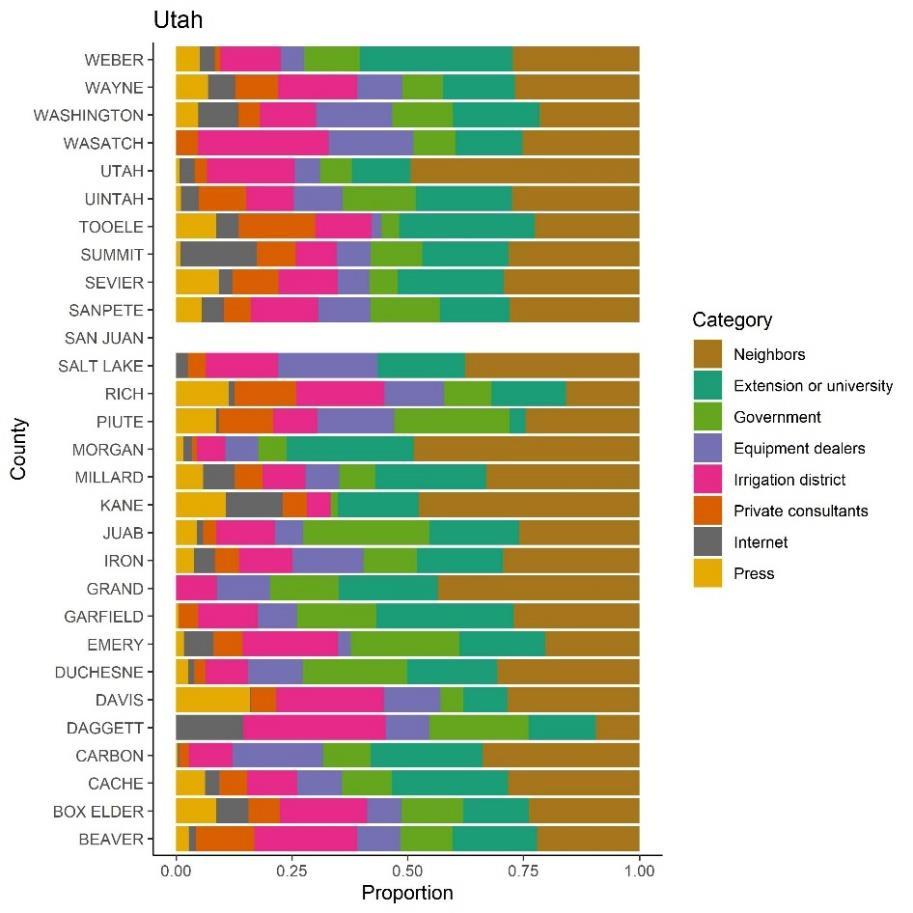
Between 2003 2018, farmers across 11 western states relied primarily on information from neighboring farmers to reduce irrigation costs or conserve water used for irrigation (Figure 4). The second most important source of information was extension agents or university specialists, highlighting the importance of both local knowledge and expert information networks in irrigation decision making. The trends observed across the West were similar to trends in Utah, where the major source was neighbors with a nearly even split among three other sources (Extension, government, and irrigation districts).

Between 2003 2018, farmers across 11 western states overwhelmingly scheduled water use based on the condition of their crops (Figure 5). Using condition of the crop to schedule irrigation is problematic because when water stress is visible, yield loss has already occurred and often cannot be recovered. This suggests large opportunities to improve irrigation scheduling with advanced techniques that monitor the soil moisture or water potential. This was further evidenced by the fact that very few irrigators reported using soil moisture sensing devices. The 2018 map of irrigation scheduling methods did show enhanced use of soil moisture sensors, but it was still among the least used methods for irrigation scheduling.
6
Barriers encountered by irrigators varied at the state and county levels and by year. For instance, in 2018 (not shown), irrigators in Arizona rarely cited risk of reduced yield or poorer quality crops as a barrier to implementing irrigation improvements; in New Mexico and Washington,

Figure 5. Primary Irrigation Scheduling Methods (county map data reported 2003 2018; parentheses show the number of counties cited)

Between 2003 2018, farmers in the 11 western most states found financing and prioritizing improvements as the largest barriers to implementing improvements in their irrigation systems (Figure 6). Interestingly, irrigators consistently noted uncertainty about future water availability as a third major contributor to their decisions not to implement improvements that may reduce energy costs or conserve water. Without the promise of consistent water availability, why invest thousands of dollars in new equipment and technologies to conserve?
5. Which scheduling methods are used the most?
Figure 6. Average Barriers to Implementation (county map based on 2003 2018 survey data, with legend categories listed in order from most to least common, top to bottom; parentheses show the number of counties cited)
The second most important scheduling method across the region was turn based, whereby irrigators use water when it’s delivered, a “no choice” method. The turn system is unique to some parts of the Western U.S. and gives irrigators limited choices as to when they water their crops. This method was more prevalent on the southern half of this region than the northern half including Utah, where six of 29 counties cited this as the major method (Figure 5). Although water turns are practiced in many areas, there may still be many opportunities to use techniques to adjust the rate and sometimes the timing of irrigation.
6. What are the largest barriers to irrigation improvements?
Figure 7. Average Primary Sources of Financial and Technical (*) Assistance (county map based on data reported 2003 2018, with legend categories listed in order from most to least common, top to bottom; parentheses show the number of counties cited)

Bridges to irrigation improvements were only recorded by farmers that indicated they had made irrigation and/or drainage improvements above regular maintenance in the past five years with the aid of technical and/or financial assistance. Assistance is low in many areas, so there is a lot of missing data. From 2003 2018, farmers overwhelming cited both financial and technical USDA programs for water conservation and environmental improvements as bridges, or support, for implementing improvements to their irrigation systems (Figure 7). Interestingly, the importance of USDA programs (e.g., CTA, EQIP, RCPP, WHIP, and CIG) for financial and technical support was relatively consistent across counties and states. This was also true in Utah where seven of 11 counties with data stated that USDA conservation programs were the major source. Some counties in some years stand out as anomalies to this general rule. In 2018, in Napa, California, for instance (data not shown), irrigators reported using only non USDA federal programs, or Bingham, Idaho, where irrigators relied heavily on private businesses and state programs.
7. What are the largest bridges to irrigation improvements?
7
however, this barrier is cited as a top concern. Contrastingly, some barriers are consistently cited across states and counties. One such barrier is that improvements will not reduce costs enough to recover implementation expenses. These local barriers should assist water planners and irrigators seeking to effectively finance and make irrigation investments.

1. Irrigation productivity varies greatly over time and space.
8. Does assistance acceptance influence barriers to conservation?
3. Irrigation productivity differs significantly across multiple water use, delivery, and other categories.
4. Growers report an incredible diversity of information sources, scheduling methods, and barriers and bridges to implementing improvements.
References
These county level data should help water managers more accurately and sensitively assist growers.
2. Water applications do not always respond dynamically to drought.
Not all growers implementing improvements sought financial or technical assistance between 2003 2018. Though “financing” was cited as one of the greatest barriers to implementing irrigation improvements on Western operations, many growers did not use available financial resources from the USDA or other federal, state, or private programs (Figure 8). Growers that implemented improvements on their operation and received assistance to do so cited “prioritizing improvements” as a barrier about half as often as growers who did not seek out or receive assistance, suggesting that ready access to assistance may decrease barriers to implementing improvements that increase efficiency and save water. Though most other barriers cited were consistent among growers who received or did not receive assistance, growers receiving assistance for improvement implementation cited their landlord’s unwillingness to help in the cost of implementation as a barrier twice as often as growers who did not receive assistance
Borsato, E., Rosa, L., Marinello, F., Tarolli, P., & D’Odorico, P. (2020). Weak and strong sustainability of irrigation: A framework for irrigation practices under limited water availability. Frontiers in Sustainable Food Systems, 1 16. https://doi.org/10.3389/fsufs.2020.00017
California Department of Water Resources (CADWR). (2014, January 31). DWR drops state water project allocation to zero, seeks to preserve remaining supplies: Severe drought leads to worst ever water supply
8

Figure 8. Barriers to Implementing Conservation Based on the Proportion of Growers That Did (right bar) or Did Not (left) Seek Assistance for Improvements

Summary
We found notable spatial and temporal variability in Western irrigation practices, with neighboring counties often exhibiting large differences in efficiency, water use, and crop yields, as well as in the sources of information, scheduling methods, and technological improvements employed. This analysis addresses a critical need: to gather and disseminate irrigation information at local and regional scales regarding how growers irrigate their crops, steps growers are taking to use water efficiently, and barriers growers face to conserving water. We found that:
Peer reviewed fact sheet
In its programs and activities, including in admissions and employment, Utah State University does not discriminate or tolerate discrimination, including harassment, based on race, color, religion, sex, national origin, age, genetic information, sexual orientation, gender identity or expression, disability, status as a protected veteran, or any other status protected by University policy, Title IX, or any other federal, state, or local law. Utah State University is an equal opportunity employer and does not discriminate or tolerate discrimination including harassment in employment including in hiring, promotion, transfer, or termination based on race, color, religion, sex, national origin, age, genetic information, sexual orientation, gender identity or expression, disability, status as a protected veteran, or any other status protected by University policy or any other federal, state, or local law. Utah State University does not discriminate in its housing offerings and will treat all persons fairly and equally without regard to race, color, religion, sex, familial status, disability, national origin, source of income, sexual orientation, or gender identity. Additionally, the University endeavors to provide reasonable accommodations when necessary and to ensure equal access to qualified persons with disabilities. The following individuals have been designated to handle inquiries regarding the application of Title IX and its implementing regulations and/or USU’s non discrimination policies: Executive Director of the Office of Equity, Matt Pinner, JD, matthew.pinner@usu.edu, Title IX Coordinator, Hilary Renshaw, hilary.renshaw@usu.edu, Old Main Rm. 161, 435 797 1266. For further information regarding non discrimination, please visit equity.usu.edu, or contact: U.S. Department of Education, Office of Assistant Secretary for Civil Rights, 800 421 3481, ocr@ed.gov or U.S. Department of Education, Denver Regional Office, 303 844 5695 ocr.denver@ed.gov. Issued in furtherance of Cooperative Extension work, acts of May 8 and June 30, 1914, in cooperation with the U.S. Department of Agriculture, Kenneth L. White, Vice President for Extension and Agriculture, Utah State University.
outlook. www.water.ca.gov Retrieved July 20, 2021, Nationalhttps://www.lvmwd.com/home/showpublisheddocument?id=3860from.AgriculturalStatisticsService(NASS).(2021).
9
National Centers for Environmental Information. (2019). State of the climate: National climate report for annual 2018. National Oceanic and Atmospheric Administration (NOAA) Retrieved May 24, 2021, from Rosa,https://www.ncdc.noaa.gov/sotc/national/201813.L.,Chiarelli,D.D.,Tu,C.,Rulli,M.C.,&
September 2022
D’odorico, P. (2019). Global unsustainable virtual water flows in agricultural trade. Environmental Research Letters, 14(11). https://doi.org/10.1088/1748 9326/ab4bfc Swain, D. L., Tsiang, M., Haugen, M., Singh, D., Charland, A., Rajaratnam, B., & Diffenbaugh, N. S. (2014) The extraordinary California drought of 2013 2014: Character, context, and the role of climate change. Bulletin of the American Meteorological Society, Insitute of the Environment & Sustainability, University of California Los Angeles.
Utah State University Extension
United States Bureau of Reclamation (USBR). (2014, February 21) Reclamation announces initial 2014 Central Valley Project water supply allocation. Retrieved July 20, 2021, https://www.usbr.gov/newsroom/newsroomold/newsrelease/detail.cfm?RecordID=46045from
Surveys: Census of irrigation. U.S. Department of Agriculture. Retrieved May 24, 2021, from USDA National Agricultural Statistics Service Surveys Irrigation and Water Management
Supplemental Figures
Figure 10 Primary Irrigation Scheduling Method by County in Utah Across All Survey Years (2003, 2008, 2013, and 2018)

Appendix:
10
Figure 9 Primary Source of Irrigation Information by County in Utah Across All Survey Years (2003, 2008, 2013, and 2018)
Figure 11 Primary Barrier to Irrigation Improvements by County in Utah Across All Survey Years (2003, 2008, 2013, and 2018)
11
Figure 12. Primary Source of Irrigation Financial and Technical (*) Assistance by County in Utah Across All Survey Years (2003, 2008, 2013, and 2018)

