Integrated Pest Management Program and Utah Plant Pest Diagnostic Laboratory
PLP-032PR
Cherry Powdery Mildew in Utah
July 2025
Marion Murray, IPM Specialist • Christina Lilligren, Utah State University • Megan Kast, IPM Technician
Quick Facts
• Powdery mildew on sweet and tart cherry is caused by the fungal pathogen Podosphaera cerasi. • The pathogen infects young leaves and, occasionally, fruit. • Warm, dry days followed by cool, humid nights favor disease development. • Infections reduce tree vigor and can affect fruit yield and quality.
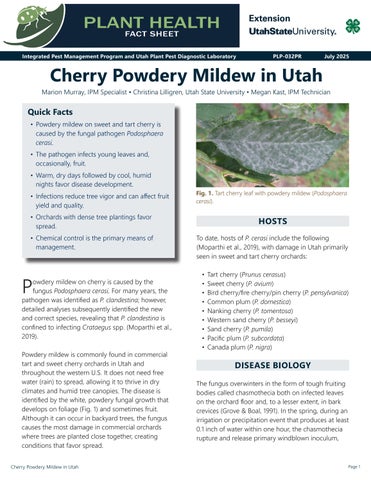
Fig. 1. Tart cherry leaf with powdery mildew (Podosphaera cerasi).
• Orchards with dense tree plantings favor spread.
HOSTS
• Chemical control is the primary means of management.
To date, hosts of P. cerasi include the following (Moparthi et al., 2019), with damage in Utah primarily seen in sweet and tart cherry orchards:
P
owdery mildew on cherry is caused by the fungus Podosphaera cerasi. For many years, the pathogen was identified as P. clandestina; however, detailed analyses subsequently identified the new and correct species, revealing that P. clandestina is confined to infecting Crataegus spp. (Moparthi et al., 2019). Powdery mildew is commonly found in commercial tart and sweet cherry orchards in Utah and throughout the western U.S. It does not need free water (rain) to spread, allowing it to thrive in dry climates and humid tree canopies. The disease is identified by the white, powdery fungal growth that develops on foliage (Fig. 1) and sometimes fruit. Although it can occur in backyard trees, the fungus causes the most damage in commercial orchards where trees are planted close together, creating conditions that favor spread. Cherry Powdery Mildew in Utah
• Tart cherry (Prunus cerasus) • Sweet cherry (P. avium) • Bird cherry/fire cherry/pin cherry (P. pensylvanica) • Common plum (P. domestica) • Nanking cherry (P. tomentosa) • Western sand cherry (P. besseyi) • Sand cherry (P. pumila) • Pacific plum (P. subcordata) • Canada plum (P. nigra)
DISEASE BIOLOGY The fungus overwinters in the form of tough fruiting bodies called chasmothecia both on infected leaves on the orchard floor and, to a lesser extent, in bark crevices (Grove & Boal, 1991). In the spring, during an irrigation or precipitation event that produces at least 0.1 inch of water within one hour, the chasmothecia rupture and release primary windblown inoculum,
Page 1