


Maria Kleinstaeuber, Ashley Yaugher, Emily Roundy, and Michael Levin
According to the National Institute of Neurological Disorders and Stroke, pain is your body signaling that you have been, are, or are expecting to be injured or ill (NINDS, 2024). Pain is an unpleasant experience that motivates us to care for our bodies and avoid harmful behaviors. The International Association for the Study of Pain (IASP) emphasizes that pain is not just a "sensory" but also an "emotional" experience (IASP, 1994). Pain is highly personal, and no two people feel pain the same way. Our experience of pain is influenced to varying degrees by biological, psychological, and social factors (IASP, 1994).
Commonly, pain is temporary or “acute,” meaning it often goes away when the cause of the pain is resolved. In some cases, pain can be experienced for long periods, known as “chronic pain ” Chronic pain can last over three months or for more than the expected healing time (NINDS, 2024). In 2021, approximately 21% of Americans reported experiencing chronic pain (Rikard et al., 2023). There is not always a known reason why someone is experiencing chronic pain. This challenge can make it difficult to treat, and sometimes, it cannot be “cured” (Rikard et al., 2023). Fortunately, there are many options to help alleviate and cope with chronic pain that allow people to live their lives while managing their chronic pain (Driscoll et al., 2021).
Opioid pain medications are one option to relieve temporary or acute pain, but they may not always be the best option for managing chronic pain. Opioids are not proven to be the most effective strategy, nor are they sustainable for long-term chronic pain treatment (Volkow & McLellan, 2016).
Specifically, opioids have undesirable side effects, such as dizziness, nausea, depression, dependance, muscle rigidity, and more (Benyamin et al., 2008). Sometimes, when one has been using opioids for a long period, they can actually feel more pain than they would have felt if they hadn’t taken the opioids in the first place. This is called “hyperalgesia” (Purves et al., 2001). Those who experience hyperalgesia become more sensitive and responsive to the pain around the injury (Purves et al., 2001). Additionally, with opioid medications, there are possible negative impacts, such as the “misuse” or using them in unprescribed ways and opioid use disorder (OUD) (Volkow & McLellan, 2016).
Opioid medications are not the only treatment option to manage chronic pain, and fortunately, there are other options with few negative side effects, including alternative pain management and psychological treatments. Some alternative pain management programs that can be used in combination with other treatments include:
• Mindfulness or meditation.
• Physical therapy
• Biofeedback.
• Low-impact exercises such as yoga
• Stress management
• Relaxation training or therapy.
• Pain coping skills training. (See Centers for Disease Control and Prevention [CDC], 2020; Driscoll et al., 2021; Swenson et al., 2020; and Yaugher et al., 2020.)


Negative emotions or thoughts can increase pain, just like pain can increase negative emotions or thoughts. Thus, psychological distress can make the experience of pain worse and vice versa (Driscoll et al., 2021). Psychological treatments help break this cycle by addressing distress and other troublesome psychological consequences associated with pain, changing how we relate to difficult thoughts and feelings so they aren't as overwhelming (Cleveland Clinic, 2015; Driscoll et al., 2021). Some examples of evidence-based psychological pain treatments are:
• Cognitive behavioral therapy (CBT).
• Mindfulness-based stress reduction (MBSR).
• Acceptance and commitment therapy (ACT) (See Driscoll et al., 2021; National Center for Complementary and Integrative Health [NCCIH], 2023; Swenson et al., 2020; and Yaugher et al., 2020.)
There are multiple alternative pain management programs and psychological therapies that individuals can participate in, including CBT and ACT. CBT therapists help people develop problemsolving skills to deal with chronic pain, and some of CBT’s benefits include improved daily functioning and increased quality of life (Swensen et al., 2020; Yaugher et al., 2020). ACT therapists help people develop value-based chronic pain management. This fact sheet reviews the benefits of ACT for managing chronic pain.
To better understand what ACT is and what its goals are, let us first consider Carina’s experience:

Carina is 42 years old and a teacher. She has worked for 25 years in the same place, but now she does not work anymore. The pain spreading across her body has become unbearable. She feels very frustrated after her enormous but unsuccessful efforts to gain control over her pain. She feels left alone, explaining that “everyone turns their backs on me; they can’t stand me.” Carina is disappointed because everyone made promises to help her get rid of her pain, but nothing seems to work. Like many pain patients, Carina feels “stuck” in her life, her pain, and all the distress and disability that comes with it.


ACT works well for situations like Carina’s. Like many other people suffering from pain, Carina has persistently searched for immediate relief and ways to reduce her pain avoiding the pain and its associated emotional pain has been her central goal. This search has led her to be preoccupied and constantly think about finding the “right solution” at the expense of focusing on things in her life that are more important to her. This type of pain management that Carina practices is common. Especially in our Western world, we have established a strong biomedical model of pain, meaning that we believe pain can always be attributed to one specific, identifiable, and treatable cause. From this point of view, persistently searching for the “right treatment” and “fighting against the pain” appears to be a logical approach to managing pain. However, for many types of pain, this strategy does not work well. People get “stuck” with it.
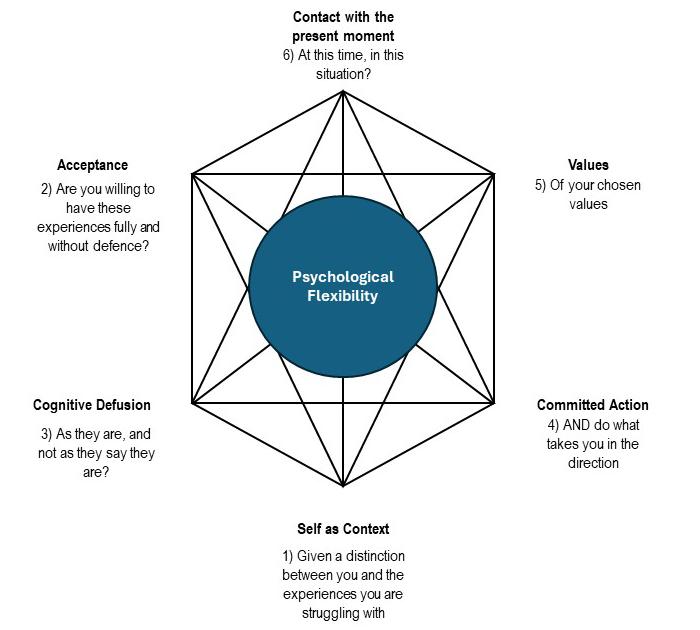
ACT guides individuals to free themselves from this unproductive and often destructive “fight ” Patients learn to mindfully and compassionately experience their pain and associated negative feelings and thoughts and focus and act according to their values and what is really important in their lives (Hayes et al., 2004). ACT helps patients increase their psychological flexibility which means their ability to do what is valuable and meaningful to them, while being open to whatever thoughts, feelings, and other internal experiences arise in the process (Hayes, 2016).
Acceptance is a word that is often associated with a negative meaning. For example, some people think that acceptance means they should learn to “like” their problem and its causes, or they must accept everything that is negative in their life, or they even have to give up and resign. Acceptance in the context of ACT, however, means to stop unproductive, unhelpful attempts to control and change things in situations where one cannot control them. It helps people lean in and be willing to experience things that cause them distress. This sounds like the opposite of what we may want, but this is actually the first step to change things in the long term. People develop openness when they finally give up on unproductive attempts to control what they can’t and shift their focus to doing what is really important to them. ACT is learning to understand that previous attempts to solve a problem have not been helpful and that it is time to open up to new, alternative pathways and create space for trying something else.
Rather than focusing on controlling pain like with a pharmacological or medication-based approach, ACT aims to help people engage in a meaningful life and improve their quality of life even when pain shows up. ACT focuses on helping patients with chronic pain act and behave according to their goals
and values, despite having pain (Dahl et al., 2005). In comparison to another very popular approach of psychological pain management, CBT (Swensen et al., 2020), ACT does not try to change behavior through changing the thoughts and feelings themselves, but through changing the experience of pain and associated thoughts and feelings.
ACT builds on six treatment questions to increase psychological flexibility in individuals (Table 1; McCracken, 2015). As Figure 1 shows, these questions are related to each other and contribute to psychological flexibility for people.

Credit: Pixaby, 8198852
Table 1. Acceptance and Commitment Therapy Treatment Question Explanations
1
2
3
Self as context means making a distinction between you and the experiences you have (i.e., even if severe pain can make you feel worthless, this does not mean that you are worthless. You are not your experiences).
Acceptance means that you stop unproductive, unhelpful attempts to control and change things in situations where you can’t. This means that you learn to develop openness to fully experience things that you cannot control (e.g., your pain), without defense.
Cognitive defusion means that you learn to notice your thoughts as just thoughts. For example, many pain patients experience negative ideas about their body because they cannot function as they used to due to their pain. ACT helps patients with pain to understand that although their mind judges them with thoughts like “I’m useless,” these are just thoughts, and they do not mean that they really are “useless.”
4 & 5
6
Committed action means that you learn to shift your focus from your pain to doing the things in your life that are important to you your values. This takes an ongoing commitment, especially when people inevitably slip from their goals and are tempted to give up instead of recommitting. For example, many pain patients start giving up activities (e.g., exercise) that were important to them because they are concerned that they could increase their pain. According to ACT, you would commit to do the opposite and find ways to still commit to your beloved activities despite pain.
Developing contact with the present moment means that you learn to do things in your life with special attentiveness, by trying to be connected in each situation. For example, instead of eating your lunch while you answer your emails, you take a certain time for your lunch and experience it with full attention.

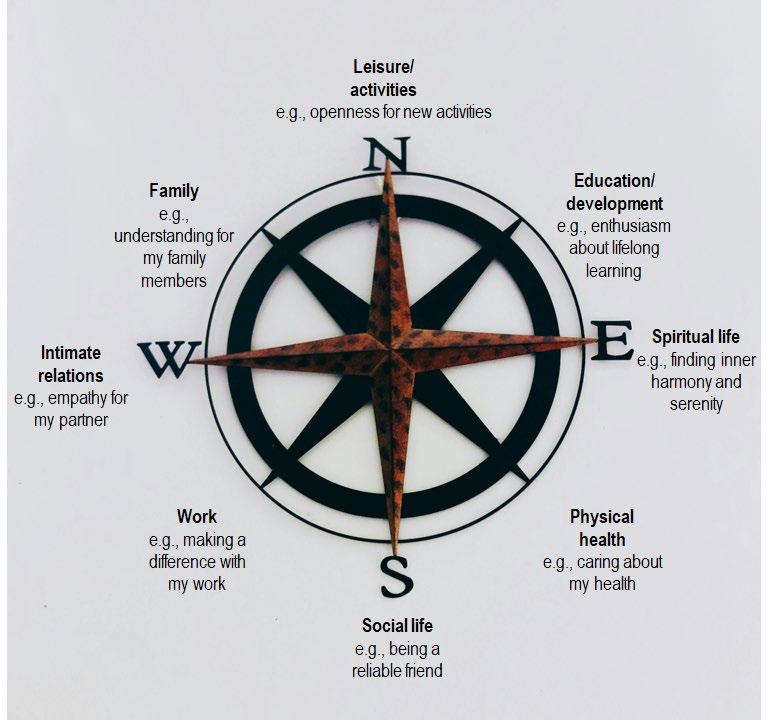
To address these six treatment questions, ACT applies various strategies. Mindfulness-based methods help people make contact with the present moment and pay attention in a particular way: with purpose, in the present, and nonjudgmentally (Kabat-Zinn, 2009; Wright Voss et al., 2019). ACT also applies cognitive defusion strategies. Our thoughts are often automatic, and we have little awareness at the time that they occur and influence our behavior. Cognitive defusion helps to loosen the impact of our thoughts on our behavior. We are not our thoughts and we do not have to act according to our thoughts. Cognitive defusion is like listening to a radio playing in another room while you read a book. You can hear the radio, but you do not listen to it. ACT therapists explore together with their patients their core values, goals, and concrete actions that would produce those goals and commit patients to put these goals and actions into reality, as shown in Figure 2 (Hayes, 2016). ACT also relies on paradoxes (i.e., contradictions), metaphors (i.e., creating images by comparing two things), stories, exercises, and behavioral tasks to foster the experiential processing in individuals (Hayes, 2016).
Yes. Acceptance and commitment therapy has proven effective in helping individuals improve and manage their pain. A substantial body of research literature demonstrates ACT’s effectiveness (Association for Contextual Behavioral Science [ACBS], n.d.).
• Patients reported reduced symptoms of depression and anxiety, and less catastrophizing (i.e., thinking the worst will happen, even if it is unlikely) thoughts at the end of an ACT treatment (Martinez-Calderon et al., 2024).
• ACT helps patients to increase their pain-related functioning, psychological flexibility, mindfulness skills, and acceptance of pain. Research shows that ACT also has long-lasting effects beyond treatment (Martinez-Calderon et al., 2024; McCracken & Vowles, 2022).
• ACT has also been demonstrated to be effective when used in web-based formats, lowering pain interference and intensity as well as other psychological symptoms (Trindade et al., 2021).
• Studies have shown that ACT’s effectiveness is increased as a component of interdisciplinary approaches compared to ACT being delivered as stand-alone intervention (Vowles et al., 2020).
• Studies that compared ACT with medication or pharmacotherapy are rare; however, one study showed beneficial effects favoring group-based ACT compared to recommended pharmacological treatment in patients with fibromyalgia (Luciano et al., 2014).
• ACT has been successfully applied to prevent opioid misuse as a consequence of pharmacological treatment of postsurgical pain (Abid Azam et al., 2017; Dindo et al., 2018). However, selecting treatment approaches should always be tailored according to the specific needs of an individual patient and their providers.
Chronic pain is a common experience for people and can be difficult to manage. However, there are many evidence-based and effective psychological treatments for chronic pain to help people improve their lives. One of these is acceptance and commitment therapy, or ACT. ACT teaches people to accept pain and live a life full of meaning and quality with pain. It helps individuals increase their quality of life through mindfulness-based methods, experiential processing, and a focus on values, goals, and actions. ACT has been shown to be effective in reducing pain, improving pain management, and improving personal well-being. Additional resources are below.
• Utah State University (USU) Extension, Health Extension: Advocacy, Research, & Teaching (HEART) Initiative
• USU, Sorenson Legacy Foundation Center for Clinical Excellence
• Utah Department of Health and Human Services, Living Well With Chronic Pain (and other health and wellness workshops)
• American Psychological Association’s article “Managing Chronic Pain: How Psychologists Can Help With Pain Management”
• National Center for Complementary and Integrative Health’s article “Chronic Pain: What You Need to Know”
• Psychology Today, Find a Therapist
• Substance Abuse and Mental Health Services Administration (SAMHSA), National Helpline (treatment referral routing service)
• American Chronic Pain Association
Always consult with your behavioral health and medical providers when considering treatment or management of a medical or mental health condition.
Please note that all the resources provided are for educational purposes and USU does not specifically endorse their services. ACT and other resources are intended to provide information, not to treat chronic pain or other mental health concerns. USU does not control the websites or books referenced in the Additional Resources section
Depositphotos provided the banner photo.
Abid Azam, M., Weinrib, A. Z., Montbriand, J., Burns, L. C., McMillan, K., Clarke, H., & Katz, J. (2017). Acceptance and commitment therapy to manage pain and opioid use after major surgery: Preliminary outcomes from the Toronto General Hospital Transitional Pain Service. Canadian Journal of Pain, 1(1), 37–49. https://doi.org/10.1080/24740527.2017.1325317
Association for Contextual Behavioral Science (ACBS). (n.d.). Meta-analyses and systematic, scoping, or narrative reviews of the ACT evidence base. Retrieved from https://contextualscience.org/metaanalyses_and_systematic_scoping_or_narrative_reviews_of_th e_act_evidenc
Benyamin, R., Trescot, A. M., Datta, S., Buenaventura, R., Adlaka, R., Sehgal, N., Glaser, S. E., & Vallejo, R. (2008). Opioid complications and side effects. Pain Physician, 11(2 Suppl), S105–S120.
Centers for Disease Control and Prevention (CDC). (2020). Know your options. Health and Human Services. Retrieved April 6, 2020, from https://www.cdc.gov/drugoverdose/patients/options.html
Dahl, J. C., Wilson, K. G., Luciano, C., & Hayes, S. C. (2005). Acceptance and commitment therapy for chronic pain. Context Press.
Dindo, L., Zimmerman, M. B., Hadlandsmyth, K., StMarie, B., Embree, J., Marchman, J., TrippReimer, T., & Rakel, B. (2018). Acceptance and commitment therapy for prevention of chronic postsurgical pain and opioid use in at-risk veterans: A pilot randomized controlled study. The Journal of Pain, 19(10), 1211–1221. https://doi.org/10.1016/j.jpain.2018.04.016
Driscoll, M. A., Edwards, R. R., Becker, W. C., Kaptchuk, T. J., & Kerns, R. D. (2021). Psychological interventions for the treatment of chronic pain in adults. Psychological Science in the Public Interest, 22(2), 52–95. https://doi.org/10.1177/15291006211008157
Hayes, S. C. (2016). Acceptance and commitment therapy, relational frame theory, and the third wave of behavioral and cognitive therapies [Republished article] Behavior Therapy, 47(6), 869–885. https://doi.org/10.1016/j.beth.2016.11.006
Hayes, S. C., Strosahl, K. D., Bunting, K., Twohig, M. P., & Wilson, K. G. (2004). What is acceptance and commitment therapy? In S. C. Hayes & K. D. Strosahl (Eds.), A practical guide to Acceptance and Commitment Therapy (pp. 5–29). Springer.
International Association for the Study of Pain (IASP). (1994). Pain terms. https//www.iasppain.org/terminology
Kabat-Zinn, J. (2009). Wherever you go, there you are: Mindfulness meditation in everyday life. Hachette Books.
Luciano, J. V., Guallar, J. A., Aguado, J., Lopez-Del-Hoyo, Y., Olivan, B., Magallon, R., Alda, M., Serrano-Blanco, A., Gili, M., & Garcia-Campayo, J. (2014). Effectiveness of group acceptance and commitment therapy for fibromyalgia: A 6-month randomized controlled trial (EFFIGACT study). Pain, 155(4), 693–702. https://doi.org/10.1016/j.pain.2013.12.029
Martinez-Calderon, J., Garcia-Munoz, C., Rufo-Barbero, C., Matias-Soto, J., & Cano-Garcia, F. J. (2024). Acceptance and commitment therapy for chronic pain: An overview of systematic reviews with meta-analysis of randomized clinical trials. The Journal of Pain, 25(3), 595–617. https://doi.org/10.1016/j.jpain.2023.09.013
McCracken, L. (2015). ACT for chronic pain. https://www.div12.org/wp-content/uploads/2015/06/ACTfor-Chronic-Pain-manual-McCracken.pdf
McCracken, L. M., Yu, L., & Vowles, K. E. (2022). New generation psychological treatments in chronic pain. BMJ, 376. https://doi.org/10.1136/bmj-2021-057212
National Center for Complementary and Integrative Health (NCCIH). (2023, January). Chronic pain: What you need to know. National Institutes of Health. Retrieved April 18, 2024, from https://www.nccih.nih.gov/health/chronic-pain-what-you-need-to-know
National Institute of Neurological Disorders and Stroke. (2024, February 8). Pain. National Institutes of Health. Retrieved April 17, 2024, from https://www.ninds.nih.gov/healthinformation/disorders/pain Purves, D., Augustine, G. J., Fitzpatrick, D., et al. (Eds.) (2001). Hyperalgesia and sensitization. In Neuroscience (2nd ed.). Sinauer Associates Retrieved March 17, 2024, from https://www.ncbi.nlm.nih.gov/books/NBK10999/ Rikard, S M., Strahan, A E., Schmit, K M., & Guy, G. P., Jr. (2023, April 14). Chronic pain among adults — United States, 2019–2021. MMWR Morbidity and Mortality Weekly Report (MMWR), 72, 379–385. Retrieved March 17, 2024, from http://dx.doi.org/10.15585/mmwr.mm7215a1
Swensen, K., Voss, M. W., Condie, A. W., & Yaugher, A. (2020). Cognitive behavioral therapies for the management of chronic pain [Fact sheet] Utah State University Extension. https://digitalcommons.usu.edu/extension_curall/2128/ Trindade, I. A., Guiomar, R., Carvalho, S. A., Duarte, J., Lapa, T., Menezes, P., Nogueira, M. R., Patrao, B., Pinto-Gouveia, J., & Castilho, P. (2021). Efficacy of online-based acceptance and commitment therapy for chronic pain: A systematic review and meta-analysis. The Journal of Pain, 22(11), 1328–1342. https://doi.org/10.1016/j.jpain.2021.04.003
Volkow N. D., & McLellan A. T. (2016, March 31). Opioid abuse in chronic pain misconceptions and mitigation strategies. New England Journal of Medicine, 374,1253–1263. Retrieved March 17, 2024, from https://www.nejm.org/doi/full/10.1056/NEJMra1507771
Vowles, K. E., Pielech, M., Edwards, K. A., McEntee, M. L., & Bailey, R. W. (2020). A comparative meta-analysis of unidisciplinary psychology and interdisciplinary treatment outcomes following acceptance and commitment therapy for adults with chronic pain. The Journal of Pain, 21(5–6), 529–545. https://doi.org/10.1016/j.jpain.2019.10.004
Wright Voss, M., Atisme, K., Yaugher, A., & Sulzer, S. (2019). Mindfulness for chronic pain management [Fact sheet]. Utah State University Extension. https://extension.usu.edu/heart/research/mindfulness-chronic-pain-management
Yaugher, A. C., Bench, S. W., Meyers, K. J., & Voss, M. W. (2020). How psychologists can impact the opioid epidemic. Professional Psychology: Research and Practice, 51(1), 85. https://psycnet.apa.org/record/2020-06637-011
In its programs and activities, including in admissions and employment, Utah State University does not discriminate or tolerate discrimination, including harassment, based on race, color, religion, sex, national origin, age, genetic information, sexual orientation, gender identity or expression, disability, status as a protected veteran, or any other status protected by University policy, Title IX, or any other federal, state, or local law. Utah State University is an equal opportunity employer and does not discriminate or tolerate discrimination including harassment in employment including in hiring, promotion, transfer, or termination based on race, color, religion, sex, national origin, age, genetic information, sexual orientation, gender identity or expression, disability, status as a protected veteran, or any other status protected by University policy or any other federal, state, or local law. Utah State University does not discriminate in its housing offerings and will treat all persons fairly and equally without regard to race, color, religion, sex, familial status, disability, national origin, source of income, sexual orientation, or gender identity. Additionally, the University endeavors to provide reasonable accommodations when necessary and to ensure equal access to qualified persons with disabilities. The following office has been designated to handle inquiries regarding the application of Title IX and its implementing regulations and/or USU’s non-discrimination policies: The Office of Equity in Distance Education, Room 400, Logan, Utah, titleix@usu.edu, 435-797-1266. For further information regarding non-discrimination, please visit equity.usu.edu, or contact: U.S. Department of Education, Office of Assistant Secretary for Civil Rights, 800-421-3481, ocr@ed.gov or U.S. Department of Education, Denver Regional Office, 303-844-5695 ocr.denver@ed.gov. Issued in furtherance of Cooperative Extension work, acts of May 8 and June 30, 1914, in cooperation with the U.S. Department of Agriculture, Kenneth L. White, Vice President for Extension and Agriculture, Utah State University.
June 2024
Utah State University Extension Peer-reviewed fact sheet
Suggested citation:
Kleinstaeuber, M., Yaugher, A., Roundy, E., & Levin, M. (2024). Benefits of acceptance and commitment therapy (ACT) for chronic pain [Fact sheet]. Utah State University Extension.