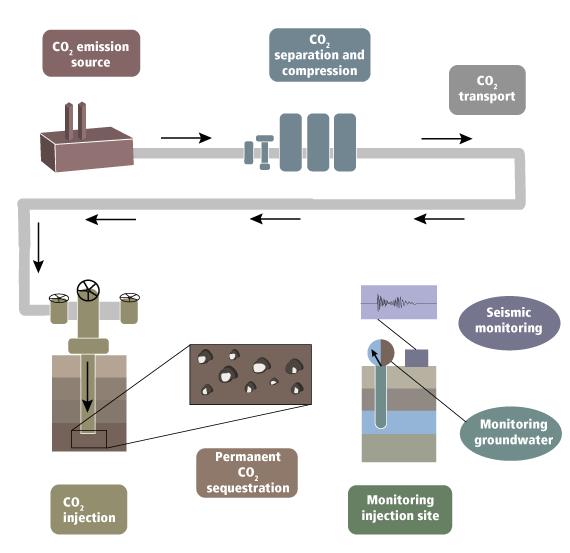
Where Can Geological Carbon Sequestration Take Place?
Whether a site will be a good place to store carbon dioxide depends on several factors, including ground permeability, porosity, and the presence of low permeability caprocks. Permeability refers to how easily a fluid can move through a material. During geological carbon sequestration, the carbon dioxide in supercritical fluid form should be able to move throughout the rock or liquid where it is being stored. Sites with suitable porosity have holes or cracks the supercritical fluid can occupy. Sedimentary rocks like sandstone and limestone are both highly permeable and porous, making them good candidates for storing carbon dioxide (Chidsey, 2016; CLEAR Center, 2022; De Silva et al., 2015; Szymanski, 2022; UCTV, 2009).
Geological carbon sequestration also requires a caprock to limit carbon dioxide leakage during and after injection. Caprocks have low permeability and porosity. These rocks act like a “cork” by trapping carbon dioxide within the highly permeable and porous rock below Shale is an effective caprock because it has low permeability and porosity (Chidsey, 2016; CLEAR Center, 2022; De Silva et al., 2015; Szymanski, 2022; UCTV, 2009).
In addition to permeability, porosity, and presence of a low permeability caprock, anyone intending to perform geological carbon sequestration must consider the following factors during site selection: injection techniques, pressure, temperature, storage capacity, carbon dioxide movement within the storage location, the risk of inducing small earthquakes, and the potential for harmful leakage into freshwater aquifers (Bachu, 2015). Several geological structures deep saline aquifers, depleted oil and gas fields, subsurface sedimentary formations, large folds of bedrock, buried basalt flows, and deep coal beds commonly meet these criteria and can support successful geological carbon sequestration (Chidsey, 2016; CLEAR Center, 2022; De Silva et al., 2015). Below, we focus on how geological carbon sequestration works in two types of sites that are relevant in Utah: deep saline aquifers and depleted oil and gas fields.
Geological Carbon Sequestration in Deep Saline Aquifers
One of the most promising locations to store carbon dioxide is in deep saline aquifers. Deep saline aquifers are underground reservoirs of extremely salty water. Because the water is so salty that it is undrinkable, using these features for carbon sequestration should have no effect on water supply (CLEAR Center, 2022; De Silva et al., 2015).
When carbon dioxide is injected into a deep saline aquifer, the resulting supercritical fluid rises to the top of the reservoir because it is less dense than the salt water. Once there, it spreads out along the bottom of the caprock, where it is constrained into small gas bubbles within the caprock’s pores. This process is known as capillary trapping (Berkeley Lab, 2010; UCTV, 2009).
Eventually, the carbon dioxide will dissolve into the water, a process known as ionic trapping. Depending on the minerals available to react within the aquifer, the dissolved carbon dioxide can precipitate out of solution, forming a solid. Ideally, the dissolved carbon dioxide precipitates out of solution as carbonate minerals, such as calcite or dolomite (Berkeley Lab, 2010; UCTV, 2009). Although forming carbonate minerals is a long and slow process, it is also the most stable form of trapping and sequestering carbon dioxide (CLEAR Center, 2022; De Silva et al., 2015; Jia et al., 2021; Szymanski, 2022). Carbonate rocks lock up carbon in terrestrial forms on million-year time scales until it is eventually released as carbon dioxide gas or dissolved carbonate ions via tectonic processes, such as uplift and weathering, metamorphism, or volcanic processes.
Geological Carbon Sequestration in Depleted Oil and Natural Gas Wells
Another place where carbon dioxide can be stored via geological carbon sequestration is in depleted oil and gas wells. Oil and natural gas are fossil fuels made of long-decayed organic matter, which, by definition, contains carbon. When decomposing organic matter is buried under Earth’s surface by natural processes, the matter and its carbon can get trapped in pockets. Over time, these pockets become oil and/or natural gas wells. For centuries, humans have drilled and extracted fossil fuels from these wells, proving the potential for these sites to store carbon (Chidsey, 2016; CLEAR Center, 2022). Large oil and gas fields that were developed in the 20th century but are now inactive can be suitable targets for carbon sequestration.
Geological carbon sequestration can also be combined with a technique called enhanced oil recovery that is used during fossil fuel extraction at some drilling sites. Enhanced oil recovery is when carbon dioxide is injected into active oil wells. The carbon dioxide, in its supercritical phase, loosens the oil that sticks to the permeable and porous rock and helps recover a higher percentage of oil from the well. Typically, the carbon dioxide is then allowed to leak out of the well after injection because carbon sequestration is not generally the end goal of the oil extraction practice (CLEAR Center, 2022; El-kaseeh & McCormack, 2023; Jia et al., 2021). However, some drilling operators have begun adding carbon sequestration into their enhanced oil recovery process. Combining these two practices is possible because enhanced oil recovery and carbon sequestration both require injecting carbon dioxide so it transforms into a supercritical fluid. By fusing these processes, drilling operations could improve the balance between the carbon dioxide emissions they enable and the carbon dioxide they sequester. One location that is currently applying enhanced oil recovery and geological carbon sequestration simultaneously is the Aneth oil field located in Southern Utah (Figure 2; Chidsey, 2016; Huang & Zhang, 2022).


Note. Since 2005, research on simultaneous enhanced oil recovery and carbon sequestration has been possible at the Aneth oil field because it is supplied with carbon dioxide via a pipeline from a Colorado source (Utah Geological Survey, n.d.).
Sources: (left) McPherson, 2016; (right) Slaker et al., 2013
Figure 2. (left) Drilling at the Aneth Oil Field in Utah Began in 1953, and (right) Map of Greater Aneth and Carbon Dioxide Supply Pipeline
The Aneth Research Project
Since 2005, the Utah Geological Survey and Southwest Regional Partnership for Carbon Sequestration have been conducting research on the effects of combining enhanced oil recovery and carbon sequestration at the Aneth oil field (Utah Geological Survey, n.d.). The project aims to determine whether sequestering carbon dioxide is possible while also increasing the amount of oil produced from the field. The research involves monitoring the movement of the carbon dioxide within the well and tracking the well’s ability to effectively store the carbon dioxide (Chidsey, 2016; Huang & Zhang, 2022; Szymanski, 2022; Utah Geological Survey, n.d.). By monitoring the site, risks like small earthquakes from applying pressure deep underground and carbon dioxide leakages can be understood and addressed
Potential for Geological Carbon Sequestration in Utah
Utah has multiple geological structures, including deep saline aquifers, oil and gas reservoirs, and subsurface sedimentary formations, that could potentially sequester carbon dioxide. However, conducting geological carbon sequestration at a large scale in Utah would require installing pipelines for transporting liquid carbon dioxide to key locations around the state. Moreover, further research is needed to understand and mitigate risks associated with small earthquakes and possible water table contamination (CLEAR Center, 2022). In addition to their research on the Aneth oil field, the Utah Geological Survey is exploring other options for geological carbon sequestration throughout Utah (Szymanski, 2022). This work is important because Earth’s natural carbon storage processes can no longer keep up with the amount of carbon being emitted.
Acknowledgments
This publication was produced as part of the Climate Adaptation Intern Program (CAIP) at Utah State University (https://qcnr.usu.edu/research/caip/). CAIP was supported by the “Secure Water Future” project that is funded by an Agriculture and Food Research Initiative Competitive Grant (#2021-69012-35916) from the USDA National Institute of Food and Agriculture. This fact sheet was improved based on suggestions from Dennis Newell, Ph.D., and feedback from CAIP participants
For correspondence, contact Scott Hotaling: scott.hotaling@usu.edu
References
Bachu, S. (2015). Review of CO2 storage efficiency in deep saline aquifers. International Journal of Greenhouse Gas Control, 40, 188–202. https://doi.org/10.1016/j.ijggc.2015.01.007
Berkeley Lab. (2010). Carbon cycle 2.0: Don DePaolo: Geo and bio sequestration [Video]. YouTube. https://www.youtube.com/watch?v=8EqDlUMzra4
Chidsey, T. C. (2016, January 21). Geological sequestration of carbon dioxide and enhanced oil recovery. Utah Geological Survey. Retrieved on June 14, 2024, from https://geology.utah.gov/map-pub/surveynotes/carbon-dioxide-sequestration/ CLEAR Center. (2019, September 20). What is carbon sequestration and how does it work? University of California, Davis. Retrieved on June 14, 2024, from https://clear.ucdavis.edu/explainers/what-carbonsequestration
De Silva, G. P. D., Ranjith, P. G., & Perera, M. S. A. (2015). Geochemical aspects of CO2 sequestration in deep saline aquifers: A review. Fuel, 155, 128–143. https://doi.org/10.1016/j.fuel.2015.03.045
El-kaseeh, G. & McCormack, K. L. (2023). Multi-scale seismic measurements for site characterization and CO2 monitoring in an enhanced oil recovery/carbon capture, utilization, and sequestration project, Farnsworth Field, Texas. Energies (19961073), 16(20), 7159. https://doi-org.dist.lib.usu.edu/10.3390/en16207159
Esser, R., Levey, R., Mcpherson, B., O’Dowd, W., Litynski, J., & Plasynski, S. (2010). Preparing for a carbon constrained world; overview of the United States regional carbon sequestration partnerships programme and its Southwest Regional Partnership. In Geological Society, London, Petroleum Geology Conference Series, 7(1), 1189–1195. https://doi.org/10.1144/0071189
Huang, L. & Zhang, Z. (2022). Chapter 8: Time-lapse offset VSP monitoring at the Aneth CO2-EOR Field. In Geophysical Monitoring for Geologic Carbon Storage (pp. 125–144). Wiley-American Geophysical Union. https://doi.org/10.1002/9781119156871.ch8
International Energy Agency (n.d.). Carbon capture, utilisation, and storage Retrieved on June 14, 2024, from https://www.iea.org/energy-system/carbon-capture-utilisation-and-storage
Jia, W., Xiao, T., Wu, Z., Dai, Z., & McPherson, B. (2021). Impact of mineral reactive surface area on forecasting geological carbon sequestration in a CO2-EOR Field. Energies, 14(6), 1608. https://doi.org/10.3390/en14061608
McPherson, R. S. (2016, April 26). Aneth oil field. History To Go. Retrieved on June 14, 2024, from https://historytogo.utah.gov/aneth-oil-field/ Milligan, M. (2019, May 8). Energy news: A partner in the CarbonSAFE Rocky Mountains Project. Utah Geological Survey. Retrieved on June 14, 2024, from https://geology.utah.gov/map-pub/surveynotes/energy-news/carbonsafe/ National Energy Technology Laboratory. (n.d.). Unconventional storage U.S. Department of Energy. Retrieved on June 14, 2024, from https://netl.doe.gov/carbon-management/carbon-storage/unconventionalstorage Slaker, B., Westman, E., Luxbacher, K., & Ripepi, N. (2013). Application of double-difference seismic tomography to carbon sequestration monitoring at the Aneth Oil Field, Utah. Minerals, 3, 352–366. 10.3390/min3040352
Szymanski, E. (2022, April 27). Assessing geologic carbon sequestration opportunities in Utah. Utah Geological Survey. Retrieved on June 14, 2024, from https://geology.utah.gov/map-pub/surveynotes/assessing-geologic-carbon-sequestration-opportunities-in-utah/ Understanding Global Change. (2020, September 10). Carbon cycle. University of California Museum of Paleontology. Retrieved on June 14, 2024, from https://ugc.berkeley.edu/background-content/carbon-cycle/ University of California Television (UCTV). (2009, September 17). Geologic carbon sequestration [Video] YouTube. https://www.youtube.com/watch?v=D9U0fRYrHyw Utah Geological Survey. (n.d.). Greater Aneth Oil Field - geologic sequestration demonstration. Retrieved on June 14, 2024, from https://geology.utah.gov/energy-minerals/ccus/aneth-oil-field/#tab-id-1 Washington Geological Survey (2021). Geologic carbon sequestration [Fact sheet] Washington Department of Natural Resources. Retrieved on June 14, 2024, from https://www.dnr.wa.gov/publications/ger_fs_carbon_sequestration.pdf
In its programs and activities, including in admissions and employment, Utah State University does not discriminate or tolerate discrimination, including harassment, based on race, color, religion, sex, national origin, age, genetic information, sexual orientation, gender identity or expression, disability, status as a protected veteran, or any other status protected by University policy, Title IX, or any other federal, state, or local law. Utah State University is an equal opportunity employer and does not discriminate or tolerate discrimination including harassment in employment including in hiring, promotion, transfer, or termination based on race, color, religion, sex, national origin, age, genetic information, sexual orientation, gender identity or expression, disability, status as a protected veteran, or any other status protected by University policy or any other federal, state, or local law. Utah State University does not discriminate in its housing offerings and will treat all persons fairly and equally without regard to race, color, religion, sex, familial status, disability, national origin, source of income, sexual orientation, or gender identity. Additionally, the University endeavors to provide reasonable accommodations when necessary and to ensure equal access to qualified persons with disabilities. The following office has been designated to handle inquiries regarding the application of Title IX and its implementing regulations and/or USU’s non-discrimination policies: The Office of Equity in Distance Education, Room 400, Logan, Utah, titleix@usu.edu, 435-797-1266. For further information regarding nondiscrimination, please visit equity.usu.edu, or contact: U.S. Department of Education, Office of Assistant Secretary for Civil Rights, 800-421-3481, ocr@ed.gov or U.S. Department of Education, Denver Regional Office, 303-844-5695 ocr.denver@ed.gov. Issued in furtherance of Cooperative Extension work, acts of May 8 and June 30, 1914, in cooperation with the U.S. Department of Agriculture, Kenneth L. White, Vice President for Extension and Agriculture, Utah State University.
July 2024
Utah State University Extension
Suggested citation: Storrud, S., Becker, K.M.L., & Hotaling, S. (2024). Artificial carbon sequestration in Utah [Fact sheet]. Utah State University Extension.