
Alternative Tree Species for Utah Syrup Production
Abigail Porter, Steven Price, Youping Sun, and Darren McAvoy
When thinking about producing syrup from trees, most people's minds go straight to maple trees. This is understandable given that the United States produced over 4 million gallons (about 1.7 x 10⁷ liters) of maple syrup in 2023, with Vermont producing more than half of that total (National Agricultural Statistics Service, 2024). The most common maple trees to tap are sugar maple (Acer saccharum), black maple (Acer nigrum) and red maple (Acer rubrum). However, a variety of other species in the Intermountain West can be tapped for sap.
Maples (Acer spp.).
Did You Know?
The United States produces a lot of syrup, and while maples (Acer spp.) are the most common trees tapped for syrup-making (Norway maple, boxelder, bigtooth maple, Rocky Mountain maple, Tatarian maple, and paperbark maple), a variety of other species in the Intermountain West may be tapped for sap as well, such as birch, walnut, sycamore, and, possibly, aspen.
Maples are within the genus Acer. Any species from the genus can be harvested for sap collection. Some maple species are more common in the Intermountain West and have been harvested with varying levels of success.
Norway Maple
Norway maple (Acer platanoides) is native to Europe, but it is a common ornamental tree in Utah. The cultivar 'Crimson King' is popular for its reddish-purple leaves, although many other cultivars exist. This hardy tree grows in U.S. Department of Agriculture (USDA) Plant Hardiness zones 3–8 and can range anywhere from 25 to 60 feet tall at maturity, depending on the cultivar (Hansen et al., 2021).
• Identification:
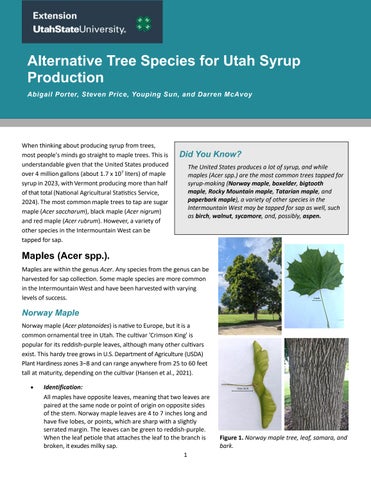
All maples have opposite leaves, meaning that two leaves are paired at the same node or point of origin on opposite sides of the stem. Norway maple leaves are 4 to 7 inches long and have five lobes, or points, which are sharp with a slightly serrated margin. The leaves can be green to reddish-purple. When the leaf petiole that attaches the leaf to the branch is broken, it exudes milky sap.


Figure 1. Norway maple tree, leaf, samara, and bark.
The bark of the Norway maple is smooth on younger trees and becomes furrowed as they age. Maples produce samara, a winged fruit, which are 1.5 to 2 inches long and mature in late summer to early fall (Figure 1; Utah State University (USU) Extension – Forestry, n.d.).
• Tapping:
Norway maples have been tapped in late winter, generally February, in Utah and have produced enough sap to create syrup. For more information on how to tap Norway maples, reference USU Extension’s fact sheet “Producing Maple Syrup From Boxelder and Norway Maple Trees ”
Boxelder
Boxelder, ash-leaved, or Manitoba maple (Acer negundo) is a species native to Utah that is generally undesirable as an ornamental plant, due to its weak structure and attractiveness to boxelder bugs (Boisea trivittata), which can be a nuisance. However, this tree is hardy from zones 2 through 9 and has been tapped with success in Utah.
• Identification:
Boxelder leaves are unique because they are pinnately compound with multiple leaflets attached to the petiole instead of just one (Figure 2). Boxelders can have three to seven leaflets, which sometimes look like poison ivy leaves.
The samaras of boxelder trees are small, V-shaped and hang down in bunches. They tend to stay on the tree during the winter, making it easier to identify during the tapping season. The bark of boxelder trees is generally light gray or light brown with deep furrows (Figure 2).
These trees grow quickly to around 25–50 feet tall. They also have an oval-shaped canopy with a mature width of around 30 feet (Hansen et al., 2021).
• Tapping:
Boxelder trees have been tapped in the late winter in Utah, generally in February, producing enough sap to create syrup. For more information on how to tap Boxelder maples, reference USU Extension’s fact sheet “Producing Maple Syrup From Boxelder and Norway Maple Trees ”
Bigtooth Maple


The bigtooth maple, also known as the canyon maple (Acer grandidentatum), is a small tree species native to Utah. Most wellknown for its beautiful red-orange fall color, it also has the potential to become a significant tapping resource in the Intermountain West.


Figure 2. Boxelder tree, leaf, samara, and bark
Figure 3. Bigtooth maple tree, leaf, samara, and bark.
• Identification:
Bigtooth maple are sometimes referred to as a large shrub. The bigtooth maple is commonly multi-stemmed with a trunk diameter of 9 inches at maturity. Heights average around 30 feet and crown spread around 15 feet (see USU Extension’s TreeBrowser).
Leaves are around 4 inches in diameter and divided into three to five lobes that have blunt “teeth” on the edges (USU Extension – Forestry, n.d.). They are bright green in the spring and summer and a vibrant red in the fall. The samaras are about 1 inch long, hanging in clusters on the tree. The seeds in the samara are prominently rounded compared to other maples (Figure 3).
• Tapping:
Bigtooth maples have been tapped successfully in Utah. The nonprofit organization “Bigtooth Maple Project and Syrup” in Woodland Hills, Utah, tapped over 900 trees in 2024 to make nearly 60 gallons of syrup. This additional USU Extension article (King, 2023) is about tapping maple trees in the Intermountain West: “Tapping Maple Trees for Syrup in the Intermountain West.” Note that because of bigtooth maple’s small size, a 7-inch diameter is acceptable for tapping. This is a smaller minimum diameter than recommended for other maples.
Rocky Mountain Maple
Rocky Mountain maple (Acer glabrum), also known as mountain maple, is a small tree native to Utah and surrounding states. It is not as common as a landscaping tree, but the shoots are edible, and it was used by Native American tribes for arrow shafts and snowshoe frames (USU Extension, n.d.-a).
• Identification:
Like the bigtooth maple, this tree can also be a multistemmed shrub or have a single dominant stem. It can reach up to 25 feet in height, with a narrow spread of around 10 feet. The leaves of Rocky Mountain maples are 3 to 5 inches wide, with three to five lobes. The leaves are rounded and have serrated edges that are dark green in the summer and yellow to red in the fall (Figure 4).
The samaras of Rocky Mountain maples are, on average, 1 inch long, pinkish at maturity, and brown in the fall (see USU Extension’s TreeBrowser).
• Tapping:
Little is known about the specifics of tapping Rocky Mountain maples. Still, it is likely similar to tapping bigtooth maple trees due to their similar sizes.
Tatarian Maple


4. Rocky Mountain maple tree, leaf, samara, and bark.
The Tatarian maple (Acer tataricum) is a small tree planted as an ornamental species in Utah. Its native habitat is southeastern Europe and western Asia, and its showy fruit are quite attractive.
• Identification:
Tatarian maples generally reach 25 feet in height, with a spread of around 20 feet and a trunk diameter ranging from 8 to 20 inches (Hansen et al., 2021). They can be shrubby or have a single dominant trunk. The leaves are slightly elongated compared to other maples and can be unlobed or slightly three-lobed. The edges are serrated, and the leaves are bright green with a yellow or red fall color. The flowers of Tatarian maples are creamy white
Figure
and showier than many maples. The samaras are around 1 inch long and are usually a brilliant red color (Figure 5; see USU Extension’s TreeBrowser).
• Tapping:
Anecdotally, Tatarian maples have been successfully tapped for sap, but research into quality or yield is locally lacking. Like all maples, the general rule of thumb is to tap in late winter when night temperatures are below freezing, and day temperatures are above freezing.
Paperbark Maple
The paperbark maple (Acer griseum) is a small tree native to China. It is planted as an ornamental tree in Utah because of its unique flaky bark and fall color, as well as its tolerance of high-pH soil.
• Identification:
Paperbark maples have an average height of 25 feet and a spread of 20 feet, with an average 10-inch diameter. The leaves are trifoliolate with three leaflets, similar to boxelder leaves. The edges of the leaves have few teeth, and they are bluish-green in the summer and red in the fall. The bark of the tree is cinnamon brown and smooth when young, but it starts to peel as the tree ages. The samaras are 1 to 1.5 inches long and pubescent or fuzzy (Figure 6; Utah State University Botanical Center, n.d.).
• Tapping:
Little is known about the practicality of tapping paperbark maples. Because its primary characteristic is attractive bark, people may hesitate to tap into the tree. However, the tree should still produce sap when correctly tapped
Birch (Betula spp.)
As with Acer species, many species in the Betula genus can be tapped for sap. Birch sap flows in the early spring when air temperatures reach around 50 °F, which is much later than maples. Birch sap has a low sugar content at around 0.5% to 1.5%, while maple sap has around 2% to 3%. Birch sap is a popular drink in some European countries and contains minerals such as calcium and potassium. Birch syrup has a unique flavor, generally described as fruity molasses. Boiling around 100 gallons of birch sap yields 1 gallon of birch syrup.


Figure 5. Tatarian maple tree, leaf, samara, and bark.
Figure 6. Paperbark maple tree, leaf, samara, and bark.
European White Birch
The European white birch, also known as the European weeping birch (Betula pendula), is a common landscaping tree in Utah. As the name suggests, it is native to Europe and northern Asia. These beautiful trees can be prone to borers but tend to do well in northern Utah.
• Identification:
European white birch can get large at 30–50 feet tall with a 20- to 30-foot spread. The bark is chalky white with dark horizontal lenticels on the older wood. The leaves are alternate and can be 1 to 3 inches long and 1 inch wide. The leaf shape can vary depending on the cultivar, but it is generally diamond or oval-shaped with serrated edges. The fruit is held in a catkin, a 1-inch-long cluster of tiny flowers in a cone shape that hangs down. The branches tend to have a weeping habit that is attractive in landscapes (Figure 7; see USU Extension’s TreeBrowser).
• Tapping:
Tapping European white birch trees has been successful. They are more prone to diseases than maples, so properly sanitizing tapping equipment is essential. Healthy trees can flow quite heavily for 2 to 3 weeks, some producing over 5 gallons in a single day (Farrell, 2013). It is important to note that after the tree stops yielding a significant amount of sap, do not plug the tapping hole. This practice was common in traditional tapping practices but has since been found to slow the healing process of the tapping wound.
Paper Birch
Paper birch (Betula papyrifera) is native to northern North America, but it is not commonly planted in Utah. Its wood is important in pulpwood and plywood production.
• Identification:
Paper birch can grow to 70 feet tall with a 25- to 30-foot spread. The dark green leaves are 3 inches long and ovalshaped with coarse teeth on the edges. As with European white birch, paper birch has white bark, but the older bark of paper birch will peel and easily separate from the tree. The younger branches are a dark reddish-black before becoming white, and the inner bark is a reddish-orange. The tree has male and female catkins with the male catkin 2 to 4 inches long and the female 1 inch long. Both catkins are generally in groups of three. Unlike the European white birch, the paper birch has little to no weeping habit (Figure 8; see USU Extension’s TreeBrowser).


Figure 7. European white birch tree, two types of leaves, catkin, and bark.
Figure 8. Paper birch tree, leaf, catkin, and bark.
• Tapping:
Paper birch is the most commonly tapped tree species in Alaska, where it is one of the few widespread hardwoods, making tapping easier. While the sugar content of the sap can vary from site to site, paper birch is one of the sweeter birch saps (Farrell, 2013).
Water (River) Birch
Water birch (Betula occidentalis) is the only birch native to Utah and is commonly found near streams or lakes. It is not as common in landscaping because it prefers wetter sites.
• Identification:
Water birch can be a multi-stemmed shrub or have a single dominant trunk. As a shrub, it grows to around 25 feet tall. As a tree it can reach up to 40 feet. The leaves are shiny green and 1 to 2 inches long and around 1 inch wide. They are rounded with a serrated margin. The bark is unique, with a reddish-brown color, and is very shiny. The older bark also has light horizontal lenticels. The catkins are around 1 inch long and they mature in the fall (Figure 9; USU Extension, n.d.-a; see USU Extension’s TreeBrowser).
• Tapping:
Little has been published about tapping water birch, but they should produce successfully. Water birch typically grows near water, which may contribute to high sap volume production.


Walnut (Juglans spp.)
Utah's two most common walnut trees are black walnut and English walnut. Many are unaware that walnuts produce tappable sap, although yields are much less than those from maple trees. Similar to maples, walnuts move sap amid the freeze/thaw cycle during late winter. The sap has an approximate 2% sugar content and can be boiled down into a nutty-tasting syrup. Walnut sap has high amounts of pectin, which can be difficult to boil down into a syrup without proper filtering.
Black Walnut
Black walnuts (Juglans nigra) are native to the eastern United States and Canada. Known primarily for their beautiful lumber, black walnuts produce sap around the same time as maples. Unfortunately, there has been an increase in the incidence of thousand canker disease in sizeable black walnut trees in Utah. Once contracted, this disease is nearly 100% fatal, discouraging people from planting black walnut trees.
Figure 9. Water birch tree, leaf, catkin, and bark.
Figure 10. Black walnut tree, bark, fruit, and leaf.
• Identification:
Black walnut trees can grow around 50 feet tall with a similar spread. Leaves are alternate and pinnately compound, with 15–23 leaflets per leaf ranging from 1–2 inches long. The leaflets will usually drop in autumn before the petiole does, making winter identification easier. Black walnuts produce a hard nut encased in a yellow-green fruit that, if not picked, will turn black and fall off the tree. The bark is dark brown with ridges in a diamond pattern, and the wood, though commercially important elsewhere, is generally not milled for lumber in Utah due to its poor quality (Figure 10; see USU Extension’s TreeBrowser).
• Tapping:
Black walnut is tapped in the Midwest and eastern United States. Its production is far below that of maple, both in yield and use, but the taste is reportedly good (Farrell, 2013) Spring is the most common time to tap. Walnuts have very thin sapwood, so a sufficient tapping depth is around 1.5 inches. Due to thin sapwood, walnuts produce less sap than maples, although the sugar content is similar (Farrell, 2013).
English Walnut
The English walnut (Juglans regia), also known as the Persian walnut, is native to southeastern Europe, the Himalayas, and China. It is generally not as cold-hardy as black walnut, so growers in Utah are advised to plant them in areas more protected from cold winter conditions. Grown mainly in California, these are the most common walnuts in the United States.
• Identification:
Like black walnuts, English walnuts can grow 50 feet tall with a similar spread. Their leaves are pinnately compound but generally have five to nine leaflets instead of the 13 black walnuts can have. Their bark is silver-gray and smoother than black walnuts. The wood is commercially valuable and has a purple-brown color, prized for woodworking. English walnuts have a smoother and thinner shell than black walnuts, with a milder taste (Figure 11; see USU Extension’s TreeBrowser).
• Tapping:


Tapping English walnuts is very similar to tapping black walnuts. The smooth bark of English walnuts can make tapping slightly easier, but the sugar content and yield seem to be similar. More research is needed to address the differences in black versus English walnut sap and syrup production values (Farrell, 2013).
Aspens (Populus spp.)
Quaking and Swedish aspens are the most common aspen species in Utah. These beautiful trees often have an interconnected root system and are sometimes found in large groves. Some evidence suggests that aspens may be tapped for sap using a vacuum, but more research is needed to validate this method.
Quaking Aspen
Quaking aspen (Populus tremuloides) is Utah's state tree. It is native to the northern latitudes of the United States and Canada. Utahns love this attractive tree, which is very common at higher elevations. Quaking aspen reproduces primarily through root sprouts, sometimes forming genetically identical groves.
Figure 11. English walnut tree, bark, leaf, and fruit.
• Identification:
Quaking aspens can grow up to 40 feet tall and have a narrow canopy spread. The trunks are usually slender but can have a diameter of up to 3 feet. They have simple, round alternate leaves (USU Extension, n.d.-a). The leaves can range from 1–3 inches, with serrated margins. The leaves are green in the summer, turning brilliant yellow in the fall. The leaves are very flat and thin, causing them to flutter, or “quake,” in the wind. The creamy white bark grows furrowed on older trees (Figure 12; USU Extension, n.d.-a; see USU Extension’s TreeBrowser).
Swedish Aspen
Swedish aspen (Populus tremula), also known as European aspen, is native to Europe, Asia, and northern Africa. This species may do better than the quaking aspen in Utah’s valleys. It is a uniquelooking tree that offers a windbreak for homes.
• Identification:
Swedish aspens can grow from 30–60 feet tall but have a very narrow canopy spread of less than 10 feet in columnar varieties, such as the popular ‘Erecta’. Like quaking aspen, their leaves are round and alternate but have distinct rounded teeth. They also turn yellow in the fall, and the flat leaves flutter attractively in the wind. The bark is smooth and cream-colored, and the branches are strongly upright (Figure 13; Utah State University Extension).
• Tapping:
There is currently no published research on tapping aspen trees. Michael Farrell, Ph.D., an expert in tapping various tree species in the eastern United States, reported successfully tapping aspen trees with a vacuum system. Many people are reluctant to tap aspen trees for fear of injuring them. Natural quaking aspen populations in Utah are already under stress from drought, pest and disease outbreaks, and herbivory, which are exacerbated by climate change (Rogers, 2017). It is unknown how the stress of tapping will further affect this keystone species. In addition, more research should be done on vacuums in tapping systems. However, there is potential for success. If aspen trees can be tapped for syrup, it would be a uniquely Western product that would catch the interest of many.


Figure 12. Quaking aspen tree, bark, and leaf.
Figure 13. Swedish aspen tree, bark, and leaf.
American Sycamore
The American sycamore (Platanus occidentalis), also known as the American planetree, is a large tree native to the eastern United States. It is occasionally planted in Utah, along with its hybrids, and is salt and drought tolerant. While it is not well known, American sycamore does produce tappable sap in the spring.
• Identification:
American sycamores can grow from 70 to 100 feet tall and spread 60 to 75 feet. They have large, alternate leaves that are 3 to 8 inches wide. The leaves are lobed and smooth on the top and hairy on the veins underneath. The outer bark is mottled and brown, and the inner bark is smooth and white. The fruit is a round yellow-brown achene cluster ball, around 1 inch wide, that hangs from a long stem. The fruit usually persists through the winter, making identification easy when the tree is dormant without leaves (Figure 14; Utah State University Extension).
• Tapping:
There are a few reported cases of successfully tapping American sycamore trees. They are tapped in the spring and do not produce a large amount of sap. The syrup has a unique butterscotch taste (Farrell, 2013). While rare in the state, if these trees are on a homeowner's property, they may be worth tapping to see how well they produce.
Acknowledgments


Figure 14. American sycamore tree, leaf, branches, and bark.
Photos were provided by Abigail Porter, S.J. and Jessie E. Quinney College of Agricultural and Natural Resources, Utah State University.
The authors did not use generative AI in creating this content, and it is solely the work of the authors. This content should not be used for the purposes of training AI technologies without express permission from the authors.
References
Farrell, M (2013). The sugarmaker’s companion: An integrated approach to producing syrup from maple, birch, and walnut trees. Chelsea Green Publishing Hansen, S., Gunnell, J., & Emmertson, A. (2021). Maples in the landscape [Fact sheet]. Utah State University Extension. https://extension.usu.edu/yardandgarden/research/maples-in-the-landscape King, N. (2023). Tapping maples trees for syrup in the Intermountain West [Fact sheet]. USU Extension. https://extension.usu.edu/forestry/publications/Utah-forest-newsletter/maple-tapping National Agricultural Statistics Service (NASS). (2024). QuickStats. United States Department of Agriculture (USDA). Retrieved September 4, 2024, from https://quickstats.nass.usda.gov/results/EEC1F21C-E8F3-3EA8-9F9AA8D52FE8DAE9/ .
Rogers, Paul C. (2017) Guide to quaking aspen ecology and management with emphasis on Bureau of Land Management lands in the Western United States. Western Aspen Alliance
Utah State University Botanical Center. (n.d.). William A. Varga Arboretum: Trees of the arboretum. https://extension.usu.edu/botanicalcenter/gardens-venues/arboretum-trees
Utah State University Extension - Forestry. (n.d.). Tree identification. https://extension.usu.edu/forestry/treeidentification/
Utah State University Extension. (n.d.-a). Range plants of Utah. https://extension.usu.edu/rangeplants/
Utah State University Extension. (n.d.-b). TreeBrowser. https://extension.usu.edu/treebrowser/
In its programs and activities, including in admissions and employment, Utah State University does not discriminate or tolerate discrimination, including harassment, based on race, color, religion, sex, national origin, age, genetic information, sexual orientation, gender identity or expression, disability, status as a protected veteran, or any other status protected by University policy, Title IX, or any other federal, state, or local law. Utah State University is an equal opportunity employer and does not discriminate or tolerate discrimination including harassment in employment including in hiring, promotion, transfer, or termination based on race, color, religion, sex, national origin, age, genetic information, sexual orientation, gender identity or expression, disability, status as a protected veteran, or any other status protected by University policy or any other federal, state, or local law. Utah State University does not discriminate in its housing offerings and will treat all persons fairly and equally without regard to race, color, religion, sex, familial status, disability, national origin, source of income, sexual orientation, or gender identity. Additionally, the University endeavors to provide reasonable accommodations when necessary and to ensure equal access to qualified persons with disabilities. The following office has been designated to handle inquiries regarding the application of Title IX and its implementing regulations and/or USU’s non-discrimination policies: The Office of Equity in Distance Education, Room 400, Logan, Utah, titleix@usu.edu, 435-797-1266. For further information regarding non-discrimination, please visit equity.usu.edu, or contact: U.S. Department of Education, Office of Assistant Secretary for Civil Rights, 800-421-3481, ocr@ed.gov or U.S. Department of Education, Denver Regional Office, 303-844-5695 ocr.denver@ed.gov. Issued in furtherance of Cooperative Extension work, acts of May 8 and June 30, 1914, in cooperation with the U.S. Department of Agriculture, Justen Smith, Interim Vice President for Extension, Utah State University.

March 2026
Utah State University Extension Peer-reviewed fact sheet