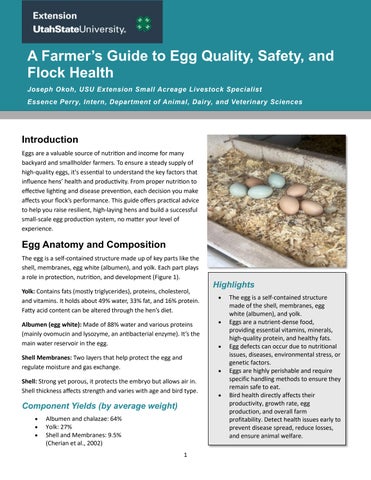
A Farmer’s Guide to Egg Quality, Safety, and Flock Health Joseph Okoh, USU Extension Small Acreage Livestock Specialist Essence Perry, Intern, Department of Animal, Dairy, and Veterinary Sciences
Introduction Eggs are a valuable source of nutrition and income for many backyard and smallholder farmers. To ensure a steady supply of high-quality eggs, it's essential to understand the key factors that influence hens’ health and productivity. From proper nutrition to effective lighting and disease prevention, each decision you make affects your flock’s performance. This guide offers practical advice to help you raise resilient, high-laying hens and build a successful small-scale egg production system, no matter your level of experience.
Egg Anatomy and Composition The egg is a self-contained structure made up of key parts like the shell, membranes, egg white (albumen), and yolk. Each part plays a role in protection, nutrition, and development (Figure 1). Yolk: Contains fats (mostly triglycerides), proteins, cholesterol, and vitamins. It holds about 49% water, 33% fat, and 16% protein. Fatty acid content can be altered through the hen’s diet. Albumen (egg white): Made of 88% water and various proteins (mainly ovomucin and lysozyme, an antibacterial enzyme). It’s the main water reservoir in the egg. Shell Membranes: Two layers that help protect the egg and regulate moisture and gas exchange.
•
•
•
•
Shell: Strong yet porous, it protects the embryo but allows air in. Shell thickness affects strength and varies with age and bird type.
Component Yields (by average weight) • • •
Highlights
Albumen and chalazae: 64% Yolk: 27% Shell and Membranes: 9.5% (Cherian et al., 2002) 1
•
The egg is a self-contained structure made of the shell, membranes, egg white (albumen), and yolk. Eggs are a nutrient-dense food, providing essential vitamins, minerals, high-quality protein, and healthy fats. Egg defects can occur due to nutritional issues, diseases, environmental stress, or genetic factors. Eggs are highly perishable and require specific handling methods to ensure they remain safe to eat. Bird health directly affects their productivity, growth rate, egg production, and overall farm profitability. Detect health issues early to prevent disease spread, reduce losses, and ensure animal welfare.