SPRING 2016 I VOL. 3 NO. 1
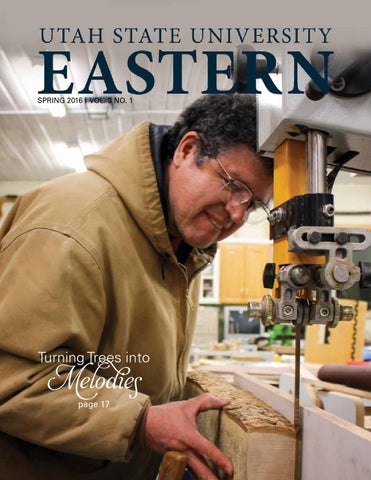
Turning Trees into
Melodies page 17
REFLECTING ON THE SAC While taking some parting shots prior to the sacking of the old Student Activity Center in February, I swung my camera around and was stunned by this haunting reflection in the window of the Central Instruction Building. The old SAC, like memories, was about to fade away into a distant blur. “So dawn goes down to day,” observed Robert Frost. “Nothing gold can stay.” — John DeVilbiss
CONTENTS MANAGING EDITOR
Vol. 3, No. 1 | Spring 2016
John DeVilbiss john.devilbiss@usu.edu
NEWS EDITOR Susan Polster susan.polster@usu.edu
DESIGN & PRODUCTION Holly Broome-Hyer
CHANCELLOR Joe Peterson
VICE CHANCELLORS Guy Denton Peter Iyere Greg Dart
USU EASTERN REGIONAL ADVISORY BOARD MEMBERS
Perfect Place for Wildlife Studies
10
Renee Banasky, Chair Erroll Holt, Vice Chair Jason Dunn Jeremy Redd Sophia DiCaro Mark Holyoak Frank Peczuh, Jr.
UTAH STATE UNIVERSITY EASTERN MAGAZINE is published biannually by Utah State University Eastern Institutional Advancement. Periodical postage paid at Price, Utah and additional mailing offices. POSTMASTER: Send address changes to USU Eastern Office of the Chancellor, 451 E. 400 N. Price, UT 84501. Reproduction in whole or in part without written permission is prohibited. Opinions expressed do not necessarily represent the official position of USU Eastern. USU Eastern is committed to equal opportunity in student admission, financial assistance, and faculty and staff employment.
Keeps on Truckin’
6
13
Stellar Writing Advice
PLUS: 4 Six Honored at Founders Day
27 The Natural Poetry of Nancy Takacs
5 Student Ryan Cano Bound for Yale
28 Larry Severeid’s Life of Quiet Victories
19 From CEU to BMX Champ
29 A Fellow Historian Graces Blanding
22 Coach Paur Says He’d Do It Again
31 Class Notes: How Are You Doing?
25 New Dinosaur Named Special thanks to Peczuh Printing, Price, Utah, for the printing in-kind of this biannual magazine.
COVER: USU Eastern Professor Elias Perez transforms a beloved campus tree into an elegant guitar. Photo by Elias Perez with a remote control on his camera.
SALZETTI YOUNG
USU Eastern Joined USU Logan in
SEVEREID
Founders Day Celebrations
G
rab the fire extinguisher. Utah State University’s birthday cake had 128 candles — plus 79 from USU Eastern and another 39 from USU Eastern Blanding. It was all part of the March 4th combined celebration of the founding of three institutions March 4. Festivities commenced with Price hosting its own traditional celebration and recognitions prior to linking with the Logan campus via satellite. In addition to Price and Blanding, USU’s regional campuses at Moab, Uintah Basin, Tooele and Brigham City also joined the broadcast. The founding of Carbon College 79 years ago was celebrated by USU Eastern and included the presentation of awards to Edward Salzetti, “Gold Circle Donor;” Jan L. Young and Larry W. Severeid, “Upon Their Shoulders” recipients; Kirk Sitterud, “Lifetime Achievement Award;” April Hatch Cooper, “Athletic Hall of Fame;” and Chris Ashton, “Outstanding Alumnus Award.” Salzetti, 94-years-old, was honored for his gifts to USU Eastern. He was born in Sunnyside, Utah, where, as a boy, he helped his father load coal into the town’s coke oven. He and his bride, Paula, were married in 1947. She died in 2014. Together they founded the Po-
4 USU
EASTERN
lar King drive-in franchise that allowed them to branch off into hotel and real estate investments. Salzetti, who resides in Salt Lake City, says he relishes the opportunity to give back in some small way to the community that has meant so much to him. Young was honored with the “Upon their Shoulders” award. In December, 2015, she retired from USU Eastern. Her 35-year career, beginning with the College of Eastern Utah in 1981, involved many responsibilities including records technician, college registrar and director of records and registration where she played a key transition role during the college’s merger with USU. Severeid also received the “Upon their Shoulders” award. He started his teaching career at CEU in 1976 after earning a master of arts degree in English from the University of California, Los Angeles. He taught courses in composition, technical and vocational writing, English and American literature, nature literature, poetry and drama. Sitterud, superintendent of the Emery County School District, was given USU Eastern’s “Lifetime Achievement” award in recognition of his 44-year-career commitment to educa-
SITTERUD
COOPER
tion in Eastern Utah. Born and raised in OranASHTON geville, Utah, he graduated from Emery High School and earned an associate degree from CEU in 1970. Cooper was inducted into the school’s “Athletic Hall of Fame” in recognition of her basketball prowess. She played forward and center for CEU and later for USU. Cooper is ranked in the top 10 all-time for scoring, shooting and rebounding. Ashton was given the “Outstanding Alumnus” award. He earned a graphic arts degree in 1996 from CEU and financed his education working as a graphic designer for the college and as an artist for its prehistoric museum. For the past 20 years, he has created video games and is at the forefront of the interactive game industry. — John DeVilbiss
left his parents and siblings to move in with his aunt in Price. “My parents grew up in Mexico and were dirt poor,” he said. “It was tough for them growing up. My mom graduated from high school, but my father never had the chance to graduate. Because of the socioeconomic conditions in Mexico, it was not possible to economically support a family. They uprooted and moved to the United States in search of a better life. Ryan Cano with Professor John Weber. Photo by Tyson “Mom was driven Chappell to make sure I knew the value of education,” he said. “The intrinsic drive that she taught me was that through education I could better myself, help more people and change the world.” He did well while a student at CHS, rediting his mother for instilling graduating with a 4.0 the value of education, Ryan Cano GPA while working 30 hours a week and prepares to attend the Summer Medical participating in extra-curricular clubs and Dental Education Program at Yale and activities. University in New Haven, Connecticut. While in high school, “I enrolled in Cano will shadow physicians at every honors and advanced placement Yale’s New Haven Hospital with a curcourse I could,” he said. It was in honors riculum similar to what he will be exbiology that his penchant for science was posed to in medical school. He applied drastically amplified and his career goal to this program at Yale and Columbia became focused on medicine. universities and was accepted to both. He spent two summers at the Utah Born in Price, Utah, his family Rural Health Scholar’s Health Career moved to Huntington when he was a Exploration Camp and remembers a sectoddler. He attended schools in Emery ond-year medical student from the Mayo County until he was 16 when he transMedical School say, “there are no long ferred to Carbon High School because shots, only unprepared shooters.” Those it was a bigger school and had more words made an impression on him. opportunities for his major. He also Cano started shadowing doctors liked that Utah State University Eastern Shane Gagon and Scott Justesen whenwas close and he planned to take classes ever he had time. “Dr. Gagon introduced at the university while in high school. me to the science and art of medicine The downside of the move was he plus the other side of the profession: the
Accepted at Yale, Columbia: USU Eastern Student Proves
“There Are No Long Shots”
C
long hours and stacks of paperwork.” When he arrived at USU Eastern fulltime, he embraced every pre-medical class he could take from one of his three favorite professors: John Weber, Wayne Hatch and Tyson Chappell. “The hardest class I have ever taken was anatomy from Dr. Chappell, but it was also the most enjoyable class I have ever taken.” His fondest memory was studying the cadaver in Chappell’s lab. He appreciated all the extra time Weber spends out of class with his students. “He’s very invested in the students,” he said. “He even spent part of his fall break helping students with chemistry. Not many professors would give up their vacation to help students like he does.” Cano maintains a high GPA while at Eastern, with only two “A” minuses and a “B” in his perfect row of straight “A’s.” In addition to his classes, he holds the position of student association’s diversity representative, chemistry department tutor and lab assistant, Parkdale Health and Rehabilitation nursing facility volunteer, CHS physics and biology tutor, all while working 15-20 hours per week as a bilingual communication assistant at CaptionCall Communications. “I need gas money so I have to work during the week,” he smiles. “My mother told me to reach for the stars and believe in myself,” he said. “The health-care path is the way I have chosen to pursue my dreams.” When he graduates from Eastern in the spring, he will leave behind some of his favorite professors. “Students can connect with the faculty at USU Eastern,” he said. “They provide a lot of one-on-one attention, know your name and mentor students. Each professor made me feel important.” He hopes to defy the stereotypes imposed upon him and does not want to be a physician simply to break the mold. “I want to use my knowledge and humanity to make a positive contribution to the lives of individual people and society as a whole.” — Susan Polster USU EASTERN
5
Objects in Motion Justin Bergeman Keeps On Keepin’ On
T
he art of billiards is the ability to imagine, focus, anticipate and predict the force of one object upon another. This axiom did not come from reading a manual about playing pool; it came from hanging out with Justin Bergeman, director of professional career and technical education (PCTE) at Utah State University Eastern Blanding, who just so happens to also be a billiards instructor in his spare time. It is a hobby that informs his life and teaching. He is one who loves forward motion. Maybe it’s the 17 years of driving trucks and heavy equipment before he went to college. He can’t seem to stop moving now. “Some people say I don’t have an ‘off’ switch,” he says. And nothing pleases him more than to set into motion his own students and see the impact their lives can have on others, especially family and friends. A little nudge here, a little push there, is often all that it takes. “Something I like to talk to students about is their influence on others, how people view them and the hope they create for others,” he says. “There is a social responsibility there.”
And he considers it his responsibility to make them want to be there in the first place, to provide practical training that leads to real jobs and rewarding careers. “I think it’s important that our students can expect to get something out of their education,” he says. “They don’t want to be cheated by not getting enough from their classes.” To help ensure that, he often steps back and assesses the situation. Where are the opportunities? Where are the gaps? This penchant for kicking the tires before getting behind the wheel was likely a quality they recognized early on when they hired Bergeman shortly after graduating from CEU in 2007. He started in Blanding as an instructor of trucking and heavy equipment. Six years later, he was named director of the multi-faceted technical education program. Bergeman falls under USU’s School of Applied Sciences, Technology and Education within the College of Agriculture and Applied Sciences. While technical and professional education is not new to USU, programs in this field
Photos by John DeVilbiss
6 USU
EASTERN
had been in decline until the merger of CEU with USU in 2010. Joe Peterson, USU Eastern chancellor, says the technical and professional offerings that have long been a staple of former CEU, is helping the university, with its statewide reach, to expand those offerings, particularly to the benefit of rural economies. He says workforce projections show a demand for workers with some technical expertise, some post-secondary career training and technical skills, but not necessarily a baccalaureate. “That’s where the demand for jobs are, and the university is looking to USU Eastern with its nearly 80 years of experience in career and technical education to help lead the way,” he says. It was important enough to the chancellor and rest of the university to hire and house on the Price campus Gary Straquadine, vice provost and ASTE associate department head. He says his mandate is to grow these programs statewide, and its forward-thinking people like Bergeman who are helping to make this happen. “He’s so malleable,” Straquadine says. “He hasn’t been constrained by the Ph.D.” In addition to Bergeman’s adaptability, he also shows a knack for keeping his eye on the ball; lots of balls. For the past eight years he has carefully tracked all potential trucking and heavy equipment students, something now he and his colleagues will also be doing for their building construction students. The careful tracking has paid off in terms of increased enrollment for the program. And once students are enrolled, they continue to track them, monitoring their completion and employment rates. “I want just enough information so I can see what’s going on,” Bergeman says. “I want to see if things are being followed up.” So when a prospective student called him earlier in the month and expressed interest in the trucking program, a new file was created. Bergeman not only wants to make sure that this potential student gets a follow-up call, but also wants to make sure the referral agency
that sent the student his way is kept in the loop. Maintaining a good relationship with agencies is essential. And doing what it takes to help find financial help for students is equally important to him. His first big success in this area came in 2008 when he applied and received $250,000 over a two-year period from the Navajo Department of Workforce Services. It was vital funding that not only helped to enroll 32 Native Americans from the Navajo tribe, it also engendered trust in Blanding’s trucking and heavy equipment program. In the years since, hundreds of Navajo students have gone through the program with, at times, more than 90 percent graduating and finding jobs. Currently they are at 88 percent. Students like Clint Bitsue, a Navajo from Teec Nos Pos, Arizona. Bitsue was one of 17 USU Eastern Blanding students who earned a trucking certificate in December and 13 others who graduated with heavy equipment certification. Within weeks Bitsue was hired by Swift Trucking and today is
driving big rigs on cross-country hauls. Ninety percent of the 30 completers were Native American students. Blanding holds graduation ceremonies three times a year for its trucking and heavy equipment students. These impressive placement rates are the result of a number of things, foremost of which are students who graduate fully prepared to go to work. But being qualified to do the job in such a comprehensive industry comes with its own set of qualifiers: the more complex the job, the more skills it requires. The Blanding campus program lays a strong foundation for students starting out. Like with anything else, the more training students obtain, the more confident and competent they are as drivers. It is why offering courses that boost skills are important to Bergeman. These are add-on credentials for things like first-aid and CPR, OSHA safety training, air-brake adjustment and inspection, fire extinguisher use and use of respirators. With these little extras, his students more often find themselves at the head of the employment line than not.
Justin Bergeman with trucking and heavy equipment students. USU EASTERN
7
They also come out ahead in money. For example, if one of the brakes a long-haul truck is found to be out of adjustment, the driver can’t make that adjustment himself unless he’s certified. If this happens out on the road, it means having to wait until someone certified comes and makes that adjustment, all at a tremendous cost of time and money to the driver and his company. “During times like that, it’s a good thing to have,” he says. And it is good for the campus because it draws more people to these classes. It is the business side of Bergeman in play here, particularly marketing strategies. He earned a bachelor’s degree in business from USU’s Huntsman School of Business in 2012. He expects to complete a master’s degree in career and technical education at USU’s School
of Applied Sciences, Technology and Education in 2017. It is no surprise then that he runs his program like a business. Straight off, after becoming director, he started looking around and began asking “where’s my growth going to be?” He focused on declining enrollments and turned to his database to help him find solutions. “I knew if I didn’t find answers to those problems, we soon wouldn’t have students in our classes,” he says. “If the system is broken and we don’t fix it, we won’t get people here. If we don’t help them, they don’t get here.” He applied the same principles he used to build the trucking and heavy equipment program to the construction side, starting with finding the right individuals to be a part of his team — an essential first step, he says. A year ago, the construction pro-
gram was languishing with about seven students and three houses previously built that were still on the market. Today enrollment in this program has tripled. He says his team did this first by beefing up the program to make it more comprehensive, and then hiring instructor Roy Yoakam, who had worked in housing construction. They sold the three houses, got out of debt and began work on a new house. They also changed the construction period from a one-year to a two-year rotation to allow for more teaching and learning time. They expanded their recruitment reach into New Mexico, Arizona and Colorado, with special emphasis on adult learners. They met with referral agents to ensure them the houses they built would be industry-standard homes based on industry needs and the students they sent them would, in turn, be well-qualified once graduating. “It was vital that we talked to agencies on and off the reservation, otherwise they wouldn’t support us,” he says. “We talk about our success stories, we show the quality of services we provide and how we care about our students. We build our relationships based on our successes.”
Justin Bergeman is fond of reminding his students that “almost everything we have, drive on and eat at some point was hauled by a semi-truck and driver.”
8 USU
EASTERN
It’s a bottom line approach that resonates with agencies, students and administrators. And just as important as getting the students trained, is making sure that they are hirable by having skills the industry actually needs and wants. That means paying attention to the blind spots. Listening up, for example, when construction bosses complain that nobody wants to swing a hammer anymore, that everyone wants to be managers. “We don’t need more construction managers,” they tell Bergeman. “We need workers. We need people with skills who can be productive.” So does that mean he’s re-thinking the school’s associate of applied science degree that is designed to prepare students for construction management positions? Yes, it does, but not in a limited way. For him he sees this as an opportunity to make the program more comprehensive. After all, it’s no fun to play pool with just one ball. He’s all about taking a comprehensive approach in everything he does, so long as the balls on the table find their pockets as efficiently as possible. And what better field than construction to do this? “I can see adding things to our building program with opportunities to double and triple what we have now,” he says. “It’s something we can help with because building construction branches out in so many different areas.” Students currently have the option of earning a building construction-core certificate of completion by taking 10 courses ranging from building code and safety to exterior finishing, plus four to five credits in approved electives, for a total of 23 credits. To enhance that, students may earn a one-year certificate, along with the 23 credits, by fulfilling 10 credits of general education requirements, including English, math and a choice of other classes ranging from business to communications. These are considered stackable-core competencies that students can build upon to make them more valuable to potential employers. From here a student can go on to earn an associate of applied
science degree for construction management positions, small business ownership and general contracting. The stack can be arranged and piled on in any way a student desires. So when Bergeman hears from industry that they want more workers than managers, he looks at what kind of workers that are needed. One such area with promise is in the field of facility maintenance. “As far as I know, no other school offers a facility maintenance,” he says. “I see a gap that we can fill. Justin Bergeman: “Know who you are, decide what it We can be the niche takes, and find your motivation to get it done.” and we can expand on that niche.” He hopes to have an associate degree with a facilities and, honestly, I have students who are maintenance emphasis up and running getting excited about it: ‘You mean I by fall. There are other ideas that he and can get an applied associate’s degree in his colleagues have been mulling over, construction?’ ‘Yah, you can.’” like paving the way for a bachelor’s de Bergeman gets it because he’s been gree path for Blanding students in these there, from driving trucks, to pushing programs. One opportunity leads to real estate. He can swing a hammer but another, like one ball striking the next. he can also run an Excel spreadsheet. “Just this morning, I was telling He wears that rare combination of blue students ‘now that USU has an applied and white collar where academics blends associate’s degree, you can plug in your with technology, where “professional one-year certificates in building concareer” combines with “technical educastruction or heavy equipment,’” he says. tion.” It’s a wide swath but one intended He likens it to an educational freeto help students succeed, no excuses. way with both on and off ramps. That Because “excuses cause no results,” he means students can earn their one-year likes to tell his students. “Reasons cause certificates and immediately go to work. results.” But the option remains open for them Keeping your eye on the ball also to also return to school and pick up helps so long as you have an idea of what where they left off. So if they want to go pocket you want it in. It means focusing, on and earn an associate’s degree, their looking ahead and anticipating how the earned certificates will apply toward that force of one decision influences another. degree. So if you happen upon Bergeman when “That’s been the focus of the he is in such deep thought, don’t think stacking credentials we’ve been working he’s daydreaming, he is just cueing up. on these past couple of years,” he says. —John DeVilbiss “It leaves options open for our students USU EASTERN
9
Making a Place for
Wildlife Studies
at USU Eastern
W
allace Stegner in Wolf Willow talks about the importance of place and how it provides its own form of identity when he said, “I may not know who I am, but I know where I am from.” Put another way, “Our Mike King with wildlife students. where determines our who,” says Reg Saner. That appears to be the case for Michael King, Utah State University Eastern wildlife science professor. He loves where he lives and cannot seem to get enough of it, even after 32 years of living in Price. Glance through his collection of finely crafted photographs and you get a strong sense of his passion for place. The vast landscape that surrounds him has opened his eyes to a variety of things; often things that move. Wild things in the air and on the land and in the water. It has been this way since he was a boy growing up in Carbon County. What an apt place, then, to become a wildlife biologist. And what a perfect spot to teach the science of wildlife and for students to study it. King knows this and he’s well aware that his students know it too. Up until five years ago, however, students studying wildlife at USU Eastern earning their associate degrees had to move on to some other place if they wanted to pursue a bachelor’s. What made it doubly frustrating was the fact they had to leave an area strategically
10 U S U
EASTERN
located with agencies key to their field of study, entities such as Utah Division of Wildlife Resources, the U.S. Forest Service, the Bureau of Land Management and Natural Resources Conservation Service. It was like being a computer science or entrepreneurial student starting off in Silicon Valley only to leave halfway through for someplace else. Why would you? For wildlife students in Eastern Utah, this is their Silicon Valley, so why should they leave? Being able to work as interns at these agencies in and around Price is ideal. They are not only where they need to be, they are doing what they need to do: building resumes and gaining invaluable on-the-job experience. King knows this in the same way wildlife science professor Rich Etchberger recognized the importance of place back in 1995 when he established the wildlife program at USU’s Uintah Basin campus in Vernal. This was long before the merger
Students in Wildlife 2400 participate in a population survey of fish. Photos by Mike King
of USU with the College of Eastern Utah in 2010, but King had his eye on the Basin. He saw what was happening as a potential model for a program of his own at his college. By the time he became interim president of CEU in 2008, he was ready to start the conversation about what it would take to get a four-year wildlife science degree program started at Price. Those in on the conversation included Etchberger, Snow College and the wildland resources department at USU. The door opened when CEU merged with USU in 2010. King stepped down from his administrative post and stepped up his efforts to get the new four-year wildlife program off the ground. “The program wouldn’t be here without the merger,” he said. “It is up and running now and doing well. It’s exciting for me to be on the ground floor. It is certainly something that I
had been hoping to do for a long time. A nice way for me to spend my pre-retirement years.” And Casey Olsen, for one, is grateful that he happened to be in the right place at the right time. Olsen distinguished himself by becoming the first to receive a BA in wildlife science from Price at the college’s 2015 commencement ceremony. It was a big deal and he knows he could not have done it without King. Olsen was 35 years old at the time, making him the quintessential non-traditional student. But this Utah boy from Snowville did not start out that way. He first attended USU in Logan straight out of high school where he got involved early with the College of Natural Resources, including a chance to work as a landowners assistance specialist with the Division of Wildlife Resources in Utah’s northern region. He liked what he was doing and stayed on as a “seasonal” with DWR for four more years. When a full-time job with the division opened in Price, he jumped at the chance. It was all good except for the part about not being able to complete his degree. Moving back to Logan to finish was no longer an option. It meant that Muhammad would need to come to him if he wanted to finally bag that four-year degree. This place-bound urgency did not go unnoticed by King. He scrambled to get the courses Olsen would need to complete his four-year degree and in the process helped to make the new baccalaureate program a reality. It is safe to say that Olsen was able to walk across that stage last spring and receive his bachelor’s degree – in Price – because of what King did many years prior. Being able to stay in place to earn that degree has
earned a special place in Olsen’s heart for his professor. “Dr. King is awesome,” Olsen said. “He bends over backwards for you. He is not only interested in how you are doing as a student, but also in how you are personally doing.” Good for him and good for the students who benefit from his knowledge, experience and passion for place. King was honored this last year as academic advisor of the year in the College of Natural Resources and as a finalist for the university’s prestigious Robins Awards. He is also finishing a six-year appointment on the seven-member Utah Wildlife Board, appointed by Gov. Gary Herbert and confirmed by the Utah Senate in 2011. It is not the accolades, though, that he desires. What he wants is assurance that the program will continue and thrive long after he retires. He knows he does not have the 20 years that Etchberger has had in the Uintah Basin, which is why he is working to get additional full-time professors hired at Eastern. While this would
Andrew Todachinnie
USU EASTERN
11
benefit the Price campus, he envisions it bolstering the Uintah Basin as well. King already coordinates with Vernal and Roosevelt. Students from the Basin participate with his Price students on annual bear-denning trips. He broadcasts some of his classes to Vernal and Roosevelt, as well, and generally drives there to teach in person three to four times during the semester. He understands, as Etchburger has shown, that programs like these are well-suited for rural Utah. When they are run well, and resources shared, their impact can be enormous. The accolades Etchburger received of late, speaks to this. In November he was named the 2015 Carnegie Professor of the Year for the state of Utah, one of only 35 in the nation to take home this award. He did not obtain this honor by coasting. During the past two decades, Etchburger has received 65 grants with more than $2.4 million in funding to help support 300-plus undergraduate research and internship students. Best of all, 100 percent of the alumni in his program have started successful careers, gone on to graduate school, or both. And so far, thanks to Olsen, King’s program also boasts 100 percent placement. (“We’ll see what happens this next commencement,” he said with a smile.) The streak looks pretty good at holding when you consider this year’s crop of students. All five who are planning to receive their bachelor’s degree in April from USU Eastern have already, or continue to have, internships or seasonal positions with local agencies, especially with the DWR. “We have a lot going for us being here,” King said. “There are almost always opportunities to get involved with these agencies in some form and those opportunities lead to bigger and better opportunities for the students.” Work opportunities like sampling area streams and lakes, working on aquatic invasive programs such as checking boats for quagga mussels, working on habitat crews, building fences, planting fields and spraying for noxious weeds.
12 U S U
EASTERN
Casey Olsen graduated with his bachelor’s degree in 2015 in wildlife management. Photo by John DeVilbiss
It’s all good, every bit of it says Xaela Walden of Salt Lake City. This future biologist (she is still deciding between habitat and wildlife) can’t get enough of it. As an intern with DWR last summer, she worked in the fisheries and habitat departments doing pretty much everything across the board, from electrofishing to vegetation monitoring. She also got to meet with various organizations to discuss and present habitat projects for different species like big horn sheep and mule deer. She even did a bat survey and telemetry flights for several different species. “I enjoy going to work every single day,” she said. “There’s not a day I don’t want to go. I am still working for the habitat department right now. I like the days I go to work more than the days I don’t go.” Another April graduate, TJ Cook, of Price, spent last summer as a warm-waters-fisheries technician with DWR. He’d be content to do anything with fisheries. Tyrell Mils has been working for DWR full and part time for several years, including work at the Huntington Game Farm. Andrew Todachinnie of Montezuma Creek, also graduates in spring. He spent his summer working in northern Utah with Professor Terry Messmer, USU wildlife professor in the wildland resources department, doing radio-telemetry work tracking sage grouse at Deseret Land and Livestock. “I’ve had lots of opportunities I couldn’t have otherwise had,” Todachinnie said.
Scan a map of where these students have worked and studied along their four-year path to a Price-based degree and you see it has entailed a lot of road time. Travel is key to their studies and their eventual careers. Place certainly still matters even for graduates like Olsen because now “where” he works heavily dictates “what” his work involves as a wildlife-landowner-assistance specialist with the DWR. His “where” takes in all of Utah’s southeastern region, “… a pretty good chunk of ground,” he said. A pretty good chunk, indeed, chunks of ground where the deer and the antelope play. Well, more like where deer, elk, moose and your occasional skunks, pheasants, snakes and prairie dogs play and call home. He gets all kinds of calls. Without those places, he’d have no place to work. Farmers and ranchers also call this region home. When predator and feeders interact with them, trouble often ensues. So he’s there to mediate. Like Olsen, with his rural roots, all of these students are products of place – places they grew up, places they hunted and fished, places that motivated them in one way or another to choose wildlife as a career goal. Here’s the thing, though: they are students who seem to know exactly who they are, not just where they are from. They are candidates for a bachelor’s in wildlife science from USU Eastern with full-time jobs in their future. Their “where” does seem to be determining their “who.” Point taken, Reg Saner. —John DeVilbiss
Josi Russell in her writing studio flanked by her husband’s paintings. Photos by John DeVilbiss
Hitching Her Stories
to the Stars
Y
ou will want to cut Josi Russell a little slack when she resumes her duties in the fall as associate professor of English on the Utah State University Eastern Blanding campus. Her year-long sabbatical took her beyond the planet Minea and into the midst of a highly advanced, hostile alien race — publishers and critics. Just kidding, Future House Publishing. Haha. Wink. Wink. You too, brusque, insensitive internet critics. Minea is actually a planet of Russell’s making. And any reservations about getting her stellar stories published was also of her making. Fact is, Russell stared down her monster and triumphed. Future House is more like home sweet home as far as she is concerned with the publishing of her first two science fiction novels the past six months. One has already been made into an audiobook and the second soon will be. That monster of hers, incidentally, was a fear that many budding authors share in common, the dread of rejection. “I was so sure of rejection after I sent the manuscript that I didn’t check my email,” she says. “The acceptance letter from my publisher had been in my inbox nine days when I finally saw it.” Creating something for all the world to see, as with any artistic endeavor, can be a scary thing. It is a highly personal act, and so it is hard not to take what others say and think about it personally. Same goes for taking a creative writing course. Just the thought of that red ink can send shivers down one’s spine. If any student who plans to take Russell’s class this fall is nursing such apprehensions, he or she can stop now. The color of ink in the pen she wields is not fire-engine USU EASTERN
13
red, it’s Valentine’s red. She is passionate about what she does and loves her students. She has also gained some fresh insights along the way of getting published that make for a choice stepby-step primer for future authors. Step one, she will tell you, is observation. Be fanatical about it. “Writers should be more observant than others,” she says. “That’s true of artists in general, I think. We have to see, hear and feel things in order to write well about them.” She never goes anywhere without keeping a notebook nearby, says her husband, Richard Lance Russell. He smiles as he says that because he had to admit, he never goes anywhere without his sketchpad. He is a full-time oil painter. These are essential tools of their trades. Russell says she has filled dozens of notebooks over the years. Finding the time to sort through those little bursts of inspiration and make sense of all her random thoughts weighed heavily on her. The two hours a day she set aside for writing was helpful, but she knew she would need more time than that to get her creations from manuscripts to published works. If anyone could use a little more time, she surely could. Civilizations on distant planets depended on her almost as much as she relied on the rejuvenating, calendar-clearing promise of a sabbatical.
It’s been invaluable to me,” she says. “It has given me the time to edit, attend signings and conventions, work on new manuscripts and fully engage with the publishing process.” It has also moved the entire procedure along much more quickly than she originally anticipated. Last fall she set a goal to get her first book published by April. It is a literary fiction called The Wildflower Café. At the time, she was also working on the final stages of a science fiction novel called Caretaker that she decided to send off to her publisher to see if there might be some interest — a little dipping her toe in the water, as she described it. Before she knew it, she was up to her neck and happily launching her first space adventure, Caretaker. It was published in November and quickly followed by its sequel, Guardians (Caretaker Chronicles Book 2), published in February — both Future House Publishing best sellers on Amazon. In addition, Caretaker has been named a finalist in both the Speculative Fiction and the Best Novel by a New Author categories in the 8th annual Whitney Awards celebrating excellent fiction by Mormon authors. All the while, her third sci-fi, Shadows of Empyriad, is in manuscript form. This early success comes as no surprise to her family and friends, her
“She never goes anywhere without keeping a notebook nearby,” says her husband Richard Lance Russell.
14 U S U
EASTERN
husband says. It’s been a passion of hers since the second grade, a flame burning deep inside as brilliant as her vermillion hair. He talks about friends and family posting on her Facebook page saying how they remember listening to her stories as children. They even put on a play once. “As soon as I learned to write, I was making stories,” she says. “I loved stories, as many children do, but I loved creating them. I would make up stories that I would tell my cousins and friends, and they were even serialized!” It was not until her study abroad in England, as an animal-science major at Brigham Young University, that the thought of being able to do this for a living dawned on her. “I went to London on a whim to study British literature and I just fell in love with English all over again,” she says. “I knew I would always write and read, but I guess I didn’t really know I could do this as a major. It felt like too much fun to do for your life’s work, but I decided then and there that this was what I wanted to do and so I came back and switched to English.” She went on to earn a master’s in English at BYU and began teaching as a way to combine her love of people with writing. And having grown up in the Four-Corners area, she longed to return. She remembers attending some classes on the Blanding campus straight out of high school and thought teaching there one day would be her dream job. In 2005, soon after completing her graduate studies, a position opened on the Blanding campus and her dream turned to reality. Other realities happened too, like getting married and having two children, not to mention the demanding daily rigors of teaching. But that’s life, and that’s okay, “because you can’t write in isolation from your life,” she observes. “Your life is where your inspiration will come from.” It is what helps her to create characters that feel real, even if they are fictional. She says she got into science fiction because she relishes the action and problem solving that comes with it. At the same time, she also enjoys writing literary fiction, such as The Wildflower Café. For her the goal is to find a balance between the two genres.
“I love the way science fiction allows us to stand at the brink of everything we know and just sort of imagine what might come next,” she says. “I also love the introspection that you get when you really get to know a character and you see what he or she is thinking and what motivates them. We get that more in literary fiction, I think. A lot of science fiction glosses over that and says it doesn’t matter what they’re thinking because they have to fire a blaster now! What I try to do is somewhere between those two extremes.” And she tries to do it every morning between 5 and 7. That is her time to pore through her notebooks and begin to get down on computer all the characters and storylines whirling around in her head. It also happens to be step two in her primer, and that is to write, a lot. “So often I meet people who have ‘a great idea for a book’ and when they tell me about it, I see that they’re right: it is a great idea,” she says. “Then I go years waiting for them to write it so I can read it, but they’re not writers. “They’re thinkers,” she says. “They don’t actually write. So the second step, after you observe something in the world that you want to capture as a story or a poem, is to actually sit down and write consistently until the project is done.” The place in her home where she does this is worth mentioning. Her work space, an addition to their Blanding house, is actually an art studio that she shares with her husband. It is a spacious light-filled room with a vaulted ceiling. All four walls, from top to bottom, are populated with portraits and landscapes beautifully painted by her husband. In addition, the room contains couches, a classroom easel used for homeschooling their two children, a coffee table, bookshelves and a computer workspace along the south wall. The fact that her husband is an artist is an important part of this story because, as she points out, they feed off each other. Both of their art forms share much in common: one paints with words on paper and the other with brushes on canvas. The mediums may differ, but the intended outcome is
exactly the same: creating emotional responses through vivid images. “I like to talk to my students about it in terms of resonance,” she says. “In my classes we often talk about sentiment and sentimentality. Sentimentality uses a set group of images to evoke a set group of emotions. True sentiment, however, reaches into the readers and asks them to find something in their own experience that resonates with what the character is feeling, and asks them to invest in the world of the story or the poem.” She referred to a poem she loves: The Hundred Yard Dash Man, by Barry Goldensohn, about a man whose father is dying. He Cover of Josi Russell’s first book of fiction. carries his dad to his bedroom and notices how this man, “You cannot demand that readers who was once a muscled track star, is feel a certain way because that is how a now so light and frail in his arms. character is feeling,” she says. “You have “It’s very subtle,” she says. “To read to connect with their own experience the poem is to feel the emotion, but and ask them to recognize that emotion there is nothing in it that is overtly sad, in your character.” that is overtly dripping with sentimen It is a deep dive when plumbing tality. The image of a man gently lifting the depths of emotion, but it is ever his father carries emotional weight. It is so worth it if what emerges from those the image of things changing. It is the murky waters is the writer’s clear voice. sound of voices fading that reaches into That is key to Russell, and while she people’s personal experience and asks considers the mechanics of writing to be them to tap into their own emotions. important, what is even more important It allows them to invest. As opposed to, to her early on is what is going on inside ‘My life is over! My world is destroyed! of her students. Her focus is on helping I have lost you and I’ll never get you them find their voices. back!’” she says in dramatic tones. “All “The thing is, everyone has someof those are clichéd phrases that we thing about their writing that is unique expect to carry emotional weight, and and beautiful,” she says. “I think it’s they don’t. really important that as teachers we USU EASTERN
15
“You have to learn that if you bring that out almost before we bring out anything else.” She described a student who came to her anxious about his poor writing skills, and then he commenced to tell her a story about a traumatic experience he had in high school. “The way he told the story was artful,” she says. “I said to him ‘you think you have to be a good writer first to say what you just said? You just told a story with detail and emotion. You can do this!’” Russell says she sees many in her classroom who have not had positive experiences in education and who are hesitant and insecure about their abilities as students. It is why helping them to feel comfortable in a university environment is one of her first tasks, and helping them to understand that achievement comes in increments. “It’s teaching them how to work towards success and, in my field, that’s often revision. It is not expecting them to turn in a perfect paper the first time. It’s building in my syllabus lots of discussion time on the subject of revision and lots of opportunities for revision, because that’s my job, really. If I’m teaching writing, I’m teaching revision.” That is step three. Revising is what every writer must do, whether novice or
Richard and Josi Russell.
16 U S U
EASTERN
professional. Even though Russell was well aware of this when she submitted her manuscripts to her publishing house for review, it was still a bit jarring to suddenly see her own work in the crosshairs of editors. “This was my first time being on the other side of the red pen in many, many years,” she says. “I got lots of feedback from editors, some useful and some not so useful. Overall, it’s helped me to see what useful feedback is. And when I am back in the classroom, I think it will have changed my feedback. I’ll be more specific and efficient.” Russell would be the first to tell you that revision is hard and that writing can be tedious, but overall it’s a thing of joy for her. And when you are passionate about something as she is, when you live and breathe it, as she does, nothing can stop you, not even rejection. “You have to love it enough to get through the multiple drafts,” she says. “But the other thing about rejection, it’s not a one-time thing. This has been a surprise to me.” That involves getting used to the fact that even after your book is published, criticism still comes, often in the form of reviews.
are going to be a creator of things, you are going to have to learn to be true to your art and be true to your vision. Find what you are passionate about — what you love, what you hate — what brings your true emotions out.” “You need to be able to take that with a mature perspective as well,” she says. “Readers are different just as writers are different and it’s okay if what you wrote is not for everyone. If you go into despair every time someone doesn’t love your work, then I think your path is going to be a lot tougher to traverse.” So be strong, disciplined and passionate. Love what you do enough to be able to get through multiple drafts. And be honest, clear and true. That’s step four. “You have to learn that if you are going to be a creator of things, you are going to have to learn to be true to your art and be true to your vision,” she says. “Find what you are passionate about — what you love, what you hate — what brings your true emotions out. That’s what you can write well about … those things that give you a visceral and strong response. I think there is usually some honesty there.” And finally, step five: do yourself a favor and take Russell’s class. She truly believes you have something valuable to say, even if you do not think you do. And no matter how daunting it may feel, keep in mind that she had a little something to do with saving 4,000 passengers from some pretty nefarious characters in galaxies far away. She knows a thing or two about how to help people through stressful situations. Like writing that first essay. — John DeVilbiss
Song
Trusty Campus Tree
LIVES ON IN
From a familiar campus chestnut tree to elegant guitar, Professor Elias Perez transforms rough timber into the smooth tones and timbre of plucked guitar strings. Photos by Elias Perez.
F
or decades, about two-dozen chestnut trees grew in a row in front of the Price campus along 400 East. They bloomed magnificent pink flowers with burgundy leaves every spring semester; by fall semester, hundreds of spiny-brown chestnuts littered and spattered all over the sidewalks. As time passed, some of the trees died, while others were replaced by the construction of new buildings. The last two trees were removed when construction of the Central Instruction Building started in the spring of 2014. Utah State University Eastern associate professor, Elias Perez, loved those trees and understood their history and connection to the college campus. When the final two trees came down, he asked if he could have the wood. He was given permission to remove the wood and hauled it to his house to dry. His goal was to have a guitar made when the new building was completed over the next 14 months. The guitar was finished just in time for the building dedication and Kris Krompel played it during the opening ceremonies of the CIB in October 2015. Guitar-making class Perez taught a guitar-making class until 2010 when all of the CEU
distance education classes were dropped due to the merger with Utah State University. “I taught the class in Carbon High School’s woodshop every Thursday evening so it really did not cost the college very much. I had 12 students and that’s really all I could handle, so I never understood why this fun class was dropped.” After the class was cancelled, Perez told his students he would continue meeting with them every Thursday night until their guitars were finished. “I even told the university I would teach the class for free if they would continue offering it. “The students loved the class so much that they kept making more guitars plus recruiting more students to attend the ‘unofficial’ class,” he said. He’s been offering the class the past six years gratis. Just how popular is the class? Steve Carlson, superintendent of the Carbon School District, made a guitar. Robert Cox, human relations for the school district, made eight guitars and Wes Thompson, a faculty member at the Lighthouse, made one for himself, one for his daughter and one for his brother. Lou Korenko, former county building inspector made four guitars and continues to work on new ones. The Wayne and Jeanette Parker families made guitar-building a family affair with their son and grandson joining their team.
Learning the craft One of the first photos Perez remembers of himself is when he was 2 years old. He is holding a flute with his aunt holding the back of his collar to help him stand. He asked his dad to buy him a guitar at 8, but did not get one until he was 11 or 12. “My dad gave me my first guitar lesson,” he said. “I found I could hear the notes and played by ear from the start. I could listen to a song on the radio and come home and play every note. I visualize songs before I play them.” This worked out perfectly for Perez, except he never learned how to read music. “I still cannot read music to this day,” he smiled. “I can hear every note and play it without looking at a sheet of music.” Moving to the U.S. He was born in Mexico, earned his bachelor’s degree at Benemerito de las Americas in education and moved to the United States to attend the College of Eastern Utah where he planned to learn English and run track. “One of my first classes was a music class from Derral Siggurd. He gave me a sheet of music to memorize and I took it home. I listened to the music and came back the next day and played USU EASTERN
17
Elias Perez shows what it takes to change a tree into a guitar.
it for Mr. Siggurd without ever learning how to read music. I guess I am good at faking reading music because I passed the class,” Perez smiled. “However, I still wish I could read music.” He had his credits from Mexico translated through the U.S. Office of Education and took classes from Brigham Young University and USU in order to earn the recency credits needed to teach in the state of Utah. He eventually earned his master’s degree from Western Governor’s University. Perez stayed in Carbon County and worked for Joy Manufacturing for nine years as an electrical machinist. “I was doing something I had not planned on doing and was unhappy so I got my teaching endorsement recertified and took a job at Carbon High School.” He taught woodworking, drafting and Spanish off and on for 14 years and accepted work as an adjunct machine shop instructor at CEU in 1993. In 2002, he left the high school and taught computer-aided drafting at the college and Spanish and machine shop when needed. Becoming a luthier He always wanted to learn how to build guitars so one day he stopped by a luthier’s shop (a person that builds and repairs stringed instruments) in his native Mexico. “Apparently luthiers don’t like to divulge their secrets because the owner closed and locked his workshop doors when I asked him questions about his craft,” he said.
18 U S U
EASTERN
Not giving up, Perez found a luthier named Paul Hart in Mt. Pleasant. “I met with Paul and he had a breadth of knowledge about the craft,” he said. “Paul showed me his shop, tools and explained his secrets including how to create the finishes on the instrument. I could have spent months talking with Paul, he is that knowledgeable. “Rodney Scott, another teacher at Carbon High, makes guitars so I asked him a lot of question,” Perez said. “I bought books, watched videos and read papers on how to make guitars. “I researched scientific journals on how to get perfect acoustics in a guitar and found one needs a math and physic’s background to figure this aspect out,” he said. “How the plates vibrate to make the sound is simply another amazing field.” He is always tweaking the guitars he makes. “I think I can change this and sometimes it works, sometimes it doesn’t,” he said. “I use better materials now. I’m improving at figuring out the bracing patterns; these patterns make the sound and the tone of the guitar better; the highs remain high and the lows remain low. There is no merging of sounds. It’s just crystal clear.” Perez is always experimenting with the construction of the guitar using thicker or thinner sides and backs or bending the sides just right in order to create the perfect sound. When he made the guitar from the USU Eastern chestnut tree, he let the wood cure, cut it thin and ordered the top wood from a spruce tree in Sitka, Alaska. “Wood from Alaska gets expensive because shipping is $90 and the wood is $180.” Another wood often used on the sides and backs of a guitar is Brazilian
Rosewood that is getting rare. The wood is in high demand and there’s low availability of it. A good guitar made of quality wood can costs upwards of $7,000 or more, he said. He spends 80-100 hours making one guitar and it’s strictly a hobby for Perez who has finished 24-plus guitars. On occasion, Perez sells a guitar. A few years ago he made a deal with his son. If his son sold one of his Brazilian Rosewood guitars online, they would split the money. His son was getting married and needed money to buy a ring for his fiancée. His son worked hard, sold the guitar and it was shipped to England. His son brought a wedding ring with his half of the proceeds and got married. Most people store their cars in garages, not Perez. He customized his garage into his woodshop so he can work on projects 24/7. He is constantly searching for wood to make not only guitars, but other instruments including violins, cuatros, charangos (10-string South American instruments), flutes and quenas, African drums and Irish hammer-dulcimers. “There’s no perfect guitar anywhere, just good and excellent ones,” he said. “I’m always looking for flawless notes that have distinctive sounds. Each string retains its own personality and that is what I am creating in my guitars.” When Perez is not teaching or building guitars, he is playing and singing in a band he has been a part of for 25 years called Los Hermanos de los Andes. “Three of the band members are from Chile, two from Bolivia and myself from Mexico,” he said. “We’re all friends and have performed at UVU, BYU, U of U, BYU Hawaii, Snow College, USU, Latin festivals and other events . . . basically all over the western United States.” — Susan Polster
From CEU to Big Blue,
A BMX CHAMPION TOO T
hirty-four-year-old Jonas Harmon looks more like a body builder than a man chasing the No. 1-ranked bicycle motocross (BMX) championship in the world. The title was in his line of vision in July 2015 as he sat as the No. 4 racer in the world. Flying into Zolder, Belgium, Harmon had competed internationally many times and was ready to up his ranking with each successful race. He said the race started with 90 riders and each race had scaled down the competition to the top-20 riders. “The top 16 move to the quarterfinals.” Known for his ability to explode at the beginning of the 35-45- second race, Harmon shot out in front of all the riders. At some point, going between 25-27 MPH, a rider from New Zealand collided with him, knocking him out of his pedal only to plant his leg straight into an oncoming jump, coincidently tearing apart every major tendon and ligament in Harmon’s left knee. “My ACL, PCL, lateral, medial and posterior meniscus were destroyed,” he said. “I have never felt that kind of pain in my life; I have never sustained a major injury.” However, at that point in time, he had no idea the seriousness of the injury. “I wanted to continue competing so I asked if anyone had a knee brace I could borrow for the next race.” A USA-team member had one and offered it to Harmon. “It stunk so bad, but I had to use it to get my knee to work for the next race,” he said. “I came out of the gate so fast; I didn’t see a soul. I had the lead and the race was mine.”
Jonas Harmon catching air in a race. Photo courtesy of BMX News.
USU EASTERN
19
Jonas Harmon as USU’s beloved Big Blue.
“I couldn’t ask for a better life. I love my job because I get to help people; I love competing throughout the world, and most of all, I love my wife Devin and two daughters, Hadley and Remi.” 20 U S U
EASTERN
Next to Harmon was a rider from Great Britain whose bike started to wobble and finally crashed into Harmon, taking both out of the race. Harmon still was not done. He spent another four days in Belgium hobbling and coaching Team USA before he boarded a plane to the United States to see Dr. Travis Maak, a University of Utah joint specialist and Utah Jazz doctor. “He promised me he could put my knee back together so I could resume my racing career.” Six weeks in a knee brace with no mobility or weight bearing was Harmon’s worst nightmare. “I had never experienced anything like this. Mentally it was taxing, but I was in an emotional wasteland.” Then rehab meant six months of not touching a BMX bike. He was released to begin training Feb. 22 and has six and a half weeks to prepare for the world championship BMX races in Columbia in May. How did this football player, baseball player and wrestler get into BMX racing? “It was my dad’s idea,” he said. “One of his co-worker’s sons raced and dad bought me my first bike at 14.” By the time Harmon was 15, he was the No. 1 racer in the Western U.S. At 17, he won the national championship in Japan and turned professional at 19. Harmon thought four years of racing was enough and decided to go to college in his hometown of Price, Utah. He enrolled at College of Eastern Utah where he spent the next two years writing a column for The Eagle with Les Bowen, titled “Say What.” “That was the most fun column to write and everyone read it,” Harmon said. “We would bring attention to something on campus. It could be as simple as a hole in the concrete that needed fixed. I think we got under the administration’s skin a lot, but the students loved it.” He also joined the cheer, yell and song squad where the 38-member squad placed third in the nation at the USA Championships in Las Vegas, Nevada, both years he was there. After graduation, he moved to Logan and tried out and made Utah State University’s cheer and yell squad. It
was here his love of Aggie football and basketball developed. After two years of cheering, an opening for the mascot was announced. “Big Blue offered a better scholarship that included tuition, fees and books so I tried out and was selected,” Harmon said. “That was the most fun and the fans love you. Big Blue is an icon at USU and it’s amazing to be able to represent the university.” If that was not enough for his extra-curricular life, he spent three years as a member and vice president of the Sigma Chi fraternity plus played hockey. “Being in the fraternity taught me leadership and networking skills,” he said. After six years of college, he graduated, but not before earning three bachelor’s degrees: criminology, sociology and health education plus minors in human resources and business management. He also met his wife Devin while at USU. “She was an Aggiette and I was on the cheer squad so we ran into each other all the time,” he smiled. “I stood her up on our first date to go on a motorcycle ride. I’m glad she gave me a second chance.” “When I gave up racing at 23, I never told anyone, including my wife, of my love of bicycles and racing,” he said. “We bought matching mountain bikes for our birthdays and started riding again. When I started racing again, I was so out of shape and would get beat by almost every racer. However, that first race opened the flood gates of my love for cycling and the need to get back into shape. “Today Devin and my two girls are my biggest fans,” he continued. “When my alarm goes off, she makes sure I get up to go to the gym. She watches my nutrition intake and makes sure I eat healthy meals. She wants me to be the best version of me. If I am going to be on the road competing every two weeks, I better be prepared and win.” Harmon is no slouch and trains seven days a week using his coach’s guidance to make sure he is training correctly. To achieve his peak power
output, his workout includes plyometric jumps, Olympic lifts, bike training, yoga and breathing exercises. At 1:15 p.m. on Feb. 22, he was cleared by his doctor to get back on his bike to begin intensive work to compete in the international competition in May. He’s already competed in Sweden, Denmark, Canada, Japan, Holland, France, Germany, Belgium, Australia and New Zealand. Since his injury, the past six months is the longest Harmon has been home in four years. He usually is on a plane heading to competitions every two weeks. Watching Harmon compete is a family affair. “My family supports me to no end, win or lose, they are always
there for me,” he said. “My main goal is to inspire my girls to reach for greatness.” Since BMX competitions were allowed as an Olympic sport in 2008, Harmon regularly flies to San Diego to the Olympic Training Center to identify and develop the 2020 Olympic BMX hopefuls. He also coaches the athletes competing in the Worldcup and Junior Elite World Championships. “I couldn’t ask for a better life,” he smiled. “I love my job because I get to help people; I love competing throughout the world, and most of all, I love my wife Devin and two daughters, Hadley and Remi.” — Susan Polster
Jonas Harmon family USU EASTERN
21
ABOVE
PAUR F
Dave Paur. Photo by Tyson Chappell.
22 U S U
EASTERN
orty years coaching 1,560 games, with 26 of those years spent at Utah State University Eastern and Dave Paur said if he had the chance, he would do it again. “Absolutely, if I had to do it all over again I would; guess I’m nuts.” “Coaching women is the best thing that ever happened to me,” he said. “I wouldn’t trade it for most division 1 jobs in the country. I loved coaching women.” Paur started his career at the College of Eastern Utah as a student-athlete from 1969-71, playing basketball for coach Curt Jenson. “I had just got back from three years in the army and one in Vietnam. My brother Steve was playing here so I moved from Salt Lake to Price as a walk-on. By winter quarter, coach offered me a scholarship. “That summer I practiced with the University of Utah basketball players working on my game,” he said. “I came back to CEU as a much-improved player.” His teammates included Chuck Anderson, Sid Hansen, Jerry Carlson, Dave Tolman, Jimmy Horton, Brad Monks, Clint Anderson, Kohn Smith and his brother Steve. “I was named all-conference my second year while averaging 15-pointsper game, 8.3 rebounds and shooting 78 percent from the foul line. If there was a three-point line then, I would have averaged 21 points per game because most of my shots were from the perimeter. “I wasn’t much of a student in high school or college,” he said. “And I sure in the heck wasn’t doing well in college. Edith Allred was my English teacher and she called me in one day and changed my attitude about education. “She asked me if I was going into education and I nodded yes. She told
me I had to do better in classes and take a speech class from Neil Warren. “I forgot to take a midterm from another English teacher, Frank Postma. He found me on campus and made me take the midterm. “Jay Andrus taught music and that’s where my love for classical music began. Each of these teachers pushed me in the right direction. They cared for me and that’s why I spent 40 years in education. They taught me the importance of study, how to study and how to be a good student. I really did not know how to study until I came to CEU. “I cannot tell you how awesome the faculty were and still are at Eastern. They started me on this journey, and 40 years later, I still think they are the best faculty anywhere,” he said. After CEU, Paur continued playing basketball at Southern Utah University where he was recently inducted to its Hall of Fame. “SUU has produced more coaches who have won state championships than any other college or university. It’s referred to as a coaching factory. Some of the best coaches in Utah are from SUU,” he said. After graduation, Paur moved back to SLC and earned his master’s degree from the University of Utah. His first teaching/coaching job was at North Layton Jr. High and then East Carbon High. California beckoned and he signed a contract to teach, plus coach football and men’s basketball at Chowchilla High. After a few years he moved to the collegiate level where he coached men’s basketball and track at Kings River College. “My wife is from Price and we had a subscription to the Sun Advocate,” he said. “She read an advertisement for a women’s basketball coach position at CEU and told me I had to apply. Bob Taniguchi was the A.D. and when I interviewed, he asked me if I could also coach the baseball team. He liked that I had A.D. experience. I was offered and accepted the job. My first contract was in 1989.”
Dave Paur (left) as a soldier in Vietnam.
“I had helped coach girls at Chowchilla High School on playing defense, but that was it. Now as I look back, my favorite jobs have been coaching women. They are like sponges that take in everything you tell them. They want to be good and succeed in the game.” He figured he coached 156 players in his career at Eastern and 77 of those athletes celebrated his retirement in Midvale, Utah, on Aug. 1 while another 20 sent him emails wishing they were there. His former players created a Facebook page, “Coach Paur’s Crew,” where they posted and tagged hundreds of photos of his players at CEU and Eastern. They posted videos and photos of the party as well as photos of each team he coached. They wrote how much they loved the man, his nuances and their respect for him. They talked about the long bus rides, his dog Porter and
“I cannot tell you how awesome the faculty were and still are at Eastern. They started me on this journey, and 40 years later, I still think they are the best faculty anywhere.”
USU EASTERN
23
Coach Dave Paur: “Coaching women is the best thing that ever happened to me.” Photo by Tyson Chappell.
ordering T-shirts to commemorate his retirement party. They even invited members of the eight baseball teams he coached and 15 of his former players came to the reunion. With 40 years of coaching under his belt, Paur said his No. 1 mentor, hands down, is John Wooden who coached 10 national championships while at UCLA. “John spent 20 minutes of a clinic talking one-on-one with three of us coaches,” he said. “I have read all of his books and likes how he deals with people; he never swore or raised his voice. I tried to run his high-post offense, but never was successful at it.” One of his favorite weekends was in 2015 in the final games of the season in Coeur d’Alene and Twin Falls, Idaho. “We beat College of Southern Idaho and North Idaho on the road; we have never done that before,” he said. When he watches the basketball games now, he misses not having a relationship with the players. “Don’t get me
24 U S U
EASTERN
wrong, the games are good, but I miss knowing the tightness and comradery of each team,” he said. Paur coached great athletes over the years and fondly remembers “Angela Ross, point guard, third-team All American; Lindsey Allen, power forward; SWAC MVP, Brittney Hawks, best post player ever and second-team All American; Chelsie Warburton, guard, best shooter I have ever seen; and Pricilla Santos, guard, led the nation in scoring, averaging 30 points per game plus named first-team All American,” he said. When he says he has been tight with all his teams, he admits attending 90 percent of their wedding receptions. “If one of my team members gets married in Utah, Idaho or Arizona and invites me, I go,” he said. He also promised one of his players, Brazilian-born Santos, that he would attend her graduation from William Woods University in Fulton, Missouri. In May 2014, Paur attend-
ed her bachelor’s degree graduation exercises. She has since graduated with her master’s degree from Marshall University and maintained her 4.0 GPA throughout all her higher education. Paur couldn’t stay retired full time and so he came back to Eastern on a part-time basis to manage the BDAC two days a week and put on his athletic director hat the other two days this past fall. He thinks he has another year of work in him at Eastern. Now that he is not tied to the recruiting road, he and his brother Steve travel every summer to places like Washington DC, New York, Nauvoo, Missouri and Israel. They are still discussing where their next adventure will be. “I have received several awards throughout my career, but nothing is better than remembering the relationships I have built with all of my teams,” he said. “My life has been truly blessed.” — Susan Polster
Dr. Ken Carpenter inspects a bone in USU Eastern Prehistoric Museum’s vast collection that is still in storage.
T
he naming of a new dinosaur and a new Utah-original dinosaur are among some of the bare-bone essentials that have emerged in recent weeks from Kenneth Carpenter, director and curator of paleontology at Utah State University Eastern Prehistoric Museum. A hip bone of a young horned dinosaur found in Utah’s San Rafael Swell may have an origin and age different from what scientists previously thought. With apologies to Central Asia, North America — Utah in particular — may have bragging rights to this distant relative of Triceratops. It appears that these horned dinosaurs were roaming Utah’s ancient sea shores around 98 million years ago — some 8 million years prior to the ones found in Uzbekistan and New Mexico, according to Carpenter in a paper recently published in the science journal Cretaceous Research, and co-authored by Richard L. Cifelli, curator of vertebrate paleontology with the Oklahoma Museum of Natural History. “Prior to this discovery, it was a toss-up as to whether they originated in the United States or Central Asia because advanced horned dinosaurs of the same age were found in both places,”
Carpenter says. “This specimen pushes the evidence towards a North American origin and from here migrating across an ancient Bering land bridge to Asia.” And in another published work, Carpenter and colleague Peter M. Galton, professor emeritus at the University of Bridgeport, Connecticut, announced the discovery of a new dinosaur that’s been right under scientists’ noses for the past 102 years. Meet Alcovasaurus longispinus, the dinosaur formerly known as Stegosaurus longispinus. Over the past century, no one questioned the original species label given to the great beast when it was first uncovered in 1914 near Alcova, Wyoming. For one thing, scientists didn’t have much to go on since most of the specimen was destroyed in the late 1920s when ceiling pipes in the museum holding the specimen burst and flooded the facility. All that was left was one femur, plaster casts of the two most complete elongated tail spines, and a few photographs of the quarry and of the skeleton as it was displayed in the museum gallery. While peer reviews were lacking at the turn of the last century, by the advent of the new century, scholars
Hip bone of a young horned dinosaur found in Utah’s San Rafael Swell. Photos By John DeVilbiss
Lying Bones
TELL NO LIES
USU EASTERN
25
“The Utah pelvic bone, however, is totally surprising because it shows the presence of an even more advanced ceratopsian, and so it was not what was expected. It is like finding a Boeing 747 in a Da Vinci drawing.” showed a renewed interest in the bones. Ongoing work on stegosaurs by Galton and Carpenter found them at odds with some of their peers. One scholar from England concluded that the original species designation was invalid, that it was not, in fact, a new species of Stegosaurus at all.
Galton and Carpenter recognized anomalies as well, namely longer spikes and a shorter tail and a creature that stood a full foot taller than its Stegosaurus relative. Their research led them to conclude that what they were seeing was much more than a species of Stegosaurus, it was actually a new genus altogether based on specimen studies, both real and cast, and analysis of archival photographs. Their paper has now been published in the Neuse Jahrbuch fur Geologie und Palaeontologie, an international journal of geology and paleontology, based in Stuttgart, Germany. “We’re presenting it and we’ll see how it holds up under the test of time,” Carpenter says. “Who knows, somebody may conclusively prove that it’s not valid, although it would be hard to do because of the long spikes.” Spikes that were up to three-feet in length, or about twice as long as the Stegosaurus. Its rather short tail, about
A rendering of the new dinosaur, Alcovasaurus longispinus. What stands out about this relative of the Stegosarus, is its extra-long tail spikes, up to 3 feet in length. This is another example of finding new dinosaurs in old collections. Rendering by Ken Carpenter.
26 U S U
EASTERN
25 percent shorter than Stegosaurus, made it possible for the dinosaur to accommodate the extra-long tail spikes, he says. “Besides the short tail, this bobtailed stegosaur probably could not swing its tail as much as Stegosaurus based on what we know of the tail vertebrae,” he says. “So, having longer spikes makes sense as a way to compensate.” This dinosaur is important, even though its genus line appears to be a dead-end, because it shows that the dinosaurs of the Jurassic period were far more diverse than scholars previously realized. Numbers of species and genera help fill in gaps and paint a more complete picture of what life was like 150 million years ago, he says. As for the pelvic bone of the herbivorous dinosaur from Utah, lying bones tell no lies. Cifelli had previously found in Montana a little skull of a small ceratopsian related to Protoceratops in rock roughly the same age. That dinosaur was named Aquilops. Its discovery was not so unexpected because it fit in the early evolutionary scheme of ceratopsians, and was even the right age, Carpenter says. “The Utah pelvic bone, however, is totally surprising because it shows the presence of an even more advanced ceratopsian, and so it was not what was expected,” Carpenter says. “It is like finding a Boeing 747 in a Da Vinci drawing.” It means, that at least for now, Utah can claim more than 71 species of dinosaurs, of which 28 are unique to the Beehive state, the most famous of these being the Utahraptor. The truth these bones utter about time, history and diversity, combine to provide scientists greater clarity of what life was like on earth millions of years ago, including some of Utah’s earliest residents, Carpenter says. — John DeVilbiss
N
The book cover was designed by USU Eastern adjunct professor Janet Bergera of Helper. Her late husband Cliff Bergera was an art faculty member at USU Eastern.
Gold Star for
“BLUE PATINA”
Former Faculty Member Lauded
ancy Takacs, Utah State University Eastern English department member from 1986 to 2008, is receiving high praise for her newest book of poems, Blue Patina. The book includes poetry that traverse Utah, Lake Superior and New Jersey landscapes. Former poet laureate for the state of Utah, David Lee, notes that “Besides being one of the best kept secrets in Rocky Mountain literature, Nancy Takacs is genuinely one of the most generous and very most talented poets I have ever read.” Takacs says that she is “drawn to nature,” when asked to discuss her latest project. “It has always been inside me, even as a girl growing up in a city in New Jersey, where I found myself in parks or outside on the sidewalk under the trees, playing with friends,” she says. “I think Blue Patina’s poems reflect my love of nature and what I have learned from it, as well as how Utah is an important place for me — its roominess and beauty and the small-town culture of Carbon County and its surrounding quiet canyons.” She is also a very social person and so people in her book are too. In the process of writing her poems, she acquired a deeper understanding of her acquaintances in the Price grocery store, her Wellington neighbors, her relatives, husband and childhood friends, she says. Takacs was featured on YouTube as Utah Arts and Museums’ Bite-Size Poet for January 2016 in the reading of The Worrier. She was at USU in Logan in February and at Snow College’s convocation in March giving readings as part of the Helicon West Reading Series. She will also be at Fairmont State University in West Virginia in April. — Beth Icard USU EASTERN
27
Larry Severeid on the evening he received USU Eastern’s “Upon Their Shoulders” award. Photos by Tyson Chappell.
A Unique ADDICTION
W
hen the chancellor’s assistant called Larry Severeid to tell him that he was chosen to receive the prestigious Upon Their Shoulders award at Utah State University Eastern’s annual Founders Day dinner, he wasn’t thrilled. Unlike most people, he steers away from recognition. Finally conceding, “I’ll do it, if I don’t have to do anything to promote myself.” A few weeks later, the public relations department sent him an email with an example bio asking him to write one. The example read that so and so was born here, got his degrees there, went on to win this and that award. Severeid was mortified. The prototype looked like an academic obituary. His upcoming retirement is the start of a scholarly adventure, far from the graveyard, he said. “I’m not going to write that crap about myself!” he exclaimed. Far from accolades, Severeid said he prefers the quiet victory of watching his students’ views change. When they come into class, many tell him that they hate a short story or novel they were assigned to read. Right from the start, his objective is to transform those feelings into awe and wonder for the literature. “When it works and students are engaged, and I feel it working, it’s like a very nice drug,” he said. “It feels like I made a contribution.” His dedication is centered on the subject he teaches and students. “Literature has made me a better person,” he said. “Everything I read has taught me to understand other people and why they do what they do. My students come in without thinking much about how people who are different from them feel. They get to experience it through literature.” Severeid prevailed with the PR department and someone else had to write the “crappy” bio about him. Here is the unpolished, unedited version of how he became the socially timid, loud in the classroom, funny, passionate, thoughtful and intellectual professor who owns (and has read), quite possibly, more books than most college professors combined. It is impossible to know Severeid without understanding where he came from. His father, Ron, was a strict, almost puritanical, Norwegian. He loved to work with his hands, especially outside, and he didn’t like talking to people much. Ron and his future wife, Pat, met in Iowa. “It was a miracle that he got her to marry him,” Severeid said, “but somehow he did.” They moved to Santa Monica, Calif., and Severeid’s dad thought that it was the most amazing place on planet Earth. Ron worked his way up through the Santa
28 U S U
EASTERN
Monica parks department, eventually to superintendent of parks. He went to work every day grooming the parks and when he came home, he went outside to labor in the yard and garden until dark without saying more than a few words. Ron transferred his Norwegian work ethic to his son, but Severeid found his own way to express it. At 18, Severeid was known by his classmates as a joker and screw-off. They definitely wouldn’t have chosen him as “the most likely to become a college professor.” By the time he entered college at the University of California, Los Angeles, the only thing he had read were books like James Bond and The Hobbit. In his first literature class, the professor made assignments and Severeid went home and read them. The next day in class, as they discussed the literature, he was bewildered. “I’d go… really? How did he come up with that?” he recounted. “I thought that my professor had a hotline to divinity. How did he know so much about what the plays and stories really meant? It was amazing.” Severeid was hooked. “The art of it all seduced me.” As a student, speaking in class or asking questions terrified Severeid. He hadn’t developed the confidence, but he read everything he could get his hands on.
He was a graduate student in 1975 when Albert Broadmiller, a professor of Shakespeare, asked Severeid to sit in on one of his lectures. Severeid didn’t notice that one of his high school classmates, Tony Trust, was a student in the class. Severeid was relaxing in the back of the room, likely daydreaming, when Broadmiller called out, “Larry, what do you think?” He scrambled to reply with something intelligent. He left after class and forgot the experience. Twenty years later, at their high school reunion, Trust approached Severeid with the memory and exclaimed, “I had no idea that you were so brilliant.” Severeid was as shocked as Trust. He continued to think of himself as the high school goof-off that he used to be. Even after teaching college classes for a decade, Severeid didn’t view himself as smart. He still doesn’t. That, some of his students would argue, is part of what makes him a brilliant teacher. His father was not too happy about Severeid’s passion for literature and subsequent career choice. When he graduated from UCLA with his masters of arts degree, Ron was sure that his son would not find a job anywhere. In some ways, his dad was right. The job market for college professors was extremely tight in 1976. It all happened by pure accident. A college professor at College of Eastern Utah was killed in a car accident in July of that year. One day Severeid happened to see a job listing on the UCLA English department’s cork board for a teaching position at CEU. “I tore it down so no one else would see it because there were only two jobs in the whole country that I knew of: CEU and Ohio,” he said. He ran to a local photo booth, took a couple of sullen-looking snapshots for his application and sent it off. As he drove to Price for the interview, Severeid expected to be going to a campus framed by the state’s famous snowcapped mountains. He was shocked to find himself, instead, in Eastern Utah’s high desert. Even so, the campus was beautiful, he said. The job interview obviously went
well and Severeid was thrilled to prove his father wrong. After 40 years of teaching in Price, Severeid has three words to describe his academic experience: “freedom, sweet freedom.” When he began teaching, the English department was relatively small and that gave him the opportunity to design curriculum and keep it fresh through the years. “No other institution would have given me the freedom to teach so many different authors,” he said. One semester his introduction to fiction class reads (along with many short stories), As I lay Dying by William Faulkner. The next semester, he switches to different novels. One semester he took on War and Peace by Leo Tolstoy. The variety has kept Severeid engaged and his students interested. Working at CEU stretched Severeid. When he was in college he was shy. He recalled going to a party where a friend said, “I want to introduce you to these people from Texas.” Severeid jokingly went over and faked a Texan drawl, greeting them with, “Hi Mam!” They said, “That was perfect! We need you!” To his astonishment, they explained that they were in a play and someone had dropped out at the last minute. They needed Severeid to take his place. The production was the next day. Though he had never acted before, Severeid told them he would pinch hit. To memorize his 80 lines, Severeid stayed up all night studying. When he arrived the next day, he realized that he was in a professional production that was being filmed. “It was really embarrassing,” he recalled. “I was so nervous that my tongue was cleaving to the roof of my mouth.” The rest of the cast were seasoned actors and they helped him through the production. When he watched it later, it was pretty obvious that he was a novice groping his way through the experience. He was determined to stay away from the stage because he said he failed miserably. When he signed on to teach at CEU, Lee Johnson, drama department chair, was on the hiring committee. They became fast friends. Johnson must have known how to work magic, because he
talked Severeid into starring in several productions. In Happy Birthday Wanda June by Kurt Vonnegut Jr, Severeid played the lead. The director didn’t want him to wear his glasses on stage. The only problem is that Severeid was blind without them. “I went into the green room during the production and put my glasses on,” he said. “I forgot to take them off when I went back on stage. During the second half, I thought ‘What’s going on? I can see!’ I realized while I was on stage what I had done.” Performing gave Severeid a high that was similar to the feeling he had when teaching. It was an immediate thrill to hear the audience laugh, both when there was something funny going on and when they were uncomfortable. He became addicted to theater; something he thought he would never do. He went on to star in many productions and direct three plays for the college. During the summers, Severeid said he indulges his passion for literature and spends eight to 12 hours a day reading. His office is lined with bookcases stuffed to the limit. They are organized according to their time period and region of the world. He has marked them all and remembers the content. Though he would deny it, Severeid’s voracious appetite, mixed with his father’s work ethic, created a true professor who, in every way, fulfills the definition of the word scholar. He generously shares additional books and articles with students when they come to his office with questions. He has graded thousands of essays in his career, but he is one of few professors who offers to take a look at students’ papers prior to the due date so he can give them suggestions. After retiring this spring, Severeid plans to spend more time with his two children, Will and Erin, who live in Salt Lake City. There is no doubt that he will keep his summer reading schedule year-round. He has ordered a shelf full of books and is ready to go. That should keep him occupied for a week or two. — Renee Banasky
USU EASTERN
29
Dr. Bob McPherson standing outside his unique one-room office building on the Blanding campus that he affectionately named “Walden.” Photo by John DeVilbiss.
A GOOD FELLOW
istory writers can be history makers too, such as when Bob McPherson became the first Utah State University Eastern faculty member not housed on the Logan campus to receive promotion and tenure as a full professor back in 2012. Now more history for the Blanding campus is being made with the naming of this resident expert in Native American history and culture as a fellow of the Utah State Historical Society, the first USU Eastern professor to be so recognized. “It’s a wonderful honor,” he says. “I love the Utah State Historical Society. I love what it does. I love the people.” The feelings are mutual. “He is an unassuming fellow, modest, incredibly intelligent and hardworking,” says Brad Westwood, director of the Utah Division of State History. “He is a gifted historian. No one is more constant when he puts his mind to a project.” The naming of new fellows coincides with the division’s annual conference held in the fall. It is considered the State Historical Society’s most prestigious honor. It is presented to individuals with long and distinguished careers in scholarly research and writing or who have made extraordinary contributions to state history, historic preservation or archaeology. “Their reputations will endure for generations to come,” Westwood says. McPherson fits the bill with his 18 books and four monographs, 150 oral histories and a lifetime commitment to teaching and mentoring students. After nearly 40 years of writing and teaching, however, instead of slowing down, he seems to be speeding up, cranking out nearly a book a year since 2009. And even though he plans to retire next year, do not expect him to hang up the hat or put down the pen. So long as there is something new to learn, there is a new book begging him to write. “This is my thing,” he says. “I just love to learn — I really love to learn — and I don’t learn it until I sit down and work it over and write about it.” And still at the top of his “list of things to learn” are the cultures of the Four-Corners region, particularly the Navajo and Ute ways of life. Among his books on Native American history are Navajo Land, Navajo Culture: The Utah Experience in the Twentieth Century, Comb Ridge and Its People: the Ethnohistory of a Rock and As if the Land Owned Us: An Ethnohistory of the White Mesa Utes. Westwood says McPherson is likely one of the state’s most prolific historians living today. What makes his productivity especially remarkable is how much of it has been done without help from research assistants, as is commonly the case. Also, how much of it has been done far away from the quiet and comfortable confines of university libraries. “The whole county and all of southeastern Utah is one big library of history that people haven’t really touched, and not just history, but culture too,” McPherson says.
H
30 U S U
EASTERN
“And so, basically, I’d rather be here than have to depend upon the libraries of the big campuses. I kind of specialized in this area and made this my library.” It is because of his work with rural and often-isolated groups that McPherson acquired an “everyman sensibility,” Westwood says. “He exemplifies the Utah State Historical Society’s commitment to make history approachable to all citizens.” He has been equally accessible to his fellow historians throughout his career. For 21 years, McPherson has served on the Utah Historical Quarterly’s Board of Editors and presented papers at Utah’s annual history conference for three decades. He also served on the Utah Board of State History for eight years and has written for the Utah Historical Quarterly throughout his career. Being named a fellow no doubt demonstrates how much colleagues value him for this work and service. Being named a fellow in the tradition of Dale Morgan, Wallace Stegner and Juanita Brooks, demonstrates the extraordinary degree of this value. Most gratifying of all to McPherson is that one of his mentors, the late Leonard Arrington, considered the dean of Mormon history, is also among this august group of scholars. He was once a graduate student of Arrington’s and was even asked by him to become his research assistant. He says he was not only a teacher, but a friend to him. His influence and encouragement, from helping him get his first article published, to showing him the importance of finding one’s niche and voice, has been key to his own success as a teacher and writer of history. Over the years, he, too, has encouraged his students to write and get published. During the past three years, he has co-authored with three of his undergraduates. Their articles appeared in the Utah Historical Quarterly, the very publication that gave him his start. Three more fellows in the making. Fellow historians. — John DeVilbiss
CLASS NOTES
How are you doing? We want to hear from you.
Send your news to: Vicki Noyes, 451 East 400 North, Price, Utah, 84501, or email her at: vicki.noyes@usu.edu 1958: Holdaway, Karl Karl Holdaway started at Carbon College in 1957 and went on to earn a bachelor’s degree from USU in 1960, the same year he was commissioned in the U.S. Marine Corps. His 20-year military career included time in Vietnam as commander of Mike Company, 3rd Battalion 7th Marines, during the massive Tet Offensive. He attended numerous military schools and was director of the Instructional Management School at Coronado, Calif., training USMC Formal School Instructors in classroom preparation techniques prior to retiring from the military in 1980. That same year he obtained an MBA from National University, San Diego, and then embarked on a successful 30-year career in residential real estate sales in the Houston area. He and his wife Janice have been married 49 years and have three sons. They reside in The Woodlands, Texas.
1985: Martinez, Joseph Joseph Martinez attended CEU on a theater/ journalism scholarship and was involved in 20 productions. He was a writer and photographer for The Eagle, yell leader, choir, PEDS dance company, master of ceremonies of the Miss CEU Pageant and technical creator of masque club’s haunted house. Earning his degree at SUU in theater and communications, he spent three summers with the Utah Shakespeare Festival. He performed two summers with the Utah Musical Theatre in Ogden, toured as an actor with the Missoula Children’s Theatre for a year and spent 13 years as MCT’s project coordinator. Working with the U.S. Air Force took him to Korea and Japan to instruct teachers, community theater groups and community-center personnel in producing and staging musicals, talent shows and pageants. In 2005, he was named managing artistic director/resident director at the Arizona Broadway Theatre in Phoenix. He returned to the Missoula Children’s Theatre in 2011 as artistic director overseeing its international tour, which visits 1,200 communities in all 50 states, five Canadian Providences and 16 countries, casting 65,000 children worldwide.
1986: Burge, Steven Steven Burge served as student body president, was a member of the forensics team under legendary coach Neil Warren, named history student of the year and served as valedictorian of his class at CEU. He grad-
uated from the U of U summa cum laude and was inducted into Phi Beta Kappa in ’89. Three years later, he graduated with a JD degree from the U’s S.J. Quinney College of Law. He returned to his alma mater, creating the criminal justice program at CEU where he was a tenured-faculty member. He was elected as a Carbon County Commissioner from ‘03-‘08 and left the college to become vice president/safety, health and environment at Savage Services until January ’16. He continues to travel the world, is writing a book and is a professional consultant.
2002: Carlson, Heidi Mason Heidi Mason Carlson was a member of the award-winning cheer program her sophomore year. The CEU team took third at the USA/ UDA National competition at the Cache Center in Las Vegas. She was a single parent and brought “her little guy to tag along with her to every game.” After earning her associate of science degree, she transferred to USU where she completed her BS degree in psychology in ’05. She was part of a research preschool which focused on helping children with severe autism. She is currently a licensed social worker and works for the State of Utah as a supervisor for the Division of Family Services in Price since June ‘05. She and her husband Dustin are both Aggies and hope their three children decide to follow in their footsteps.
2002: Everett, Gypsie Delgado Gypsie Delgado Everett graduated from CEU with an AS and criminal justice degree. She was ASCEU’s PR chair, inter-club council VP plus news editor and editor-in-chief of The Eagle newspaper, softball club president, SUN Center leader and outstanding journalism student. She was a two-time recipient of The Utah Coalition for the Advancement of Minorities in Higher Education Scholarship. After transferring to USU, she served as a transfer ambassador and graduated ‘08 with a BS in journalism PR and minor in human resource management. She worked at SLC’s Workforce Services as an employment counselor, Carbon County Corrections Officer and assistant chief deputy court clerk where she was named Employee of the Month. In ‘13, she accepted the staff assistant for academic advising at USUE and academic adviser position in ‘14. She is working on her master’s degree in social work, which she hopes to complete summer ‘17.
2005: King, Skyler Masaji Skyler King was a student admissions ambassador, played club soccer, full-time student recruiter and was the student’s choice Sophomore Student of the Year in ’05. Transferring to Weber State University, he was admissions ambassador and graduated with a bachelor’s degree in marketing in ‘07 plus earned his MBA in ’11. Moving to Washington State University, King graduates with his doctorate degree in marketing on May 7, 2016. His dissertation is titled, “Product Recalls Conceptualized as a Social Dilemma.” He returns to WSU fall ’16 where he accepted a tenure-track marketing professorship.
2005 and 2009: Byrd, Kennedy Kennedy Byrd first attended CEU in 2003 when she received her associate of arts degree in French and theater. She later entered the nursing program and graduated with her RN accreditation. While attending CEU, she was in several theater productions including “Cactus Flower,” “Movie Game” and “The Crucible.” She was also active in the local student-nursing chapter and served as its president. Kennedy finished her academic career at the U of U where she earned her doctoral degree in nursing. She practices as an acute-care nurse practitioner in Salt Lake City. In her role as a hospitalist’s nurse practitioner, Kennedy treats adults with serious conditions requiring hospitalization.
2008: Erramouspe, Jake Jake Erramouspe received the CEU Presidential Scholarship, as well as the WAIMME and RMEL scholarships. He was active in the engineering and mathematics departments and participated in the Pumpkin Chuckin’ Festival in Moab. Erramouspe was awarded CEU’s Outstanding Mathematics Student and received the Governor’s Scholar Award while maintaining a 3.97 GPA. He earned an associate of science degree in electrical engineering. He completed his bachelor’s from USU in electrical engineering plus his MS and MBA degrees from the U of U in electrical engineering. Since 2014, he serves as the Eastern Division General Manager for USU A SSouth TERN Intermountain Electronics (IE)E in Point, Ohio. Jake previously worked for United Technologies Aerospace Systems in Hartford, Conn., as a project engineer. USU EASTERN
31
31
Office of the Chancellor 451 East 400 North Price, UT 84501
PARTING GLANCE AT WINTER Utah State University Eastern’s scenery, whether in Blanding or Price, is picture-perfect and award-winning if you find yourself in the right place at the right time. Walt Lacy did and it earned him the pick for the college’s 2015 holiday card. He is part of the Information Technology team on the Blanding campus. If you’ve seen Lacy’s other photo gems, this recognition comes as no surprise, but here’s the real kicker: he captured this image just a short walk away from his office. It was the day after Blanding got blanketed with the white stuff a few years back. “I decided to go for a walk on my lunch break,” Lacy said. “I hiked west of campus down into West Water Canyon and decided to take some pictures of the fresh snow.” Glad he did.