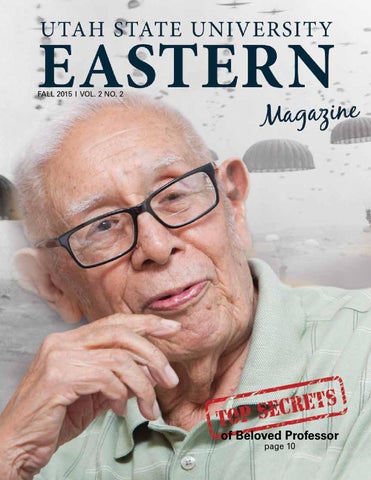
FALL 2015 I VOL. 2 NO. 2
of Beloved Professor page 10
USU EASTERN
1
“The individual bowed elements of concrete form a progression of movement in an alternating rhythm, repeating and changing as one moves around, through or within the work…It is a structure both simple and complex. The coloration of this sculpture is in response to the color of the rock formations within the environment of this area.”
A work of art and more. See new CIB on page 4.
2 USU
EASTERN
Photo by Donna Barry
— Sculptor Dann Nardi
CONTENTS MANAGING EDITOR
Vol. 2, No. 2 | Fall 2015
John DeVilbiss john.devilbiss@usu.edu
NEWS EDITOR Susan Polster susan.polster@usu.edu
DESIGN & PRODUCTION Holly Broome-Hyer
CHANCELLOR Joe Peterson
VICE CHANCELLORS Guy Denton Peter Iyere Greg Dart
USU EASTERN REGIONAL ADVISORY BOARD MEMBERS
USU-CEU Merger Five Years Later
18
Renee Banasky, Chair Erroll Holt, Vice Chair Jason Dunn Jeremy Redd Sophia DiCaro Mark Holyoak Frank Peczuh, Jr.
UTAH STATE UNIVERSITY EASTERN MAGAZINE is published biannually by Utah State University Eastern Institutional Advancement. Periodical postage paid at Price, Utah and additional mailing offices. POSTMASTER: Send address changes to USU Eastern Institutional Advancement, 451 E. 400 N. Price, UT 84501. Reproduction in whole or in part without written permission is prohibited. Opinions expressed do not necessarily represent the official position of USU Eastern. USU Eastern is committed to equal opportunity in student admission, financial assistance, faculty and staff employment.
Special thanks to Peczuh Printing, Price, Utah, for the printing in-kind of this biannual magazine.
Danny Kourianos Dares to Dream
23
29
A Poet’s Ache
PLUS: 4 New Kid on the Block
9
6 Debate is Back!
27 USU Logan Students Mine History
7 Blanding Students Gain Confidence
31 Class Notes
8 SWELL time for Student Leaders
Can a Dinosaur Get a Little Respect?
Meet Your New CIBling! T
he common thread of connecting Utah State University Eastern to the community and the community connecting to the university was Method Studio architect’s Shawn Benjamin’s thought process when he visualized the completed CIB – Central Instruction Building. The new $21 million campus landmark, dedicated Oct. 30, marks the first-major step towards a long-term campus transformation into a socially and intellectually vibrant higher education campus, added principal architect Joe Smith. Music, theater, visual and fine arts, communications and criminal justice programs are housed in the 58,000-square-foot facility. “The facility consists of interior and exterior gathering spaces intended to serve the community, students and faculty alike,” Smith said. “The floor plan provides fluid circulation paths that are intended to invite curious meandering and foster interaction between faculty and student. “The CIB is uniquely located where the heart of campus and the community intersect and is envisioned as a device to support a welcoming union between these two essential environments,” he said. “The project enhances connections to the historic Geary Theater and Reeves building and reinforces an evolving image for campus.” In sharp contrast to the brick and mortar that now stands, the process of achieving this Price campus pinnacle has been a fluid one. “We don’t have any preconceived notion when we design a building,” Benjamin said. “We try to take the client’s hopes and dreams and extrapolate what they want in the building’s design. . . we approach work as a collaboration between our clients and our designers.”
24 UUSSUU EEAASSTTEERRNN
USU Eastern Chancellor Joe Peterson requested a building that would invite the community to the university and make the community part of the university. He wanted a different image, not a building of pure function, Benjamin said. “We came to Price and looked at the history, economics and growth of the valley with its strong mining background,” Benjamin said. “We looked at mining as a pedestal and the strong foundation of the area. We acknowledged those that built CEU [College of Eastern Utah] and USUE. “By using materials that showed strength like the cement, steel and wood interiors and exteriors, it reflects what has gone on before and embraces what it means to move forward,” he said. “Each material takes on different meanings as one walks through the wide corridors. “The black metal walls reflect the seams of coal seen on U.S. 6 as people drive Price Canyon,” Benjamin said. “The area is surrounded by layers of rock. The angled walls take on the esthetic value of the rock formations and geological layers.”
Photos courtesy of Method Studio
Smith added, “The exposed concrete base is formed by wood planks. This board-forming strategy is inspired by historic construction and mining techniques used locally and echoes the warm-wood cladding on the building’s interior. “A public art gallery is engaged with the choral room at level one, but narrows before penetrating the roof for natural daylight through a skylight,” Smith said. “The walls surrounding the gallery are canted inward creating a twostory canyon-like space.” He said he is proud of the wallpaper outside of the communication and criminal justice wings. White, gray and green triangles contain communication jargon: a hashtag, a picture message, a video conference, a newspaper, talking, mail, update status, social media and a text message. The wallpaper outside of criminal justice uses yellow and black dots to form words on crime-scene tape with black-and-white images in the background. The Peterson (Black Box) Theater is formed as a cube to maximize internal versatility and is clad in raw hot-rolled steel. The use of raw steel reflects the mining industry and is expressive of the refinement of this material into an elegant surface. The interior-facing surfaces of steel will remain raw, dark and pristine, while those surfaces on the exterior façade will weather into rich rusted tones, Smith said. “In contrast, the Dorothy Brown Choral Studio and Deane Brown Instrumental Studio are shaped directly in response to their acoustic performance requirements to evoke landforms of the local region,” Smith said. “This volume is wrapped in finely crafted cedar planks for
“By using materials that showed strength like the cement, steel and wood interiors and exteriors, it reflects what has gone on before and embraces what it means to move forward.” its natural warmth and reference to the instruments held within. This is also a nod to the local mining industry and the old tradition of forming mine shafts with raw wood planks while at the same time refining the execution to reflect the higher education environment.” Interior designer, Brighton Meservy, knew from the beginning that she wanted the structure to speak for itself. “There are many areas that were stunning left alone. We searched for a long time for the perfect wood species and stain because that was going to really effect the space. The wood against the metal had a beautiful contrast that also tied into the history of the area that we loved. “We wanted the space to highlight beautiful natural colors, then as we added furniture and wayfinding, we threw in bright colors to play off this really neutral and natural canvas,” Meservy said. “Then when we started talking finishes, we were inspired by how volume is graphically represented with undulating blocks of sound…In the restrooms we slightly angled the wall tile to mimic the linear rock as you drive through the canyon into town. It is these small inspirations that start influencing the space.” Her favorite space was the second floor lounge. “The eight lounge chairs floating through colors, and the concrete lights above the bar table, the subtle vending corner and the built-in lounge seating that can look into the gallery..... all of that space had so much potential, so it was fun to work through.”
The sculpture in front of the building is by Dann Nardi, who calls it “Passages.” He said the plaza and amphitheater surrounding it set a stage for multiple users and activities. The sculptural composition is in two parts and presents a symmetry of forms, framing a space on both sides and shaping an opening between the two. “The individual bowed elements of concrete form a progression of movement in an alternating rhythm, repeating and changing as one moves around, through or within the work…It is a structure both simple and complex, he said. “The coloration of this sculpture is in response to the color of the rock formations within the environment of this area.” Benjamin and Smith are now designing the complete remodel of the Geary Theater. “I have to take construction from the late ‘50s and have it hold its own in 2015,”Benjamin said. “I need to bring everything up to code, whether it be structural or wiring.” They are already seeing the first part of their theater design work being implemented in the nearly completed theater scene shop. Of the work ahead, Benjamin said he thinks there will be a lot of stripping away to the bare bones of the building to make it workable in this century. The CIB was constructed in 14 months, the remodel of the Geary Theater is expected to take two years. —Susan Polster UUSSUU EEAASSTTEERRNN 5 3
Photo by Donna Barry
Debate Coach Jeff Spears talks to Neil Warren, former debate coach of nearly four decades.
Debate is Back!
T
Neil Warren’s Legacy Lives On
hirteen years after the debate program was dropped at College of Eastern Utah, Jeff Spears stood in a Utah State University Eastern classroom full of debaters and individual-events students who each hoped to bring the program back to its national level of competition. Spears, who was a freshman debater at the college when the program was dropped in 2002, was elated when USU Eastern Chancellor Joe Peterson allowed him to bring the program back as a competitive club. “We’re always looking for ways to increase enrollment at USU Eastern and a debate program fit the bill,” Spears said. He spent the past year researching and writing proposals to secure funding for travel. He also reached out to Neil Warren, who, along with assistant coach Scott Pullan, brought back to campus hundreds of regional and national awards. Warren’s debate career spanned almost four decades: CEU 32 years and Carbon High four years. In 1991, his team brought home 272 awards and in ’92 they brought home 273 awards, thus propelling them into a national powerhouse. In 2001, Ben Warner and Scott Odekirk represented CEU at the National Debate Tournament for District Nine. This was the first and only time a two-year college team represented the district made up of the University of Utah, Idaho State University, Southern Utah University, Weber State University, Utah State University and the University of Wyoming. Odekirk now coaches at Copper Hills High School in Salt Lake City and sent two of his best debaters to Eastern this fall: David Rawle and Rodrigo Leon. Warner went on to coach debate at the University of Kansas where his team won the national championship in ‘09, earn his doctorate and now teaches communication at the University of Missouri. Warren said he always thought the college would bring back debate. He was glad he got to see it return in his lifetime. He remembers loading two vans full of students on a Wednesday or Thursday night and driving to tournaments throughout the United States. The students would compete all weekend and would make the return trip on Sundays so everyone could be in class on Monday morning, including Warren. “I used to keep track of the miles I traveled every year and it was a lot,” he said. “We were always pretty well funded in terms of travel and scholarships.” Since Spears is just beginning the program, his students won’t travel to the extent the old CEU teams did due to limited funding. But where they lack in dollars, they
4 USU 6
EASTERN
make up for in enthusiastic support from well-placed coaches with CEU-debate ties. “CEU produced 10-active Utah high school debate coaches who are extremely successful running programs at their respective schools,” Spears said. “… I made a phone call to some of my coaching friends to send students my way. They were all excited to hear the college brought the program back and I got great talent from those coaches.” Spears has been able to secure enough funding from USU Eastern and from private individuals to travel to tournaments in Utah, Wyoming, California, Nevada, Colorado and Louisiana. His team is attending seven tournaments in individual events and four in policy events. Coaching the team is all volunteer for Spears who came back to his alma mater two years ago as director of Residential Life. His debate and IE students are stoked to begin the new season of competition. Josh Bone from Carbon High School said he has high expectations for the team and is excited to try his skills on the collegiate level. Eric Love from Taylorsville, competed three years on the high school circuit in public forum. He plans to hone his skills in the collegiate level this fall with an increased level of intensity. Khyra Colley, Winnemuca, Nev., has already formed a bond with the club and likes the idea of competing on the collegiate level to see how good she is. Tasia Roach, from St. George’s Deseret Hills High School, has six years of experience in oration. Her expertise will be in persuasive, informative, interpretive and communication analysis. “Once I get used to the rhythm of the competition and build upon my research skills, I should do well.” Bringing debate back to the college is now a dream come true, both for Warren and Spears. “My first day of class, the students called me coach, and it’s then that I realized this is for real,” Spears said. — Susan Polster
Blanding Students Gain Confidence in STEM Fields
Photo by John DeVilbiss
T
Ashley Nez and Ty Charley in the Utah Water Research Laboratory on the USU Logan campus.
wo weeks before the end of a six-week stint on the Logan campus of Utah State University, Christina Morgan was spotted working out on the elliptical in the Health, Physical Education & Recreation building. She had already settled into a routine. She looked like any other student taking an exercise break. The fact that she’s a sophomore from the university’s Blanding campus would be missed by most everyone else in the facility that day. No different the next week in Professor Anne Anderson’s biology laboratory where she and lab partner, Chris Capitan had been conducting fungus research throughout the week. It is not until you catch up with their 19 peers and see them together does the significance of this unique collection of students begin to sink in. They are Blanding campus undergraduates participating in an intensive summer program in connection with a Science Technology Engineering Mathematics (STEM) exploration mentorship for Native American students. They are happily tackling subjects as expansive as the world of buttes and bluffs from which they come. The USU Eastern Blanding campus borders the Navajo Nation Indian Reservation and the majority of its 600 students are from this reservation. What makes them stand out is that, first of all, they already have a handle on STEM subjects, above average to be sure. This is notable because most come from small high schools on the Navajo Reservation where facilities and qualified teachers are stretched to the limit. And while 77 percent of Native Americans earned high school diplomas, only 13 percent (compared to 28 percent of the general population) have at least a bachelor’s degree. To help these students begin to see careers tied with STEM studies, the Blanding campus created a STEM pathway. Along this path is the USU Logan campus. USU Eastern Blanding, under Virgil Caldwell, Curtis Frazier and Guy Denton, helped secure funding through a NASNTI grant initiative (Native American-Serving Nontribal Institutions), complete with a departmental certificate and a group of core courses for students who want to go onto STEM in their degrees and future careers. Much credit, as well, goes to Alan Savitzsky and his graduate students on the Logan campus who set up the departmental mentorship for the students, Frazier said. “It was a huge undertaking.” USU Eastern Blanding professor, Jared Berrett, also played a significant role in helping students along the STEM pathway, including taking them to rocket launches and robot USU EASTERN
5 7
tournaments. His hope is to fire up the imaginations of these students and to help them see themselves in careers. If they know what they want to become, it’s then just a matter of identifying the skills needed to get them there, he said. Jump four months ahead and you find the program continues to have impact. At the time of this writing, Morgan and Capitan were about to leave for Washington, D.C. to present academic posters at the annual conference of SACNAS (Society for Advancement of Chicanos/Hispanics and Native Americans in Science). Their work is poster worthy because it is actual research. No one had ever done some of the experiments they conducted, Anderson said. “I try to give them research opportunities where there is a fair chance of something working out,” she said. “They were the first people to actually work in that way with the organisms they selected.” Organisms involving bacteria and fungus, particularly Pseudomonas chlororaphis (Pc06), used as a soil inoculant in fighting fungal plant pathogens to determine how plant roots nurture bacteria on their surface. Their grasp of the subject, let alone spot-on pronunciations of the scientific names, was impressive. “We’ve been able to apply what we have learned, and that’s helped us a lot,” Morgan said. “Now when I go back and take these classes, I have an edge.” A preparation edge that translates into a lot more confidence when the time comes to move on to a larger campus.
That essentially is the purpose behind the program said Emily Sadler, a Ph.D. candidate in biology who assisted as a mentor. It’s designed to give them exposure to the breadth of STEM research and studies beyond the Blanding campus. “I think the most satisfying experience for the facilitators involved was to talk to the students one-on-one and to hear them begin to question and wonder about their future,” she said. “To hear the students say that they are more confident and more ready to go to a larger institution, and to hear some want to pursue careers they never considered before, was incredibly satisfying.” Shaniah Dickson, a sophomore in criminal justice, put it another way: “It shook up my thoughts.” Her work in the lab intrigued and excited her. She wondered if she should change her major or do a double major. “Now I am looking at using the techniques I learned in the lab.” It is good to try things on, whether it be a lab coat or a campus, when thinking about one’s future. It gives students a starting point and an opportunity to replace the dread of the unknown with the assurance of experience. “I got a more diverse experience being here and learning and working in the STEM fields than I ever would have, considering I am an English major,” wrote a student in her critique of the program. “It’s nice to learn new things and be able to understand what I am doing especially when the sciences and math subjects are my weakest point. So with that being said, I am more confident than before I came.” —John DeVilbiss
Photo by John DeVilbiss
M
From left to right: USU Eastern participants Ben Bjarnson, student body president; Phil Raich, Leslie Reyes and Kim Pratt.
Student Leaders
Wowed by Work in Stunning Scenery
68 UUSSUU EEAASSTTEERRNN
aybe a day of hefting logs, painting picnic tables and cleaning up after thoughtless visitors on Utah’s public lands had its moments of tedium, but the work done by 300 college and university student leaders hosted by Utah State University Eastern in May, brought warm feelings to Bureau of Land Management personnel. As one relatively new BLM employee put it: “this has been the best day of my job so far.” The student leaders were part of the state’s annual Utah Leadership Academy held each year at different colleges statewide. The three-day conference includes an afternoon service project. Typically such projects are conducted either on the campuses hosting the event or in the community. Terry Johnson, SUN (Serving Utah Network) Center program coordinator, had something else in mind. Why not have this small army of 300 focus its efforts on helping to clean up and restore some of the spectacular landscapes surrounding the Price area? He hoped that in the process it would help an overwhelmed force of public employees in their work to maintain federal lands and leave a lasting impression on the minds of the student volunteers. The plan seemed to work.
Can a
Dinosaur Get a Little Respect Here?
Photo by Donna Barry
I
Ken Carpenter at the USU Eastern Prehistoric Museum.
“It was amazing to see all these leaders together,” said Jane Prefumo, a SUN Center involvement leader. “There was lots of unity and team spirit.” And, being the Millennials they are, they left their own digital traces while cleaning up the physical traces left by tens of thousands of visitors to the San Rafael area each year. They mostly did this in the form of tweets and Instagrams. “First time in Eastern Utah,” tweeted a Salt Lake Community College leader. “Such a naturally beautiful place!” Another UVU leader tweeted: “Watch out, World! We gon (sic) change you!” And change they did. At least a little bit in a few highly frequented areas of the Swell. Improvements that will hopefully help to preserve this much-loved area for years to come. And most certainly, the experience changed the perception of at least one student who had never been to Price before. “I never knew you lived in such a beautiful place,” she told Prefumo. “I want to come back now, and bring my family. You are lucky to be so close to so many recreation areas.” — John DeVilbiss
f you missed Jurassic World in the theaters, now you can watch it in the comfort of your home – or NOT, if you’re Kenneth Carpenter, director and curator of paleontology at Utah State University Eastern Prehistoric Museum. He watched the flick on opening weekend in June. He did so because he is a good guy and a certain public relations dude took advantage of that by urging him to be one of the first to see the movie and critique it. Well, two things came from that. First, he did not like the movie, and second, nobody seemed to care what a respected paleontologist had to say on the matter. The film trampled all previous box office openings and within 14 days, it became the first movie to earn $1 billion in global box office sales. The sad reality, though, is that beyond the cool counterbalancing tails, scaly feet, hip wiggling and trendy museum depicted, it just wasn’t enough to sustain poor Dr. Carpenter’s interest. “Frankly, I was bored within 10 minutes of the start,” he said. “I hope the franchise follows the path of real dinosaurs and becomes extinct.” Ouch. Even the soaring Mosasaurus failed to lift his spirit. When he saw the marine reptile leap out of the water to get the so-called bad dinosaur, Carpenter said he was expecting it. They likely modeled the jump after Carpenter’s work on National Geographic’s 2007 film “Sea Monsters – A Prehistoric Adventure.” But if the dinosaur DNA is supposed to come from dino blood cells trapped by biting insects, such as flies and mosquitoes, where, Carpenter asks, did the DNA for the mosasaur come from? “No biting flies in the ocean.” So why so many inaccuracies? Jack Horner, Montana State T. rex expert and advisor for the previous Jurassic Park films, told Carpenter his advice often went unheeded. “They had in mind what they wanted to see on the screen,” Carpenter said. “And so whenever it came down to a choice between the science and the drama, they always went with the drama.” Carpenter said he supposes the same thing happened when they depicted a giant predatory dinosaur that becomes invisible to sensors by blocking all heat radiation from its body. True, some frogs can control their body temperature, but that doesn’t mean they can shut it entirely down. And true, paleontologists can try to watch dinosaur movies like these by blocking out all formal training and research, but as Carpenter has shown, it doesn’t mean they can shut all thinking entirely down. But go ahead, rent the mega blockbuster and indulge yourself in this little fantasy. Just don’t invite Carpenter. Once was enough. — John DeVilbiss UUSSUU EEAASSTTEERRNN 97
8 UUSSUU EEAASSTTEERRNN 10
3-D SPYTurned CHEMISTRY TEACHER (and Other Astonishing Tales from Dr. Al Trujillo)
Y
Photos by Donna Barry
ou wouldn’t want to slam a book down in Alfonso Trujillo’s chemistry class in the early 1950s.
He was a bit anxious when he first started teaching at Carbon College. In fact, ask him today and he tells you he was downright belligerent and angry. Sleep did not come easily, and when it did, it was fitful and fraught with frightening dreams of German soldiers coming back to hunt him down. “I tried not to think about it,” he says. “I tell you, I prayed that I could forget it and I have pretty much forgot. But in those days, they didn’t recognize this, I guess, like they do now.” By “this,” he means post-traumatic stress syndrome. World War II ended, but it was still raging on in his mind. Back then they politely called this condition “combat exhaustion.” It was something you just didn’t talk about. Good soldiers were expected to shake it off, tough it out, keep silent about it. And so he did. No surprise then that today, 70 years since the war ended in Europe, few — least of all his students — know the un-solemnized, war-hero side of their stern chemistry and math teacher. Trujillo’s teacher-hero distinction, however, appears to be well in hand. Jim Piacitelli took classes from Trujillo in 1962 as a sophomore and still remains in close contact with him. He says he and so many of his peers respect and revere him to this day. “People loved to be taught by him and to have their children taught by him,” he says. “For me, the experience has been after 55 years, one of deepening appreciation for the quality of individuals who taught me, especially those at Carbon College.” Kenneth L. Gilbert was taught by Trujillo in 1965 and took the time, 48 years later, to thank him for his influence. He says he owes his 24 years as a chemist at the Idaho National Laboratory to Trujillo for helping him get his start. It only seems fitting then for Gilbert to be winding down his own career as an adjunct professor of chemistry at the Eastern Idaho Technical College in Idaho Falls. In a letter to Trujillo on May 20, 2013, he tells his students “the reason I became a chemist was because of the inspiration and impression Dr. Alfonso Trujillo made on me. I also tell them I teach the way Dr. Alfonso Trujillo did. The fact is that if you, dear Al Trujillo, had been a physicist, I would have been a physicist. The same is true had you been a psychologist, sociologist, mathematician, etc.” The possibility of “combat soldier” in Gilbert’s “etcetera” may be why Trujillo chose not to talk to students about his war years. He certainly denies any hero characterization and inserts the word “stupid” in its place. And he laughs wholeheartedly as he says it. And you instantly know you are in for a ride as you settle down for a visit with this legendary teacher and former U USSU U EEA ASSTTEER RN N
11 9
the self-deprecation and you quickly realize it was more likely his carpe diem attitude, intelligence and youthful zeal — qualities that could have led to his death but went on, instead, to serve him well through life.
Before the War Just how a 19-year-old kid from little Manassa, Colo., got in on the early planning stages of one of the most significant battles of World Trujillo with his sweetheart, Vera, now in their 71st War II is part of a litany of year of marriage. stories he strings out over two fleeting hours. His soft-spoken, academic vice president at the College of but animated, voice makes you sit up Eastern Utah. close and listen carefully. His tales are Trujillo speaks fondly of his years at sprinkled with laughter, often as chuck“the college.” While he could have gone les ironically placed. The plush sofa of anywhere to teach, including a cushy job his modest ranch-style home in Helper, at a two-year college in the prospering Utah, envelopes his lean 5-foot 8-inch post-war years of California, he says he frame. His agile mind defies his 92 years chose Carbon College because the area of living as he bounces between chemisoffered him exactly what he needed back try equations and historic WW II battles in those early years: quiet spaces and throughout the interview. His full head good places to hunt and fish. He also of military-cropped hair, complements loved the classroom and took comfort his youthful mannerisms. His olive skin in being able to explain the chemistry of remains remarkably smooth. He wears carbon. It is the chemistry of war, howjeans and a short-sleeved shirt that fit his ever, with its unfathomable properties, relaxed and comfortable demeanor. He’s reactions and phenomena that continues had a good life, been blessed with Vera, to haunt and perplex him. his wife and companion of 70 years, five It was not too many years before children, 13 grandchildren and five great that he was falling out of the sky above grandchildren. the shores of Normandy, France, in the He speaks as with surprise and midst of mortar shells. He was among delight to still be around. That sense of the throng of D-Day paratroopers wonder fills his storytelling. He talks floating like giant schools of medusa about how amazed he felt as a teenager towards a battle that ultimately killed when he learned he had taken second or wounded some 425,000 allied and place in a statewide high school chemisGerman troops. try exam, despite not really preparing for He was scared all right and during it. It got him some early recognition and that endless plunge to Earth, he could more than a few scholarship offers. blame no one but himself. He lobbied After graduating from Manasa High for the chance to be there, and not out School as class valedictorian, he enrolled of ignorance. He knew more about the at Brigham Young University. He had invasion, dubbed Operation Overother schools in mind, but his parents, lord — including when it would take devout members of the Church of Jesus place — long before most. He jokes, Christ of Latter-day Saints, wanted him again, that it was his stupidity that got to go to BYU. him in that predicament. Sift through
12 UUSSUU EEAASSTTEERRNN 10
“I wasn’t too happy,” he says. “I got on the honor role the first quarter and then second quarter I got introduced to girls (he laughs) and as a result, I didn’t do too well.” He is placed on academic probation and called in to the dean of students. He doesn’t want to let his parents down, but his heart just isn’t in it and he decides to leave BYU. Instead he gets involved in a federal government program that pays for training in different trades. He finds machine shops, especially milling machines, to be fascinating and takes classes. Soon after he is offered a position as a machinist at Hill Air Force Base, in Ogden, Utah. By then the U.S. war effort in Europe and the Pacific is in fullbore and the base is buzzing.
Off to War I wanted to get into the war,” he says, “Oh, boy, did I want to go. I WANTED TO GO TO WAR.” He enlists in 1943 and is sent to Clearwater, Fla., a major training base for U.S. troops destined for Europe and the Pacific. The majority of those in his basic training are shipped to the Pacific. His wish for action is to go to Europe. He gets it, eventually, but not in typical fashion. Out of his Boot Camp group of some 100 men, he is part of a handful selected to go on to a military installation just outside of Washington, D.C. “Boy, what did I do?” he wonders when he’s called in to headquarters. They won’t tell him. They just put him on a train bound for D.C. where he’s whisked away by a staff sergeant to “some big government building” and then given orders to report to Camp Ritchie. He is told that not too many recruits are sent to this facility “so don’t be surprised when you get there.” He quickly comes to know that he is at a highly classified site used for central intelligence training. He says he can’t tell anybody he is part of military intelligence, not even family members. In his second week there he begins taking military classes with majors, captains, lieutenants, sergeants and privates. He is given some tests and eventually assigned
“They told us that we had a to a photo intelligence group. The U.S. military is in great need of detailed maps of Western Europe. Tourist-type maps are basically all they have at this point. Trujillo is trained to develop highly comprehensive maps from aerial photo mosaics. His task is to learn how to spot enemy tanks and rockets by using stereoscopes to create three-dimensional images. At the conclusion of his training, he jumps from private to staff sergeant.
3-D Spy His first assignment takes him outside London, England, where, to his dismay, he does little his first month. He wants to get into the war, but all he does is tour England, including the Cliffs of Dover. He does not know at this time that the U.S. government is further vetting him. Even his parents are being scrutinized about their ancestry. The reason for this becomes clearer in time. He is to be part of a highly elite group of men and women with super security designation called Bigot – a classification above top-secret. “Why such a name?” he asks. “It was said to me that it was because we were bigoted.” He laughs. It actually stands for British Invasion of German Occupied Territory that Churchill chooses, according to the BBC-produced History of the World, prior to the U.S. involvement in the war. Even as Eisenhower takes over the planning role, this Top-Secret classification continues. “We thought that was for the invasion that would take place,” he says. He later learns it is actually part of a ploy involving a fake army buildup under Gen. George Patton. This ghost army of Patton’s is part of a huge deception to keep the Germans guessing at where allied troops will invade. By 1943, Germans are pinning down possible invasion sites along the coast of France adjacent to the English Channel. The port of Calais, the narrowest point between England and France, is where Patton makes it appear as if he will be leading the allied charge. So convincing is this feigned buildup on the English side of the channel prior to
Normandy, that it causes Adolf Hitler, fearful of a major counter-attack at port of Calais, to insist that German garrisons guarding this region stay put, even after the massive allied invasion on Normandy. After about a month, he and a few others are separated from the rest of the intelligence photo team. “They told us that we had a super-top-secret classification and then I got a very thrilling experience,” he says. “While we thought the area where we were studying would be for the attack, they instead showed us a big map of the Normandy Peninsula and they said, ‘this is where the invasion will take place. As a result, you are not to discuss this with anyone.’” If knowledge is power, then this 19-year-old boy is suddenly growing into a powerful young man. Not only does he know WHERE one of the most significant invasions in World War II will take place, he also knows WHEN it will occur, and before most everyone else. Combine that knowledge with the photo intelligence he is helping to gather and it is not difficult to appreciate the significant role Trujillo plays in a battle that Churchill calls “the beginning of the end.” They may not have known it then, but what Trujillo and his fellow 3-D photo spies accomplished was highly significant in the overall war effort. Trujillo, and those who preceded him in the years leading up to Normandy, painstakingly pored through photographs of French landscapes captured by cameras mounted on retrofitted Spitfires. The mosaics created from these photographs, and viewed through stereoscopes, reveal vital details such as camouflaged rockets, missiles and ships that otherwise are lost in one-dimensional images. As a result, deadly German V1 and V2 guided rocket launch sites spread across France were being identified and destroyed through thousands of bombing missions in what was called “Operation Crossbow” prior to D-Day. This operation virtually eliminated most
super top-secret classification and then I got a very thrilling experience,” he says. “While we thought the area where we were studying would be for the attack, they instead showed us a big map of the Normandy Peninsula and they said ‘this is where the invasion will take place. As a result, you are not to discuss this with anyone.’”
all rocket threats that likely would have hampered a successful allied invasion at Normandy, according to a NOVA documentary 3D Spies of WW II that first aired July 24, 2013 on PBS. Trujillo recalls how he first spots some sort of oblique object in his own scanning. It turns out to be a rocket with 2,000 pounds of warhead attached to it. “So there was real interest in it,” he says. Real interest in EVERYTHING comprised of and around the beaches of Normandy. As a result, Trujillo’s team makes thorough studies of the peninsula and develop comprehensive relief maps, overlays and everything they can possibly do to provide a complete picture of what military brass and troops can expect. It even includes maps of where the beach landings and the drop sites for airborne divisions will be.
Normandy Trujillo says the day then comes for him and other members of his intelligence group to go to every platoon commander and orientate them and staff. It was when he and two fellow officers are briefing a captain of the 82nd Airborne Division under Gen. Matthew B. RidgeUUSSUU EEAASSTTEERRNN 11 13
way, that they make an unusual request. “The three of us were quite young and stupid,” he says. “We told them, ‘we don’t want to just see this, we want to get in on it.’” That entreaty creates a bit of a stir back at headquarters. All three of these officers know too much and are, therefore, a great risk to military intelligence if they are captured. They persist though,
and fly back to London to make their case. Eventually they are allowed to go, but only after destroying all their identification, including their special Bigot Neptune cards (the assault phase of Operation Overlord is code-named Operation Neptune). They have only one more hurdle to get over, a big hurdle — none of them have any parachute training (he laughs).
Their captain approached them with some recent aerial photos that had been taken showing unidentified objects. Using their stereoscope training, Trujillo and his two companions were able to determine that what they were seeing were “great big poles sticking out” that turned out to be anti-airborne obstacles with barbed wire and razor blades attached. They had not been there before but now were exactly where the 505th would be touching ground.
Trujillo as a paratrooper with the 82nd Airborne Division.
14 12UUSSUUEEAASSTTEERRNN
No glider training, nothing. They start with learning how to hit and roll on the ground and then how to collapse and fold their chutes. After that their trainers announce to them, “you’re ready to take your first jump,” he laughs. “I had never been in a (paratrooper C-47) airplane in my life (he laughs again). Once up, they drill them on the three-step procedure: stand up, hook up, check your equipment. Hooking up involves the static line. First making certain they are properly attached and second, making sure the line never gets under their elbows “or it will pull your arm right off.” They take five jumps in all. Jump six is on D-Day, June 6, 1944, the day of the Normandy landings, the largest amphibious assault in history. It was supposed to be the day before, but poor weather conditions prompted the delay. It is during this wait that these three intelligence officers-turned-paratroopers prove especially valuable to their division. Their captain approaches them with some recent aerial photos that had been taken showing unidentified objects. Using their stereoscope training, Trujillo and his two companions determine that what they are seeing are “great big poles sticking out” that turn out to be anti-airborne obstacles with barbed wire and razor blades attached. They had not been there before, but now are exactly where the 505th would be touching ground. “So we had to change the drop zone for the 505th,” he says. “You’ve probably seen the movie or heard about how a lot of them hit the town of St. Mere-Eglise. I was fortunate enough to apparently have a rookie pilot who got scared and didn’t give us the light to go, and so we missed our drop zone by 10 miles, fortunately, or I’d a hit St. Mere-Eglise.” St. Mere-Eglise, just six miles due west of the Utah
Beach invasion site, was the first town in France under 2nd Battalion Commander, Lt. Col. Benjamin Vandervoort, to be liberated, at the cost of many lives. After digging through the pockets of his wallet, Trujillo pulls out his torn 82nd Airborne Division Association Charter Member laminated card with the word “Secret” in the torn bottom-right corner. It is as if he thinks he needs to prove something. He even hunts down the New York Times Bestseller, D-Day, by Band of Brothers author Stephen E. Ambrose and begins reading a paragraph from it that includes his name. After all these decades, it is as though these few remaining items provide him with some tangible evidence and reassurance that this wasn’t just some crazy dream. “So that is how I got into the airborne and my classifications… I’m not talking too much, am I?” Vera sits in an easy chair to his left, her fingers lightly tapping on her lap. You see in her slight smile that there is more to come.
On Patrol Like the story about how he was supposed to help take and hold the line for the soldiers fighting on the beach, “but that was a mess” because of the way paratroopers are strung out across the countryside. It turns out that the wide unintentional scattering of troops becomes a tactical advantage because the Germans think they are being hit with a much bigger force. “They guessed that we had dropped whole corps of airborne in that area instead of divisions.” Trujillo says their objective is to secure Cherbourg and the road that leads to it. “We were to take that road and hold it so that the Germans couldn’t bring their stuff up.” He’s never been back to France since the war, but he takes pride in the role that the 82nd and the 101st airborne divisions played in capturing and defending this strategically important deep-water port city. Without Cherbourg, situated at the northern end of the Cotentin Peninsula in Normandy’s northwest coast of
France, reinforcements and supplies from the U.S. could not have been rapidly deployed. It was strategically vital for the allies to ensure this continuous front. He recalls how he and a fellow soldier, also a Colorado-native, stumble upon a squadron of German soldiers while on patrol — “not elite, more like home-guard, 40 or 50 of them,” he says. “When they saw us, they shouted ‘comrades!’ They surrendered!” He says the two of them are initially astonished and don’t know what to do with their yielding enemies. After some discussion, they decide to march them back to division headquarters as their prisoners “and so we come marching in with a whole bunch (he chuckles) of Germans all ourselves, just me and him. These guys didn’t want to fight.” And when it came right down to it, Trujillo says he didn’t want to fight either, but that was beside the point because at this stage in the war, he was in a fight for his life. He somberly recalls the first time he has to fire his gun in combat. “I had a Thompson sub, clip of 18, and when I ran across him, I pulled the trigger. You could hear as I hit him, but I hit him in the helmet. That .45 has a kick to it, and it dropped him and by the time I realized what was happening, I kept firing. I was shooting straight up! I was so nervous, and the poor guy was trying to struggle to his feet when I …” his voice trails off. While fighting at Normandy, his patrols typically consist of five men. In some skirmishes, they all survive, but in others, they are not so fortunate. He says his division continued to fight at Normandy for about a month before suffering a 40-percent casualty rate. “Not all dead, some were incapacitated, so they pulled us back after 30 days.” As a ground soldier, he is classified an intelligence observer. “Not a very good title,” he quips. He heads up observation posts, sometimes ahead of the front line, sometimes on it. “There’s not really a line, it’s just a garbled mess.” His task is to observe and report back any
enemy activity. In one such patrol, they establish “a dandy observation post” in a two-story farmhouse they take. “Somehow or the other, the Germans went around it,” he says. “Well, I had one guy with me; he was kind of a jerk. I told him: ‘Don’t move out! Don’t give any sign there is life in this house! All our observations will be away from the window!’ Well, he decided to go out. When they (German soldiers) spotted him, he ran back into the house and so boy, oh boy, the mortar shells started to come in, and we scattered. I ran and jumped in this foxhole…I jumped in and saw a dead German soldier there. I didn’t know that he was dead, and so I turned my Thompson sub on him before I realized he was dead. I lost about half of my patrol at that time, but that was my job. I never got hit. I was just lucky.” Luck with a heavenward gaze. He manages to go on and safely navigate through the maze-like hedgerows of France where Germans easily hid. “It was really, really bad,” he says. “It was scary. I remember one occasion, I wouldn’t usually pray at this time (he chuckles), but on this occasion I prayed ‘Lord, God help me…if you do, I promise that I’ll be a good Mormon and marry in the temple. I’ll do ANYTHING!” he chuckles. He recalls a conversation he has with an atheist friend after Normandy. “When we got back to London to regroup, I saw him and I said, ‘did you pray?” and he said “of course I didn’t;’ ‘to hell you didn’t!’” Trujillo laughs.
Holland Invasion Trujillo’s stories weave battles together as if a compilation of trailers from all the great World War II films. He is at once narrator, character and living witness. It is one thing to watch movies or read books about these events and very much another to actually hear from somebody who was there. You see, for example, not just the disappointment in his eyes, but you hear the frustration in his voice as he describes missions and operations that went awry, operations such as the Holland invasion. UUSSUUEEAASST TEERRNN13 15
He and fellow soldiers from the “All American” 82nd and the 101st Airborne “Screaming Eagles” divisions were part of an unprecedented aerial attack of 35,000 allied paratroopers dropping from the sky into German-occupied Holland, 60 miles behind enemy lines. The airborne objective of the invasion, called Operation Market Garden, was seizing and controlling bridges across the Meuse and two arms of the Rhine rivers so allied armored divisions could quickly cross into Northern Germany unimpeded. While the 82nd was successful in securing key Netherlands bridges from Mook to Nijmegen, the ambitious operation did not go quite as planned for the British airborne, he says. At Arnhem, the British 1st ran into strong resistance. A smaller force was only able to take and hold one end of the Arnhem road bridge — “a bridge too far,” declared a British general. Without adequate ground force support, the few who were still holding the bridge were soon overrun. The remainder of the division became trapped and had to be evacuated a few days later. “The British 1st Airborne was a great outfit, but out of about 10,000 men, about 2,000 got through,” he says. “They had to swim back. They lost, and that’s what caused the Russians to get to Berlin before us.”
14UUSSUUEEAASSTTEERRNN 16
Do a quick Google search and read that of the 10,600 men of the 1st Airborne Division and other units who fought north of the Rhine, 1,485 died and 6,414 were taken prisoner of whom one third were wounded. Scan through the struggles of the 82nd that Trujillo did not mention, such as taking heavy fire from the Germans, at a cost of some 200 paratrooper’s lives, as members of his corps, along with the 504th and 505th — frantically fought — on shore and from boats, to secure the bridge at Nijmegen. You realize as he talks about these epic struggles, which eventually combine to turn the tide against Hitler, he is in the middle of those horrors without the luxury of historical perspective and hindsight. It is one thing to read about it already knowing the outcome, but quite another to be there as it unfolds.
Battle of the Bulge The Invasion of Normandy would have been more than enough. The struggles in Holland, certainly an apt bookend for Trujillo’s stories of war, but there is more. After being given a brief respite in France, he is sent to Belgium to fight in yet another epic World War II struggle, the Battle of the Bulge. Once again, the 82nd and the 101st found themselves fighting together at
different fronts. The 82nd was ahead of the 101st and made it to Bastogne and then kept going north to keep the Germans from further advancing around Elsenborn Ridge. They are called up in such haste, there is no time to swap out their summer uniforms. “It was a brutal winter,” he says. In the course of this epic struggle, these two divisions prove crucial in the battle to prevent Hitler from splitting allied forces. They hold their ground and prevent the Germans from accessing key roads, despite being outnumbered and ill-prepared for the harsh weather conditions. He says that while his division was fighting to the north, the 101st made it as far as Bastogne before being cut off and surrounded by German troops. This is the story of Brig. Gen. Anthony McAuliffe, acting commander of the 101st, doggedly replying “Nuts!” to a German demand to surrender. Trujillo smiles as he recalls the terse response, “he was quite a guy.” This is the noble account, but keep listening to Trujillo and soon you’re treated to a less-sanitized, human side of these war heroes as he candidly talks about the rivalry between the 101st and the 82nd and the ignoble fights that sometimes break out among them. Trouble always seems to follow when these two highly decorated divisions get together and alcohol is involved. One such time was in the days leading to the Bulge when they were together in a small village north of Paris for rest and relaxation. They will fight and die to defend Bastogne from the Germans, but watch out when they start fighting each other. The poor village they peacefully occupy, takes the less-than-peaceful brunt of their intoxicated interactions. “I remember seeing one who got so drunk that he walked through a glass door,” he says. “They destroyed that town.” And they have hell to pay the following day from their commanding officer, Maj. Gen. James Gavin. Trujillo recalls Gavin telling them, “I am proud of you men whenever you are in battle; you are a great group of men. But you become animals; you disappoint me.
Look at what you did to this city! You will be restricted.” Trujillo says that means “When the 101st gets to go out, we don’t, and when they stay, we go,” he laughs. “I don’t know, but I never could figure out some of these men in war. They were brutes!” In his final battle, he tangled his arm in a parachute cord during a jump. “I’m lucky it didn’t pull it clear off,” he says. “What happened was a guy froze at the door. I had to push him out and while I was pushing him out, the cord got tangled around my shoulder. It spun me around real bad.” The injury, which landed him in the hospital, continues to plague him to this day. He says that was the last time he was a paratrooper in the war. He is soon transferred from the 82nd and is placed in charge of an aerial photo distribution center. “I had a very tough assignment,” he says. “I had an office in Paris. All I had to do was wait for requests of photos from divisions and ship them out to them.”
Return from War He remains in Paris through VE (Victory in Europe) day, May 8, 1945. By V-J day (Victory in Japan), Aug. 15, 1945, he is back home. The 82nd is called to fight in Japan, but he already has more than enough points to earn a discharge, and most certainly, he has had more than enough of war, he says. He goes from jumping out of planes in ’45 to jumping back into the classrooms of BYU where he finishes his bachelor’s degree. He starts teaching at Carbon College in 1952. In between, he takes time off to complete a master’s degree in chemistry from Utah State University (where he recalls pleasant conversations with Merlin Olsen, future member of the Pro Football Hall of Fame and defensive tackle with the Los Angeles Rams. Olsen has a part-time job mopping the floors in his lab.) Trujillo goes on to earn a doctorate in fuels engineering from the University of Utah. When he starts teaching again, Carbon College has morphed into the College of Eastern Utah. He is begin-
ning to hit his stride, including letting go of some of the memories of his battles in Europe. By the time the ‘70s roll around, students know Dr. Trujillo as a demanding chemistry teacher, not the army intelligence officer he once was. “I don’t recall any World War II stories,” says Scott Woodward, who took his class in 1975. He does recall, however, a few war stories of his own about the class. “I tried to suppress those memories,” he jokes. “He was a very thorough teacher. He made sure that students who went through his class knew chemistry. As I am sure it is with most teachers and their subjects, chemistry, for him, was the most important thing in the world. He was very good at teaching. I still have nightmares of his exams. It was not a class you took for easy grades.” Woodward apparently did just fine and turned out pretty well, too. Today he is world-renown for his work as a microbiologist and molecular biologist specializing in genetic genealogy and ancient DNA studies. He earned his doctorate at USU and went on to teach at BYU and the U of U. He currently teaches at Utah Valley University. Boyd Nielson, pharmacist and owner of Boyd’s Family Pharmacy in Castle Dale, Utah, remembers taking chemistry from Trujillo in 1972, but he also doesn’t recall Trujillo ever talking about his World War II adventures. “I don’t think I was even aware of that part of his life story,” he says. What he does remember is Trujillo’s sense of humor and gentle prodding whenever students asked him questions that he thought they should first try to figure out on their own. “I frequently use a quote of his that I learned in his class,” Nielson says. “When someone asks a question, sometimes I’ll say, ‘you were born with that information.’ That was one of his favorite quotes that I remember to this day. Just delightful.” Woodward says the Socratic method that Trujillo used to get his students to think for themselves and engage them in meaningful discussion is a technique he
also has used over the course of his 30 years of teaching. “He was very keen on asking probing questions that required more than just a one-word, yes-or-no, answer,” he says. “You had to justify your answer. He required that you understand the subject matter and made you think about it.” Being able to justify your answer still reigns supreme for Trujillo. He fought a war that he knows was justified, to stop a madman who wanted to conquer the world. The justifications for wars that have since followed leave him questioning, including the Vietnam War where his son and namesake, Alfonso, fought and lost one of his legs as a U.S. Marine. The terrible wounds he suffered in that war are part to blame, Trujillo says, for his son’s early death. “War is hell,” he says. And returning from such a place can take a long time. It haunts him still to think about how on three different occasions soldiers collapsed on top of him dead from enemy fire. “They died and I lived and I don’t know why,” he says. “Three times I hit the dirt, three times soldiers fell on me who were zapped.” He considers war a last resort and says those who fight in it are never fully free from its clutch. “I feel very sorry for these young men who come back,” he says. “I can understand why so many of them commit crimes and get alcoholic.” He also understands why so many of them choose to simply shut down and withdraw, because he was once in that lonely place too. “I hated how you lose individuality,” he says. “You become like anti-social or something. After the war, I got to where I hated people, I really did. Slowly that went away. I prayed hard for that.” Boy oh boy, did he, as he did at Normandy and in Holland and Belgium, and as he now does for his own grandchildren facing their unknowns, for what else is there but prayer, he asks, when plunging headfirst into uncertainty? Like leaping out of a plane and hoping for the best. —John DeVilbiss UUSSUU EEAASSTTEERRNN15 17
18 U S U
EASTERN
5
YEARS IN CEU-USU Bond Remains
STRONG AND TRUE
M
y how the time has flown since that little party in March of 2010 at the Utah State Capitol. That modest gala came complete with cake and Aggie Ice Cream in honor of the legislative vote declaring the official pairing of the College of Eastern Utah with Utah State University. The union was consummated four months later. If you think of it as a marriage, it might be compared to a coal miner’s daughter hitching up with a strapping farmer nearly 50 years her elder. Okay, that last part seems creepy, but neither were exactly spring chickens when they decided to tie the knot. She was 73 and he was 122! But who’s counting? Age doesn’t matter unless you are Aggie cheese, paraphrasing Luis Bunuel. But to be completely honest about this union, it was more a prearranged marriage than it was a love-at-first-sight thing. Something along the line of: “You two are going to do this; now make it work!” So how’s that going? “I think we are in a state of companionate love where life is easier because of the other,” says Joe Peterson, USU Eastern chancellor. “We know what to expect; we collaborate well. We are able to rely on the other for meeting practical needs.” This glowing assessment appears to be shared by others in the community as well. Jae Potter, Carbon County commissioner, says he gives the marriage high marks, overall. “There were struggles and naysayers, but I think it’s been very, very good for us,” he says. The frustrations and doubts heard early on from constituents have subsided. People now are asking the commissioner about what is going on at the college more than wondering whether the college itself will go on. It is a credit to CEU and USU, Potter says, for turning what could have been an annulment waiting to happen to truly working things out. “I have stopped hearing frustrations and doubts,” he says. “I think the university has taken major steps in recruiting, as well as their community involvement and civic responsibility — all those things speak volumes.” The recruitment challenges are what has kept Greg Dart up at night over the years. He has had to stare down the double barrel of change since the day he was first hired by USU Eastern to head up the college’s recruitment efforts shortly after the merger. Despite a new role as vice chancellor over enrollment management and student life, he remains closely connected to the college’s recruitment efforts. He also remains keenly aware of the college’s ambitious goal to double the number of students under Peterson’s Four-in-Four initiative. While he expressed no doubt that the merger was the right way to go, he is not blissfully oblivious to how challenging it has been to recruit students
USU EASTERN
19
“Everyone knew Utah State University as a beacon for all and they knew what a great place it was, but the question locally was: ‘can we be part of Utah State University and maintain our identity that resonates so well in the community, with alumni and with employees?’ and that, I think, has been positively answered.” — Greg Dart
20 18UUSSUU EEAASSTTEERRNN
since the merger. It spawned a school of questions about what, exactly, has emerged. Is it a new institution? Is it USU? Is it CEU? Or is it some kind of strange hybrid? The Utah Legislature defined it as a “comprehensive regional college.” That sounds very official, but also a bit mysterious. What, exactly, is a comprehensive regional college? Early on the pressures centered on the identity that the College of Eastern Utah painstakingly had developed over the years. “Everyone knew Utah State University as a beacon for all and they knew what a great place it was, but the question locally was: ‘can we be part of Utah State University and maintain our identity that resonates so well in the community, with alumni and with employees?’ and that, I think, has been positively answered,” Dart says. Peterson recalls that at the time of the merger, the college knew that its well-being relied upon enrollment and so, understandably, it was reluctant to give up control over it. Consequently, the college chose to continue to recruit students separately from the university — a concerted effort by and for the college, but not necessarily for the university. “And because of that, we would go out on a thing called the high school tour and stand in front of all high school juniors and seniors around the state in a venue where every university and college had one recruiter, except USU, which had two,” he says. “The problem is that students would look at that and see Weber has a recruiter, the University of Utah has a recruiter, Dixie has a recruiter, USU has a recruiter and then there’s this other recruiter from USU Eastern. That must mean that USU Eastern is not USU!”
In hindsight, that was probably not the best approach to take since it created an unnecessary disconnect between the college and the university. “And we did that to ourselves for five years,” he says. “And that is not good …. It’s taken us until now to get to the point where we are comfortable with letting that go.” This mode shift from independent to co-dependent began to gel early in 2015 and marks, in Peterson’s estimation, one of the most significant changes to date as a result of the merger. That says a lot when you consider the bevy of other changes that have occurred over the past half-decade across both Price and Blanding campuses, including a major revamping and upscaling of the college’s library in Price, new four-year degree programs, a new $21 million classroom building in Price and new administration and residential buildings in Blanding. This fresh centralized approach channels all recruitment efforts through one office based in Logan with recruitment specialists promoting all campuses in the Utah State University system. The idea is that each campus has its own set of strengths and so matching student needs with the best campus offerings for a particular student is the goal, and not necessarily trying to get that student to go to Logan. With a new approach of combining scholarships system-wide, along with USU Eastern’s attractive distinctions such as its stunning scenery, small campus personalization, open enrollment and tuition nearly half the cost of Logan, the college is now in a position of being a truly attractive choice within USU’s rich menu of campus options, Peterson predicts. The USU Eastern option on this menu offers tuition waivers to prospective students who otherwise will pay the university’s full tuition rate. This comparison will likely turn the heads of a significant portion of the university’s new student recruits — perhaps as many as six or seven out of 10, Peterson observes.
He says when he first heard about the planned integrated recruitment from James Morales, USU vice president for Student Services, he thought Morales was perhaps being “self-destructively generous.” He says he then had a serious conversation with Morales and asked: “’Are you sure you want to do this James?’ And he said, ‘Yeah,’ and I said, ‘then I accept this proposition on these terms.’” In reality, it also proves to be good for USU because it means, despite being tapped out by record enrollment numbers in Logan, the university does not have to turn students away, including under-prepared students. They have this other option to still be admitted to USU, but in a more personalized, rudimentary settings uniquely available in Price and Blanding. And, since they are already USU students, many will eventually end up in Logan anyway for four-year and advanced degrees: a win-win. “The level of intimidation in Price and Blanding is very low,” Peterson says. “It’s embracing and inviting and so students who, because of financial and other reasons, would not go to college can and do go to college because of USU Eastern.” Guy Denton, vice chancellor over the Blanding Campus, says his campus is thriving as a result of the merger because it gives them the chance to be flexible in their offerings while being able to offer much more than they could before. “I think the great thing about how USU Eastern is set up is that we can still be nimble in meeting community needs because of our integrated approach in workforce and offering credit and non-credit degrees,” Denton says. “It allows us to build programs quickly in meeting needs and demands. I think it will continue to be a benefit.” A benefit for both institutions, says USU’s chief academic officer Provost Noelle Cockett. “I think the merger is beyond great,” she says. “Far more than what I would have thought. In some sense at
the beginning it seemed a little bit more like reaching out and maybe a second chance for what was CEU, but as this merger has become more concrete, I realize it’s beyond just helping CEU stay afloat … there is actually great benefits moving in the other direction as well.” Most notably the opportunity for the university to expand core offerings in career, technical education and applied technology at Price, Blanding and USU campuses statewide. Peterson said this opportunity was initially viewed as a significant challenge for the university because it went from having only a handful of technical offerings to suddenly inheriting 15-such programs at the time of the merger, programs that employed one-third of USU Eastern faculty. “At first the university was like, ‘wow, what are these, what do we do with them?’” he says. “There were White Papers at the time of the merger that really show the university scratching its head.” He says that despite having more questions than answers, some great wisdom was shown early on in the eventual decision to combine all the college’s career and technical education programs (CTE) into a single department under USU’s Applied Sciences, Technology and Education (ASTE). David Woolstenhulme, out-going president of Uintah Basin Applied Technology College, was hired by USU to help the university incorporate CTE. As well, Gary Straquadine, vice provost and ASTE associate department head, is now based fulltime on the Price campus specifically to help grow the programs statewide. Peterson says the days of head scratching are over. It is clear now to most that these programs are going to become one of the principle frontiers of expansion for the university. Workforce projections indicate a demand for workers with some technical expertise, some post-secondary career training and technical skills, but not necessarily a baccalaureate. “That’s where the demand for jobs are, and the university is looking at that as an opportunity,” he says. “And
it is something that USU Eastern has 75-plus years of experience in. We’re contributing in the university’s forward development.” And to be able to look forward, more than anything else, is one of the great gifts the merger brought to the college and the community. Mike King, interim president at the time of the merger, says he got awfully tired of hearing legislative threats about funding that might necessitate shutting down CEU. “I don’t know if it would have gone that far, but it sure did ease our minds when the merger happened,” he says. “It gave us the assurance that we were going to be around. The assurance that we would still be here and functioning and serving Southeast Utah. To me, that’s one of the great things. We’re still here and still viable and still providing a valuable service for this part of the state.” Services like helping to fuel the economy, not only by attracting new businesses in support of students, faculty and staff, but also in creating new businesses through research and innovation, such as at the Carbon Energy Innovation Center, in Price Canyon. USU owns a patented, clean-coke-production process and is partnering with private and government entities at the center in developing ways to produce clean energy sources from waste coals. Success in this endeavor could help to reinvigorate energy development in the region, Potter says. “This is a facility that can do the bench testing or larger testing,” he says. “It’s one thing to prove in a lab, it’s another thing to prove on a larger scale. The potential is that it could be applied to almost any coal or any energy type. It would utilize clean technology for additional uses of coal and petroleum extracts.” In September, USU Eastern and Bowie Resource Partners, announced a $300,000 donation from BRP to advance the university’s clean coke technology and commercialization efforts. This partnership, which allows the university to upgrade research equipment, UU SS UUE E AA SS TT EE RR NN19 21
“I feel personally that USU has engaged exceptional leadership in Joe Peterson who has been able to move the transition forward making sometimes difficult decisions while at the same time implementing programs, procedures and changes necessary for success.” —Erroll Holt
Chancellor Joe Peterson
signals a new level of commitment by commercial entities in energy development technology, not only to the university, but also to the region. Potter says he fully expects to see a plant built in Price with a potential of employing 60 to 80 workers once this clean coke technology becomes commercially viable. Best of all, he says, this could very well happen within the next year or less. “I often tell people ‘you know you have a lot to smile about being here and so put on your happy face because coal is not dead,’” he says. “And then you turn on a light like the university and see what they’re doing. There are a lot of reasons that it’s here at this time and in this place. It signals progression.” During a lunch interview five years ago with Erroll Holt, Price Financial Center Manager and Zions Bank vice president, he spoke about the role the college has played in the community. He listed a Who’s Who among the college’s alumni: doctors, scientists, successful entrepreneurs. He wondered what the community would have been like without the college. He talked about how the college, for a brief time,
20UUSSUUEEAASSTTEERRNN 22
was under the University of Utah in the 1960s, a suitable suitor, he infers. As he talked, it almost felt like an interview session a father gives the soon-to-be groom of his beloved daughter. Yes, it was that intense. You knew, after a brief hour with him, just how much the college meant to him and to the community. It’s THEIR college and anybody thinking of hitching up with it had better be worthy. It is a local institution that deserves respect, autonomy, nurturing and, above all else, faithfulness. Don’t even think of abandonment! And so it is with some relief that Holt’s assessment of this arrangement, five years in, begins with: “The institutions are both better off because of the merger.” He points to how the university’s wide profile and model is enhanced by bringing in the “Eastern side of Utah” with its industry and cultural diversity, while CEU’s merger with USU allowed its students to take full advantage of the university’s array of academic offerings while still enjoying a small campus. “There was a time in the beginning where there was some resistance, from a
local perspective, due to a long independent tenure as CEU and the feel of local control,” he observes in an e-mail response to several follow-up questions about the merger. And then to the one who has very much been the face of the new USU Eastern, he heaped praise. “I feel personally that USU has engaged exceptional leadership in Joe Peterson who has been able to move the transition forward making sometimes difficult decisions while at the same time implementing programs, procedures and changes necessary for success,” he writes. “The campus infrastructure improvements are visual and obvious, the more subtle and challenging improvements of employee restructuring, programs adjustment and vision implementation are bright spots that will affect the success of the university for years to come and will ultimately prove to be the foundation of a successful transition and merger.” Did you note the future tense wording? Yup, no coasting in this union. — Photos and text by John DeVilbiss
Playing it
(Un)Safe Danny Kourianos Finds the Courage to Jump into His Dreams
D
anny Kourianos played it safe. He had been out of college five years. He and his wife, Stephanie, worked for Ebay. They were doing well financially, building a life in the suburbs of Salt Lake City and living the dream. But, it was someone else’s dream, not Danny’s. Something made him stop and realize that he was at a crossroad: he could carry on playing it safe or he could try to strike out big and risk everything. He was getting to the tipping point where he might have too much to lose, so it was time to venture out and risk it all. UUSSUUEEAASSTTEERRNN21 23
Together Kourianos and Steph found the courage to sell everything they had, quit their jobs, cash in their Ebay stock and move to New York City. Sound crazy? It was. But, before you wonder why, you have to know something about Kourianos: he’s hilarious. Being around Kourianos is like being in a sitcom; he is bigger than life. He probably came out of the womb cracking jokes, but it took him 30 years to find the courage to pursue his dreams and feel confident enough to be funny on stage. For Kourianos, living in New York City was like being in a crazy dream. “Every day I walked out of my apartment door thinking, ‘This is awesome, this is terrible, I can’t believe I’m here!” New York offered him everything he hoped for. The dream was remarkable and, at times, a bit of a nightmare. “There was the most amazing architecture in the world… with a homeless man peeing in front of it. I’d walk down the street and look at the incredible sights, then I’d see two people on the sidewalk lighting each other on fire.” The goal was to get gigs doing comedy while trying to make enough money to live in the big city. Steph made it possible. She had just finished her teaching degree and found a job teaching English in the Bronx. Kourianos got into an improv group and was working his way into some club gigs. He needed a day job to help get by, so he ended up at an online ad agency during the day. “I made like nothing,” and in a city as expensive as New York, it really was nothing, he remembers. Even so, New York was an amazing, fabulous, grueling and refining experience. Kourianos is sure that the highs outweighed the lows. “The reality actually lives up to the fantasy,” he said. “There are so few things that can deliver on that promise, but New York can.” He had dreamt of living in the heart of American culture his entire life. As a kid he had stayed up late every
22UUSSUUEEAASSTTEERRNN 24
weekend to watch Saturday Night Live. During his teenage years, his life was centered on music, and New York City was still the center of it all. He read the Village Voice, an independent New York newspaper, and dreamed about being at the concerts that were playing in the Big Apple. Kourianos’s outgoing personality makes it hard to think of him any other way. But, he spent a lot of time in his younger years unsure he had the courage to be himself. “When I think back to when I was 18, I think that kid was an idiot!” When Kourianos graduated high school, he didn’t really have a plan. He was a good student, but mostly good at blending in with his friends. He didn’t have direction or purpose in his education. His goals were to fit in and to have fun. He loved going for walks around his neighborhood with his mom in the evenings. As they walked, they would talk about life. “I didn’t know what to do,” he said. “I was so confused. I thought I might sign up for the Air Force or just work.” One night they saw Kim Pullan, Kourianos’s high school debate coach, out walking as well. Pullan asked Kourianos about his plans and told him, “You’re going to the college tomorrow to meet with my husband, Scott. He has a place open on the debate team. He will give you a scholarship, and you’re going to college.” In high school Kourianos participated in debate for fun, but he wouldn’t have called himself a debater. The next day he went to CEU and nervously snuck into the back of the debate room. Scott Pullan was coaching another student, Tristy Atwood, as she performed a dramatic monologue. Kourianos was shocked, “And I was like, ‘wait what is this? This was not what we did in high school! I can do this acting thing?’ When I saw Tristy acting, I realized that I could do that.” Comedic monologues, dramatic pieces and reader’s theater dominat-
ed Kouriano’s time on the nationally ranked debate squad. He would never have been a “theater kid” in high school because he was afraid of getting ridiculed, though secretly he would have loved to do that. CEU created a huge moment for him. “It really changed everything about me,” he said. Acting created a new thrill in his young life. He loved the rush of performing. It gave him the guts to do stand-up comedy. Kim and Scott Pullan and CEU changed his life. The natural jokester gets seriously teary when he talks about it. For Kourianos, CEU wasn’t about the degree. It was about finding freedom to learn to express himself without fear. “I could try anything I wanted and spread my wings in a way I couldn’t under the social pressure of high school or the pressure of big state academics and expenses.” During his second year at CEU, Kourianos soared. He tried many activities that he hadn’t before. He wrote for the entertainment section of The Eagle newspaper and won a position as the activities vice-president in student government. “CEU was an incubator to test things out — like the research and development for my life,” he said. “It didn’t take a lot of investment and the rewards of trying everything out were so valuable. I wasn’t afraid of failure and was protected in a way that I could fly!” After graduating, Kourianos finished a bachelor’s in communications at the University of Utah. His time at the U of U was all about getting finished and preparing for life. But… “When I look back at my college days, I think about CEU,” he said. “That is what I talk to my friends about.” When he graduated from U of U, Kourianos had his future planned: he would get a job at the Salt Lake Tribune as an entertainment writer, then work his way up in the entertainment writing world until he wrote for Rolling Stone magazine. The Tribune rejected Kourianos without batting an eye, and he was
crushed. All of the sudden, he realized that his degree in communications was a little nebulous. Though he had a broad knowledge, he didn’t have indepth skills that he could market in the real world. It was another one of those defining moments, but Kourianos had the maturity to relax a little and pursue other options. He decided not to get hung up because things didn’t go according to plan. “Now I’m so glad that I didn’t get a job at Tribune,” he said. “Chance took over and I’m so much happier. I can’t imagine being anywhere else.” The lesson Kourianos learned from the Tribune came in handy years later when he was in New York trying to live his ultimate dream as a stand-up comedian. After two and a half years of doing everything he could to make it big in the comedy world, he realized that he was about 10 years too old. His peers were all in their 20s living on their parent’s dime. They were East coast rich kids who could afford to invest 10 years to develop a career, get an agent and make a name for themselves. He and Steph felt like they had to decide if they wanted to continue to
chase his dream, or if another dream was becoming more valuable. It was time to start a family, and New York City wasn’t where they wanted to raise kids. Steph’s parents are British. She grew up half a world away from her extended family and wanted her kids to have quality and quantity time with their grandparents, aunts, uncles and cousins. Together, Kourianos and Steph decided it was time to move forward in their lives. Salt Lake City was where they wanted to live to be close to family again. Giving up his life-long dream was gut-wrenching, but Kourianos is proud of the fact that he risked it all to live a dream. Now when he tucks his two boys into bed, there may be a few stories about New York City sprinkled into the regular regimen of fairy tales. He is encouraging them to live their dreams. “The only thing I would change was to do the N.Y. experience when I was 19 or right after college,” he said. “I had a lot of fear that held me back, which was stupid. I didn’t go before I was married because I wanted someone there with me.”
For Kourianos, CEU wasn’t about the degree. It was about finding freedom to learn to express himself without fear. “I could try anything I wanted and spread my wings in a way I couldn’t under the social pressure of high school or the pressure of big state academics and expenses.”
UU SS UUE E AA SS TT EE RR NN23 25
Photos by John DeVilbiss
“You have to treat your life and career the same way,” he said.
“You need to
embrace the curves,
the bumps, the scary and dangerous elements of all of it.”
26 24UUSSUUEEAASSTTEERRNN
Kourianos doesn’t want to go back to where he was, but finding the courage to take risks is one of the reasons he is successful as an executive in a multi-national company today. Kourianos’s boss at a little on-line ad agency in New York City moved on to working for Yahoo! When Kourianos was ready to leave New York, things fell into place. He worked remotely in Salt Lake for Yahoo! Though Kourianos loved his work, he became frustrated with the company’s vision. Yahoo! went through three CEOs while he worked for them. “To be honest, the company was sort of a mess,” he said. “It was trying to find its identity. I was thinking it was time to go somewhere else. Most of the tech jobs are concentrated on the coasts. We were thinking that we would have to move to California or New York because there wasn’t much in Salt Lake at the time.” Steph found an ad on Craig’s List for a start-up company called Media Forge. Kourianos was skeptical, but he decided to check it out. Media Forge was thrilled to find someone with his qualifications in Salt Lake City. They planned to meet and Kourianos found a little, scrappy company with good contracts creating internet advertising for some great clients. He had an enthralling conversation with one the company’s founders and realized that they were really speaking the same language. So, this time he had the courage to make a big leap without fear. The job opening at Media Forge wasn’t exactly what Kourianos wanted to be doing, plus the pay was low, but he was willing to take a risk. “I really saw the potential of the company and liked where it was headed,” he said. “I thought, ‘I want a seat on this bus, even if it isn’t the exact seat I want to be sitting in, I’ll get on the bus.’” Without hesitation, Kourianos jumped from a world-wide company to a little startup working out of an office space in Cottonwood, Utah. Pretty soon, he moved to the seat on the bus
he wanted, the head of product development. Media Forge was steadily growing and had 40 employees. Rukaten, the largest e-commerce business in Japan, was looking to acquire a company that specialized in display advertising (banner ads for retailers). The search led them to Utah to the little company with 40 employees. Herosha Nikatami, the CEO of Rukaten, and Tony Zito, a founder of Media Forge, met and hit it off. Nikatami had a vision and really liked the founding team at Media Forge. Together they built a company based on the “startup” culture. The entire Media Forge team stayed in place when Rukaten bought them, which is rare. Overnight, the little startup company in Cottonwood was able to capitalize on the resources of a multi-national company with offices in London, Chile and Sydney. Today, Kourianos travels the world as vice president of product strategies, looking for other companies for Rukaten to acquire, seeking ways to increase their presence internationally and focusing on keeping Rukaten’s products on the cutting edge. Every day is different because running the product is a scenario that touches every part of the business. Looking back, Kourianos is thrilled with where his career has taken him. Playing it unsafe has paid off in ways that he didn’t expect. “You have to treat your life and career the same way,” he said. “You need to embrace the curves, the bumps, the scary and dangerous elements of all of it.” —Renee Banasky
USU and USU Eastern students visit the Castle Gate mine opening, the sire of the 1924 accident.
MINING History
Area Mining Sites Visited by USU Logan and Eastern Students
P
rice was the destination for students on the Utah State University Department of History’s first Utah history road trip. The two-day trip last April brought students from Logan to visit several sites important to the history of coal mining in Utah. “The department has history majors spread out across USU’s many campuses and we were looking for ways to help build a greater feeling of community among our students,” said history department head Tammy Proctor. The students came up with the history road trip idea and picked Price for the first excursion. “They loved the idea of piling in a van with some faculty and heading off to see history up close and personal,” said Chris Conte, head of the department’s undergraduate committee that helped organize the trip to Price. “Fortunately, USU has regional campuses in some fascinating places and that makes logistics for the road trip idea do-able.” Eight history majors from Logan and one from Price joined Proctor and USU Eastern history professor Susan Neel for the tour. Colleen O’Neill,
co-editor of the Western Historical Quarterly and a professor on the Logan campus who specializes in U.S. labor history, also accompanied the group. “Carbon County has such a rich history,” Neel said. “What happened here is an important part of the history of mining in the American West and the history of the labor movement in America. The students were fascinated by the stories of ordinary people who came from all over the world to work in the coal mines. Of course a lot of those stories are pretty dramatic—two of the worst mining disasters in U. S. history, armed conflict between workers and the mining bosses—it’s an incredible history.” Guiding the tour were Darrin Teply and Sue Ann Martel of the Eastern Utah Tourism and History Association. According to Martel, coal production in Eastern Utah began in 1870 with mines opening in Scofield. The rich coal deposits caught the attention of railroad magnate William Jackson Palmer, who quickly bought the mine and rerouted his railroad to be closer to the deposits. As new mines opened, the
What happened here is an important part of the history of mining in the
American West and the history of the labor movement in
America.
UUSSUUEEAASST TEERRNN25 27
Photo by Susan Polster
Photo by Donna Barry
A mine shop building in one of six communities in Spring Canyon named Standardville. The canyon is located west of Helper.
mining companies built towns, called coal camps, and provided the miners and their families with basic necessities. Sometimes this included a small cottage; sometimes only a canvas tent. It was common for coal miners to work both day and night and Carbon County soon became 12th in the nation for coal production. Immigrants representing at least 30 nationalities worked in Carbon County’s 98 underground coal mines. The coal camps were hard living, Martel said, but they could also be places of joy. There was a lot of ethnic diversity in the camps and each brought pieces of their country and infused their lifestyles into the camps’ unique cultural brew. The students visited remnants of several coal camps in Spring Canyon. Six towns with over 3,000 people occupied the six-mile area: Peerless, Spring Canyon (Storrs), Standardville, Latuda, Rains and Mutual. Each town had a band, baseball team and shared schools, hospitals and company doctors. Amusement halls, theaters and confectionary stores were also common in these coal towns. All that remains of the six towns are a few buildings, stone foundations, broken glass, railroad tracks and memories of the bygone era. An asphalt trail alongside the main road runs almost the entire length of the canyon and it makes viewing the remains fairly easy. The USU students were entranced as Teply
26UUSSUUEEAASSTTEERRNN 28
Signed rocks outside of Castle Gate Cemetary.
and Martell recounted Spring Canyon’s folklore, including some of the White Lady ghost stories that originate from the Latuda Mine, where many of the mining structures still stand. USU student Abigail Fritz, a native of Boise, Idaho, loved the ghost stories about the closed mines. “I’m a sucker for ghost stories so I was intrigued with every detail.” It was fascinating to hear about the brothels and culture of the miners and gain an inside perspective of their lifestyles, Nick Gittins from Logan said. He recognized the Gittins name on the plaque at the Scofield Cemetery listing the names of those who died in 1900. “My family is from Wales and came to the U.S. to work in the mines. It’s part of my family history.” Mining was often a family affair, with men bringing their sons, some as young as 6 years old, to help load as much coal as possible. Since miners were paid by how much coal they brought out of the mine, the contribution of the “bony pickers,” as the boys were called, was critical to a family’s income. Mining was hard work and often dangerous. The mines averaged 1,500 feet below the surface and produced methane gas and coal dust, both highly explosive when exposed to an open flame. Explosions at the Winter Quarters Mine in 1900 and Castle Gate Mine No. 2 in 1924, are ranked among the top 10 disasters in U.S. mining history. The
USU history students visited the site of the Castle Gate disaster, which killed 171 miners. Standing in front of the Mine No. 2 entrance, now gated and filled in, Teply showed students some of the historic tools used by miners and discussed what is now known about the causes of the 1924 accident. Joanna Dobrowolska, one of the Logan students, commented on how moving it was to stand at the quiet, remote site where so many had died. “I felt it brought me so much closer to the history of this area,” she said. The students were also moved as they walked through the nearby Castle Gate cemetery where many of the miners from the 1924 disaster are buried. “One can feel a sort of reverence here as you look at the list of names on the plaques of those killed. You can feel it in the air, it’s almost eerie and the silence permeates throughout—this is the kind of history you don’t get from reading books,” Neel said. “The trip to Price was terrific,” Proctor said. “It was a lot to do in a day and half, but everybody, the students and the faculty, too, really enjoyed it.” The department of history plans to continue the Utah history road trips with visits to the USU Vernal campus this fall and to USU Eastern Blanding in the spring. —Susan Polster
The Serendipity of
A POET’S ACHE
Photo by Tyson Chappell
J
ason Olsen’s poetry career as a writer began with a toothache. He had terrible toothaches around the time he graduated with his bachelor’s degree from University of Las Vegas. He realized it would be more cost effective to enroll in several college classes so that he could have student insurance. So, to get insurance, Olsen took several fun classes in film and creative writing. Though he had a degree in English, he didn’t have much exposure to writing poetry and short stories. Martin Corliss-Smith, a poet from the United Kingdom, happened to be the guest creative writing professor that semester at UNLV. The toothache led him to Corliss-Smith and changed Olsen’s life. “I was at a point where I needed direction,” he said. Corliss-Smith told Olsen, very pointedly, that he had a talent and was going to get a master’s degree in creative writing. He went as far as giving Olsen a list of universities to apply to and pushed Olsen to get his applications in. He ended up going to Eastern Washington University and then continued on to earn a doctorate degree from Western Michigan University, at Kalamazoo. The rest is history. Olsen is making his own history today with his award-winning writing. He is also winning awards as an associate professor at Utah State University Eastern. In May, Olsen was named, “Professor of the Year,” by USU Eastern’s faculty for his excellence as a teacher. Students enjoy his creative classes. He has a way of mixing lighthearted creativity with his amazing drive and work ethic. A passion for writing carries into Olsen’s English classes. He enjoys interacting with all types of students. As a first-generation college student, he wasn’t sure what to expect when he started college. His professors made all of the difference. “Now, I have the opportunity to work with students who are just starting their college careers,” he said. “Some are not enthusiastic about English and I get to share my excitement with them. “Other students are already creative writers. I get to help them develop their skills. They inspire me.” In addition to working full-time as a professor, Olsen is driven to write and publish. The main goal as a poet, for Olsen, is to make his poems easy for anyone to read and enjoy. His quips are laughout-loud funny and this lighthearted style rolls off UU SS UUE E AA SS TE RR NN27 TE 29
his tongue so easily that it’s possible to forget that he does it by design. His poem, “Everybody’s Jealous of Everybody Else,” hit the big screen last fall. You can watch it on YouTube and find out why the Utah Division of Arts and Museums made him Poet of the Month as part of their “Poetry Bites” campaign. Inspiration for the poem came from a conversation Olsen had with his mother. She has a handicapped-parking permit. Someone made a jealous comment to her about how she was lucky because she could get the parking spots closest to the store. Olsen was amazed that someone was envious of his mother’s disabilities. “I was thinking about the way people view other people and their possessions,” he said. The poem takes a unique approach by examining the smaller, insignificant ways that we as humans feel envy. In a playful, but thoughtful attitude, he invites his readers to look inside. “I wanted this poem to create expectations and then move in an unexpected way,” he said. “I focused on mundane jealousies: food, hair, toys and clothes. Then the poem breaks, by piling on some transcendental moments. Then, just as fast, it returns to the mundane.” The Utah Division of Arts and Museums invited Olsen to choose one of his poems and to make a video of it at Twig Studios in Salt Lake City, Utah. The video combines Olsen reciting the poem with playful effects, graphics and music. The artists at Twig Studios had full leeway to design the video. Letting someone else determine the presentation of a work might be scary for some writers, but not for Olsen. “The drawings and special effects created a collaboration that I am thrilled with,” he said. “For me, when I write and share a poem, though it is mine, it belongs to everyone I share it with.” In addition to poetry, Olsen is an award-winning short-story writer. He is working toward publishing two books, Robot Action Pinball, a short-story collection and The Behooving, a compilation of poetry. The manuscript for The Behooving has been a finalist of semi-finalist for 10 book awards. The book is not destined to
28UUS SUUE EAAS ST TE ERRNN 30
continue being the bride’s maid and never the bride. Olsen’s dogged determination will keep going until it is published as a winner. Robot Action Pinball won first place in the category of book-length compositions in an original writing competition for the Utah Division of Arts and Museums. His work looks at serious life issues in a funny way. “They are a loosely connected collection of stories about quirky characters who are on the outskirts of normalcy. One character, who is a linguist, is attracted to women’s dialects over everything else. In another story, a couple moves into a town almost entirely populated by professional wrestlers. The stories deal with relationships and humor,” Olsen explains. Positive relationships with the faculty at USU Eastern drew Olsen to Price. He was finishing graduate school in Kalamazoo, and sent applications to universities and community colleges all over the country. The college in Price was appealing because it was only a five-hours drive to visit his family in Las Vegas. When he interviewed on the phone, the appeal changed and Olsen was impressed with the people. He was offered a second
interview and flew to Salt Lake City. When he came to campus and met with Greg Benson, the vice chancellor at the time, and the faculty in the English department, he felt comfortable. “I felt a natural, organic connection with my future colleagues and students.” He called his wife, Chapel, who was in Michigan and told her how he felt. She was from Michigan and hadn’t even visited Utah before. They made the decision that day to accept the job. Chapel trusted her husband to find them a place to live in a town she hadn’t visited, in a distant state. What became a search for a rental property, became the purchase of a house located a few blocks from the college. Chapel moved into a house sight-unseen that he picked on his whirlwind visit. Eight years later, the Olsen family feels firmly planted in Price. They have a preschool-aged daughter, Eliza, and just added a new boy, Eli, to the family. “We feel a part of the community,” he said. “The college has been terrific. I really like my job. I really do. It feels good to be in a nice safe place. There is a comfort that comes living here.” And good dental care too. — Renee Banasky
Everybody’s Jealous of Everybody Else Charlie’s envious of Belinda’s handicap parking permit and Belinda wants Deborah’s adequate posture; Deborah dreams about having Stan’s enterprising houseplants and Stan longs for a pair of pants like Dante wore on Thursday; Dante covets a head of hair like Stephanie’s and Stephanie would like Jamie’s kaleidoscope; Jamie wants to be able to make porridge as competently as Diane and Diane would love nothing more than to be fluorescent in the deepest part of the hollow night and to let her fluorescence slip deep into every cell of her body, channeling her personal excesses back into the sludge of humanity, just like Steve. —Jason Olsen
CLASS NOTES
How are you doing? We want to hear from you.
Send your news to: Vicki Noyes, 451 East 400 North, Price, Utah, 84501, or email her at: vicki.noyes@usu.edu. Evans, Alison A., 2008 While at CEU, Alison Evans was part of student government and residential life. She continued her education at USU where she graduated magna cum laude with a bachelor’s degree in human resource management in May 2010. She worked in a human resource role at a staffing agency. She began the executive MSHR program at the USU Kaysville site in January 2012 and completed her master’s degree in 2013. She is the director of human resources at Your Employment Solutions and president-elect of Northern Utah Human Resources Association. Jensen, Ryan, 2007 Ryan Jensen attended CEU on a theater scholarship. He was a founding member of the school’s improv team “Actors on the Spot” plus a student senator for English and arts. After graduating, Jensen moved to Logan on a presidential scholarship and earned a bachelor’s and master’s degree in geology from USU. He went on to work as an intern in California with Chevron on heavy-oilsteam floods. He was eventually offered a full-time position with Chevron and moved to Houston, Texas, two years ago, where he works today. Warner, Ben, 2001 Ben Warner attended CEU when he and debate partner, Scott Odekirk, became the first community college team to qualify for the National Debate Tournament. While at CEU he served as The Eagle editor and was named “Mr. CEU.” He earned a bachelor’s in political science and a master’s in communication at Missouri State University. He coached debate at the University of Kansas where his team won the 2009 national debate championship. He earned a doctorate in communication in 2011 and teaches today at the University of Missouri. Fry, Andrew, 2000 Andrew Fry was recently awarded principal investigator for the U of U over a U.S. Department of Energy research grant. He earned his bachelor’s and
Ph.D. in chemical engineering at the U. His dissertation research was on fundamental reactions of mercury in coalfired utility boilers. In 2013 he became director of the industrial combustion and gasification research facility and associate research professor at the U. He co-developed MerSim software. He also managed full-scale demonstrations of mercury abatement technologies on utility boilers. Thurman, Mandy Braby, 1999 Mandy Braby Thurman is principal at Oquirrh Elementary in West Jordan, Utah. As a student at CEU, she was awarded the Val J. Halamandaris Caring Award in 1999. Braby was president of Phi Beta Lambda (PBL) and an advisor for the Price Youth Council. She finished a bachelor’s at the University of Utah and has earned two master’s degrees: one in teaching and learning from the U of U and administration degree from BYU. She began working as an elementary teacher in 2011 and became a principal three years later. Pendergrass, Danielle Howa, 1997 Danielle Howa Pendergrass was elected as Utah’s newest representative for the American Association of Nurse Practitioners. She serves as the key state contact for AANP, working closely with Utah State legislators in connection with nurse practitioner legislation and practice issues. She is a 1997 graduate of the nursing program at CEU. She earned a bachelor’s degree in nursing from Weber State, master’s in nursing, women’s health nurse practitioner from the U of U and a doctorate in nursing from the U in 2013. Young, Gwen Peterson, 1985 After Gwen Peterson Young graduated from the CEU, she eventually attended the University of Texas at San Antonio to earn a bachelor’s in biology in 2001, and a master’s in environmental science in 2004. In 2007 she became the first woman to receive a Ph.D. in environmental science and engineering from UTSA. Today Young is employed by
CPS Energy as a strategic research and innovation manager. She is the lead for the UTSA/CPS Energy Strategic Alliance – a research partnership initiated by then San Antonio Mayor Julian Castro. Copeland, Maggie, 1979 Maggie Copeland attended CEU from on an athletic scholarship where she played basketball and softball for Kendra Tomsic and earned “The Hustle Award.” She attended USU on an academic scholarship and graduated with her bachelor’s degree in education where she secured her training at Logan’s Edith Bowen laboratory school. She taught fifth grade and middle school math six years in her native Moab. Copeland went on to work with the Montana Education Association for the next 27 years in the Montana University System. Rand, Jama Zubal, 1972 While at CEU, Jama Zubal Rand was a member of the Blue Debutants, Golden Eagle student newspaper and president of the Athletic Booster Club (ABC). She earned a bachelor’s in English/sociology/ elementary education from Weber State, a masters of human resource economics from the U of U and a doctorate in organization and leadership from Capella University. After nearly 30 years in human resource management, she is now dean of faculty for the graduate school of business and human resource management at Strayer University. Tonc, Vincent, 1971 Vincent Tonc attended CEU on an honors scholarship while playing third base and pitching for Curt Jenson. His team was one win away from going to the NJCAA World Series. He earned a bachelor’s degree in mining engineering from the U o f U. He has 20-plus years of experience in the mining technology field and environmental management with a number of government agencies, including the Department of Energy, EPA and NASA. Today he is projects manager at Battelle Energy Alliance, DOE Idaho National Lab, in Idaho Falls. S UE A ES A TSET R EN R N29 UU SU 31
Institutional Advancement Office 451 East 400 North Price, UT 84501
UPCOMING STORIES It’s been five years since the union of USU and CEU (see page 18) and the man who was interim president at the time, Michael King, couldn’t be happier. The college is still here and stronger than ever with expanded offerings, including a four-year wildlife science program. In the spring issue, we will look at what this new program provides, under King’s leadership, and how it benefits students in Price, Blanding, Logan and the Uintah Basin.
Michael King
ON THE WILD SIDE
Robert McPherson
ON BEING NAMED A FELLOW
What does it take to get your first book published? Josi Russell, associate professor of English on the Blanding campus, has a few thoughts on the matter for the next issue. Her first book, “Caretaker,” is now out and gaining traction.
More accolades for Robert S. McPherson, Blanding Campus professor of history, who was recently named a new fellow of the Utah State Historical Society. The next issue takes a closer look at what it means for him to have joined the ranks of such luminaries as Dale Morgan, Wallace Stegner, Juanita Brooks and Leonard Arrington.
Josi Russell
ON GETTING PUBLISHED