Est. June 3, 1961
Experience Life Three Billion Years In The Making July 2018
Raptor Review
Issue 51
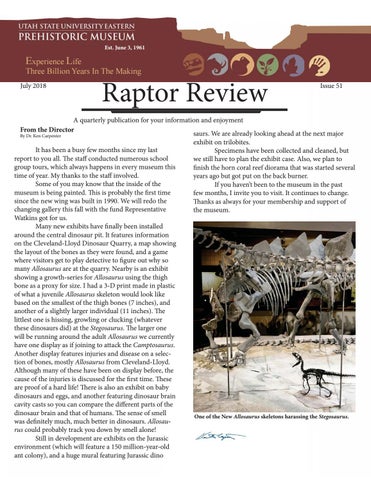
A quarterly publication for your information and enjoyment From the Director saurs. We are already looking ahead at the next major By Dr. Ken Carpenter exhibit on trilobites. It has been a busy few months since my last Specimens have been collected and cleaned, but report to you all. The staff conducted numerous school we still have to plan the exhibit case. Also, we plan to group tours, which always happens in every museum this finish the horn coral reef diorama that was started several time of year. My thanks to the staff involved. years ago but got put on the back burner. Some of you may know that the inside of the If you haven’t been to the museum in the past museum is being painted. This is probably the first time few months, I invite you to visit. It continues to change. since the new wing was built in 1990. We will redo the Thanks as always for your membership and support of changing gallery this fall with the fund Representative the museum. Watkins got for us. Many new exhibits have finally been installed around the central dinosaur pit. It features information on the Cleveland-Lloyd Dinosaur Quarry, a map showing the layout of the bones as they were found, and a game where visitors get to play detective to figure out why so many Allosaurus are at the quarry. Nearby is an exhibit showing a growth-series for Allosaurus using the thigh bone as a proxy for size. I had a 3-D print made in plastic of what a juvenile Allosaurus skeleton would look like based on the smallest of the thigh bones (7 inches), and another of a slightly larger individual (11 inches). The littlest one is hissing, growling or clucking (whatever these dinosaurs did) at the Stegosaurus. The larger one will be running around the adult Allosaurus we currently have one display as if joining to attack the Camptosaurus. Another display features injuries and disease on a selection of bones, mostly Allosaurus from Cleveland-Lloyd. Although many of these have been on display before, the cause of the injuries is discussed for the first time. These are proof of a hard life! There is also an exhibit on baby dinosaurs and eggs, and another featuring dinosaur brain cavity casts so you can compare the different parts of the dinosaur brain and that of humans. The sense of smell One of the New Allosaurus skeletons harassing the Stegosaurus. was definitely much, much better in dinosaurs. Allosaurus could probably track you down by smell alone! Still in development are exhibits on the Jurassic environment (which will feature a 150 million-year-old ant colony), and a huge mural featuring Jurassic dino
Page 2
Castle Country Cultures By Dr. Tim Riley
Greetings from the Hall of Archaeology! Summer is here and we are enjoying this warm, dry weather as we start up our field season for the year. There are three main field projects happening for the Hall of Archaeology this year. First, I will be spending some time excavating a portion of the experimental pithouse we built and burnt for science. While we haven’t had the precipitation-related weathering we had hoped for, it is interesting observing how quickly insects, rodents, and other biological agents of change have taken residence. Excavating a known house layout has been a twist on how I think about an archaeological site, particularly since we can trace the uneven impacts of combustion across the interior.
(Experimental Pithouse before excavation.)
Second, I am testing a rockshelter site along Buckhorn Wash during the summer. This site has intrigued me since I moved onto the Colorado Plateau and I am looking forward to this chance to explore its story. Finally, I am again partnering with the BLM, Montgomery Archaeology, and Arizona State to excavate the Cottonwood Village site in Nine Mile Canyon. Continuing on the success of last year’s project, we will be introducing archaeology to highschool student groups and other engaged community members over the course of six weekends. Find out more information here: https:// www.facebook.com/groups/152910701902341/ https://ninemilevolunteer.weebly.com/ This was a busy school tour season! It was lots of fun showing off our new Ancestral Puebloan exhibit to all of the students as they celebrated the end of their school year. We had schools from as far away as Atlanta, GA stop by this year. A highlight for the Hall of Archaeology was an extended tour
and hands-on activity with primitive pottery college students from Utah Valley University and Jacksonville University in Florida. We are always happy to schedule a guided tour for any group. Contact Shai Reiswig for more information. I spent a week in the nation’s capital for the annual Society for American Archaeology meeting. Though I did get to stop in the National Museum of the American Indian, most of my time was spent excitedly exploring archaeology at the conference. I gave a presentation on coprolites and Fremont Paleocuisine , served as a discussant in a symposium on mentoring in the archaeological sciences, served as Utah’s Public Archaeology Coordinator, and started my term on the Committee on Museums, Collections, and Curation. Phew! As always, I came away awed and impressed at the incredible archaeological research happening around the world. A long-awaited article on a bighorn sheep headdress in the private Tommy Morris collection and the depiction of headdresses in rock art across the west was published in the journal, Rock Art Research, this past Spring. It was fun collaborating with so many co-authors and working to tie to tangible material record to the symbolic expressions carved and painted in so many of our canyons. Our Family Day for Utah’s Archaeology and Preservation Month was a blast. Thanks so much to the Manti-La Sal National Forest and Castle Valley Archaeological Society for helping out!
(Charmaine Thompson, Heritage Program Leader @ Manti-La Sal National Forest, demonstrates how to use a pump drill.)
Page 3
Events & Information By Shailetia Reiswig
Members be on the lookout for upcoming events! Members have the benefit of 33% discount on classroom rental fees, which includes the admission for your invited guests. Our classroom has been very popular for birthday gatherings of young dinosaur enthusiasts! We hope you consider us, especially during these summer days. If you have any questions, about your membership, or how to book the classroom, please contact Shai Reiswig by phone at 435-613-5755, email at shai. reiswig@usu.edu, or in person.
next time you are here. I have also been cataloging trilobites in preparation for an upcoming exhibit. We have a great variety of species from all over Utah that we can’t wait to show off. In fact, when you visit the museum, you will notice many of the paleontology cases being revamped and updated. The same thing is happening behind the scenes in our paleo storage. Where we use to have Cambrian trilobites stored next to Eocene fish, we are now designating storage areas by geologic era. We will have separate storage areas for Paleozoic, Mesozoic, and Cenozoic materials. This, combined with the ongoing location inventory, will make it much easier for visiting researchers
Secrets from the Vault by Katy Corneli
Summer time greetings to all our members. I hope you are staying cool wherever you are! Here in the climate-controlled museum, I have just completed an inventory of all the archaeological artifacts currently on display. It is really fun to open each case and look at the objects one by one. It makes you notice things you may have overlooked before. For example, you may have been to our museum many times but did you ever notice this beautiful little projectile point? It is called a Nawthis Side-notched point and dates between 800-1200 A.D. They were first identified in the Great Basin but are now known to Nawthis Side -notched point span a range from the dates between 800-1200 A.D. Grand Canyon northward to Central Utah. They are commonly found at both Fremont and Ancestral Puebloan sites. See if you can find it
Before and after of the Salado olla, currently waiting in storage before being displayed.
to access individual specimens within the collection. Between working on all these other things, I have managed to complete work on the Salado olla, highlighted in past newsletter articles, one year after it was started. For now, it has a home in our storage area, but plans are underway to get in on display shortly. Gift Shop By Jennifer Shorthill
We are well into the Summer and having a fantastic time here! It is wonderful to see so many people stopping by to say hello and to visit our lovely little gem of a Museum! We have enjoyed seeing all the schools that took time to come and tour and learn more about us. Our gift shop has some wonderful items for purchase, and they are moving fast. More items will be coming in July. Need a birthday gift or have a Dino enthusiast on your list?
Page 4
Don’t forget; we’re here for you. Thank you, to all of our patrons. We appreciate your business. You are what keeps us going! Can you dig it? We hope you’re enjoying your Summer!
A new exhibit case discusses Allosaurus growth, based on a series of femurs from the Cleveland Lloyd Dinosaur Quarry. There are several cases in development at the moment. Many times exhibitions need models produced to help interpret the fossil. This is called scientific illustration or fossil reconstruction work. Two items recently completed were a brain case of an Apatosaurus that required sculpting and casting Growth series of the a model. References were taken Allosaurus femur, as part from a 3-D image and partial cast. of the new Cleveland Lloyd Dinosaur Quarry exhibit.
Brain case from sculpture to cast
New items arriving in the Gift Shop. Stop in and get them before they are gone!
Exhibits by Sandra Budd
Greetings from Exhibits, Upgrades to the Paleontology hall are on-going. A large floor mural of a dry lake bed with dinosaur foot prints was painted and installed in the central display area.
3-D Scan Image
Final Cast
The second project was a plant specimen that Dr. Carpenter reconstructed from fossil shoots and then I spent some time detailing the form and painting according to his scientific illustration. Plant model from fossil to sclupture
Fossil Shoot
Thanks to volunteer Riley Crismore for his skillful help in painting the mural.
Molding Sculpture
Illustration
Reconstruction
Special Exhibitions Gallery Schedule 2018 Ancient Skies Through Ancient Eyes March 17 - October 27, 2018. Please reach out to me with any questions regarding exhibitions. sandra.budd@usu.edu or 435.613.5760.
Page 5
I see dead things.... by Dave Alderks
AMMP Conference At the end of April, I was given the opportunity to travel to the Association of Materials and Methods in Paleontology conference held in Lincoln Nebraska. There I presented on the building of the “Gooseneck� Allosaurus display modifying a method developed in 1909. The presentation was well received with lots of interest from other museums around the country.
We were shown the area and collected some eggshell fragments, and were also informed of a second site nearby, with small bones. We collected several samples for screen washing. The first part of the screen washing has produced scutes from a small crocodile along with micro gastropods, and other Small Crocodillian scute under microfossils, indicating the microscope collected at the the area may have been a micro fossil site in the Morrison Formation. small pond. Eocene Mammals The last few weeks of this quarter I spent out in the Uinta Basin south of Vernal, UT looking for and collecting mammals. With the help of some volunteer, I was able to obtain several blocks of Brontothere material and some reptilian material. The specimens might be used in the upcoming Eocene exhibit next year. If you would like to go on an excavation, you can contact me at dave.alderks@usu.edu or 435 613 5756.
Poster session at the AMMP conference at the University of Nebraska, Lincoln campus.
Jurassic Ferns Sandra and I spent several days down in Southeastern Utah looking for evidence of the environment during the Jurassic Period. We found an area that contained the remains of ferns and cycad leaflets, and other plant remains. This deposit was in a fine-grained sandstone and was likely along a river or lake system in the Morrison Formation. Jurassic Microsite Ken and I also went out and checked an egg location in the Morrison Formation, that was reported by an individual last year.
Collecting Jurassic plants from the Brushy Basin Member of the Morrison Formation in SE Utah.
Volunteer opportunities Volunteers are always welcome here at the museum, and we will even take you into the field in Archaeology and Paleontology. You could be working on one of our cool projects. To volunteer, please contact one of us from the information below: Archaeology Tim.riley@usu.edu or 435.613.5280 Collections Katharine.Corneli@usu.edu or 435.613.5765 Paleontology Dave.alderks@usu.edu or 435.613.5756 Exhibits sandra.budd@usu.edu or 435.613.5760
Prehistoric Museum 155 East Main Street Price, Utah 84501 Visit us on the web at usueastern.edu/museum Local (435) 613-5060 Toll Free (800) 817-9949
ADDRESS SERVICE REQUESTED
Inside This Edition
Editor/Layout Dave O. Alderks
Item From The Director Castle Country Cultures Events & Info Secrets from the Vault Gift Shop Exhibits I see dead things...
Page Cover 2 3 3 3 4 5
Advisory Board Ken Fleck-Chairman Tim Gwyther-Vice Chairman Mike Leschin Charles Semborski Maurine Tanner Mark Bunnell Andrew Urbanik Bruce Burgess Dennis Willis Terry Willis - Ex- Officio Advisor Don Burge-Founding Director Dr. Gary Straquadine- Acting Chancellor USU Eastern Dr. Kenneth Carpenter-Museum Director