Est. June 3, 1961
Experience Life Three Billion Years In The Making April 2018
Raptor Review
Issue 50
A quarterly publication for your information and enjoyment From the Director This 525-year interval is when the modern Indian tribes By Dr. Ken Carpenter of Utah began taking shape. I start with the great news that State Representative Thanks as always for your membership and support of Christine Watkins got $50,000 from the state legislathe museum. ture for the museum. This will finally allow for a major upgrade of the Changing Exhibits Gallery, as well as pay for some basics, like utilities. We plan to cover over the distracting cinder blocks to give the room more visually pleasing wall for the art that often hangs there. That work is scheduled to commence in the fall after the Ancient Skies Through Ancient Eyes photographic exhibit. I have long dreamed of making that room look better and more professional, and Representative Watkins' hard work will make that possible. Elsewhere, work is slowly progress in developing exhibits for the central dinosaur pit. It will feature new material that is not displayed anywhere else in the state, and in few museums worldwide for that matter. This is all in keeping with my plans to give this museum some unique exhibits to keep visitors coming back. As part of this renovation, Sandra has repainted the floor tarps under the dinosaur skeletons to look more like the ground, complete with footprints. Check it out. I decided not to invest in putting in a proper deck under the skeletons at this time because of how difficult and potentially damaging to the skeletons it would be to remove once we move to a new museum. Progress on that also putters along slowly. On the archaeology side, funds have been made available for conservation of artifacts in the collections. We are also planning to submit a National Endowment for the Arts grant to photograph many of the objects on display for an online catalog. Exhibit work in the archaeology gallery is postponed until exhibits are caught up on the paleontology side. Sometime next year, we will probably start on the Numic Indians, i.e., the Indians from after the Fremont & Anasazi to the appearance of the Spanish in Utah in 1776.
Castle Country Cultures By Dr. Tim Riley
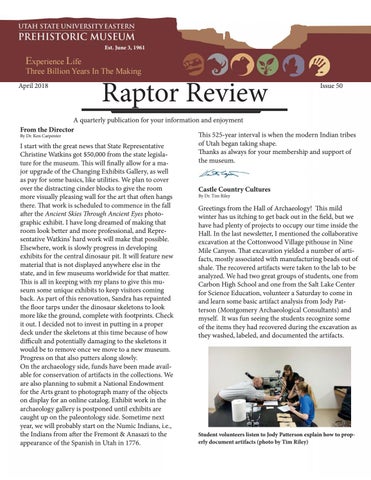
Greetings from the Hall of Archaeology! This mild winter has us itching to get back out in the field, but we have had plenty of projects to occupy our time inside the Hall. In the last newsletter, I mentioned the collaborative excavation at the Cottonwood Village pithouse in Nine Mile Canyon. That excavation yielded a number of artifacts, mostly associated with manufacturing beads out of shale. The recovered artifacts were taken to the lab to be analyzed. We had two great groups of students, one from Carbon High School and one from the Salt Lake Center for Science Education, volunteer a Saturday to come in and learn some basic artifact analysis from Jody Patterson (Montgomery Archaeological Consultants) and myself. It was fun seeing the students recognize some of the items they had recovered during the excavation as they washed, labeled, and documented the artifacts.
Student volunteers listen to Jody Patterson explain how to properly document artifacts (photo by Tim Riley)
Page 2
Following these lab days, the museum hosted a Nine Mile Canyon Excavation Celebration in February. We had great attendance at this Saturday event, which featured speakers involved in the excavation including one of our student volunteers and our local BLM archaeologist. Some of our partners were unable to make it due to inclement weather, but we were able to use Skype to bring them to us for part of the event. Thanks so much for those of you who joined us! This first year of excavation uncovered about half of the structure down to the floor before we backfilled it for the winter. This project will continue next fall, where we hope to excavate through the floor exposed last year and finish excavating the rest of the structure with the help of student and community volunteer groups. If you have not been to the museum in the last couple of months, the Ancestral Puebloan exhibit suite is well worth the visit. In addition to an array of artifacts used by the Ancestral Puebloans, there is a diorama of the Five Kiva site brought to life through the work of our head of exhibits, Sandra Budd. The highlight for many visitors is the reconstructed room of a pueblo that you can enter through a T-shaped door, a typical (and small) entry in many pueblos. Bring some friends and family and bask in the incredible record of past cultures preserved here in eastern Utah. Artifact of the Quarter The Prehistoric Museum is blessed to house an incredible collection of artifacts made from plant fibers, wood, and leather. These perishable artifacts, sometimes called the “missing majority,� are rarely preserved outside of rockshelters and other protected environments. Unfortunately, the records for many of these privately donated objects rarely give information that allows us to associate these objects with a particular time period or location. Recently, we have started radiocarbon dating some of these artifacts in order to tell a more complete story about the object and the people who made and used it.
The first artifact I would like to highlight is also one of the most spectacular. This cradleboard, made from willow, rabbitbrush, yucca, cotton, deer and rodent hide, is the only known Fremont figurine accessory. Found by Ephraim Pectol in the early 20th century, we know little about it other than it came from somewhere in the Fremont River drainage near Capitol Reef. With the assistance of David Yoder (Weber State University), we were able to radiocarbon date both the woven cotton cloth and some of the yucca cordage. These dates confirmed that this incredibly intricate artifact was lovingly constructed around 1000 AD!
Tim Riley examining the Pectol figurine and cradleboard (Photo by Ken Carpenter)
As always, we appreciate your support of the museum and look forward to seeing you at the museum. Secrets from the Vault by Katy Corneli
The large Olla I wrote about a few months back has been completely disassembled, and all the mold, plaster, and old glue have been cleaned off. I used steam to soften the old adhesive and separate the individual pieces. The fragments were then cleaned in a solvent bath followed by a water bath to remove the plaster. I am now piecing it back together and have completed the rim. I hope to put together a short video detailing the process before the project is over.
Page 3
Cody will be with us through the end of the semester. Inventory work continues in paleontology as well where I have also been supervising the reorganization of our storage areas. I am much in debt to Dave Alderks for all the heavy lifting. As always I am seeking volunteers. Do you have some extra time coming up this summer? Why not put in an application? We have work to be done in almost every department. Get involved behind the scene and see what makes your Prehistoric Museum tick. More than 200 pieces of the disassembled Olla laid out in the lab ready to be put back together
Reconstructing the rim.
Thanks to Dr. Riley we have learned a little more about the Olla and where it came from. This particular type of pottery is most likely Gila Red Ware. It dates from between 1150 – 1450 A.D. and comes from a unique and interesting culture in northern Arizona called the Salado. These people may have descended from farmers migrating from Utah, New Mexico, and Arizona. Again, more information is forthcoming and will, of course, be included in any exhibit featuring this impressive Olla. In other collections news, I am pleased to mention that we have hired a part-time, temporary collections assistant (long-time volunteer Cody Merritt) who has been conducting inventory on the archaeological collection.
Events & Information By Shailetia Reiswig
It has been an exciting year with many events! Coming up we will have Family Day on May 12th, with fun activities for the whole family. Be sure to check your email for updates on exclusive members only events too. Members have the benefit of 33% discount on class¬room rental fees, which includes the admission for your guests. Our classroom has been very popular for birthday gatherings of young dinosaur enthusiasts! We hope you consider us. If you have any questions, about your member¬ship, or how to book the classroom, please contact Shai Reiswig by phone at 435-613-5755, email at shai.reiswig@usu.edu, or in person. Gift Shop By Jennifer Shorthill
Spring!! Time to shake off those winter blues and get outside! We are just as anxious and excited for some warm weather, and we are looking forward to seeing our patrons visit us. There will be some new items coming into the gift shop in the next few months.
Page 4
You’ll need to come and check it out! We are grateful for your business and your patronage. Our success depends on you! Stop by and visit this amazing Museum and bring your friends along. We cannot wait to see you and look forward to another wonderful season. There’s dirt on my shirt and leaves in my hair, There’s mud on my boots but, I don’t care. Playing outside is so much fun! To breathe the clean air and feel the warm sun, To stomp in a puddle or climb a big tree Makes me feel happy, just look, and you’ll see! -Jeff Foxworthy Thank you all who participated and attended the reception.
We are very excited to present our new special exhibition Ancient Skies Through Ancient Eyes that opened March 17 and runs through Saturday October 27, 2018. Bob Maynard’s photographic exhibition takes you on an exciting discovery of the unexpected abundance of ancient rock art and ruins in and around the Colorado Plateau of the American Southwest.
Reggie escaped from the Museum in celebration of Spring and was last seen along the Highway somewhere in Eastern Utah!
Greetings from Exhibits by Sandra Budd
The Other Side of Utah opened February 10 with a delightful representation of artists from our community. Many of the artists were new, and the excitement is high in looking towards next years’ exhibit. This year’s exhibition represents a wide array of mediums. There were several large paintings and photographs as well as prints and sculptures. Many of the artists celebrate the special features of this state; from its wildlife to its classic car beauties, star-filled night skies and iconic mountainscapes.
It examines rock art styles and delves into ways the ancient ones used rock art panels and architecture to mark the passing of time and the seasons. The exhibit features several night images from the Nine Mile Canyon. The starry skies juxtaposed with these ancient petroglyphs, bridges time and place with these ancient peoples. It is a beautiful and insightful view of one of Utah’s most significant rock art locations. Bob Maynard founded Colorado Plateau Photo Tours and has published two books, A Photographer’s Guide to Colorado’s National Parks and Monuments, and Ancient Skies Through Ancient Eyes.
Page 5
He has given presentations to camera clubs in Colorado, Utah, New Mexico, Illinois, and Arizona. His photography of the American desert southwest has been exhibited in the Edge of Cedars Museum (2013 and 2016) as well as many galleries. Please contact me regarding any exhibitions. Sandra.budd@usu.edu or 435.613.5760.
One of the Allosaurus fragilis femurs that was prepared for the new Jurassic Pit exhibit.
I see dead things.... by Dave Alderks
The winter has come and gone, which means field season is just around the corner. Before field season can happen, I must give you all an update as to what I have been up to for the past three months. Since the beginning of the New Year, I have been working on the Jurassic Dinosaur Pit, which will include specimens from the Cleveland-Lloyd Dinosaur Quarry. To prepare for this new exhibit, I have taken trips to Cleveland-Lloyd and Dinosaur National Monument to learn more about the Jurassic Period here in Utah. It was interesting to learn more about the debate between paleontologist as to the reasons why so many predators are found at Cleveland-Lloyd Dinosaur Quarry.
The growth exhibit is fascinating to me, as I keep comparing the different femurs to modern animals. I will also be working with the son of the late Dr. Tidwell to collect some fern fossils from the Jurassic here in Utah. These are scarce fossils here in Utah, and it will take some walking to find them, but they will also make a great addition to our Jurassic collection. The other big project that I am working on is the rearranging of the bone lab on campus. We are moving the unprepared material to an upper level which will make access to future projects much more easy. We are arrainging the other rooms according to time periods. This should aid in finding fossils quickly for researchers and also allow for similar items to be close to each other. With the weather warming up field season is quickly coming upon us, and if you follow my blog you will beable to see where I will be collecting this year once it is posted. If you would like to volunteer or ask questions you can contact me at dave.alderks@usu.edu or 435 613 5756.
Volunteer opportunities
Prepositioning the Camarasaurus lentus codal (tail) vertebrae after the new floor cover and repairs were complete.
For my part, I have worked on a new skull for our Allosaurus, getting it to match the skeleton. This new skull is a little larger than the old head, but it is lighter than the old one because it is not plaster. This will help prevent the Allosaurus from doing a headstand. I have also been working on several Allosaurus femurs for part of the new Jurassic display, which will show a little about how dinosaurs grew and changed as they matured.
Volunteers are always welcome here at the museum, and we will even take you into the field in Archaeology and Paleontology. You could be working on one of our cool projects. To volunteer, please contact one of us from the information below: Archaeology Tim.riley@usu.edu or 435.613.5280 Collections Katharine.Corneli@usu.edu or 435.613.5765 Paleontology Dave.alderks@usu.edu or 435.613.5756 Exhibits Sandra.budd@usu.edu or 435.613.5760
Prehistoric Museum 155 East Main Street Price, Utah 84501 Visit us on the web at usueastern.edu/museum Local (435) 613-5060 Toll Free (800) 817-9949
ADDRESS SERVICE REQUESTED
Inside This Edition
Editor/Layout Dave O. Alderks
Item From The Director Castle Country Cultures Secrets from the Vault Events & Info Gift Shop Greetings from Exhibits I see dead things...
Page Cover Cover 2 3 3 4 5
Advisory Board Ken Fleck-Chairman Tim Gwyther-Vice Chairman Mike Leschin Charles Semborski Maurine Tanner Mark Bunnell Andrew Urbanik Bruce Burgess Dennis Willis Terry Willis - Ex- Officio Advisor Brad King Don Burge-Founding Director Dr. Joe Peterson-Chancellor USU Eastern Dr. Kenneth Carpenter-Museum Director