Est. June 3, 1961
Experience Life
Three Billion Years In The Making July 2017
Raptor Review
Issue 47
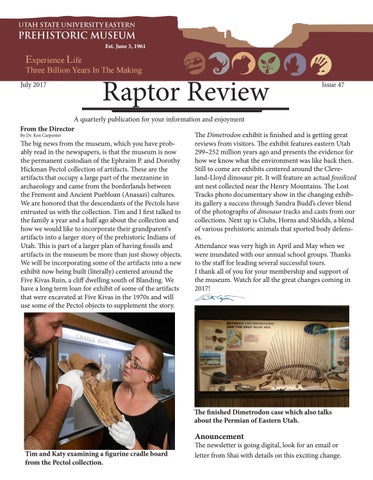
A quarterly publication for your information and enjoyment From the Director By Dr. Ken Carpenter The Dimetrodon exhibit is finished and is getting great reviews from visitors. The exhibit features eastern Utah The big news from the museum, which you have prob299–252 million years ago and presents the evidence for ably read in the newspapers, is that the museum is now how we know what the environment was like back then. the permanent custodian of the Ephraim P. and Dorothy Still to come are exhibits centered around the CleveHickman Pectol collection of artifacts. These are the land-Lloyd dinosaur pit. It will feature an actual fossilized artifacts that occupy a large part of the mezzanine in ant nest collected near the Henry Mountains. The Lost archaeology and came from the borderlands between Tracks photo documentary show in the changing exhibthe Fremont and Ancient Puebloan (Anasazi) cultures. its gallery a success through Sandra Budd’s clever blend We are honored that the descendants of the Pectols have of the photographs of dinosaur tracks and casts from our entrusted us with the collection. Tim and I first talked to collections. Next up is Clubs, Horns and Shields, a blend the family a year and a half ago about the collection and of various prehistoric animals that sported body defenshow we would like to incorporate their grandparent's es. artifacts into a larger story of the prehistoric Indians of Attendance was very high in April and May when we Utah. This is part of a larger plan of having fossils and were inundated with our annual school groups. Thanks artifacts in the museum be more than just showy objects. to the staff for leading several successful tours. We will be incorporating some of the artifacts into a new I thank all of you for your membership and support of exhibit now being built (literally) centered around the the museum. Watch for all the great changes coming in Five Kivas Ruin, a cliff dwelling south of Blanding. We 2017! have a long term loan for exhibit of some of the artifacts that were excavated at Five Kivas in the 1970s and will use some of the Pectol objects to supplement the story.
The finished Dimetrodon case which also talks about the Permian of Eastern Utah.
Anouncement Tim and Katy examining a figurine cradle board from the Pectol collection.
The newsletter is going digital, look for an email or letter from Shai with details on this exciting change.
Page 2
Castle Country Cultures By Dr. Tim Riley
Greetings from the Hall of Archaeology! A lot has happened since the last newsletter. The Ephraim P. and Dorothy Hickman Pectol collection, most of which was on loan to the museum, was formally donated by the descendent families. This donation includes 42 objects that were on loan to Capitol Reef National Park. This is one of the finest collections of Fremont basketry ever assembled. Ephraim Pectol was also one of the important local guides to Noel Morss, the archaeologist who defined the Fremont culture based on these very sites along the Fremont River. We are indebted to the descendent families for their donation, which will keep the entire collection together and accessible to the public.
Artifact of the Quarter The artifact of this quarter is a reminder that artifacts come in all shapes and sizes. This tiny slate bead was recovered from the fill on top of the pithouse structure at the Martinez Pithouse site. The location reminds us that the outside of this structure was an important work area, much like a porch today. The white square you see is 1cm in length, making the bead about 2.5 mm in diameter! Artifacts like this are the reason why we double-screen all the dirt on site, first through a ¼” screen and then a 1/8” screen. Even with the smaller screen, this bead was nearly small enough to fall through. You never know what you might find once you start excavating.
Descendants of Ephraim and Dorothy Pectol at the transfer of Pectol artifacts to the museum. I am wrapping up my excavation at the Martinez Pithouse site out by East Carbon. This typical Fremont home yielded an interesting assortment of architectural and artifactual evidence during excavation. I hope to share this site with many of you during our member’s only tour of the archaeology of Grassy Trail Creek this fall. Look for an invitation to this opportunity later this summer. While the mission of the Prehistoric Museum encompasses all of Eastern Utah, the Ancestral Puebloan world south of the Colorado River has largely taken a back seat to the Fremont archaeology closer to the museum. This is all changing with the suite of exhibits currently under installation. Using a specific site, the Five Kiva (or Westwater) Ruin south of Blanding, as a focal point, this suite will include a life-size Puebloan roomblock, artifacts from the site itself, and a scale diorama of the entire site.
Artifact of the month, a slate bead found at the Martinez pit house. Events & Information By Shailetia Reiswig
Members, I hope you all get a chance to come visit us to see our new exhibit Clubs, Horns, and Shields by Robert Gaston. If you were not able to make it to the opening, do not worry, these amazing beasts will be up through October. The next upcoming show will be the annual community art show, “The Other Side of Utah: 20172018” opening in mid-November. Be sure to keep a look out for special members-only events in the future for more details. Do not forget that as members when you get exclusive
invitations to these gallery openings that includes up to 5 guests! If you have any questions, comments, or concerns about your membership, please do not hesitate to contact Shai Reiswig by phone at 435-613-5755, email at shai.reiswig@usu.edu, or in person. Secrets from the Vault by Katy Corneli
What a whirlwind couple of months it has been here in collections. I have been spending a lot more time in archaeology since the last newsletter. I have even had the chance to get my (gloved) hands dirty doing some pottery conservation on an impressively large Olla from around the Utah/Arizona border. You can see a short video about that project if you follow us on Facebook but here is a “before” photo of the piece that I hope you will be able to compare to an “after” photo in a future newsletter. The pot is upside-down in the photo because the rim is more solid than the base. Before it was donated to us the pot was stored on the floor of a shed. Hence, the bottom of the pot has flattened, as the glue has softened and warped. The materials used during the last restoration are now failing and the whole pot is covered in mold and dirt. In a nutshell, I have to get the old adhesive off, clean the sherds, and re-mend them so the Olla can eventually go on display.
Upside down Olla before conservation
Page 3
I have also been busy with the incoming Pectol collection. Many of these incredible artifacts were already on loan to the museum and can be seen in our upper gallery. The rest were on loan to Capitol Reef National Park so Dr. Riley and I took a trip down to retrieve them. We were amazed by the quality of these pieces that we had not seen before and are very excited for them to join their counterparts already in our museum (for more see Dr. Carpenter’s section of this newsletter). The beginning of summer brought with it a decline in my student volunteer workforce. If anyone out there needs a way to fill those long summer days give us a call or come by the museum to fill out a volunteer application. We will gladly put you to work! Gift Shop By Jennifer Shorthill
We are so excited to have some new products in the gift shop! Come and check out the new shirts, new jewelry and new toys. Our older t-shirts are on sale for $10.00 each. Come and get them while they last! When you visit, stop by and meet our newest member, Sydney Ho. All of our clerks are friendly, kind and ready to help. Do you know anyone that might benefit from a Museum Membership? Is it time for you to renew? Come and reap the rewards from being a member of the Museum. Whatever you do, this summer, get out! Enjoy this gorgeous state of ours and come and visit the Museum. Tans will fade but, memories will last forever! Can you dig it? Have a fun Summer and thank you for your patronage!
New products at the gift shop
Page 4
Exhibits
by Sandra Budd
New necklaces now in the gift shop.
Hello, museum members. Now on display in the special exhibits gallery Clubs, Horns, and Shields: Armored Dinosaurs and Other Prehistoric Animals. For millions of years defense and display have triggered the evolution of bizarre and extreme body structures. In the Clubs, Horns and Shields exhibit visitors will witness such extraordinary animals as a giant scorpion from a prehistoric ocean, an armored dinosaur with 14-inch spikes along its back and a formidable 30-foot crocodile. The exhibit uses diverse fossil skeletons and models to bring these creatures to life. Animals living today are juxtaposed with these anatomical wonders. Visitors of all ages will be amazed to see a 4,400-pound prehistoric armadillo (Glyptodon) with an elaborate club tail. The exhibit includes a selection of human armor that mirrors these extreme body structures. Clubs, Horns, and Shields was produced by Robert Gaston of Gaston Design Inc. located in Fruita, Colorado. Gaston Design Inc. specializes in restoring, molding, and casting of fossil skeletons and has restored several armored dinosaurs from the Prehistoric Museum collections. Rob Gaston’s long history with the Prehistoric Museum stems from his 1989 discovery of an armored dinosaur Gastonia burgei, north of Moab, UT.
The new shirts are here, get them while they are hot. They are going fast.
Please contact me regarding any exhibits. Sandra.budd@usu.edu or 435.613.5760.
All old shirts are now on sale, only $10.00.
Some of the displays that will be here for the Clubs, Horns, and Shields exhibit.
Page 5
I see dead things.... by Dave Alderks
During the last week of May and the first week of June, I spent time working in the fossil beds of the House Range of Utah and the Uinta Basin of Utah. The trips were to collect samples for new exhibits in development for the museum. The House Range trip focused on Trilobites from the Cambrian Period, while the Uinta Basin trip focused on Turtles, Crocodiles, and Mammals from the Eocene. The Trilobite expedition was a continuation of the trip from last year, and we had a few more volunteers this time with one expert coming from Wyoming. We spent a full week hunting the Weeks Formation, and the Wheeler Shale. In the Weeks Formation, we found several well-preserved specimens that potentially have three-dimensional eye stalks. I also located some soft body specimens that will take time to prepare but are a great addition to the collection. The Wheeler Shale was also very productive in the two locations that we collected fossils. I found several four-inch trilobites and several partial trilobites. I found one slab that has several large complete trilobites that look like they were deposited during a storm event. The following week I was looking for mammals in the
I then went to one of the better places to look in the Myton Member of the Uinta Formation, hoping to find some nice smaller mammals, and I did find some smaller mammals along with a crocodile and five turtles, several of these turtles are around 90 % complete. As I was leaving this site, we went by an old locality and found more bone that had been exposed in a cliff overhang. I will have to go back for this and the several teeth and skulls found in the area. All in all this was a very successful two weeks, and I look forward to more field work this year.
Jaw bone located in the Uinta Basin. Associated with this specimen is other post crainial material.
Volunteer opportunities The pit we dug in the Wheeler Ampitheater looking for trilobites. Uinta Basin south of Vernal, Ut. My first stop on this trip was to my super secret fossil canyon where I have collected several skulls from Brontothere sp. I went to the location where some teeth were just starting to show through the large sandstone boulders. However, I was too late as someone else collected the skull. I found my first surprise a large crocodile was lying in wait, and if it had been alive I would have been lunch!
Volunteers are always welcome here at the museum, and we will even take you into the field in Archaeology and Paleontology. You could be working on one of our cool projects. To volunteer, please contact one of us from the information below: Archaeology Tim.riley@usu.edu or 435.613.5280 Collections Katharine.Corneli@usu.edu or 435.613.5765 Paleontology Dave.alderks@usu.edu or 435.613.5756
Prehistoric Museum 155 East Main Street Price, Utah 84501 Visit us on the web at usueastern.edu/museum Local (435) 613-5060 Toll Free (800) 817-9949
ADDRESS SERVICE REQUESTED
Inside This Edition Item
Editor/Layout Page
From The Director Cover Castle Country Cultures 2 Events & Info 2 Secrets from the Vault 3 Gift Shop 3 Exhibits 4 I see dead things... 5
Dave O. Alderks
Advisory Board
Ken Fleck-Chairman Tim Gwyther-Vice Chairman Mike Leschin Charles Semborski Maurine Tanner Mark Bunnell Andrew Urbanik Bruce Burgess Dennis Willis Terry Willis - Ex- Officio Advisor Brad King Don Burge-Founding Director Dr. Joe Peterson-Chancellor USU Eastern Dr. Kenneth Carpenter-Museum Director