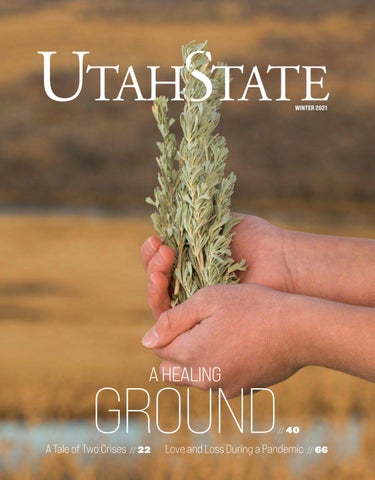
A HEALING
GROUND
// 40
A Tale of Two Crises // 22
Love and Loss During a Pandemic // 66
THANK YOU to all our
generous donors!
We could not have done it without each and every one of you.
One Day. One Aggie Family.
One Great Big Impact. $89,195 Raised Assisting 69 different areas around USU # of Gifts 634 (+ 27% over last year) # of donors 577 (+ 43.5% over last year) 82.7% increase in USU staff/faculty giving Student Emergency Hardship Fund recipients
“When people speak of COVID-19 in the future, I will not think of the hardships that I faced, I will think of the person that, although they didn’t have to, decided to act and help. I will remember the person whom does not know me and decided to help me regardless.” - Colton
“I am so grateful for the opportunity that I have been given to further my education and you have played a huge part in making that possible for me.” - Montana
“Thank you for your support, generosity, and compassion during these difficult times. We hope that all of the goodness and kindness you’ve given us will be rewarded back to you tenfold.” - Julie
A N O T E F R O M N O E L L E //
Finding the Light in Dark Times This time of year can be particularly hard in the best of times. We have
short days, long nights, surrounded by seemingly perpetual cold. It is a time when, for many of us, we hold warm memories of spending the holidays with our loved ones close to our hearts. But I, like many of you, had a di!erent experience this year because of the COVID-19 pandemic. Rather than hosting my traditional gathering with neighbors and extended family, this holiday season was quieter and included video calls to family and friends I could not see in person. However, the fall semester went better than expected at Utah State University. We did not have to end in-person classes earlier than planned and were able to provide the testing and resources to keep our campuses open. I was pleased to see everyone’s compliance with mask wearing and social distancing to make that happen. We share a common goal of reducing the risk of infection to others. The spring semester will likely be challenging right from the start. While I had hoped we would have less restrictions, high caseloads throughout the state mean we will continue o!ering a mix of course delivery methods as we did for fall semester. This is disappointing, but there are bright spots for us to celebrate. Since May, Utah State has distributed over $7 million to more than 9,000 students struggling with unexpected financial strains from COVID-19. This was possible through an allocation from the federal Coronavirus Aid, Relief, and Economic Security (CARES) Act. The university’s own Student Emergency Hardship Fund awarded another 235 grants to help students with immediate
myself getting very emotional. During this period of time, my son and I were at a restaurant when I began talking about something and started to cry. “Mom, you have to get some help,” he said. “This isn’t you.” Knowing I would likely blow this o!, a friend helped me schedule an appointment where I was diagnosed with anxiety. I am still on medication for it. I encourage anyone who is noticing changes in your behavior or those of your loved ones, to reach out and seek or o!er support, just as my family and friends did for me. I know reaching out to loved ones has lifted my spirits during the pandemic. My family has started to Zoom with each other on weekends. We hold up our pets, talk about new purchases, compare menus, and simply check in. I have actually talked to my older brother more now than I have in years. I find it is easy to connect with people in this new virtual world, President Noelle E. Cockett wears her Aggie mask to we just have to make the e!ort to reduce the risk of COVID-19 infection to others. do it. sustain the good practices we have been The little things make a big di!erence doing to prevent the spread of infection. in this weird world. Send a card. Make I worry that the prolonged isolation from a 10-minute phone call to an old friend. COVID-19 will drive each of us in one of Remember to go outside. (There have been two directions—too much self-isolation days when I realize I did not go outside may make us depressed and too much on once, which is a very foreign experience for the other side of self-isolation will make me.) Look at the stars. Find some light in us act recklessly. the darkness. That is why I want to emphasize the We will get through this together. importance of self-care. Mental health is a significant issue and I believe people should reach out and get help whenever and however they can. I have had to do Utah State University President this in the past and it is not easy. While serving as Utah State’s provost I found needs so they can continue their education. Nearly one year into the pandemic, the novelty of working from home and remote coursework has worn o!. It is no surprise people are getting tired of wearing masks and limiting their social activities. I am tired, too. And being tired of COVID-19 can make it harder to
Noelle E. Cockett
WINTER 2021 I UTAHSTATE 3
L E T T E R F R O M T H E E D I T O R //
Darren Parry, the former chairman of the Northwestern Band of Shoshone, stands at the site of the Bear River Massacre where the remains of about 400 of his ancestors still lay. He helped architect the purchase of the land and engineer a partnership with Utah State University to restore its ecology.
Change is hard. But the status quo can be worse. Nearly a year into the COVID-19 pandemic, many of us have learned to master, by necessity, new things. That may include working from home or working from home while your children are also working on their schoolwork from home. The pandemic has disrupted so many rhythms we used to take for granted. The maskless stroll across campus for a 3 o’clock cookie. Dinner and a movie. Hugs.
S
ometimes change can’t come fast enough. Like news of a promising vaccine coming to market, relief for anxiety worsened by isolation, or in the case of our cover story, the restoration of a homeland once lost. Meaningful change doesn’t often happen overnight. It requires intention, persistence, and faith that conditions can improve. We focused the winter 2021 issue on health because we wanted to identify Utah State University resources and expertise for those struggling during this time of COVID-19 and to share stories that can uplift our shaken spirits. The cover story “A Healing Ground” has been on our radar at Utah State since 2018 when the Northwestern Band of Shoshone purchased the 550-acre site of the Bear River Massacre where the remains of about 400 of their ancestors still lay. The tribe’s former ceremonial grounds also mark the country’s largest slaughter of Native Americans in the West. The partnership between the Shoshone and researchers at the S.J. & Jessie E. Quinney College of Natural Resources will take years to restore the landscape. It requires more than removing nonnative plants and trees and planting new seeds. It involves restoring the watershed, which entails buy in from neighbors upstream. It won’t be something the Shoshone can do alone. Healing begins when you bring people together, says Will Munger, a USU Ph.D. student in the Department of Environment and Society working on the project. He may be right. During this time of turmoil, Utah State will publish two issues a year. While we are finalizing the new print schedule, we are devising new plans to engage with readers throughout the year through digital issues and events. We will pivot, and hopefully, master a new thing or two.
4 UTAHSTATE I WINTER 2021
Kristen Munson Executive Editor, Utah State magazine
C O N T E N T S //
Vol. 27, No. 1 l WINTER 2021 www.utahstate.usu.edu EXECUTIVE EDITOR Kristen Munson SENIOR WRITER Jeff Hunter ART DIRECTOR Elizabeth Lord PHOTOGRAPHER Levi Sim
22 // A Tale of Two Crises
40 // Cover Story A Healing Ground A team of USU researchers partners with the Northwestern Band of Shoshone to restore the site of the Bear River Massacre with native plants and make a homeland feel like home once more.
USU PRESIDENT Noelle Cockett
Shorts: 32 // Traces of Us 38 // A Space for Darkness
USU BOARD OF TRUSTEES Jody K. Burnett, chair Kent K. Alder, vice chair Sami I. Ahmed, Laurel Cannon Alder, John Y. Ferry, Gina Gagon, David H. Huntsman, Wayne L. Niederhauser, David A. Petersen, Jacey Skinner, Terryl Warner
Where is This?
46 // Art is for Everyone 50 // Balance in the Chaos 51 // Making Remote Work for You 54 // Utah, How are You?
Features: 16 // A Shared Mission Photographer Roland Miller has a folder labeled “crazy ideas.” His latest project, a visual exploration of the International Space Station, never made the list. 28 // Connecting During COVID-19 Think of your freshman year in college. Now, imagine it unfolding over Zoom. 34 // The Face of Care The World Health Organization designated 2020 the Year of the Nurse. How prescient it was. 48 // Celebrating with Food Food comforts and connects people. But COVID-19 complicates traditional celebrations. Tara Bench’s first cookbook meets the moment. 66 // Love and Loss During a Pandemic USU Neurobiologist Sara Freeman explains how COVID-19 disrupts our social primate brain.
58 // Targeting Treatments 60 // The Rise of Mental Health Technology 62 // The Kids are (Not) Alright 70 // Ask an Aggie
Departments: 14 // Campus Scene – It’s Not Quite Room Service 26 // Dissected – Wastewater Testing 56 // Shelf Life – The Latest Books by Aggies 64 // Look Back – 50 Years of Influencing for Good
Web Exclusives: Cooking During COVID-19 – Tips from a farmer. Invisible Forces – A Q+A with Jimmy Moore. Early Influences of the Prophets—Their Dads – A conversation on the book Fathers of the Prophets. Toward A More Holistic Understanding – Putting Shoshone youth at the center of their story.
On the Cover: Sage is a sacred plant to the Shoshone and used for medicinal and cleansing purposes.
First right answer wins Aggie gear. And while you’re at it, letters to the editor are always welcome! mageditor@usu.edu UTAH STATE (ISSN 1542-2712) is published two times a year by Utah State University, 0500 Old Main Hill, Logan UT 84322–0500. Postage paid at Salt Lake City, UT. POSTMASTER: Send address changes to Utah State University, Development Records, 1522 Old Main Hill, Logan UT 84322–1522. Reproduction in whole or in part without written permission is prohibited. Opinions expressed do not necessarily represent the official position of the university. Utah State University is committed to equal opportunity in student admissions, financial assistance, and faculty and staff employment.
WINTER 2021 I UTAHSTATE 5
L E T T E R S //
We welcome your thoughts. Please email letters to mageditor@usu.edu or mail to Utah State Magazine Editor, 0500 Old Main Hill, Logan, UT 84322–0500. Please include full name, address, phone number, and email, if available. Letters should be 200 words or less. We reserve the right to edit for length and clarity.
Building Better Buildings
Something To Look Forward To Congratulations on creating and maintaining a very high quality stimulating, informative and sophisticated collegiate publication. I look forward to each edition. Keep up the great work. I encourage all alums to support your endeavors. Thank you. —Barry Moore, ’65 Del Mar, CA
I congratulate Lianna Ethchberger and selected architects in their e!ort to create the “first 100 percent carbon neutral building at USU” on the Moab campus (Utah State magazine, fall 2020 issue). While this may be a step in the right direction toward carbon neutrality, there is a dire need to design/build structures and create sites that actually sequester carbon. Carbon sequestering buildings and their sites no longer utilize the high embodied carbon “bricks and mortar” of outmoded, conventional building materials, such as large quantities of concrete, polystyrene foam board insulation, particle board using toxic adhesives, and synthetic building wrap. Natural building methods using straw-bale wall insulation and natural lime plasters rely on as many locally produced building materials as possible; as well as grey water systems, photovoltaic arrays, on-site organic food production, etc. Although they may already be doing so, USU faculty and administrators are encouraged to engage themselves, and students, with the work being done by Community Rebuilds (CR) in the Moab
area. CR is working with Arch Nexus architects to create the first buildings that may meet the Living Building challenge in the Moab area. These are carbon sequestering residential homes that demonstrate building characteristics that can be applied to larger, institutional structures to create an even more sustainable sense of place.
—Professor Bryan Dorsey, ’85 Urban and Regional Planning Program coordinator; Department of Geography, Weber State University, Ogden, UT
One Last USU Adventure Thank you, Kristen Munson for the awesome article “Mortui Vivos Docent!” This is a topic we don’t hear enough about. As a military family, I have spent the last couple years thinking how hard it will be to choose where to be buried since we don’t really have a “home.” The thought of donating my body to a cadaver lab has been very intriguing and after reading Kristen’s article I feel even better about my decision to let my body have an extra (hopefully at USU) adventure. —Allison Chase ’99
Cover Confusion I was bemused by the fall 2020 issue cover. Its dark image and black background projects a foreboding sign that perhaps a plague has descended upon the land. Yet inside, the president and editor columns and photos are light and upbeat about dealing with and conquering the pandemic. So why the dark cover? Regarding flying cars, I’m still waiting although I think a Japanese company claims to have built a prototype for production in the next couple of years. One thing that perplexes me, however, is that while flying cars are very Jetsons, does anyone expect that they will never crash? — Isaac Martin, ’74 Sherman Oaks, CA
6 UTAHSTATE I WINTER 2021
From Social Media @tjmiller2004 Enjoyed reading about @DicksonSyd in the USU Alumni Magazine. We are fortunate to have her leadership at this time in our state. @utahstatealumni
I N B R I E F // N E W S @ U S U
Kelie Hess’s exhibit “Consciously Breathing” can be found at cehs.usu.edu/hess.
“
I spend a lot of time thinking about the air we breathe. I think about the effort required for our lungs to make the exchange from air to oxygen to carbon dioxide. With a dangerous virus riding on the wind, these thoughts have occupied my mind even more than usual lately.
Elevating Career Options for Persons with Disabilities A new five-year, $1.9 million U.S. Department of Education grant provides funding for two new programs at USU Eastern and Utah Valley University for young adults with intellectual disabilities in Utah, as well as for Aggies Elevated, an award-winning post-secondary program on USU’s Logan campus. The Transition and Post-secondary Programs for Students with Intellectual Disabilities grant allows students with intellectual disabilities ages 18-26 to enroll in college courses with a path toward competitive, paid employment after graduation.
We breathe in. We breathe out. We keep living. But I don’t just want to be alive. I want to live. I want to consciously breathe with purpose. I want to live with intention and make every breath count. — Kelie Hess, a visual artist born with a rare genetic disorder who uses a power wheelchair for mobility assistance and a ventilator to support her lungs. Her exhibit Consciously Breathing explores air, breath, and life and was on display at the Sorenson Legacy Foundation Center for Clinical Excellence’s Lyndsley Wilkerson Gallery through October.
“
View it online at aggiewellness.usu.edu.
Room for Improvement: Women in Utah’s Public Sector New research from USU’s Utah Women & Leadership Project (UWLP) finds that women are underrepresented in leadership, holding only 29.1% of positions in Utah’s municipal governments, 42.5% in county governments, and 39.3% in state government. Diversity in leadership conveys that a range of interests, experiences, and priorities are being represented, which is why this groundbreaking research is so important, says Susan Madsen, founding director of the UWLP and the inaugural Karen Haight Huntsman Endowed Professor of Leadership at the Huntsman School of Business. “It’s hard to know if we’re progressing if we don’t know where we’ve been.” WINTER 2021 I UTAHSTATE 7
Aggie Spencer Cox ’98 won the 2020 Utah governor’s race after running what may be one of the most congenial political races in recent memory. Leading up to the election, Cox and his Democratic challenger Chris Peterson released a series of videos calling for a return to civility. They went viral and earned the candidates a joint appearance on MSNBC. “We disagree on lots of things, but the one thing we both agree on is the political atmosphere has gotten too toxic in our nation. We have to do better,” Cox said.
Merrill Heads to the NBA
Photo by Jeff Hunter ’96
SPORTS
Despite numerous conference titles and NCAA Tournament appearances, the Utah State basketball went 34 years without having a player selected in the NBA Draft. That drought, which dated back to Greg Grant going to the Pistons in the sixth round of the 1986 draft, came to an end on Nov. 18, when guard Sam Merrill was selected with the 60th and final pick of the virtual draft. The hero of the 2020 Mountain West tournament and the second-leading scorer in school history, Merrill signed a two-year deal with the Milwaukee Bucks. 8 UTAHSTATE I WINTER 2021
HUMAN HEALTH
Stop! For Health If you knew you could immediately help someone with a health by dDara condition by simply turning o!Created your parked car, would you? A team from the Noun Project of electrical engineers, computer engineers, and psychologists from the University of Utah and Utah State University think so. Flashing speed limit displays help to slow motorists on roadways. Perhaps a version designed with behavioral economics in mind can reduce idling. The National Science Foundation awarded the team $1.2 million to test their theory by placing air pollution displays at several schools and hospitals throughout the state. The natural human preference is for immediate gratification, explains Gregory Madden, a psychology professor at USU who studies impulse decision-making. “Idling your vehicle gives the immediate gratification of the heater staying on. Although pollution creates long-term problems, we don’t feel the immediate e!ects of those small decisions.” The new LED signs use low-cost sensors that continuously measure the air quality in micro-environments and give immediate feedback to drivers. Infrared sensors can detect an engine being turned o! and will alert parked motorists when air pollution rises to dangerous levels. Madden is creating community-crafted messages for the displays to motivate drivers to make smart choices. The sign could flash with a message that says, “One driver just turned o! their engine! Thank you!” or “It’s getting better!” The idea is that when people immediately receive a reward of knowing they are helping susceptible people, like children with asthma, those messages will connect.
“
The pandemic has derailed many plans, but disruptions to education could have a huge impact on students’ future careers and financial stability. This cycle of emergency grants is intended to get funds to Aggies who continue to face ongoing financial impacts so they can continue their education. — USU President Noelle E. Cockett, describing the university’s distribution of funding for students experiencing
GIVING
$46.6 million
unanticipated expenses related to COVID-19. The awards are made possible through an allocation from the federal Coronavirus Aid, Relief, and Economic Security (CARES) Act to aid students. Since May, USU has disbursed more
“
Lt. Governor Spencer Cox jokes with Governor Gary Herbert in 2018. Photo by John DeVilbiss.
than $7 million to more than 9,000 students based on need.
Thank Yous
Private giving to Utah State University increased 15% last year, raising $46.6 million from July 2019 through June 2020. Among the gifts are 37 new endowed scholarships, $6 million for student scholarships, and nearly $149,000 for 72 student organizations generated in 24 hours as part of the university’s annual A Day of Giving fundraiser. “The Aggie family has shown incredible compassion for this university and its students in what must be one of the most tumultuous years we’ve experienced,” says Matt White, vice president for advancement. “We know the pandemic put many students in some difficult circumstances. We are so grateful for the commitment and the empathy demonstrated by our donors, especially in recent months as we’ve worked to restart classes and provide the full Utah State experience to our new students.”
Jay H. Price’s Generosity Continues Jay H. Price, a beloved professor known for his service and generosity, began his second career as an educator at 62 after retiring from Arthur Andersen. He donated his time teaching accounting at USU’s Jon M. Huntsman School of Business. Price established the Arthur Andersen Alumni Accounting Professorship endowment and the Jay H. Price Student Scholarship endowment at USU. He died in June 2019. In October, his estate gave over $1 million to establish the Dr. Jay H. Price, Jr./Arthur Andersen Endowed Professorship to support the School of Accountancy.
FY 2020 Philanthropic Impacts: 2,906 Main-campus students who received scholarships totaling more than $3.1 million.
646 An additional 646 students attending USU Eastern received more than $460,000 in scholarships.
235 Grants awarded between May and August from Utah State’s Student Emergency Hardship Fund to help students faced with unexpected financial challenges threatening their ability to continue college.
WINTER 2021 I UTAHSTATE 9
SPACE DYNAMICS LAB
SDL Wins “Mission of the Year” A small sattelite manufactured by USU’s Space Dynamics Laboratory was honored with the Small Satellite Mission of the Year by the American Institute of Aeronautics and Astronautics Small Satellite Technical Committee for its innovation in spacecraft capabilities. The Hyper-Angular Rainbow Polarimeter satellite was deployed into orbit from the International Space Station last February and carries a payload designed to measure the microphysical properties of cloud and aerosol particles in Earth’s atmosphere.
SDL to Build Six NASA Spacecraft NASA Goddard Space Flight Center.
In October, about 201 million miles from Earth, a spacecraft launched by NASA in 2016, extended its robotic arm to collect debris from the surface of an asteroid called Bennu. The spacecraft had already spent months orbiting the asteroid, mapping its surface, and locating a site to finally touch down. Utah State University’s Space Dynamics Laboratory helped make it possible. SDL built the camera electronics for a three-camera suite onboard NASA’s Origins, Spectral Interpretation, Resource Identification, Security-Regolith Explorer spacecraft (OSIRISREx) known as PolyCam, MapCam, and SamCam. PolyCam imaged Bennu from about 1.2 million miles away and aided the spacecraft’s navigation to the asteroid. MapCam searched Bennu for debris and gas emissions, mapped the asteroid’s surface and identified a suitable collection site. SamCam, a close-range camera, verified the sample acquisition. But why a mission to this particular asteroid? Scientists believe Bennu may contain evidence of our solar system’s primeval history, including molecular precursors to the origin of life. Bennu is also among the most potentially hazardous asteroids known. It has a relatively high probability of impacting Earth late in the 22nd century. OSIRIS-REx will determine Bennu’s physical and chemical properties—critical knowledge in the event of an impact mitigation mission. Once enough dust and debris is collected, OSIRIS-REx’s sample will be placed in a return capsule for the long return to Earth, beginning this year. 10 UTAHSTATE I WINTER 2021
NASA’s Jet Propulsion Laboratory contracted with SDL to build six spacecraft for its Sun Radio Interferometer Space Experiment mission, known as SunRISE. The constellation of six CubeSats weighing just 11 kilograms each, will fly in a formation acting as a single radio telescope to observe radio images of lowfrequency emissions from solar activity and share them via NASA’s Deep Space Network. This new data will help scientists observe powerful solar storms that send trillions of tons of charged matter towards Earth, a!ecting life on Earth and beyond.
EVENTS
Introducing Blue Plate Blue Plate Research is a new event series from Utah State University that is focused on sharing applicable well-being research and tools with Utah health advocates, statewide stakeholders, and the public. The events will be hosted virtually, with a presentation on YouTube that features presenters, followed by a live question and answer session hosted on Zoom.
Understanding Obesity: New Insights Into Body Fat Measurement, Disordered Eating, and External Factors Wednesday, January 13, 2021 11:30 a.m.–12:45 p.m. Please RSVP, when available, for more information on this event. Visit www.usu.edu/blue-plate for details.
Advancing Remote Electrification
WATER
From Waste to Resource
What if remote regions could bypass the need
Treated wastewater may contain elevated levels of nutrients that promote toxic algae growth in lakes and reservoirs when released in the environment. Professors Ron Sims and Charles Miller developed the Rotating Algae Biofilm Reactor that exposes the organisms to a mix of nutrient-rich wastewater, carbon dioxide, and sunshine. The result is a thick film of biomass that can be converted into bio-based products including fuel, fertilizer, and plastics. Another benefit: cleaner water. “What was once considered a waste is really a resource when viewed from a di!erent perspective,” says Sims, a professor of biological engineering leading a $1.9 million U.S. Department of Energy funded project. The project holds promise to help expand the nation’s energy supply and accelerate the bioeconomy.
A New Tool to Forecast Colorado River Flow The Colorado River is one of the country’s most important water resources and faces growing demand from users across the arid Southwest. A team of scientists at Utah State University developed a new tool to forecast drought and water flow in the Colorado River several years in advance, giving water managers, farmers, and wildland firefighters a jump-start to prepare for changes in supply. The group’s findings were published in October by Communications Earth and Environment, an open-access journal from Nature Research.
ENVIRONMENT
Tianbiao “Leo” Liu
to build conventional energy grids? What if it was possible to convert and store energy in one unit? USU chemists Tianbiao “Leo” Liu, Bo Hu, and Maowei Hu co-authored a paper recently published in Nature Materials describing a solar flow battery design that can do just that. Both o!er di!erent advantages, says Liu, a 2019 recipient of the National Science Foundation’s Faculty Early Career Development ‘CAREER’ Award. “The photovoltaic cells convert sunlight into electricity, while the flow batteries can be charged by the solar cells to store solar energy simultaneously. The integrated design produces very high voltage and very stable cycling.” Historically, a setback for widespread adoption of solar and wind technologies has been a!ordable and safe battery storage for times when there is no sun or wind. Aqueous organic redox flow batteries (AORFBs) may circumvent this problem. Liu’s lab is working to develop AORFBs for integrated saltwater desalination and energy storage, which o!ers the opportunity to address not one, but two growing global issues from one hardware installation, he says.
Photo by Pixabay.
Herbivores at Risk A study led by Trisha Atwood, assistant professor of watershed sciences, upends the perception that predators are more likely to face mass extinction than plant-eating prey. She and her team analyzed a dataset of the diets of over 24,500 mammals, birds, and reptiles to determine which faced the greatest threat of disappearing from changing landscapes. “The results were somewhat shocking,” she says. The researchers found that more than 25% of herbivores are threatened with extinction. Their findings, published in the journal Science Advances, echo the loss of megaherbivores more than a million years ago. Identifying which animal species are at the highest risk of extinction is a critical first step for understanding the consequences of their loss and to pinpoint strategic management and conservation e!orts. “Our next step is to understand the intricacies of why this pattern is occurring; only then will we really have a chance at stopping these future extinctions,” Atwood says.
WINTER 2021 I UTAHSTATE 11
“
CAMPUS LIFE
More people will experience voting by mail this year than have ever experienced by-mail voting before. And our research shows that when people have a by-mail voting experience, they are more likely to appreciate and respect that mode of election administration. — Damon Cann, USU political science professor, told the Washington Post. He is one of three researchers who studied the feasibility of Utah using a vote by mail election
“
administration system. Utah has been a leader in vote by mail for years.
BY THE NUMBERS
#1
Utah State University Water Quality Extension led the first statewide trails and waterways volunteer cleanup this fall to remove garbage from public lands and help improve waterways.
#6 College Magazine’s ranking
of USU in the nation for its response to the COVID-19 pandemic. USU was praised for providing housing and meal refunds in spring 2020, offering a multitude of instructional delivery options in fall 2020, and identifying students in need of extra financial help.
#7
The spot that USU earned on 2020 Rival IQ Higher Ed Social Media Engagement Rankings, out of the top 350-plus colleges and universities nationwide, the highest ranking of any school west of Colorado.
12 UTAHSTATE I WINTER 2021
NEHMA Collections & Exhibitions Coordinator, Selina Ramsey, helps care for the over 5,500 artworks in the museum’s permanent collection. Photo credit: Phillip Brown.
12 The number of Sterling Scholars
attending USU Uintah Basin this academic year. The program, created by the Deseret News and sponsored by the Larry H. & Gail Miller Family Foundation, recognizes high school seniors for the pursuit of excellence in scholarship, leadership, and citizenship.
$50,000
The amount of funding awarded to the Nora Eccles Harrison Museum of Art (NEHMA) from the Coronavirus Aid, Relief, and Economic Security (CARES) Act and the National Endowment for the Arts to support its collections and exhibitions coordinator position during the next two fiscal years.
$200,000+ The minumum estimated energy savings per year by converting USU facility lamps to light-emitting diodes, known as LEDs. Lighting accounts for about 11% of a university building’s energy usage.
Temporary Reduction in USU Student Fees Utah State University lowered student fees for full-time students across its campuses for fall 2020 due to the impact of COVID-19. Fees support long-term investments into university infrastructure costs such as buildings, campus recreation and athletics programs, as well as services including health care. Recently, student fees were used to ensure that students can access telehealth services, expand electronic access to library resources, and development of no-cost textbooks.
No Test? No Problem. Applicants for undergraduate admission to all Utah State University campuses for the 2021 semesters do not need to submit ACT and SAT scores, although students may include standardized test scores to be considered for select majors and programs. The university will conduct a review of retention and recruitment data over the year ahead to aid decision-making on standardized test requirements in the future.
USU Joins Cohort Committed to Diversifying STEM Utah State University joined 53 other universities to develop inclusive faculty recruitment, hiring, and retention practices. The Association of Public and Land-grant Universities co-leads the e!ort, known as Aspire: The National Alliance for Inclusive & Diverse STEM Faculty which is funded by the National Science Foundation. Research shows that when underrepresented students are taught by diverse faculty members achievement gaps between minority and majority students are significantly reduced.
Photo courtesy of Brigham Young University.
RESEARCH
“
If you were an animal in the oceans less than 6 meters (20 feet) in length, you are most likely on the menu for Gnathomortis … ‘Jaws of Death’seemed appropriate for this kind of critter and it turns out to be an awesome name. — Joshua Lively, USU Eastern paleontologist and curator of the Prehistoric Museum in Price, on CNN. He reclassified a giant marine lizard Gnathomortis stadtmani found in 1975 as part of his doctoral research. Lively’s findings appear in the
“
Journal of Vertebrate Paleontology.
MISSED IT? USU’s third annual Inclusive Excellence Symposium, organized by Aggies Think Care Act, can be found online. The event promotes racial, cultural, and ethnic diversity and inclusiveness in the USU community. Talks are available at thinkcareact.usu.edu/symposium.
Seth Archer, assistant professor of history and USU students’ choice for 2020 Honors Outstanding Professor, gave the 45th Annual last lecture Oct. 21 titled “After the Vaccine: The United States Discovers Public Health.” Hear the complete lecture and discussion at www.usu.edu/honors/last-lecture/index.
• Ecologists behind an assessment of 67 bee species of the Colorado Rockies, a nine-year National Science Foundation-funded monitoring project, say climate change may cause “phenological mismatch,” between bees and the flowers they pollinate and could reduce pollinator populations and plant abundance. Their findings were published in Ecology Letters in August. • The USDA’s National Institute of Food and Agriculture awarded more than $1 million for two program grants to Ruby Ward, professor of applied economics, and her team to help improve the economies of Native American reservations in Arizona, Nevada, South Dakota, and Utah. The three-year grants focus on rural entrepreneurship and small farms.
• USU anthropologists Molly Boeka Cannon and Anna Cohen received a $217,000 grant from the Bureau of Reclamation to study water heritage. The project involves mentoring for USU students and defines a research trajectory for the Water Heritage Anthropological Project.
• The Developmental Disabilities Network Journal is a new open-access scholarly journal focused on disability issues in the United States launched by USU Libraries, in collaboration with USU’s Center for Persons with Disabilities.
• The Career and Technical Education (CTE) Program at USU Eastern received a $240,000 grant from the U.S. Department of Labor’s Mine Safety and Health Administration to provide mine safety training and technical certification for new and experienced miners in the state.
• USU’s Tribal and Rural Opioid (TROI) Initiative was awarded a two-year, $1.1 million Rural Opioid Technical Assistance (ROTA) grant from the U.S. Department of Human Services’ Substance Abuse and Mental Health Services Administration to provide opioid use disorder resources to rural and tribal communities.
WINTER 2021 I UTAHSTATE 13
C A M P U S S C E N E //
14 UTAHSTATE I WINTER 2021
It’s not quite room service. But this fall, hundreds of meals were delivered each day by Utah State University’s Dining Services sta! to the doors of on-campus students in isolation after potential and confirmed exposures to COVID-19. At its peak, the team prepared meals for four dorms under quarantine in the early days of the Logan campus re-opening. Providing meals directly to students in isolation insured they got the nourishment they needed without having to leave their apartments to shop and cook. Life and work in the COVID-19 era shifted overnight for the catering wing. What used to be a staple at events went from “1,000 to zero in a couple of days,” says Alan Andersen, executive director. The group has evolved into a COVID-19 care force. In October, the team was feeding, on average, 220 students three meals a day. “Everything I’ve learned in 30 years of dining services and how to feed people has changed,” says Andersen. “Our market has been totally upended.” The number of people coming to campus has changed as well as how they are consuming food. Takeout is up while some eateries on campuses have closed. The uncertainty is stressful and something Andersen notices wearing on his team. “I think too often as a society we forget the impact on employees,” he says. “We too often minimize the impact on employees and how it impacts their world. They still have the same concerns of their health, for their family’s health, and they still have to show up.” And they are. Three times a day. By Kristen Munson.
McKenna Greco, left, and Johanna Peel, right, making lunch for students.
WINTER 2021 I UTAHSTATE 15
A SHARED MISSION: PRESERVING THE INTERNATIONAL SPACE STATION
P By Kristen Munson
hotographer Roland Miller has a folder in his office labeled “crazy ideas.” His latest project, Interior Space: A Visual Exploration of the International Space Station, never made the list. It was too crazy to imagine possible. “The space station is really a spacecraft that has been orbiting the Earth for 20 years, which is amazing—even the Star Trek Enterprise was only a five-year mission,” says Miller ’80, MFA ’83 from his home in Ogden. The International Space Station (ISS) is a training ground for human life beyond Earth.
THE CUPOLA is one of the most photographed parts of the ISS because of its front seat view of Earth. Paolo Nespoli still managed to capture this shot that stunned even Roland Miller for its dreamy composition.
16 UTAHSTATE I WINTER 2021
Cupola with Clouds and Ocean. International Space Station – ISS. Low Earth Orbit, Space
WINTER 2021 I UTAHSTATE 17
It is a partnership in science between five space agencies where astronauts conduct hundreds of experiments each year. The ISS is also a time capsule orbiting Earth at 17,500 mph. Miller’s book Interior Space serves as a visual record of human curiosity and the best technology we had when we began flinging habitable parts into space. Spoiler: It doesn’t resemble the minimalistic environment depicted by Hollywood. “There are just cables and computers sticking everywhere. It’s chaos,” Miller says. “It’s just a crazy rat’s nest of equipment. I think it’s important for people to see that. This is where we are at. Hopefully, what I am doing preserves and displays some of those things that are not normally shown.” Astronauts aboard the ISS work and live together for months at a time in a sealed 13,696 cubic foot facility. For most humans, the most we will see of the ISS is during the brief intervals it is visible to the human eye as it traverses lower Earth orbit. A tiny fraction step (float?) inside. Miller and Italian astronaut Paolo Nespoli collaborated on a photography project to document the ISS for future generations—because all missions come to an end. “We are not going to be able to save it,” Miller says. “It is too big to bring the pieces down. Someday, probably in the next few years, it is going to have to be de-orbited.” Photography is a way to preserve it. Miller’s storytelling voice emerged at Utah State University. He came to major in forestry but pivoted to photography as a freshman. “I had no idea how deep and how broad and how varied photography was,” Miller admits. “I liked taking landscape pictures. Utah State really helped me understand and lay a foundation for everything I have done since then.”
18 UTAHSTATE I WINTER 2021
A SELF-DESCRIBED “COLOR FANATIC,” Miller noticed early on in his photography of ISS mockup facilities that the spacecraft’s interior is dominated by neutral tones. He found inspiration in the geometry and abstraction.
Clockwise from top left: Nadir View of Extravehicular Mobility Units and Extravehicular Activity Hardware in Equipment Lock Quest Joint Airlock. International Space Station – ISS. Low Earth Orbit, Space Signed Space Shuttle Atlantis Model, Eye Chart, Cabling, and Patch US Laboratory – Destiny. International Space Station – ISS. Low Earth Orbit, Space Nadir View of Pressurized Mating Adapter Node 1 – Unity. International Space Station – ISS. Low Earth Orbit, Space
WINTER 2021 I UTAHSTATE 19
Professors Ralph T. Clark and Craig Law helped Miller crystallize his approach. He learned to balance the technical with the aesthetic and the strengths of fine art with commercial photography. He learned the human aspect of photography and its power to inform and even change minds, Miller says. He began photographing space relics while teaching at Brevard Community College in Cocoa, Florida, near Cape Canaveral. While out to dinner he heard “a tremendous rumble” and ran out to watch an unannounced launch—the first of many he would witness. It rekindled the awe Miller experienced watching the moon landing on television as a kid. “At that point in time, to be an astronaut you had to be a pilot, which meant you had to have 20/20 vision,” Miller says. “I got glasses in the third grade. I knew that there was no way I was ever going to go into space. Now, pretty much all the astronauts on the ISS end up wearing glasses because the lack of gravity changes the shape of your eye. The irony to me is poetic on some level.” Corrected vision or not, Miller’s eye for composition and subject matter has kept him busy photographing decommissioned launch sites littered across the country for the last three decades. Each location is a step along humankind’s path to the cosmos. Miller’s abstract style in his book Abandoned in Place: Preserving America’s Space History, named for the words stenciled on the retired facilities, hints at a darker history of the space program. “The early rockets they launched people on were missiles originally designed to launch warheads, mainly at Russia,” Miller says. After the Cold War, space exploration shifted in scope. “We took these things that were meant for very destructive use and turned them into a much more peaceful use.” The ISS represents that hope. Its mission is shared across space agencies, including Russia. Miller’s project with Nespoli embraces that col-
20 UTAHSTATE I WINTER 2021
laborative spirit. But it was an unlikely a!air. The concept was first suggested by astronaut Cady Coleman who challenged Miller to find a way to get his vision inside the ISS. A giant hurdle remained: gaining permission. “Astronaut time is the most valuable resource on the space station,” he says. “If you make a mistake while doing an experiment, it might never get done.” Miller needed to find someone willing to share in the artistic vision and take on the project in their personal time. Coleman suggested Nespoli, an astronaut she had worked with who also shared a passion for photography. He called Miller for details. “From the get-go, Paolo talked about the importance of including the humanities in space exploration,” Miller says. “He thought we should be sending artists and writers, dancers, and theologians into space to translate that experience for the rest of humanity.” Nespoli suggested the two photographers email images back and forth rather than attempt a real-time e!ort unlikely to be approved. Miller visited the full-scale mockup of the ISS at the Johnson Space Center to understand what, where, and how Nespoli should shoot and leaned heavily on the ISS Google Street View to direct the composition. Nespoli shot over 500,000 photos, most time lapsed, for the project. “Looking through this book, I finally understand what “space archaeology” means: it’s a documentation of what we, the human species, have been capable of achieving in space not only from a technological point of view, but also from a human point of view,” Nespoli writes in Interior Space. “Just look at the complexity and intricacy of this hightech marvel along with all the little signs we have dispersed around it to make it cozy, livable, and civilized. It’s a perfect documentation of what we are: thoughtful beings, humans.”
Top to bottom: Longitudinal View, from ISS Forward to ISS Aft US Laboratory – Destiny. International Space Station – ISS. Low Earth Orbit, Space Z1 Truss High Bay. Space Station Processing Facility – SSPF. NASA Kennedy Space Center, Florida
WINTER 2021 I UTAHSTATE 21
A Tale of Two Crises: Opioid Use Disorder and COVID-19 By Julene Reese ’88
Illustrations by 22 UTAH STATE I WINTER 2021 Arielle Trenk.
For those who struggle with opioid use disorder (OUD), the COVID-19 pandemic has been a devastating crisis within a crisis. In addition to the challenges associated with OUD recovery under “normal” circumstance, the fallout from the epidemic has brought on even more complications. Decreased access to treatment, social distancing, isolation, transportation, and other challenges have caused those with OUD to struggle to get the services they need. Early reporting shows a spike in overdoses since COVID quarantines started, and with it comes the fear that social isolation has and will continue to increase the risks of misuse. Also, many people with OUD have other pre-existing conditions that put them at higher risk for respiratory symptoms, and some substances can increase the e!ects of COVID-19, causing a true collision of an epidemic and a pandemic. There are also mental health aspects that come into play with OUD. The National Center for Health Statistics has conducted surveys since April to track the mental health impacts of COVID-19 on adult Americans. Their findings show that from April 23 to July 21 the percentage of adults with anxiety or depression symptoms was between 33.9 and 40.3%— triple the number of past years. This is exceptionally
challenging for those with OUD, because anxiety and depression often co-occur with substance use disorders and can cause additional complications for those in recovery. Due to the great need for general and mental health information and support, as well as the sharp increase of OUD in Utah, particularly in rural areas, Utah State University Extension launched a program in 2018—the Health Extension: Advocacy, Research & Teaching (HEART) Initiative. The team includes five faculty members with backgrounds including health education, occupational science, and psychology with a specific focus on opioid misuse prevention and treatment education. The HEART initiative has collaboratively contributed $5 million in grant funding to state and local communities to provide programming and education, emphasizing Narcan (Naloxone Hydrochloride) opioid reversal medication training. Thousands of Utahns have been trained in its use as a safe, temporary reversal for opioid overdose. The opioid crisis has claimed tens of thousands of American lives per year for decades.
WINTER 2021 I UTAHSTATE 23
“
I knew if I didn’t seek help
I was going to die, and I wasn’t ready for that. My story had just started, but it felt like I was drowning each day. I am the mother of two precious babies who needed me to be okay, and I wasn’t.” — Mersades Morgan
“During the past several years, health agencies and coalitions have worked to combat the epidemic by addressing opioid prescribing habits, educating the public about their addictive properties, and improving access to services for those who have a substance use disorder,” says Ashley Yaugher, psychologist, HEART faculty member, and program team lead. “One step in the right direction for Utah was being included in a recent pharmaceutical company settlement since many people were prescribed opioids without a clear understanding of the risks involved. The Purdue Pharma settlement for the overproduction and marketing of opioid prescription medication will hopefully help shed light on the harms of prescription pain medication.” Yaugher believes this is a big win for Utah to help reduce this public health crisis. In addition, she says HEART has partnered locally and nationally with many organizations providing events and assistance for individuals and families facing what has been called an “opidemic.” Tim Keady, health educator and HEART faculty member, says one particularly damaging aspect of OUD is the negative stigma associated with it, as people with OUD are frequently marginalized in society and judged because of their condition. This can cause feelings of shame.
24 UTAHSTATE I WINTER 2021
“While working with OUD harm reduction groups, clients in our intensive outpatient programs often express how difficult it is to remain in recovery, get a job, and find a place to live,” he says. “Many realize they have little hope for the future without treatment, yet they experience daily stigma from family, friends, and others related to their past. Unfortunately, COVID-19 has increased their anxiety, depression, and feelings of loss of control over their lives.” Gabriela Murza, HEART faculty member, says that people trying to help may not realize the power their words and actions can have. “Using person-first language, such as ‘person with OUD’ rather than ‘opioid addict,’ avoiding blame, and having a conversation to encourage treatment and recovery are examples of things we can do to help reduce stigma,” she says. “We can also share our own experiences and the learning we gain from people in recovery.” Medication-assisted treatments, which combine prescription medications with counseling and behavior therapies, have shown positive results by reducing dependence on pain relievers over time. “We have seen the skills our clients gain change their lives and provide hope,” Keady says. “For many of them, this is the first time in years they have the ability to make a di!erence and not be seen as
the ‘drug addict,’ but as a real person who has value in society.” Mersades Morgan, now in recovery, started taking prescribed medications at the age of 16, a pattern that went with her into her young adult years. “I woke up every day simply existing, in this limbo place between living and dying,” she says. “I knew if I didn’t seek help I was going to die, and I wasn’t ready for that. My story had just started, but it felt like I was drowning each day. I am the mother of two precious babies who needed me to be okay, and I wasn’t.” When asked what helped her most in working toward recovery, Morgan said connection, connection, connection. “Substance use disorder (SUD) is not something I could have ever recovered from without others leading the way and showing me human decency and compassion,” she says. “Those who had similar experiences shared the things that helped them. I was lifted up by a community that I didn’t even know existed because addictions and SUD have, unfortunately, become so stigmatized, many people don’t want to acknowledge they are happening.” Morgan says it’s important for those needing help with OUD or SUD to know that they are not alone. “Reach out, get help, and don’t be ashamed.” She now works as a full-time certified peer support specialist for the nonprofit organization Utah Support Advocates for Recovery Awareness, which o!ers mutualaid support groups, family support groups, and one-on-one peer recovery coaching. “I am now lucky enough that I get the chance to help others,” she says. “SUD may be what you are su!ering from, but it is not who you are. The life I get to live today is far more than I could have ever dreamed of.” Morgan has worked in the treatment field for over two years now and says it’s been interesting to see the e!ects COVID-19 has had on OUD and those working toward recovery. “I think COVID has been a doubleedged sword,” she says. “While it has made it difficult for in-person connection, it has also allowed us to connect virtually
with others in recovery across the nation. It has been incredible to see what others in di!erent areas are doing to utilize recovery services, and we are all learning new tools.” Maren Wright Voss, HEART faculty member with a background in occupational science, agrees.
Five Ways to
Support Someone with Opioid Use Disorder 1. Reach Out.
Pick up the phone, send a text, or write a letter—which can be particularly helpful so the person can re-read what you said. Feeling stigmatized, marginalized, and cut off is corrosive to a person’s sense of safety and stability. Connection is an essential healing tool for us all. Remember to use person-first language, such as, “person with OUD” rather than “opioid addict;” I sentences, such as, “I have noticed you seem down lately, want to talk?” rather than, “You act like you’re feeling down, why can’t you get it together?”
2. Share Resources.
Encourage the use of support services and treatment services. Find and share local resources for mental health support, and check out the national resources listed below. When in a difficult time, simply searching for help can feel like an overwhelming task for someone with OUD. Shorten that path by finding help for the person.
3. Join Local Coalitions.
Many prevention coalitions have moved their meetings online. Find out what is happening locally to support people with substance use disorders and impact public policies.
4. Carry Naloxone.
Be prepared by learning how to use naloxone (resources below) and keep it with you at all times. If you suspect an overdose, always call 911 before administering it.
5. Listen to Stories of the Opoid Crisis.
Listen to Stories of the Opioid Crisis. Listening to the experiences of people who have dealt with OUD, either themselves or with a loved one, is an important way to build an understanding. Hearing their stories gives hope that treatment works, recovery is possible, and there are things loved ones can do to help. USU’s Extension Informing the National Narrative, Stop the Opidemic, and CDC Rx Awareness are three helpful resources with real-world stories from this crisis. It can be accessed at: digital.lib.usu.edu/digital/collection/p16944coll134.
Resources: SAMHSA: Resources for Families Coping with Mental and Substance Use Disorders: www.samhsa.gov/families • National Suicide Prevention Hotline: suicidepreventionlifeline.org.
“With hospitals, health centers, and other social support systems being overwhelmed, online supports have been highly beneficial for people with OUD and other mental health concerns,” she says. “It is important for them to reach out, even during times of physical distancing, to get the resources and support they need through local communities such as coalitions, schools, or other prevention arenas.” Morgan says connecting with people is key, no matter what your situation, and if other people hadn’t listened and shared, she wouldn’t be where she is today. A new digital collection featuring stories from people a!ected by the opioid crisis has been a beneficial tool for treating OUD. “Informing the National Narrative: Stories of Utah’s Opioid Crisis Digital Collection,” a partnership with USU Libraries, the HEART initiative, and others, is intended to start the conversation about OUD and help people gain insight to address the negative stigma surrounding it. The collection comprises 32 interviews with individuals from nine Utah counties who have a personal connection to the opioid epidemic. “People with OUD are people first— OUD isn’t just for ‘bad’ people and it doesn’t have to define you,” says Yaugher. “This could be any one of us, and we appreciate these peoples’ bravery as they share and instill hope. Many of their stories are tragic and heartbreaking, but the impetus behind the project is that it will help open the door to understanding that recovery is possible and that there is life in recovery.” Yaugher emphasizes that we can all make a di!erence in the lives of our loved ones, friends, neighbors, or colleagues who experience OUD. “Reach out and o!er support in a nonjudgmental way” she says. “Even with a pandemic, people are finding unique and innovative ways to support one another, and it’s been remarkable to watch. Don’t give up, there is hope, treatment works and recovery is absolutely possible.” For more information and to connect with a HEART faculty member, visit: extension.usu.edu/HEART.
WINTER 2021 I UTAHSTATE 25
D I S S E C T E D //
Wastewater Testing An early warning system for detecting SARS-CoV-2
How It Works: 1. Collection Wastewater samples are collected from sewer lines at strategic locations and delivered to a USU lab. (They are not collected directly from individuals.)
Illustrations by Elizabeth Lord ’04.
26 UTAHSTATE I WINTER 2021
2. Disinfection Technicians wear personal protective equipment including safety glasses, gloves, lab coats, and respirators to handle samples. Bottles are cleaned with a solution of
10% bleach and samples are handled in a bio-safety cabinet. Possible SARS-CoV-2 in samples is inactivated at 70°C for one hour in a water bath.
In the fall, Utah State University was one of only five colleges using wastewater monitoring to identify SARS-CoV-2 in sewage from residence halls. The idea was that wastewater tracking can serve as an early detection system. By routinely testing samples for the virus, technicians could pinpoint which facilities may have unidentified cases and conduct testing that could prevent an outbreak. Just days before classes began, samples came back positive. Testing found several asymptomatic students, prompting the university to quarantine four dorms. The pilot program began with 10 facilities in Utah and has grown to 65 facilities statewide. “Analyzing wastewater to monitor an infectious disease was implemented previously to monitor the polio virus,” says Keith Roper, a USU professor of biological engineering leading the effort. “This is the first time, however, that wastewater monitoring has been performed using modern technologies at a broad scale during a pandemic.”
3. Concentration Inactivated sample is centrifuged to remove solids. Supernatant is acidified, then filtered through a cellulosic filter. The filter is stored at -70° C in a 2-mL tube.
See how USU researchers are testing wastewater on campus at aggie. link/covid-testing.
4. Extraction Frozen filter is pulverized. Organic matter is extracted using CTAB, phenol, chloroform, and isoamyl alcohol. Excess phenol is removed. PEG is added to precipitate nucleic acids. Ethanol is added to wash nucleic acid pellet.
DNase is added to a redissolved pellet to remove residual DNA. Sample is stored at -20 oC until analysis.
5. Quantification Samples and positive control are diluted to the standard curve range. Sample is combined with primers, probe, enzymes, and reagents before thermally cycled to analyze for SARS-CoV-2 RNA.
Results are usually available within 2 business days of receiving a typical wastewater sample and urgent results are generated within 24 hours. WINTER 2021 I UTAHSTATE 27
:) NORMAL? WHEN WE CAN TRAVEL
THER TIME
OVE IT
R
*
NEXT YEAR
ZOOM!
LIVE
& I MISS YOU OKAY
Y
PROU CAN’T
DAD HAS BEEN LONELY
Connecting During COVID-19 By Alek Nelson ’21 W
hen James Rencher arrived at Utah State University in August, he didn’t know any of his roommates. As a freshman from Helena, Montana, he also didn’t have many people from his hometown attending school in Logan, Utah. While he hadn’t experienced issues making friends before, restrictions related to the COVID-19 pandemic made making friends more difficult. “It’s harder to branch out,” he says. “If I see someone else sitting alone at lunch, I’ll be like, ‘Hey, can I sit here and talk?’ A lot of times, people will be like, ‘No.’” He has found it difficult to determine how comfortable people feel with social interaction during a pandemic, resulting in occasional rejections. Rencher bonded with his roommate by watching Narcos on Netflix at the beginning of the semester. However, he still sought other ways to get to know fellow students. He signed up for multiple clubs ranging from interests in running to politics. Rencher went to outdoor locations like the Living Learning Community’s fire pit to meet people. Occasionally, he joined a group that played video games in a common area of his residence hall. Thanks to his perseverance, Rencher now enjoys the company and support of a close-knit group of new friends. He’s also
Images by Emeline Huntsman Humphries ’18.
managed a date during his first semester. One girl had seen him around and asked for his Snapchat. After chatting online for a bit, they went on an ice cream date at Arctic Circle, masks in tow.
Making the Connections Meanwhile, freshman Ella Olsen, of Minneapolis and Anders Gilvear, a transfer student from Bountiful, Utah, started a relationship amidst the pandemic. They, too, attribute their new friendships to the fire pit outside the LLC residence halls. After meeting a few people there at the beginning of the semester, Gilvear invited some attendees to a small movie night. Olsen came to the gathering, where they watched a John Mulaney comedy special, and the duo started dating shortly afterward. As a couple, they enjoy socially distanced activities like hammocking, homework on the Quad, and axe throwing. “I think meeting new people is the hardest part of it all,” Gilvear says. “But once you make that connection, then meeting up with them again is a lot easier.” One way they’ve found to be social in a world of online classes and videoconference lectures is utilizing the chat
function in Zoom because it’s the only way to socialize in classes. This might be easier than talking to people in person, according to Gilvear. “I never realized how much lipreading assisted hearing until everybody started wearing masks. I can only catch every other word,” he says. Like Rencher, Olsen and Gilvear tend to hang out with the same, small group of friends. This is partly an e!ort to control who they come in contact with if they were to test positive for COVID-19. Olsen had to be quarantined and tested early in the semester following a breakout at the LLC and wants to keep others from having to do the same. “I’m not that worried about myself because I think I’ll be fine. It’s just everyone else that I was around; I don’t want them to have to quarantine and then have them have to tell other people, ‘My friend tested positive. You might need to quarantine,’” she says.
Disrupted Norms While the pandemic continues to spread illness and lockdowns uproot economies, one area often neglected is how it a!ects emotional and mental health, especially among students.
WINTER 2021 I UTAHSTATE 29
“All of us are born with three essential human needs and they’re the needs for safety, satisfaction, and connection,” says Dave Schramm, professor of family life and USU Extension specialist. “You think about what COVID-19 has done recently, and it’s really knocked out all three of those.” Not only has the pandemic a!ected physical safety but also mental and emotional safety. It has also limited activities that many normally use to find satisfaction, like going to the movies or traveling. Connection has also been limited by precautions like social distancing. Dr. Stacy Gerberich, psychologist with USU Counseling and Psychological Services, the on-campus counseling and mental health center, says we have a
need for connection in our DNA. “As human beings, we are mammals and mammals are community-based creatures. Connection is hardwired into our brains.” For college students, these connections often come via hanging out with friends, dating, through participation in clubs, study groups, and jobs. With safety guidelines and restrictions, however, traditional social activities have been limited and social norms are often abnormal. Many clubs meet exclusively online. Some events, like the Day on the Quad, were canceled altogether. Dating can be difficult during this time, too. In addition to the usual anxieties of getting to know someone you find attractive, there are now added uncertainties. Is the other person comfortable going to a restaurant? Are they okay with holding hands or kissing? Would they rather communicate digitally than in person? The pandemic has introduced a new level of consent and conversation centered around
COVID-19 safety. While important, this can introduce an additional barrier to pursuing a relationship. The fulfillment of safety, satisfaction, and connection needs is crucial and connected to mental health. According to Gerberich, connection and belonging within a community can bu!er against presentation of symptoms for mental illnesses like anxiety, depression, or bipolar disorder. Because university students tend to have increased stress levels anyway, additional stress from the pandemic and lack of social connection can be tricky to navigate. This stress can be heightened for those who are deemed “essential workers,” which many college students are. According to a study conducted in Switzerland this year, college students had higher levels of depression, anxiety, and stress in April, shortly after the pandemic and lockdowns had begun in the country. Heightened stress levels not only a!ect a student’s schoolwork, but also family life and other relationships. Humans do not live compartmentalized lives. What happens in one area of life can and often will a!ect other areas. In psychology, this is known as the spillover e!ect. As such, it’s important for people to seek ways to fulfill these needs, even when it’s complicated to do so.
Socialization and connection during a pandemic requires thinking outside of the box. 30 UTAHSTATE I WINTER 2021
Finding Silver Linings Socialization and connection during a pandemic requires thinking outside of the box and students “may have to push themselves a little bit out of their comfort zones,” Schramm says. There may be awkward situations, but it will take time and work to adjust, Gerberich admits. “It’s almost like we’re all doing this cultural adjustment to these new social norms and no one really knows what the social norms are supposed to be. Don’t give up. It can be disheartening and discouraging when you’ve tried a couple things and it’s not working.” Using digital tools is another way many students have found to connect. “Technology often gets a bad rap, in that it sucks our time,” Schramm says. “But, really, it was a huge go-to and really a savior in many ways through Zoom and this technology that has allowed us to connect. Even a decade ago, if this were to happen, I think the e!ects would have been worse.” Many students are turning to online formats to meet new people. In a study by Dating.com in early March, 82% of singles reported turning to online dating to improve health and wellness. A survey administered by American Campus Communities shows that up to 87% of American students are using technology to stay connected while isolated. Match Group, which owns services like Tinder, Match, and OkCupid, reported an 11% increase in paying subscribers during second quarter compared
to the previous year. Meanwhile, Mutual, a dating app popular among students who are members of the Church of Jesus Christ of Latter-day Saints, reports it has seen a 16% increase in users since March. “I know a lot more people are on dating apps like Mutual and Tinder,” Rencher says. For fun, he and his friends created a group account on Tinder. Rather than posting an individual photo, they uploaded a group photo. When they match with other users, they send a list of their names so the other person can let them know who they are most interested in. Events and activities have continued to proceed at USU, albeit a little di!erent. These activities have been a main way through which students are interacting amidst coronavirus restrictions like masks. Every evening when it is warm enough, the Legacy Fields and courts near the Aggie Recreation Center fill with students playing soccer, softball, and ultimate frisbee. During the first half of the semester, the Caine College of the Arts hosted concerts on the Engineering Quad underneath a large tent every Wednesday. The Howl, known as the biggest Halloween party in Utah, was separated into smaller, socially distant events like a drive-in movie at Maverik Stadium or scavenger hunt. “This year, event planning has been challenging but rewarding. It takes a lot more time and e!ort to ensure that we are providing events for our students while still making sure they are safe to attend,” says Alexis Needleman, this year’s USUSA activities director. While there have been difficulties, she says, Needleman is grateful for the opportunity to give back to Aggies during the pandemic. Students have also taken dating outdoors, with more dates navigating corn mazes, hiking, miniature golfing, or sitting around campfires. Whether through school-sponsored activities or on their own, students are finding ways to socialize despite COVID-19 restrictions.
“Anything really worthwhile, worth doing, is going to take some e!ort and perhaps, they come out of this stronger because they’ve developed new skills,” Schramm says. “Try to lean in and say, ‘Okay, how can I benefit from this?’” While navigating the new space of connection during COVID-19 can be challenging, Gerberich says that people are becoming aware of how important connection is. “That’s always a good thing when you realize what’s important.” Despite hardships, Rencher is seeing the silver linings with his current situation. “I’ve made some pretty good friends here, honestly, and I think, just because of COVID, the people that you do find, you latch onto. You’re forced to make them your buddies,” he says. “I’m really close to them. We do everything together.” Alek Nelson is a senior at USU and the managing editor for the Utah Statesman. He will graduate in the spring with a degree in journalism and public relations. You can find his work at www.aleknelson.com.
With COVID-19
adding additional emotional and psychological stressors to students, Utah State is focused on offering mental health and wellness preventative services, with workshops and support groups that are open to anyone affiliated with USU on any campus through USU Counseling and Psychological Services. Visit aggiewellness.usu.edu for information about services near you.
WINTER 2021 I UTAHSTATE 31
Microplastics abound. Professor Janice Brahney noticed bright flecks in dust samples she collected from 11 protected regions of the United States. Her team estimates microplastics—about 120 million plastic bottles worth—litter national parks out West, including Grand Canyon National Park pictured above.
32 UTAHSTATE I WINTER 2021
Traces of Us By Kristen Munson
When was the last time you bent down and studied dust? Often, we notice dust the moments before unceremoniously wiping it from our windowsills. Dust, to the bare eye is tiny, nearly weightless, and seemingly insignificant. Unless of course, those particles are vectors carrying pathogens, microbes, pesticides, or microplastics directly into pristine ecosystems like mountain lakes or deep inside your lungs. There are a lot of reasons why people should care about dust, says Janice Brahney, assistant professor of watershed sciences at Utah State University. “It can influence agriculture because it can transport pathogens, it can remove nutrients from soil,” she says. “Dust from the major deserts like the Sahara influence the carbon cycle because they bring nutrients like iron to central ocean areas that then act as a fertilizer to increase [phytoplankton] production and suck up carbon. There are lot of di!erent ways that dust touches on humanity.” Brahney has studied the e!ect of dust on alpine ecosystems for the last decade. She became interested in the subject when her doctoral advisor mentioned taking a sediment core that showed dust deposition increased 400 times since settlers came to the American West. Brahney’s dissertation research found that even trace amounts of dust—mere micrograms per liter—can have large e!ects on habitats like mountain lakes that acquire most of their nutrients from rain or snow. Tiny disturbances in phosphorous levels from dust may alter life across trophic levels. “One of the things that is striking to me is we don’t monitor dust,” she says. “We just don’t have a good idea of how much material moves through the atmosphere or its makeup.” Brahney’s research investigates ways to quantify material in the atmosphere, determine its chemical composition, and find out where it goes. She recently invented a sampler to capture and measure both dry and wet material. While examining dust samples collected across 11 protected
regions of the United States, including the Wind River Range and the Grand Canyon, something bright caught her eye under the microscope. Brahney noted another colored fleck. Then another. So much material, she wondered if she had somehow contaminated her samples. Although Brahney’s grant funding was to study how nutrients like phosphorus carried by air and precipitation a!ect remote ecosystems, she began logging nights and weekends teasing more than 15,000 particles from the dust. “I knew I was finding something that no one else had found yet,” she says. Outdoor dust is a concoction of particles like decaying organic matter, pollen, pollution, and soil minerals. It arises from man-made activities such as road building and agriculture or from natural sources like plumes of windblown topsoil. The colored pieces on Brahney’s slides were fragments of plastics of unknown age and origin. They were found in 98% of samples and comprised more than 4% of soil concentrations, the majority from synthetic fibers used in clothing. Her team crunched the numbers and estimates a minimum of 1,000 tons of microplastic fallout is raining down on the nation’s protected areas in the West each year. Envision 120 million plastic bottles littered across national parks like Canyonlands and Joshua Tree. “That is an enormous amount of plastic in the atmosphere,” Brahney says. “That number was shocking. I honestly thought it would be less than one percent.” For years, scientists have known microplastics have made their way into marine organisms, disrupting the
photosynthesis of algae and accumulating in fish gills. Brahney’s discovery of large quantities in wilderness areas suggested microplastics are not only airborne but ubiquitous. There is likely no escaping microplastics on Earth. Her team published their findings in the June 2020 issue of Science. “It’s going to get worse before it gets better,” Brahney told National Geographic. “There’s so much that we don’t know, it’s really difficult to fully comprehend the implications of plastics that are absolutely everywhere.” Humans manufactured 359 million metric tons of plastic in 2019. We know how to make plastic. Getting rid of it is another problem entirely. In part because the life cycle of plastics remains unclear. It may take decades, and likely centuries, for certain plastics to fully break down in the environment. We also don’t know the health ramifications of inhaling microplastics. “What we do know is that certain sizes, regardless of their composition, are bad for lung tissue, particularly the really small particles,” Brahney says. “We don’t know what the e!ect is of a low concentration of plastics in our aerosols.” The problem of microplastic pollution requires systems level change with solutions beyond one dust scientist. In August, Brahney and a team of five other scientists were awarded a five-year $5.1 million grant from the National Science Foundation to study the dust cycle in the Southwest from its formation and movement to its impact on snowpack and alpine watersheds. The project is part of an NSF initiative to understand how distant ecosystems are connected. “The Earth is one big system, and nothing exists in isolation from everything else,” says Je! Munroe, a geologist at Middlebury College leading the study. “Dust is a great example of how processes in one location can a!ect the environment somewhere far away.” Brahney’s piece of the puzzle will model how dust moves through a watershed and potentially drives ecosystem change. At least, that’s what she is looking for this time. WINTER 2021 I UTAHSTATE 33
The Face of Care:
USU’s Nursing Students Embrace Work on the Front Lines By Rebecca Dixon ’08
Nursing students practice caring for computerized pregnant mother “Bertha” in the Nursing Simulation Suite. All images are by Russ Dixon and were taken before the COVID-19 pandemic.
34 UTAHSTATE I WINTER 2021
T
he hands of a nurse can carry knowledge and experience to a fragile human body at a critical juncture; the tenderness of those hands can comfort us during some of the most difficult moments in our lives. We know that nurses are often the personalized face of care in the American healthcare system. But at the beginning of 2020, no one knew just how urgently our nation would need its nurses. For decades, Utah State University has sustained outstanding nursing programs at some of its statewide campuses. In fall
2017, the first cohort of students entered a new nursing program on the Logan campus, housed in the Emma Eccles Jones College of Education and Human Services. In spring 2019, not only did 100% of the cohort graduate, but every student passed their National Council Licensure Examination (NCLEX) exam on the first try. “That is very unusual for a first cohort,” says Carma Miller, head of the nursing department. “It speaks to the quality of both our students and our instructors.” In another indicator of that quality,
Baylee Dusenberry listens to a lecture in the nursing laboratory.
100% of those students were employed in a nursing profession within a few months of graduation. One of those students, Raegan Sassner, earned her Bachelor of Nursing (BSN) degree and now works in in Aurora, Colorado in the transplant/ hepatology unit of the Anschutz Medical Center, caring for both transplant donors and recipients. Sassner is excited to be a part of the “new life” she sees every day. She recalls how the instructors at USU taught her to trust herself. “I see now, as a nurse, that you’re with the patient 12 hours of the day, so you know your patient. My USU instructors were amazing because they taught me to use my intuition and to speak up if something feels o!.” Students enter the program as juniors after completing prerequisite courses and general education courses and then learn management of care, evidence-based practice, population health, health information management, pharmacology, family health, leadership and management, and completing their capstone. The program began in response to high demand in the community for baccalaureate-prepared nurses as well as high student demand for a BSN. Nationally and statewide, the nursing profession is moving toward the baccalaureate degree as the entry-level degree for registered nursing. Acceptance is competitive; 30 students are admitted each year. There are currently 400 prenursing majors on the Logan campus, and USU is working to double the number of students admitted annually. The nursing skills laboratory on the Logan campus includes four state-of-theart simulation rooms equipped with highfidelity mannequins to simulate various medical conditions. The mannequins look like people, but are actually intricate computers that simulate medical events and respond accordingly to the treatments they are given. They exhibit vital signs, have heart attacks, bleed, give birth to smaller mannequins, and even yell “ouch” when they detect that a
Nursing instructors at USU are known for the personal investment they make in their students’ education. procedure is not handled gently. These state-of-the-art mannequins support hands-on teaching from experienced nurse educators, along with a wide variety of clinical experiences. As Sassner recalled her experience at USU, she gave particular credit to instructor Jeanette Harris. “Jeannette took time to explain the deep background of why nurses do certain procedures, and she taught me the importance of empathy and communication, with both patients and doctors. I have already seen how well a patient progresses with great communication, and how a lack of it can actually impede their recovery.” Nursing instructors at USU are known for the personal investment they make in their students’ education. But Miller related how the students also impressed their instructors when the COVID-19 pandemic hit. Many senior capstone students were already in the midst of clinical preceptorships in medical/surgical, labor and delivery, ICU, and emergency departments. “Our students enthusiastically embraced the opportunity to make use of the skills they learned during the past two years while doing full-shift clinicals with progressively
more responsibility,” she says. “Many of our students set and achieved their goal to take over the entire patient load of their nurse preceptor.” That experience is already paying huge dividends for nursing students, their patients, and their employers. Jessica Stock, a recent graduate who now works at the University of Utah Hospital with acute medicine and surgical patients, including COVID-19 patients, says she felt well prepared. “USU’s nursing program helped me face uncertainty with confidence. I have no qualms asking for help from more experienced nurses because of the way my instructors approached learning. They taught me with patience and kindness, using mistakes as a learning experience. “At USU, I learned that being a nurse is about caring for patients. That might sound obvious, but it is so much more than just distributing medications or performing nursing skills,” says Stock. “My instructors helped me understand that my patients need to feel safe, understood, validated, and heard. That matters more than whether their medication is one minute late or a dressing change took longer than it WINTER 2021 I UTAHSTATE 35
USU nursing student Chrissy Douglas swaddles a high-fidelity baby mannequin in the Nursing Simulation Suite.
should have. Having that understanding helps me navigate a busy workload at the hospital and end my day feeling accomplished and good about my contribution as a nurse.” Nursing students are now at the front lines of the university’s fight against COVID-19 as they sta! its own oncampus testing site. “President Cockett is a forward thinker,” says Miller. “At the beginning of the pandemic, she was already making innovative plans to contain the virus; she had the brilliant idea to transform the Utah Veterinary Diagnostic Lab into to a human testing lab. After much e!ort, we received federal and state approval, and we now have the capacity to conduct 400-plus tests per day.” The new testing site is housed in the ticket center east of the Maverik Stadium. With a large parking lot, easy access, signage, and barricades, nursing students can approach the waiting cars and administer tests (while those without vehicles can walk up to the auxiliary tent). As industrial heaters rumble away to keep them from freezing during long hours in the winter air, nursing students wearing layers of personal protective equipment are meticulous and efficient 36 UTAHSTATE I WINTER 2021
with each step of the procedure. They exude kindness towards every individual in the near-ceaseless succession of cars. “Our BSN students are excited to be providing this service,” says Miller. “We worried that they might fear exposure to the virus, but instead they were eager to be a part of it. It took a great deal of work, but we were able to obtain all the necessary personal protective equipment.” Each weekday, five students and their clinical teachers sta! the site. They provided over 750 hours by the end of October and, one week in November, tested more than 1,800 USU students and employees. Miller praised the students’ dedication and professionalism. “They know they are making a di!erence in the real world, and it matures them quickly. A major aspiration of our BSN students is to become proficient in real-life patient care, and with this testing site, they are not only getting a face-to-face clinical experience, but one that is very relevant.” The nursing program is rapidly growing, too. In fall 2020, a muchneeded online Registered Nurse (RN) to BSN completion program was granted accreditation by the Accreditation Commission for Education in Nursing and currently enrolls 45 students per
semester. The program is designed for licensed RNs who want to pursue their degree while balancing work and other life responsibilities. “This is a great opportunity for USU to expand its commitment to educating professionals by providing working RNs the ability to achieve their career and educational goals while continuing to live in, work in, and contribute to their local communities,” says Miller. “Many students begin their nursing education at the associate degree level and complete their general education requirements at community colleges before transferring to RN to BSN completion programs.” The online RN to BSN completion program provides convenient advancement opportunities for nurses in rural areas to help meet industry needs. The program is completely online to help students remain in their local communities while completing their education. USU is also working to address nursing shortages through its statewide programs in Blanding, Moab, Price, Tooele, and the Uintah Basin, where it has sustained exceptional nursing programs for the past 50 years. Paige Brooks earned her BSN on the Logan campus and is now in a Ph.D. program at the University of Utah to become a psychiatric and mental health nurse practitioner, where she will practice therapy, diagnose mental health disorders, and prescribe medication. While completing her Ph.D., she also works as a nurse at a residential treatment center in Brigham City for teenage boys struggling with addiction and behavioral issues. “USU’s nursing program has so many strong traits, but its best assets are the instructors,” says Brooks. “The entire program is run by passionate, experienced, smart nurses. They o!ered me real-world experience that helped me understand the academics, and they gave me confidence in my ability to help people.”
Pursue a master’s in health and wellness. Flexible schedule. Top-quality teaching. Earn your master’s at your own pace with USU Online, Utah’s #1 online university. Gain real-world experience as you work with expert faculty, and make a positive impact as you apply your knowledge and skills. • Dietetics Administration, MDA • Food Safety and Quality, MFSQ • Dietetic Internship Certificate
• Health Education & Promotion, MPH • Public Health Nutrition, MPH • Veterinary Public Health, MPH
For a complete listing of online programs, visit online.usu.edu/degrees.
USU is committed to a learning and working environment free from discrimination, including harassment. For USU’s non-discrimination notice, see https://equity.usu.edu/non-discrimination.
“
When you look at something as vast as the universe and you see a really dark sky and how much is out there, those are transformative experiences.” — Zach Miller
38 UTAHSTATE I WINTER 2021
Visitors from around the world gather at iconic overlooks, like this one at Deadhorse Point State Park, to enjoy kaleidoscopic sunsets, shooting stars, and view the International Space Station against a galactic backdrop that has changed little throughout human existence. This photograph is composed of two exposures made facing South.
A Space for Darkness By Kristen Munson
Utah is famous for its wild spaces. In 2019,
tourists spent more than $10 billion in the state, with travelers seeking adventure in Utah’s vast park system among its highest spenders. But the state is also rich with darkness—a shrinking well that human development continues to deplete. “Two-thirds of Americans live in a place where they can no longer see the Milky Way,” says Zach Miller, assistant professor of park and protected area management. “People call it the pathway through the sky, the backbone of the universe; it is like the bridge between the spirit world and the people world, and the disconnection from that is crazy.” There is a term for the diminished relationship between humans and nature. “We call that the extinction of experience,” Miller says. “Most people have never seen really pristine sky before. It’s almost such a novel experience that it makes people a little uncomfortable.” Stargazing is the original GPS system. For centuries, mapping the night sky allowed humans to navigate the world and wonder about their place in it. Increasingly, light pollution makes the simple act of looking up at the stars nearly impossible. Light pollution has been documented to interfere with the navigational abilities of wildlife like sea turtle hatchlings and birds. But what about its e!ects on us? There is evidence that light can disrupt circadian rhythms in humans, which is associated with depression, insomnia, cardiovascular disease, and some forms of cancer. While a researcher at Penn State, Miller tested how light pollution altered people’s mood and emotions in a lab setting. Using augmented reality, his team found that the darker the night sky appeared, the more restored people reported feeling. Miller is now bringing the lab to Utah dark sky
parks. This spring, he and members of USU’s Institute of Outdoor Recreation and Tourism will measure how visitors experience awe at eight di!erent state and national parks with dark sky designation in Utah. The e!ort also includes quantifying the economic benefits of dark sky tourism for local communities to aid in planning practices. “We don’t have opportunities to experience a lot of awe in our everyday lives,” Miller says. “We are behind computers, we are on our phones, we see things on TV, but when you look at something as vast as the universe and you see a really dark sky and how much is out there, those are transformative experiences.” The National Park Service is mandated to protect natural resources for future generations to experience and Miller’s research tries to help salvage the ecological health of these preserved spaces so people can have transformational experiences. But what does that look like? Perhaps it is a close encounter with a grizzly or bison, the melody of birdsong at dusk. For others, it could be the dumbstruck feeling of looking up at a sky smeared with starlight for the first time. “As we continue to develop the world, it’s necessary to have places that are reservoirs of silence, reservoirs of these dark skies—those most essential things of what it means to be connected to the rest of the universe,” Miller says. When the COVID-19 pandemic hit in March, Utahns retreated to nature in droves. If the pandemic has taught us anything,” Miller says, “it’s that these protected areas provide essential services for human health and wellbeing and people are definitely noticing that.”
WINTER 2021 I UTAHSTATE 39
A HEALING
BY JOHN DEVILBISS
“
The souls of my ancestors peer out from behind my mask of skin, and through my memories and efforts, they get to live again.” — Darren Parry
D
rive north along Highway 91 just past Preston, Idaho, and you’ll round a curve that opens to a panoramic view of the Bear River bottomlands below. On a cold winter day, if you know where to look, you can still see steam rising along the river’s edge. One hundred and fifty-eight years ago, it was at that spot that some 500 members of the Shoshone tribe were spending the winter, as they always did. Hot springs nearby provided a welcome place for them to catch their breath and catch up with friends and family during the cold winter months. They called it Home of the Lungs, or Mo-so-da Kahni. A half-mile to the east, Col. Patrick E. Connor and his 220 calvary soldiers had that same birds-eye view in the early morning hours of Jan. 29, 1863, as they made their way down a ravine toward the sleeping village and steaming waters. When something terrible happens in a place where human lives are lost, it takes on new meaning—the 14.6 acres of the World Trade Center, the beaches of Normandy, a homemade memorial at the side of the road where a traffic fatality occurred. Places that haunt and hurt for the wounds they hold, but still compel us to keep going back for some unexplainable comfort.
For Darren Parry, his solace is in knowing that around 400 of his people still lie there just beneath the surface. He is the former chairman of the Northwestern Band of the Shoshone Nation, after stepping down this past summer to run for Congress. In January of 2018, he finalized the purchase of 550 acres of this hallowed ground as a lasting way to honor and protect their memories, he says. It is the site of the largest massacre of Native Americans in the Western United States. The deep irony of having to purchase land that was once theirs is not lost on him, but neither is its significance. These are his ancestors whose lodges were burned to the ground and whose babies and children were slaughtered during a four-hour rampage in which few escaped. Those who did, never returned. A pall hung over the landscape. What was once a blessing had become a curse. That is why today Parry especially marvels at what seems to be rising from the ashes. He says purchasing the land is helping his people renew their
connection to it while providing new impetus as stewards. Voices that have been silent for more than a century and a half, are beginning to be heard again, he says. And new alliances are being forged between the Shoshone and businesses and community members, and Utah State University, to help bring back what his tribe thought was forever lost. Will Munger, a USU Ph.D. student in the Department of Environment and Society, vividly remembers his first visit to the massacre site as a third grader. His USU Edith Bowen Laboratory School teacher, Steve Archibald, took the class on a fieldtrip there. “It made a deep impression on me,” Munger says. “The story of the hurt that was inflicted on the Shoshone, I could see that hurt inflicted on the land. This was in the early 90s when we went out there, and the site was trashed.” He began to make a connection between violence done to people and the degradation of land. It sparked his curiosity. “How do we understand our history and the real things that happen and keep that history alive and make sure that we never forget that?” he asks. “But then, more importantly, how do we heal from that history?”
Parry has been grappling with those questions throughout his life. He talked about them at his newly built
home in Providence in which he still managed to find some space in his suburban yard to include a full-size teepee. “I look at the Earth and what she has provided as the same thing,” he says. “I don’t di!erentiate. I believe in Mother Earth and she is hurting in so many aspects by the way we live today, but especially out there because such an atrocity took place that we really haven’t acknowledged.” Following the purchase of the 550 acres, he says most of the tribal members seemed content with
Opposite page: Darren Parry feels a connection to this sacred ground where his people (seen above) lived and died, as much as he does to the plants and the trees that once flourished here. Photo above from USU Special Collections and Archives.
WINTER 2021 I UTAHSTATE 41
Seen from the viewpoint of the new interpretive center, this stretch of the Bear River is the site of the largest massacre of Native Americans in the Western United States. 550 acres of this hallowed ground were purchased in January 2018 as a lasting way to honor and protect their memories.
3
1
4
2
keeping things as they were, but he saw something more. “We really need to tell the story of our people here,” he told the tribal council. “And we do that with an interpretive center and restoring the land to what it was.” Soon after, he got in touch with faculty from the S.J. and Jessie E. Quinney College of Natural Resources that eventually opened the way for Sarah Klain, assistant professor in Environment and Society, and her graduate students from the Climate Adaptation Science Program—“a jolly band of misfits,” as Munger describes themselves—to help the tribe create a habitat restoration plan as part of their science studio project. Munger also calls himself a co-facilitator, because “we’re co-producing science together” and this particular site has a lot of unique challenges. “We’re working in the Bear River watershed that spans Wyoming, Idaho, and Utah,” he says. “There’s a complex series of dams and irrigation systems. The water quality issues present at the site are the result of land management practices throughout the watershed. We have to think about the human relations and systems the site is embedded in.” What that means is finding ways to bring the right people to the table to develop complex solutions to complex problems surrounding the environment—not only at the massacre site, but threatened landscapes throughout the Interior West. “These include farmers, 42 UTAHSTATE I WINTER 2021
scientists, native peoples, and students,” Munger says. “What’s amazing about this project, in particular, is the way it forces us to look at our history. The Shoshone have given a real gift to Cache Valley and to the world because they’re thinking about how they will steward this site of great pain and su!ering to show the resilience and the capacity to adapt as a people.”
Parry is halfway through a $6 million fundraising campaign with plans to break ground for
the new interpretive center within the next two years. In November of 2019, Brad Parry, Darren’s cousin, and a tribal councilman who worked for the Bureau of Reclamation in water quality and land development, was hired fulltime as project manager. Their grandmother is Mae Timbimboo Parry. She heard accounts directly from tribal elders who survived the massacre, including her grandfather, Da-boo-zee, who later took the name Yeager. In the rich tradition of Native Americans verbally passing stories down from one generation to the next, she taught her grandsons what life was like along the Boa Ogoi, or Big River. The Parry men learned where the village with its 70 teepee lodges was located. They learned how important the hot springs were for their daily use, and how visiting bands from all around would gather there for their annual Warm Dance celebration to hasten the coming of spring. They also learned where most of the killing
“ 5
How do we understand our history and the real things that happen and keep that history alive and make sure that we never forget that? But then, more importantly, how do we heal from that history?” — Will Munger
took place, where the women tried to escape by jumping into the river with their babies, and where their great, great grandfather Yeager, who was only 12 at the time, laid in the snow for four hours with his grandmother, sparing them death by playing dead. “My very earliest memories of grandma were here and her telling me about this,” Brad says. “She wanted me to know about what happened here and what an awful thing it was. She wanted me to know where my ancestors came from, and she wanted me to know that I belonged here.” He is standing on the east end of their new property in a plowed field flanked by an agricultural canal that flows among stands of Russian olive trees. Nearby, the jolly misfits were together discussing the various components of the work they accomplished over the summer and what still needs to be done. That is because, in truth, it’s a decades-long program that can keep students busy for years to come. “We want this to be long term,” Brad says. “We want Utah State and Professor Klain to keep bringing students up here to help monitor and protect everything that we are going to do.”
It is a tall order, and a complex one, as Munger points out, but his team of graduate students have
already indexed and cross-referenced the site’s plants and trees with detailed ethnobotanical records kept by Mae
6
Important Locations Connected to the Bear River Massacre Site 1
Location of the largest portion of the village where some 500 Shoshone were living on Jan. 29, 1863.
2
Natural hot springs warmed and rejuvenated the Shoshone people who wintered here every year. They called the area Mo-so-da Kahni, “Home of the Lungs.”
3
Hillside from which a subset of Col. Patrick E. Connor’s 220 calvary soldiers descended upon the village in the early dawn.
4
The Bear River, known to the Shoshone as Boa Ogoi, or Big River, is where villagers tried to flee from the attacking soldiers by jumping into the freezing water with their children.
5
The land surrounding the massacre site still contains the remains of slain Shoshone.
6
It was from this ridge that Connor’s calvary descended through a ravine, about two miles east of the village, in the early morning hours of Jan. 29, 1863.
WINTER 2021 I UTAHSTATE 43
With help from USU graduate students and faculty, invasive plant life such as cheatgrass, Canada thistle, and Russian olives will eventually be replaced by plants and trees known to have flourished at this Shoshone winter camp, including Cottonwoods, willows, mint, sage, and camas. Restoration also involves cleaning up Beaver Creek that runs through the property and into the Bear River.
Timbimboo Parry. In addition to chronicling the plant life, Sofia Koutzoukis, a Ph.D. student in wildland resources, researched how a changing climate might impact these plants in the future by using species distribution models. It could prove to be instructive to talk about how some plants that thrived in the late 19th century may not be able to survive, without some extra care, in the coming decades, Munger says. Over the years, Mae methodically recorded all of the plants that were used for food, medicine, and ceremonies by her people. That means the plants and trees that the students now know were once there, such as willows, cottonwoods, mint, sage, sego lilies, and camas, will be brought back as the invasive habitat is removed, such as cheatgrass and Russian olives. Munger says cultivating indigenous species like willow and cottonwood can support the abundance of birds and insects. But to bring back willows and cottonwoods you have to think about how water moves through the site. That is why restoration also includes plans to clean up Beaver Creek that runs through the property and then flows into the Bear River. It is currently loaded with suspended sediments and phosphorus from overuse of fertilizers. The degraded condition of this creek means that aquatic life once there can no longer survive. The geomorphology of the stream has changed as well. It has been incised and cut down and shunted along the road to the point where it is now just an irrigation runo! ditch, Munger says. To change this, they turned to Lindsay Capito, a master’s student in watershed sciences who tapped into research on how you can restore watersheds
44 UTAHSTATE I WINTER 2021
naturally by changing the flow of water by introducing beavers that build dams. Capito, along with assistance from USU watershed science alum Kyle Todecheene, a Navajo from Monument Valley, are also mapping the river using geographic information system (GIS) models to determine where beaver dams may be appropriate with tools developed by researchers from USU’s ET AL lab. “And the cool thing about this project is we’re not starting from nothing,” Munger says. “Local ranchers and groups like BioWest, Utah Conservation Corps, and the Bear River Land Conservancy have tried to do this sort of restoration project. And so there is knowledge already in the community that we can begin to draw on.”
Healing begins when you bring people together, Munger says. In the future, this might
involve organizing riparian bu!ers and conservation easements with farmers and ranchers upstream to help improve the water quality and changes to road cuts or infrastructure engineering that might help improve water quality. And most certainly, it will involve people on the ground to make it happen. That could come quite naturally through the collaborations between Shoshone youth and students from Preston, Logan, and around the region. “This would be such a great spot for young people to participate in a living-learning laboratory,” Munger says. Social impacts are also being considered at the site. Klain, co-instructor of the Climate Adaptation Science studio project that brought all of these students together, added a social science component
by bringing in graduate research assistant Cole Stocker. His task is to interview locals who own or work on land and have ties to the massacre site. He is interviewing landowners to learn from their experience working on the land, their perspective on what will take place at the site, as well as their opinions about future plans. They are looking for potential red flags. For example, introducing beaver for habitat enhancement and river restoration could prove controversial. “So we want to know if that will be a problem for people who live near here or not,” Klain says. This is the kind of feedback that could prove highly useful to Shoshone members as they plot the site’s future, Brad says, especially if it helps to prevent a repeat of the mistrust and misunderstanding that contributed to the tragic events of Jan. 29, 1863. While Munger and his colleagues are focused on the habitat in this restoration e!ort, Breanne Litts is laser focused on the people. She is an assistant professor in the Department of Instructional Technology and Learning Sciences and a recipient of a five-year, $1.15 million National Science Foundation grant to help tribal youth create place-based storytelling experiences. These will be stories that users can pull up on their mobile devices in specific locations around the site. “Just like the habitat restoration is important and significant, the preservation of the actual people and the knowledge in the tribe and the culture is incredibly important,” Litts says. “They have only 500 or so members in their tribe. They have a single digit number of people who know the language, and a single digit number of people who have the story of the Bear River Massacre site in their head.” It is through traditional oral means almost exclusively, she says, “and so like Darren always says, ‘when an elder dies, a library dies with them.’”
The emerging reality of being able to, at long last, tell their story in the actual place
and setting “as though it was the day before the 29th” has changed what was once “a feeling of sad-
ness and of darkness” when at the site, to that of peace, Brad says. “For the first time in 40 years, I feel like this is home now.” It is a coming home story that up until now, was relegated to roadside explanations removed from the site itself. Plaques created by the Daughters of Utah Pioneers placed on a pyramid-shaped stone monument with a miniature teepee atop its truncated cone. A 1932 plaque calls the genocide a “battle” and refers to “combatant women and children,” while a 1953 marker gushes over the pioneer women “trained through trials and necessity” who tended to the wounded soldiers. The Daughters of Utah Pioneers plan to replace the 1932 plaque in time for this month’s annual memorial service at the site on the 29th. But Parry doesn’t want to see any of the original plaques completely go. He often talks about how history is written by the victors, but recognizes that even if they got it wrong, their accounts should be preserved in some way, if only to demonstrate, through these snapshots in time, evolving attitudes towards his people and their history. “We’re just taking back the narrative,” he says. “It’s our story, let us tell our story. Whether you agree with it at the end of the day, that doesn’t matter, but we need to be heard.” “Oh Great Spirit,” a Shoshone prayer begins, “whose voice I hear in the winds and whose breath gives to all the world, hear me.”
Above: No grass is growing under these feet. Sofia Koutzoukis (left), Will Munger (with his dog, Luca), Brad Parry, Sarah Klain, Cole Stocker, Kyle Todecheene, and Lindsay Capito. Below: Some 70 teepee lodges made up the village that housed up to 500 members of the Northwestern Band of the Shoshone Nation that annually wintered here. Photo from USU Special Collections and Archives.
Read about Breanne Litts’s NSF grant to help Shoshone youth create storytelling experiences at the 550acre site at utahstatemagazine.com/ a-more-holistic-understanding. To watch a video of Darren Parry explaining the project visit aggie.link/ bear-river-massacre. WINTER 2021 I UTAHSTATE 45
Dancing with Utah State University students in her ballet and tap classes brings Stephanie White, program coordinator for Arts Access, joy amidst the pandemic.
Art is for
everyone
It is safe to say that this pandemic pauses our regularly scheduled lives. We find ourselves significantly cut o! from experiencing art. Empty stages, dark theaters, vacant art galleries, closed classes. But imagine having pandemiclike restrictions placed upon you just because of who you are. What if you were banned from a theater performance because you couldn’t sit still or would vocally interrupt the show? What if you weren’t given the chance to paint because you couldn’t hold a paintbrush? What if you weren’t allowed to dance because your legs func-
46 UTAHSTATE I WINTER 2021
tion di!erently? COVID-19 o!ers a glimpse into how people who are regarded as di!erent become isolated from participating in the arts. Art is for everyone! It is like oxygen—needed, but unnoticed. It weaves through our culture. It builds identity, develops tenacity, and forges our social understanding. It becomes part of the human experience, fueling our creativity and hope. Have you been inspired by listening to music, observing a dance, watching a play, reading a book, or looking at a painting or sculpture? Did it make you think, change your emotion,
By Stephanie R. White
engage your imagination, or make you crave for more? What we sometimes forget is that we are all artists: we sing in the shower, we dance in the kitchen, and we doodle on paper. It’s both healthy and necessary for everyone to be artists—especially when we are separated from others for a time. Stuart Brown, in his book Play: How it Shapes the Brain, Opens the Imagination, and Invigorates the Soul, says, “... [play] is intensely pleasurable. It energizes us and enlivens us. It eases our burdens. It renews our natural sense of optimism and opens us up to new
possibilities … play lies at the core of creativity and innovation.” We forget how it feels to be the artist, the creator, the improviser, the writer. We are socialized to think that only ‘the trained artist’ is eligible for the benefits of art; we place such high expectations on those who create/enjoy/engage in the arts that we self-quarantine and keep ‘six feet apart and socially distanced’ to art by choice. As the program coordinator for Arts Access, I work to debunk the myth that art is exclusionary and out of reach for those with disabilities. In 2007, Beverly Taylor Sorenson, a passionate advocate for children and the arts, endowed the Caine College of the Arts with funding to create a program that would o!er art experiences to students with disabilities, primarily within the elementary and secondary school systems. Raymond Veon, the founding director for Arts Access, and I advocate for the arts, working with schools and other organizations to create artistic experiences for their students. Arts Access provides teaching artists and training videos, supports performative events and transportation to theaters, and organizes conferences and family art camps. As a dancer, parent, and educator, I am so grateful for a program that promotes the
arts to all and am so grateful to watch art happen in the lives of these students. We’ve seen young people of all abilities THRIVE when o!ered the opportunity to create. I remember one student who was reaching that older age where it wasn’t cool to do art anymore. I knew from working with him that he loved superheroes, so I prepared my playlist and my dance lesson plan accordingly. I had the students lumber heavily like the Incredible Hulk and fly like Superman. He became more invested as we moved through each of the superheroes, but when we got to Spider-man, oh wow! He just lit up! He started wrist shooting his imaginary web and pulling his aide toward
him, alternating webs from table to table, and taking the superhero stance. Yes, it was a planned attempt to get him to participate, and it was incredibly worth the e!ort. Arts Access teaching artists continue to expand and empower students in varied art forms. Je! Mather, a sculptor and site artist, has taught students how to use power tools as they work together to build amazing sculptures that fill rooms, hallways, and outdoor spaces. Marquetta Johnson, a textile artist, is magical in building up her students one by one, making them reach their ‘limitless potential.’ The arts o!er the chance to see true humanity at work; students
rallying to help one another participate, reaching a common goal to create a mural, finding connections with those who are di!erent. Finding acceptance and being included. This is the goal. During COVID-19, Arts Access is continuing its outreach to students. Through the use of Zoom and protected inclass visits, actor Barry Stuart Mann and I are working with the Sound Beginnings’ preschool and kindergarten classes to o!er a taste for creating art and opening up imaginations. Mr. Barry, who lives in Atlanta, Georgia, Zooms with the students remotely. Like a reincarnation of Mr. Rogers, Mr. Barry can tell a story and engage students from 2,000 miles away. I have the pleasure of meeting with the students in person, using the elements of Mr. Barry’s stories to dance and move through space. Each class is unique and has its own surprises, so, being flexible and finding what interests the students is the key to o!ering creative experiences. For instance, one class wanted to just run and jump and play. From behind my face shield, oblivious to my dance lesson plan but fully engaged in our own kind of creative movement, I heard an energetic young student say, “Ms.
Stephanie, you are sweating.” Yes, yes, I was. I was dancing and trying to keep up with them. I needed to dance just as much as they did. Especially at this time, to dance with my students, whether they be in preschool or in college, is an incredible privilege for me and whether we have to dance with masks or on Zoom, we will continue to dance. So, while experiencing the joy of art, in large groups or as audience members, is still cautiously on hold, it’s worthwhile to reflect on what’s been missing and to recognize how critical it is to include everyone, even ourselves, to fully participate in the arts. Pull out those knitting needles, buy some clay, dust o! those dance shoes! Give yourself the gift of art, which is so easily accessible and totally rewarding. Stephanie R. White is the program coordinator for Arts Access and professional practice instructor for USU’s Department of Theatre Arts. Learn more about Arts Access at cca.usu.edu/artsaccess/index.
WINTER 2021 I UTAHSTATE 47
Celebrating with Food
48 UTAHSTATE I WINTER 2021
By Kristen Munson
T
ara Bench ’00, known on television as Tara Teaspoon, was visiting family in Utah when COVID-19 shut down New York City. She canceled her return flight and rummaged around her parents’ food storage room for ingredients. Inspiration often comes when one is forced to pivot, and for many people stuck in the quarantine routine, food is one thing that can break up the monotony and provide comfort in chaotic times. “My passion is gathering people around food because I think it connects people,” Bench says. “It creates history, it’s nostalgic, it’s a conversation point. So how do you pivot that and still create those connections? … How do you create a party and celebration that will be remembered in some way? I still believe so much of that is around food.” Bench knows food. In October she published her first cookbook Live Life Deliciously: Recipes For Busy Weekdays & Leisurely Weekends after spending two decades as a recipe developer, senior food editor for Martha Stewart Living, and food director of Ladies’ Home Journal. But before she was a regular guest on the Today Show teaching Al Roker how to make cookie-stu!ed brownies, Bench’s culinary education had more humble origins. “I remember sitting on the cupboard when I was tiny and watching my mom work and dipping my finger in a mixing bowl,” she says from her New York apartment. “Then I was on a stool and she’d let me mix in ingredients.” Bench’s mother, a former home economics teacher, passed on her love of cooking and entertaining to Tara. Bench initially studied food science at Brigham Young University but transferred to Utah State University’s culinary arts program for the hands-on experience she was after. There she connected with Tammy Steinitz about her passion for cooking, but disinterest in catering or becoming a chef. “I want to make food in magazines. Who makes the food in Bon Appetit and
Swedish Meatballs with Noodles and Cranberry Chutney TARA'S TIP: Instead of cooking all the meatballs in a skillet just to create flavor for the sauce, I add the step of
browning one meatball in the pan, then baking the rest. It’s my flavorful-sauce gift to you. Make a double batch and freeze meatballs for up to a month. Just add an extra 15 minutes onto the baking time.
For Tara’s full Swedish meatball recipe, go to: utahstatemagazine.usu.edu/ taras-swedish-meatballs-recipe
Food & Wine?” Bench asked her. “I was a naive student and she was new to the culinary education world.” The question sent Steinitz hunting for answers. She brought Bench a trade article on food stylists using Crisco for ice cream and glue for milk, not exactly what Bench had in mind, but closer. “Tammy was the one that introduced me and explored that world with me and find out about food styling and food
While a student at Utah State University, Tara Bench wanted to know who makes the food in food magazines? Now she does. Images courtesy of Tara Bench.
publishing,” Bench says. “From there I reached out to every magazine in the country and was able to go to Martha Stewart and work in the food department.” After 20 years of designing recipes for other brands, Bench wanted to release her own vision for food into the wild. Her cookbook Live Life Deliciously is where “I was able to speak with my soul,” she says. The book reflects her everyday life—a mixture of recipes for entertaining, those for easy weeknight nourishment, and innovations on comfort foods. (Garlic-lime carnitas totchos, anyone?) Bench lists staples for the modern kitchen that can fit in a New York City apartment pantry and introduces new flavors to boost creativity in the kitchen, a space that may feel more trafficked than usual since the COVID-19 pandemic began. “I look at this as a time to be creative. To flex some di!erent food muscles,” Bench says. Whether you are in a bakery-style chocolate chunk cookie or more of orange-ginger pork dumpling mood, Bench’s cookbook lands in a moment where there is resurgence in cooking from home. And potentially, she hopes, it might even spark a new fire. “There are so many restaurants that are closing and the chef and restaurant world is changing,” she says. “These are food people who now get to pivot and say I can share my talents, share my skills, share my food creativity in di!erent ways, whether it is online cooking classes or starting a small business. That is something I am seeing and love to talk about with people. Take those opportunities. There are things that you never knew existed. “I think back to Tammy. I think where I got my inspiration was a page ripped out of a magazine about food styling. I never knew food styling existed and that is what I made a career on. Times are changing and pivots are important right now.”
WINTER 2021 I UTAHSTATE 49
Images courtesy of McKenzie Rockwood.
Balance in the Chaos
We know that a healthy diet is part of the recipe for good health. But how do you By Kristen put that into daily Munson practice when your life is turned upside down?
M
cKenzie Rockwood ’08, a nutritionist, sensed “a disconnect” between the information she gave patients at the hospital where she worked and their actions once discharged. Most of her patients were in the intensive care unit and required to meet with a nutritionist before leaving the hospital.
50 UTAHSTATE I WINTER 2021
Some were newly diagnosed with diabetes or heart disease. “By the time I got in there, I just felt like they were so ready to go home,” she says. “They also don’t feel well.” Rockwood tried balancing the need for education in the few moments she had with them with the practicality of what they would retain and put into practice outside the clinical setting. “You don’t want to overwhelm them with information and make them think they have to change everything overnight,” she says. “I think the biggest barrier is just that feeling of being overwhelmed and not knowing where to start.” Often, it felt like her consults were checking o! a box rather than making a meaningful di!erence in their lives. “I was just thinking, how overwhelming would it be to get a new diagnosis, with a new lifestyle change of your diet, and then have to go to the grocery store and see these long, daunting aisles and know what can I choose and what do I need to avoid?” Citrus Pear was her workaround. “Give them a resource so that they can come, and have it all planned, and know that everything is safe and healthy for them to eat,” Rockwood says. In 2016, she opened the first Citrus Pear location in Cache Valley. What started as a cooking class at the Logan River Golf Course clubhouse shifted to renting space at a Lee’s Marketplace grocery store. During the class, participants assemble two heart-healthy meals developed by Rockwood or one of the 29 other Citrus Pear nutritionists. The format allows participants to take ownership of preparing meals
and knowing the meals are modified for health conditions they may have such as food allergies. Citrus Pear quickly expanded to 28 sites across Utah, Idaho, Arizona, Colorado, and Nevada. All people need to do is register beforehand and bring a cooler. “Initially I thought this was going to be a learning environment where we are going to do some nutrition teaching,” Rockwood says. Two classes in, she saw something else happening. “I realized it is such a bonding event for these people as well,” Rockwood says. “They were all connecting with each other. That really is something Citrus Pear has evolved into— a community—that comes together and is being productive. That to me is just as important as the nutrition aspect. I think we have all seen that reinforced with COVID-19 and quarantine and how much we need that.” Social support, like a healthy diet, is another component of good health. Medical journals have long documented the benefits of having a strong network of friends and family who care about us. Social support can not only help reinforce healthy behaviors like getting regular exercise or eating more vegetables, but also create a sense
of belonging and stability that can reduce conditions like depression. COVID-19 upended the way many people congregate. That includes Citrus Pear’s model of in-person classes. In the early weeks of the pandemic, the company’s website crashed as people stockpiled healthy meals for their freezers. Rockwood’s team of 175 employees, including her husband Mace, ’03, MBA ’09, who oversees Citrus Pear’s operations, shifted to making preassembled meals and meal kits for pickup while juggling the search for new food vendors and rental spaces to prepare for online onslaught. In recent months, the frenzy eased, and some Citrus Pear sites have reopened. “Our whole mission and vision is to find balance in the chaos,” Rockwood says. “Everyone is in chaos right now. Life was chaotic before the pandemic, too, but it is trying to find that balance with your schedule, with your diet, with your time together. There is balance in all things.” To learn tips from McKenzie on how when life gets di$cult, your diet doesn’t have to suffer, go to utahstatemagazine.usu. edu/when-life-gets-di$cult.
Citrus Pear's events provide a space for people to connect while doing something productive for their health.
Making Remote Work for You By Kristen Munson
Image by Pixabay.
Remember life before Zoom? Your commute before the world tilted and millions of Americans suddenly found themselves working from home? Be honest. Are you reading this right now in your pajama bottoms? The headlines about remote work can give one whiplash. From the same week in October, stories titled “Working From Home Is Making a Lot of People Miserable” and “Just in Time for a New Age of Remote Work, Kibbo Combines Van Life and Co-Living,” appeared giving the impression that people are either distressed or happy from this new
life arrangement during COVID-19. Truthfully, it may be a little of both. A July survey by Monster.com reported a 35% increase in worker burnout since May, while 42% of respondents working from home wanted to find permanent remote jobs. Clearly, there are some benefits to working from home, despite many schools are also remote and childcare options limited. And yet, for a significant population, remote work is working for them. What can we learn from this natural experiment? Kathy Chudoba, associate professor of data analytics and information systems at the Jon. M Huntsman School of Business and an expert of dispersed environments, explains how to make remote work, work for you. WINTER 2021 I UTAHSTATE 51
How has remote work changed since you began studying it in the 1990s? There are a couple of things that have changed over the years, including better technology support that makes it easier to have these kinds of meetings like you and I are having today [over Zoom]. Managers are also a little more trusting that it can work. I did some research with an insurance company four years ago and the managers were very concerned about letting employees work from home a couple of days a week. ‘If I can’t see you, how do I know you are performing?’ Now that we have jumped into the deep end of the pool, most people have realized that the world hasn’t fallen apart. This fall, you taught classes in person and have remote options for students. How did students adapt? I am used to not having students in the same room. I am not used to having students Zooming in from home. I am finding that students are flexing— sometimes they want to be in person and other times they are logging on from home. Recently, one student did because his childcare fell through. Zoom gives us that type of flexibility. Another student accepted a job in California. He was able to move to California and start his job and complete his coursework remotely. We would not have had that opportunity other semesters. How will student expectations shape the workforce moving forward? We have already seen that with dress codes and expected attire when millennials went into the workplace. There is going to be this change in expectations. In general, younger professionals are more concerned about personal work life balance. After COVID-19, we may still bring many people back into the office, but remote work will continue. Who works best in a remote office environment? That depends on the person and how their organization is setting up metrics for evaluating performance. If you have got clear expectations, then you can tell for the most part whether those outcomes are being produced or not. If managers 52 UTAHSTATE I WINTER 2021
have a little more squishy evaluation metrics then they are going to have issues. It’s important we have got routines and expectations about when you are going to be available and very measurable ways to assess performance and contributions. What are some strategies for preventing burnout? Establish routines and recognize your personal commitments versus work commitments. Decide if there are times of the day when you have to be online and available to respond to emails or phone calls or be part of meetings, then figure out how to balance that with home life. For instance, if you are on a team and have to navigate time di!erences, block out a schedule that conflicts with personal times. Another thing is setting up a dedicated workspace to have that mental mindset of ‘I am working.’ Prior to the pandemic, what have you said to companies who were hesitant to do remote work? Take baby steps. With the insurance company I mentioned earlier, we set up a six-month pilot program where a certain number of employees were working from home two to three days a week. They figured out which days worked best to have FaceTime and they didn’t allow people who had been with company less than six months to participate until they learned the shared norms and expectations of the company. What are some challenges of remote work? Often people are on more than one team at a time. One of the productivity challenges is that each team can have its
own set of norms and processes. This can impact the team’s performance negatively more so than not being co-located or working across time zones. Make sure that teams spend time establishing norms like ‘what is the response time to an email?’ Be explicit about expectations. If you are working across cultures and countries, you need to understand that, too. Research has shown that when people are on a team with people they don’t know, their initial reaction is to say ‘they are blowing things o!,’ when there could be a very understandable reason for why they have taken two days to respond to your email. What are some best practices to keep in mind? Schedule regular and frequent meetings. Don’t finish one meeting until you have the next meeting on the calendar. And when we are in the distributed remote situation, you might need to have those more often. Keep them brief but keep everyone on the same page. Those are little techniques that can make a big di!erence. There is a value to in-person work. How can people maintain ties to their officemates while remote? Schedule celebrations and video lunches together. If you are here in Utah, organize a home delivery of Crumbl cookies to celebrate some major accomplishment. I expect that the depression and the burnout by March are going to be pretty scary. We are used to having a holiday break with friends and family, and whatever our traditions are, they are going to be di!erent. In the spring when COVID-19 hit, the days were getting longer and warmer and it was a di!erent circumstance.
“Now that we have jumped into the deep end of the pool most people have realized that the world hasn’t fallen apart. Necessity is the mother of invention.” — Kathy Chudoba
MASTER OF HUMAN RESOURCES PROFESSIONAL PROGRAM
#1 MHR Professional Program in the nation
(intelligent.com, 2019)
3 start dates
January, May, August
4 semesters
Start-to-finish or choose a longer track
Many things have changed since I graduated. I got promoted and with that many learning and development opportunities came. I’m very grateful for the MHR program that USU offers. Much of my professional success is a result of my participation in this program. It was certainly one of the best decisions I’ve made. VICTORIA CARPIO | MHR 2020 GRADUATE
To learn more and apply, visit huntsman.usu.edu/pmhr.
Utah, How Are
YOU? Courtney Flint and the Utah Wellbeing Survey Project By Jeff Hunter ’96
W
hen one first encounters the Utah Wellbeing Survey Project, it’s only natural to assume that the data collection and analysis orchestrated by Utah State University sociologist Courtney Flint is something done in response to the COVID-19 pandemic. After all, 2020 has proven to be the optimal time to inquire about the mental, physical, and economic wellbeing of our friends, relatives, and co-workers. But due to some fortuitous timing by Flint, a professor of natural resource sociology and the community development specialist for USU Extension, the Utah Wellbeing Survey Project has the opportunity to provide a cross-section of life in Utah during one of the most challenging times in the history of the state. 54 UTAHSTATE I WINTER 2021
Originally rolled out on a limited basis in 2019, the Utah Wellbeing Survey Project canvassed the state in greater detail in early 2020, and Flint anticipates the project continuing through 2021 and beyond. “The pandemic will obviously have big-time economic impacts on individuals, families and certainly localities in the state, so there are going to be a lot of decisions to be made about tweaking expenditures.” Flint’s primary goal with the project is to try and keep “a finger on the pulse of residents’ wellbeing and attitudes about community issues” as a way of helping to promote sound planning and decision making by Utah’s municipalities. The survey questions ask residents to rate their general wellbeing based on criteria
such as landscape features, population growth and economic development, and the importance of cultural opportunities, connection to nature, leisure time, and living standards in their communities. Flint acknowledges that many of the survey results are likely to change due to the impact of the pandemic, but she was very optimistic with what the research showed in 2020. “Overall, on average, Utahns are doing pretty well,” she declares. “The average overall personal wellbeing score is about a 4 on a 5-point scale, where 5 is excellent. And this doesn’t vary too dramatically across study communities. However, when you peel back the layers and look at di!erent aspects of wellbeing or look into how demographic characteristics are related to wellbeing, the picture gets a bit more complicated. “It’s these variations across wellbeing dimensions, places, and people that make this project interesting,” Flint adds, “and hopefully provides useful information to decision makers. In these times of rapid change, keeping our finger on the pulse of the quality of life or wellbeing of Utahns is important.” The Utah Wellbeing Survey project initially got underway during the summer of 2019, with most of the data being collected by students armed with iPads working directly with residents of 16 cities and nine counties. Flint compiled the data and released the findings from more than 2,100 completed surveys in December 2019. “And then we really developed partnerships where we could dig in deeper and do more robust surveying and try to get more representative samples,” Flint says. This year, surveying begin in late January and wrapped up in mid-March, just as the pandemic was taking hold in the United States. The 2020 surveys were conducted online, with individual municipalities publicizing them via social media, newsletters, websites, and other methods. Eighteen di!erent cities participated, resulting in feedback from nearly 4,500 people.
One of those municipalities, Nephi, plans to use some of the when the city updates its general plan for the first time since 2011. “Things have really changed in our community during that almost decade, so we’re due,” says Nephi city administrator Seth Atkinson, a USU alum who completed a dual bachelor’s degree in finance and economics and a master’s in applied economics. Atkinson was particularly enthused by the opportunity for the city to ask some questions tailored specifically to their community about concerns regarding a!ordable housing, “something we had heard about through the grapevine, but didn’t know about specifically.” The survey also provided Nephi will information regarding residents’ living standards, environmental quality safety and security and physical and mental health. “We can now use that data to help us make decisions about how to allocate some of our budget money,” Atkinson notes. Flint presented the results of Nephi’s survey to its mayor and city council through a virtual meeting, something she’s had to do numerous times because of the pandemic. Flint published a summary of the 2020 surveys in September and plans on starting the collection of new data this month. Working in partnership with the Utah League of Cities and Towns, Flint hopes to add additional cities to the Utah Wellbeing Survey Project in 2021. “The Utah Wellbeing Survey has specifically helped our local leaders to formulate general planning principles for their communities through survey results, and the project has allowed Utah planners and elected officials to more easily identify elements and characteristics important to current residents,” says Meg Ryan, Land Use Manager at ULCT. “As the city or town plans for growth, these important community characteristics can be preserved or enhanced through the planning process.” Utah Wellbeing Survey results for individual municipalities are available online at extension.usu.edu/business-and-community/ utah-wellbeing-project.
Rating Average
Utah Wellbeing Matrix
Importance Average
“ Each city matrix is different. The “red zone” highlights important categories deemed to be highly important, but rated lower than average, explains sociologist Courtney Flint, head of the Utah Wellbeing Survey Project. “This is a key ‘action arena’ for cities to consider.” Matrix image courtesy of Courtney Flint. Photo by Jeff Hunter ’96.
In these times of rapid change, keeping our finger on the pulse of the quality of life or wellbeing of Utahns is important.”
— Courtney Flint
WINTER 2021 I UTAHSTATE 55
S H E L F L I F E // A roundup of general interest books by Aggies. within the last year. Email details to mageditor@usu.edu.
We welcome submissions for consideration that have been published
Before he was an Aggie basketball hall of fame legend, before he played with the Seattle SuperSonics, Jimmy Moore was “Shimmy”—the 10th child of a pulpwood worker and domestic servant, growing up in the tiny town of Leakesville, Mississippi. His book Basketball and Some of Life’s Technical Fouls chronicles his path to Utah State University and provides a glimpse into what school integration was like in the Deep South. The book celebrates hard work and family and shows how forces beyond one’s control shape a life. Read a conversation with Jimmy at:
utahstatemagazine.usu.edu/the-making-of-jimmy-moore.
Photo by Ted Hansen. Courtesy of USU Special Collections and Archives.
Faculty Christmas in Montpelier By Ross Peterson ’65, emeritus professor of history
Probitas Press October 2020
Sky Songs: Meditations on Loving a Broken World By Jennifer Sinor
University of Nebraska Press October 2020
Why We Age—and Why We Don’t Have To
Reel Latinxs: Representation in U.S. Film and TV
By David A. Sinclair and Matthew LaPlante
By Frederick Luis Aldama and Christopher Gonzalez
Simon and Schuster September 2019
University of Arizona Press September 2019
Lifespan:
56 UTAHSTATE I WINTER 2021
Created by vigorn from the Noun Project
Recipient of a 2020 International Latino Book Award
Alumni Basketball and Some of Life's Technical Fouls
Fifty Years in America with Glimpses of Heaven By Hari J. Krishna, Ph.D. ’80
Independently Published, July 2019
By Jimmy Moore ’75, MS ’03
Newman Springs Publishing, Inc. April 2020
Reading the Landscape of Nebraska: An Ecological Aesthetic By Richard K. Sutton MLA ‘74
CreateSpace Independent Publishing Platform, April 2020
A Thousand Dead Horses By Rod Miller ‘75
Five Star Publishing, February 2021
Interior Space: By Roland Miller ’80, MFA ’83 and Paolo Nespoli Damiani October 2020
In the Temple of the Stars By Margaret Pettis ‘74
Live Life Deliciously with Tara Teaspoon:
Independently published October 2020
Recipes for Busy Weekdays and Leisurely Weekends By Tara Bench ‘00
Shadow Mountain Publishing October 2020
The Colorwork Bible:
Fathers of the Prophets:
Techniques and Projects for Colorful Knitting
From Joseph Smith to Russell M. Nelson
Jesie Ostermiller ‘06
By Susan Arrington Madsen ’75, Emily Madsen Jones ’98, and Rebecca Madsen Thornton ’02
Interweave October 2020
Producing Ancient Scripture: Joseph Smith’s Translation Projects in the Development of Mormon Christianity Edited by Michael Hubbard MacKay, Mark Ashurst-McGee MA ’00, and Brian M. Hauglid
Deseret Book, May 2020
Roshier H. Creecy: A Black Man's Search for Freedom and Prosperity in the Koyukuk Gold Fields of Alaska By Margaret Merritt ’78 MS
RDS Publications, July 2019
University of Utah Press, June 2020 WINTER 2021 I UTAHSTATE 57
F I E L D N O T E S //
Targeting Treatments By Jeff Hunter ’96
W
hen Mitchell Heap used to return home to Star Valley for family events, “I’d start losing people at, ‘So, the other day I was doing chemistry,’” he admits. That’s not the case anymore. Especially when Heap, ’20, a bioengineering major, points out that some of his research could help make antiviral drugs more e!ective. “We’re trying to come up with something that helps out society and makes things a little bit better,” says Heap, who is in the process of deciding where to attend medical school. Prior to the arrival of SARS-CoV-2 in the United States, Heap and fellow bioengineering student Andrew Kjar were investigating self-assembling polymer compounds and using them to encapsulate antiviral drugs to deliver therapeutics to infected cells and prevent oxidation of the drug prior to delivery. The goal is to increase efficacy and reduce side e!ects associated with antivirals that have high toxicity profiles. In simpler terms, they researched the possibility that carrier molecules could transport antiviral drugs to infected cells. “We’re talking about really small things that are on a molecular scale, our method allows us to dissolve these poorly soluble things in water without them clumping together essentially,” Heap explains. “The applications are pretty widespread.” A 2020 Goldwater Scholar, Kjar’s motivation is seeking better methods of treating cytomegalovirus infection, a source of infant deafness that can lead to death.
58 UTAHSTATE I WINTER 2021
“Current treatments have unfavorable side e!ects,” Kjar says. “We aim to reduce these e!ects by supplementing the current antiviral treatments with a nanoparticle excipient composed of quercetin (a plant pigment) and Pluronics (an amphiphilic carrier).” Kjar presented this work in Philadelphia in 2019 at the Biomedical Engineering Society (BMES) conference, providing an opportunity to share the USU team’s research and learn of rapid advances in biomedical devices and therapies. Following the conference, Kjar worked with Ian Wadsworth, a bioengineering master’s student, and took the most promising nano-formulations and tested them in cell culture antiviral assay against cytomegalovirus, a herpes virus that is the leading cause of non-hereditary birth defects. But COVID-19 abruptly changed some of that focus. “Last spring, the research team transitioned aspects of this work toward enhancing the activity of antivirals such as Remdesivir against SARS-CoV-2 through collaborations with Dr. Brett Hurst at USU’s Institute for Antiviral Research,”
says David Britt, professor of bioengineering. Kjar is continuing his research on treatment of cytomegalovirus. The pursuit is a personal one after watching some friends deal with the loss of their 10-yearold son, who was born with a congenital cytomegalovirus infection. “I’m currently working with the same nanocarrier in a more realistic cell culture model—inner ear cells—and we will move towards animal models in the future,” he says. “The physicochemical characterization that Mitch did helps us understand what modes of action the system may be exploiting. This same nanocarrier might be valuable for other, similar antiviral treatments.” For Heap, the closing down of the main USU campus last March forced him to adapt and learn new methods of presenting research, he says. “On the positive side, COVID-19 did help give my work a sense of purpose in the larger community. The drug delivery method I had been researching has shown certain antiviral applications.” “Although not implicated in COVID-19 treatment, I began to realize that I was part of a greater whole, which was trying to solve the world’s health challenges. I began to realize that the research process I had been learning is the same as the ones being used by those trying to find a treatment method for COVID-19. Realizing that I was not so di!erent from these researchers is very comforting and has helped give me a sense of belonging among them.”
“We’re trying to come up with something that helps out society and makes things a little bit better.” — Mitchell Heap Images by icons8 and The Noun Project.
Aggie Nation, you already know that our students are hardworking, entrepreneurial, and have a global perspective that belies our location in a rural community. If you are not familiar with us, come visit, and find out why global organizations such as Deloitte, Goldman Sachs, and General Mills, along with hundreds of companies large and small regularly recruit our students.
Higher Talent. Hire Huntsman.
AD G OE S H E RE
huntsman.usu.edu/hire
Does COVID-19 have you feeling anxious? Mike Levin explains how to manage it. How can we alleviate mental distress during the pandemic? First, recognize that feeling distress is a signal telling us things are not right, and we should use that signal for what it is. Think of it like a fire alarm. When it goes o!, you don’t blame the alarm—instead, you look for the cause. We need to treat our mental health the same way. Our alarm is going o! because something is wrong, so this is actually good news—it means the system is functioning properly. Focusing on making thoughts and feelings go away is not productive.
The Rise of Mental Health Technology By Rebecca Dixon ’08
M
ost of us experience a strain on our mental health these days from disrupted sleep, limited exercise, and little to no change of scenery from day to day. And the windows to the outside world are often filled with distress over which we feel little control. Some of us are even dealing with a loss of job security or health. It may feel overwhelming to begin traditional therapy now, even though many of us need mental health support more than ever. There may be an easy way to start. For over a decade, Michael Levin and Michael Twohig, psychology professors in the Emma Eccles Jones College of 60 UTAHSTATE I WINTER 2021
Education and Human Services, have studied how online and remote health interventions can be e!ectively used by patients. They translated the skills that clients typically learn in traditional, therapist-guided acceptance and commitment therapy (ACT) into an online self-help format so that people can learn at their own pace in the privacy of their homes. Since its release last year, more than 1,600 people worldwide have used it. It was so successful, they recently launched a pilot version for adolescents 12–17. In this extraordinary time of the COVID-19, online tools or telehealth can be excellent supports.
After we realize that we are sad or anxious or afraid, what’s our next step? Practice normalizing those reactions and then re-engage with the things that are meaningful to you in a way that is safe. Don’t push those feelings away. Bring them with you as you come back to meaningful things that you may need to do in a di!erent way. For example, identify what is meaningful to you about social interactions and figure out how to bring that into your life safely. What is a new way to get to “curiosity” or “invention” or “adventure” or “connection?” Have really curious, creative conversations and connect with people.
Are Zoom calls helpful? In the right circumstances, video calls can be just what we need, especially if it’s a call with our therapist. But many of us are experiencing Zoom fatigue. It can feel invasive because we have to deal with impression management (the way we come across and look). It can be helpful to turn your camera o! and to make sure others in your group feel permission to turn theirs o!. It is a cause of burnout for many people. As humans, we lose the variability we need when we see the same platform day after day—the same chair, the same screen. Humans need variety. Image from Pixabay.
Shouldn’t we be happy to see each other?
Can you give me an example of what I might learn?
With in-person interactions, we don’t all arrive at the same time, so we naturally connect and socialize and goof o! a little. With Zoom, we lose those small but critical moments of interaction. There is a hard beginning, a hard ending, and only one person talks at a time. We are not used to this, and these new environments are not giving us what we need. Mental burnout during a pandemic is a common and serious issue. Be mindful of this, and work to improve things for our groups. Meet with people you enjoy talking to, and save time to chat or have social moments at the beginning or end of meetings.
Our minds are like an overeager assistant, trying to help us by constantly planning, evaluating, and trying to make use safe. They are always handing us notes and telling us what to worry about. Remember that you are the boss and you can choose what to do with those notes. Acknowledge the note. Say, “thanks for trying to keep me safe!” And then go on with our day. Your assistant is trying to help you, and you can’t fire them because they’re part of you. When we keep getting notes about a persistent threat we can better respond to the danger when we don’t let ourselves be pushed around by those worries. Otherwise, we get burned out. This is a big issue and part of the reason for the virus spiking. People have a hard time social distancing because they’re burned out.
Why aren’t we getting used to this? If we focus on always not stressing, and being happy, that won’t lead to success. During this pandemic, most of us have become more isolated and we are constantly feeling unsafe—our world has changed and is no longer set up in the way it’s supposed to be. Interestingly, our minds evolved to keep us safe; not to keep us happy and content and living a meaningful life. Our minds are very skilled at finding danger, so sometimes we get stuck when we feel sad and anxious, because sadness and anxiety seem dangerous to us. When the internal cues are telling us something isn’t right, and we need to normalize that. ACT helps us practice that.
What is ACT Guide at USU? ACT is an evidence-based treatment found to be e!ective for a wide range of mental health concerns in more than 300 clinical trials. Since the pilot program was launched last year, it was found to improve students’ mental health— including issues such as anxiety, depression, academic concerns, and overall flourishing in life. The program we created includes 12 self-guided sessions that give you tools to help your mind to be more open, aware, and active.
The ACT Guide is available for purchase for $10, which directly supports the program’s hosting and development. The program is free for USU students. scce.usu.edu/services/act-guide.
What is telehealth? Mike Twohig breaks it down. What is telehealth? Basically, it is remote therapy where you are on a secure HIPPA-compliant Zoom call with your therapist. We use professional Zoom accounts that have encryption, and then there’s another level where our therapists go through the USU server which has another level of security.
How has the pandemic impacted telehealth? When COVID-19 hit Utah, the whole state had to immediately shift to telehealth. It took the pandemic to force us to start doing it on a large scale. At the Sorenson Center, we previously had two
telehealth suites. We quickly added 10 additional telehealth suites in the building and also created the ability to do telehealth o!site. Both therapists and clients were a little cautious about whether telehealth would work—it was an unknown. But now, I believe many clients are going to keep doing it that way. It solves many access problems like travel. We knew we needed to go this way eventually, but the pandemic forced us to just do it.
What are the specific benefits of telehealth? Telehealth is a good way for people in remote, underserved regions or those with mobility constraints to get care they need. There is no commute time, no parking, and it allows you to see anyone in the state with internet access and you can see someone in a window that works for you.
Is it better to have therapy in person? Evidence is strong that you get the same level of care with telehealth. I did many years of in-person therapy and many years of only telehealth; in terms of quality and I can do everything I want to do. Studies say they have the same outcomes.
Have you seen an increase in clients seeking telehealth? Our general behavioral health clinic, which is now mostly telehealth, has seen a huge increase. Therapy never fell apart during COVID-19—my lists are longer. We are actually able to provide more services than we could pre-COVID-19. It’s been a great success during the pandemic and it’s going to change the way we work.
What kind of telehealth is offered specifically through the Sorenson Center and who can get help? In the behavioral health clinic, we have all di!erent levels of specialty therapists. At a community clinic like the Sorenson Center, anyone can get services, and that includes students, but it is not only for students. We can work on a sliding scale or with your insurance, depending on who your therapist is. WINTER 2021 I UTAHSTATE 61
Image from Pixabay.
The Kids are (Not?) Alright
H
By Jeff Hunter ’96
OPES WERE HIGH as young students returned to the classroom in late August, just over five months after the COVID-19 pandemic led to the abrupt end of in-person learning at schools across Utah. But Tyler Renshaw, an associate professor of psychology, and founder and lab director of the School Mental Health Partnership (SMHP) at Utah State University, says he and graduate students in the partnership quickly came to a concerning realization: many schoolchildren were su!ering from a much higher stress level than previously seen at the start of a school year. “Typically when kids come back to school at the beginning of the fall, it’s their best time of the year because they’ve just come o! a great break during the summer,” he says. “They haven’t had the stressors of 62 UTAHSTATE I WINTER 2021
school ... But we saw a di!erent situation coming into this school year. It’s the same distribution of problems that we always have, but they’re just more elevated. Usually it’s around early November when things kind of start to deteriorate, and also again towards the end of winter.” He believes that many students weren’t able to enjoy their usual outlets for fun and relaxation due to the pandemic over the summer and returned to school in the fall su!ering from higher stress levels, leading to a lot more risk assessments, specifically for suicide risk in adolescents. But Renshaw says starting out at an elevated stress level doesn’t necessarily translate to bigger issues for young students later in the school year, and that through the SMHP there are resources that can help them cope with life’s usual challenges, as well as something as unique as the coronavirus. “The pandemic is just this really unusual and really durable condition that is causing lots of a stress, so we have to think of it just within the frame of stress management,” Renshaw says. “And the pandemic is one really huge stressor.” Ironically, he and his grad students witnessed a very di!erent trend last March after schools were suddenly forced to move to online learning. Many of the young students who had been struggling with emotional problems improved substantially when COVID-19 protocols were initially put into place. “They reported that they liked not coming to school; that staying home was kind of like a vacation for them and a vacation from their stressors,” Renshaw says. “Our hypothesis is that a lot of the things that were making them anxious or maintain depression came from either social- or performance-based things that were really centered around the school environment, and all of a sudden, all of those things went away.” The creation of the SMHP at the start of the 2019–20 school year proved to be fortuitous as graduate students provided mental health services at three schools in the Logan City School District via telephone and/or online delivery methods once the pandemic arrived. The SMHP worked so well last school year, that for 2020–21, the program has grad students providing mental health
services at additional elementary schools in the Logan City School District, schools in the Rich School District in Rich County, and at Edith Bowen Laboratory School on the Logan campus. In all, 10 graduate students are currently involved in the SMHP this school year, working either 10- or 20-hour weeks. “It’s a very true-to-life practicum experience in that we’re actually on the ground and providing services in a very realistic setting,” Renshaw says. “It’s not like a laboratory setting where there are artificial conditions in place; they’re bumping into these real challenges all the time.” The COVID-19 pandemic has greatly increased the demand for free mental health services in Utah schools but Renshaw doesn’t see much opportunity for growing the SMHP in the near future, primarily because he is currently the program’s lone supervisor. “We definitely have had some success stories in that we have demonstrated time and time again improvements in outcomes of the kids we work with,” Renshaw says. “And we suspect that we’re reaching a lot of students who wouldn’t be getting services elsewhere if we weren’t in those schools.” Specific information on children and COVID-19 can be found at: cdc.gov/ coronavirus/2019-ncov/daily-lifecoping/caring-for-children.html.
Prepare vs. Scare Many news stations and websites report events in a dramatic and sometimes scary way. One way to reduce stress is to just turn the television or computer off once you and your family have the information you need. Too much viewing will scare, rather than prepare.
Talking to Your Kids Many adults wonder how best to check in with their children and approach conversations with children about the pandemic. Tips can be found at utahstatemagazine. usu.edu/talking-with-kids-tips.
Your MBA. Your way. Now with
3 options:
On Campus 1 year on Logan’s beautiful campus
Online 1 and 2-year options. Learn where you live!
Executive Available statewide in Utah and in Rexburg, Idaho
Ask about our entrance exam waiver. Currently accepting applications. Apply now!
Kennedy Mpungu • Organic Chemistry PhD Candidate • 2019 Huntsman MBA Graduate • Father • Native of the Democratic Republic of the Congo
HuntsmanMBA.com
L O O K B A C K //
50 Years of
Influencing for Good By Megan McCuistion ’12
In 1970, with much of the Utah State University campus community involved in the Vietnam War—whether actively deployed or protesting at home— students in Logan needed something unifying to put their energy toward.
Student volunteerism through the Val R. Christensen Service Center (founder above) has changed over the last 50 years, but at its core remains a commitment to service. Images courtesy of the center.
64 UTAHSTATE I WINTER 2021
The result was the Volunteer Organization for Involvement in the Community and Environment (VOICE). Now, 50 years since it was established, the Val R. Christensen Service Center is still finding ways to be a positive influence on campus and around Cache Valley. Christensen was USU’s Director of Student Activities at the time and oversaw the founding of VOICE after observing a similar program while pursuing his doctorate at Michigan State. The first VOICE project involved raking and gathering leaves all over town, but quickly grew into other events and programs. “They (students) were always so willing to volunteer and wanted to be involved,” Christensen says. “Many of our students already come with a commitment and culture of service. This is also consistent with the USU’s mission to be engaged in service.” Christensen continued to be heavily involved with VOICE but made sure it was student-directed. He was known for giving his student leaders the reins, encouraging them to think big and not limit themselves or their ideas.
“
I felt like I found a place I belonged. I have enjoyed getting to know other students, creating new programs, and being part of larger conversations.” — Kara Bachman, USU Service VP
Christine Lord was the first student elected to oversee the service programs. She spent the 1972–73 school year as the Volunteer Services vice president. “When I got on board, Val Christensen was my advisor, and he said, ‘You can do anything you want, you’re the first one,’ so I was able to institutionalize a lot of programs under one umbrella,” Lord says. Her first project was expanding the Special Olympics program, driving around the tri-county area to bring kids to campus for activities. That continued to grow, and Lord worked with other groups like Big Brothers Big Sisters and Friends of the Elderly. She worked directly with then-university president Glen L. Taggart to create an on-campus childcare center for children of USU students. Under Christensen’s guidance of “don’t knock down any ideas,” Lord welcomed it when her committee set an ambitious goal to take a group of Special Olympics kids to Disneyland. “I just had to remind myself that Val taught us to be open-minded. We can accomplish this,” Lord says. “They brainstormed. Val always said to never nix any ideas, so we brainstormed and wrote every idea down on sheets of paper on the wall.” The group gathered donations for everything from the bus driver to meals to hotel stays, taking the participants to Disneyland and Knotts Berry Farm on a very minimal program budget. Though her experience with the Service Center was nearly 50 years ago, Lord still reflects fondly on her time as volunteer services VP and the impact it had on her life. “It changed my life completely. I learned a lot more from hands-on experiences than I did from the textbook,” Lord says. “When you can apply your Stage Learning class to a real-life situation, you learn so much more from it.” She cites her involvement in the Service Center as the thing that brought her out of her shy shell and led her to a future she wouldn’t have imagined. She worked for Congressman David Marriott, then with Senator Orrin Hatch on disability and aging policy in Washington, D.C. The torch of volunteer services VP, now known as service VP, has been passed several times and is currently held by Kara Bachman. She joined the Service Center working
with the Food Recovery Network, eventually taking over as director of that program. “Being a volunteer, member, and director in the service center I felt like I found a place I belonged. I have enjoyed getting to know other students, creating new programs, and being part of larger conversations,” Bachman says. “As someone who didn’t know anyone when I arrived as a first-year student at USU, being a participant in the programs and a director has made the biggest impact on me and has helped me feel included. I have made countless friends who support and care about me and my future.” From the founding of VOICE through its growth over the years, Christensen remained very hands-on and involved in the service programs on campus. In 1998, the center officially became known as the Val R. Christensen Service center, much to Christensen’s surprise. “President George Emert came over to my office in the TSC and just said ‘Let’s go upstairs.’ We went up to the Service Center and there was a small group of students gathered and he announced that the university was going to name it after me. I was very honored but kind of embarrassed,” Christensen says. “Over the years it was really the students that did all the work and came up with the creative ideas, I just made sure they had the funds they needed to run their programs.” After 50 years of dedication and service to the USU community, the Val R. Christensen Service Center has created a special legacy on campus. “It’s tremendous. They’re still doing all kinds of diverse projects,” Lord says. “I’m very proud of what they’re doing and accomplishing.” Now 85 years old, Christensen, who retired from USU in 1996, celebrated the 50th anniversary of the Service Center at home. “I believe it is the probably the most important part of student government and student involvement because of the consistency and the impact it has had on thousands of students,” Christensen says. “The motive of students who get involved in the Service Center is to help and serve others. It has been a powerful influence for good for the community and on campus.” WINTER 2021 I UTAHSTATE 65
Love and Loss
During a Pandemic
W
andering through the world of masked faces beyond my home feels like I am constantly being subjected to the “Reading The Mind in the Eyes” test—a psychological task designed to test a person’s ability to accurately describe the emotional state of a person, based on only a photo of the eye region of their face. When the cues from a smile, frown, or sarcastic smirk are obscured, it becomes incredibly difficult (not to mention anxietyproducing and exhausting) to understand the mental states of others during everyday interactions. “Was that comment judgmental…or sarcastic?” “Does that furrowed brow indicate confusion…or anger?” The “Eyes Test,” as it’s sometimes called, has been used in psychological studies to measure the social abilities of individuals with autism spectrum disorder, a developmental condition in which difficulties in social behavior is one defining feature. By characterizing di!erences between patient populations and una!ected individuals, it becomes possible to test the e!ectiveness of various interventions on social function by measuring performance on the task before and after treatment. There are currently no prescription drugs approved
66 UTAHSTATE I WINTER 2021
by the FDA to treat the social symptoms of autism. However, one experimental treatment option involves targeting the brain’s existing social circuitry, namely the oxytocin system. Oxytocin is a hormone produced by your brain and has traditionally been known for its role in childbirth, lactation, and maternalinfant bonding. In recent decades, researchers have found that oxytocin is also critical for the formation and maintenance of strong social bonds and for the social and cognitive abilities that allow us to interact with others in expected ways. Because of its role in modulating sociality, the oxytocin system has been implicated in the underlying neurobiology of autism. The oxytocin system is the center of my research program as a new faculty member in the biology department at Utah State University. I am fascinated by the neurochemical mechanisms that govern complex social behavior. Oxytocin acts by binding to the oxytocin receptor in specific parts of our brain and activating those neural substrates, which ultimately leads to changes in behavior. Much of my research focuses on defining where oxytocin receptors are located in the brain, and one branch of my work seeks to determine if oxytocin receptors are
expressed at di!erent levels or in di!erent locations in tissue specimens from individuals with psychiatric diagnoses like autism. My students and I study postmortem human brain tissue that was donated from individuals who had autism while they were alive, and we compare these specimens to tissue from typically developing donors. Recently, I found the first evidence for dysregulated levels of the oxytocin receptor in the autistic brain, which has important implications for our understanding of the biological basis for the social symptoms of autism. Beyond humans, my research also compares the distributions of oxytocin receptors across the brains of several animal species, using tissue acquired opportunistically after death. My research has found that the regions of the primate brain that express oxytocin receptors overlap with the circuits of the brain involved in visual processing and attention. If you compare this pattern with that of rodents’ brains, the regions highest in oxytocin receptors overlap primarily with the circuits that process olfactory signals from the nose. It appears these animals have evolved so that oxytocin is acting in brain regions that process incoming information from the sense organ primarily used to navigate their social
By Dr. Sara Freeman
environments: olfaction for rodents and vision for primates. Our own visual, social primate brain is being exhausted by the COVID-19 pandemicrelated challenges of having to navigate our world with fewer facial clues to guide our interactions. But that assumes that you’re regularly leaving the house. Many individuals have reduced their social activities and rarely interact with friends or individuals outside of their household. People across the globe are sheltering in place to the greatest extent possible to protect themselves or members of their family due to health conditions that put them at greater risk of death. What impact is this social disconnection having on our brains? My first hypothesis is that the oxytocin system is being underactivated. In humans, oxytocin is released by di!erent kinds of social stimuli, including eye contact, hugging, skin contact, and other forms of physical touch—the types of close interactions that many people have reduced or eliminated in their daily lives during the pandemic. Oxytocin has been shown to interact with two important neurotransmitter systems of the brain—dopamine and serotonin—that have strong modulatory e!ects on our mood. But close physical interactions that release oxytocin in our brains aren’t the only
The author with her mother Nancy on her wedding day in April 2019. Professor Sara Freeman studies the oxytocin system and how it affects social behavior and bonding. But the loss of her mother during the COVID-19 pandemic has prompted her to ponder how it also affects how we grieve. Photo by Anfinson Photography, illustrated by Elizabeth Lord ’04. Oxytocin icons from the public domain.
social connections that this pandemic has diminished. One particularly painful challenge is the lack of social connection during major life events, like celebrations for births and weddings, but also shared sorrow after the death of loved one. As disappointing as it may be to limit a celebration, marriage ceremonies can proceed with small numbers
of attendees, and wedding receptions can be postponed. But it is devastating to have to postpone a funeral and delay the gathering of grieving loved ones in order to prevent disease spread during a pandemic. Unfortunately, I have experienced this difficult and painful decision firsthand. On May 2, my mom died after a five-and-a-half year battle
with breast cancer. She and my dad, as well as my brother and sister-in-law, live in Atlanta, Georgia, where I was born and raised. So when my mom’s health started to decline rapidly at the end of April, my husband and I packed our bags, put our six-month old puppy in the car, and hit the road for a three-day journey to the South. We opted to drive,
because getting on a plane while COVID-19 was rapidly sweeping through American cities did not feel like a smart decision, especially given my mother’s immunocompromised state. But a sharp decline in her health resulted in a detour to the Denver airport, and I took a one-way, nonstop flight to Atlanta to get there as fast as I could. WINTER 2021 I UTAHSTATE 67
I N M E M O R I A M // Through July 17, 2020 1940s
Marian Afton Collins (Blaylock) ’48, Aug. 1, UT Lula C. DeValve (Clark) ’47, ’77MED, Oct. 27, ID Elizabeth W. Holmgren ’44, Sept. 25, UT Winifred B. Horspool (Bingham) ’48, Jul. 22, CA LaWauna Larson (Draper) ’47, Oct. 20, UT Donna Lee Nelson (Jorgensen) ’46, Sept. 13, UT Louise Perry (Whitby) ’48, Aug. 6, VA Ila Mae Schwab (Pugmire) ’46, Oct. 15, UT Helen Smedley (Brunson) ’47, Oct. 6, UT Derrald L. Watkins ’49, Sept. 20, UT
1950s
Margo Adams (Jorgensen) ’56, Sept. 19, UT Clyde Merlin Anderson ’57, Oct. 7, UT Marloe L. Archibald ’56, ’65MS, Sept. 13, UT Jayne V. Arellano (Vickers) ’55, ’74MS, Jul. 25, UT Samuel H. Banner ’52, Aug. 2, UT Bill G. Barnes ’58, Sept. 7, UT Mary Helen Bauer (Tankersley) ’52, Sept. 14, UT Gerald J. Beeton ’52, Jul. 23, UT Theron R. Blazzard ’55, Nov. 9, UT Leroy Bouwhuis ’59, ’62MED, Oct. 5, UT Florence Butler (Griffin) ’52, Nov. 12, UT Norman R. Cannell ’50, ’52MS, Sept. 11, UT Alan Munn Cannon, Jr. ’57, Nov. 1, ID Rondo A. Christensen ’54, Sept. 16, UT Eugene M. Crocco ’57, ’74PHD, Jul. 27, UT Mardene G. Dalton ’51, Sept. 20, AZ Robert D. Davis ’57, Aug. 5, UT Kaytherine H. Denton (Heinze) ’56, Sept. 18, ID Henry W. Drewes ’54MS, Aug. 30, OH Dick Everton ’59, Oct. 16, UT John Wallace Ford ’54, Oct. 17, UT Stacy V. Gebhards ’53, ’59MS, Oct. 28, ID Phil M. Gillies ’54, ’69MED, Aug. 2, UT Fred B. Gomm ’50, ’56MS, ’77PHD, Oct. 22, WY Dale E. Goodwin ’53, Oct. 12, UT Victor W. Hammond ’50, Nov. 11, UT Kent K. Harris ’56, Oct. 15, UT Joan Kearl Hebertson ’51, Oct. 14, UT Allen P. Jacobson ’55, Aug. 2, UT Mary Evelyn Jensen (Davis) ’54, Aug. 8, UT Calvin Johnson ’59, Sept. 7, KS Leon Perkin Johnson ’57, Jul. 27, UT Charles W. Jones ’55, Sept. 17, UT Margaret E. Jones (ELLISON) ’56, Oct. 21, CA Donald J. King ’53, Aug. 22, NV Frank E. Lamb, Jr. ’59, Oct. 6, CA Paul Low ’55, Oct. 21, UT Laurna C. Lundberg ’54, Oct. 15, ID Joseph V. Matassino ’58, Oct. 26, DE Leon R. McCarrey ’58, Nov. 1, UT Henry James Middleton ’56, ’65MS, Sept. 5, UT Albert E. Miller ’59, Sept. 5, UT Dwight Miller ’59, Sept. 30, UT Wendell G. Montague ’59, ’61MFA, Aug. 16, CA Francis E. Morawetz ’55, Oct. 24, UT Jay L. Nielsen ’59, Oct. 21, ID Glen Chapman Oldroyd ’50, ’56MED, Jul. 25, UT Cecil R. Olsen ’54, Aug. 31, ID Julia Y. Olson ’50, Sept. 24, WA Parley R. Ormond ’52, Oct. 13, UT Wayne L. Pack ’52, Aug. 17, UT Carl D. Peterson ’51, ’57MED, Sept. 22, UT Lorin W. Pickett ’59, Sept. 23, UT Merl Prince ’50, Sept. 11, UT Gene Raymond ’57, ’89MS, Oct. 5, UT Lee C. Ream ’55, Aug. 26, UT Pat J. Robinson (Lacey) ’54, ’74MED, Sept. 18, CA Ward F. Savage, Jr. ’58, Aug. 17, UT Reed Schi!man ’56, Nov. 13, UT Jean Marie Showell (Christensen) ’54, ’88MED, Oct. 4, ID Jo Anne C. Smith (Christensen) ’55, Nov. 11, UT Mckinley B. Thomas ’59, Sept. 24, UT Jerry H. Tyrrel ’57, ’58MS, Sept. 22, AZ R. Dale Webber ’50, Oct. 26, UT Melvin N. Westwood ’53, Oct. 31, OR John Whatcott ’57, ’59MS, Sept. 5, UT Lt Col Daniel M. Wheatley ’50, Jul. 28, UT R. M. Whitesides ’51, Oct. 24, ID Marvin L. Wolfe ’58, Aug. 20, ID Dan J. Workman ’55, ’58MS, Sept. 7, UT Sidney C. Yeates ’54, Nov. 6, CA
1960s
Newell T. Anderson ’60, Sept. 27, UT Sandra L. Anderson ’64, Oct. 29, UT Audrey O. Bean (Hansen) ’60, Nov. 4, ID Susan C. Bennett (Brown) ’62, Aug. 28, NV Steven R. Bjornn ’66, Sept. 6, ID Suzanne Blakesley ’69, Oct. 8, UT Robert J. Botsford ’62, Sept. 20, UT Jon E. Bouwhuis ’67, Oct. 3, UT James M. Briggs ’62MS, Sept. 3, UT Don C. Burbank ’69, ’73MS, Jul. 31, UT Warren L. Burton, Sr. ’62, ’65MS, Oct. 31, UT Herman P. Byington ’64, Jul. 29, ID Bill Caldwell ’61, Sept. 18, UT
68 UTAHSTATE I WINTER 2021
Wayne Roundy Cardon ’65, Aug. 21, UT Yvonne Joy Cardwell (Carwell) ’65, Aug. 30, UT Marion Bruce Carr ’63, Jul. 20, UT Benita Christensen (Mundy) ’63, Sept. 27, ID Utauna Christensen (Christensen) ’66, Oct. 2, ID Charles C. Claybaugh ’63, Sept. 3, UT Eugene Lamar Colton ’64, Nov. 7, ID Rodney G. Cox ’67, ’71MS, Oct. 14, UT Richard L. Crapo ’66, Oct. 28, UT Thelma Fisher Crook (Fisher) ’63, Jul. 25, WY Curtis Darrow ’67, ’69, Oct. 11, ID Myron L. Dickey ’66MBA, Nov. 8, UT Ann Earl (Eichmeier) ’62, Aug. 16, UT Richard L. Emik ’69, Jul. 30, ID Donald H. Ensign ’63, Aug. 21, CO James A. Evans ’62, Sept. 16, UT Sondra Lee Farris (Francom) ’65, Aug. 16, UT William I. Fletcher ’68MS, Oct. 7, UT Mac Forbes ’65MS, Aug. 26, BC Donald E. Francis ’63, Oct. 27, UT Maridee M. Fulkerson ’66, Oct. 3, NV John E. Genasci ’68MS, ’72EDD, Oct. 17, NV Robert L. George ’65, ’74PHD, Oct. 4, CO Ronald W. Goede ’61MS, Aug. 29, UT Jerry Taylor Goon ’60, Sept. 22, MO Darryl Grant Hafen ’61, Aug. 30, UT Shirley Tyler Hales (Tyler) ’61, Oct. 16, UT Nikki Hansen ’60, ’63MA, Sept. 14, UT Eugene C. Hardy ’66, Nov. 16, CO Carol Zeneth Hogan ’69, ’71MS, Sept. 3, UT Taylor Hollist ’61, Nov. 7, NY Gloria H. Howells (Howells) ’61, Sept. 29, UT Wallace Laird Jenkins ’69, Nov. 2, AK Floyd G. Jensen ’61, ’65MS, Sept. 7, UT Linda H. Jensen (Harshbarger) ’62, Aug. 19, UT Phyllis C. Jensen ’65, Oct. 9, UT Ross T. Jensen ’60, ’72PHD, Aug. 21, UT Jacob C. Johnston ’62, Aug. 10, ID John F. Jones ’61, Oct. 4, UT Lois H. Kirch ’63, ’68MS, Oct. 2, UT Ada J. Kleinman (Truman) ’62, Aug. 29, UT William Leon Klippert ’68, Jul. 26, UT Maurice E. Lefevre ’64, Jul. 18, WA Kenneth R. Lindquist ’60, Jul. 23, UT Lowell D. Long ’63, Jul. 29, UT Robert J. Lund ’65, Aug. 12, AZ Richard J. Marasco ’65, ’67MS, Aug. 23, WA Wallace Reed Mathis ’61, ’82MED, Oct. 19, UT Kay L. McI! ’64, Sept. 16, UT Pearl M. Mickelsen ’63, Sept. 27, ID W. Budd Mortensen ’66, Sept. 10, UT Patrick Morton ’69, Oct. 19, MO Terry C. Nelson ’63, Oct. 17, UT Vickie L. Nelson ’69, Jul. 30, UT Martin A. Nielsen ’68, Oct. 4, UT Bruce E. Nielson ’60, ’61MS, Aug. 26, UT Charles P. Olson, Jr. ’66, Nov. 10, UT Chester Peterson ’68, Nov. 7, ID Julie Ann Puzey (Broberg) ’67, ’72MS, Aug. 6, UT Kayanne Een Rasmussen (Een) ’64, Sept. 5, UT Ralph S. Rawlinson ’62, Oct. 5, UT Glenna Rea (Christensen) ’63, Oct. 17, NM Roy Ritchie ’62, Jul. 18, UT Gerald W. Rogowski ’67, Aug. 24, UT Sherrie A. Rubink (Olsen) ’66, Oct. 22, UT Barry C. Saunders ’68MS, Sept. 4, NV Rulon C. Scott ’62, Nov. 13, UT Dennis F. Seegmiller ’60, Sept. 26, UT Jean Shaver (Topolovec) ’64, ’78MS, Aug. 7, SD Jerald C. Sherwood ’63, Oct. 4, UT Beryl Carlyle Shurtz ’64, Oct. 8, UT Allen Morris Sorenson ’69, ’89MED, Jul. 19, UT Bryan G. Swartz ’67, Nov. 15, UT Joan K. Swartz (Peterson) ’67, Nov. 15, UT Wilburn D. Talbot ’61, Nov. 1, UT George L. Thompson ’68, Oct. 16, WY James B. Thornley ’60, Sept. 6, ID Lawrence J. Wanlass ’64, Aug. 6, CA Kay Wheeler (Cherrington) ’63, Aug. 13, UT Lynn C. White ’60, Nov. 12, UT Cleone W. Wight ’60, Sept. 19, UT Grant D. Williams ’64, Oct. 30, UT Wayne G. Williams ’68, Sept. 9, UT Kenneth G. Yearsley ’61, ’68MS, Jul. 21, UT
1970s
Patricia Albers (Koike) ’73, Aug. 4, UT Mark S. Alcorn ’79, Oct. 11, CO Joyce Barnes (Colburn) ’70MS, Sept. 19, UT Nancy Bolton (Champlin) ’75, Nov. 15, UT Clyde E. Bu!, Sr. ’72, Oct. 28, ID Ellis N. Child ’74, Sept. 11, UT Daniel Sayre Collier ’73, Sept. 4, CO Marie Lois Cook ’72, Nov. 9, WY Neal Lavaun Cox ’73, Aug. 2, UT Paul N. Cox ’71, Sept. 5, ME Michael Paul Egan ’78, Aug. 16, NV Jerry T. Elliott ’77MS, Nov. 4, OR Doran J. Erickson ’72, ’81MS, Oct. 4, WY Daniel B. Evans ’73MMA, Jul. 29, UT
Utah State Magazine • mageditor@usu.edu • 1590 Old Main Hill, Logan, UT, 84322–1590
Callie C. Godfrey (Christensen) ’76, Sept. 8, UT Pamela F. Hatch ’70, Oct. 11, UT David W. Heath ’70, Aug. 17, UT Randy Holm ’76MFA, Oct. 29, AZ Terry Humphreys ’73, Nov. 9, CO Patsy Lou Jackman (Sorenson) ’78, ’82MS, Sept. 25, UT Jack P. Kennealy ’78PHD, Aug. 27, ME William D. Krompel ’72, Oct. 2, UT Marilyn Sylvia Long ’72, Sept. 24, AZ David Ralph Lundstrom ’76, ’79MED, ’90EDD, Aug. 3, UT JoDe B. Miles (Bisel) ’70, Oct. 23, UT Richard Franklin Ordyna ’70MS, Aug. 12, UT David P. Phippen ’78, Sept. 21, UT Paul Platis ’73, Jul. 25, UT William Mark Player ’76, Sept. 4, UT Nedra Tanner Price ’75, Nov. 17, ID David A. Reeve ’76, ’77MBA, Sept. 28, UT Donna Roberts (Miller) ’75MS, Oct. 14, UT Richard D. Roberts ’79EDS, Nov. 5, UT Darrell M. Roskelley ’73, Nov. 1, ID Steven J. Seamons ’76, Oct. 15, UT George Robert Smith ’74, Oct. 3, UT Darryl R. C. Strickland ’76, Aug. 7, CA Kim Martel Thomas ’74, Oct. 7, ID Aden G. Thornock ’70, Oct. 20, WY Susan Woodhead (Adams) ’71, Aug. 11, UT Janet Wright (Horsley) ’74, Aug. 7, UT
1980s
Laurie A. Allex ’80, Oct. 8, CO Karri Jo Campbell (Spencer) ’82, Oct. 24, ID Je!rey K. Fronk ’81, Aug. 13, UT Debra O. Guinand ’81, ’83MS, Oct. 30, AZ Rick Arlin Harry ’82, Nov. 6, UT Linda Hassan ’87, Oct. 7, CA Lance Ipson ’87, Jul. 24, AZ Kayla G. Janssen ’82, Oct. 9, MS Darrell L. Jensen ’81MS, Aug. 5, AZ Tamera Mullins Jensen (Mullins) ’84, Jul. 18, UT Patricia Z. Lind (Zohner) ’81, Oct. 5, ID William H. Lowry ’81MED, ’83EDS, ’90EDD, Aug. 19, UT Janet Ellis Maw (Ellis) ’81, Jul. 29, UT Kathy A. Payne ’87, Oct. 30, UT Diane Purcell ’86, ’88MS, Sept. 26, UT Kelly Rindlisbacher ’83, ’88MED, Aug. 7, UT Gina A. Stuart ’85, ’88MED, ’95MED, ’07PHD, Aug. 31, UT M. Don VanNoy ’87MBA, Nov. 8, MS Naida R. Williamson ’83MS, Sept. 4, UT David B. Wolford ’86MED, Aug. 26, UT
1990s
George Michael Anderton ’90MS, Sept. 13, OR Andrea R. Billings ’97, Sept. 3, UT ShaNee N. Boucher ’95, ’98MAC, Aug. 27, ID Ginger Bright ’96, Sept. 22, UT Sherril D. Burge ’97, Nov. 16, UT Marion L. Duke ’95, Oct. 1, UT Allen Henricksen ’99MBA, Nov. 16, UT Sharlene B. Homer ’90MED, Aug. 13, UT Jill Howells (Parker) ’98, ’06MED, Aug. 17, UT Lowell J. Lefler ’92, Aug. 7, WY Dewayne D. Martin ’96, Jul. 21, UT Luann Martin ’92, Oct. 26, UT Verlynn J. Oviatt ’90, Jul. 24, UT Jann Simpson Parker (Simpson) ’93, Nov. 16, UT Celestina N. Punzalan ’96MS, Aug. 10, UT Krista K. Scheen-Stribling (Scheen) ’95, Jul. 21, NV Richard William Waters ’94, Aug. 7, UT Jill F. Woods ’95, Aug. 24, UT
2000s
Dalene G. Burch ’07, ’13MS, Oct. 18, UT Pat Gordon (Hunter) ’04, Nov. 11, NH Sally Larson ’04MSLT, Nov. 1, UT Corene Marie Snow (Goodman) ’07MS, Jul. 24, UT
2010s
Jason Rex Averett ’15, Jul. 22, UT Whitney A. Gudac ’14, Oct. 11, UT Teresa Lynn Ingalls ’14, Nov. 13, CA Brian Kellan Suite ’14, Sept. 1, HI
ATTENDERS
Charles J. Abarno, Jr. Aug. 8, FL Rex D. Adams Sept. 14, UT Benjamin Thomas Akers Aug. 3, AZ Judy Allen (Morrill) Sept. 10, UT Evan LaDell Allred Jul. 21, UT Fred Allred, Jr. Oct. 19, UT Ilean Woodbury Amacher Aug. 20, UT Carolyn Andersen Sept. 21, UT David H. Ashcroft Oct. 21, UT Wayne T. Ashcroft Oct. 24, UT Elmo A. Atler Aug. 20, UT Sandra Balls Aug. 19, UT
Gloria Barfuss Oct. 29, UT Duncan E. Barlow Sept. 23, UT Clara L. Bawden Jul. 31, AZ Nathan Leigh Bell Oct. 8, MD Donna Mae Bendixen Aug. 11, CA Dannette Bergin Sept. 1, KY Richard J. Bettencourt Sept. 10, UT Thora Bills (Peterson) Nov. 13, UT Tad H. Bingham Sept. 24, UT Mary R. Bliek Sept. 5, MN Sandra B. Bogdin (Baird) Sept. 27, UT Leoyce Henderson Broadbent Aug. 9, WA Grant Bulltail Oct. 1, MT William R. Burch Nov. 8, AZ Bruce Burton Jul. 30, UT Duane Clarence Burton Nov. 2, UT Bill Byrge Aug. 5, OK John T. Calevas Oct. 1, UT Henry Reed Cammack Nov. 12, ID Brian William Campbell Nov. 1, UT Harriet Joyce Cardall Aug. 8, UT Kenneth R. Cardon Sept. 7, UT Virginia H. Casteel Sept. 30, UT Janet B. Cellan Sept. 15, ID Delar B. Cheney Sept. 12, ID Jack Childress Oct. 22, UT Mark R. Christensen Jul. 25, UT Merwin Berthel Christensen Oct. 26 Victor Royden Christensen Sept. 28, UT Clair Loyd Christiansen Oct. 10, CA Jeannette Clark Nov. 8, UT Joseph Robert Clark Oct. 5, MI Diane R. Clotworthy Oct. 17, UT Kent L. Colby Oct. 18, AK Paul W. Conrad Jul. 20, UT Doris E. Cramer (Erickson) Oct. 21, UT Glenda Louise Crebs (Walker) Oct. 1, UT Van A. Criddle Oct. 16, MT Glenna J. Cutler (Thorpe) Oct. 22, UT Rodney L. Dalton Sept. 1, UT Sherry Jeane Day (Peck) Aug. 28, GA Carol Jeanne Deane Oct. 10, ID James Darrell Didericksen Oct. 12, UT Margaret J. Doran Aug. 21, UT J. Howard Dygert Nov. 15, UT Ada May Eagar Sept. 10, AZ Sonja Smith Egbert Aug. 19, UT Mark Dale Elliott Aug. 8, UT Joseph A. Elsmore Aug. 8, ID Diana Gae Estep Oct. 20, UT Willis Scott Every Oct. 21, UT Max LaVar Ficklin Nov. 17, WA Thelda Fife (Larsen) Aug. 17, CA Jay P. Fonnesbeck Aug. 23, NV Diane B. Forsgren Oct. 8, UT Wallace Blair Foulger Oct. 24, WY Jean Gibson Nov. 10, UT Bennett Gunderson Nov. 15, UT Allen Guptill Aug. 7, UT Geraldine Hajj (Nielson) Oct. 24, UT Narrvel E. Hall Oct. 9, UT Margie Halling Sept. 30, UT Fred Halverson Oct. 18, UT Adele T. Hanchett Nov. 11, UT Edwin Earl Hanson Jul. 22, ID Elwood H. Harris Nov. 15, ID Lawrence Robert Henderson Aug. 28, CO Glendon Hendricks Oct. 20, UT Grant Leland Hiatt Oct. 5, UT Todd Dwayne Hiibner Aug. 12, AK LaRay Kenneth Hill Sept. 27, UT Robert Steven Hinton Sept. 8, UT Brian Hoagland Jul. 18, UT Janet Howe (Pond) Oct. 23, MT Je!rey Hulse Oct. 15, UT Mary E. Isom (Patterson) Sept. 1, UT Ronald E. Jarrell Oct. 14, FL Daniel A. Jensen Oct. 11, ID Henry E. Jensen Sept. 14, UT Kathryn A. Jensen (Mason) Sept. 14, UT Yvonne K. Jensen (Korfonta) Aug. 9, UT Afton A. Johnson (Anderson) Nov. 10, UT Earl Arve Johnson Jul. 27, MT Charles J. Johnston Jul. 22, UT Terry Andrew Kelley Oct. 24, UT Carver G. Kennedy Nov. 12, GA Rodger B. Kirkham Sept. 7, UT Dorothy Kotter (Christensen) Nov. 1, ID Frederick J. Kundert Aug. 2, WI Debbie Casteel Larsen (Casteel) Sept. 1, UT Kimble C. Larsen Oct. 6, UT Ted Ray LeBeau Oct. 19, UT Scott C. Lee Sept. 29, UT Marilyn Carr Lindberg Jul. 30, UT Peter J. Lionakis Jul. 25, UT William Alonzo Little Aug. 12, CA Rosalie Glenda Long Sept. 10, UT Norman Allen Malmstrom Sept. 1, UT Sharon Lynn Maughan Aug. 31, UT Judy McCandless Jul. 17, MD
Cora M. Mccurdy Oct. 7, UT Iris McDonald Oct. 26, UT Mikell L. Miller Oct. 26, WA Lannice A. Montague (Papworth) Aug. 19, CA LaNae Morgan (HIRSCHI) Aug. 4, UT Meeks Morrell Nov. 15, UT Ray Douglas Morrison Aug. 21, WA David L. Munk Oct. 3, UT Byron Hunter Naisbitt Nov. 16, UT Dean J. Nelson Sept. 16, UT Janet Marie Nelson Sept. 10, UT M. Kim Nielsen Sept. 24, UT Paul H. Nielsen Jul. 28, UT Gladys Jeanne Olson Aug. 17, UT Helen Orr Nov. 13, UT Stanley Verl Ottley Oct. 12, ID Nancy L. Owings Sept. 3, UT Mitchel W. Pace Oct. 2, UT Samuel Parks Sept. 21, WY Darrell Dean Patterson Jul. 19, ID Evelynn Perkins Oct. 11, UT Eulene Perry Aug. 27, TX Gayle Jean Perry Sept. 20, UT Darla Pettigrew Aug. 30, UT Brandon L. Petzold Sept. 26, WY Alan R. Pitts Sept. 25, UT Addison M. Provost Jul. 28, UT Veann K. Reece Sept. 14, UT Brett Gerald Reese Oct. 23, UT Alec H. Richards Oct. 15, UT Becky Val Richards Oct. 10, UT Deon M. Richards Jul. 27, UT Evangeline B. Robertson (Bikakis) Sept. 6, UT Ida Mae Romm Oct. 15, WA Michael Rowlands Sept. 25, IL Roger Rowley Jul. 25, UT Raymond Salzetti Aug. 27, UT Brent Jay Sanford Jul. 27, UT Sherrie Savage (Hansen) Aug. 6, UT George H. Searle Sept. 4, UT James W. Seely Sept. 13, UT Jack Richard Sevison Oct. 28, UT Harold J. Shaw, Jr. Oct. 16, UT Colleen W. Shinkle Sept. 28, UT Jody Sorenson Sidwell (Sorenson) Sept. 13, UT Geniel Siggard Sept. 2, CO Erwin J. Smith Oct. 18, UT Paul Snyder Sept. 6, UT Beth J. Somers (Johnson) Aug. 8, UT Annabel D. Spencer Sept. 23, UT Gaylyn M. Stewart (Jensen) Nov. 6, UT Alan Clark Stock Oct. 14, UT Je!rey Steven Stoddard Oct. 24, UT Ryan Jerald Stuart Sept. 17, UT Paul W. Swapp Aug. 4, UT Sylvia S. Symons (Swainston) Nov. 4, UT Margaret Ann Tam Oct. 27, UT Nedra F. Taylor Jul. 31, UT Cloyd Theobald Nov. 9, UT Ludean Muir Thompson (Muir) Jul. 26, ID Edgar B. Tibbitts Nov. 7, UT Charles J. Travis Oct. 28, WY Norma Jean Trost (Lindsay) Nov. 1, ID Marc A. Turcasso Oct. 8, UT Norma Turnbull Oct. 4, UT Senta Tyler (Wilcox) Aug. 5, AZ Jolyn Udy (Udy) Aug. 31, UT Berniece Ashdwon Weber Jul. 31, OR Rexferd West Oct. 22, ID Elizabeth P. Whitaker Oct. 5, UT Betty Lou Williams Oct. 18, UT Clifton Newman Williams Nov. 14, UT Gaynor P. Williams Sept. 3, ON Margene Willie Oct. 31, UT David Wilstead Sept. 5, AZ Robert Scott Woods Sept. 19, UT Karen Quayle Wyatt Aug. 28, ID Terry L. Young Aug. 1, UT Donald Lee Younker Nov. 15, UT
USU EDUCATORS
Leon R. McCarrey Nov. 1, UT Steven Nelson Kropf Sept. 2, UT Warren L. Burton Oct. 31, UT Bud Covington Oct. 20, UT R. Kent Wood Oct. 1, UT Laura L. Campbell Aug. 11, ID Sam Curley Sept. 10, UT Sandra Charlson Aug. 23, UT Ronald W. Goede Aug. 29, UT Steven R. Nelson Jul. 25, UT William D. Krompel Oct. 2, UT Donald H. Ensign Aug. 21, CO Warren L. Burton Oct. 31, UT Kathy A. Payne Oct. 30, UT Rondo A. Christensen Sept. 16, UT William I. Fletcher Oct. 7, UT Clinton Hovey Aug. 23, UT Nolan D. Cli!ord Sept. 19, UT
Everywhere Nancy went, she made a friend, often several, who frequently became dear friends for life, Dr. Sara Freeman says of her mother. “We will all forever miss her smile, the sound of her laughter, her caring and generous spirit, and the way she lit up every space she entered.” Photo by Sara Freeman.
But I didn’t make it in time. I missed her by only a couple of hours. Thankfully, my mom died at home in bed, which brought everyone peace and comfort, especially given the alternative of being alone in the ICU of a hospital during a pandemic. Still, it was the most painful experience I have ever endured, made worse by the fact that our family was then tasked with the decision of when to hold a memorial service to celebrate her life with her friends and family across the country. After deliberating for weeks, we postponed the service somewhat indefinitely and prioritized the safety of her extensive network of family and friends, even though it meant delaying the support, sympathy, healing, and closure that would come from mourning her death side-by-side. Sharing hugs, tears, stories, laughter, and meals in-person together will just have to wait a bit longer.
I know that my family and I are not alone in this painful period of waiting. More than 267,000 Americans have died from COVID-19, leaving multitudes more in mourning. And that doesn’t take into account the deaths this year from cancer, accidents, heart disease, or any of the other leading causes of death in our country. So while this pandemic has disrupted many aspects of our daily lives, the toll on our ability to appropriately mourn, in the opinion of this social neuroscientist, is likely the most damaging of all of the impacts of this pandemic. My husband wisely reminds me during my lowest points, that the depth of my grief is a direct reflection of the intensity of the love that my mother and I shared. When I’m struggling, this view helps me to flip the narrative from something inexplicably sad to something incredible. And it also brings me perspective when thinking of my research on the neurobiology of strong, social attachment relationships. My work may focus on the biological forces involved in the formation and maintenance of social bonds, but there is certainly a biological impact of the loss of these social bonds as well. With vaccine options in sight, eventually those of us who are grieving will be able to safely gather in large numbers and to hug one another, laugh and cry together, share memories, and resume our lives. In the meantime, for those of you who can, call your mom and tell her you love her. It just may give her the burst of oxytocin she needs to get through the day. Dr. Sara Freeman is an assistant professor of biology at Utah State University. She studies the neurobiology of strong social bonds. WINTER 2021 I UTAHSTATE 69
Ask an Aggie:
How Have You Been Staying Healthy and Mentally Fit? The COVID-19 pandemic upended the everyday lives of people across the world. Suddenly remote school, remote work, Zoom weddings, and even delayed funerals, became the new norm. 2020 was understandably hard. We asked Aggies on Utah State’s Alumni Association social channels @UtahStateAlumni, how they have maintained their health during these challenging times and how they plan on tackling 2021.
I get up and work out at 5:30 every morning. I don’t always enjoy waking up so early, but it makes such a di!erence in my day when I start o! the morning with exercise! My day always goes better if I have made time for myself first. — Krystal Plott ’04
Funny enough, memes! 2020 has been great to look at memes and laugh. When I need to de-stress, I avoid all the political and news-related items and look or scroll through groups that are about my interests ... cattle, crafts, and birding. It’s nice to still be able to view social media but get away from the negativity. — Nicole Beckstead ’08
My best practice is reaching out to someone I can’t see in person and telling them I love them, I’m thinking of them, and something about them that is important to me. It lifts my mood and helps me be positive. I also try to get my steps in and work standing at my desk instead of sitting all day. — Lisa Hudson, USU staff
70 UTAHSTATE I WINTER 2021
I scheduled a daily team walk. We all join a call and talk non-work items while going on a wellness walk. Keeps us connected socially while getting some steps. — Jeff Johnson ’03
I have been more focused on my kids and my family. I have started working at a high school to help students get ready to go to college and it has been so rewarding to feel like I’m helping them see their options for a great future. — Jenica Bingham Whitworth ’06
“Start off the new year maintaining close personal relationships and integrate yourself socially with the people with whom you interact on a daily basis. Research has shown that these two factors are the strongest predictors of longevity in life. As a gynecology/oncology fellow, these are some of the things that I inform our patients about as we navigate their cancer care.” — Nnamdi Gwacham M.D. ’09
I turned morning commute time into exercise time. I’ve lost 80 pounds! — Ryan White ’01 Reading and writing encouraging material to friends and family has been my goal through this COVID crisis. If I can just give a little encouragement and sometimes humor to a friend or family member, it helps me feel better that day. — Gary Rawlings ’68
I had a family member, with whom I was very close, pass away late last year. To honor them, I decided to do a year of grateful on Facebook. Every day for the last year, I have posted at least one thing that I am grateful for. With this year being this year, there were many days I didn’t want to be grateful for anything, and yet I could find something. Sometimes it was something as simple as I am grateful for cold cereal so I don’t have to cook tonight. I think that has helped a lot with my mental health and getting through this challenging year. — Amanda Massengale ’16
Sta y Conn ec t ed Wit h
Ag gie Ch ap ters We have twelve Alumni Chapters throughout the country, engaging Aggies near and far to serve communities, share Utah State experiences and traditions, and inspire the next Aggie generation.
Aggies in Phoenix
Aggies in Davis
Aggies in D.C.
I love hosting Aggie events in Phoenix. It's always fun to run into people you went to school with, make new friends, and be around others who love Utah State! Join or bring a USU Alumni chapter in your area!
All of us who have gotten involved in our chapter have loved it, and you will too. Feel welcomed home to your alumni chapter!
The D.C. chapter promotes Aggie Pride, supports annual giving campaigns, and provides professional networking, mentoring, and internship opportunities for students and recent graduates. Go Aggies!
Jennifer Erickson Chapter President
Terry Camp Chapter President
Nikkel Skinner Nielsen Chapter President
Visit usu.edu/chapters to join or start a chapter near you!
I give because… "I see the impact on the faces of students when they have just a little help to pursue their vision and vocation. I believe every little bit helps, so, over time, I have been consistent in my giving." — Sally F. Sears, Coffee Maven Emerita Caffe Ibis
Because you give… "We have many talented students in this college; it makes me so happy to see us recognized and supported by our donors! The money that I receive through donors' scholarships makes a big difference in my academic and artistic life." — Caesar Perfidio, Music Performance
The gifts you so generously donate help us continue to provide our students with the ability to obtain in-depth and hands-on learning. Give to what you love about USU today at usu.edu/give or call (435) 797-2055.
Nonprofit Org.
1522 Old Main Hill Logan UT 84322–1522
U.S. Postage
PAID Utah State University