.r- · ·-'
.
~
' '
,·
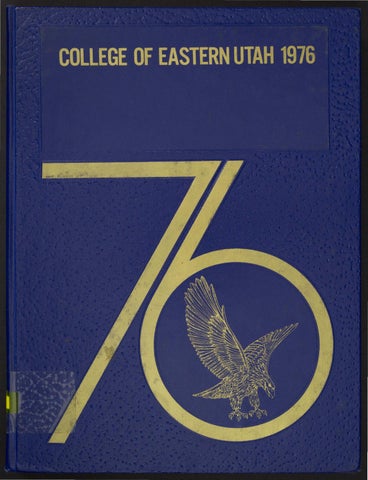
COLLEGE OFEASTERN UTAH 1976
Nothing ever built arose to touch the skies unless some man dreamed that it should, some man believed that it could, and some man willed that it must. -Charles F. Kettering
I - ~
.._ __
200 Years of Freedom The cost of freedom is always high, but Americans have always paid it. And ope path we shall never choose, and that is the path of surrender, or submission. -John Fitzgerald 4
Kennedy-
FREE TO FOLLOW THE SUN! Live free, and I ife is worth I iving, but only worth I ivingif you're Born Free.
llHHE ~lEG~NN~NG '. ·,t. :\
""""" ...,_'"""'• ....,,.,, ,,_a-n: i."t~. ~ ~
i.......___,.. -,,..-J~•
:r~,.\ 1,' .
~ ~
lo·~..~.,, . ..
~
I
·. ,. ';.
...
·..
\•
. ..
C
l,-,
' :r-
..
:~,- ---'
ADMINISTRATION -FACULTY-STAFF
A d m. 1
n. 1
s
t r a
t •
1 0
n Dean M. McDonald President Dr. LaVeil King
Dean F. Walton D e a n 0
f
D e a n 0
f n s t r
u C
t 0
n
8
s t
u d e n t s
D e
a n Director of Admissions
0
f
& Records
Charles Olson
w 0
m e
n
C
Earlene Gibson
0
n
t i n
u i n g
E d u C
a
t i 0
n
Ted Jensen Business Manager
Administrative
Assistant
Luci I le Jensen
9
Applied Science Business Rue Ware CosmetoI ogy Nursing
Chairman
Trade and Technical
Norman Clendenen
10
Julius Spigarelli
Gary Prazen
Sharon Norris
Linda Davis
Henning Olsen
Gene Brown
Lorraine Hafstad
Kathryn Merri 11
11
Humanities Art
Physical Education
English
Social Science
Family Life
Speech
History
Theatre Arts Lee Johnson Chairman
James Young
12
Jay Andrus
Neil Warren
Mary Pizza
Ray Barrus
Kristen Taylor
Curtis Jenson
Joy Peterson
William Peterson
13
Leland H ofel ing
Anita Mesta s
Richard Jensen
Derral S iggard
Frank Postma
14
Joseph Salva :or2
Natural Science Engineering Life Science Mathematics Physical
Science
Pre-Professional Alfonso Trujillo Chairman
Robert Torgerson
Wilson Hend ers on
Norman Larsen
Lamont Arnold
Don Burge
William
Krompel
15
Library-Learning Center Troy Anderson
Gunda Cromar
Marie Knight
Jon Yack
Jack Tobiasson
16
Bonnie Johnson, Helen Nelson, Louisa Hurst, Bessie Mahleres.
Jon White
18
Steve Belnap
ORGANIZATIONS
BLUE DEBUTONS 76'
21
Cheerleaders
-----
Karee Sherri ff, George Trujillo,
22
---
-·
LaMar Selman, and Joyce Lipsy.
Songleaders
Carol Jensen, Sharon Gustas, Kathy Shiner, & Karen Keller
23
CEU
s t u d e n
t s
24
0 n
the
M 0
V
e
25
A
N e w
H 0
m e
26
f 0
r G •
1
b b y
27
At Rest At Last
28
Phi Ro Pi
Susan Widman, President, Carol Tomsk, Kathy Piaz, Terri Leamaster, Linda Slaugh (NOT PRESENT) AWS OFFICERS
31
The Eagle
Newspaper Staff 32
Student Nurses
A-G'I 9
-
_ .. _..,,,.,
/ ,a /
ll''
..
-
/
~
..;:.., ;;;;;;,
35
Home-Ee Club
Kris Hardy, Kristel! Justesen, Carol Tomsic, Chloe Merrill, Kristen Taylor, (Advisor), Mary Pizza, <Advisor), ROW TWO; Mona Kilpack, Brenda Crocco, Carol Oakey, Racheal Peterson, Ilene Ehler, ROW THREE; Joyce Lipsy, Carol Jensen, Betty Fausett, and Marsha Nay.
36
Business Club Officers Diane Sconyers, Paul Dunford, Marion Wilson,
Mary Jane Bickel,
and Janalyn Farren
37
Cosmotology
38
for a New You!
39
Concert Choir
-
ChamberChoir
I I A._/"
..
I -
I
"
V
41
STUDENT GOVERNMENT
Scott T. ¡Morley StudentbodyPresident
44
EXECUTIVE COUNCIL
George Trujillo, Rodger Sorrenson, Kerstin Tucker, Susan Widman, Lary Zieu, Scott Morley-TOP ROW-Marsha Nay, Janet Massman, Brian Brockbank, Pam Piacitelli
45
Student Body Officers
Marsha Nay Social V. P.
,,..
Brian Brockbank AMS
Sophomore Class Officers
Freshman Class Officers
,, I
I
. \ ,,. ~
"
., .. ·: ! I'
•• \-
,...,, .- }
/, f (
,,
•
ACTIVITIES
Remember: Eveyone who got where hie is had to begin from where he was!
52
Hello Week
This year was started off with many different activities to help the students get acquainted. A Roi Ier Skating party was held to start the week fol I owed by a barbeque, a movie, and finally a dance to bring things to a close. All in all, the welcome to CEU was worth it 1s effort in bringing the new students together.
54
Powder Puff Football ~~!:;:~ Sophomores Emerge Victorious!
Strategy! Courage! Broken Fingernails!
"":dlr·-0 0 • ..
Wendy Atwood
Homecoming Queen
.... .. "
... •
,
.... •
.... .
~ ,..:i.. .. ,,,,, •
't
~.
.
•
., ,
1
,. .,· ~ -·. J ·.,, ·,
·i;.4
•• • . ,· .. r: ,,
I
·~'!,':.9
.
•
~
.-
Greek Dancing · With Father John
... The warmth of the sun and the shade of a tree
These are things that are favorites with me
-
-1'•
! jl
, ,. ,
-
,..
.,,
,I •• '
f"'?I#' - , •
.,
~,, ,J,
,,,_,,,.:J'
~,.· •t
,:
~.
-.
..:..~
-
61
Preference Ball That Christmas Feeling
ost Preferred
-
Ah, Wilderness!
Cast of Charactors: Nat Mi Iler • • • • Essie ••••••• Arthur • Richard • • Mi Id red • Tommy • • Sid Davis Lily Miller •••• David McComber •• Muriel McComber •• Wint Selby • • • Belle • • • Nora ••••••• Bartender • • • • Salesman • • • • Produced by special Samuel French Director ••••••
• Scott Jewekes Michelle Powell • Barry Snow • Lance Wright • Linda Slaugh • Brent Slaugh • Marty Estrada Chloe Merrill John Keller Donna Johnson • Brian Brockbank • Mary Jane Bickel Patricia Slaughter • Kent Wright • Scott T. Morley arrangement with Rodger Sorensen
Jan Johnson
Penny Gale
Conna Minchey
66
Helen Kourianos
Connie Anderson
Cindy Olsen
Betty Jean Fausett
Michelle Powell
Shawn Bond
MASTER
OF
CEREMONIES
Miss CEU Contestants Brian Brockbank
Marsha Nay
Eraine Jensen
Karee Sheriff
Lunch Auction
Halloween 69
1976
Good Year
70
A C
t.
1
V
.
1
t.
1
e s
1975-1976
71
STUDENT BODY
I know nothing but that I'm willing to learn. ,} I •
11
Why did I pick today to show up to class?"
74
Casey Donaldson (F)
Ray Richens (F)
,I
Dale Bradshaw (S)
Jill Spencer (S)
Marsha Nay (S)
Debra 01iver (F)
Jan Johnson (F)
Guy Worley (F)
75
Carol Jensen (F)
Michael M artinez (F)
76
Shawn Bond (F)
Jim Simone (F)
Scott Morley (S)
Rita Humphrey (S)
Catherine Schroeder
Kris Hardy (F)
Carolyn Carter (F)
Allen Marshall (S)
Jack Housekeeper (F)
}
11
1 vaguely remember being excited about today • 11
LeRae Stuart (S)
Linda Nelson (S)
77
11
Now, If I only had someone to play with •••
La Mar Se Iman (S)
78
11
Eraine Jensen (F)
Mark Severin (S)
Marti
K. Peterson '.F)
f •
I
r I
b:td
Jody Cooper (F)
Dean Marchello (F)
Cindy Vogrinec (S)
Karen Christensen (F)
Vicki Tidwell CF)
Phyllis Oliveto CS)
Chloe Merrill CS)
Karla Davis (S)
Mona Killpack (S)
79
Kaye Neeley (F)
Sam Hunt (S)
Angelina Colacito
80
Kerstin Tucker (S)
Lizz Bonacci (F)
..
,
.
~
11 ~
Betty Fausett (F)
11
Ah; come on, fe I las!
11
Edwin Ericson (S)
John Urbanik (5)
Patricia Slaughter
Dean Smith CF)
Alan Campbell CF)
Steve Spencer (F)
81
Todd Christensen (F)
James D. Banasky (S)
Brad Huff (F)
Lorene Senechal (S)
82
Jacquene McKean (S)
Dennis Archuleta
(F)
Terri Leamaster (S)
Nancy Wight CF)
Susan Widman (S)
George Chappe11CF)
Lance Wright CF)
Barry Snow CF)
Mark Carrillo CS)
Shelly Nielson CF)
83
11
0ne more time, now--B as in Boy •••
11
\ Norma Trease (S)
Kurt King (F)
84
Brian Brockbank (F)
Barry Evans (S)
Cathy Paiz (F)
Rachel Rigby (F)
Cindy Mele (F)
Faye Colton (F)
Lynette Brown (F)
Linda Slaugh (F)
Leslie Ware (F)
Scott Jewkes (S)
85
Lila Madsen (F)
Angela Juliano (F)
Michelle Powell (F)
86
George Trujillo
(F)
Doug Martinez (F)
Kathryn Wi Ison (F)
Glen Jackman (F )
Jeff Lott (F)
Larry Zieu (F)
Alden Yates (F)
Milo Whitehead (S)
Greg Thorne (F)
Gary Davidson (F)
Diane Sumner (S)
Vivian Graham (F)
87
David Pace (F)
,,, •
David Brown (F)
88
Diane Sconyers (F)
Donna Johnson (F)
Mary Mcewan (F)
Yoshi noh Kosuge (S)
Diane Potts (S)
Pam Piacitelli
(S)
89
Mary Lou Marstella
Alan Scholtec (F)
90
Karen Keller (S)
Sachiko Kawamura ( F)
Mary Jane Bickel (F)
Cheri Davis (F)
Karee Sheriff (F)
Carlos Escandon (S) C:-E U TRACK • FIELD RECORDS 1 I
Connie Anderson (F)
Ileen Ehler (F)
Robin Hussey (S)
Janalyn Farren (F)
~ ~
I I
\
\
Paul Dunford (S)
91
With each step I learn something new. Today-1 saw myself, and I liked the view.
lraj Asgharzadeh (S)
\.
\i
~ 'J, /.,\<[\ ¡, \
\
Lorenzo Purin (F )
Dennis Villar (S)
92
James Muhlestein (S)
Diane Burgess (F)
S haharazad T avangar (F)
I
Cheryl McMurdie (F)
Cloyd Plumer (F)
/I
Kiyohiko Koshizawa (S)
Carl Fivecoat (F)
93
I
j
/'
) Lynn Snyder (S)
Alan Young (S)
94
Arlinda Ashby (S)
Benny Valentine (F)
Randy Hanson (S)
Danette Powell (S)
Friend:
I will remember you
Think of youAnd when another day is through I'll still be friends with you.
SPORTS
Nate Phillips
Stan Kohler
Ronnie Stubbs
Jim Wiscombe
Milo Whitehead
Benny Valentine
B a s
k e
t b a
1 1 Chava Lopez
Alan S hol tel
Greg Morri II
Ed
Bob
Seymor
Slager
Eagles
Fly'n High
V 0
L L E y
Wendy Atwood
Phyllis
Oliveto
B A L L Kendra Smith
Kris Hardy
102
Ji II Spencer
Kerstin Tucker
Mary Lou Mars tel lo
Women's Basketball
104
Coach, Barbara Curtis, Kristel! Justesen, Helen Kouranis, Kendra Smith, Mary Lou Marstello, LaRae Stewart, ROW TWO; Helen Nielsen, Mary Jane Bickel, Wendy Atwood, and Leslie Ware
Swim Team
Wrestling Team
That which we persist in doing becomes easy to do.
C
E
Bill Valora
u
Not that the nature of the thing has changed, but the ability to do has increased.
Tim Sandoval
Mark Byram, Nate Phi II ips, Bi 11Valora, Alan Campbel I, Ron Howes, Julio Feliciano, Jeff Lott, Coach Barrus. ROW TWO; Tim Stubblefield, Alan Young, Carlos Escandon, Stan Kohler. ROW THREE; Dennis Archuleta, Alden Yates, David Jarami I lo, Glen Jackman, Terry Marshal I.
CEU Track Team
Gymnastics
Wendy Atwood, Carolyn Carter, Connie Anderson. Pat Siseneros, and Karen Keller .
110
ROW TWO; Conna Minchey,
Karee Sherriff,
Life affords no higher pleasure than that of surmounting difficulties, passing frQm one step of success to another, forming new wishes and seeing them gratified. -Sameul Johnson -
LITERARY
I do my thing, and you do your thing •
.I am not in this world to live up ·to your expectations. And you are not in this world 1to live ·up .to·mine. You :ar.eyou ·andll ,.amd. And iif ;b,y chano:e we ;fiml each (Other., it's :beatitifo I.•
I heard the, world cry last night and l' know why. One soul left it with a sigh ~,->.t'~ for al I the years not understood. _,;~,,,_~ The lost good day-~fS'-, run out betweeh路tne fingers, r andfor the after-glow tnat lingers ---路 路 :路 I ike a memory not quite remembered, or a dream not wholly dreamed. Dear soul, goodnight. Only Go ___ ,,,...,,,_.,,,,:,;>, ~~
-Trona Roofe-
Why is it that this 'five letter word' is so important? Don't say it isn't! You know as well as I How much it means to a person. • •
Pride. I hate it-yet I still cherish it. It seems to control me. It seems to put reality into values. 11 Don 1t do this! 11 11 11 Don't do that! 1 11 You re too good for such tings! 11 11 Where 1s your Pride •••
11
Pride. Can you I ive with it? Can you live without it? I'd like to try--Wouldn1t you?
-M airk Byram-
116
lt 1s getting late-Not measured by time, but emotion. You want to know and understand Yet society and your own selfish desires are holding you back. Life is only one spontaneous experience within eternities.
Today is but another day. In dismay I look at how life is treating me. or perhaps how I am treating life. Awesome to the things I do not know Seeking not to find them. Wondering what tomorrow might chance to bring. - T rona Roofe-
11 7
.·..
t i
~ --:..... ,;:. ~
~ ~ - ~ ~
.
~• •.-. ,
it that makes me feel the way I do? s this thing of both pleasure and sadness? ~ ~a...t i~ t seems I ike a stranger to me, el secure with its presence.
-- o-:m :::e=h ;::: a::v~e::a~ word for it, c:::But is it necessary to give it a title? ---:> A material bond to tie it in with reality? It's a funny feeling. It seems al most universal. I can share it with more than one, Yet, in each case, it's different. In some I find it very moving, It seems to create a complete sense of inner peace. Yet just I ike tomorrow, it can be unpredictable. I guess that is why it moves me the way i t does. I pray you have found this fee Ii ng. If you have not, continue to search. Look not only to others, but also to yourself, For the best friend a person can have is self. Only if one really knows, understands, and is satisfied With the person he really is ••• Then one can experience the feeling of true inner peace. Al I in al I, my friend, I wish for you The experience of LOVE.
-Mark Byram-
118
Someday when the winds blow ov'r the river and your voice beckons me from miles and places I've left behind. I wi II close my eyes to the love I've started-dreading the finish.
All things must finish, you said. And so our Iove had ended. • • Bitter, our fairwell. Our paths slowly accepted the seperate ways they must endure. You were so wise back then, when you foresaw, so sweetly, the world to be, and enjoyed my Iove, so young and easy. we became as one. This is why our break-up h...:rtso badly: Fighting to survive with only half a heart, mind and soul. Impossible! When your voice ecboes ov 'r the river • •• I'll know how wise you are. You stole my other half, and refused the return. - Kelly Johnson-
THE FIRST 200 YEARS A knowledge of American history is an invitation to experience the accomplishment, drama, tragedy and hope of an infant nation struggling to grow up . Sturdy, determined pioneers hacked away at the edges of a raw continent and, with blunders and achievements alike, modeled a country with a spirited nature and a united commitment to individual liberty for every one of its citizens. Americans, great and not so great , have given us a heritage to carry on and improve upon. Farmers and soldiers, industrialists and merchants, dreamers and leaders, are all there in two centuries of progress. But the maturing isn 't finished. You 'll find the boundaries of growth as endless today as when our forefathers first envisioned them . You can seek out your own destiny with the wisdom and judgement which comes with re-creation of the past. Your knowledge , dreams and industry will carry on through many more centuries of living history .
Daniel Booneleads pioneersthroughthe CumberlandGapm this paintingby GeorgeBingham
<l
-----, '' '' '',,
\
.,.,,.. ..., ' ..__ '\./-
o,,a...,. .....~''r,.,(),
,,,,..,,,, ...,,,,,,,.,,,11,_ ""'''
Isl Transconlmenlal Raolroad (1869)
',.,
-·-...,,...~,.. '•iesllj
,,,,,,,.,,,,,~....
·-
GoldDiscove redm
Coloma , Califo rnia (Jan 12, 1847)
HAWAII (50thstate)
ALASKA (49thstate)
THE CHANGING NATION Admittedto the Unionin 1959
Admittedto the Unionin 1959
Owner s hip of land had been just a dr eam to most of the colonists from feudal England . With the great expan se of cheap land opening up in the West, the dream became reality .
build their homes . Railroads were instrumental in the quick civilization of the West , bringing people in numbers s o large that the resentful Indians were finally pushed back into unwanted and infertile areas .
The Louisiana Purchase of 1803 opened the fir s t sizable frontier in the Midwest , but the nation was not ready for it yet. It took a growing market in the East , where land was getting high-priced and scar ce, and development of good transportation, to really start the frontier movement. The Gold Rush caused hordes of settlers to take various routes to the Pacific Coast and its yellow riches . The railroads brought farmers and ranchers, along with the miners , who decided to stop all along the routes and
America became a haven for immigrants from every nation as freedom beckoned them to the teeming cities of the East , the plains , and the rich west coast farmlands . Sick of the Civil War and with their o wn land s divided up and lost , many Southerners set out to " begin again " in the virgin territorie s . " Westering " soon became the national tradition as North and South moved together tow ard a new life . Americani s m was advanced socially , by the hard-working , bare-fi sted types who settled the frontier s.
CHAPTERS OF AMERICAN HISTORY
The Stamp Act of 1765 was an attempt by England to tax items that were wholly American. The colonists reacted in seething resentment which erupted into angry protestations. The first blood of the American Revolution was spilled during one such incident at Boston in 1770 . Several Americans lost their lives over a snowball thrown at a British sentry.
Frontiersmen cleared the wilderness, built settlements and drove back the Indians. The Pony Express and the telegraph became primary means of communication.
While "gold rush fever " gripped the country states were increasingly more divided on the slavery issue. Civil war broke out in the EasL This "Brothers War" was bitterly fought and though the scars remain even today, slavery was abolished.
Agriculture was the wealth of the country. American inventions of the time were often related to working the soil. The McCormick Reaper , mowing machines, textile looms and the cotton gin were instrumental in the settling of new frontiers.
Cities grew at an alarming pace; often without regard to the limits of safety. The great Chicago fire of 1871 burned the bustling cattle market empire beyond recognition. But the pioneer spirit was not broken. Chicagoans began rebuilding and preparations were underway to celebrate the 100th birthday of the country.
In 1848, James Marshall found gold in the race of a sawmill he was building for John Sutter at Coloma, California. The lust to" get rich quick " was the force behind this biggest and gaudiest gold rush ever.
The "Iron Horse," carrying homesteaders, greatly helped settlement of the new country. The first transcontinental railroad connected the country at Promontory Summit, Utah, on May 10, 1869.
In the fight to achieve commerce equality, the United States found itself in a naval war over shipping lanes. Fort McHenry was heriocally held during a British naval bombardment, and the stars and stripes still flew after a night of hard fighting. The next morning Francis Scott Key penned the immortal words of what would become the national anthem.
Settlers had to have permanent access to the new lands, so canals and bridges were built to carry stages and wagon trains loaded with machinery destined for settlements in the West. The pioneers foresaw great wealth in the cheap acreage that was available.
Transportation was setting the pattern for the American way of life . The country became a mobile society with electric trolleys, automobiles, farm machinery , and bicycles , all the rage. Along with the accessibility of travel came a new era of nationalism.
A World War called upon the nation 's young men to unite and fight . After the war in Europe , the nation pulled itself together and industry flourished once again. A carefree America buried war memories in the new moving pictures, telephones , light bulbs, electric generators , stock market ticker tape machines , phonographs and a wealth of inventions from the fertile minds of its young inventors. Baseball be came the national sport and prohibition was law.
The steel industry geared up for the revival while rumors were whispered in the Roosevelt administration of another impending war. The nation 's leaders scoffed; until December 7 , 1941 Pearl Harbor 1
Industrial production reached a peak during the ¡war years. Upon their return from four years of battle , the veterans forged ahead with an eye on a " better life for everyon e ' Several moderate recessions in the so 's and 60 s reminded cautious citizens of past decade s.
Huge strides were being taken in the scientific field. Television became a part of every family's life. National events were household topics while they happened - thanks to the new medium. Individuals and groups were seen " on the tube " as they advocated new social reform, or justice, or special causes of their own. TV gave individuals and political systems power greater than ever before. Audio-visual journalism had made its impact.
Black Thursday, October 24, 1929, saw the American stock market crash to the lowest level in history. Panic set in as the unemployment level skyrocketed. The country was in its worst economic crisis . Slowly, but surely, the wounds of the " crash, " the "dust bowl," and poverty healed .
Nearly 100 years of struggling for civil liberties were realized when President Lyndon Baines Johnson signed the Civil Rights Act of 1964 into law. The Act outlawed segregation in any form.
The seventies shed light on a new trouble for the nation as it approached its 200th birthday. The world ' s energy sources and natural re sources were being used up faster than they could be replenished. Americans once again waded into a new frontier. The " energy crisis " and •¡ecology " were prominent words in the language. Ways to save nature from the neglect of mankind and ways of preserving precious fuel without damaging that balance of nature were the objectives of Americans across the country .
Earth's crises spurred Americans into further pioneering. This time outer space. American astronauts were the first on the surface of the moon and the U.S. was first to build a "skylab " for more scientific study. American is still learning and growing after a mere 200-year infancy. The original determination of our forefathers was told again in the words of Neil Armstrong as he made the first step on the moon .. "a small step for man, but a giant step for mankind. "
CONGRESS.
Jury
4,
1776.
"Everything that is right or reasonable pleads for separation. The blood of the slain, the weeping voice of nature cries,' tis time to part'." - Thomas Paine.
....-------·····----------••••
I BENJAMIN FRANKLIN FLAG ALSOCALLEO "SERAPIS " FLAG . GENERALLY ACCEPTED ASORIGINATED BY BENJAMIN FRANKLIN ATCOURT Of LOUI S XVI.
CULPEPER FLAG- 1775 ONEOf THEEARLY RATTLE SNAKEFLAGS CARRIED BY THEMINUTEMEN.
•
*
* * *
*
*
• *
BENNINGTON FLAG - 1777 FLAGOFVICTORY Of THEGREEN MOUNTAIN BOYS .
• * • * *
* *
* ..
FIRSTSTARS ANDSTRIPES UNITEDEMBLEM Of INDEPENDENCE SAIDTOHAVE BEENORIGINATED BY GEORGE WASHINGTON FOLLOW INGACTOFCONGRESS OFJUNE14. 1777.
... * * *
• • • * • * ••••
* •
* • ... * * •
,t
*
* • * • *
... • • *
THEFLAGOF 1818 SHOWING RETURN TOTHIRTEEN STRIPES ANDADDITIONAL STARSIN CANTON .
...
,t
...
• •
" OLDGLORY " NAMEGIVE N BYCAPTA IN WILLIAMDRIVER , COMM ANDIN G THEBRIG "CHARLES DAGGETT " IN 1831.
...* * * * * * * * * • * * * ******** * • * ** *
.......... FLAGOFTHECIVILWAR 1861-186~ THE"STARS ANDSTRIPES" WITHTHIRTY SIXSTARSIN THEUNION . CARRIED BYTHENORTHERN ARMIES DURING LATER YEARS OFTHECIVIL WAR .
Banners
* * * ** * * * ** ** *
CONTINENTAL FLAG CARRIED IN 1775-1777 . SHWOING PINETREE. SYMBOL OF MASSACHUSETTS BAYCOLONY, IN PLACE Of THECROSSES Of ST.GEORGE ANOST. ANOREW .
LIBERTYTREEFLAG- 1776 THEPINETREE COMES FROMCOINSOFTHE COLONY OFMAS SACHUSETT S. 1652.
FIRSTNAVY STARS ANDSTRIPES IN ABSENCE OFSPECIFIC ARRANGEMENT OFSTARS BYCONGRESS , JUNE 14, 1777. IT WAS CUSTOMARY FORNAVYTOPLACE THESTARS IN FORM OFCROSSES OFST. GEORGE ANDST. ANDREW .
-
*
•
• * * *
•
*
*
,t
* * •
FLAGOf THE THIRDMARYLAND - 1778 CARRIED ATTHEBATTLE OFCOWPENS JANUARY , 1778ANDUSEO AS COLORS OFAMERICAN LANOFORCES UNTIL MEXICAN WAR .
·••*••·····•..
~
• • • * .. •••~-- * * * • ...
FREMONT , THEPATHFINDER 'S FLAG- 40's EMBLEM THATBLAZED THETRAI L FORTHECOVlRED WAGON IN THEROAR ING40'S. THEEARLY ENSIGN OFTHEPLA INS.
I
FLAGOf THEMEXI CANWAR - 1845 NOTACTU ALLYUSEDAS REGIMENTAL COLORS BYTROOPS BUTAS FLAG OFCONQUE STANOOCCUPATION .
..
...
' FLAGOf THESPANISH AMERICAN WAR - 1898 TH[ EMBLEM Of LIBERTY THATBROUGHT FREEDOM TOCUBA.
of Freedom
. .... . ..... . . ..... . .... ....... .
******* • •** ******* ***• * .. * ......
" *,.*,.* * • * * •• " * " * * * * * * * * * * •* " " ...•* " • • * * * * * * *
CONFEDERATE BATTLE AND NAVY FLAG USEDFRO M MAY 1. 1863TOEND OFWAR. 1865. THEBATTLE FLAGWAS SQUARE.
FLAGOf THEWA R Of 1812 (1812-'IB14} SHOWING FIFTEEN STARS ANOFIFTEEN BAR S ASCHANGED UPON ADMISSION OFVERMONT.
JOHNPAUL JONES"STARRYFLAG" RESCUED FROMTHESEABY JAMES BAYARD STAFFORD DURIN G BATTLE BETWEEN BONHOMME RICHARD ANOSERAPI S.
COMMODORE PERRY'S FLAG - 1854 THEFLAGTHATOPENED JAPA N TOWESTERN CIVILIZATION .
Imagine buying that acre of land you have spotted for $1.25! Or , even at the higher price of $10. Those are the prices offered to our founding fathers to encourage settlement of the wilderness areas of this nation. A stage wasn ' t the most comfortable way to go, but you could get from city to city for as little as $3 - at the amazing pace of six miles per hour. Compare today ' s wages with a 12-hour day in the early 1800 's . A man earned 50¢ a day. Of course his dollar bought a little more than today ' s. Butter in 1826 was about 5¢ lb. in the Midwest ; eggs , 3¢ doz. ; corn 6¢ bu. , wheat , 25¢ bu .; and a cow could be bought for $5. With travel becoming the American tradition , you could choose train , wagon, horseback or the water. A canal ride, with bed and board included, averaged 3 or 4¢ per mile. And when you reached your destination, you could sit down to a 5, or even 10 course meal for 25¢ . (Ladies 20¢, in consideration of appetite.) Farmers in the early 1800 ' s could own the famous McCormick Reaper for a mere $100. But the Civil War increased prices as the machine became the first item farmers could buy on time payments for the sum of $1 ,500. A good suit of clothes then might cost $1.95 and ladies waists (blouses) were marketed for 49¢ to $3.50 with a whole dress pattern priced at 15¢. Cookstoves, " quality-satisfaction guaranteed, " could cost you $29.25 at $4 per month and a dandy heating stove could set you back as much as $5.73 and up. The first electric refrigerator cost $900 - which might be enough to make you faint on your 1907 fainting couch that had cost a mere $7.85 . Your new baby travelled in the height of fashion in a wicker sleeping coach (stroller) for the sum of $12.04. If you had $1,500 in 1903 you could show off in one of the first automobiles. Ah , those were the days. Some of the current prices are reminiscent of those days , but at frontier prices , which were a whole different story. Hardy pioneers had to pay $2 a pound for sugar , too. And the same for a pound of coffee or pepper. Those items were only 15¢ per pound back in civilized St. Louis. Flour was marked up 100 times for sale to the frontiersmen and during the famous Gold Rush, that precious commodity went for $400 a barrel.
,. I mm!trta lllfflllm a
W11fir ta 11111111 i1,._ ii
PERRY DAVISS VEGETABLE PAIN IIL1Elt-----:i:=~iiiiiil"ll~::-----i -llifaotwe«
~
-.,,,._........,...,,
.., r
.......
COTTON.
11u.,.~c ........,...11
I U ''""• \c.-
,r 84VD
....
••., ..........
CJrll:111-.. ,.,.
••
I& IIOW•
a.L
.,.,,Ye1~.. , ....
~~lm1 l»o lISU~Wl»~lll'l1s;
QUILL llanufacturer
..,. •
95 South Second street, (Oppo•ite thP- !llerchants' YANUFACTURt:S
Cotrce-Houoe, Philad.) ALL KL DOI' QT;ll,LS,
Dutch, }~nglish, German, and Opaque,
TH1: Sta~ will orra•ionallv rr•urn to NPw Ca,tle in the lnre"4lon.wbrn a •uffiricn1 nftmbu of pa.-rn~rs mfrr. nml hu,k tn W,l111in,;ton,and J,a,·c there every d&y for New-Cu•le aner the arri,al nr the Philadrlpl11a !'ta~•
♦. •
+
l'B.0111S 2 60 TO 30 S Pm\ 1000. A. IH'ROW Ql'ILLS,
SW.'-
T,n: !foa<rRtnr.Rs re•rrrtrnllv inrnrm thP l'uhlir, anrl 1hr fit,1.rn• nrWilmin~on an-' in Jlllrli_rulnr, that tlorJ l,11.,:,P•tahli•hecl a St~ Int ti r purpa1t or rarr,,m; 1hr \11.lil • het"een lhe afol'1',a1<lJ'l•rc,, ancl al•n (or the ronve,·ance orpa .. en,;,-r. anti ha::(lla;r ... It w,ll lr11.H . 'cw-f'utlr rnr Wilmina;fon, ncry momin~ h~twecn ~ and 7 o'dnrk, and uri,·e at D. fl, BRt>ITON's Tavern, in time for ra."e~:;tN to takr t 1e II o'clock Sta~ for Phih11!elpl11a. , •cw-f'a•II~
~
""'"'"Ii""
'"~Y ,,d a•S11rrd, thnt !hi• •t11.bli•hrn•nt,..·n be mn•h ,11r,•r11.ndmnrr npediti•u• rlrn.n nny heretofore estahl18htd bct,,ce'1 those twn Towns; ha,·in~ the bc,t hc,..es, 11.n,I a eareful dr1>rr.
,TOSEPH BRINGffl'Rt;T, D.AYJD .MORRISON, ,.
at a.riou, pn<t"Be also otfeN fof' ulr.
and l.et:p! cop lantly on hand, at Manu.•
N,
,. N, W,imingto,i. J-ttw-Cn$iU.
facturtrs rrl( r,, a 1..ir~t" tock. vr
GRENVJJ,LE'S Warnnled
CH ~.MJCAL INK POWDER,
1,up,crior far immediate procfoctiun of Jet Black Ink.
Af,SO, ST;PERIOll !:!EALING WAX, Warraftled to bum
rru
and ~lick w,.11, nf
uz.. Ligl1t an,1 Dari.. Blur, Light and Duk Rrowo, Gokl, Ro,,, flf"Sb,Oranv, llr
colouf'lt
T&r1ou1
GN"ea.,Yellow,
INCORRUPTIBLE
Porcelain
·1HE
Teetl,. Subaa,ber
te••
peel.fully u,fu,..., 1.lle1,ub-
l1cf th&I he •~LI Purcd..un, or l'e1.111 the pers1.n ni.,r_ de11rt, on modrra1c
afty flliH..r h.:rmt. Thi apP,nvctJ Pon.:cd.u11 Tee1h, '"hu h he m&nuf11e1oreal\( 1nv 1l.a1lc lo corrt..·trond -..,1h U,f' narura.1 one,, will rrt;1tn their ur11111alcolour fur W'lY 1~11~1hofumc, a.nd art nol. '1,coin~-d by ac1dl warrAultd lo 11.anil, and M U
1bc kin..! oan be made.
01,cra11,,1>1oo ..,,,..,_
Tbose oet by h,m will be 1en1cuabl~ U &117lhU'J& ul
l11pcrlor P•«nt
Teetb perl'vnnod oo .~cuon~ble
1h1
PA '11JEL Cll\ \IBERLAJN, De111.c,
r\
No. 47 !'fnrl .. Eiabtb, ,11, dour btlo• 4rco 11t,ec. a11riltO-tf
'l'llt llo11Mll~t ar,· ha tlu•
Dfl
Fire Proof Com~tloa
CIIESTS
.
hy ""'"'""' ••\ldy and •n1.-u,l1!1-<1 tod...lr.111a.&tf• for IM1 IUI t•·ch e mc,111h• a
• ,aµ1J tU...eov--ryl,1 11,e.11ron( matnta1.. He contln•u'9 to at•••ufeau,Iha- 1b.,ff a.,r,da •& u luw prtee'9 .. uae-7 caa io. , .. ,c1,_4 la a,17 pa,1 or u,e IJolLt<J.,,., ... JIJIIN f!C()TJ', lfo I Lhd,e 11\ttN,-.n"h of .,,,..,1la Dank. A I nrdtto tJ1a,,lru!l7 rtet.,til &nd-1 tn aoy nt I.Ile
Com posed o1themostfragrant andcostly· extracts fromflowers
.,.
r ...
l:a!i.4 151.atea.
r•"
•1•-l ~hf
•· ra perfn ~
WM. COU'PLAND'S
LIJ"ERY
C'oMA1£&1JU' llEWY~RK
81"'.iBl.1ES,
Harmony Strrct, Rl':S. 'ING FRO,\[ THlRD TO FOl'RTH.
1•1111.ADEt.rnu.
GIAASS t;UTTl~G HOlt!-1)•:,; ~, II l' .\IUH.\f, ES, .. ·•· .IH HOI hU,::;, SADDLr. 1101!:,b::;, i:;c
TOmnE, 1:-i \T LIVF:fiY
nrns.
'1
l<'A.t.,1'0RV.
POWELL & THORP'S WES'\'E\\N & NOl\'\'I\'E\Uit
~HE ,ob,rriber 1till contim.1,1 the
GI, .. Cun111r k•i•..., ib all Ill Uri. alKI bu al hit lt.Gtt, No. 68 NOC1b'l'bird otrnt, l'lliloct.lphia, 1 •••7 esleu1ire aunr1.menl or all ~lodo ul G1 ... , ~I, plain aoJ pre-.!; ruruilure knob,, l.c of _.11 ltiod•-Cnaatry t,J,rcllau11 and Jlh, n .,, "''lllrtl•d tu call tiDd uanuM pre. •!~••rt_ atticlc trill be 11,td•• 1.11, Ollf bruc:bto,
~ion~
r~~~•-"•~ _
"'-~= Stage f.<?Canal l'acket Boat O.IJlce,
THEY MADE THEIR MARK Men and women who helped shape America's history
THOMA S PAINE , a bankruptQuakercorsetmaker. sometime teacher,preacherand grocerwrote the most bnlhant pamphletol the American Revolution, His wordsm CommonSensere~lectedlongingsand aspirationsthat haveremainedpart of Americancultureto this day.
ChiefJusticeJOHNMARSHALL establishedfundamental pnnc1ples of Americanconst1lutional law. He1snotedfor his precedentaldeclarationof a Congressional act as unconst1tuhonaL He served through five admm,stra · t,ons. from 1801-1835.
ABRAHAM LINCOLN epitomizedlhe Americandreamof a humbleyoungmanascendingto the highestofl1ce of lhe land. He wassuperblyskilled al analyzingcomplex1s· suesandtranslatingthem into meaningfulwords for the public. Hewasdevotedlo the preservation of the Union.
DANIE L WEB STERchoselaw as a careerand wenton lo becomewell-knownin the courtsand in politics. Hewas twice Secretaryof Statewith an eyealwaysto the Presidencywhicheludedhtm.
Borna slavem Maryland , FREDERICK OOUGLA SStaughl himself to readandwrite secretly anCI.al 2l , escapedto freedom. He was an ardent abol1tion1st campaigning success fully for Negro suffrageand civil rights.
H~RRIHBUCHERSTOWE wrote Uncle Tom's Cabinm an effort to makethe wholenationreahzethe 1nhuman1 ty of slavery.Herbookresu:tedin oneof the most popu• lar and controversialplayson the Amencanstage. The C1v1I War waskindledby this work.
DOROTHEA DIX workedher entireadulthfe for reformof the existingpenaland mentalmshtutmnsin the mid1800's. The first statehospitalm the natmnat Trenton, NewJerseywas a direct resultof her efforts
Thecrealor of the Cherokeealphabet,SEQUOYAH , was an artist, wnter and silversmith. He useda simple1821 Englishpnmer to composethe characters . The famous redwoodtreesof the Pacific coastbearhis name.
"The NewColossus,"a sonnelcomposedby EMMALAZ, ARUS In 1883is inscribed on a bronzetablet at the base of the Statueof liberty. Sheorgan1zed relief for Jews and helpedfugitivesfrom the Czars~hellosto establish homesIn America .
AMELIAJENK S BLOOMER , besl known for a mode of dressshe adoptedduringher campaignfor eQualrights for women . Thoughridiculeduntil she gaveup the cos· tume, the term "bloomer" came lo symbolizewoman's bid for md1v1dua 1freedom.
HORA CE GREELEY'S admonition lo "Go Wesl young man·· wasa rallyingcry of the pioneer s of America.He wasfounderandeditorof the NewYorkTribune. He was best knownfor his philosophyof socialreformand his unsuccessful bid for the Presiden cy m 1872.
JOSEPHPULITZER wasthe lirsl journahsllo reacha lruly massiveaudience . His NewYorkWorldnewspaper was the symbolof "yellow journalism" with ,ts sensatio nal· ism aimedat the commonman.
ANDREW CARNEGIE wasa giantin the railroadandsteel industries.Hebelievedthat It wasthe dutyof a rich man to distributehis wealthduringhis l1fet1me. To that end. he estabhshed 2800 librariesand manycultural halls throughoutAmerica .
A hletime passionfor machineryled HENRYFORDto Detroitwhere. m 1896. he completedhis first motor ve• h1cle . The Ford MotorCompanymanufa cturedthe first " ModelT" ,n 1909.
Servingan unprecedented four termsas Presidentof the UnitedStates.FRANKLIN DELAND ROOSEVELT was a popularleaderwhomadeextensiveuseof f1res1de radw chats to explainhis plansand generateenthusiasmto pushthemthroughCongress .
ROBERT FRO ST's poetry was clear. understated.well· meteredand told the storiesof ruralAmerica . He wasa lour·t1mewmner of the Pulitzer Pme and has been calledAmerica·s poetlaureate.
Thecripplerpol1omyel1tis wasconqueredby OR. JONAS SALK,n 1953aftermorelhan 15yearsof research . Polio wasreducedby 96% m lessthan ten years. SALK 's researchcontinuesm Californiaat theSalkInstitute.
MARTIN LUTHER KINGwasa leader,n the causeof CIVIi nghts. He hadbeena pastorbeforeturningto the cause of segregalton . His leadershipearnedhim the Nobel PeacePme m 1964. Hewas assassinated by JamesEarl Rayin 1968.
One of the most elementarysymbolsof the Amencan wayof life wasestablished whenJ. EDGAR HOOVER and his FederalBureauof Investigation" G-men" set out to cleanup the country. His careerspannedover40 years.
A plain. homelywomanwith tremendousappeallo the masses . who was alwaysin the "thick of things"·de· scribesELEANOR ROOSEVELT and her lifetime of pol1llckmg besideher husbandduring his four terms.
lieutenantColonelJOHNGLENNstartedAmerica 's trav• els to outerspacewhenhe becamethe first Americanto orbit the earth. He had beenan aviatorm World WarII and a test pilot in peacetime .
Themotion·pictureindustrywasrevolutionized m Ameri· ca and DAVIDWARKGRIFFITH becameknownas the "Fatherof the film art" and "kmg of directors" for hrs part m this revolution.His cameratechmqueswerethe pIoneermg stepsof theindustry.
THURGOOD MARSHALL is the first Negroto serveas a 1ustIceof the SupremeCourt.His law careerwasaimed primarilyat civil nghls cases.
GERALD R. FORD , lhe first Presidentlo achievelhe of· lice without an election . In 1974, througha seriesof scandalous events,the Nixonadministrationtoppledand FORD reached the position through approval by Congress .
NECESSITY IS THE MOTHER OF
TELEPHONE
II/,,,,_;;,
Without realizing it, England instilled in the colonists the individual purpose and ingenuity that necessity breeds. With trade goods cut to a minimum, determined young leaders of the time set out to find ways of surviving without support from the Mother Country. Agricultural methods and machines and labor saving devices were designed by our forefathers. As frontiers opened, Yankee genius had to conquer natural barriers in the wild new country, so suspension bridges were invented and methods of transportation were perfected for the purpose of opening the untamed areas. Later, they sought to section off the land with the revolutionary and controversial invention - barbed wire. Cooper's I-horsepower Tom Thumb train in 1830 and later, automo-b-il¡es- like the first Model T, and the 4-horsepower airplane ; became American modes of travel from city to city and coast to coast. Americans knew that the fertile lands of this nation would produce unequalled harvests if machines were designed to take over for man. They knew also that trade routes were difficult to travel and manufacturing would have to be done close to home. The cotton gin, textile looms, drill presses and a reaper which could cut six times as much grain as a hand scythe were some of the tools invented. Protection for themselves and for their young country prodded inventors like Eli Whitney to perfect firearms and others to work on plans for the first submarine. Young inventors like Alexander Graham Bell and Thomas Edison (called the nation ' s most valuable citizen) visualized machines that would light the country and open up communication with those in the far corners of the nation. The telephone , telegraph, phonograph and the first light bulb were discovered in the late 1800 ' s and early twentieth century. This American way of doing for oneself inspired many to become inventors in their own right. Some sought to save labor and massproduce for profit while others envisioned not only riches, but excitement and adventure as they discovered ways to defy nature. Throughout the past 200 years the American mind has been unleashed to take whatever paths necessary to fulfill the needs. In the last half-century, the pace of discovery has been overwhelming and in vent ions for the taming of the universe lie in the grasp of America while the habit of " finding a way " is ingrained in its people. The seeds of industrial America were sown by these inventors resulting in today ' s mechanized society.
----
-
- :--•
THE SPIRIT OF A NATION "I was born American; I live an American; I shall die an American." DANIEL WEBSTER
''D on ' t give . up t he Sh.1p.'' CAPT.JAMES
LAWRENCE
"So you are the little woman who wrote the book that made this great war." LINCOLN to Harriet Beecher Stowe.
"Give me your tired, your poor, your huddled masses yearning to breathe free, ... ,, EMMA LAZARUS
"The people are the only sure reliance for the preservation of our liberty.,, THOMAS JEFFERSON '' A truly American sentiment recognises the dignity of labor and the fact that honor lies in honest toil..,., GROVER CLEVELAND 11
8e sure you are right, then go ahead.,,
DAVID CROCKETT
"A knowledge of the past prepares us for the crisis of the present and the challenge of the future." JOHN F. KENNEDY
" ... That this nation, under God, shall have a new birth of freedom." LINCOLN Historic continuity with the past is not a duty; it is only a necessity. JUSTICE OLIVER WENDELL HOLMES 11
II
11
America is a tune. It must be sung together.'' aERALDsTANLEYLEE "Go West, young man, and grow up with the country." HORACE GREELEY "I come to present the strong claims of suffering humanity." DOROTHEA DIX
_t,__