go - more water bottle-filling stations and bicycle maintenance stations.
Additional projects selected to receive Blue Goes Green funding will be announced in April.
Brooke Evans, ASUSU Diversity vice president, and Blake Nemelka, a senior majoring in marketing, business administration and international business, designed a project
from the Blue Goes Green Fee fund, but
the project total is projected around $12,000. The additional $4,000 will be raised through this year's senior project initiative. Jared Stapp, a senior majoring in environmental studies who is a mechanic at Aggie Blue Bikes, received $1,700 for his project idea to install bike-maintenance stations across campus.
"It's a bike stand where you can hang your bike up by the seat post," Stapp said. The tools you need for most basic bike repairs are tethered to the stand, he said. The idea for bike maintenance stations stemmed from the University of Utah, where the stations have been extremely successful, said Roslynn Brain, a member of the sustainability council.
Sites on campus have been approved for installment of the stations. One station will be in front of the library and another in front of See STUDENTS, Page 3
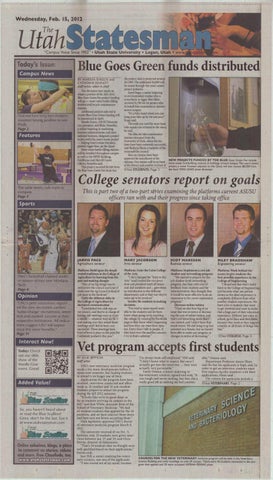
College senators report on goalS
This is part two of a two-part series examining the platforms current ASUSU ... officers ran with and their progress since taking office ;:
Pla~form: Build upon the deeply rooted traditions in the College of Agriculture by learning from the past and making changes
"One of my big things was to restructure the council and kind of make sure the Ag Council is kind of put more in the forefront."
Unify the different dubs in the College of Agriculture by increased communication
"I established two club reps on my council, and they're in charge of having club meetings once or twice a month - whatever they see fitand making sure they attend those meetings and I feel its been very successful. Those meetings have kind of been in place in the past, but I definitely pushed it this year."
MARY JACOBSON
Arts senator
Platform: Unite the Caine College of the Arts
"I did a banquet for "Intro to the Arts" (and) invited the vice president and president (and) all deans and club members and gave them an introduction to the different departments and so that way they're more apt to be involved."
Involve the students in making decisions
"I've tried to make myself available to the students and let them know whats going on by emailing the college, by creating the Facebook page so they know what's happening and how they can voice their opinion. Every time I talk to people, if they have even the smallest concern, I try to find a solution."
SCOT MARSDEN Business senator
Platform: Implement a new job shadow and networking program
"We started to prepare for the job-shadow (and) networking program, but then with a lot of feedback from students and the Administration, they thought that it would be more effective to do an expansion to the career exploration program."
Decrease online tuition
"I had no idea how big of an issue that was in terms of decreasing the cost of online tuition, and that's not something alone that I can control, and I didn't have that much vision. We did bring it up last semester as a Senate, but we haven't been able to make any progress or changes in terms of decreasing."
Engineering senator
Platform: Work behind the scenes to give students the best possible experience in the College of Engineering
"I found out that that's really hard in the College of Engineering, just because what one person deems as the ideal experience is completely different from what another student experiences. We have a lot of students that want to get involved and want to make that a huge part of their educatio~ experience. (Others) just come to~ school, go to class and then leave~ because they work or they suppot1 a family or all kinds of things lik(. that." :
•) See COLLEGE, Page 3
Vet program accepts first studentS
BY ALLIE JEPPSON staff writer
USU's new veterinary medicine program needs a few more developments before it opens next semester, but finding students to attend is no longer one of them. Applications for the program have been received, interviews conducted and offers made as 20 resident and 10 non -resident students prepare to attend the program during the fall 2012 semester.
"It _looks like we're in good shape as far as students arriving on campus in the fall," said Ken White, associate dean of the School of Veterinary Medicine. "We had 43 resident students that applied for the 20 positions, and we have selected those down and have sent out letters accepting them."
Utah legislators approved USU's doctor of veterinary medicine program March 9, 2011.
The university received 43 on Oct. 3; however, only 29 students were given interviews between Jan. 27 and 29, said Chris Davies, director of Admissions.
"That's 29 students that we thought were well-qualified based on their applications ," Davies said.
Jace Hill, a senior studying bio -veterinary sciences, was one of the applicants.
"I was scared out of my mind, because
I've always been self-employed," Hill said.
"I didn't know what to expect. But once I actually got into the interview they were actually very personable."
Emily Ozmun, a junior majoring in bio-veterinary sciences, agreed and said, "It was tough and nerve racking, but they did a really good job at making me feel comfort-
able," Ozmun said. Department Professor Aaron Olsen said the bar for applicants is high, and, in order to get an interview, students must first impress f<!culty members with their applications, Olsen said. The criteria for applicants include a ------' See VETERINARY, Page 2
Council votes to amend· ASUSU Constitution
BY ROUCHELLE BROCKMAN news senior writer
ASUSU Executive Council passed a series of changes to the ASUSU constitution at its meeting Tuesday.
The council proposed the amendments at its meeting Feb. 7, and the student body will vote on the revisions during elections between Feb. 27 and March 1.
One major change reflects a change in the way graduate students are represented. The council voted on Jan. 31 to dissolve the Graduate Student Senate. This dissolution was a result of lack of student interest in senate positions and was meant to streamline the legislatiYe process, said Cami Jones, Graduate Studies vice president.
All students will now be represented in the Academic Senate, in which undergraduate and graduate students can serve as senators for their respective colleges, Jones said. The Academic Senate will also contain one seat for a graduate student senator, she said.
The constitution changes will also provide more representation for regional campuses and distance education students, said Jordan Hunt, ASUSU administrative assistant. Formerly, the regional campus councils were appointed and represented in the USU main Logan campus by a single representative.
Under the revismns, the regional campuses and distance education students will vote for their own executive council which will represent all regional campuses and distance education students, said Justin Watkins, ASUSU regional campuses and distance education representative. He said he hopes to see higher voter turnout at the regional campuses' election than at the Logan main campus election. Under the revisions, the student judicial bodies
of the Grievance Board, Student Court and Hearing Board will be combined under the Hearing Board. These bodies were formerly in charge of separate disciplinary and dispute resolution functions involving student elections, the student code and other areas of student conflict and discontent, Hunt said.
Another amendment changes the current title of the ASUSU position of Diversity vice president to Organizations and Campus Diversity vice president. Current Diversity vice president Brooke Evans proposed this amendment because "some people are intimidated by the title. They don't think they are cultural enough to run for the position, while most of the work I do is with clubs and other organizations," she said at the meeting Feb. 7.
Many of the other amendments were purely superficial, Hunt said Due to a recent software change, there were many formatting errors in the former constitution which was last updated in 2005, he said. The new amendments also eliminate a good deal oflegal jargon and other unnecessary wording, said ASUSU Executive ,,ice president Kirsten Frank.
- rouchellebrockman@gmail.com
Campus News
The things students do for music
JESSY AUGER,A SOPHOMORE majoring in interior design, and Andrew Haws, a junior majoring in international business and econom1es, won the iPod Kissoff Tuesday in the Bookstore. Each pair of contestants held a box between their mouths and stood in various postures to increase difficulty. The winning record was two hours, three minutes, 23 seconds. Each winner received an iPod Touch. DELAYNE LOCKE photos
•> From Page 1
high GRE score, approximately 500 hours of experience with animals or veterinary medicine and a 3.5 GPA or better, he said. Applicants also must have good temperament, he added.
"We want to see that they are going to be good colleagues,'' Olsen said.
Hill and Ozmun, along with 18 other resident students, were accepted into the program via email notification sent Feb. 6 and then more formally through a letter sent Feb. 8.
"It was extremely successful," White said. "We.were very pleased with the quality of students that will be admitted in this first year."
Olsen said a few things must be done before the grand opening of the school.
"We need to finish out the process of hiring new instructors, though we feel very well positioned for the fall," Olsen said. "We also need to complete (building) renovations. Beyond that, we just need to make sure the processes are in place for students."
PoliceBlotter
Saturday, Feb. 4
• USU Police responded to the Quad area near Old Main after the complainant reported hearing a bang. The complainant reported the bang could have been a firework or a gun shot. Police were unable to locate anyone in the area.
• Complainant reported to police that he and a friend left their longboards near the Early Childhood Education Building. They said when they returned the longboards were gone. Police are investigating a possible suspect.
Sunday, Feb. 5
• USU Police responded to the Agricultural Science Building on a possible smell of gas. Upon arrival, officers met with the complainant who stated he could smell natural gas in Room 323. Police went to the room and could detect a very faint odor described as a smell similar to natural gas. Officers checked all the valves in the room and found a gas valve that was slightly open.
Monday, Feb. 6
• Police responded to the 700 E. 400 North tunnel for a report of a tent in the tunnel. Utility workers were working in the tent. No further action was taken.
• Police responded to the Aggie Terrace on a property damage report. The complainant informed the police that the east parking gate fell on her vehicle as she was passing through the area. Pictures were taken and a report was filed.
• Police are investigating a call in which the complainant stated a male senior citizen was possibly stealing items from the Taggart Student Center. Police are investigating at this time.
• Police stopped and warned four individuals riding longboards in the Aggie Terrace after receiving a call from an individual who was concerned the riders may get hit.
Tuesday, Feb. 7
• Police responded to an attempted suicide at
Briedi Gillespie has been hired as an anatomy professor for the new department, and the search for more faculty members and staff is under way, White said. Because of the way the program is set up, more faculty won't be needed until a little later on, and all faculty needed will 'be in place by the fall, he said.
Buildings in which classes will be held are also being prepared.
"We don't have a specific facility for the vet school, so classes will be held in several different facilities," Davies said.
Some courses will be held in the new College of Agriculture building, Davies said.
Renovations are also planned for an anatomy lab and a lecture hall in the Veterinary Science Building, Davies said. The Hilliard Building located off campus on the South Farm Agricultural complex will also be utilized, he said.
"People might say that the opportunities will be cut because its a new program," said Audrey Rabey, a senior
Aggie Village. Police made
and was able to reset the
Wednesday,
•
majoring in animal and veterinary sciences. "Many people think that because it's a new program, people won't be looking at us and think we won't be competitive. But why wouldn't we?"
"The thing about this program that I really like is how personable the professors have been," Hill said. "The doctors up here are amazing the way they relate to the students. They want you to succeed."
Davies said he agrees and also feels the program will not only be beneficial to the students,. but to the university as a whole.
"Medical schools and vet schools are typically some of the premiere colleges or schools on any university campus," Davies said. "They tend to be the hub for biomedical sciences and we envision that the school of veterinary medicine will evolve into playing that role.
-"tlllie.;eppson3@gmail.com
Thursday, Feb. 9 by Steve
•
•>From Page 1
Students weigh in on necessity of bottle-filling stations
Aggie Blue Bikes.
"All the infrastructure is there, they just need to get the physical models," she said.
The Blue Goes Green fee raises about $90,000 per year and is 0.08 percent of student fees, said Kristin Ladd, the campus outreach intern for the Student Sustainability Office.
About $41,000 of the Blue Goes Green Fee pays the salary for full-time coordinator of the Student Sustainability Office, Mark Blaiser. Three studentinterns are paid $2,500 each over a year-long period.
Any student from any department can apply to become a student intern, Ladd said.
Ladd said $34,575 goes toward grants for students from any depart• ment who applies to work on a sustainability project. The grant application deadline is Feb. 29 at 5 p.m, the Student Sustainability Office will announce the grantees and their projects after Spring Break, she said.
"I don't feel it's the right fee or the right course of action for the school," said Justin Hinh, president of USU Students for Liberty. "Personally, I saw it as a lobbying effort by the (CoUege) of Natural Resources, because who benefits the most from a green fee? The students who are involved in the green movement, and those typically are the natural resource students."
Hinh said natural resources majors are the ones who want the change most, and he believes their initiatives should not be paid for by students.
"The grant has always been open to all students," Ladd said. "There's a misconception about the Blue Goes Green Fee that it wasn't (open to all students)."
Students from the psychology, English and business departments have shown interest in the grant, she said. Everyone at USU would benefit from the grantees' projects, because being at a sustainable college will boost the value of degrees, she said.
A survey about green initiatives
From Page 1
be purchased using the
illustration
was emailed to USU students and drew responses from 2,670 students, Ladd said.
According to survey results, a majority of students use and enjoy the water bottle-filling stations - students said they loved the convenience of the devices, and some even asked if more could be installed, Brain said.
Even though sustainability is a controversial issue throughout the U.S., Brain said the high number of survey responses shows USlJ's progressive drive toward eco-friendliness.
The survey was created by members of the Sustainability Council who adrninis!ered it through the Survey Monkey website to gauge students' perspectives of sustainability initiatives on campus.
"Even though they were a mix of
different responses, I'm just glad that people weren't apathetic," Ladd said. ''l'd much rather them have an opinion, and that's great, and we want to know them."
Brain said she was pleased to see a strong student interest in sustainability and most responses were positive.
"What the Sustainability Office wanted to see was how can they, from the onset, gain support from students and make this a student-driven process," Brain said.
The other goal of the survey was to determine what factors kept students from living sustainable lives, Brain said.
The survey results state that 45.8 percent of respondents marked cost as the biggest difficulty in sustainable living, and 66.1 percent saw financial incen• tives as a "very influential" motivation to live more sustainably.
The second-most influential motivator was personal heath, with SO. I percent of2,601 respondents marking health as "very influential" and 36.9 percent marking it as "influential."
"There's such a great amount of positive responses and very useful feedback," Brain said.
"(The fee) doesn't seem like that big of a deal - it's only $3," said Scott Marshall, a senior majoring in aviation science.
Zach Card said he disagrees with Marshall and has been against the Blue Goes Green Fee from the beginning. Card, a senior majoring in FCHD, said he thinks the fee is not a wise use of students' money. • "I can't think of a bigger waste of student fees than the water fountains," Card said. "When I heard about the large drinking fountain on the Quad, I felt the same way. I don't think the drinking fountain on the quad is a horrible idea, but the extra money wasted ~o people don't have to tilt their water bottle 45 degrees is ridiculous. Personally, I have no idea what the Blue Goes Green Fee has to do with a drinking fountain."
Amanda Morgan, a junior majoring in journalism said she supports any campus initiative that aims to improve the quality of the em'ironrnent.
The fee will move USU in a more modern direction and preserve the beauty of USU's campus, Ladd said. She wants students to know the fee isn't a waste of lime or money and is used as efficiently as possible, she added.
The survey helped emphasize the importance of managing the fee properly to have the best impact on students, said Sean Damitz, Student Sustainability director. The feedback from the survey will be used in planning for the usage of the fee during the next three to five years, he said.
College senators describe accomplishments and difficulties
& Community
Musical tribute honors pianist
Pianist and teacher Betty R. Beecher has been a vibrant contributor to northern Utah's musical community for many years, according to Dennis Hirst, a faculty member in the piano program in the department of music at USU.
A musical tribute honoring Beecher is Tuesday, Feb. 21, at 7 p.m. in USU's Performance Hall. The evening features performances by USU music faculty and Beecher's current and former students.
Beecher's debut recital at age 12 was announced on the 'Page for Women' in the "Herald Journal."
Attending the recital was fellow 12 year-old Florence Griffin who formed a friendship with Beecher that has lasted for more than 50 years.
"I imagine that I have worked with thousands of piano students since I started teaching when I was 15," Beecher said.
The catalyst for the musical tribute to Beecher came in August 2011, when Florence Griffin Butler contacted professor Hirst. Butler wanted to honor Beecher's musical achievements and contributions.
Exhibit to display forgotten artwork
A new exhibit featuring artwork long forgotten by most has been assembled at USU.
"Lost Treasures of Utah State University" opens Feb. 21 in the Tippetts Exhibit Hall, located in the Chase Fine Arts Center, and features generation~ of rediscovered art.
"Packed in closets and storerooms all over USU's campus are examples of art that are virtually unknown lo most students and faculty," said Christopher Terry, USU art department professor. "Many of these pieces were created by former faculty or studt>nts from the USU art department, but others were commissioned or purchased and have been forgotten over time."
One example includes a large fabric collage that was commissioned for the inauguration of the Chase Fine Arts Center in the late 1960s.
"While the artist of the collage has yet to be identified, we're hoping to discover its creator in time for the show," Terry said.
Seven USU students who have researched various pieces of art discovered across campus are the curators of the exhibit.
JOE WATSON Science senator
Platform: Bring prestige to the college and our university
"The main goal that I had was to set an example for future years in this senate position to kind of step away from programming. We spend so much time trying to program when we already have dedicated programmers. So I was kind of thinking, 'Why the heck are we programming so much?'
"I think that just getting involved with the Dean and showing him that I do care about the students has kind of, in effect, brought that prestige to the undergraduates, even just in the slightest. I mean, I'm not saying I've made a huge impact there, but I also think I've kind of opened the door more than gone down a path."
BLAKE THOMAS Natural Resources senator
Platform: Bring greater unity within our diverse colJege
"I feel like in the college there's always been a little bit oflines drawn between the different departments within our colJege, which is a lot of difference in lifestyle. I tried with Natural Resources Week to have projects that would be of interest to each different club or department and bring them together in that sense, and then also just helping to advertise.
"I tried having emails or other things like that to keep everyone together or on the same page. And one thing that isn't completed yet that I'm working on and hope to see done before I finish is to have more of a student body calendar within the CNR."
ERIKA NORTON CHASS senator
Platform: Create Unity within the college
"One of the things that we do is called the Student Giving Campaign, and this is something that no other college is doing."
Create a comfortable climate where students can voice their concerns through a Facebook page
"We have a Facebook page. We also have two Twitter accounts, and then we also have a blog that my PR chairs do, as well. It's all about creating outlets, so people know what's going on. I still want to work with the dean to get some sort of drop box, but that's one thing that's in the works right " now.
BECKY CHECKETTS
Education senator
Platform: Let students know that the College of Education is a great pJace
"One of my main goals as being a senator was to do more events and kind ofget the name of the College of Education and Human Services out. In the past, people didn't even know that we had an Education Week, that we're College of Education students.
"The thing I wanted to do was fust of all involve students in what the council is doing and also let the students know they have a voice, too. One of the things I did was the A frame that's in the Education Buildinglobby. We have posted up questions throughout the )'l'ar, and it's on a chalkboard, and chalk's there for students to write comments on it or anything like that, and that's been a huge hit."
•>Compiled by Arianna Rees and Allie Jeppson
James Ito, a USU senior majoring in art history, serves as the liaison between the exhibition and the Nora Eccles Harrison Museum of Art. "While looking through the collections in the museum's basement, I found a dresser that had a head, claws and arms that reminded me of something I would find at Hogwarts in the Chamber of Secrets," Ito said. "It has such a horrid look to it that whoever walks down into the basement might just be scared to death."
or
or
There is one word many avid outdoor runners use to describe treadmills: boring. Even though winter temperatures in Logan can dip into the mid-20s, some runners, like USU junior Morganne Longmore, stick to their favorite form of exercise undeterred by rain, snow, sleet or hail.
Longmore, who is majoring in community health, said she much prefers running in winter over summer. Heights "When you run (in tbe winter), you don't feel like you're going to die of heat stroke," she said.
C/1 £6008 (,1 8 m Longmore, who said she is training for a half-marathon in March, generally runs everyday, whether u it's raining or not.
"If I don't keep up with the trainn ing schedule, then I'll be screwed the day of the race," she said. @ Though she runs in most weather conditions, Longmore said she won't run in blizzards or hard rainstorms, because her shoes get wet, which creates friction and rubbing on her feet.
Longmore said going to the gym § is an alternative, but she doesn't z like running on gym treadmills because of the higher concentration of"body odor and mundane scenery."
; \'II
"It's just not as fun," she said~ "I love being outside."
• ::= BreeAnn Silcox, a senior majoring in health education, said she z has been running for five years and W 100 N agreed that gym atmospheres aren't ;: exciting when running in one fixed 8 spot.
"I do sometimes run in the gyms, but I feel like it's really boring," she said. "You're not seeing anything new." -==-il!llft'~1,1,1001A,ia....
She said winter temperatures don't bother her, either.
"I like to run in the winter
3: because it's cold, and I get really frustrated sometimes when I get hot," Silcox said.
She said she runs in most winter weather conditions.
"Snow is snow, it's not going to kill me. If it's hailing sheets of ice, I won't go run, but I've run in snowstorms before, and it doesn't bother me," she said.
Jessica Hansen, a senior majoring in FCHD, said she likes that cold air keeps her from sweating. Like Silcox and Longmore, Hansen said she dislikes running on treadmills.
"All I think about is how far I've gone," Hansen said. "If I'm outside, I have things to look at, things to listen to, and it doesn't seem like I run as far."
Mike Deamer has managed the Runners North store in Providence for more than a year. A runner for 10 years, Mike said he likes running outside, even in winter, because it mixes up his routine.
"It's not so much that I like running outside, it's that I don't like running inside," Deamer said. He said said treadmills are not only boring, but can make a person to quit running.
"I thtnk it's better to go outside on a trail and go explore," he said. Deamer said he prefers avoiding extreme weather situations like blizzards, but there has been nothing this year that has stopped him. He said it's important to dress for the weather, and there is special apparel to keep runners warm but layering clothes is important.
"If you get too hot, you can shed a layer," he said.
To prevent frozen fingers and toes, Hansen said she wears special running clothes to keep warm and soak up perspiration. She also wears a headband to keep her ears warm.
"You just have to dress for it, so you don't freeze," Silcox said. Deamer doesn't wear any specific winter attire, but he said he occasionally puts a pair of Ice Trekkers on his shoes to give him more traction. These shoes act similar to snow chains on tires but are made for runners, he said. • See LOGAN, Page 5
Table tennis team competes across state
BY MANDY MORGAN staff writer
t,lost students know about the football, basketball and gymnastics teams at USU, but what about table tennis? Also known as pingpong, the sport has become increasingly popular in the past few years, and now students at USU are becoming interested in it - enough to create a campus club for students to play regularly.
Jaron Dunford, a junior majoring in public relations, said he and his friends decided USU needed a table tennis club last year.
"We recognized there was a need," Dunford said. "A couple buddies and I started the club."
There was actually already a table tennis club in existence, but it had not been active for a while, so it was re-formed, Dunford said, by him and a few of his friends.
Dunford said he is now the president of the club and has found there is more to running a club than just having a good time with other students.
"It is a lot more work than I expected," Dunford said, adding that he has to go to meetings with the council of student clubs and organizations, also known as CSCO.
"We have to think of ways to get people to come," Dunford said. "We also have to work on retention - we have to figure out ways to get people to come back."
Troy Vawdrey, a sophomore majoring in engineering, said coming back after his first visit wasn't hard, and it was actually a pleasant surprise for him.
"I came (to the HPER Building) to play basketball, and they said the gyms were full," said Vawdrey. "They said the pingpong tables were up here, so I checked it out."
Vawdrey said he had always really liked to play table tennis, but had never played competitively at all. When he was told about the club's practices, he said he decided to check them out. He now practices with the club regularly.
Vawdrey said being a part of the team is a good way to meet lots of different people, plus to see just how well he can play.
"There's really all sorts (of talent levels) on the team," Vawdrey said. "I came to first see where I was, and it doesn't really matter how good you are."
Though Vawdrey is fairly new to the club, he said he has already seen how the team is able to work together, teach each other and have fun.
For their twice -a-week practices, the club members play each other in games to work on new things, to improve -and to learn from one another, he said.
"You get to see certain people's strengths,
and others weaknesses," Vawdrey said.
"Everyone can kind of help each other out."
Landry Toomer, a senior majoring in management information systems, said this is also one of his favorite things about the club.
"Any skill level can come play," Toomer said. "Some are good and some are just learning who maybe started just a month ago."
For Toomer, one of the vice presidents of the club, playing with pingpong is a break from work and school that gives him something else to do each week.
"It's just fun. We just do it for fun," Toomer said. "It's fun to meet new people and to play against new people."
Toomer is one of the two best players in the club, Dunford said. He has been with the club for about a year and a half, and helped Dunford and others re-form the club.
However, the joy of playing is what Toomer is there for.
"It really is fun," Toomer said. "It doesn't cost a thing, you can just go in and play."
Dunford said what he likes most about the club is "anyone can come."
"You don't have to be good. It's OK if you're bad, it's just fun," Dunford said.
Dunford said he also sees table tennis as a way to get to know new people and as a different way to be involved.
Though the club started out as uncompetitive, they have since joined the National Collegiate Table Tennis Association and compete against other university teams in the state, Dunford said.
In a NCTTA tournament held at the University of Utah on Jan. 28, the USU table tennis team took second place overall, competing against other universities, including Weber State, Brigham Young University and the U of U, Dunford said.
"We are in the Rocky Mountain division, which basically includes Utah, Wyoming (and) Idaho," Dunford said. "They host tournaments for us. The winners of divisions then get to go onto nationals."
Dunford said even though the team is new, he has seen improvement in those who've joined.
"We started it to have fun, but then to add the competition level was to add more of a new dimension besides just having fun," Dunford said.
He said he never had a real passion for the game until the club. He said he has also discovered there is much more to table tennis than those playing for fun.
"There are all kinds of different paddles and professional rules," Dunford said. "Really, there are just so many different ways to play."
TABLE TENNIS CLUB MEMBER, Sam Blatchford, gets ready to return a serve from Andrew Coenen. CURTIS RIPPLINGER photo
From Page 4
Logan runners brave chilly weather
Though Logan inversions can become problematic for many outdoor exercisers, Silcox said she isn't bothered by Logan's winter air.
Longmore agreed and said, "People talk about the inversion, but I don't think it has been bad this year."
On red-air days, Deamer said he still runs outside but doesn't enjoy it as much.
"It's not pleasant to run during the inversion, it makes my throat itchy," he said.
Longmore uses a website called Map My Run to keep track of her running routine online. She said she can click on roads to create a specific route and distance goal and then record how long it took her to run the mapped trail. Her routes are usually located in the Island Neighborhood, she said.
Longmore swaps between short, medium and long runs every week, with the distance of ' '
each run "increasing gradually throughout th schedule" until she gets to the day of the race, she said. Silcox said she tries to run at least three times a week, anywhere from 3-8 miles, depending on how she feels. She is not currently training for a specific event, because she said she wants to wait until she is done with school before committing the time.
Silcox said she sticks to familiar routines and likes to stay in the neighborhoods to avoi traffic. "There are specific places that I know how far they are, and I like to go on those runs," Silcox said. - l.nemelka@aggiemail.usu.ed lf,tJ.IP ' p~ b,a Daniel Davis o~ FORGOTTS\J PHOTOGRAPHS OF THE UNION PACIRC RAILROAD Wednesday, February 15 7:00 p.m. Library Room 101
Tl1e winners for the 2011 Leonard J. Arrington Writing Awards will be announced.
TIANYU CHEN (TONY), vice president of the table tennis club, returns a serve during practice.
CURTIS RIPPLINGER photo
t/
comeback boy band an earring. Rob Zombie and my skin orange. left the spectacle quite dis- that will not only put the Mr. Clean, welcome to the appointed. memorable genre back on fold.
Adele got six awards? the map, but back for good.
KARAOKE NIGHT BUFFET
Cashing in from Potato Bowl
SPENCER WRIGHT staff writer
The 2011 Utah State football season ended
as
season began - with a heartbreaking defeat in the
minutes. For many of those involved with USU, however, the 2011 season was defined more by what happened than what didn't.
USU may have lost the bowl game but it still left as a big-time winner in some other respects.
For quite some time now, college bowl games have been at the center of many heated debates. For naysayers, it seems there's an endless list of things wrong with bowl games: There are too many of them, people don't really care about them, the break between the end of the season and the bowl game is too long, BCS games are the only ones that matter - the list goes on.
For universities that participate in bowl games there is evidence to the contrary - bowls can be fun events for fans and students, and they bring revenue and exposure vital to a program's success.
This is true for Utah State after this most recent appearance in the Famous Idaho Potato Bowl. USU Athletic Director Scott Barnes said not only will the bowl appearance positively affect the football program, but it .will also help the athletic department and the university in general.
"We view ourselves as the front porch to the university," Barnes said. "We're not the most important, but we're the most visible. Having that success is an opportunity to introduce people to our university as a whole, through the athletic door."
There are many contributing factors as to why bowl games are important and bring many advantages to a university. One of the many factors, of course, is the revenue generated from the bowl, Barnes said.
After all expenses, USU pulled in a little more than $100,000 from the Potato Bowl. Barnes said the university might not have taken that revenue home, but the athletic department got creative and reduced some of the traditional expenses.
"Instead of chartering a flight, we took buses and had a great turnout from our fans. To come away with a net gain, it was absolutely a good step," Barnes said. "I'm happy with it, definitely."
USU President Stan Albrecht said the athletic department administration should be praised for the part it played in making any money at all from the bowl.
"There is a widely held perception that participation in a post-season bowl game generates huge revenues for the school and team invited to play," Albrecht said.
"This is true only for a handful of the high-end BCS bowls. Most others struggle to break even. The fact that we came out of the Potato Bowl with modest positive revenue is a tribute to our athletic administrators."
The revenue from the Potato Bowl doesn't go exclusively to the football program. It is spread out among the entire athletic department.
"The actual proceeds are going into our general operations to help take care of all our sports," Barnes said. "If we have success in football, that helps all of us."
Besides the money, head football coach Gary Andersen, Barnes, and Albrecht all pointed out that there will be - and already have been - other positive effects from the bowl appearance that could potentially have a much greater long-term impact than the $100,000.
The increased ability to recruit higher prospects is one of those effects, and it will allow the Aggies to compete consistently at the top level, Andersen said. The exposure from the game itself has already brought some positive consequences on the recruiting front, he added.
"I believe that it was a very big impact initially when we got into homes," he said. "It shows people that we are playing games that are meaningful late in the season, we are competing for championships, and we are playing in bowl games."
Not only has the exposure generated a positive impact for those recruits being courted by USU, but it's allowed the university to reach prospective players who might not have been interested in past years.
"We're having conversations with recruits that we haven't had conversations with before," Barnes said. "We're competing at a higher level with those prospective student-athletes."
Bowl games, though, aren't just for the coaches, players and administrators, they're also great opportunities for the fans and students, Albrecht said.
"The payoff for participating in bowls comes in other ways," Albrecht said. "It is a great experience for our fans, as was
reflected in the number who traveled to Boise and participated in all of the pregame and game activities. The fun associated with all of the hoopla surrounding a bowl appearance is also great for our students."
Bowl games are beneficial in the immediate effect they have on athletics and the university, and they have enormous long-term potential, too, for both athletics and the university, Albrecht said.
"The real revenue potential comes from sources other than the game itself," Albrecht said. "This includes increased ticket sales - something that extends into future seasons as we build a more successful program with regular bowl appearances - and increased gift opportunities that are created with our alumni and fan base."
Barnes agreed with Albrecht's statements and said, "There's a lot out there about the value of highly successful athletic programs and what those can do for a university in terms of raising enrollment - not just the number but the. quality - and creating more fundraising opportunities for the university as a whole."
Andersen said, "It is a big step in the right direction for us. You walk in, and that Utah State logo is something that people are used to seeing."
- eliason.wright3@aggiemail.usu.edu
BY CURTIS LUNDSTROM staff writer
The Utah State women's basketball team heads to Reno, Nev., to take on the Wolf Pack on Thursday. The Aggies hold a 16-7 overall record and are 7-2 in Western Athletic Conference play Junior guard Devyn Christensen leads four Aggie players
and
the stops." Christensen leads the WAC in free throw percent-
at 89.7 percent. She is also
No. 2 in the WAC in scoring. Brown and seniors Maddy Plunkett and Brooke Jackson are all in the top 15. In two games last week, Christensen averaged 16 points and 4.5 assists in a loss to Louisiana Tech and a win over New Mexico State. Utah State leads the WAC in field goal percentage at 473 percent and 3-point field goal percentage at 41.6 percent. The Aggies are ranked No. 2 in : • scoring margin, free throw percentage and rebounding • defense.
"Rebounding has been an issue all year," Jackson said. "We just have to come out hungry." Jackson leads the WAC in field goal percentage at 58.5 percent. Christensen and Plunkett both rank in the top 10 at 53.4 and 46.6 percent. "We're a motivated team," Christensen said. "All of our goals are in sight."
Utah State is 8-4 on the road this year. Nevada is ranked No. 4 in the WAC in scoring offense, averaging 66.8 points per game and is 1-7 record in the conference. The Wolf Pack is ranked last in scoring defense, giv- • See WOMEN, Page_8_
Sonia Grabowska pole vault, track
Senior Sonia Grabowska won her second title of the season, clearing 4.05m (13-03.50) at the Boise State Team Challenge in Nampa, Idaho, on Saturday. Grabowska already leads th~ WAC in the pole vault with a 4.1 lm vault and the second-place vault is 3.82m.
January Athlete of the Month is Preston Medlin Medlin, a 6-4 sophomore guard from Carrollton, Texas (Hebron HS) led Utah State to a pair of WAC home wins in January, against Hawai'i (77-72) and San Jose State (82-65). Against the Rainbow Warriors, Medlin scored 25 points as he was 5-of-11 from the field, 2-of-5 from three-point range and 13-for-14 at the free throw line. He also had two rebounds, two assists and one stea l in the game. Against the Spartans, Medlin scored 15 points as he was 5-of-10 from the field, 3-of-6 from behind the arc and 2-for-2 at the line. He also had five rebounds, four assists and one steal in the game.
From Page 7
Women to face Nevada, Reno
ing up 79.5 points per game.
Senior guard Kate Kevorken leads Nevada with an average of 14.0 points per game. Junior guard Chanelle Brennan averages 13.9 points and senior forward Kayla Williams
• adds 12.4 points per game
• for the Wolf Pack. Brennan
• is ranked 11th in the WAC , in rebounding with 6.3 rebounds per game.
In a loss to Fresno State
• on Saturday, Williams
' scored 24 points to lead ' Nevada. Kevorken and
Brennan combined for 16 points, and Brennan pulled down nine rebounds in the loss.
The Wolf Pack is second in the conference with an average of 4.1 blocks per game. Nevada is ranked No. 3 in defensive rebounds, with 37.1 per game, and is 4-8 at home this season.
Tipoff is at 8 p.m. on Feb. 16 in Reno.
- curtis.lundstrom@aggiemail. usu. edu
Aggies scrape by Montana Tech
BY TYLER HUSKINSON assistant sports editor
After a disappointing Western Athetlic Conference loss to New Mexico State on Saturday, the USU men's basketball team looked to bounce back against NAIA opponent Montana Tech on Tuesday.
Despite trailing at halftime - and for a good portion of the entire game - the Aggies pulled out a non-conference victory over the Orediggers, 70-58, at the Dee Glen Smith Spectrum.
Because of a missed pre-game meal, senior guard Brockieth Pane and junior forward Kyisean Reed did not start and did not play the first four minutes of the game.
USU held four one-point leads throughout the first half but trailed 34-30 at halftime.
"Monday, after practice, I had some oral surgery, and that was better than what I just saw," Morrill said. "So, that's about what I thought of that game. Give Montana Tech credit, they came in and did what they bad to do, but we were not ready to play."
USU shot 3 of 13 from 3-point range for 23 percent and hit just over 39 percent overall in the first half.
do was get up and pressure them, and fortunately they missed some shots, and we got going a little bit and got out of there with a win."
Sophomore guard Preston Medlin, who finished with 22 points and nine rebounds, led the Aggies in the first half with 13 points. Freshman center Jordan Stone was the second-leading scorer with six points.
"He was really upset," Medlin said of Morrill at halftime. "We were down at half to a team we should be up against. Obviously, they did great tonight, but he was obviously mad when we came in. He yelled at us a little bit."
Morrill was visibly upset from the bench throughout the game.
"I was mostly pissed," Morrill said. "Disappointed was the other night, when we just frittered away a game we were right in. Tonight, it was just generally irritated. We weren't ready to play. You can find all the excuses but, to me, there really shouldn't be any."
Montana Tech came roaring out of halftime to take its largest lead of the game 11 seconds into the second half.
SENIOR ASHLEE BROWN looks to shoot against New Mexico State defenders Saturday. CURTIS RJPPLJNGER photo
Why
"Montana Tech just ran us around and made shots; in the first half, they made us look stupid," Morrill said. "The only thing we could
Senior forward Morgan Grim committed a turnover, and Montana Tech senior guard AJ Paine capitalized with a fast-break layup plus a foul shot. Paine did not convert the free throw, but
MONTANA, Page 9
LeBron James should act as classy as Tim Duncan
Poor LeBron. He's in his
• : ninth season, stiJJ has zero
, championships and keeps
• : on talking. He should just shut his mouth and win a championship. On Friday, ESPN.com reported the following
• quote from LeBron James:
"I'm an easy target; if ' someone wants to get a point across - just throw : LeBron's name in there," ' James said. "You could be watching cartoons with your kids, and you don't like it, you say, 'Blame it on : LeBron.' If you go to the grocery store, and they
don't have the milk that you like, you just say, 'It's Lebron's fault." Really? I'll rememtime I'm watching ber that next at Macey's or "Scooby-Doo."
Is this really King James? The same player with the infamous commercials that said we were "witnesses"? Or maybe the player that was quoted as saying after the 2011 NBA Finals defeat, "At the end of the day, all the people that were rooting for me to fail, they have to wake up tomorrow and have the same life that they had before they woke up today. Ther have the same persona problems they had today. I'm going to continue to live the way I want to live and continue to do the things that I want to do with me and my family and be happy with that."
Quotes like these really make you appreciate the players that come in and get the job done quietly and efficiently. They don't need to be the king or the villain; they just win.
One quick look at the NBA Midwest standings and you'll see the San Antonio Spurs in first place, once again. It's nothing new, they've won their division eight times since 1997, and their lowest finish in that same period was an unimaginable second. Behind all that success has been one
player - Tim Duncan. I send my apologies as well to Suns fans that must have infinitely more anger toward Duncan and the Spurs t~an I do. Just know it builds character. I'm going to set aside the anger I have harbored toward Duncan for his constant dominance against the Jazz and appreciate what a pleasure it has been to watch him throughout his career.
For starters, Duncan got his first championship ring in his second season and had four NBA titles after I 7 l t ·I
just 10 seasons. Besides the Lakers, the first decade of the 21st century was dominated by Duncan and the Spurs. He led his team to three titles in that span, two Western Conference Finals appearances and only twice didn't get past the first round of the playoffs. In his 14 seasons, the star from the Virgin Islands has played in 13 All-Star games - the only exclusion b'eing this year. In his career, he's averaged almost three assists pergame and a double-double every year except the last two. His post-season statistics are almost a mirror-image of his regular-season numbers. He's averaged a double-double all but three seasons and 3.4 assists per game. He gets the job done in the regular and post-seasons. Consider how all his success and dominance has come in the star-heavy Western Conference. He's had to battle the best big men the league has to offer, and he's done it masterfully. Duncan's success has come down to his simple, approach to the game. He works hard, he's a great teammate, he's good with the media, he's a master of the fundamentals, and he ' s a winner. His career may be coming to its end, but his legacy will continue to live on. In a league with too many talkers and too little doers, Duncan has talked a little and done a lot. Others, like LeBron, should do the. same. : Hats off to Mr. Duncan,. one of the greatest players the game of basketball has or ever will see.
• • - Spencer Wright is a sophomore majoring in broadcast journalism : He supports Manchester. United and hopes to /iv'=: long enough to watch the, Cubs win a World Series ~ Send any comments to e/iason. wright3@aggiemai/. usu.edu
• • "' • 'I
OREDIGGER JUNIOR BRIAN CUMMINGS muscles past Aggie guard Preston Medlin. CODY GOCHNOUR photo
USU HOCKEY'S JEREMY MARTIN handles the puck in Friday's 20-0 win over BYU. The Aggies officially earned an automatic bid into the ACHA National Tournament. KIMBERLY SHORTS photo
USU hockey is nationals boulld
BY MEREDITH KINNEYsports senior writer
It's official. The Utah State hockey team is heading to Florida over spring break.
The final American Collegiate Hockey Association rankings were released Monday night and USU is sitting at No. 2 in the Western Division, making them the second team in the West to receive an auto-bid to nationals.
Arizona State University captured the No. l spot and will join the Aggies on their national title quest. The rest of the teams from the West will battle it out in the ACHA regional tournament in San Jose, Calif.
The 27-1-2 Aggies lost 6-1 to the Sun Devils in early December but still managed to hang on to the top spot.
After last week's 8-8 tie to Northern Arizona, the Aggies auto-bid chances took a hit. USU's strength of
schedule eventually pushed them into the No. 2 spot, but the Aggies held on to receive the auto-bid. The berth allows Utah State to skip the Western Regional competition which would normally be the route to Nationals qualification. Because of this, USU has no scheduled games from Feb. 17 to when Nationals are slated to begin.
The ACHA National tournament will be held in Fort Myers, Fla: The top two teams from each division have already been given an exemption pass and will not have to compete in the regional tournament. The tournament is hosted by Florida Gulf Coast University, which sealed its bid by winning the Southeast division. Nationals will be held March 16-20. - meredith.kinney@aggiemail.usu.edu
JOBS JOBS
Never be without a job. Learn a part-time profession that you can earn a I00% on your own investments. A dollar earned is a dollar saved, plus I00% more of it makes you wealthy. Learn how to double your savings. Learn how to become wealthy. The American Dream
•From Page 8 Montana
the Orediggers came up with the offensive rebound and Brian Cummings, who finished with 11 points, hit a 3-pointer from the top of the key to put Montana Tech up 39-30. Grim wasn't the only post player to struggle against the Orediggers. Morrill subbed in every forward and center on the lineup, including little-used junior forward Igor Premasunac.
"Our posts were struggling so bad I was trying every post we had," Morrill said. "Our post guys were getting beat off the dribble - they weren't rebounding."
Stone logged all six of his points in 11 minutes but posed problems for USU defensively.
"Jordan Stone probably played the best of any of our post guys, but he just had match-up problems," Morrill said. "He was guarding 6-foot-4, 6-foot-5 guys, and they are taking him off the dribble. So, he's doing some goods things, he's just a real liability matchup-wise,
defensively."
The Orediggers led the Aggies for the final five minutes of the first half and the first six minutes of the second half, until Pane made a layup for two of his 16 points. The Orediggers cut USU's lead as close as two points, with six minutes remaining, before USU finished the game on a 12-2 run.
"We just didn't come out ready to play tonight, and we picked it up in the second half," Medlin said. "I think we just need to come out with a lot more energy and come out prepared."
USU finished the night shooting 4 of 18 from 3-point land for 22 percent and just under 48 percent overall.
"They just kept playing that zone on us, and we weren't making shots," Medlin said.
USU has four games remaining in the regular season, with two at home and two on the road.
"We showed our vulner-
ability physically and mentally," Morrill said. "It's been an issue for us. If this thing is going to have a good ending, going down the stretch, those are two things (we need to do). We
have to be tougher physically and mentally. That's about what it boils down to."
Point guard Jeremy Lin is having success in the few games he has played for the Knicks, but how good is he, really?
BY MEREDITH KINNEY sports senior writer
Jeremy Lin is overrated.
Yes, Lin's recent performances for the New York Knicks have people comparing him to Steve Nash and other greats, but is he really deserving of the recent obsession?
For the first half of the season he played benchwarmer for the Knicks. It was newsworthy if he got in the game. Now, Lin sneezes and it's front page news.
The point guard has found success in New York head coach Mike D'Antoni's system, but it's the system he has been playing since his high school days in California. Lin rolls off a high screen and lets his instincts take over.
He has yet to be tested under a different system. Lin was undrafted out of college even though he led Harvard to a national ranking. He has been cut by two NBA teams. Lin's is getting publicity
from reporters who make questionable comments about his race creating a fire storm of criticism. Much of his publicity is based on how unknown he was and not how good of a player he actually is.
- meredith.kinney@aggiemail.usu.edu
BY CURTIS LUNDSTROM staff writer
It's "Linsanity." Jeremy Lin has taken New York - and the NBA - by storm. In his first four starts, the Harvard graduate scored at least 20 points and recorded at least seven assists. No other player in NBA history has dona.that.
The Knicks signed Lin, and he played significant minutes for the first time in his career Feb. 4 against New Jersey. He didn't start but scored 25 points in the win. Since then, the 23-year-old has led New York to six straight wins and averaged 26.8 points during the stretch. Lin went off for 38 points against the Lakers and outplayed Kobe Bryant in every way en route to a dominating win. To cap it all off, Lin scored 27 points and hit the game-winning 3-pointer with less than one second to play against the Raptors on Tuesday.
He may or may not go on to have a Hall of Fame career, but there's no doubt Lin can play. In his first five starts he's scored 136 points - an NBA record. All he does is Lin er, uh, win.
- curtis.lundstrom@aggiemail.usu.edu
OurYiew
You paid the fee, now make it count
After floods of doubt, controversy, skepticism and a little hope exuded by a few brave students with nothing more than a dream and some resilience, the Blue Goes Green Fee was adopted by the university. As of this year, students were charged a few bucks each to fund a sustainability initiative that gives innovative young people who care about the planet they live on a chance to do something creative to help keep the grass green, the sky blue and the campus - and the world around it - nice enough to look at from day to day.
Depending on your political, · religious, ideological, socioeconomic or other outlooks on life, you may or may not believe in things like human-induced climate change, the effectiveness and efficiency of recycling or the health benefits of eating organic or sustainable foods.
No matter your outlook on all things green, the fact remains that the Blue Goes Green Fee was passed and recently cost you 25 cents per credit to enroll as a USU student and register for classes. One-third of all the money allocated by the fee is awarded to students who devise plans such as retrofitting water bottle-filling devices onto existing university water fountains and providing bicycle-maintenance stations around campus. That means there is roughly $30,000 saved in a safe place, waiting for people to get their think on and come up with worthy ideas.
How are you going to make that money matter? It's going to be given to somebody, so are you just going to sit there and continue to complain about somethjng you can't reverse? Or are you going to put your ire to work and come up with something you and your skeptical friends can benefit from? If only a few people apply for the grant money and their ideas are not much more than mediocre, they'll still get the cash. This means the more people who propose a ground-breaking, earth-shattering, mindblowing idea, the more competition there is to win the grant.
The more competition, the cooler the ideas that garnish our campus. Just think about it, ours may be the first-ever campus to have a cold-fusion trash compactor or a sun-powered computer lab; you could be the next person to be awarded a portion of that $30,000 and make our campus more innovative than it already is. Put your thinking caps on and make those ideas count.
Connect with unfamiliar cultures
A big-boned, raspy-voiced African-American woman with a thick Midwestern accent with an enthusiastic voice said to my 14-year-old self, "Sing with me baby girl."
I was not accustomed to such invitations in the Walmart checkout line. I was taken back as she began to vicariously dance and sing to some rap song I had never heard of. Not only was this musical behavior in the checkout line slightly disturbing to my perfeel life paradigm, but for the first time in my life, I experienced the overwhelming feeling of being a racial minority
My family just moved from Cache Valley, Utah, to a suburb of Indianapolis. In many instances throughout my high school years, I was a white face in a sea of color. When I quickly realized my paradigm had room for change and progress, my perception shifted from scared white girl to sister, friend and neighbor.
A thin, raspy-voiced African-American woman with broken English said to my 16-year-old self in the Walmart checkout line "Sing with me lady."
I did not think twice to join in her zealous song and dance rendition to Hurricane Curtis's chorus of the song "Ay Bay Bay." I now know her life-song meant something to her, and her invitation was .i chance to share 15 seconds of understanding between two vastly different human beings. Using our differences as an excuse for hatred and bullying is unacceptable. As a nation and a university, the line between tolerance for others and bullying is quickly growing
• See MUSINGS, Page 11
C~Gu-\G. "the 85\AAIT & \-\ORt-\lJZ. USU needs the Aggie Rec Center
For over a year a committee of students, faculty and staff, representing all the university's interests have been evaluating the need to improve USU recreation facilities. Because USU Administration is committed to responding to student initiatives on this important project, President Stan Albrecht and vice president of Student Services James Morales recognized the authority of ASUSU Executive Council to bring this vote to the students If the project is approved, students will continue having a voice during the facility's planning and design stages through representation on a working committee.
In the absence of a dedicated student recreation facil· ity, recreational space has been carved out in the current academic facilities - the Fieldhouse constructed in
1939 and the HPER Building, con structed in 1972. This situation has led Campus Recreation to share space with intercollegiate athletics and academic classes, causing scheduling issues overcrowding and reduction in services to students
For example "drop in " recreation use by students in the Fieldhouse has been steadily increasing. Students accessed the Fieldhouse 58,988 times fall semester of 2008. This number increased to 100,903 by fall semester of 2011. This is a 71 percent increase. These numbers do not include students who access the HPER building or Outdoor Recreation Program.
Concerning structured Campus Recreation programs, this year intramurals will have served abo ut 1 080 less students due to space conflicts
Forumletters
Take advantage of research
To the editor:
Undergraduate research is not only a worthwhile experience. For many, it is a critical aspect of their education Students interested in post-graduate study such as medical or graduate school are acutely aware that research experience is vital to their acceptance in these programs The knowledge I have personally gained from classes has been greatly supplemented by experiences I have had in the lab Last year 1 had the opportunity to present my work at a research symposium in New York and it was one of the greatest experiences that I have had while attending USU.
Clayton Bingham draws
plans for a workshop held every semester that would provide interested students with information on the current research conducted at the sc hool.
Each year, hundreds of students pass through the College of Science that are capable of being passionate research participants and completing quality projects," Bingham said.
For many students it is merely a lack of knowledg~ of research opportunities that is preventing them from participating , but you can get involved in many different ways. You c an receive credit through classes like BIOL 5800 apply for URCO grants or simply talk to professors about volunteering. USU is rich in these opportunities and it would be a shame not to participate.
and loss of outdoor playing fields. This is in comparison to the average 5,000 students who were able to participate in intramurals over the three previous years.
These numbers are indicative of the space conflict issues experienced by Campus Recreation's 13 club sport teams, and the hundreds of students that participate in the Fun, Fit, Forever and aquatics programs in Campus Recreation
• See WISE, Page 11
Letters to the editor• A public forum
Natalie Nelson also participated in research at Utah State University and she said, " Doing research at Utah State University under doctors Ron and Sandra Gillam has opened many doors for me. I had the opportunity to learn about research procedures and methods, narrative development in children and different tests used to monitor progress."
Students take advantage of these resources. In an increasingly difficult economic climate, it is becoming harder and harder to fund these opportunities, and motivation to do so will be diminished if students do not participate So get involved and let our faculty know how important research is.
Bailee Binks
• Letters representing groups
• Writers must wait 21 days before submitting successive letters - no exceptions. letters can be hand delivered or mailed to The Statesman in the TSC, Room 105 or can be e-mailed to statesman@aggiemail.usu. edu, or click on www. utahstatesman.com for more letter guidelines and a box to submit letters.
MUSINGS, Page 10
thinner. Whether you are male or female, religious or non-religious, conservative or liberal, gay or straight, black or white, or anywhere in between, your majority or minority status should never stand as acceptable grounds for an absence of compassion and kindness.
Living in a highly religious community, religious reasons are the natural come-to-mind example of how some in the majority can take teachings of what should be love, compassion and kindness to become an identity of superiority, bringing down those in the minority- liberals, the LGBT community, feminists, non-LOS and so on. That being said, let me first address the religiously devoted and, in my perspective, the dominant group of USU's population. In general, Christianity supports living a Christ-like life and patterning behavior after God's perfect son. Last time I checked, Christ loved everyone regardless of their social status - the Jew and Gentile, the sinners and minori-
Views&Opinion
ties, the adulterers and sick. this notion.
We must remember that claiming unconditional love but only if one adheres to degrading conditional lists is hypocrisy at its finest. After all, Christ himself was a minority, and to many groups around the world, you are a minority.
To the various minority groups: It is also greatly hypocritical to fight for individualism, tolerance and acceptance, but not accept the individualism and right to opinion of the dominant culture. Your minority status is not an excuse for hatred - the same hatred that so deeply feeds your passion for societal change.
I know it is not feasible to demand everyone love everyone. But it is feasible to step out of our ethnocentric views and still work to advance our goals without causing traumatic and emotional damage to those who differ in opinion. It is wonderful and liberating to feel passion and push a cause you believe in -I would not be writing this if I did not agree with
I will continue to advocate for feminism and wrestle for pragmatic solutions to the growing wealth disparity in the U.S. I will speak up for minorities, children and the oppressed. I expect others to wholeheartedly disagree with my beliefs and fight for the causes they deeply care for. But because we have different causes does not justify us using them to rank ourselves as better than others and as a reason for hatred.
According to the National Coalition of Health Professional Education in Genetics (NCHPEG), "The fact that any two humans are approximately 99.9 percent identical at the DNA sequence level indicates that we are genetically quite similar to one another."
To get more specific and compare humans on a more global scale, NCHPEG states, "When averaged over the entire genome, about 85 to 90 percent of the genetic diversity WISE, Page 10
Additionally, Campus Recreation administers the Outdoor Recreation Program. Last year Campus Recreation hired True Blue Public Relations, a student-led public relations team, to identify what USU students know about the ORP, as well as what they want and need from the program. The results demonstrated the ORP's lack of visibility on central campus was the primary reason many USU students did not take advantage of ORP services.
Many of USU's peer institutions have had similar problems related to a lack of centralized indoor and outdoor space for programmed and open recreation. Over the past 15 years, most, if not all, of our peer institutions have addressed these issues by building dedicated student recreation facilities.
The proposed Aggie Recreation Center and Legacy Fields would provide students with facilities comparable to those found at other universities of similar size and character throughout the country. USU's peer institutions reported the new recreation centers "turbo-charge" recruitment, retention and student success at their respective institutions. All indications suggest USU will expenence the same benefits.
On Feb. 29 and March 1, USU students will vote on two projects that can mitigate the issues and conflicts mentioned above, and make USU one of the premier student life oriented institutions in the country. These two projects are the Aggie Legacy Fields and Aggie Recreation Center.
The proposed Aggie Legacy Fields will replace the existing HPER fields with artificial turf playing fields, and include a lighting system. The key features of the Aggie Legacy Fields will include durable, latest-generation, artificial turf - one collegiate soccer field, two regulation flag football fields, two regulation softball fields, multi-lined fields for lacrosse and ultimate Frisbee, a one-third mile jogging path
present in the human species can be found in any human group."
Essentially, two individuals from entirely different continents would be expected to genetically differ by a mere 10-15 percent more than two individuals from the same continent. Humans are more alike than I think most of us prefer to acknowledge. How much better would the world be ii we could join as one human race to learn each other's songs and allow ourselves into each other's paradigms? Let's stop the hatred and focus on the 99.9 percent similarities we share.
Let's learn to dance and sing harmoniously together in the checkout lines of life.
- Tyra Simmons is a senior majoring in socio/ow Her column runs every other week. Comments on her column can be sent to tyrasimmons@gmail.com.
with water-efficient landscaping, and lights for nighttime use that utilize dark-sky compliant light fixtures.
the proposed Aggie Recreation Center would provide USU students with a dedicated recreation facility that would not be shared with academic classes or intercollegiate athletics. The facility has the potential to offer drop-in recreation, outdoor equipment rentals, and house lap and leisure pools, a climbing wall and various fitness activities from early morning to late evening. The
/ 1 Who votes for the ,,,,,,,,......_ Academy Awards?
The more than 6,000 members of the Academy of Motion Picture Arts and Sciences vote for the winners of the annual awards. A little more about the vaunted academy: It was originally made up of 36 members when it was organized in May 1927. Douglas Fairbanks Sr. was the first president. Membership has grown over the years. and now academy members represent 15 branches: actors, art directors. cinematographers, directors. documentary, executives. film editors. makeup artists and hairstylists, music. producers. public relations. short films and feature animation. sound. visual effects and writers.
2. Do studios campaign for awards? Studios and publicists campaign vigorously for the nominees. though the academy has clamped down in recent years on gifts and gimmicks. Now. the campaigns consist mainly of efforts to make sure voters see the nominated filmsspecial showings. screening DVDs and free admission to commercial runs of the films. So-called "for your consideration" ads in trade publications are also de rigueur, and have been for quite a while. In 1935, MGM was the first studio to campaign with ads in the press touting its film, "Ah, Wilderness!" It didn't work - the movie didn't earn a single nomination.
3 How many award categories are there?
There are 24 categories. a big increase from the 12 awards that were handed out the first year of the Oscars in 1929. The newest category, Best Animated Feature, was added in 200 l. Some awards have been eliminated along the way. including Engineering Effects: Best Director, Comedy Picture; and Title Writing, which became obsolete after the success of talking pictures.
4. What about the Scientific and Technical Awards?
A committee of about 40 experts representing the technical areas of film. including lighting and equipment. digital imaging and electronics and research, meets to evaluate entries. The committee then gives recommendations to the academy's Board of Governors, which selects the winners. The Scientific and Technical Awards are presented at a formal dinner on a date prior to the Oscar ceremony.
5 So how does someone become an academy member?
To become a member, a candidate must be sponsored by two members of the branch for which he or she qualifies. (For example. an actor must be sponsored by two member actors.) The application then must be approved by the branch's executive committee before it goes before the academy's Board of Governors. The board also can invite members-at-large - members whose craft does not fall into one of the established branches.
6 How long do academy voters have to make their decisions? Nomination ballots are sent to academy members in December or January. and voters have two weeks to return them to PriceWaterhouseCoopers. the firm that has
SpecialFeatures
been counting the ballots since 1934. Final ballots are mailed in February. and voters have another two weeks to return them. Up to five nominations are made in most categories, and balloting for the nominations is restricted to members of the academy branch concerned. (That means directors, for instance, are the only nominators for the directing award.) A committee of members from all branches chooses the nominations in the foreign language category. Nominees for Best Picture and final winners are chosen by all academy members.
7 How long does it take PriceWaterhouseCoopers (PWC) to count the ballots?
A long time. In fact, the company says it takes about 1,700 "person-hours" to count and verify the ballots by hand.
8. Does PWC really count each ballot by hand? Yes - that's why it takes so long. Once the winners are chosen. PriceWaterhouseCoopers brings two complete sets of envelopes to the ceremony by separate, secret routes. The company's balloting partners (there are usually two or three) also memorize the list of winners as a precautionary measure - they are the only people who know the winners before they are announced on the Oscars telecast. PWC partners hand the sealed envelope to the presenters just before they walk onstage. (The partners used to hand-deliver the envelopes to the presenters onstage, originating the phrase, The envelope. please ")
9. Are all of those security measures really necessary?
The academy works very hard to ensure the secrecy of the results, but it wasn't always that way. When the first Academy Awards were presented in 1929. the winners were announced three months before the ceremony. For the next decade, the academy released the list of winners to newspapers for publication at 11 p.m. on awards night. ln 1940. the Los Angeles Times broke the embargo, spilling the beans to many showgoers. who read the•list of winners before they even arrived at the ceremony. From then on. only Price Waterhouse (the former name of the company) knew the results before the ceremony.
10.who designed the Oscar statuette? It was designed by MGM art director Cedric Gibbons before the first awards were presented in 1929. George Stanley, a Los Angeles sculptor, brought it to life. The statuette features a knight standing on a reel of film, gripping a sword in his hands. It hasn't changed much over the years, except when the pedestal was made higher in 1945. The statuette stands 13 1h inches tall and weighs 81/z pounds.
Facts and trivia about the scars
few years in favor of the smoother britannium. For three years during World War II. the statues were painted plaster, but wartime•winners were given gold-plated metal awards when the war ended. In 1949, the statuettes began to be numbered behind Oscar's heels, beginning with No. 501. Where are the statuettes made? Since 19-83. they've been cast. molded, polished and buffed by R.S. Owens and Company, a Chicago awards specialty company. It takes a dozen people 20 hours to make one Oscar statuette. A few extra awards are created each year to account for the possibility of ties or multiple recipients. Extras are stored in the academy's vault until the next AMPAS A craftsman demonstrates casting an Oscar statuette. year's ceremony.
13 How do the statuettes make the trip from Chicago to Los Angeles? '-.._ Believe it or not, they traveled by common carrier for many years. But in 2000. the Oscars were stolen from the loading dock. They were recovered a week later.
in 2002. the academy began requiring interested showgoers to submit applications to get one of the coveted seats. Online registration begins in the fall at www.oscars.org, and a random drawing determines which lucky fans will get carpet-side access. Getting inside the Kodak Theatre to see the Oscars presented isn't as easy; attendance at the awards is by invitation
1 6. What year was the longest Oscar show? The 74th Academy Awards, which aired March 24. 2002, hold the record for the longest show at four hours and 23 minutes.
1 8 When was the awards ceremony first broadcast on television?
19.
14. Is "Oscar" the statuette's official name? No - it's actuaJly called the Academy Award of Merit. There are several theories about how it got its nickname, including that an academy librarian thought the award resembled her Uncle Oscar, and starting calling it by his name. The name was first used by a Hollywood columnist in 1934 in reference to Katharine Hepburn's Best Actress win. The academy oflkially adopted the name in 1939.
15. Can anyone attend the Oscars presentation?
Yes and no. The academy offers a few hundred bleacher seats to fans who want to gawk at the stars on the red carpet. Starting with the 74th Academy Awards
11 What Is an Oscar statuette made of? Today. it's made of gold-plated britannium. a pewter-like alloy. The original statues were made of gold-plated bronze. but that was abandoned after a but the academy changed its ways. Now. the statuettes travel by air, accompanied by an R.S. Owens representative.
Argyle Sweater
The Joke's On YOUI
Check it out! Take a look at this cartoon the only thing missing is the punch line, the big finish, the gag! You need to supply that for readers of The Statesman. We post those on our website, www. utahstatesman.com, as soon as we get them and folks can vote for their favel Winner will receive a restaurant gift certificatel Here are the gags received for th is week's cartoon:
Sheldon couldn't understa n d why Nikki didn't appreciate his Valentine's Day present. "All this and I still get the brush-offfrom the beautifu l maiden "
Send your gag in today!
Wednesday Feb. 15
Today is Wednesday, Feb.15,2012.Todays issue ofThe Utah Statesman is dedicated to Hannah Thompson, a junior majoring in English from Sandy, Utah.
Almanac
Today in History: On this day tn 1950, Walt Disney's
Weather
High: 40° Low: 19° Skies: Partly cloudy with a 20 percent chance precipitation.
Thursday Feb. 16
t)
Nora Eccles Harrison Museum of Art t) Social Skills Workshop- 10:30 to Noon
310
USU Meditation Club- Noon to 1 p.m. TSC 335
Big Band Swing Club-7:00 p.m. HPER 215
Friday Feb. 17
t)
Forecast: Onceyouveeatenat Cal/away's Garage, you?/ never go back to the Garden!
or to learn about 15th at 7:30 am. Come hit other activities, call 713-0288. the slopes with our great ski Common Ground hosts staff. Adaptive equipment is full-moon snowshoeing on available. Cost is $25 for a Thursday, February 16th at half day of skiing at Beaver 5:00 pm. Adaptive equipment Mountain. Common Ground is is available and cost is a non-profit organization that $3. Common Ground is a provides outdoor recreation non-profit organization that for people with disabilities. To provides outdoor recreation sign up for this activity, request for people with disabilities. To transportation or to learn about sign up for this activity, request other activities, call 713-0288. transportation or to learn about "Hands for Charity" An other activities, call 713-0288. event where students come Jenson Books is having a get their hair braided by the book sale Feb 17th to Mar 3rd, African Student Association for Monday to Saturday 10 a.m. to $5. The profits to this event will 9.pm. 70 E 400 N (Old Honks be donated to UNICEF which Building) Almost all books is active in ending the famine $1. We want your old books. in Somalia. This event will be Buy- Sell - Trade. Find us on held on Wednesday, February Facebook. 15, 2012. At the MSS Lounge The Friends of the Utah on the 3rd floor of the TSC. Avalanche Center in Logan The event will be from lOa.m. is holding an Advanced to 2p.m. Avalanche Awareness class The Utah Assistive on Feb. 16 and 18. Only $90 for Technology Program will students. present a FREE online Are you interested in interactive training, learning how sex can be a Assistive Technology and healthy, positive aspect of your Early Intervention Part 2, life? The Healthy Sexuality Wednesday, Feb. 15, from group has been designed to 3- 4:30 p.m. Presenter Amy help you understand your own Henningsen, occupational values, desires, and boundaries therapist, will cover additional when it comes to sex, and assistive technology ideas for challenge common myths about early intervention. In order this taboo subject. The goals to participate, you need a ' of our group are to increase computer with high-speed knowledge about sex, selfInternet access. RSVP by efficacy in communication, and Monday, Feb. 13, to Storee strengthening personal beliefs Powell via e-mail: storee. and values. powell@usu.edu, or call