Wednesday, April 18, 2012

"Campus Voice Since 1902" • Utah State University• Logan, Utah
Today's Issue:
Campus News
Find out who won this year's Red Bull Chariot Race.
Page3
Features
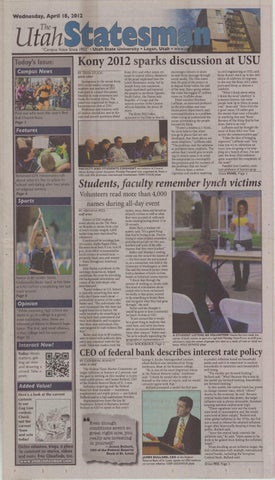
Wednesday, April 18, 2012
"Campus Voice Since 1902" • Utah State University• Logan, Utah
Find out who won this year's Red Bull Chariot Race.
Page3
Features
BY TAVIN STUCKI sports editor
In response to the recent Kony 2012 social media campaign, students and teachers at USU took part in a panel discussion Monday to raise awareness and funds for Central Africa. The panel was organized by Steps, a humanitarian club at USU. Professors and students with of various disciplines met to discuss and answer questions about
Kony 2012 and other issues relevant to central Africa. Members of the panel explained how the Lord's Resistance Army, led by Joseph Kony, has murdered, raped, mutilated and tortured the people in northern Uganda South Sudan the Democratic Republic of Congo and the eastern portion of the Central African Republic for about 20 years The Kony 2012 video, uploaded to YouTube in March,
FACULTY AND STUDENTS COMMENT on violence in Central Africa during a panel discussion Monday. The
USU club that promotes international involvement.
Returned LOS missionaries talk about what it's like to adjust to school and dating after two years of religious service.
Page4
Sports
Senior pole vaulter Sonia Grabowska oks back at her time at USU before completing her last track season.
Pa.ge8
Opinion
"While preparing high school students to g college 1s a good, even nee , idea there are inherent pr ms in Brown s legislat10n. The first, and most obvious, 1s th di ge 1sn t for everyone."
Today: Music matters, getting air time and drawing a crowd. Take a peek: Added Value!
Here's a look at the current cartoon in our Gag Line contest. Check out the
encourages viewers to share its anti-Kony message through social media. The film states that the goal of the project is to depose Kony before the end of the year. Since going online, the video has logged 87 million views on YouTube alone.
Panel member Matthew LaPlante, an assistant professor in the journalism and communications department, said oversimplification is a problem when trying to understand the issues surrounding the people harmed by Kony.
"There's a tendency, I think, for us to believe that when you go to places that are not developed, that those places are more simplistic," LaPlante said. "The problems and the solutions to problems seem simplistic. The advice that I would give in working in remote areas is to avoid the temptation to oversimplify the greatness and the vastness of the problems that are faced."
Patricia Ayaa, a native Ugand~n and student majoring
in civil engineering at USU, said Kony doesn't stack up to her definition of celebrity, in response to the way the Kony 2012 video portrayed Kony as almost a celebrity.
"What I think about when I think the word 'celebrity' is someone famous, but some people look up to them in some way," Ayaa said. "Even if it's for a good cause, I'd rather give the money than wear a bracelet or anything that says 'Kony.' Because of the thing that he has done, there is no way."
LaPlante said he thought the irony of Kony 2012 was "lost across the communication gap."
"I like the idea of bringing exposure," LaPlante said. "Any time you try to celebritize an issue, you are going to be stepping on a bunch of toes. I'm not sure the Kony 2012 endeavor quite respected the complexity of the issue."
Panelist Ann Laudati, assistant professor of human geog•) See PANEL, Page 2
Volunteers read more than 4,000 names during all-day event
BY ARIANNA REES staff writer
Dozens of USU students stood silently on the TSC Patio on Monday as names from a list oflynch victims roughly 4,000 names long were read aloud by volunteers.
Coordinated by sociology honors society, Alpha Kappa Delta, the event went from 9 a.m. to 6:30 p.m. in an effort to memorialize lynch victims of several racesprimarily black men and women - from throughout American history.
Amy Bailey, a professor in the sociology department, helped coordinate the event by providing the background information and names of the individuals who were honored.
"Racial violence in U.S. history is typically something that most folks don't know much aboutparticularly in terms of the scope," Bailey said. "The individuals who were victimized like this have just largely been lost to history. We really wanted to do something to bring back their personhood and their individuality and recognize that there were individuals who were targeted by mob violence like this."
Bailey said close to 60 students were involved with publicity, data entry and volunteer work for the event. Volunteer readers read the
names, races , dates and locations of lynch victims as well as what they were accused of, with each name reading lasting about 15 to 20 seconds.
Myles Hart, a student volunteer, said, "It's a good thing that they're trying to do. They're trying to raise people's awareness and educate people on who was lynched and some of the silly reasons that they were lynched."
Bailey said Monday's reading event was the second she knows of - the first event she participated in, as a researcher, was held at the University of Washington in 2008. She said the research project there built a database of lynch victims based on historical census reports.
"I think that through the process of working so closely with this kind of information about people who've been victimized, we really, at that point, wanted to do something to honor them and recognize what they had gone through," she said.
Bailey said she thought it would be great to host a memorial for lynch victims at USU.
"It just seemed like it would be a great thing to replicate that event here, and we've also been able to incorporate information from other sources," Bailey said. "So we're actually expanding the geographical representation of •) See SOCIOLOGY, Page 2
BY CATHERINE BENNITT editor in chief
The Federal Open Market Committee set target inflation in January at 2 percent, and the goal in settling on this number is to promote stable prices, said James Bullard, CEO of the Federal Reserve Bank of St. Louis.
Inflation targeting and the Federal Reserve's dual mandate - maximum employment and stable prices - are linked, Bullard said to a full auditorium Monday.
Representatives from the Jon M. Huntsman School of Business invited Bullard to USU to speak at this year's
Even though conditions aren't so great right now, you really are investing in yourself."
- James Bullard, 0110 of the Pederal Beserve Banlt of St. Louis
George S. Eccles Distinguished Lecture, where Bullard was introduced by Doug Anderson, dean of the business college.
"He is one of the most important voices in the Federal Reserve today," Anderson said. "I think he would like to refer to himself as the voice of reason, and we would certainly agree with that."
Bullard presented a model the Fed uses
to predict inflation based on household needs and said it is important to analyze households to maximize each household's well-being.
"The models are forward looking," Bullard said. "Why? Because the actors in the model are forward -looking, households are forward-looking."
In this model, the central bank has power to change interest rates, which "offsets" shocks to the economy, he said. Because central banks have this power, the target inflation rate is always attainable, therefore keeping national employment high.
"These equations turn out the steady state level of consumption and the steady state level of labor supply,"
said. After global inflation in the 197Qs, the Fed saw a need to release the adopted inflation target after historically keeping it from the public, Bullard said.
"Since the central bank controls the inflation rate," he said, "there seems to be little to be gained from hiding the inflation target." When deciding on an inflation target, the Fed collaborates with multiple international central banks, including the European Central Bank, Bullard said. t' See FED, Page 3
•
BY ROUCHELLE BROCKMAN news senior writer
The ASUSU Executive Council allocated $23,500 toward renovations of a USU-owned building near Bear Lake and $10,245 for facility improvements to the USU Equestrian Center.
Both allocations were announced at Tuesday's regularly scheduled council meeting and com from the Capital and Support Fund, which accumulates money not spent during the previous fiscal year. The funds will not be allocated from this year's student fees.
The $23,500 allocation will be used to renovate a small building near the Bear Lake Training Center so that the building may be used by student groups and other USU organizations and personnel.
According to the bill's Capital and Support Funding Request, the training center is used as a retreat and to train student leaders. The building to be renovated is beside the training center and was formerly used by graduate students from the College of Natural Resources; however,

the building has been vacant and in disrepair for years. According to the funding request, training center management turns away many requests from groups each year because the training center is fully scheduled. The renovation of the smaller building will provide more opportunities for USU organizations to train staff and provide retreats for them, the request states.
The $62,500 renovation project will create two sleeping units in the building, which can accommodate a total of 16 people. Along with the funding from the Capital and Support Fund, the project will be
funded by the College of Natural Resources, which has promised a $21,000 contribution, and USU Campus Recreation, which has promised $18,000.
The cost of renting the building has not yet been fully determined, said Kirsten Frank, ASUSU executive vice president.
of
"(The project organizers) have been very reasonable," she said. "They don't want to charge more than they have to."
The project should be finished and available for use by the end of the summer, said ASUSU President Erik Mikkelsen.
The $10,245 allocation will be used by the USU Rodeo Club to make the Equestrian Center fit for rodeo events.
Currently, the Equestrian Center does not have rails high enough to accommodate livestock other than horses and is only used by riding classes, Mikkelsen said.
Renovations will provide new panelling and other equipment to accommodate a wider variety of animals, the request states.
The rodeo team currently practices at the Cache Indoor Practice Arena, which costs the team about $200 per practice session, Mikkelsen said. This money could be better "utilized to offset some of the other club expenses currently being paid directly out of the student-athletes' pockets," the request states.
The full cost of renova-
tion will be about $36,000. The Rodeo Club originally requested $17,000, but that figure was reduced to $10,245, the total remaining in the Capital and Support Fund, Mikkelsen said. The College of Agriculture will be required to provide the the remainder of the needed funds, he said. In other news, the council also passed a resolution that requires any student fee increases of more than $30 to go to a student referendum.
The former student fee policy did not specify the maximum amount by which student fees could increase without direct student approval, said Jason Russell, student advocate vice president.
"The student fee policy hasn't been updated in years," he said. "The ASUSU constitution changed, so the fee policy changed to reflect that."
The ASUSU Executive Council amended its constitution in February to reflect changes in the graduate student and distance education representation.
-
rouchellebrockman@gmail. com O From Page 1
lynch victims." with some kind of a reference Bailey said the highest to tradition, honor or p;evailconcentration of lynchings ing social norms, Bailey said. historically took place in the By that definition, lynching South, and lynch victims were incidents have been traced typically black males, but back to colonial days in 1850, there was also a high rate of and the latest occurrences incidents in the West. happened arourid 1990, she "Just from California, we've said. got 300 lynch victims," she Many incidents in which said. "It looks like a couple victims escaped or were of hundred in Colorado. This rescued are not documented was not something that left as lynchings, she said, though Western states untouched." the violence in those cases was Groups stigmatized and just as extreme. disadvantaged in the West, The scope of racial violence she said, included workers is quite und~ :represented, coming from China, Native and 15 percent of victims are Americans, Mexicans and also also unknown, but the readwhite ethnic groups, such as ings bring awareness to the Italians and Jews. extent of lynching incidents, In order to techni- she said. cally qualify as a lynch Elisa Barfuss, an undevictim, as determined by dared freshman, said her sodthe National Association for ology class helped volunteer the Advancement of Colored for the event. People, targeted individuals "It just made me really had to have died at the hands sad," Barfuss said about the of three or more individuals number of lynch victims: "It
From Page 1 Panel comments on
raphy, said perspective and specificity is needed when talking about the many issues in a "tumultuous Africa that remains poor and helpless."
"What we don't learn from Kony is that there are thousands of people, years of hard work, from Ugandans, from different organizations with Uganda," Laudati said.
"We don't hear those voices. They are not even part of it. In fact, they're invisible. In fact, the Invisible Children is based on this idea that there are invisible children. These children have been invisible until they've been found by the West."
Christopher Conte, ail associate professor in the history department, said there is more violence in Africa than Americans think.
"It's impossible to talk about violence in Africa in a couple of minutes and can it," Conte said. "People are still not over the violence that they experienced in this region. It's embedded in their society, in their culture, in the way they speak about the. · world, the way they understand their cosmology."
Panel members said they like how people want to facilitate positive changes in Africa, but some ways are
kind of reminded me of all of the racism that was going on back then, and I wanted to get the word out so that others can see what has happened and want to help others, too."
Barfuss said racism and lynching aren't excluded to the past, and students should be more active in preventing such things.
''This was not something that left the Western states untouched."
- Amy Bailey, professor of
sociology
more beneficial than others.
"We're trying to concentrate on resettling the people in (Uganda), because most of these people have lived in camps their whole lives," Ayaa said. "People in northern Uganda, most of them don't even have toilets. Many people don't have. food. They've not been going to school for a long time. They don't have a means of money to help them out. So if you can help - say, contribute to the NGOs that are trying to help out in resettling the people - then that would be one way to get involved."
Ayaa and other panel
"It's not as bad as it was then, but it's still kind of showing up periodically, and we need to just learn that everyone's the same no matter what," Barfuss said. "We all are here togeth~r. and we should learn to be friends."
Samantha Averett, a freshman majoring in law and constitutional studies, said she was curious about the event and also attended it with her sociology class.
"It was a beautiful day, and then I walked by here, and I kind of got this dreadful feeling," Averett said. "It just , made me feel helpless, like I kind of wanted to do something, but it's in the past. I guess all I can do now is hope. that it doesn't happen ever again."
Averett said the purpose of the event was primarily to raise awareness and prevent racism and hatred from occurring in tpe future.
members said loaning m<?ney to the people in Uganda to rebuild farms or businesses is a great way to help, instead of giving money to non-profit groups that pay much of the'ir money to overhead costs.
LaPlante said whatever route people choose to ]end aid, they shouldn't be overly optimistic about the effect of social networks. · "Changing your Facebovk status is not going to help anybody in the Congo, I promise you," LaPlante said - tavin.stucki@aggiemail. usu. edu
"I think it's really important that students go to these events, because I think they should be educated on these things," she said. "And a lot of people aren't aware or they are just ignorant to it, and they don't realize that it happened or it could happen."
Bailey said raising awareness of American history is important to preventing racial violence in the future.
"I think part of being Americans is having a full understanding of our history, and that requires a mature understanding of our national history, which is not always as positive and honorable as we might like it to be," Bailey said.
"I think that this event really gives students an opportunity, first of all, to learn about it, and, building on that, they'll think about why we have such a violent history in our country, why we
have thought at different times in our history that it was OK to violently target people who were different than we were."
It is important for students to be more accepting of individuals within and outside of their communities, and the· diversity of Utah gives them that opportunity, she said.
"Utah is rapidly diversifying, racially and ethnically, and I think that having a gutlevel understanding of where people from different groups and different communities are coming from isJeally ~lpful foi: students as they live in their neighborhoods (and) work in their workplaces," Bailey said. "I think it's an important perspective to have, to be able to understand where people from other groups are coming from."
- ariwrees@gmail.com
PATRICIA AYAA, A UGANDAN NATIVE ' and USU student; participates in a panel responding to Kony 2012, a film on African warlord Joseph Kony.Ayaa said she disagreed with the methodology behind the film. TAVIN STUCKI photo
•
BY KIETH JACKMAN staff writer
Researchers examining Alzheimer's disease since 1995 recently brought recognition to USU.
USU researchers for the Cache County Study on Memory in Aging were honored March 3 in Salt Lake City at a gala, entitled "Come Swing for the Cure," by the Utah Chapter of the Alzheimer's Association.
The group was chosen to be the recipient of this year's ALEXA -A Lifetime of Exceptional Achievement -Award.
The award was granted to the group for research and discoveries made since initial receipt of funding from the U.S. National Institutes of Health in 1995.
Maria Norton, of the department of family and human development and one of the researchers at the Center for Epidemiologic Studies at USU, said over the past 15 years research has included interviewing participants older than 65 in Cache County.
The award recognizes contributions made by the study over the years and how researchers have come to understand risks associated with Alzheimer's, Norton said.
"We followed them every three years, to continue to watch and monitor and evaluate and to see who developed dementia," Norton said. "The aim of that parent study, overall, was to look at the genetic and environmental factors that determined or were related to one's risk of developing Alzheimer's disease."
Norton said researchers have published between 80 and 100 articles in top journals in the fields of psychiatry, gerontology and geriatrics, relating various factors he study has discovered to have an influence in Alzheimer's risk.
JoAnn Tschanz, a professor in the department of psychology and the clinical director of the Cache County Memory Study, said, "I'd like to acknowledge the many investigators and faculty at Utah State University, as well as graduate and undergraduate students who have participated in our studies over time."
Anna McEntire, a public relations specialist in the Research Office, said
the study has brought funding and recognition to USU over the years.
"The money that is brought in for research is not the be all and end all of what we do," McEntire said. "But we do view it as an indicator of the success in the program."
Norton's research contributions have helped the College of Education •and Human Services rank among the best in the nation, McEntire said.
Norton said the study has helped researchers examine the factors influencing Alzheimer's, such as those that may increase susceptibility to the disease, including low amounts of exercise and exposure to pesticidescommon among farmers, she said.
On the other hand, researchers found that staying cognitively challenged and stimulated, social engagement with others, a healthy diet and certain classes of medications may lower the risk, she added.
Tschanz said "dementia" is a global term not specific to any particular disease, and it is described as memory impairment and impairment in other cognitive areas that prevent a person from functioning independently in day-to-day activities.
"Alzheimer's disease is one of the most common forms of dementia after the age of 65 or in later life," Tschanz said. "With progressive deterioration over time, the person experiences language dysfunction, problems orienting themselves in a space and difficulty recognizing other people or really recognizing things."
Tschanz said these symptoms can cause stress to those close to the patient.
"It's a very debilitating disorder," Tschanz said. "Because of how common it is, it creates tremendous burden on society, family and the public."
Norton said research will continue on the data produced by the study.
"We don't yet know the full story," Norton said. "We don't know definitively, absolutely, what causes Alzheimer's disease. We're making a lot of progress. At least we know some of the things people can do in (their) personal lives."
- keithjjackman@gmail.com

Page 1
The dual mandate applied in Bullard's model is actuany a triple mandate, he saidthe third piece being the Fed's aim to sustain moderate long-term interest rates.
"We are nailing the third one," Bullard said. "And no one is giving us credit for that."
The ECB follows a single mandate, and though it is different from U.S. central banks in this way, it doesn't behave differently when impacted by economic turns, he said.
Recession lowers interest rates, and economic growth will raise interest rates, he said.
''Much of the discussion about the dual mandate is, in my view, really about the nature of the Fed's reaction to economic events," Bullard said.
During a press conference held after Bullard's lecture, he spoke about the state of the economy. Bullard said many sectors are growing quickly, including retail and labor.
According to the National Employment Update released by the National Conference of State Legislatures, the national unemployment rate dipped slightly to 8.2 percent in March, from February's 8.3 percent unemployment rate. Still, there are players in the recession-weakened economy.
"Some parts of the economy aren't going to recover fast," Bullard said. "Housing is not going to recover fast - some parts of financial markets are slow to come back."
Though he maintains optimism regarding the next few economic years, thanks to
increasing market numbers for the beginning mon.ths of 2012, he said he cannot forecast whether the economy will stay on track.
"The first quarter is coming in stronger than expected," Bullard said, "It's not super robust, but it's better than people were expecting a few months ago."
In an uncertain economy, Bullard said current students should maintain a broad perspective, and know that down economies don't last forever. Students may be looking toward entering the workforce and becoming homeowners.
Luckily, Utah has one of the nation's lowest unemployment rates, and housing affordability is high, Bullard said, adding that those looking to own homes should buy now, but buy carefully because it would be unwise to overborrow.
"I am not telling young people to go into this willy-nilly," he said. "Go into it with your eyes open. If you decide to rent instead, you might pay a higher rent."
Bullard, an undergraduate student in the early 1980s, said the economy was shaky at that point in time, too, but later stabilized.
"It's a long road, so, even though conditions aren't so great right now, you are really investing in yourself over a long period of time. So take some heart from that," he said.
While painting a somewhat brighter economic picture, the Federal Reserve again pledged to keep rate near zero through 2014.
The USU Women's Choir presents "Black and White" Friday, April 20, at 7:30 p.m., in the Performance Hall, on the university campus. "Contrasts, dichotomies, differences, all are part oflife," said Michael Huff, director of the USU Women's Choir. "This concert offers snapshots of musical and poetic contrasts through the amazing artistry of the Women's Choir."
The choir will perform works by various artists including Michael Jackson, choosing pieces that illustrate contrasts distinctly. Tickets for "Black and White" are $10 general admission, $8 seniors and youth, $5 USU faculty and staff and free for USU students with ID. For more information and tickets, visit the CCA Box Office located in room 139-B of the Chase Fine Arts Center, call 435-797.-8022 or go online at arts.usu.edu.
Jeffery Hall, USU's Rodeo Coach and Advisor, was awarded the 2011-2012 "Coach of the Year" for the Rocky Mountain Region. The award was JEFFERY HALL based on a vote from the coaches and student event directors within the region. Hall was presented a goldtrimmed belt buckle at Utah Valley University's Rodeo on March 24 in Heber City, Utah.
"When they announced that I had received Coach of the Year, I was completely caught off guard," said Hall. Hall has an undying love and passion for the sport of rodeo. Riding bareback horses for nine years, saddle broncs for five years and bulls for 19 years, he has spent over 33 years of his life competing as a professional rodeo cowboy.
Because of his personal association with the sport, the knowledge and insights he gained were something he wanted to give back and share with others. His involvement with this sport has been something that has changed not only his life, but the lives of his students.
"Part of the sport of rodeo is everybody helps everybody," said Hall. "Yeah you want your team to win but, no matter what, you help each other out. That's what makes rodeo such a unique sport." With every opportunity he continues to help other students, even those on the opposing teams. This is something that made Hall the perfect recipient for "Coach of the Year."
Observatory opens doors to community
All are invited to view spring's evening sky as the Utah State University Observatory opens its doors to the public Friday, April 20, from 8:30-10:30 p.m. Admission is free.
"We invite the Cache Valley community to enjoy views of the night sky from our state-of-the-art facility," says James Coburn, Physics Department teaching laboratory supervisor and USUO coordinator.
"We'll be looking at Mars and Venus, along with Saturn, that is rising, and Jupiter, that is setting. We'll also look for the Orion Nebula."
Located on the roof of USU's Science Engineering Research (SER) building, the observatory houses a 20-inch reflecting telescope on a computerized mount that yields clear, crisp images of faraway planets and deep space objects.
The policy ofThe Utah Statesman is to correct any error made as soon as possible. If you find something you would like clarified or find in error, please contact the editor at 797-1742, statesman@aggiemail.usu.edu or come in to TSC 105.
8Y ERIC JUNGBLUT staff writer with many tasks, such as was really weird for me was earning a living, choosing that in the Virgin Islands classes and a major, and when you walk down the
For students across the active thought about career road and see someone, it's \J'.S., college might seem and their long-term life rude if you don't say, 'Good s,lraightforward. Unless a path. One adjustment they morning,' or, 'Good afters.tudent wants to pursue must make upon returning noon.' When I went back to graduate school, a doctorate from their service is the Snow College, I kept saying, or some other form of post- wider complexity of life." 'Good afternoon, good college education, college Mitch Henline, who afternoon,' to everyone that lasts two to four years, on served his mission in Puerto I walked past." average, with an expected Rico and the Virgin Islands Kyle Stubbs, a senior graduation age of about age from June 2008 to June majoring in political sci22. 2010, said his return to Utah ence and public relations, However, Utah is differ- was "a little weird." said getting back into ent. After starting a first "It wasn't too bad,'' he school was a challenge ~mester of college, many said. "(There were) things after serving his mission in students put school and that I had to adjust to like Cape Town, South Africa, lheir personal lives on hold putting the bread into the from September 2007 to Ml order to serve a two-year refrigerator, because it September 2009. mission for the Church of would go bad if you don't "I got back in September, Jesus Christ of Latter-day down in the Caribbean." so I had a few monthsSaints. Returning mission- Henline is now in his which I definitely needed ~ries can sometimes face second semester at Utah - to work with my advisers ilifficulty in re-adjusting to State after transferring from and figure out a plan," he
AFTER RETURNING FROM LDS missions, some students may have trouble getting back to the a life of school, work and Snow College last fall. A said. "In those two years rituals of daily life, including dating. Many feel the need to fit a sterotype that tells them to get married 1 b quickly. KELSIE MASON photo illustration socia interactions, ut can former social work major the catalog had changed also learn from their experi- who just recently switched and all of your expectations he said. "My mission defi- said. "That was really big ence and use it to help them to journalism, he said there changed from when I had nitely helped in making me in getting back into school, "A small proportion of missionaries' own families sometimes discover to their in their daily lives. was a social and language been a student before my prioritize and work harder being able to go after things "Missionaries' lives have barrier to overcome when he mission." in school." and get the resu_lts that I surprise, amusement or mild annoyance that missionaries so accustomed to the regimen of prayer and strict rules can return and be a little preachy toward others who have not been been very focused on their came back.
Henline said his mission Stubbs also said he hen- was after." missions," said Phil Barlow, "Every once in awhile I experience helped him efitted from his mission in There are common and professor of religious studies would say a few words in become more motivated to certain aspects of his life. often prevailing stereotypes at USU and Arrington Chair Spanish to people, and they get good grades. "It gave the skills on· about returned missionarof Mormon History and would look at me funny, but "Right before I left, I just how to talk to people and · ies, such as getting married Culture. "They have been I got over that pretty quick," kind of goofed around and communicate, how to be immediately after getting able to suspend concern he said. "Something that slacked off with my grades," proactive in achieving and back or continuing to preach
Finding two complementary flavors and coming up with interesting and delicious ways to eat them together is pretty much the ultimate goal in cooking, but it can be a little scary. Have you ever tried inventing a recipe that ended up going straight into the garbage? Cooking can be a risky business. The good news is, once you know that two foods taste great together, it's pretty safe to get creative and come up with fun new ways to eat them. If you're sick of eating the same things in the same old ways, over and over, here is a list of tried-and-true ideas to get you started coming up with new - and deliciousways to eat your favorite foods.
Caramel and sea salt
This was one of the most popular flavor combinations of 2011, .

especially in ice cream, so ypu may have already tried it. If you love it, try it another way by sprinkling a pinch of sea salt on top of homemade caramels while they're still warm, ,or try stirring some sea salt into your favorite caramel sauc~ before drizzling it over a brownie or a ·scoop of ice cream. Strawberries and basil This combination i.s perfect for
SP.ring, since both strawberries You'll be surprised how the kick · and basil are coming into season helps bring out the chocolate right now. The most common way flavor. I've seen these two items paired is in drinks. Adding some straw- Pears and bleu cheese berry slices or pulp and a few, fresh basil leaves to lemonade or soda is a refreshing and sophisticated treat. Y.ou can also add some finely chopped fresh ~asil to your strawberry yogurt for a fancy breakfast treat.
Chocolate and chili peppers
If you're thinking this combination seems odd or gross, let me remind you that Mexican cooks have been using this combination for years in the classic Mole sauce you can get smothered on burritos and enchiladas. Another easy way to try this combo is to add a few dashes of cayenne chili peppet to your favorite brownie ,recipe or a mug of hot chocolate.
The ,first time I tried this combination was in pasta. A simple sauce made from cream and bleu cheese was tossed with pasta and chunks of fresh pear. It was delicious. You can ,also top a cracker or piece of toasted bread with slices of pear and a few bleu cheese crumbles. Also, try a sal,ad with greens, pears, toasted nuts and bleu cheese.
Lemon ~nd rosemary
This combination is pretty classic, especially on chicken, but you can take it even farther. For example, you can add rosemary to lemon- cookies or cake. You can even make rosemary lemon-
ade. One way to add rosemary flavor without adding the needles is to infuse a syrup. You can do 'this by boiling equal parts water and sugar with some rosemary and letting it sit for about 30 r:ninutes before straining the rosemary out. Then, use the syrup in lemonade, frosting or anything else lemon you can think of.
Coconut and curry
This flavor combination may seem obvious, especially if you love curry made with coconut milk. Last summer I went to an ice ere.am shop with a coconut curry flavorep ice cream, and it was delicious. You could try adding a pinch of curry powder to a scoop of coconut ice cream, or even make it into a shake, if you want to try this tasty flavor on the FLAVOR, Page 7

I don't cook much. It's one of those things that is pretty low on my list of priorities throughout the day.
The funny thing is my lack of cooking has nothing to do with my ability tO prepare food. I consider myseWa aecent cook. On a scale of Jill Taylor from "Home Improvement" to Masaharu Morimoto from "Iron Chef" I am probably somewhere in the Vince LaSalle from "Recess" range - at least the episode where he successfully takes over for the lunch ladywhich is pretty impressive for a columnist who once thought "caramelizing" a dish just meant serving it with Rolos.
My life of seldom cooking stems from a much different motive. It's not that I feel I can't cook or lack the time. I, in all honesty, am simply afraid to use the co"Q!s~ facilities in my apart~.
If you saw my stove you would understand. It is something that looks as if it should new and fully functioning, but sounds as if it hasn't been used since "Aah Real Monsters" was still on Nickelodeon. In fact, it often sounded as if the stove was where the show was filmed. There are unpleasant bangs, unsettling hisses, and sometimes - no lie - something that sounds like a small child shrieking for their life, though that only occurs when the oven is preheating. Of all the things to cause a stir in my place of residence, this is the worst for me. But, since nobody on record has been known to perish from using it and my roommate Hunter - who I'd rank in the Tito from "Rocket Power" tier on the cooking scale - has often made his famous orange
juice cake inside the white, cubed gorgon, I figured I'd gather up some courage and give it a whirl. I self-commiserated throughout the day on what to whip up and settled on ravioli. I figured if I were to do this, I needed to go all out. Pasta requires at least two burners, and the use of the oven, if I had enough intestinal fortitude to heat up garlic bread.
Things began somewhat smoothly, as I strategically got up from my couch every two and a half minutes to stir pots. It was during stir trip 11 that I began to hear a strange whirring noise, and noticed a stream a smoke rising from the burner. It seemed as if someone didn't clean the burner after preparing their cream of wheat. What made this odd wasn't the fact that the stove was acting funny, that was Busch league. What threw me off was the fact none of my roommates seemed at all concerned about the matter. They all glibly attended to their current activities in the living room, passing off tbe current situation as an indoor bonfire or "~11@..,.Ynaking soy cookies." I guess their demeanor calmed me down a little, as it was a symbol everything was going to be OK. That was until the burner caught fire. I panicked. I scrambled. I did everything I saw John Travolta do in "ladder 49."
My roommate Jess tried to render assistance by commenting, "Hey, I think there is some baking soda in one of the cupboards." I replied, "OK, which one?" "I don't know, somewhere in the kitchen."
If the rising flame accompanying my noodles hadn't made things serious enough, my roommate proved to be less-than helpful.
"Jess, just help me find it," I said.
He looked at me, looked down at his plate of chicken he was eating on his lap, looked back up and said - I'm not fooling here - "I can't."
I was stunned. "You can't? There is a fire."
We stared at each other and did the only thing we knew to do. We laughed, shuffled our way across the apartment and put our conversation on a quote wall, somehow forgetting the fire on the stove. Hey, we're a college apartment. We know a priority when we see one. luckily for us, the panic moment subsided as the stove flame put itself out only the way a haunted stove can, and I was able to enjoy my well-accomplished dinner in peace. We had somehow survived. It's just a good thing I decided not to caramelize anything. Then all bets would have been off.
- Steve Schwartzman is a junior majoring in marketing and minoring in speech communication. His column runs every Wednesday. He loves sports, comedy and creative writing. He encourages any comments at his email steve.schwartzman@aggiemail. usu.edu, or find him on Facebook.
adults $10, seniors &

BY ALLEE EVENSEN features editor
After hearing Jeannie Johnson teach, her students probably never guess she was born tongue tied. The political science professor describes herself as talkative - an adjective many of her upper-division students use as well.
"She knows what she's talking about, and she has a lot of energy," said Doug Perl, an international relations major and one of Johnson's students. "She's really into the subject material. She's fun but always very professional."
Johnson said her at-birth impairment never actually stopped her from striking up a conversation.
"It didn't inhibit my talking one bit," she said.
Though she's been traveled around the world, Johnson said her passion for political science began and remains at USU. She said she knew what she wanted to do after a single day as a freshman.
"I fell in love the first daJ, in Mike Lyons' class. I was sunk - hook, line and sinker," she said. "And I really didn't look to the right or the left after that.
That was what I wanted to do."
Johnson earned her undergraduate degree in political science and international relations and her master's degree in political economy from USU. She is currently in the process of finishing her doctorate in strategic studies.
Though she's worked in multiple governmental areas, including positions in the CIA and State Department, she continues to teach because she loves sharing her .experiences with students, she said.
"Teaching is just an intrinsically enjoyable activity. It is so much fun," she said. "I love the students, and I think I admire them increasingly year by year. They demonstrate so much initiative in what they are doing - adventurous, fantastic things that at their age I never would have dared do."
Through her teaching position, she also tries to· make sure USU students are noticed, she said, and she often secures guest speakers from various govern: ment agencies to give her classes a small piece of the real world in the classro6m.
"I make sure they have a constant reminder that Utah State is on the map and that we have fantastic students to send their. way,"
Johnson said
Even thougq she teaches, Johnson said she still works· with the government in · foreign policy making and travels Washington, D.C., multiple times a year, sometimes as much as every other month.
Junior Megan Hurst, orie of Johnson's students, said her professor's real-world experience is an aspect she looks forward to in her classes.
"She has a lot of connections and brings in a lot of guest speakers into the classroom," Hurst said. "It is very challenging, but they were worth it at the end of the semester."
At the end of her undergraduate experience, Johnson said she took an internship on Capitol Hill and realized the local aspect of politics was wasn't for her.
While working on her master's degree, she took another internship with the State Department at the American Embassy in Paris. It was here that she said she found a passion for foreign policy.
As she was writing her master's thesis, she said she was recruited by a CIA member to work under the director of intelligence -a wing of the CIA that conducts analysis. She worked on the Balkan Task Force, whose primary foreign concern at the time•was Serbia.
Currrently Johnson is working on her dissertation, which focuses on the way organizational cultures, like the CIA or Marines, impact the implementation of security policy.
"I cultivate a type of· expertise in my scholarly research that is also useful in very practical ways to the intelligence community," she said. "I go back and forth to D.C. to work with the intelligence community and the department of defense to cultivate better ways of gleaning and then employing cu): tural data into actionable intelligence."
The inspiration for he.r research ·came from time she spent with the State Department in the Zagreb Embassy in Croatia. At the time, she said, the U.S. was bombing Serbia in what was expected to 1:ie a three-day war.
The Serbian government refused to respond, something the CIA could not figure out, she said.
"We were into day 30 and then day, 40 and then day 50, and they were not capitulating," she said.
The department began to make mistakes1 such as accidentally bombing the
Chinese embassy by using an outdated map.
"We were making decisions on the fly about which target sets to bomb, and we were using an old map, one that was produced in 1998, instead of the current map of 1999," she said "(The target) was labeled the federal directorate of supply procurement for Serbia. We didn't update our map to find out the Chinese had purchased that building and were using it for their embassy, and so we accidentally bombed it."
In a morning meeting, she said the ambassador came in frustrated and slammed a newspaper down with pictures of Serbians that had put actual targets on their heads. The government couldn't figure out why citizens reacted to the bombings the way they did.
"We knew everything about leadership figures," she said. '\The head of the Serbs was Milosevic. We knew everything about him down to his prescription medication. That's not a hyperbole. We knew everything about him. But we didn't know who (the) Serbs were."
The idea dawned on her that the government didn't understand the culture of the people, she said. Since then, her research has taken a turn toward what she calls "cultural typography."
"When I returned to academia, it is the thing I devoted myself to entirely - filling in that gap," she said.
Johnson said she wouldn't change anything about her position in life.
"I love this life," she said. "I love having an opportunity to live in paradise in Logan, Utah, which is as good as life gets, but still keeping my hand in the policy-making machine of Washington, D.C."
allee.evensen@aggiemail.usu.edu
Page 4
Mission life helps some students focus more on school, improves social skills under the same strict discipline," Barlow said. "This minority of missionaries may feel and express their disappointment with worldly ways out among their friends, but most have learned to be thoughtful and respectful, so far as I can discern."
Heline said he fit the description of preachy, himself, and fell victim to the stereotype of early marriage. "I guess I was still in missionary mode," he said. "I started dating this girl after I got back, and she started saying that she wasn't ready to get married after we'd only been dating for a few weeks. I had never even mentioned it."
From Page 4

Barlow said a lot of desire for meaningful social relationships has either been put aside for two years or has been accumulating pent-up energy. "Most adjust pretty well within a few months or a year," he said. "They may not have been developing the social comfort and skills that others have while they have been serving, but in other respects many have been developing social ability relatively free from the self-interest of dating."
Barlow said though returned missionaries are often cast into stereotypes, they learn a great deal about serving..~~"LDS missionaries work very hard, by and large, and they learn a good deal about unselfishness and maturity while on their missions," Barlow said. "Often they learn about cultures and people beyond what has been
sweeter side.
Peanut butter and bacon
I have to admit, I was scared when I first heard about this combination. But believe me, if you fry up some bacon nice and crispy, drain it and crumble it up, and then add it to your favorite peanut butter cookie recipe, you will swoon, and your friends will do anything for the last bite. drizzle it with balsamic vinegar before baking it. It's delicious. Another way to try this combination is to cook the balsamic vinegar on medium heat on the stove until it reduces (becomes a little thicker), and then add a little sugar. Then drizzle it over a piece of cake topped with fresh or cooked peach slices or a piece of peach cobbler.
Balsamic vinegar and peaches
This flavor combination is one of my favorites. You can make a pizza or flatbread and layer it with sliced peaches, mozzarella cheese and chopped fresh basil. Then
familiar to them. They learn something of courage, of being less self-conscious, of getting along in new circumstances not always of their choosing. All these can be advantages when they return to school and ordinary life."
- ej.jungblut@gmail.com
- Jennelle Clark is a senior psychology majo, who writes the online food blog foodislikeart.blogspot.com She loves making, eating and sharing her her food. Send comments to jenn.wilson @aggiemail.usu. edu.
Euer been involved in Girl Scouts???
Come celebrate 100
years with a dinner, guest speabers, and activities!!
Thursday, April 19th @ 6 PM USU Lundstrom Center
Cod:. $5/person
Pre-register @ bappadeltabd.blogspot.com by Monday, April 16th.
Outdoor Field Athlete of the Week, for the week of April 9-15, as announced by the league office Tuesday.
This is the second WAC Field Athlete of the Week honor for Spencer as she also won the award for the week of March

BY CATHERINE BENNETT editor
The first time Sonia Grabowska's middle school coach handed her a pole, she fell in love, but in Warsaw, Poland, where she grew up, she would have referred to her newfound obsession as "skok o tyczce," meaning pole vault. Track and field spectators can pick Grabowska out at a meet by finding the athlete with a half-sleeve tattoo on her left arm and a bright-blonde, asymmetrical haircut.
"She has a fiery personality," USU track and field coach Gregg Gensel said. "She is very outgoing, very vocal."
Aside from being one of the top-ranked pole vaulters in the Western Athletic Conference, Grabowska is an older sister who loves to Skype her friends from home and listen to music as often as she can, Grabowska said. One day, she will be "heavily tattooed," she added.
Her journey to USU began when she heard friends talk-
ing about going to school in the U.S. She said this encouraged her to call a man who was helping Polish athletes and students get connected to American universities.
Grabowska received offers to join the track and field teams at Virginia Commonwealth, Adams State, Texas State and Colorado Mesa University, as well as a slew of other small East Coast colleges.
In the end, she said, it was a toss-up between Utah State and Texas State.
"I looked at the pictures online, and they were just pretty, so I wanted to come here," Grabowska said. However, she could do without the cold weather, she said - it annoys her. So, she took a full-ride
scholarship to represent USU in pole vaulting. Ever since, she has won titles and awards for indoor and outdoor events, ranking regionally and nationally.
A few of the bullets on her list of accomplishments include setting the indoor and outdoor school pole vaulti~ records and tieing the WAC record. This is Grabowska's last season on the team, but she said her personal victories
WOMEN'S TENNIS
on the team will forever be cherished memories.
Her triumphs haven't come without struggles, Grabowska said. Not only did she need to adapt to her new surroundings as an athlete, but also as a student.
"I think the language barrier was the hardest adjustment," Grabowska said. "I remember coming here, and I knew English before, but it was hard to speak in English and think in English 24/7, but I got used to it. The culture is
BY ALLEE EVENSEN features editor
She was 3 years old when she first lifted a tennis racket - a Christmas gift from her father.
By 8, she was taking lessons, and, by 10, she was playing competitively.
By the time she graduated from Juan Diego High School, she was a fourtime MVP and four-time state champion, ranked among the top 70 high school tennis players in the nation.
However, in less than a month, Romina Nedakovic will leave competitive tennis behind for what she calls a "more stable" life. The USU women's tennis player and senior said she is ready to live outside the court.
"I want to start a new chapter of my life," she said. "I'm in a serious relationship, and he would support me, but at the same time it's a strain. It's so everywhere, living out of a hotel suitcase, and it's not what I want in ' the end."
Though she's spent thousands of hours with racket in hand, those · closest to her understand her decision to pursue other passions - something that will help her grow. Tank Conver, her boyfriend of more than two years,
said though tennis has consumed much ofNedakovic's life, it doesn't define who she is.
"Tennis is a big part of Romina's life, but it's a small part, at the same , time," Conver said.
Though Conver and Nedakovic have been dating for almost two and a half years, their relationship extends back more than 14 years, when they both lived in the same apartment complex as children.
Conver said the first day he saw Nedakovic's car pull up, he immediately asked if she wanted to play.
In the years si.\lce, he has seen her pattle through every challenge that has come her way.
"Romina is the most driven person I've ever met, and I've met a lot of people," Conver said. "She' ll never quit. Mediocre is never good enough for her."
Her coaches see the same drive in Nedakovic as Conver does. Assistant coach Byran Marchant said her natural abilities and hard work manifest themselves when she's playing.
"From atalent perspective, she gives us more depth on our team," he t. See AGGIE, Page 9
Brett Jensen
Aggie baseball club
Brett Jensen went 5 of 7 froni the plate in the series against UVU. Jensen had five RBIs, three doubles, stole three bases and crossed the plate 11 times. He was hit by four pitches and walked twice more as the Aggies , outscored the Wolverines 53-2 in·three games.
Logan Regional is, the ~ut-i1 behind your team!
Mention this ad for 10% off any Sports Enhancement Program : Call
Lamar Odom, what happened?
Just one season removed from being named NBA Sixth Man of the Year, the now-disgraced forward from Queens, N.Y., is done for the rest of this season.
How does a player go from Sixth Man to no man's land so quickly?
There are many excuses out there being made for Odom, most of which have to do with the vetoed trade that involved him before the start of the 2011-12 NBA season. The Lakers wanted to trade Odom and others to the New Orleans Hornets in order to get Chris Paul. There's nothing wrong with that right? It was a simple business decision - aging forward for a star in-hisprime point guard. Common sense. Then David Stern stepped in and vetoed the trade.
That left both the Lakers and Odom in a sticky situation. Odom knew that the Lakers weren't too intent on keeping him and looked at him as a trading asset. The Lakers on the other hand knew that Odom was becoming increasingly unhappy with the situation. Instead of dealing with his pouting, they sent him to the Dallas Mavericks. The Dallas freaking Mavericks.
Instead of going to the Hornets, who have the worst record in the Western Conference, Odom was sent to the defending NBA champions. Maybe it's just me, but that seems like a wonderful change of fortune. Instead of playing with AI-Farouq Aminu and Greivis Vasquez in a half-empty arena all season, he could be playing with the reigning Finals MVP and an old, but still talented, point guard in Jason Kidd.
Instead of drowning at the bottom of the West~rn Confereni;,~ standings he
•) From Page 8

would be involved in a tight race with Dallas to make the playoffs and defend the NBA title.
How can being traded to the defending NBA champs be an excuse for a whole season of apathetic play?
It can't.
Lamar Odom lost something that day he left the Lakers, and it looks like he might never get it back.
Was it his pride? Was it his trust?
Although Odom has been a high-maintenance player since his arrival in the NBA, who could have foreseen how poorly this most recent move would end.
The fact that the Mavs would rather list him as inactive instead of release him is a testament to how poor he's been since his arrival. It's a slap in the face to the former Olympian.
In essence Mark Cuban and Mavs organization are saying, "you have been so bad that we are better off paying you NOT to play."
So instead of getting to play every night for the defending champs, Odom can sit at home and chill with his almost $9 million.
Maybe that is what he wanted all along. It's a tragic turn in Odom's career.
It has been said that "adversity doesn't build character it reveals it." If true what does that say about Lamar Odom?
It is interesting to compare this recent occurrence with Odom to what happened recently in the NFL.
Peyton Manning who played his whole career
with the Indianapolis Colts, won a Super Bowl, guided them to numerous playoffs, and brought unprecedented success to a the capital of Indiana, was released in favor of a yet-to-play-a-down prospect.
His reaction?
Humility. Gratitude. Thanks. More gratitude. More humility .and maybe more importantly understanding for the Colts decision.
What about Tim Tebow?
After an incredible season and a playoff appearance, John Elway went out and signed Peyton Manning all but officially ending Tebow's career as a Bronco.
Tebow's trade to the Jets was anything but smooth, and had some hiccups not unlike Odom's, but his reaction was totally different.
He was happy and excited and promised to give his all to the Jets organization. Knowing full well that he might not ever start another NFL game.
Maybe these experiences are more testaments to the great character of Manning and Tebow than to the lack of character Lamar Odom has. Who knows?
I don't, but what I do know is Lamar Odom quit on the Mavs before he ever started.
He quit on the city, fans, management, team and coach before he stepped off the plane in Dallas. Great players don't do that. Classy players don't do that. Lamar Odom what happened?
- Spencer is a sophomore majoring in broadcast journalism. He supports Manchester United and hopes to· live long enough to watch the Cubs win a World Series. Send any comments to eliason. wright3@aggiemail.usu.edu.
said. "She's a team leader. The girls like her."
Marchant said next year the weight oflosing Nedakovic, along with two other seniors, will be felt by the team.
"We're going to miss her (she's) hard to replace. It's been a good ride," he said.
Nedakovic is rounding out her second year on USU's tennis team, somewhere she never expected to be four years ago.
Her collegiate tennis career began at Brigham Young University, but because of a coaching change after her freshman year, "BYU politics" and honor code issues, she said her experience was ruined, causing her to take her talent elsewhere.
"Sometimes you think you're going one direction in life and there's a curve and suddenly you're going the other way," she said. "That's what happened."
Before transferring, she looked at Boise State and Denver but ended up picking USU because she said she wasn't ready to live outside of Utah - an irony, considering she hails from Icici, Croatia. Seeking better opportunity
and a safer environment, her family moved to Utah when she was 6 years old.
"(Utah) is better for living and more safe for my kids," said Romina's mother, Sabina Nedakovic.
Both Romina and her mother said the move wasn't without its challenges, though Romina admitted she probably had an easier time than her parents did with cultural adjustments.
"Thankfully, I didn't understand all the struggles until I was older," Romina said.
She said one of the biggest challenges of the move was that neither her nor her parents knew English.
"I knew Italian fluently, and my parents knew German fluently, but it was like 'Oh, this language (isn't) useful here,"' Romina said.
After getting used to having mountain ranges on all sides, the LDS culture and an absence of beaches, Romina said Utah was a natural fit for her family.
Conver said being in Logan has allowed Romina to relax and explore what she wants to
do with her life.
"She's going out with friends and having a good time," he said. "She was always stressed, but (now) she's figured out what she wants to d0."
Sabina said Romina has manifested natural athletic talent since she was a small child, succeeding in everything from volleyball to golf.
Though both parents have encouraged her to follow her passions, Sabina said they never forced Romina to play tennis - it was something she chose for herself.
'Tm so happy with what she's done, but it's nothing we've pushed," she said.
How does tennis play into Nedakovic's future?
"With the economy being so iffy, my ambitions are to make it in the broadcast world," Nedakovic said, referring to her journalism major. "But I wouldn't mind teaching other kids the passion of tennis. That's always a fallback."
From Page 8
Vaulter hoping to represent Poland in future summer Olympic games different than back home but I adjusted pretty good, I think."
Grabowska will receive her master's degree in exercise science in one year, and she said being a graduate student has helped her prioritize her time between athletics and academics better than she did as an undergrad.
"We are gone all the time," Grabowska said. "I remember undergrad was rough, because we would leave almost every Thursday and didn't come back until Sunday, I missed a lot of my classes."
Grabowska is viewed as somewhat of a team icon, said Amber Thompsen, who is also a pole vaulter on USU's track and field team.
"She adds an element to the team that nobody else has,"

Thompsen said. "Her advice is different sometimes, and it's always good to have a different perspective. Having her gone next year, I'll definitely feel it."
Thompsen said she was slightly intimidated by Grabowska at first, but over time they've begun to support each other and learn from each other.
Over the three-year period
Thompsen and Grabowska have been teammates, Thompsen said she feels she has improved enough to compete with Grabowska, and she knows Grabowska feels the same way.
"If you can get Sonia's approval, well, that means something," Thompsen said. At every practice, Thompsen said she feels
Grabowska's intensity and knows she comes each time to work, giving each jump everything she has, despite the injuries she battles.
Grabowska ruptured both of her Achilles tendons but doesn't let that stop her from progressing in her sport.
"I just want to qualify for nationals," Grabowska said. "I've had some injury trouble this year, but it's important for me to do well at regionals and qualify for nationals."
Gensel said Grabowska's work ethic is admirable, and the other teammates take notice of that, but to Grabowska her work is the product of aiming to achieve the high goals she has set for herself. While some may think Grabowska's best memories
as a track athlete are
Grabowska
"My
Grabowska said she couldn't have become the athlete and person she is without
her teammates, trainers, doctors and, especially, her coach Gregg Gensel.
"There are several types of athletes," Gensel said. "There are the ones that have talent and use that to get by, and then there are the ones that don't have a lot of talent and work really hard. Then there are the ones that have a lot of talent and work very hard. That's where she is at."
- catherine.meidell@aggiemail.usu.edu
•
First-year offensive coordinator Matt Wells looking for more consistentcy, players to step up
BY TYLER HUSKINSON assistant sports editor
When a team loses two potential NFL running backs, the composition of the offense is bound to change somewhat. Such is the case for the Utah State football team.
Between Michael Smith and Robert Turbin - two of the three running backs named as part of the group called "The Three-Headed Monster" - the two running backs combined for 2,423 yards and 28 touchdowns.
"I feel like the biggest thing was leadership," senior running back Kerwynn Williams said. "That's probably the biggest thing with those two. That and they made a lot of plays. They brought a lot a veteran knowledge to the room in seeing the people normally wouldn't see. I felt like they did a good job helping the younger backs when we went it to spell them."
Williams - the third member of the, "The ThreeHeaded Monster" - made several plays himself during his junior year, but most of his yards were on punt and kick returns. The Las Vegas native amassed 915 return yards and 542 rushing yards to go with three touchdowns.

SENIOR WIDE RECEIVER MATT AUSTIN,
ers. With the loss of Robert Turbin and Michael
GOCHNOUR photo
"He's been in this program for three years and in a lot of system going on his fourth season," USU offensive coordinator Matt Wells said. "We do draw on his experience, we draw on his leadership and we draw on his performance. It's been excellent here in the three years from special teams to running back. I think he's got a chance to he one of the better running backs in this league."
The first-year offensive coordinator is also looking for someone to step up and show consistency in Spring football. One running back who has made his presence felt is sophomore Joe Hill.
"Right now, Joe Hill is standing out daily," Wells said. "He had an excellent
and
scrimmage. He's still got some stuff that I think you can get away with in high school that he still does that are habits we are breaking. But I think he's done a nice job in catching the football in the backfield and he's done a nice job running."
The Fullerton, Calif. native rushed for 25 yards and one touchdown last season. 20 of those yards along with his only touchdown came on a 54-17 blowout win
against Weber State.
Two other running backs vying for playing time are redshirt junior Joey Demartino and fellow junior Robert Marshall. "Joey Demartino didn't play last year, but he played the year before that and got a lot of playing time in that year," Williams said. "So, I don't think that coming in and playing will be a big shock at all for him to come in and get some playing time
early. Robert Marshall is going into his third year, so I definitely feel like there is some experience there. He's not shy to the game at all." For Wells, those who show consistency during spring practices will find playing time when the season rolls around.
"Robert Marshall has been there in spurts,
It shouldn ' t be a surprise that our campus is crawling with returned missionaries - from those who got back just months ago to those who are pulling their hair out because they are still single.
There are many clues when identifying RMs. To female students, the first and most obvious clue is the awkwardness of friendly encounters - they often greet and say goodbye with a high-five or shoulder slap. These men have been deprived of the ladies for two years and are mixed with fear and excitement about their next "transfer" - roping in a wife and starting a family. There seems to be a lot of ,pressure on a guy who still weaves scriptures into conversations about the weather.
These wide-eyed men have gone from following strict, regimented schedules, spending the majority of their days talking about religion, prayer and prophets to attempting to talk about pop culture and current events. It's no wonder the transition is rocky.
Rejoining society is a challenge. Now that they're back from service, they can watch movies and TV shows, they are encouraged to find dates, and there are no enforcements on their daily routines. Many have for_gotten what it's like to plan their own schedules and sometimes go back to the schedule they knew as a mi5sionary because it's all they know.
We don't blame these guys for their awkward social aptitude. But as much as their behavior makes sense, they need to be welcomed back to reality. Bursting RMs' bubbles can be a challenge. For roommates, who want to be friends and not companions, they might try to set up their 21-year-old roommate with a woman in his Institute class. Unfortunately, this might lead to long, uncomfortable dates filled with mission reminiscing and spiritual references - not to mention the guy remains at least five feet away from his date at all times.
It would be nice to have some type of reassuring advice for these well-meaning RMs, but generally, the best medicine is time. To those of you struggling through the awkward post-mission phase, you are certainly not alone. We interact with people like this-every day. Try to step outside of your comfort zone - this doesn't mean throw your standards out the window. Find an RM who was able to find his way back to reality and seek advice from him.
There are just as many awkward RMs at USU as there are women who want to find one to smooch on, so hope is not lost for you, boys. However, if you actually want to meet one of these women, you may need to introduce yourself, instead of avoiding eye contact. And unless you are asked, try not to give each of your dates a play by play of the past two years of your life.
Here's an unhappy observation about the minimum wage: Nat'lVolce Congress last increased the --------,.-rate in stages in 2006, topping What others are it out at $7 25 an hour in 2009 saying about Issues. · or $15,080 a year.
That amount when adjusted for inflation, is actually lower than what a minimum-wage worker earned in 1968 and is too meager to offer anyone the chance to climb out of poverty, let alone afford basic goods and services.
About 10 states are now considering raising the rate, and Sen. Tom Harkin, an Iowa Democrat, is proposing to increase the federal rate in three increments to $9.80 an hour in 2014. Many of the initiatives under consideration would smartly tie the minimum wage to the cost of living, meaning that those workers' wages would finally keep up with inflation.
The past recession was brutal on jobs, household ~ealth and economic growth. But wage s were hit hard, ·too. Real average hourly earnings have fall en below the level of 2009. Although wages often lag job growth after a reces sion, the pace of income gains this time around is far slower than in previous recoveries
It's also becoming clear that many Americans are being forced to take lower-paying jobs and that a low-wage bias is creeping into the economy, as Bloomberg economist Joseph Brusuelas recently put it. In many cases, minimum-wage work is all that's available,
• See NATIONAL, Page 13

[i1uRM(
This year, Kwame R. Brown, chairman of the Council of the District of Columbia, announced his intention to sponsor a bill that would compel all high school students in Washington, D.C., to take either the SAT or the ACT and apply to at least one college before they can graduate. His intention is to increase high school graduation rates and help high school students prepare for college. While preparing high
school students to go to college is a good, even necessary, idea, there are inherent problems in Brown 's legislation. The first, and most obvious, is that college isn't for everyone. A four-year university degree is intended to give a rounded experience, and graduates are expected to know about not just their selected field of study, but the arts, sciences and cultures that exist in the world. And frankly, we all know people
An overlooked campus staple·
To the editor:
Last week, my wife was working on her homework in the library. Next k> her was probably the only open computer in the entire buildir:g. As she sat there, some guy came and sat at the computer next to her. As soon as he sat down , he muttered to himself, "Dang it."
·
I am sure many of us have had this same experience in the library I know I have. It is almost guaranteed that if you find the last open computer in the library you will end up thinking the same thing. The reason? - the little green chair.
During my time .here as an Aggie, I have watched person after person bat-
tie with this common foe. What makes this little green chair such a drag to sit in?
Well, it ' s broken. That's all. It simply cannot be.raised to make sitting at the Gomputer a comfortable experience. It makes working at the computer such a hassle that · few people will put up with the chair for more than a few minutes. I have seen the chair excha~ged from 'place to pl~ce, day to day, ending up in many different locations. That little green chair floats around the first floor of the library like a plague. Many who sit in it will stand right back up and swap chairs wit), another computer. I have found the little green ~hair from the north side to the south. He.reminds me of a lost traveler, endlessly looking for somewhere to call home.
As much as we c"\11 ri1ight hate sitting in the little Pet Carrier
in college who couldn't care less about any of that. The Chronicle of Higher See LIZZEN, Page 13
l,.etters to the editor• A public forum green chair, we can't help but chuckle when we see some poor, unsuspecting bloke sit down expecting a soft cushiony welcome and instead dropping to six inches from the f-loor. The little green chair has given me so many good memories in the library. To me, this little green chair is as much a part of Utah State as True Aggie Night, Scotsman Dogs and the preacher on the TSC Patio And although that little green chair will most likely never find a home of its own, it will always have a home in my memory and my heart. The idea that this little green chair has gone unrecognized through generations of Aggies brings devastation to my soul. Long live the little green chair.
Jared Butler
ANY&)DY WANNA HEA~ I\N NEW EXCUSE roR Opj:DS\NG Tl\E BAILQJT ff
About letters
• Letters should be limited to 400 words.
• All letters may be shortened, edited or rejected for reasons of good taste, redundancy or volume of similar letters.
• Letters must be topic oriented. They may not be directed towar& individuals. Any letter directed to a specific individual may be edited or not printed.
• No anonymous letters will be published. Writers must sign all letters and include a phone number or e-mail address as well as a student identification number (none of which is published). Letters will not be printed without this verification.
• Letters representing groups - or more than one individual - must have a singular representative clearly stated, with all necessary identification information.
• Writers must wait 21 days before submitting successive letters - no e;:eception:;.
• Letters can be hand delivered or mailed to The Statesman in the TSC, Room 105, or can be e-mailed to statesman@aggiemail.usu. edu or click on www. utahstatesman.com for more letter guidelines and a box to submit letters.
From LIZZEN, Page 12
Education states that high school education may not be for everyone, and cites the shocking statistic that 25 percent of American males do not graduate high school.
Economist Alex Tabarrok, in another • Chronicle article concerning college dropouts, stated the classroom is the only road to knowledge in the U.S. Students are expected to sit quietly and digest information for 12-16 years, and Tabarrok doesn't blame some of them for burning out. Learning at a desk isn't appealing to everyone.
Typically, those who do not perform well in high school do not perform well in college. This is evidenced by the surprising statistics at our own university. Gaining admission requires only a 2.5 GPA in high school and an ACT score of 18.
•)From NATIONAL, Page 12
Between 2000 and 2010, less than 25 percent of USU students graduated within four years. The average six-year graduation rate is just above 52 percent.
Meanwhile, those who don't graduate are less likely to have had the high school grades and test scores to receive scholarships. Therefore, they end up with equal or more debt compared to their peers who graduate college and no degree to show for it. The story isn't much better for many who do graduate. The marketplace is currently flooded with college graduates who end up taking jobs that are more suited for high school graduates, simply because the supply of college degrees is exceeding the current demand.
According to Businessweek,
there are currently 100,000 college graduates who hold janitor jobs, while 16,000 are parking lot attendants.
In the Huffington Post, Patricia McGuire warned of another issue in universal college degrees: College becomes a right rather than a privilege that is earned.
"We already see too many students who believe that they deserve a degree simply for showing up - that's how some got their high school diplomas," she states.
While the privilege of attaining higher education should be extended to everyone, a four-year university degree should not be given without an intense amount of scholarly effort on the part of the student. And the national statistics showing 40 percent of college attendees
drop out shows most people are unwilling or unable to compete at a college level.
To those who fall into this category, vocational training is a much better option. It sets an individual up to learn short-term skills for rapid workplace entry. Those who go this route bypass spending thousands of dollars on liberal education classes they don't care about, and forgo the years spent unemployed during college.
The bottom line is that some people don't need college to be successful. My younger brother is an entrepreneurial genius, but I'll be amazed if he manages to graduate high school. He'll always make good money because he's smart and resourceful, but he'd be wasting his time and money if he tried to sit
Wednesday, April 18, 2012
through four years of college. A college diploma has never been a oneway ticket toward financial success, and it never
Raising the minimum wage won't entirely solve the problem of anemic incomes, but it would help. Economists have long found that boosting the minimum wage can raise income levels for those earning just above the minimum. Employers, seeking to protect "wage ladders," often bump up salaries for slightly higher-paid employees, too.
This is one of many reasons that critics, including business groups like the U.S. Chamber of Commerce, the National Restaurant Association and many Republicans, oppose minimum-wage increases. The argument is that it will hurt the very people it was meant to help by forcing employers to cut jobs, raise prices or both. They point to studies that minimum-wage increases hurt teenagers, because young workers typically get minimumwage jobs, which become scarce when employers are forced to raise salaries.
But a wave of new economic research is disproving those arguments about job losses and youth employment. Previous studies tended not to control for regional economic trends that were already affecting employment levels, such as a manufacturing-dependent state that was shedding jobs. The new research looks at micro-level employment patterns for a more accurate employment picture.
The studies find minimum-wage increases even proA team of economists, led by Arindrajit Dube of the University of Massachusetts-Amherst, compared employment levels in contiguous areas with disparate minimum-wage levels over a 16-year period and concluded in a 2010 paper there are "strong earnings effects and no employment effects of minimum wage increases."
The federal minimum wage was always meant to be a floor, not a ceiling. Today, someone earning the minimum would have to work 749 hours to afford one year of health
At the wide receiver position, the Aggies return two of their top three receivers in seniors Matt Austin and Chuck Jacobs.
Austin, who is returning for his sixth year, caught 34 passes for 465 yards and six touchdowns last season, while Jacobs reeled in 20 passes for 218 yards and two touchdowns.
Despite the offensive production capability of Austin, his physicality in making blocks downfield sets him apart from other wide receivers.
"Our receivers do a great job of going downfield cutting and making plays on the cornerbacks," Williams said. "They an amazing job. Matt Austin is one of the most physical wide receivers I've ever seen. He gets downfield and gets at

it at the cornerbacks and safeties. Our other receivers are coached hard to get down and make plays on the cornerbacks. They block well downfield. I don't see any receivers blocking better than our receivers do."
Austin said he has been a physical receiver for most of his collegiate career.
"I just watched some junior college film a couple days ago and I didn't realize how physical I was at that time," he said. "Now I realize it, and, when I'm in the game, I'm just a different person. I'm just an animal, and I want to hit guys. It's a different game, because, when I'm hitting cornerbacks, the next play when I'm going out for a pass, they might think I'm trying to hit them. It helps out in a lot of ways."
Austin made several game-winning catches last season and looks to be a leader.
"First, I feel like I bring a little bit of leadership leading by example on and off the field," he said. "Other than that, I feel like I bring one of the big weapons back to the squad. I'm happy to be back. It's a blessing, and I'm ready to get back to work."
Wells is also grateful to have Austin back for a sixth year.
"We're all happy with his extra year of eligibility," Weiss said. "He's a leader for us, he's got a great work ethic, he blocks his tail off, and he catches everything ih his zip code."
Jacobs has moved to the slot receiver position - the same position now-departed
On May 15th, Student Employment is joining Career Services to become a one-stop career shop. VISIT CAREER SERVICES EARLY AND OFTEN TO: E p & OBTAIN

Check it outl Take a look at this cartoon the only thing missing is the punch line, the big finish, the gag! Readers, like you, supply that. We post those on our website, www.utahstatesman.com, as soon as we get them and folks can vote for their fave! Winner will receive a restaurant gift certificate! Here are the gags received for this week's cartoon, now go vote!:
"I'm not sure it was a good idea to elect the captain of the women's rugby
as ASUSU president."
"Baby, I'll call you back My wife just walked in."
"By Thor's mighty hammer I WILL GET MY REFUND!!!!"
"Wait, you mean taxes were due YESTERDAY?"
"I take it the coffee machine is still broken " Out on a
Wednesday
April 18

Thursday April 19
Headed- 7:30 to 9:30 p.m.
Friday April 20
Return overdue books You Need to Know: The Merrill-Cazier Library Ririe Woodbury's Charlotte will forgive your overdue Boye-Christensen. Friday and fines if you pay it forward. Saturday April 20 and 21, 7 p.m. Anytime through April 23- 27 at the Ellen Eccles Theatre in at the Circulation Desk. This downtown Logan.Tickets $12 does not include Interlibrary adults, $6 students/children, $25 loan or lost books. family. Available at the theater Write Now at your box office, 752-0026 or online at Library. Is your final www.cachearts.org. paper, presentation, or final Le Nonne is having a project due soon? You can benefit night for Common get personalized help at the Ground on Thursday, April Merrill-Cazier Library from 26th. They will be giving a writing tutors, librarians and portion of their proceeds to us computer lab assistants April if you mention you are there 16-19 and 23-26, 6 to 8:30 for Common Ground. This p.m. in Library room 122. No is a good opportunity to appointment needed. · dine-out and donate to a great Religious Studies cause. Common Ground is a Department is having a non-profit organization that religious studies social for any provides outdoor recreation for current or interested students people with disabilities. For and faculty. Spaghetti dinner more information about our at 4:30 p.m. Wednesday, April program, call (435) 713-0288. 18, in Building B lounge of the The Old Barn Community Living Learning Community. Theatre, a non-profit theater RSVP: timothy.ledna@usu.edu in Collinston, is opening a Common Ground hosts show called "Remember the rock climbing at the Rock Magic: A Musical Tribute to Haus on Wednesday, April Disney''. April 13th-28th, Every 18th at l p.m. Cost is $5 and Monday, Friday and Saturday includes transportation and at 7:30 p.m. Matinees on the entrance fee. Common Ground 14th, 21st and 28th at 2:30 p.m. is a non-profit organization that Tickets are $8 for adults and provides outdoor recreation $7 for children and seniors. for people with disabilities. To Royal Princess Tea Party on sign up for this activity as a Saturday, April 21st at 1:00 p.m. participant or volunteer, or to Tickets for the Tea Party are learn about other activities, call $15 and include admission to (435} 713-0288. the matinee that follows at 2:30
2nd Annual Earth Day p.m. You can purchase tickets Soiree Friday, April 20, 2012 6 online at www.oldbarn.org or to 9 p.m. The Italian Place, 48 make reservations by calling Federal Ave. Logan Cost: $40/ 435-458-BARN ticket. Celebrate Earth Day USU students have created with Stokes Nature Center. a Pre-Occupational Therapy
Our 2nd Annual Earth Day club. If students "like" USU PreSoiree will feature delicious O.T. club on facebook, they'll hors d'oeuvres, drinks, and the find out when our meetings musical talent of folk guitarist are, what service projects Scott Shahverdian. were doing, and information
Amplify is an evening of that we've provided about contemporary dance presented Occupational Therapy. They can by Valley Dance Ensemble. Join also visit the website at http:// the dancers as they perform usupreot.weebly.com/. Going original works, including the into the field? Get informed dynamic choreography of about it.