stu Volume 68
Utah State University,
Numbe r 100
August 16, 1971
4 pages
Construction begins inWellsville Canyon Construction
on a stretch
of land 12 mile s south of Logan in
Wells vi lle Canyon has begun despite the protest of citizens in the area. Controversy over "changing the face of Wellsville Canyon" began last January when the Sherwood Corporation proposed the development of 690-condominium-type housing units in the 1,000 acre area,
John Stewart, USU professor stated. Some 150 persons from the area appeared at a public meeting in January on rezoning of the land which was needed before the build-
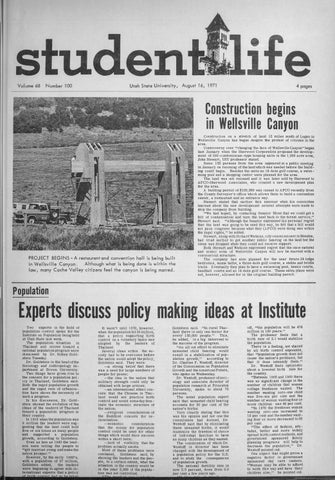
PROJE C T BEGINS - A restaurant and convention hall is being bui lt in Wellsville Canyon. Although what is being done is within the law, many Cache Va ll ey citizens feel the canyon is being marred .
ing could begin. Besides the wiits an 18-hole golf course, a swimming pool and a shopping center were planned for the area. The land was not rezoned and it was later sold by Sherwood to AFCO-Sherwood Associa tes, who created a new development plan for the area. A building permit of $100,000 was issued to AFCO recently from the County Surveyor's office which allows them to build a conve ntion center , a restaurant and an entrance way. Stewart stated that earlier this summer when his committee learn ed about the new deve lop ment several attempts were made to st op the company from build ing. "We had hoped, by contacting Senator Moss that we could get a bill of co ndemnation and turn the , land back to the forest service," Stewart said. "Although the Senator expressed his personal regret that the land was going to be used this way, he felt that a bill would not pa ss co ngress because what they (AFCO) were doing was within th e -legal rights," he added. Stewart, along with Richard Watk ins , city commissioner ln Mendon, had tried earlier to get another public hearing on the land but the issue was dropped when they could not receive support. Both Stewart and Watkins expressed regret that the once-natural and scenic area of Wellsville Canyon will now be marred with a commerica l structure. The company has also planned for the near . future 24 lodge bedrooms , sauna 1:0.ths, a three-hole golf course, a stable and bridle trails. Eventually they plan to have a swimming pool, tennis co urts, handball co urts and an 18-hole golf course. These extra plans were not, however, allowed for in the original building permit.
Population
Experts discuss policy making ideas atInstitute Two experts in the field of population control spoke for the Institute on Population being held
~
at utah State last week. The population situation in Thailand and moves toward a national population program were disucssed by Dr. Sidney Goldstein Tuesday . Dr . Goldstein is the head of the Sociology and Anthropology department at Brown University. Two things have given rise to the concern for a population pol icy in Thailand, Goldstein said. Both the rapid population growth and the rapid rate of urbani za tion have shown the necessity of such a program. In his cliscussion, Dr. Goldstein showed the evolution of the ideas of the leaders of Thailand toward a population program in their country. In 1910 when the population was 6 million the leaders were suggesting that the land could hold five or six times as many people and supported a population growth, according to Goldstein . Even as late as 1943 the leaders were telling the people to "get married young and make the nation prosper.'' However, by the early 1960's, with a population of 27 million, Goldstein added, the leaders were beginning to agree with in ternational experts that a policy
It wasn't until 1970, however, when the population hit 36 million, that a policy supporting birth cont rol on a volunt ary basis was
adopted by the leaders of Thailand. Several ideas within the soc iety had to be overcome before the nation would adopt the policy, Gold ste in said. They were: --a strong belief that there was a need for large number s of people for power; - -the idea in the nation that military strength could only be obtained with large armies; --an international ethnic conce rn that the Chinese in Thai land would not practice birth cont rol and would some day dam inate the economic structure of the nation; --relig ious consideration of the Buddhist conce rn for reincarnation; --economi c conside ration that the money for population contro l could be used for other things which would show success within a short term ; --lack of visibility that the problem actually eXists. Most of these problems were combated, Goldstein said, by showing the leaders and the people, to a certain extent, what the situation in the country would be in the year 2,000 if the population was not controlled.
"
Goldstein said. "In rural Thai land there is only one doctor for everi 150 ,000 people." This , he added, is a big deterrent to the success of the program. "An all out effort to eliminate unwanted child bearing would result in a stabilization of population growth," according to Dr . Charles F. Westoff, director of the Commission on Population Growth and the Ame ri can Future, who spoke on Wednesda y. Dr. Westoff, professor of sociology and associate director of population research at Princeton University, spoke to about 75 persons. The noted population expert said that unwanted child bearing accounts for 20 per cent of the nation's births. Very clearl y stating that this was his opinion and not one the commission had formed, Dr. Westoff said that by eliminating these unwanted births, it would maximize the freedom of choice of individual families to have as many children as they wanted. The commission of which Dr. Westoff is director has been charged with the development of a population policy for the U.S. and to study the conse quen ces of population growth . The national fertility rate is now 2. 5 percent, down from 3.0 per cent a few years ago .
off, "the population will be 474 million in 100 years." The professor feels that a birth rate of 2.1 would stabilize the population. There is a feeling, not shared by all birth cont rol exponents, that "population growth does not ca use the nation's problems, but that it does intensify them." Dr. Westoff feels optimistic about a lowered birth rate for
the country. "Between 1965 and 1969 there was no significant change in the number of chi ldren that women co llege freshmen wanted. The number wanting zero -one child was five-six per cent and the number of women wantingfouror more children was 40 per cent. "In 1970 the freshmen wo(Uen wanting zero -one inc reased to 10 per cent and thenumberwanting four or more decreased to 20 per cent. "The effect of fashion, atti tudes better and more widely sprea'd birth control methods, and government sponsored family planning programs will help to decrease the population ,'' Dr . Westof:f pointed out. One aspect that might prove a negative factor is government sponsored day care centers. "Women may be able to afford to work this way and have their children also/' he pointed out.
She calls herself
a rainbow maker.
Anyone who wants to see her display of
color and water need only walk out into the crisp morning air of Logan and onto the Utah State University quadrangle. She'll gladly set the gushers shooting into the slanting rays of the 6 a.m . sun. The rainbow maker is Sandy Duncan, a member of the groundskeeping crew at USU. She is the only female on the grounds staff which is responsible for
331 acres of lawn , trees,
shrubs
and
thousands of fresh flowers.
Female groundskeeper takespridein making rainbows ontheQuad
Sandy is the first fema le ever hired
by the university for groundskeeping duties and, as far back as the supervisory staff ca n remember, she is the only girl
ever to apply for the crew. Her specific duties involve setting the sprinkler system each day on various stretches
of lawn and keeping the sprink-
ler heads in operating condition. Other names she has chosen for herself are "Flower Girl 1 " "Water Boy " and ''Irrigation En gineer." ' Working an eight hour shift from 4 a.m. until 12 noon 1 she plans her routine so the powerful sprinklers that cover the Quad go on as the morning sun breaks over the Wasatch Mountains and tumbles onto the arched plumes of water. From special angles the dozen gushers break into an array of color. Sandy fell into her job as rainbow maker quite by chance. A graduate of Northern Colorado University at Greeley with a bachelor's degre in French, Miss Dun can taught for two years in the Cheyenne, Wyoming , school system. She also attended the University
of Wyoming for two years. "Public schools are too st ructur ed,,, the USU employee explained. "I like kids and what they can give me but the structured school setup does not allow children to really communicate and give. I left Cheyenne with the intention of teaching again.'' She moved to Logan because "It's beautiful here," she said. The last four years in the mountain va lley com munity ha ve helped Sandy learn a lot about herself, her goals and he r relations wit h other people. She worked for a time in the vege table canneries near Logan. She also tried working as a clerk in a grocery store just off campus. The market was torn down for campus expansion and Sandy was looking for another job. She describes her first meeting with the now retired director of the Physical Plant , Harold Wadsworth, as rather startling -- for him. After a pause to consider the request, Mr . Wadsworth's answer was "Why not give it a whirl?" "He was much more accepting than I thought he would be," Sandy said. So, in the Spring of 1970 Sandy joined
an all -male work force. The directorship of the Physical Plant has changed but the attitude toward this
young woman has not. Th enewdirecto r , Val Peterson, who recently offe r ed Miss Duncan a fu ll- time contract said, "I don't recall gir ls ever being in the positions predominantly done by men but I would not hesitate to hire any girl if she is as qualified as Sandy and can do her work as well."
ON CAMPUS
Letterto the Editor:
BoxElder trees indanger fromherbicides
"Tennis." Wayne Pearce, tennis coach at Brigham Young University and a brother of the USU staff member, is co-author of the publicatio n. Miss Pearce received her bachelors degree from the Uni versity of utah before completing a masters program at Washington State University. She joined the faculty at USU in 1957. "Tennis" applies selected principles of programmed learning to the development of tennis Skills.
Computer major receives grant
Friends , I am writing in regard to a previously overlooked but serious problem . The concern lies with our Box Elder trees. It seems that these pillars of strength and beauty in our ca mpus plant community are suffering from 2,4-D leaf deformatio n. One can observe at various times of the year different symp to ms which become more apparent each year. One may see irregularly shaped margins and extensive browning of the Box Elder leaves . 2,4-D affects only broad- leafed plants and is usually used in controlling broad-leafed annual and perennial weeds such as dandelions. This particular compound has no effect on grass which makes it highly valuable in contro lling broadleafed weeds in lawns. This then is why the university lawn crews have been using the herbicide so extensively on the Quad and Old Main Hill areas. My purpose is not to question so much the use of the herbicide but rather the way in which it is used. Do the lawn crews really have to be so careless in la wn applications as to spray the Box Elder trees, too? I do not think so . Perhaps a better.plan of approach to the problem can be found. Perhaps some clue to a solution to the problem lies in the mode of sp r aying. It is quite possible that the grounds keepers are spraying with high pressures in their hoses ca using a fine mi st to form instead of the larger drop lets. This mist can be swept by an aimless wind i carried further than the larger droplets which are created by lower pressures. Of course this is only one explanation but there may be others. Nevertheless, I believe something must be done about this problem and done quickly before the fall spraying in sues. Lawn crews should get together and figure out what needs to be done . This problem was quite evident last year and needs no debate. Above a ll care and forsight should be exercised in the future. I would also assume that many of my fellow students are interested in these "close to home" problems even though the administration may not have noticed it or feel that it is part of a yearly cycle of foliage damage. Think about it neighbor.
Jack Staub
Bruce Collet, the son of Mr. and Mrs. Celdar L . Collet of Lethbridge, Alberta, Canada, has been awarded a $3,500 fellowship grant by the University of Illinois. He will complete requirements for a 00.chelors degree at utah State University this summer. His major is computer science. The grant is provided by one of the large national public accounting firms and no services are required of the recipient. In addition to the grant, tuition and fees for the year have been waived.
MEDITATORS - Anyone who practices Transcendental Meditation is welcome to come to a group meditation Wednesday at 8 p.m. at 730 Southwest Street. HELP
- LINE - -
752-3964,
every day from 7 p.m. to 1 a.m. CLASSES END - The last day of classes will be August 20.
Q.e-ifeJAct Rat.,: 1 Jo 2 i•YH $ .06 o VJOrd~ luu• 3 iaUH $.OS a ward~, iuu• 4 or more lawn $.04 a word per luue Colh in odvonce or c.hedi moiled with od. No ad, pklced by phone .
Engineering Dean takesRACpost Or. Dean F . Peterson, dean of the College of Engineering at Utah State University, has accepted an invitation to serve on the U.S. Agency for Internati onal Development's Research Advisory Committee. The committee's role in international affairs is to review research proposals , evaluate ongoing activities, and provide guidance on the formulation of research policy. The committee Is responsible for aiding USAIDin assuring the fullest possible utilization of research results. Over the 10year life of the program, AID has inves ted about $100 million in about 150 research projects. "We expect resear ch to play an expanding role in our total foreign assistance effort," the AID administrator said.
On Campus
Deadlin e: Tuesday 3 p. m. befor e date desired Lott.
fc,..,nd free .. .$........
STEREO Repairs, custom built speakers. We take particular pride in our speakers. All types of stereo's repaired. Call Dave Allen, 752-0384. WANT TO SELL - Kodak lnstamatic 134 camera. Call 752-5591 or Ext. 7435.
Summer Staff
Editor PamTaylor Ted G. Hansen Photographer Facultymember RennieBott Business,
co-authors book Janice Pearce, assistant professor of physical education at · · ·s theco-
PrestonPeterson,
Circulation Reporter
Tough schedule maystop USUfromraising record By Preston Peterson Loaded with junior college transfers, Utah State should be an improved team but one of the toughest schedules in Aggie history may prevent them from improving on last years 5-5 record. Number I ranked Nebraska, Kansas State, San Diego State and Idaho are the teams which the Aggies must fight through on the way to an improved season .
NEW SOCCER FIELD - Surveyers measure land behind the high rises which will be used as a new soccer field. Construction will be finished this year and will be in condition to play by next year, Wendell Morse, campus planner, said,
Crucible
Nebraska will be the highlight of the season, or it could be its burial. The Cornhuskers return with 30 lettermen from last year's national chamionship team: 10 of 11 at offensive positions and seven starters on the defensive unit. The offense will be lead by either Jerry Tagge or Van Brownson. Tagge (6-2, 215) and Brownson (6-2,181) wil l alternate, the center of the offensive unit will be I-back Jeff Kinn¡ey. Kinney, (6-2, 210, a part -tim e starter in 1970 rushed for 694 yards on 159 carries. He also gained 206 yards in passing yardage. At slotback the Cornhuskers will have veteran Johnny Rodgers. The 5-10 171 pound junior scored 66 points last year while collecting 1,674 yards in total offense. 219 yards rushing, 710 receiving and the rest on punt and kickoff returns. At fullback lettermen Jim Carstens and Bill Olds will lead a core of four sophomores into the 71' season. The offensive line returns with 11 veterans. Jerry List leads a list of veteran tight ends; Carl Johnson is the only veteran at the weak link in the Huskers line. Johnson is backed up by seven sophomores. There are four veteran guards and two veteran ce nt ers. The defense is led by Willie Harper (6-3, 215) and John Adkins (6-3, 222). Larry Jacobson (6-6, 247) is one of the nations best tackles and leads a squad of four veteran tackles which will anchor the huskers defense. If the Aggies survive Nebraska they have to worry about a big Kansas State team, an improved San Diego State team and the old crusher Idaho. The Aggies are fa vori tes over New Mexico St., University of Las Vegas, BYU and Wyoming. The season will be made or broken by the toss-ups. Utah, Colorado State and Memphis State. If the Aggies can win these they will improve on last years 5-5. No matter what happens, the whole season will focus on Nebraska.
Editor hopes topublish second edition The Utah State University Literary Magazine, "Crucible," is publi shed yearly, usually in the spring . This coming academic year 1 1971-72 , the Crucible Editor 1 Fati Marjani 1 plans to publish a literary magazine at the end of winter quarter, in hopes that a second edition can be put out
~kly~1nq
in the spring. Such a plan depends on student donations and upon getting money from the USU student senate, Marjani stated.
The editor requests that all creative students submit their poems , essays, arts and etc.,
to either the English department or the sociology department.
. .. . ..... . by
The Crucible 1 as was policy in the past, will be open to donations from facultyandstaffmembers. Poems and essays should
be type-written and any alteration if desired should be indicated on the copy. Unused works may be returned by putting the address of the entrant on the work.
Phil Frar.i< 11
gtutleJJtlearJJ~to ''reeaytliJJ wit/J /Jelp from local yroup A diabetic who has gradually lost his sight over a threeyear period will learn to "see again" through help from the Logan Lions Club. Keith Naylor, his wife, Marky, and their one-year-old daughter are being sent to Topanga, California , where Keith will be trained to use a seeing-eye dog. He attended USU for two years before his sight finally became so bad that he had to change to the School for the Blind in Ogden. After a 30-day training period with his German Shepherd dog, he plans to return to USU and obtain a degree in social sciences and sociology. He thenpfanstogo on for a master's in special education and someday teach the blind . Keith says that about three and a half years ago his left eye started hemorrhaging . "They put my eye to sleep with an al cohol compound then and the sight was gone. The right eye still has a very small amount of light per ce ption ," he said. He found out that he had diabetes when he was five years old and his sight was always poor. He said that doctors told him that someday he would probably Jose his sight completely but he never wanted to believe them. He added that he was able to see his wife before they were married and a little while after, but he has never seen his daughter. Dr. Dean 0. Porter , chairman of the Lion• s sight con servation committee, stated that the club will be paying transportation costs for the Naylor family and will also donate money to the non-profit Eye Dog Foundation .
Newclassroo technique use at EdithBowe The open classroom
technique
is being employed at Edith Bowen
~~~~~g wl~h o:~e;!n~~~f "' chairman of the department elementary educatlon at the Uni versity of Connecticut. Rogers worked with teacher and aides at the Utah State Uni
ersity owned laboratory school. "School is a place where child
ren can take time to be childr to learn--when they are readyin ways that are right for chi ld ren ..... and feel good about them
selves ,'' Dr. Rogersstatedabo the open classroom of teaching.
techniqu
There are no individual desk
in the Bowen classrooms, trapi zoi dal
tables
in pairs
onl o
threes scattered about the room Textbooks are de-emphasiz and the child is taught to relat
LYRIC REPERTORY - David Bliss (John Beyer) and Myra Arundel (Louise Butler Baugh) "tease" one another in one of the many charming scenes found in the delightful comedy HAY FEVER. The last time it will be performed is Friday. On Thursday THE DEADLY GAME will be performed for the last time. Both performances are at the historical Lyric Theatre in downtown Logan. Tickets are available at the U . C. Ticket Office or the Lyric Box Office. Curtain time is 8:30 p.m.
to real things like a robin' nest, a hamster or anything el ln the world around him. The child decides each eta what he wants to work on. H may work on a single projec two hours or twoclaysatterwhic he discusses what he has learn with the teacher. According to Rogers, the Bow en school wlll move toward th " child centered" concept ofedu cation ln all of its sections dur ing the 1971-72 academic year "The purpose of the ope classroom concept is to adju the curriculum to the child rathe than the childtothecurriculum,' stated Dr. Arthur Jackson prin cipa l of the Bowen School The child learns self-reliancehe is responsible for his o education.
EVELYN WOOD READING DYNAMICS IS OFFERING A LATESUMMER ACCELERATED PROGRAM FOR COLLEGE STUDENTS AND FACULTY SOME OFTHEADVANTAGES OFTHISPROGRAM • • • • •
Read 3 to 10 times faster Guaranteed money back results Lifetime membership 600, 000 graduates worldwide Complete study skills program
KNOWLEDGE THROUGH READING
EvelynWood
• prepare better for exams - understand and remember more. • gain greater depth on a topic - read five times as many sources. • save time - reduce total study time by 50%. • make learning more efficient - comprehend and relate information better.
*'101t"1~(?4(t e~ /I~
READING DYNAMICS
Mon,, IH~
1s2-F2F2
G ■ arantH
,&.,
WI par111ttt ,, lltrNH tb ,.. tfflclnc, tf Hell st■dtnt AT LlAST J Hats. "Wt wUI rtfutl 11111 tt1tl,e t■ ltlCNJ to HJ st■dnt no. afttr..,...... ■1111••• clns 11d shNIIJ,,_..,......, t11n• ·1t l1tsttrlpl1llllsrt14lll1eftlclNC)'H ..... .,_ btrl1111illl1' Nd Nllq tflts. ....... ........, ...... bi ■ ts rates AID c.........,, ... ut ...........
SpecialSUMMER ,,J!.1$C.OUNT now being offered