News
04
Logan City holds second data center open house on Oct. 5.
Utah State University, Logan, Utah
Lifestyles
07
Students visit Moab, UT on an Outdoor Programs trip over Homecoming weekend.
Sports
10
USU athletics Hall of Fame inducts two teams, three members into class of 2026.
Week of October 5, 2026
Page 2 - The Utah Statesman, October 5, 202
T
The staying power of journalism
his week, Oct. 4-10, is National Newspaper Week. As the Editorial Board of The Utah Statesman, we maintain that journalism — and in turn, newspapers — are crucial to informing the public and holding those in power accountable for their actions. Student newspapers in particular play an important role in informing the campus community. The Utah Statesman is a publication run by students for students — a place to center and amplify the student voice. As the historical record of the USU community, we take our role of shaping the dialogue surrounding the student experience seriously. We strive to do our best to create space for inclusion and accountability in both the campus community and the larger Cache Valley community. The ability to highlight and document the diversity and variety in the experiences of these groups is something that we do not take lightly. To the readers of this newspaper, thank you for your role in sharing and shaping the historical record of the university and imparting the stories that are important to you.
“Were it left to me to decide if we should have a government without newspapers, or newspapers without a government, I should not hesitate a moment to prefer the latter.” –Thomas Jefferson
— The Utah Statesman Editorial Board
USUSA Update Executive Council 9/29 • Dustin Hansen, security camera coordinator for USU, answered questions regarding the newly proposed camera policy for campus. • USUSA President Alder announced that USU ranks No. 1 nationally for the lowest student loan debt burden. • Logan VP Back announced planning for this year’s annual Campus Safety Walk is in the works. Academic Senate 9/28 • Executive VP Watts announced that USU’s Space Dynamics Laboratory was selected to support NASA with a space mission. • Student Advocate VP Hastings announced a new change to the USUSA Constitution that would allow grammatical and spelling errors to be changed without a vote from the student body. • Senator Packer announced collaborating with the Student Alumni Association for an upcoming ArtSci Alumni night. Academic Senate: Mondays 4-5 p.m. Executive Council: Tuesdays 4-5 p.m. All meetings are held in the TSC Senate Chambers and are open for the public to attend.
Student-run newspaper for Utah State University since 1902. Reporting online 24/7. Printed weekly during the school year.
By Kendy Plant STATESMAN REPORTER
D
uring the Canyon Road fire on Aug. 21, a trail built by a Utah State University honors class in 2008 helped firefighters access the area and fight the
blaze. According to an article published by KSL, the fire was caused by spontaneous combustion and burned more than 17 acres of land. Nick Eastmond, a professor emeritus at USU, was the professor responsible for the honors class that built the bridge. During an interview with The Utah Statesman, Eastmond said he and his wife could smell smoke from inside their home south of campus, about three-quarters of a mile from where the bridge was built, and went outside to investigate. Upon walking down Canyon Road for 200 yards, they saw flames, called 911 and were then told to evacuate. In fall 2008, Eastmond taught an Honors 3140 course with 23 undergraduate students. One of the course requirements was to complete a service project. In a 2008 article published by the Statesman, Eastmond described the bridge project as a way “to provide easier access to campus for students residing in the island south of campus.” The project utilized student creativity and other resources, with funding sourced from a family foundation and community fundraising. One of Eastmond’s core beliefs is the power of student minds. “The biggest underutilized resource of the university is student energy,” Eastmond said. The work done by the students not only helped to improve the local community but also formed new connections. “Before the project, we didn’t interact a lot as a class. After the project we became friends,” Cooper Larsen, one of Eastmond’s students, said in the 2008 Statesman article. Eastmond explained the bridge has since been removed but that the trail and stairs are still functional. When asked if Eastmond ever thought that the bridge would aid others during an emergency, he said, “Never had a thought, and I don’t think anybody else did.” During the Canyon Road fires, Eastmond and his wife quickly evacuated to Hyde Park, where they waited with their son and daughter-in-law until it was safe. A few days later, after the fire was extinguished, Eastmond found himself on the trail and noticed that firefighters had used it as a firebreak. Eastmond said that the service project from 18 years ago had yet again helped the community. “I really think that this honors trail made a difference in how they fought the fire and also where they drew it off,” Eastmond said. Eastmond reflected on his early life and the experiences that shaped his passion for educating and serving others. He described attending university in Nigeria and then transferring to the University of Utah as a sophomore. Eastmond credits the university’s honor program with giving him access to all of the information he needed in order to succeed. In school, Eastmond also discovered his love for traveling and social systems, which led him to teaching. Eastmond joined USU faculty in 1974, with a focus on content surrounding race and communication. He retired in 2011, and since then, he has completed three missions in
FREE SINGLE COPY
THE BOARD Hazel Harris-Staples managing editor editor@usustatesman.com
—————— Essence Barnes news editor
Africa for The Church of Jesus Christ of Latter-day Saints. Eastmond has also contributed to other humanitarian efforts, such as providing human-rights education in Ghana and supplying clean water and medical support to individuals in the Democratic Republic of Congo and the Republic of Congo. When asked about the importance of service projects like the bridge built in 2008, Eastmond recognized how meaningful it is to support one’s community. “It’s recognizing that you are part of the community, that you need to do some things to improve it, even if it’s picking up litter as you go along the road,” Eastmond said. From this experience, Eastmond hopes to reconnect with his former students and share how their work contributed to firefighters’ efforts during the fire.
Jayke Martin lifestyles editor
life@usustatesman.com
—————— Camille Simpson chief copy editor
news@usustatesman.com
copyeditor@usustatesman.com
sports@usustatesman.com
photo@usustatesman.com
—————— Mark Greenwood sports editor
PHOTO SUBMITTED BY NICK EASTMOND The 2008 Utah Statesman article reporting on the honors class service project.
Page 3 - The Utah Statesman, October 5, 2026
Student service project reignites
—————— Ezra Robertson multimedia editor
The Utah Statesman Office TSC 118 435.797.1742 usustatesman.com Senior Reporters Dylan Moore Jillian Peterson Rory McNeill Reporters Quinton Papa Cambria Thurgood Kendy Plant Jen Cefalo Wyatt Cano
Senior Photographer Elise Bliss Photographers Lola Probasco Owen Clarke Dane Johnson
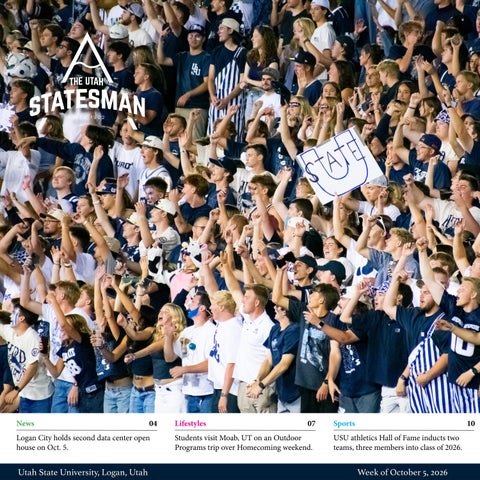
Cover art by Elise Bliss Letters can be hand-delivered or mailed to the USU Student Media office in TSC 118. They can also be emailed to editor@usustatesman.com.
Kendy Plant is an undergraduate psychology student. In her free time, she enjoys thrifting tiny trinkets, making cute crafts and, of course, writing. — kennedy.plant@usu.edu
Published and distributed by USU Student Media 0165 Old Main Hill Logan, UT 84322
For advertising inquiries TSC 118 435.797.1775 studentmedia@usu.edu
Page 4 - The Utah Statesman, October 5, 202
Logan to hold second data center open house
By Dylan Moore STATESMAN SENIOR REPORTER
L
ogan City will hold a second data center open house on Oct. 5 at 6 p.m. in the City Hall conference room, giving residents a chance to review draft zoning language before it moves toward formal adoption. The event follows an Aug. 4 open house that drew nearly 100 residents, most of whom voiced opposition to data centers, according to city officials. The Logan Municipal Council voted unanimously June 30 to impose a 180-day moratorium on data center development, set to expire Dec. 30, giving city staff time to draft regulations before any project is formally proposed. City Council member Melissa Dahle said the draft ordinance divides data centers into three categories: small operations embedded within an existing business that most residents wouldn’t notice, standalone data centers capped at roughly 100,000 square feet and eight acres with specific regulations attached, and large, hyperscale data centers, which would not be allowed within city limits at all. “We’re hoping to get some things in place before we get approached by data centers,” Dahle said. Russ Holley, Logan’s director of community development, said the regulations have involved several city departments, including planning and zoning, light and power, and public works. Once finalized, the draft must go through a public hearing before the planning commission and two city council meetings, one workshop and one action item before a vote. Adoption requires at least three council votes. Holley said the first open house, while emotionally charged, remained largely civil. “I would not say it was hostile,” Holley said. “There were a few shouts at the beginning, but it was not hostile. I would expect a similar type of atmosphere.” Dahle described the mood in blunter terms, saying some attendees arrived ready to reject data centers outright. “It was the pitchforks and daggers,” Dahle said, adding that a small number of attendees voiced support, noting that most businesses rely on some form of data storage. A team of Utah State University researchers plans to attend the Oct. 5 open house to share findings from a statewide survey on data center attitudes and collect additional feedback through a poster board and QR code. Gina Gilson, an assistant professor in the Department of Environment and Society, said the researchers see themselves as an additional resource for residents at an event designed to be informal rather than adversarial. “We just saw an opportunity as people who do research and social scientists, who think a lot about community engagement, to help provide just a little bit more capacity for the city council,” Gilson said. The survey, conducted in August through Utah State’s Community and Natural Resources Institute,
GRAPHIC CREATED BY KAMRIN MCNEILL
found that 75.8% of nearly 900 Utah adults surveyed statewide oppose or strongly oppose new or additional data center development, with opposition increasing the closer a proposed project is to a respondent’s home. Water use, energy use and the ability to participate in local decisions ranked among residents’ top concerns, according to the survey’s executive summary. Stacia Ryder, an assistant professor in the School of Social Sciences, said outright bans carry legal risks that more detailed regulations can help avoid. “If you do implement bans, it can create a lot of expensive lawsuits that the taxpayers are then on the hook for,” Ryder said. Jessica Schad, a professor and director of Utah State’s Community and Natural Resources Institute who oversaw the survey, said the data could help city leaders identify concerns not yet addressed in the draft ordinance. “It might just help surface some unrecognized
concerns that they might not otherwise be able to super easily see,” Schad said. The City Hall conference room is located at 290 N. 100 W. in Logan. City officials have said no data center has formally proposed a project in Logan, and there are currently no commercial data centers operating in Cache County.
Dylan is a senior majoring in political science. You can usually find him on some sort of outdoor adventure. — dylan.moore@usu.edu
By Jen Cefalo STATESMAN REPORTER
U
tah State University’s annual A Day of Giving was on Sept. 24. A Day of Giving is 24 hours in which students, alums, staff and fans come together to donate to USU, typically with a particular focus in mind. The focus of the 2026 A Day of Giving was on student scholarships, according to USU’s A Day of Giving webpage. The donation page for A Day of Giving states a goal of 1,000 donors. By the end of the campaign, they had reached 521 donors, or 52% of the stated goal. From those 521 donors, $730,528 was donated, which was several thousand more dollars than last year’s A Day of Giving that raised $405,116. Each donor was able to choose an area of impact to donate to, including Colleges, Statewide Campuses, Athletics, Student Success or Community. The A Day of Giving donation page shows the athletics impact area received the most donations at 232 donors and $603,215 donated, with colleges coming in second at 148 donors and $68,759 donated. Each impact area had additional impact areas for donors to further decide where their donation would be applied. The sub-area that received the most was the Big Blue Excellence Fund under the Athletics impact area, raising $590,511 to help fund the athletic programs at Utah State. Another sub-area that received many donations, surpassing their goal by 40%, was the SNAC Pantry under the Community impact area, which received a total of $10,925 to help provide students with access to food. Also under Community, the Nora Eccles Harrison Museum of Art received 108% of their goal at $9,715, which will support the purchase of a new truck to accommodate more students and fund more art education. USU associate director of annual giving Alana Haupert wrote in an email to The Utah Statesman how she felt the community response was for the 2026 A Day of Giving.
PHOTOS BY Lola Probasco Individuals gathered outside the TSC had snacks and learned about A Day of Giving on Sept. 24.
Student Alumni Association members collect donations for A Day of Giving outside the TSC on Sept. 24.
“This A Day of Giving had a great response from our community. With 40-plus areas to support around campus, we are incredibly grateful for our donors’ participation and support,” Haupert wrote. “Together, 521 donors contributed $730,528 in support of Utah State University, making a meaningful investment in our students and campus community. Donor’s funds directly support student scholarships, experiences, and allow students to have a positive college experience at Utah State. As a former USU student who benefited from donor support, I know firsthand how meaningful these gifts can be and how they can assist a student’s experience. Any funding we receive will directly impact the community where students learn, grow, and create life-long relationships. We are incredibly grateful to be able to support the Aggie experience and the Utah State community.” A current USU senior, Alta Stott, shared how she felt about A Day of Giving being focused on scholarships. “I think it could be beneficial,” Stott said. “We are all broke college students, and we love a scholarship because it’s free money, but if we are asking students to donate their own money, I don’t know, it sounds counterintuitive, but it could be beneficial if every student donates $5. We could have a really big scholarship we could share between ourselves and be able to fund our college education.” Haupert was asked more about the scholarships and if there were specific scholarships connected to A Day of Giving that students should be looking for. “A Day of Giving’s general objective is to fund as many student scholarships as possible,” Haupert wrote in the email. “There are many opportunities from every college, statewide campus, and many community groups for students to look for scholarships to support their college experience. One example is the student
emergency hardship fund, which can support students in any major who are experiencing life-changing situations that could threaten their education.” Stott was asked if she had noticed an impact from A Day of Giving in previous years. “Some of my friends have talked about it,” Stott said. “They went because their class requires service hours, so I think that it is a great way for students to get involved in service in the community.” This focus on serving others is reinforced at USU through the 1888 challenge, which was promoted during the weeks leading up to A Day of Giving. The 1888 Challenge is for graduating seniors to donate $18.88 in exchange for a philanthropy cord that can be worn at commencement. The 1888 Challenge is still ongoing and open to any graduating seniors who would like to donate. The donations directly support Aggie First Scholars, Counseling and Prevention Services or the Emergency Hardship Fund. More information and opportunities to donate to Utah State University are available at usu.edu/advancement/ howtogive. While these donations are not added to the $730,528 A Day of Giving total, any donation will still help students in need. Jen Cefalo is a junior studying kinesiology with an emphasis in exercise science. One of her favorite hobbies is watching Formula 1 races on the weekends. — a02356860@aggies.usu.edu
Page 5 - The Utah Statesman, October 5, 2026
A Day of Giving raises $730,528 this year
Page 6 - The Utah Statesman, October 5, 202
Students trade campus for Moab adventure By Jillian Peterson STATESMAN SENIOR REPORTER
W
hile other Utah State University students celebrated Homecoming weekend in Logan, some students piled into a Suburban and headed southeast to explore Moab on a trip led by Campus Recreation. The group, which included seven participants and three trip leaders, rafted down the Colorado River, splashed in the mud and hiked among the red-rock formations of Arches National Park. “It was just beautiful,” said Cooper Linderfelt, a Utah State senior and Outdoor Programs student trip leader. “There was gorgeous scenery the whole time.” Linderfelt said an unexpected highlight of the trip was camping under the harvest moon on Saturday night. “The moon was incredible,” Linderfelt said. “When it came up over the horizon, you couldn’t put your hand up at a full arm’s length and block the moon. It was just huge.” At the campsite, Linderfelt said light pollution was minimal, allowing the campers to see the night sky in a way that isn’t possible in Logan. “It’s just really incredible to be able to see the Milky Way and the stars,” said Illa Ranjan, a trip leader and Utah State junior. The students hiked to Delicate Arch at night, and on the way, Linderfelt said they saw many frogs. “I really didn’t expect to see frogs in the desert, but I think they came out because it had just rained,” Linderfelt said. In the daytime, Linderfelt said the campers enjoyed spending time on the Colorado River using rafts and kayaks.
PHOTO SUBMITTED BY COOPER LINDERFELT A Great Basin spadefoot toad on the Delicate Arch hike.
Allison Fulmer, right, and fellow participants on the Moab Daily stretch of the Colorado River.
“We were all goofing around, throwing each other in, shooting each other with squirt guns and racing each other on boats,” Linderfelt said. Linderfelt said the fun wasn’t limited to the water, as students also enjoyed splashing in the mud. “We got to play in the mud, which may not sound very appealing, but this mud was like the perfect consistency to play in,” Linderfelt said. “You could throw it, you could jump in it — it was just perfect.” According to Ranjan, trips like this can be beneficial to college students’ mental health. “I think that everyone needs a break every once in a while,” Ranjan said. “Being in a college environment can be really hard for a lot of people. Getting out and moving your body and using your brain in a new way can be really nice.” Campus Recreation plans to host several more outings this academic year, including backpacking, mountain biking, canoeing and backcountry skiing trips. The trip to Moab cost students $150 each, which Ranjan said is reasonable for a weekend trip. “It’s a lot less expensive than it would be if you were going to go on a personal trip,” Ranjan said. “When you come on a trip with us, we provide transportation and food and all the camping stuff.” According to Ranjan, students of all skill levels are
PHOTO SUBMITTED BY ILLA RANJAN
invited to participate. “The trips are set up so that people who have never had access to this kind of outdoor activity are set up for success,” Ranjan said. “All you have to do is show up, bring clothes and a water bottle, and we’ll show you how to do everything.” For more information, students can visit usu.edu/ campusrec/ or @usucampusrec on Instagram.
Jillian Peterson is a junior studying journalism. She is a big fan of concerts, snowboarding and the Taco Bell drive-thru. — jillian.peterson@usu.edu
By Wyatt Cano STATESMAN REPORTER
A
rtificial intelligence has become a major topic of discussion among university students as the technology continues to develop and expand into education and the workplace. On Sept. 23, USUSA Dialogues Society organized an AI panel for students to attend and learn more about the rapidly developing technology. The panel, which included professors and department heads, addressed questions about the costs of AI, the future of certain majors and the impacts AI could have, along with case studies of AI’s influence across the nation and at Utah State University. Before the panel began, students ate food and talked with other students and invited professors. During the event, Sam Martin, a mechanical engineering student, shared his thoughts on AI’s potential effect on his field.
their majors. Kiley Nixon, a public relations student who also has a small business as a nail technician, said AI has already become useful to her. “I’m in PR, but I’m doing this major for my small business,” Nixon said. “I feel like AI helps small businesses grow as a tool that can do it all. It can help with ads or even with post ideas.” The student-led discussions also turned toward how USU could use AI in the future. Both Nixon and Martin agreed that the university will implement AI in some form for students and staff to use, although they had different reasons for why. Martin said he believes the university will eventually adapt AI as a tool. “I think they will adapt and use it as a tool, but I know the university won’t let us use it to skip work and cheat the system,” Martin said, “but they will find ways to make it a helpful tool.” Nixon pointed to the growing uses of AI in education. “I think USU will embrace AI because of the growing trend of uses that AI is providing for us as students and teachers,” Nixon said. After an hour with the panel’s professors, many students resonated with the proposed AI center situation in Box Elder County that was discussed by professors Robert Davies and Jeannie Johnson. Even during the break, students continued talking about their worries and opinions about the technology’s effects on the environment. As students continued their conversations, one idea came up repeatedly: AI is here to stay and has the potential to become a useful tool.
Endless hours of curating music to make listeners dance. DJ Jaeden is so happy to be here, and happy to be sharing this with you. Tune in to The Collector’s Edition on Tuesdays at 4 p.m. on Aggie Radio 92.3 FM!
Southern Freeez Freeez
Strauborg/St. Denis Roy Hargrove
LOOK OUT FOR ME Turnstile
Need Something More Thee Heart Tones PHOTO BY Dane Johnson A banner for the Data Science and Artificial Intelligence Center is seen outside the office of Kevin Moon, director of the center in the Ray B. West Building.
“I think it will have a big impact because of how helpful it can be as a tool,” Martin said. “It can never replace a human, but I think it will leave people without jobs if they refuse to adapt to work with AI in my field.” Other students revealed different views on how AI could help or hurt them, both personally and within
Wyatt Cano is a freshman studying public health and premed. He loves video games, the outdoors and playing saxophone. — wyatt.cano@usu.edu
If You Want It Niteflyte
Page 7 - The Utah Statesman, October 5, 2026
Panel discusses the possible effects of AI in career fields
Page 8 - The Utah Statesman, October 5, 202
The Creative Reset gives students a space to create and recharge By Cambria Thurgood STATESMAN REPORTER
A
new art-making opportunity has made its way onto Utah State University’s Logan campus for students, faculty and the community. In the Wanless Center for Art Education and Research building, the Nora Eccles Harrison Museum of Art has set aside time for The Creative Reset: A Weekly Art Break at NEHMA every Friday from 11 a.m. to 2 p.m. “On Friday, as your week’s been kind of busy and you’re starting to look forward to the weekend but you’ve still got to be on campus, you have this chance to pop in and just reset and have a minute to yourself,” said Chiara Sorensen, the coordinator of visitor and event services at NEHMA.
The Creative Reset participants creating zines.
PHOTOS BY Cambria Thurgood
The Creative Reset program is a continuation of the Creating Wellness workshop the museum had been running for four years. With more space now available, Sorensen said they wanted to bring the program into the new space. “With the Wanless Center for our education and research being open now, we really wanted to find ways to activate that space and have students, faculty and staff on campus see it as a resource and as an interesting place to visit on campus,” Sorensen said. According to Sorensen, there have been studies that show the benefits of creating art, and they wanted this program to reflect those studies and help students throughout the school year. “The idea comes from the fact that, like research shows, art making or looking at art has significant psychological benefits,” Sorensen said. Susie Andruk graduated from Utah State in 1973 and began her career as an art teacher for elementary and junior high students before learning about art therapy when she noticed a child draw a concerning picture in one of her classes.
“That led me to learn that there was such a thing as art therapy and how when we can’t talk about something or we can’t tell about something, we can certainly make artwork about it,” Andruk said. “You can talk about the art, and it makes it easier to get difficult things across.” Andruk said the idea of calling the event a reset is for students to see it as a resource to de-stress. “The whole idea of calling it a reset is because sometimes, especially as a student, you get stressed out and need a way to express yourself and to relax and take your time to soak in the creative process,” Andruk said. She has been at each Friday event since the beginning of the program. Her last Friday was on Oct. 2. The program will continue to run with the help of Julia Messick. “I’ll be here every Friday just to talk to people and help them feel comfortable and also find a way to express themselves in different ways,” Messick said. Messick works at NEHMA and is part of the education staff. She is also in charge of running the creative reset program. She said she finds this event to not only be a place to de-stress but also to meet new people. “I think it’s a great way for people to come and talk to other people that maybe they wouldn’t see in their classes or around campus,” Messick said. “It’s also a great way to enjoy the community and other people while also being able to craft and have fun.” The craft program is emphasizing is making zines. Tabatha Pettit, a senior studying art history and the treasurer of the Art History Club, said a zine can be anything. “It can be any of those things, or none of those things. You can just make it whatever you want,” said Meg Jeppson, a senior studying art history and the president of the Art History Club. There are different kinds of zines, and Andruk said they are emphasizing the idea of the personal zine, or perzine. “We’re using the idea of making a perzine about the journey you’re on, or about your beliefs, or about resilience and encouraging positive self-thoughts and things that you’re conquering or goals you’re working on or struggles you’re working on,” Andruk said. Rose Nuffer, a senior studying mechanical engineering, has been going to NEHMA’s Creating Wellness events since the program began four years ago. They said they enjoy coming to the creative reset event and having a dedicated space for art. “In the mechanical engineering program, there aren’t necessarily a lot of creative outlets, and it can be very stressful,” Nuffer said. “It’s nice to have a place where I can come and have a dedicated time and space for creative expression.”
The Creative Reset in the Wanless Center for Art Education and Research.
Pettit said this event is a great place to relax and recharge. “This is such a nice event because it’s not draining. You don’t have to come and expend your social battery,” Pettit said. “It really is just a place where you can come and use this beautiful space and use all of these supplies and really just recharge for the rest of your day or for the next week.”
Cambria is from West Point, Utah. This is her third year at Utah State. She is double majoring in journalism and communications. She loves camping and snowboarding. — cambria.thurgood@usu.edu
By Rory McNeill STATESMAN SENIOR REPORTER
I
n preparation for the upcoming Women’s Basketball season, Utah State University’s Women’s Basketball held its media day to allow fans to get a preview of what this upcoming season will look like. The media day also allowed the media to meet the new players and coaches for the 2026-27 season. USU Women’s Basketball has not had a winning season since 2018, and has not won more than 10 games since 2021. Entering his third year as head coach, Wesley Brooks is optimistic that change will come this season. “We’re really excited about our group, really excited about the talent that we have. As I said at the end of last year, our culture has been established. I believe in what we’re doing. Our players, in return, believe in what we’re doing,” Brooks said. “We have enough depth to compete in the Pac-12, and we’re going to go and just be better one day at a time, and we really like our group and really like where we’re headed.” Brooks also believes this year’s roster is the most talented roster that USU has fielded during his time as coach. This year’s transfer class includes four players who are coming from Power Five conferences. “You have people who play at a high level and who’ve established themselves. I think with this roster in particular, we had five P5 players. Utah State’s never had five P5 players. I mean, you go look back at the rosters the last 10, 15 years. It’s never been that many people from a P5,”
Garlic Croutons
Brooks said. “I just think we have people who’ve been through it, and they know what it takes, and they just — they’re accomplished in their own right. Now we just have to mesh the team together, and once we do that and we work it one day at a time and we bring back what we have returning, I think I think we can have a really good year.” Some of these important transfer players include guard Lisa Thompson, who played at both Rutgers University and the University of Missouri. Acacia Hayes, who won Conference USA All-Freshman honors while at Western Kentucky University, played with Arizona State University last year. Center Sami Mancini transferred from Providence College, and center Danika Galea transferred from the University of Arkansas. The team feels this level of experience will help them develop together and lead to a successful season. “When you have a lot of experience on the team, and then when you have a lot of inexperience, it kind of balances out. So you have the experience, which helps the girls, the younger girls, and you can bring them in, and you help them,” Hayes said. “I think just being in tough games, we have a tough schedule, and we’re in a new conference, and I think the girls with experience, we kind of already know how that is, and so I think that will help with the other girls on the team.” The Aggies non-conference schedule will feature some of the biggest names in women’s college basketball, such as the University of Southern California and Texas Christian University. According to Brookes, these games not only
SNAC at Campus Events
Ingredients: 4 slices stale bread 2 Tbsp oil 1 minced garlic clove (can substitute with garlic powder) Salt and pepper, to taste
Note: If using an air fryer, reduce temperature to 325 and check at ten minutes for doneness. America’s Test Kitchen, The Complete Cooking for Two Cookbook: 650 Recipes for Everything You’ll Ever Want to Make. America’s Test Kitchen: 2014
Rory McNeill is a junior from Rocklin, California studying mechanical engineering. — rory.mcneill@usu.edu
SNAChampion- Bussin Bread This week’s SNAChampion is Bussin Bread- Alaskan Sourdough! Located in North Logan, Bussin Bread has been donating their baked goods to SNAC daily. We appreciate all they do to fill SNAC’s shelves and help us prevent food waste in Cache Valley! Be sure to check them out in town and at SNAC!
Find most of these ingredients at SNAC!
Instructions: Heat oven to 350. Cut the bread into ½ inch pieces. In a bowl, mix together the cubed bread, oil, and seasonings. Spread onto a baking sheet and bake until golden brown and crispy, about 15-20 minutes. Flip halfway through.
give the team an early test, but they help to strengthen the team’s image around the country. “In the words of Ric Flair, if you want ‘to be a man, you got to beat the man,’ so that’s exactly what we want to play. Obviously, they’re challenging. You know, one thing you can hear me say, talk about, is, ‘Can we play to our identity?’ We want to play to our identity, so it’s about being the best version of ourselves every night, no matter who we play,” Brooks said. “For some people it’s a stress test. Some people are going to put more stress on you than others. For us to get to where we want to go, we need to be able to see where we are. They’re measuring stick games. How far are we away? What else do we need to do? Do we need to change something? Do we need to adjust something? Who can we put in those situations?”
SNAC has had a lot of fun participating in USU’s beginning-of-semester events, including Connections and Weeks of Welcome passport activities, Day on the Quad, the Homecoming Parade, and lots of events for QANR week! We’re excited to participate in more. Be sure to look for SNAC at a variety of campus events throughout the semester! For more information about SNAC visit our website snac.usu.edu or @ususnac on Facebook and Instagram
Page 9 - The Utah Statesman, October 5, 2026
2026 Women’s Basketball season at a glance
Page 10 - The Utah Statesman, October 5, 202
Utah State athletics inducts three members, two teams into Hall of Fame class of 2026
By Quinton Papa STATESMAN REPORTER
U
tah State University Athletics recently inducted three new members and two football teams into the Utah State Hall of Fame. Jennifer Schlott, the 1960 and 1961 football teams, Chari Hawkins and Reid Newey were inducted at the ceremony on Sept. 25. The event began with current USU athletics Hall of Fame members parading into the USU fight song, “Hail the Utah Aggies.” After a brief introduction, the 2026 inductees entered to “The Scotsman.” Schlott, a USU Women’s Basketball player from 20112014, was introduced first. Schlott was named Mountain West Women’s Basketball Player of the Year as a senior in 2014, the same year she earned Associated Press Honorable Mention All-American honors for. She’s the only women’s basketball player in USU program history to receive either honor. Schlott still holds USU’s record in total points at 1,566 and free throws made at 401. “I was truly shocked, grateful and felt like it was such a special thing to be a part of,” said Schlott on being inducted into the Hall of Fame. Schlott also reminisced about what influenced her decision to play at Utah State. “When I came on my visit to USU, I loved the college town feel,” Schlott said. “I loved the outdoors and hiking and being in nature.” She also talked about her favorite parts of being a studentathlete. “Truly what I think of the most is just hanging out with my teammates and other student-athletes, all the fun times we
PHOTOS BY Owen Clarke Roger Foulk, center, accepts the Hall of Fame award on behalf of the 1960 USU football team. USU Vice President & Director of Athletics Cameron Walker, left, and USU President Brad L. Mortensen, right, pose with Foulk for a photo on Sept. 25.
had doing that,” Schlott said. The next inductees were the 1960 football team, represented by Roger Foulk. At the time, the team set the school record for wins at 9-2, tied for first in the Skyline Conference. They averaged 26.1 points per game and held opponents to just 6.5 points during the regular season. They still hold the school record for average rushing yards per game at 312. The team was ranked twice at No. 18 and No. 19, according to USU athletics. Cameron Walker, left, Terry Cagaanan representing the 1961 football team, Roger Foulk representing the 1960 football “Long time overdue and well team, Chari Hawkins, Reid Newey and Brad L. Mortensen at the USU Athletics Hall of Fame induction on Sept. 25. deserved,” Foulk said on the Hawkins said. “The thing that’s really cool about taking in team earning the award. Foulk attributed much of their success to the coaching staff. those experiences not as failures but as learning experiences “We were really fortunate in that little era to have this new is you get a little bit better every single time.” She also talked about how Utah State gave her the coach come in with his techniques and his personality, and foundation to stand on for the rest of her career. with his assistant coach Tony Knap, who was a defensive “My time at Utah State was so special,” Hawkins said. “The specialist, managed to get a bunch of young men to become a notable force in the nation in sports and in football,” Foulk people that are some of the most important people in my life are people I met here, and the culture helped raise me said. into who I am today.” Similar was the 1961 football team, represented by Terry The final inductee was Newey, a Men’s Basketball player Cagaanan. They ranked first in the nation at an average of 38.7 points per game, which was a school record until 2018. in 1984 and 1987-1989. He is the 13th highest scorer in program history, ranking fourth in school history in threeCagaanan honored those who had passed away before point field goals made at 237. being able to accept the honor. “I was overwhelmed with gratitude, really, and just “They were good people,” Cagaanan said. “They made thankful,” Newey said on being inducted. me feel comfortable when I got to Logan. I’d never been in Utah State University President Brad L. Mortensen closed snow before.” the meeting by talking about the changes in athletics over The team finished the season ranked No. 10 in the nation in both the Associated Press and UPI polls. Two Aggies were time. “It’s no secret that college athletics have changed, even first-round picks in the NFL Draft, with at least seven from since Chari was competing,” Mortensen said, “but these are the team going on to careers in the NFL. the values and type of people that we want to see from our Fourth to be introduced was Hawkins, USU Track and athletics programs.” Field athlete from 2010-2015, five time All-American, 2024 Olympian and heptathlete. She earned 24 All-Conference honors across the Western Athletic Conference and the Mountain West Conference. She was a WAC champion, a MW champion, two-time MW Female Athlete of the Year and received the NCAA Student-Athlete Sportsmanship Award. She still holds school records in the 60-meter hurdles, indoor high jump, outdoor high jump, pentathlon and heptathlon. After her collegiate career, she represented Team USA in eight different national, world, and Olympic teams. “I love Utah State,” Hawkins said. “It’s where I started my Quinton is a senior studying communication studies journey as a heptathlete, and so to be inducted in the Hall of from Springfield, Missouri. He loves writing music, offFame — it’s such an honor.” roading and being an Aggie. Hawkins talked about how her failures led her to where she is now. — quinton.papa@usu.edu “There were so many times in my career that I had done such a good job, and then I had kind of ultimately faltered,”
Page 11 - The Utah Statesman, October 5, 2026
Trash Car Racing gets muddy
Ezra Robertson in a photography major in his junior year at USU. When he isn’t shooting, he’s spends his time going to local shows and listening to music. Trash Car Racing fans convene at the Cache County Fairgrounds to watch competitors race in the mud. Racers travel from all over Cache County and Box Elder County to test their builds against each other. Many racers are on the track for the first time, including Ryan Evans, whose boss introduced him to the community this year.
— ezra.robertson@usu.edu
Page 12 - The Utah Statesman, October 5, 202
Campus Cup kicks off at Utah universities
H
ey Aggies! Are you registered to vote? This year, USU will be competing in Utah Lieutenant Governor Deidre Henderson’s Campus Cup! With the help of the Government Relations Council (GRC) and the Lieutenant Governor’s Office, we’ll be competing with other universities throughout the state to get more students civically engaged with their communities. UVU narrowly won the last Campus Cup, so this year we have to show them what it really means to be an Aggie. Prizes include the Campus Cup trophy, bragging rights, and a meeting with Lieutenant Governor Henderson. USU can earn points each time a student registers to vote or attends an event put on by the Government Relations Council. Voter registration is worth double the points until the last day to register to vote, which is October 23rd. If you register after this date, you will only be allowed to vote provisionally at the polls. Election Day is on November 3rd. You can register online on the Utah Voter Index website. Out-of-state students can still earn points for USU by registering to vote in their home state; simply send a
photo or screenshot proof of your voter registration status to @usugrc on Instagram. As an addition to the usual Campus Cup, there will be an Expedition Vote starting October 1st. Reach out to GRC to create a team and complete activities that earn points for both your team and the university. The team that earns the most points will win an additional 250 points for the university. The top team from each university will get a prize along with a grand prize for the top team in the state! We can also earn more points by partnering with other organizations on campus! If your organization is interested in getting Aggies registered to vote, send us a DM at @usugrc. We would love to partner with you and get students more civically engaged. If you’re curious about how votes are counted, pay a visit to the County Clerk! You can schedule a visit on their website and earn even more points towards the Campus Cup by sending proof of your visit to GRC. They also host events for the upcoming election, so keep an eye out for those. To vote, there are official ballot dropboxes located
throughout Cache County (including one in the TSC). The dropboxes will close at 8pm on November 3rd. Election Day voting will be held at the Cache Event Center at the Fairgrounds, 490 S 500 W, on November 3rd from 7 a.m. to 8 p.m. Aggie Vote Week will start on October 14th, so look out for upcoming events including a trivia night, Snacktivities, and more.
Carissa Jameson is a member of the Government Relations Council. She is also on the Institute of Government and Politics Student Advisory Board and recently completed internships with the Utah State Legislature and Sandy City Mayor’s Office.
O
n Wednesday, Sept. 30, a nearly sold-out audience gathered at the Emma Eccles Theatre for the premiere of Ocean in Concert with David Attenborough, presented and conducted by USU professor Ghyas Zeidieh and the Cache Symphony Orchestra. With a score composed by Steven Price and performed live by the orchestra, audiences watched in amazement as Attenborough’s exploration of the world’s oceans came to life on screen and on stage. Hope in the face of climate disaster Immediately upon entering the Emma Eccles Theatre I was struck with a sense of beauty. The theatre itself is stunning with intricate molding and tilework. This feeling continued the whole night as the music, cinematography, and messaging of Ocean in Concert left me awestruck. As the orchestra tunes, I can see the shadow of the conductor on the theatre walls as he prepares to lead a beautiful piece of music. The Cache Symphony Orchestra is composed of USU students and Cache Valley community members. I could feel the pride and joy members of the orchestra had for the piece they were performing. In a brief speech before the film, Ziedieh said, “My hobby is my full time job.” His pride and excitement in his work could be felt throughout the performance. The performance was a seamless blend between the symphony and the film. The orchestra included five vocalists whose singing elevated the whole piece and sent chills down my spine. At one point a wave crashed against a beach and I thought to myself, “How is the orchestra creating that sound?” It was not the orchestra, it was the film. That is how in tune Ocean and the music were. It allowed me to get lost in the music and movie. Ocean with David Attenborough focused on how humans and the ocean are connected. This was highlighted not just in the film but in the theatre also. The Emma Eccles Theatre is cooled using canal water. Myself and the rest of the audience were experiencing the exact connection between humans and water the film was themed around. Narrator Attenborough shares stories from his 100 years of life about how the ocean and humans have interacted. Many communities rely on the sea, from families who fish in Liberia to scallop divers in Britain and lobster farmers off the coast of California. Humans are dependent on the ocean and all it provides. — Sophie Anderson David Attenborough: Keepin’ it 100 years old As many diehard fans of nature documentaries such as myself would agree, David Attenborough is seemingly one of the last of the Jane Goodalls and Steve Irwins of our world — passion for nature so infectious you can actually feel it through technology. Ocean in Concert is a
PHOTO SUBMITTED BY SOPHIE ANDERSON AND MAX MURRAY Sophie Anderson, left, and Max Murray, right, pose for a photo at the Ellen Eccles Theatre after attending the Ocean in Concert event.
beautiful testament to the devastating impact overfishing and climate change have had on the environment from the smallest to largest scales and brings back true passion for nature and wildlife. What truly made this experience incredible was the live orchestra. It’s easy to take film scores for granted, especially in a nature documentary, but the orchestra provides an incredibly interactive element, bringing each scene to life. I found my eyes darting back and forth at times between the schools of fish on screen and the school of talented musicians on stage before us, as both were mesmerizing. While many ocean documentaries provide familiar information you could easily find in books or online, Ocean with David Attenborough provides multiple groundbreaking discoveries and reminds us that discoveries are ongoing. There were enough fascinating first looks that this documentary felt much more informative and investigative than your average watch. — Max Murray
Sophie Anderson is a junior studying social studies education and is programming manager for Aggie Radio 92.3 FM. Max Murray is a senior studying communications at and general manager of Aggie Radio 92.3 FM. — sophie.anderson@usu.edu — max.murray@usu.edu
Page 13 - The Utah Statesman, October 5, 2026
Review: Ocean in Concert makes a splash
Page 14 - The Utah Statesman, October 5, 202
For Reading Us
Last week’s solution:
Sudoku puzzles are provided by www.sudokuoftheday. com.
GRAPHICS COURTESY OF NATIONAL NEWSPAPER WEEK
Page 15 - The Utah Statesman, October 5, 2026
WE THANK YOU...
Photo by Elise Bliss
Page 16 - The Utah Statesman, October 5, 202