

Lifestyles
Students share their thoughts about the proposed data center in Box Elder county.
The Cache Valley Gardeners’ Market returns for its 41st year.
Sports
The women’s volleyball club transforms itself into a national powerhouse.
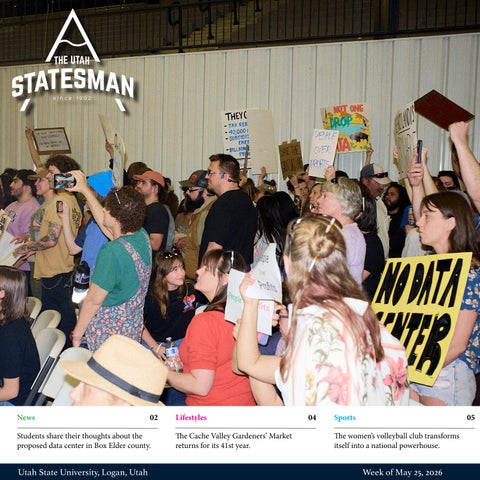
Students share their thoughts about the proposed data center in Box Elder county.
The Cache Valley Gardeners’ Market returns for its 41st year.
The women’s volleyball club transforms itself into a national powerhouse.
By Jayke Martin STATESMAN EDITOR
Aproposed data center development in Box Elder County is drawing concern from some Utah State University students and researchers who say the project raises questions about water use, energy demand and environmental impacts.
The proposed project, referred to as the Stratos Project, would span roughly 40,000 acres in Box Elder County and support artificial intelligence and cloud computing infrastructure. The development has received statewide attention because of its proposed scale and projected energy demands.
Students at Utah State University say they have noticed increasing controversy surrounding the proposed development both online and in conversations on campus.
“I think just in general we’ve seen a lot of discourse and polarizing opinions with data centers and AI use,” recent Utah State graduate Courtney Williams said, “and now being so close to it would increase them.”
Another student, Kinsley Sorensen, said she believes the project could deepen tensions among students.
“I just think it’s contributing to increased polarization and conflict on a Utah State University campus in general,” Sorensen said. “I can’t even imagine what sorts of debates this will spark on campus and the general controversy.”
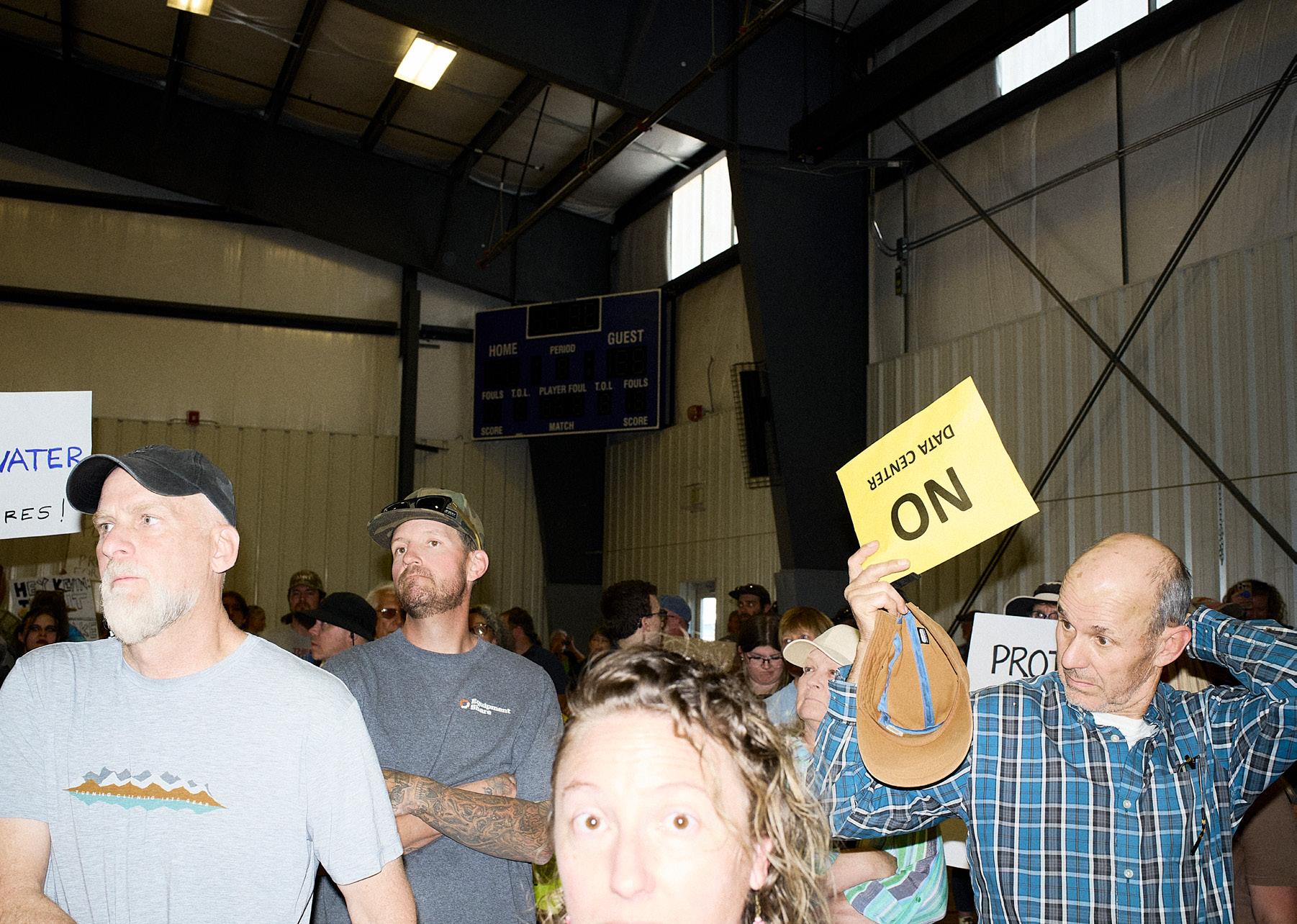
The proposed development has generated public backlash in Box Elder County, where residents and environmental advocates have raised concerns about water use, fossil fuel consumption and long-term environmental effects. Supporters of the project, including state leaders and developers, say it could bring jobs and economic development to northern Utah. For many students, however, the conversation centers on environmental sustainability and the long-term effects of a project of this size.
“The level of the Great Salt Lake ebbs and flows every decade or so, but never to the degree it has been right now,” Sorensen said. “I don’t think it would be to that degree if this proposed data center is actually put in place.”
Williams said she is skeptical of claims that the project could operate without significant environmental impacts.
“We live in a desert,” Williams said. “I think we’ll see more droughts and dryness, and everybody’s going to feel the effects of increased power use.”
Concerns about water use are also being echoed by researchers at USU.
David Tarboton, a USU water resources engineering professor, said concerns about water use are reasonable given the project’s location within the Great Salt Lake watershed and uncertainty surrounding how much water it would require.
“The water that they use would otherwise drain into
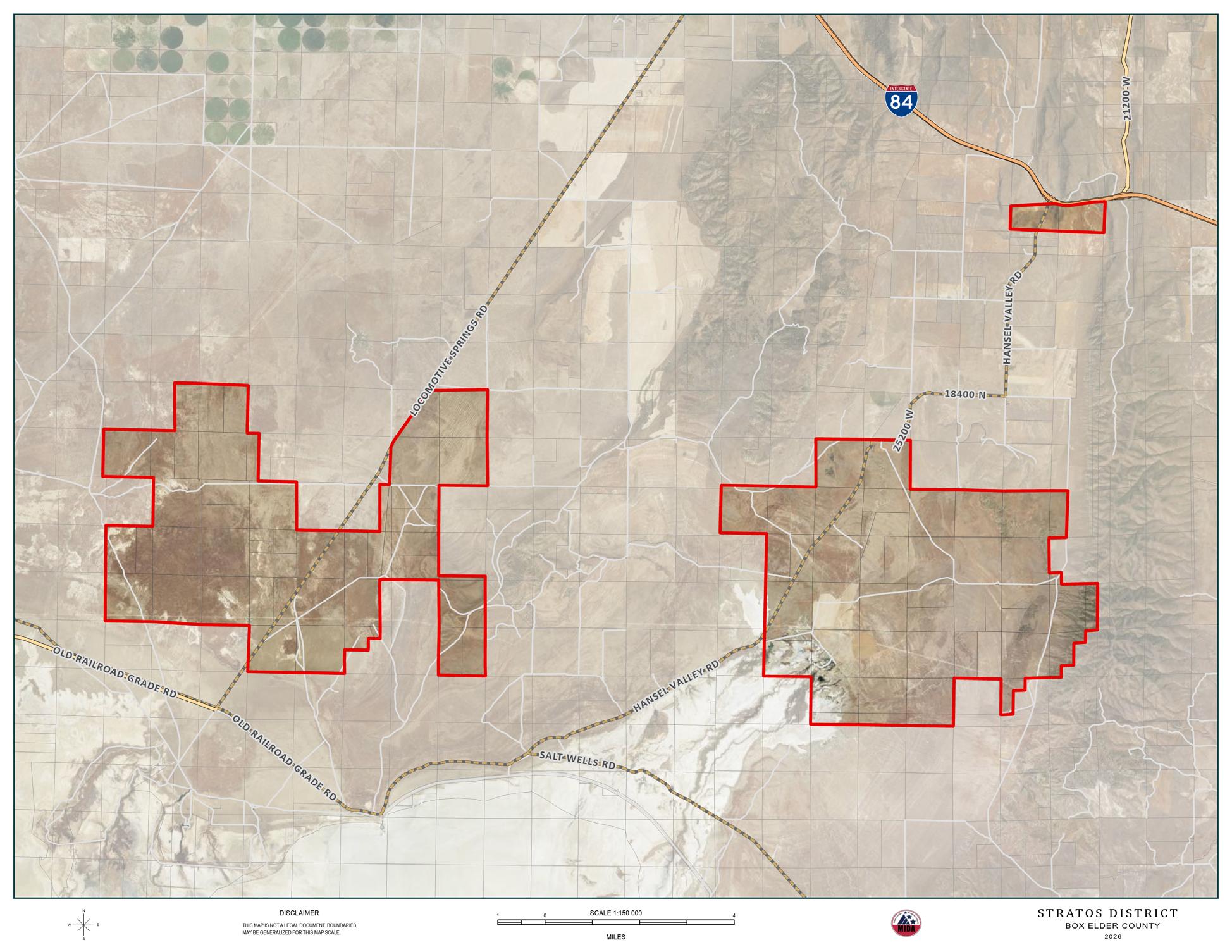
Project area map shows where data center will be built in Box Elder County.
the Great Salt Lake, so there could be an impact on the Great Salt Lake,” Tarboton said.
Tarboton said one of his first reactions to the proposal was concern about its scale and the lack of publicly available technical details about its design and resource needs.
“There should be more information and more transparency on the water impacts,” Tarboton said. “How much water would it actually use?”
He also said many Utah residents may not fully understand how closely connected local water systems are to the health of the Great Salt Lake, which has reached historically low levels in recent years amid ongoing drought and increased demand.
Students expressed frustration with the public approval process surrounding the project. Williams said she felt community concerns were not fully reflected in discussions about the proposal and how input was considered.
“When they did talk about it in their council meeting and viewers were invited to come, people were really vocal about not wanting it there,” Williams said, “which maybe doesn’t reflect the opinions of everybody, which
is fine, but it’s definitely a population that’s there and should be heard and listened to.”
As debate continues across Utah, students at USU say the proposal has become more than a conversation about technology infrastructure. For many, it reflects broader concerns about growth, environmental sustainability and the future of communities in northern Utah.

Martin is a junior studying journalism with a minor in theater. She loves reading and meeting new people.
By Emma Shelite STATESMAN REPORTER
Track and field athletes Garrett Woodhouse and Shelby Jensen, the Utah State University steeplechasing duo who recently announced their engagement on April 14, are now preparing for a walk down the aisle this August.
The couple’s journey from training partners to life partners began long before they shared their first conversation. Woodhouse, a junior from Virginia, said that the “meddling” of teammates and coaches acted as the initial catalyst for their romance.
“We were on the team for a while together,” Woodhouse said. “People start meddling around. … My cousin Anna’s starting to talk to both of us, and she’s lying to me, saying, ‘Shelby’s so interested in you. You should totally ask her out,’ and I was like, ‘Really? We’ve never even talked.’”
Jensen, a senior from Salt Lake City, reiterated the sentiment, recalling how the campus community seemed to see the potential for a match before they did.
“So many people were rooting for us before we even thought of each other in that way,” Jensen said.
The turning point occurred during a team flight to California for a meet.
“I don’t know if it was just luck or divine intervention, but we sat next to each other on the plane because we had assigned seats,” Woodhouse said. “I was like, ‘She’s so nice, and she’s so cute.’”
Following the trip, the two began studying together during finals week and bonded over their shared sport. Their first official date took place on April 25 — a date Jensen noted is significant for fans of the movie “Miss Congeniality.”

“I had a bunch of friends text me and be like, ‘Oh my gosh, it’s the “Miss Congeniality” date,’” Jensen said. By the time the conference championships arrived a month later, the relationship was official. Woodhouse asked Jensen to be his girlfriend shortly after both had standout performances on the track.
“We’d both run, and we were both really happy — good day, and then we just made it better,” Woodhouse said, “then we woke up the next morning and ran 10 miles together because it was a long-run day.”
Sharing the same sport, specifically the 3,000-meter steeplechase, has provided a unique foundation for their relationship. Jensen explained that having a partner who understands the “emotional toll” of racing is invaluable. Woodhouse agreed, noting the physical discipline required of Division I athletes.
“It’s nice to have someone who shares the same physical values,” Woodhouse said. “We’ve been able to understand when we lock in … obviously, no skiing or anything.”
The proposal, which took place on April 14, was a carefully orchestrated surprise involving a stand-up piano and a scenic trip to Green Canyon. Woodhouse, who had recently stained the piano, kept it in the back of his truck under the guise of “touching it up.”
“I wrote her a song, and so I played the song and I sang for her,” Woodhouse said. He then led her to the piano, where he had hidden a message inside the cover. “I told her to go around and lift up the cover… and when she was closing the cover, I hid behind it a little bit, got on my knee, and she saw me.”
Jensen admitted she was completely caught off guard.
“I was like, ‘Bro, we cannot lift this piano out of the truck by ourselves,’” Jensen said. “That’s what I thought … then he asked to marry me, and I said yes.”
The couple is set to wed on August 1, followed by a honeymoon cruise to Roatan, Belize, and Cozumel. While Jensen is entering her final season of eligibility, Woodhouse will return to the track for another year as the couple continues their graduate studies in Logan.
As for the future, the couple still laughs about an early prediction from director of track and field and crosscountry, Artie Gulden.
“The first time we were doing water jumps for steeple was in the middle of March last year,” Jensen said. “Coach Gulden goes, ‘Shelby, if you and Garrett get married, your kids would be really good steeple babies.’”

Emma Shelite is a senior pursuing a bachelor’s degree in communications and journalism.
— emma.shelite@usu.edu



By Dylan Moore STATESMAN REPORTER
Every summer weekend, downtown Logan fills with the sounds of live music, conversations between neighbors, and vendors calling out from beneath white tents lining the streets.
For more than four decades, the Cache Valley Gardeners’ Market has served as both a community gathering place and a launching point for local businesses, connecting residents with small farms, handmade goods and locally produced food.
Mypinkipodshuffle is curated each week around whatever Emmaree is feeling nostalgically inspired by at the time. Expect zero consistency except for in musical discovery. Listen Mondays at 2 p.m. on Aggie Radio 92.3 FM!






On the Radio Regina Spektor

As The World Falls Down David Bowie

Now entering its 41st season, the market has become a longstanding tradition in Cache Valley, drawing families, students and visitors to the center of Logan each week.
“It originally started behind Caffe Ibis in their little side parking lot area with three vendors,” said Danielle Pace, manager of the Cache Valley Gardeners’ Market.
“It was, I think, two farms and one craft vendor.”
Since its founding in 1985, the market has moved through several locations as it expanded before settling near the historic courthouse in downtown Logan more than a decade ago. Pace said the move helped the market grow because of its visibility and central location.
Today, the market focuses exclusively on small businesses, farms and local makers. Vendors must grow, produce or create the products they sell themselves.
“We are a producer, grower, maker only,” Pace said, “so you have to make it yourself. You have to grow it yourself.”
That emphasis on local production has helped turn the market into what Pace described as a “business incubator” for Cache Valley entrepreneurs.

Pace said the return of Utah State University students each fall brings a noticeable increase in activity.
“We see a young, trendy group down here,” Pace said.
“It’s kind of a place to be for the community.”
She explained that students who remain in Logan over the summer often become regular visitors, returning each week for food, music and local products.
“We’ve got fun bands, and it’s a low-stress place to hang out with your friends,” Pace said.
Beyond supporting local businesses, the market also runs nutrition assistance programs for low-income families and seniors, helping residents purchase fresh produce from local farms.
Pace said the long-term goal is not simply growth but sustainability.
“Our biggest goal is that we remain a sustainable nonprofit and that 100 years in the future, we’re still here,” Pace said.

Ritt Momney Sina Djavan

She’s Leaving You MJ Lenderman

“We have incubated several businesses down here,” Pace said. “Stacked started at our market. Spirit Goat started at our market. The Crepery started at our market.”
For many vendors, the market is not just a place to sell products but a place to become part of the community.
Terry Thompson, owner of Terry’s Tinker Shop, has sold handwoven wool rugs at the market for years after first learning to weave during a church mission in Nauvoo, Illinois.
“I saw how the pioneers wove rugs,” Thompson said, “and it just fascinated me because I’d never seen a loom before.”
After returning home, Thompson built his own loom by referencing photographs and began weaving rugs made from Pendleton wool. More than 20 years later, he said he has woven over 4,800 rugs on the same handmade loom.
Though Thompson and his wife now travel to craft fairs and festivals throughout the state, the Cache Valley Gardeners’ Market will always be their home.
“This is where we started,” Thompson said. The market also continues to serve as a social gathering space for Logan residents and students alike.
As Logan continues to grow, the market remains one of the city’s most recognizable summer traditions, bringing together longtime residents, students and small business owners in the heart of downtown each weekend.

Dylan Moore is a junior majoring in political science and minoring in anticipatory intelligence and Russian. He always loves going on outdoor adventures and cooking.
— dylan.moore@usu.edu
By Emma Shelite STATESMAN REPORTER
Utah State University’s Women’s Club Volleyball is transforming its identity from a hidden gem in the Aggie Recreation Center to a national powerhouse, recently earning the title of the 2025 “Most Improved Club” by USU Campus Recreation.
Coming off a runner-up finish in the Intercollegiate Athletics Association Division last year, the team traveled to Kansas City this season with a roster blending veteran experience and a wave of new talent. For the players, the shift in recognition reflects a year of intense commitment that extends far beyond the court lines.
“The mindset of every individual player is really important,” said Julia Freeman, a sophomore outside hitter. “We are a team, we are a program, and being involved includes more than just attending practice. We volunteer with campus rec, we run fundraisers, we support other sports here at USU and we hang out outside of team events. It’s our community that matters most”.
The transition from regular-season regional matches to the national tournament in Kansas City offers a stark contrast in intensity. While the team’s typical schedule in the Mountain West Conference focuses on local Utah schools, the national stage features over 70 courts and a relentless “electric” energy.
“At nationals, the girls are taller, hit harder and cheer louder,” said Hadley Maughan, a sophomore middle blocker. “It feels much more serious than our regular season matches — higher stakes, better refs and way more teams that we’ve never played before”.
Senior libero Lexi Fisher, who has been with the club for four years, described the atmosphere as “awesome” and “energetic.”
“There’s a really cool, fun, energetic and electric feeling and atmosphere to just have a bunch of people your age in college just doing what they love,” Fisher said. “Nationals is a highlight of every single volleyball season for me.”
Operating as a club sport requires student-athletes to handle nearly every logistical detail from booking hotels to balancing finances. The team’s leadership presidency serves as the operational backbone, ensuring the club functions as a “well-oiled machine” even without a consistent coaching staff.
“The presidency is the backbone of the team,” Maughan said. “When they are doing their job, it makes a world of difference. Without the presidency functioning, nothing would get done. They are really the ones who plan the

season and its events.”
The commitment is a full-year undertaking, involving constant outreach and collaboration, including joint fundraising efforts with the USU Men’s Volleyball Club to increase the club’s visibility.
On the court, the team’s success is rooted in a culture of deep trust established during travel and bonding events, such as team dinners and even trips to local trampoline parks.
“You cannot be successful unless you trust your teammates,” Freeman said. “You have to know that they have your back, that they are doing their job and that you will do yours. Everyone has a role on the court, and it’s so important to trust that they will do their part so you don’t have to”.
“When we’re close to each other, and when we’re friends and when we trust each other, we’re able to compete better, compete more cohesively, and to trust each other in those really crunch-time situations,” Fisher said.
Despite the “bare-bones roster” the team often faces during the regular season, the club continues to invite new students to join their growing community.
There’s a really cool, fun, energetic and electric feeling and atmosphere to just have a bunch of people your age in college just doing what they love.
For those interested in trying out, the players emphasize that the club offers a unique middle ground between the intensity of Division I athletics and the casual nature of intramurals.
“I love our club team because it is a good mix between competitiveness and hard work while also being able to balance school and have a life outside of sport,” Freeman said.
Maughan agreed with this sentiment, encouraging any interested students to attend the open gyms planned for the fall. “The environment we’re working to build is uplifting and fun, but also hard-working and competitive,” Maughan said. “At the very least, you’ll meet some really cool and fun people who love volleyball”.
— emma.shelite@usu.edu







Last issue’s solution: