New Starbucks location opens in TSC
By Bailey Daniels STATESMAN SENIOR REPORTER
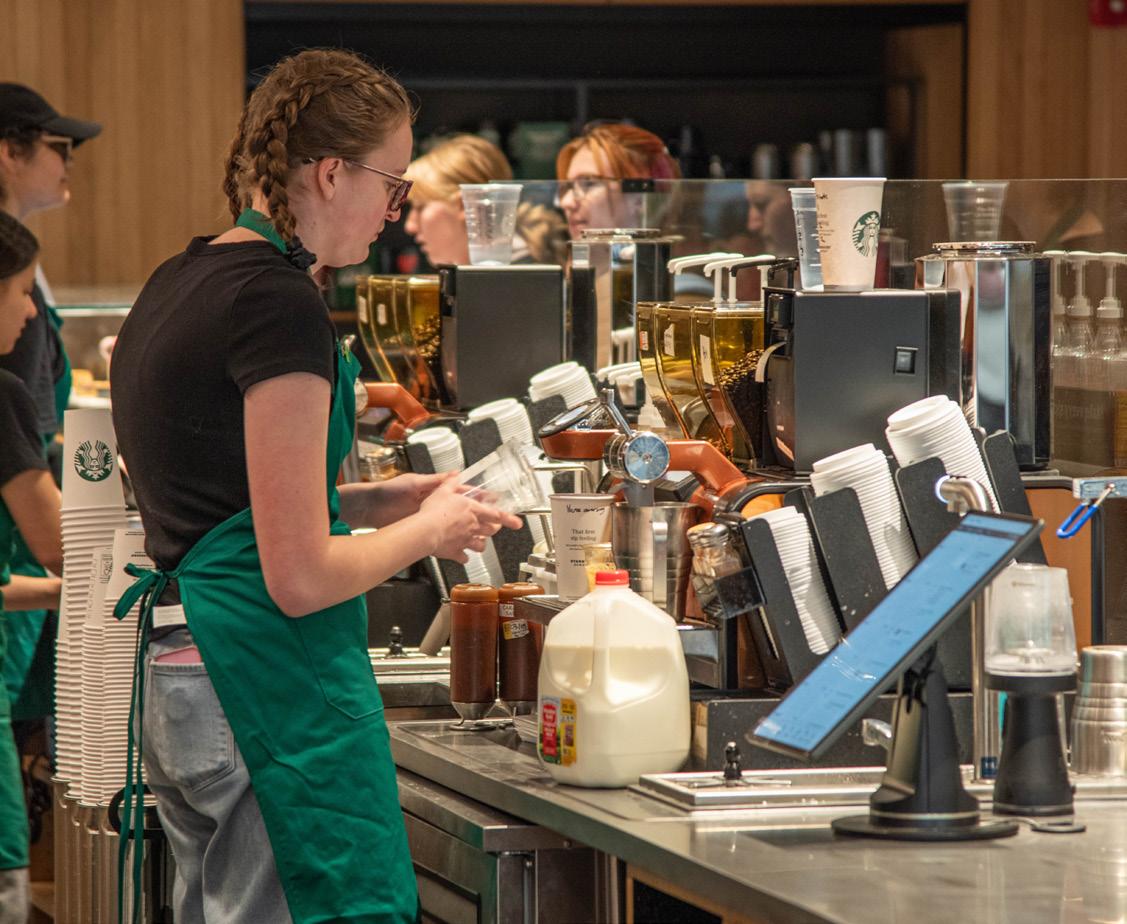
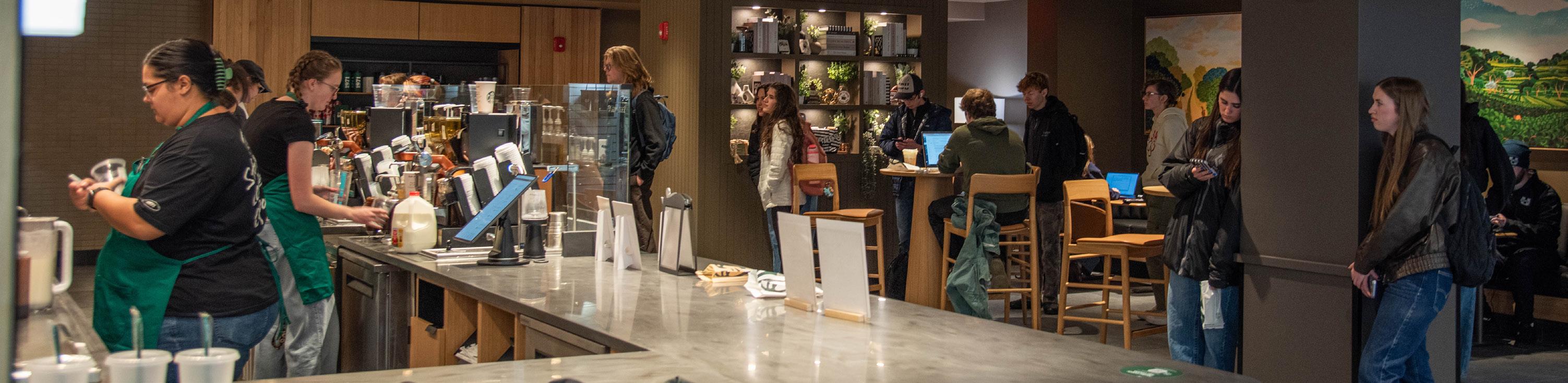
February welcomed a new inhabitant of Utah State University’s TSC: Starbucks. The new location’s grand opening took place on Monday, Feb. 23 after a soft opening the week prior. The addition to the TSC’s first floor brings a new eatery next to the everchanging Hub food court and a new spot for coffee on campus.
Aggies may remember Steeped, formerly located on the first floor of the Noelle E. Cockett Life Sciences Building. This cafe served Starbucks products but was not a fullyfranchised location. It only served drinks and offered a more limited selection. The Starbucks in the TSC is a franchise, offering the same menu as other Starbucks locations.
Alan Andersen, USU Dining Services executive director, spoke to The Utah Statesman about the location’s success so far.
“I talked to my assistant director over that area, and he said we did really well Saturday, which surprised me since we usually don’t get many people on Saturdays,” Andersen said. “It’s kind of funny — you get so busy, it’s hard to have a grand opening. You just serve people as fast as you can.”
Because the TSC is an old building, transforming the area into a Starbucks proved to be a challenge, according to Andersen. Due to there being asbestos under the tiles that were pulled up, there were delays that pushed back the grand opening at least two weeks.
However, Andersen noted this allowed the staff extra time to train, and they were able to give out free practice drinks to passerby in the TSC.
The week of Feb. 23 offered numerous opportunities for grand opening attendees to receive prizes, the big one being the opportunity to win one free Starbucks drink every day for the rest of the semester. Additionally, some cups randomly included a star decal, giving the recipient their choice of a sweatshirt, T-shirt or mug.
First-year student and self-proclaimed coffee connoisseur Rebecka Bingham was present at the grand opening and shared her opinions on the new location.
“I always wondered why we didn’t have a Starbucks before,” Bingham said. “I love the vibes of Starbucks, and they’re always consistent with drink orders. I definitely think it’s a safe bet to have a Starbucks on campus to study and meet up with friends at.”
Andersen said Steeped allowed him and other employees of USU’s Dining Services to see what the demand of Starbucks would be without investing in costly franchise fees.
Before bringing in Chester’s Chicken, staff looked into having a Chick-fil-A franchise in the Hub. After contacting Chick-fil-A, they were told it would need to be the only restaurant in the entire Hub, and the franchise fee was similar to the entire cost of putting in Chester’s Chicken.
“Franchises are important. They bring names in, but if we only have franchises, it would be very costly for the university,” Andersen said. “Starbucks has been good to work with. They are pretty rigid for the most part. There are some things I would probably change if I could, but that’s just part of being a franchise.”
Andersen said he received a lot of feedback when people found out that Caffe Ibis was moving out of the TSC, much of it critical of the decision. He explained despite Starbucks moving in, he believes 75% of the coffee served on campus is still Caffe Ibis.
“All of our catering is Caffe Ibis. The Skyroom is Caffe Ibis. We have two locations that are Caffe Ibis,” Andersen said.
Bingham echoed a sentiment similar to that of some of the students who complained. She mentioned she still plans to frequent the Forum Cafe located on the first floor of the Merrill-Cazier Library, which serves Caffe Ibis’ drip coffee.
“It offers yummy bagels and treats,” Bingham said. “I love the student feel and that I feel like I am supporting a smaller business when I go to the Forum. I don’t really feel like Starbucks needs support, considering it’s a chain.”
Andersen said his main goal is to make the TSC really feel like a student center rather than an administrative building. He said Starbucks fits into this vision.
“It’s been fun to see, as space becomes available downstairs, that they’ve focused on student-centric things, not offices,” Andersen said. “Starbucks is another reason to be in the student center and make it into a student center.”
Bailey Daniels is a senior studying technology systems. She loves Lana Del Rey, sweet treats and all things whimsical.
— bailey.daniels@usu.edu
PHOTOS BY Jack Burton
Starbucks employees work their first day in the TSC for the grand opening on Feb. 23.
Max Alder elected USUSA president
By Malory Rau STATESMAN EDITOR
With an eight-vote difference granting him the win, current USUSA Executive Vice President and the Junction-enthusiast Max Alder is the USUSA president for the 2026-27 school year.
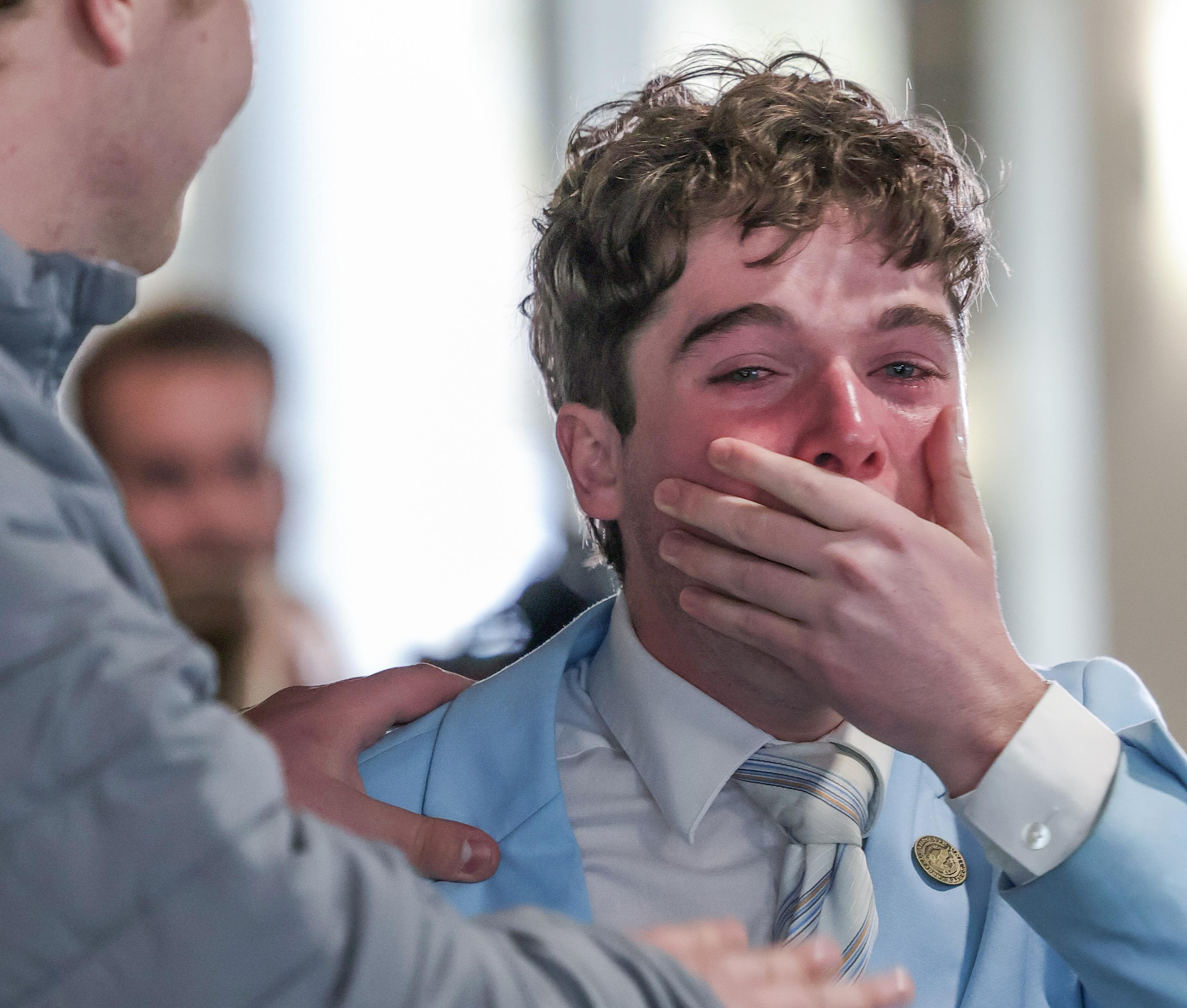
Alder has become notorious on campus for his bright baby-blue suit he has worn while campaigning for the past two years.
“I didn’t want to just do, like, a boring black suit or something that everybody else has, and originally, it was actually going to be tan, and then somebody told me, ‘No, don’t do tan. That’s boring,’” Alder said. “So, I found a blue suit on Amazon that was like $80, and I said, ‘That looks nice, and it’s cheap enough.’”
Alder comes from an Aggie family and said he has always wanted to attend Utah State University. He was born in Cache Valley and moved away but said he wanted to come back when he graduated high school.
“I originally came here as an economics major, and then spring semester my freshman year, I also added finance, and I haven’t regretted that decision one bit since I got here,” Alder said.
On top of the double major, he found himself involved in various student organizations, such as the Government Relations Council, the Student Alumni Association and the A-Team. He also competed as Mr. Greek in the 2025 Mr. USU Pageant.
Alder holds various leadership positions in the Sigma Phi Epsilon Fraternity, making him the fourth consecutive USUSA president to come from this fraternity.
He said much of his involvement was inspired by 2023-24 USUSA President Abe Rodriguez. He recounted a time when the two got dinner together.
“He told me about the A-Team. That’s when he told me about SigEp, and that’s when he basically — we walked out, and he’s like, ‘You’re going to run for exec VP next year,’ and everything we talked about in that conversation has come to fruition, and it’s amazing to look back on that,” Alder said.
Among other notable influences, Alder also mentioned support from 2024-25 USUSA President Matt Richey was extremely influential in his campaign. Alder was supported by his campaign manager, Halle Hart, who is currently serving as the USUSA Emma Eccles Jones College of Education and Human Services Senator.
“I wanted to be part of his campaign because I wanted to help him continue making a difference for students,” Hart wrote in an email to The Utah Statesman.
Hart further explained the role of an election campaign manager in the USUSA Elections.
“Being a campaign manager in these elections involved making sure the entire campaign ran smoothly and stayed on track. For me, that meant making sure Max felt supported and had someone to talk ideas through with,” Hart wrote. “My role also involved keeping everything organized behind the
scenes so that Max could focus on connecting with students and sharing his ideas.”
The election results were announced at 4 p.m. on Wednesday, Feb. 25. The results elicited emotion from the crowd, which was met with mixed reactions on social media.
USU student Will Baggett wrote the top-liked comment on the Statesman Instagram post announcing the results, which stated, “Bro you doing too much.”
At the time of writing, this comment has received 2,053 likes. Another USU student, Ethan McGregor, commented, “Didn’t realize it was this serious.”
Among these, there were also comments of support from members of neighboring student associations Utah Valley University and Utah Tech University that stated “congratulations” and “congrats max.”
When asked, Alder explained the legacy he hopes to leave behind after serving as USUSA president.
“There are a few student body presidents that we talk about all the time, and we talk about them because they went above and beyond in their position,” Alder said. “I think there’s a million ways to be a good officer and a good president, and I want to go so above and beyond that I’m talked about when I’m gone for the good work I did for the students and the good work I did for the university.”

newspaper for Utah State University since 1902. Reporting online 24/7. Printed weekly during the school year.

PHOTO BY Jack Burton
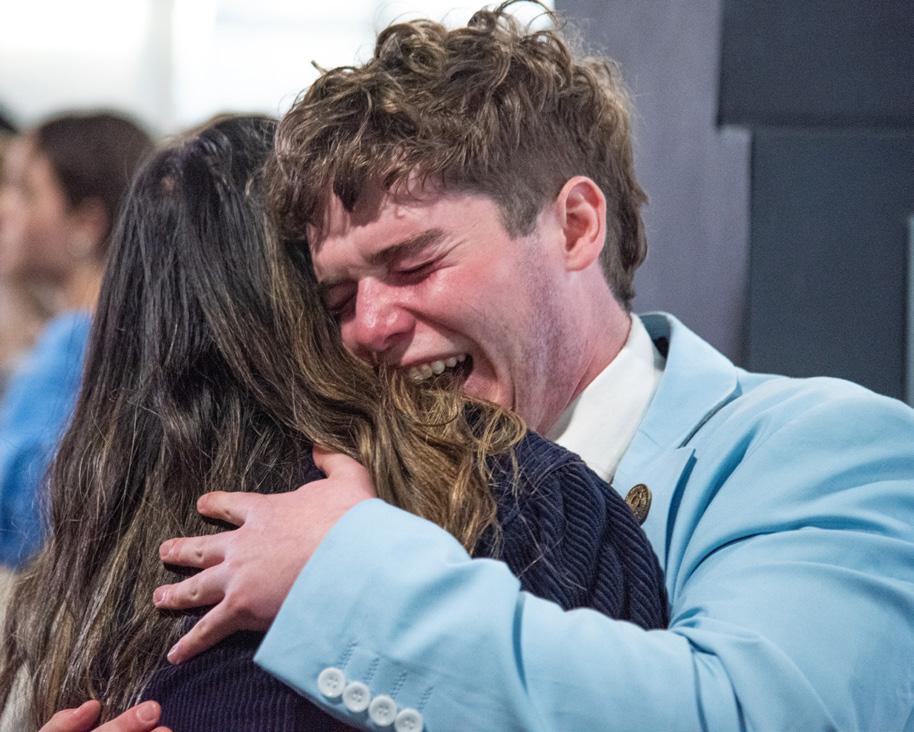
Newly elected USUSA President Max Alder, right, hugs re-elected Clubs & Organizations Executive Director Mia Bean after hearing the elections announcement on Feb. 25 in the TSC Hub
News Release: USUSA president runner-up calls for election integrity in formal report
STATESMAN
USUSA president runner-up Kapp McCallister released a formal report voicing concerns with the integrity of the USUSA Elections process.
McCallister’s report was sent to Utah State President Brad L. Mortensen, current USUSA President Brandon Sorensen and USUSA Elections, with various college senators, members of USU’s Student Involvement & Leadership Center and other university officials copied as well.
McCallister, who lost the election by eight votes, said he is not contesting the final vote nor calling for a new vote. He instead brought to light issues he believes compromise the USUSA Elections process.
“Certain actions taken during this election cycle undermined the integrity of the process and created unfair advantages,” McCallister wrote. “These concerns warrant formal review to preserve trust in future elections.”
The crux of his report centered around certain candidates receiving live voting data unavailable to all candidates or the general public. McCallister claimed certain candidates receiving “insider access” creates an unfair advantage by allowing that candidate to update their strategy in real-time based on confidential election data.
“This is not ordinary campaign strategy. It is a breach of the blind structure that protects electoral integrity,” McCallister wrote. “When one side knows how close the race is during an active polling, the system is no longer neutral.”
In an email to The Utah Statesman, the USUSA Elections Committee clarified which groups have access to the live voting data, though it did not provide specifics on individuals or positions with access. Additionally, the committee is not aware of any validity to McCallister’s claims that candidates received information prior to the polls closing.
“Those who have access to the data prior to polls closing involve select members of Student Affairs and the Student Involvement and Leadership Center,” the committee wrote. “We are currently not aware of any merit to Kapp’s claim. That said, we will conduct a review of the procedures pertaining to who has access to voting data and make any needed changes.”
According to the USUSA Elections Committee, select members have access to live voting data due to previous issues the voting process has had in the past.
“There have been voting issues in the past that we have been able to catch and correct through monitoring of the voting system, so select members of Student Affairs and the Student Involvement and Leadership Center monitor for potential inconsistencies or abnormalities in the votes to ensure good election practices,” the committee wrote.
Additionally, McCallister listed secondary grievances, claiming proxy voting misuse and bad faith grievance filings.t

— news@usutatesman.com
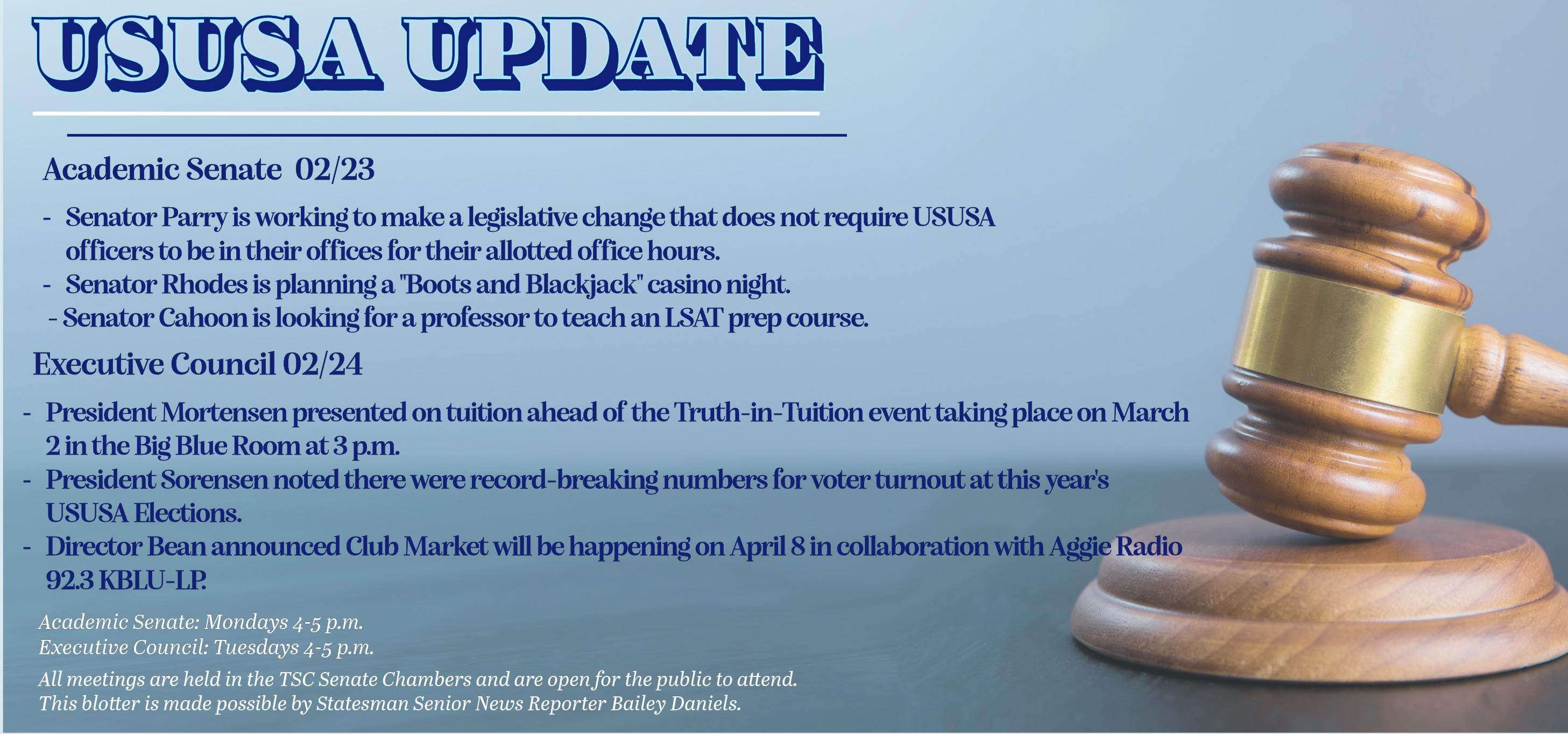
PHOTO BY Jack Burton
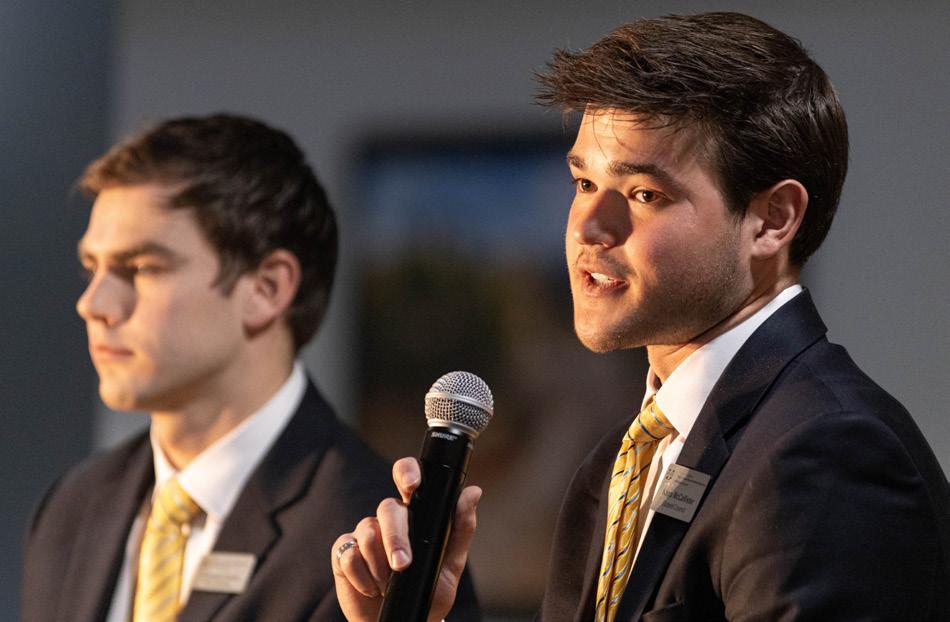
USUSA president candidate Kapp McCallister speaks at the USUSA town hall on Feb. 24 in the TSC Hub.
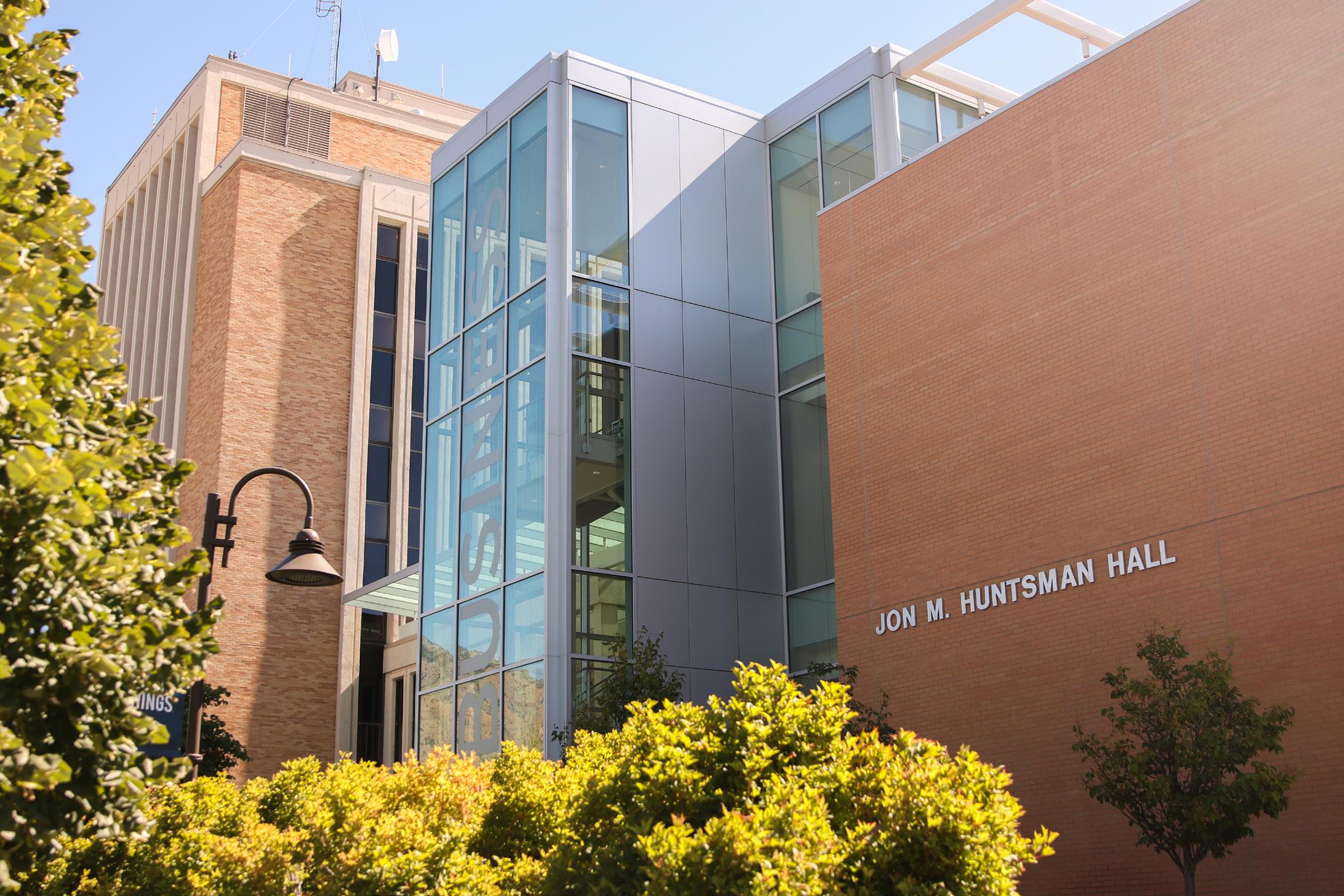
Jon M. Huntsman School of Business to add professional sales major
By Grace Colvin STATESMAN REPORTER
This autumn, the Jon M. Huntsman School of Business is selling Utah State University on a brand new degree: profesional sales.
As confirmed in a recent interview with USUSA Business Senator J.J. Watts, the Huntsman plans to introduce a new professional sales major for the upcoming academic year. The four-year degree will take inspiration from Utah State University’s existing technical sales minor — as well as its ProSales program, a student-led sales program that connects students with professional opportunities — to design its curriculum. While still pending approval from the Utah System of Higher Education at the time of publication, the business school hopes to unveil the program in time for the fall 2026 semester. It will be the eighth in the school’s lineup of available majors.
In Watts’ words, the professional sales major “takes sales bros and makes them into sales professionals.”
Culminating in a bachelor’s degree, the program will require 120 credits for graduation and participation in a relevant internship. Possible career paths associated with this major will include sales managers, technical/ scientific wholesale representatives and sales engineers.
According to Watts, the success of similar programs at Utah Valley University and Weber State University encouraged the Huntsman to bring the program to USU students, and he claims there’s no better time to introduce it.
“It’s not something that the school wanted to just throw out there,” Watts said. “It’s actually been brought because of demand in the market right now.” Although it will be an entirely new major at USU, the professional sales major will take its framework and curriculum from ProSales, which has been running at USU for the past 11 years. The program was started by USU marketing professor Sterling Bone, who has also designed the curriculum for the new degree, according to ProSales co-president Tavo Estrada.
Described on its website as “a market-driven group that provides a connection between the best sales students at USU and business executives, managers and recruiters,” ProSales is open to students of any major, who regularly attend networking events and competitions related to sales.
“That program has 100% placement, meaning if you enter into that program, do their curriculum and search for a job within that realm, you’ll get a job,” Watts said.
Estrada, who is a senior in data analytics and marketing, said he believes this existing placement rate is good news for any student planning on starting the professional sales major.
“I anticipate that’s going to extend over to the sales major,” Estrada said. “Anyone who is in the sales major will have some of the best networking opportunities on campus.”
According to Watts and Estrada, the major will include both existing Huntsman classes and new classes specifically developed for the degree. Watts said there will be a heavy emphasis on “experiential courses,” which are designed to provide students with practical experience in the field by use of role-playing experiences and case studies.
While Watts anticipates a large number of recent high school graduates will be drawn to the program, he also claims a significant number of the program’s new participants will be current students coming from other majors in the business school.
“I know a lot of students here in the Huntsman who just chose some type of major that they would be ‘okay’ doing and then they do the sales minor. I think it’ll be nice for those students who know exactly that they want to do sales,” Watts said.
According to Watts, many students — particularly marketing majors — are only in their current major because a sales major doesn’t exist, and once the professional sales major takes off, their needs will be better met through that program.
Grace Colvin is a sophomore in the theater education program. After graduation, she plans to become a middle school drama teacher. When she isn’t writing or working on a play, she loves making crafts and woodworking.
STATESMAN FILE PHOTO
The Jon M. Huntsman Hall, as seen on Sept. 25.
Cardboard boats sink and soar during Engineers Week tradition
By Dylan Moore STATESMAN REPORTER
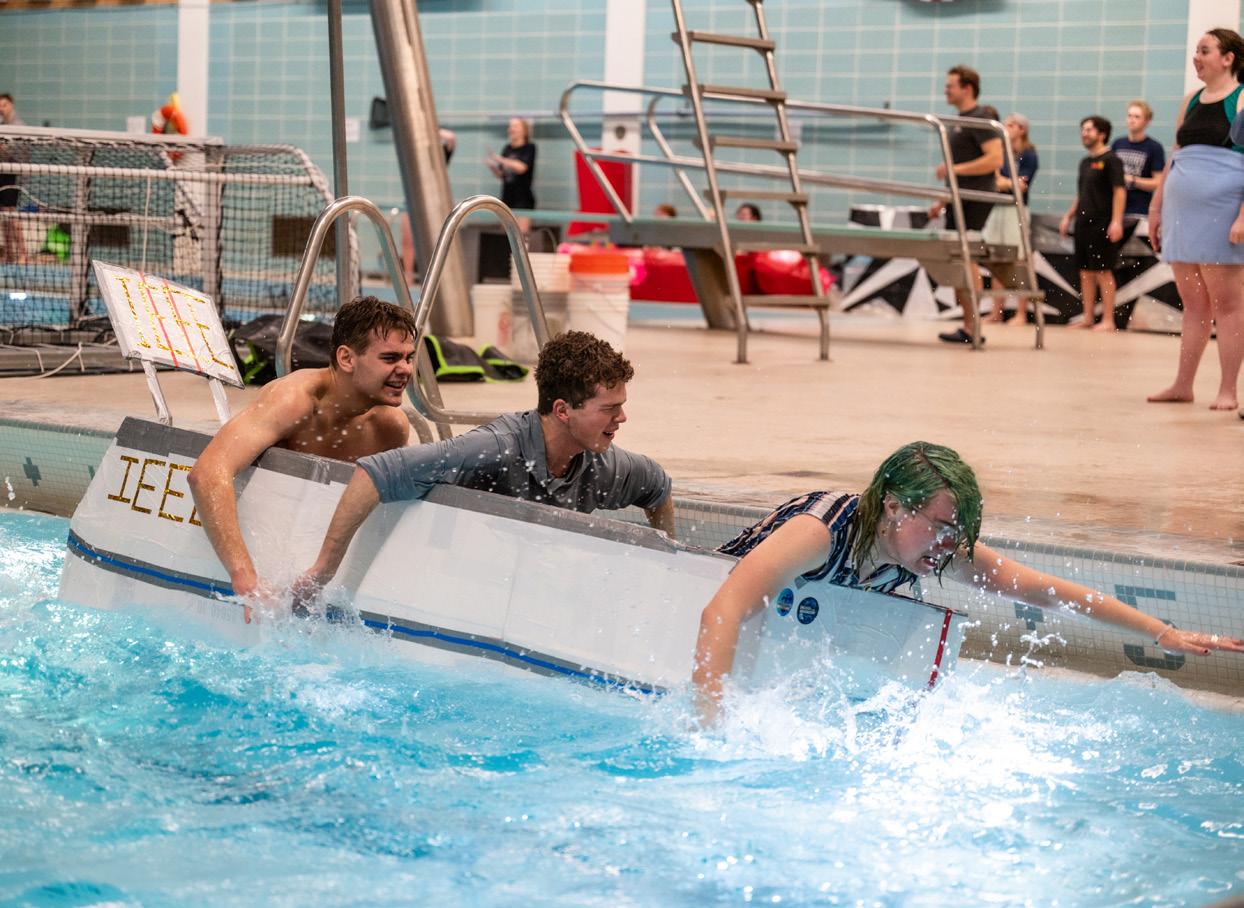
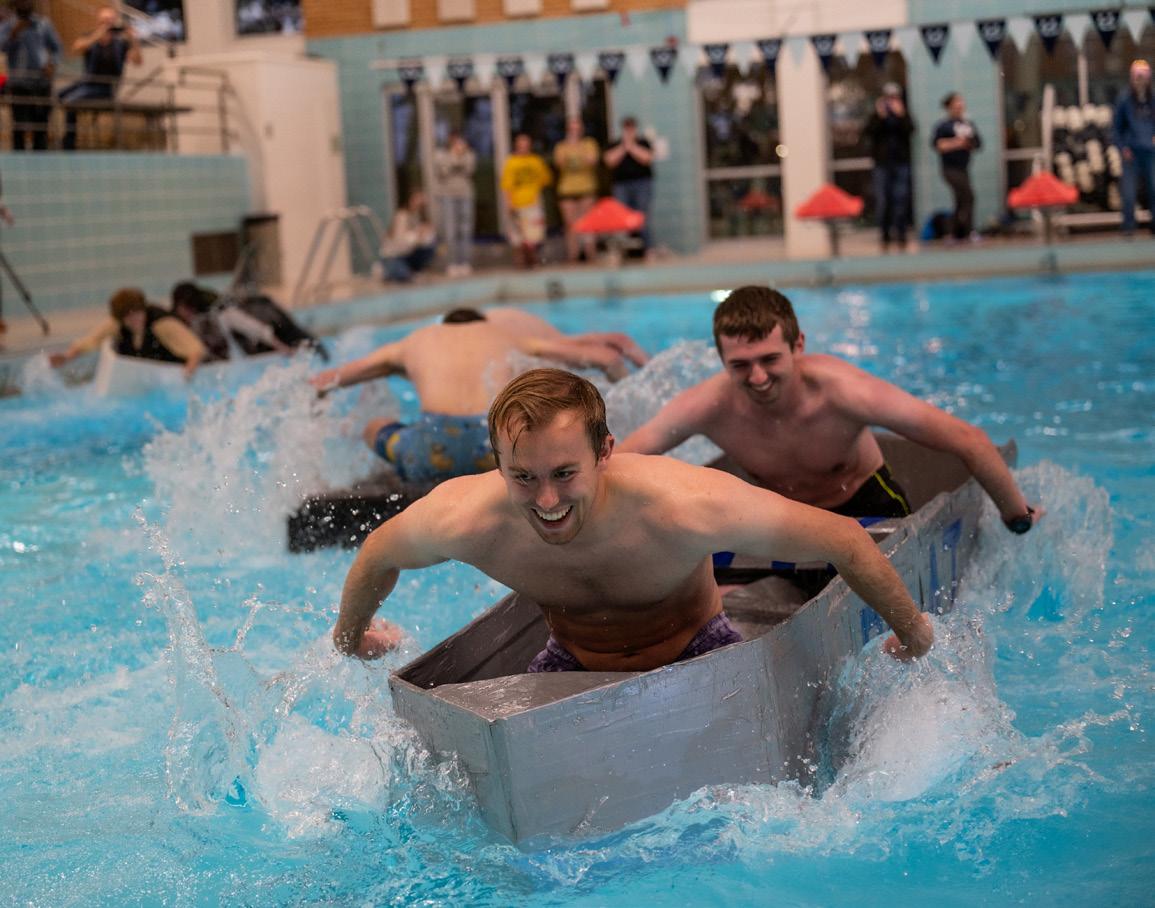
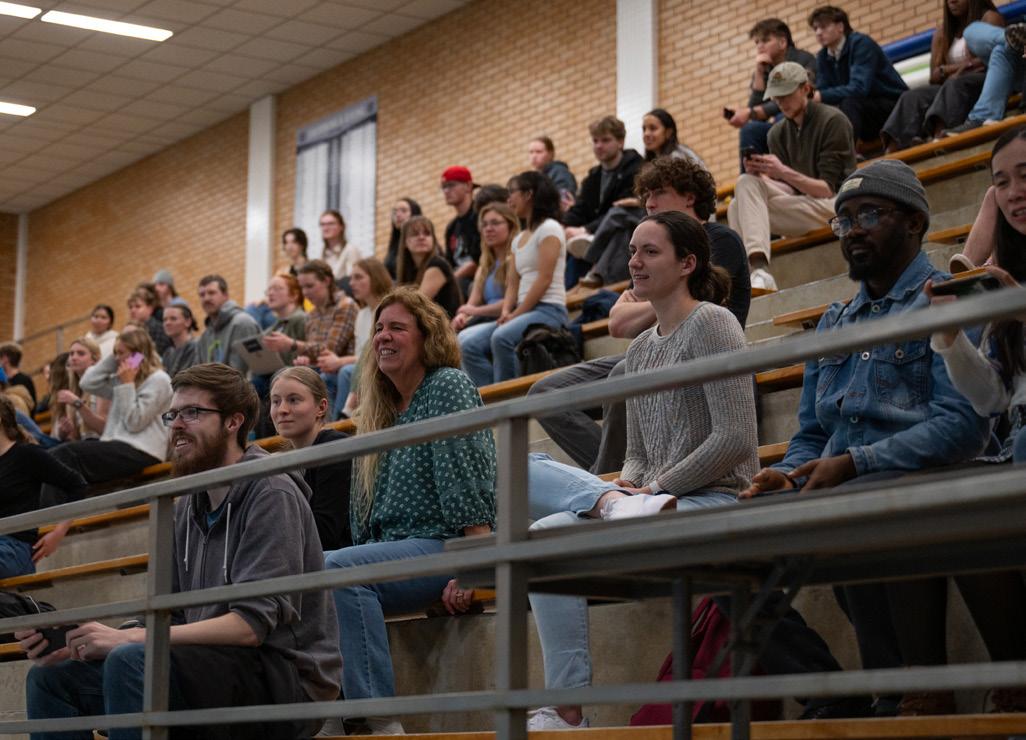
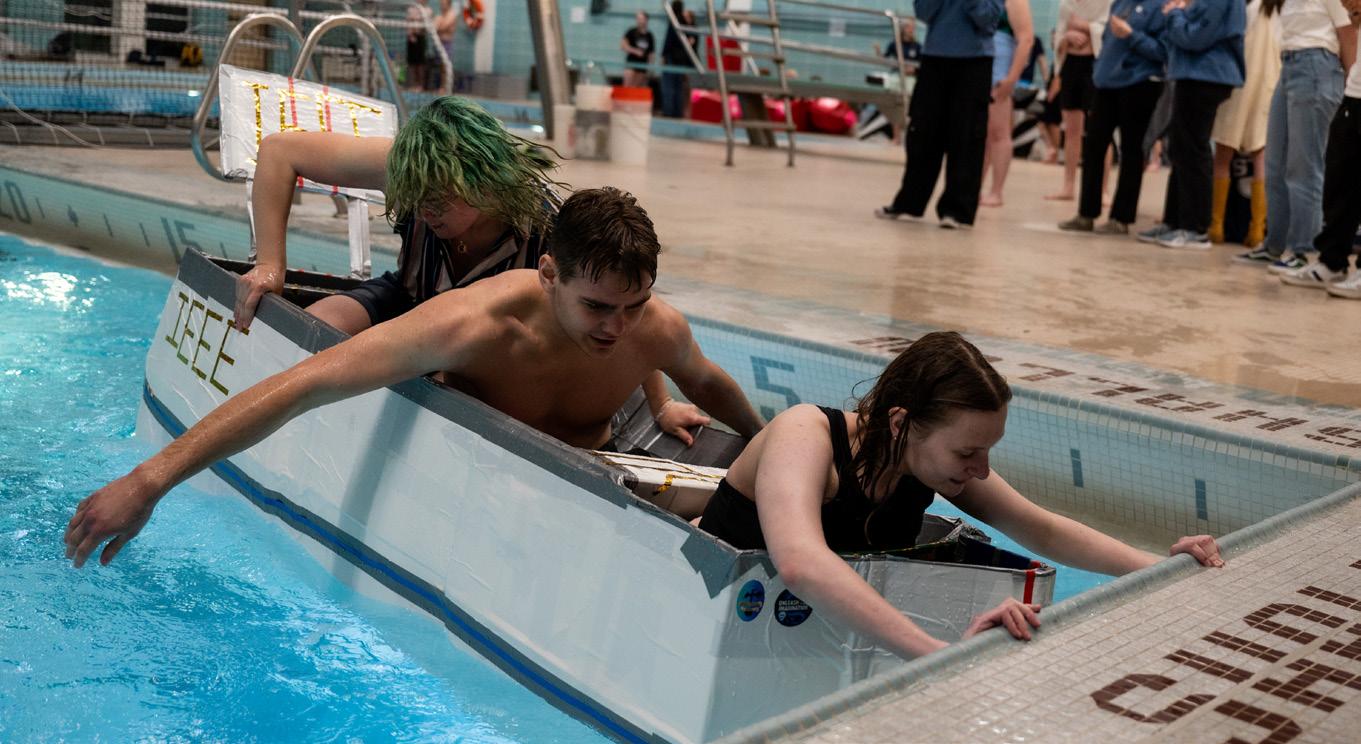
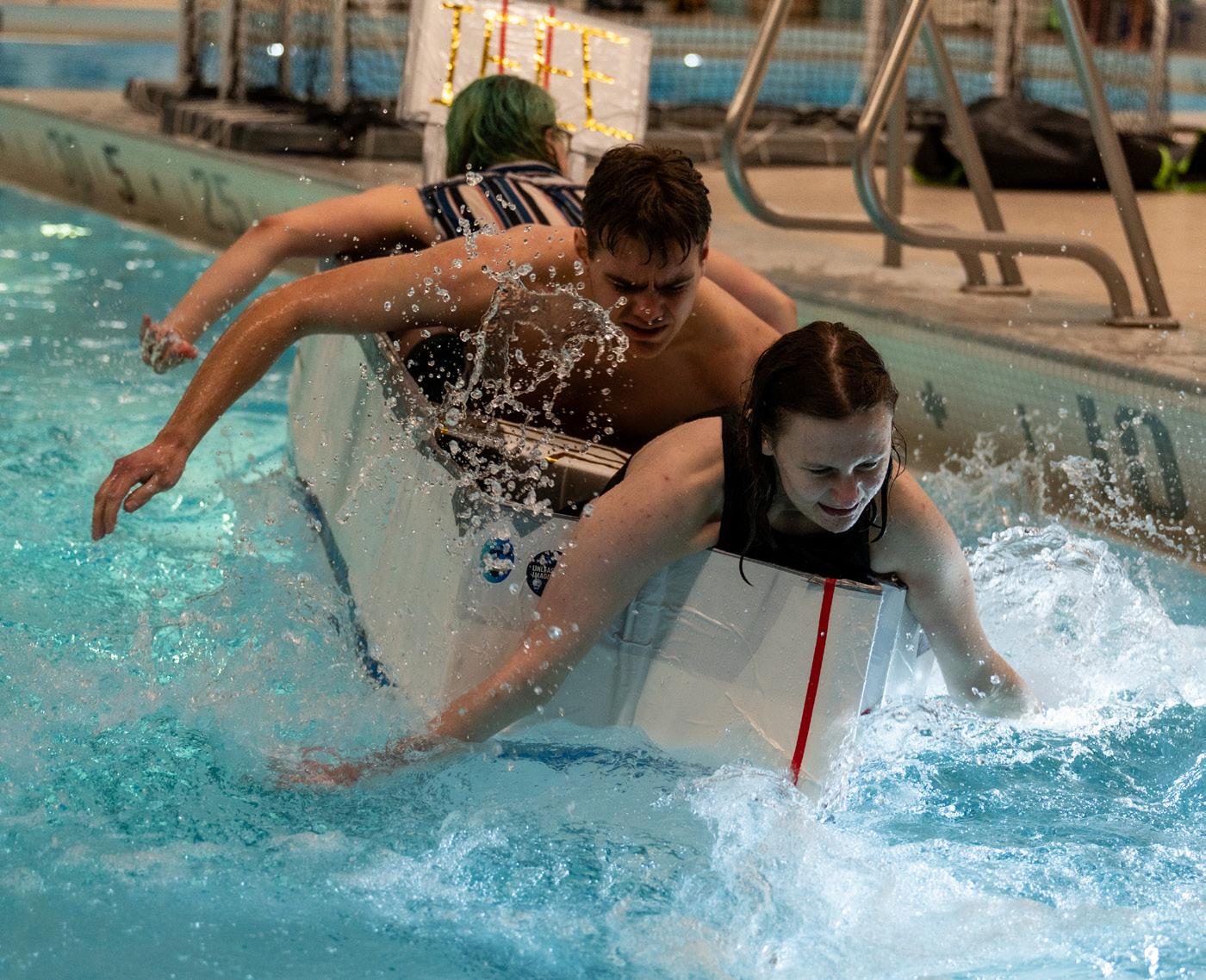
Cardboard and duct tape took center stage as students packed the HPER lap pool for Utah State University’s annual cardboard boat race, a longstanding Engineers Week tradition organized by the USU Engineering Student Council.
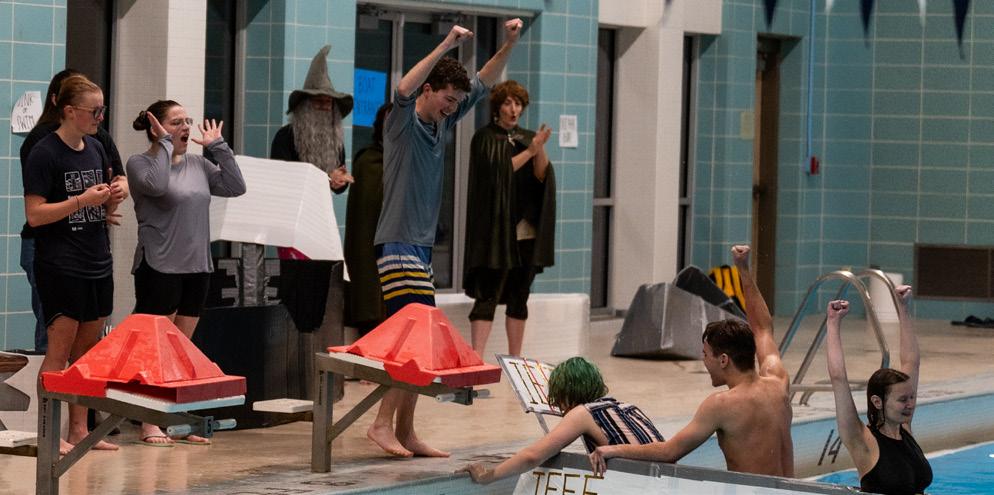
On Feb. 25, 12 teams launched handmade boats built entirely from cardboard and tape into the water, competing first for crowd approval and then for speed. The event began with a design competition where teams presented their boats poolside and the winner was determined by the loudest cheer from spectators. After the crowd-selected champion was crowned, the races began.
Each boat had to carry at least two participants. Paddlers were not allowed to use oars or props — only their hands. Teams started at one end of the lap pool and raced to the other side in timed heats.
Jackson McKenna, a senior majoring in biological engineering and one of the event’s co-directors, said the race has been part of Engineers Week for years. “It’s just a competition where multiple organizations or groups of people can sign up,” McKenna said. “They build a cardboard boat under certain stipulations, and we have a race to see who can win. It’s a super fun tradition that we have.”
Engineers Week is a nationally-observed celebration for colleges of engineering, typically held around Presidents’ Day. McKenna said the goal is to give engineering students a break from their demanding coursework while also spotlighting the engineering council.
“Engineers are so busy all the time with all their schoolwork,” McKenna said. “We just want to get students to know there is such a thing as engineering council and that the College of Engineering does do a lot of fun activities.”
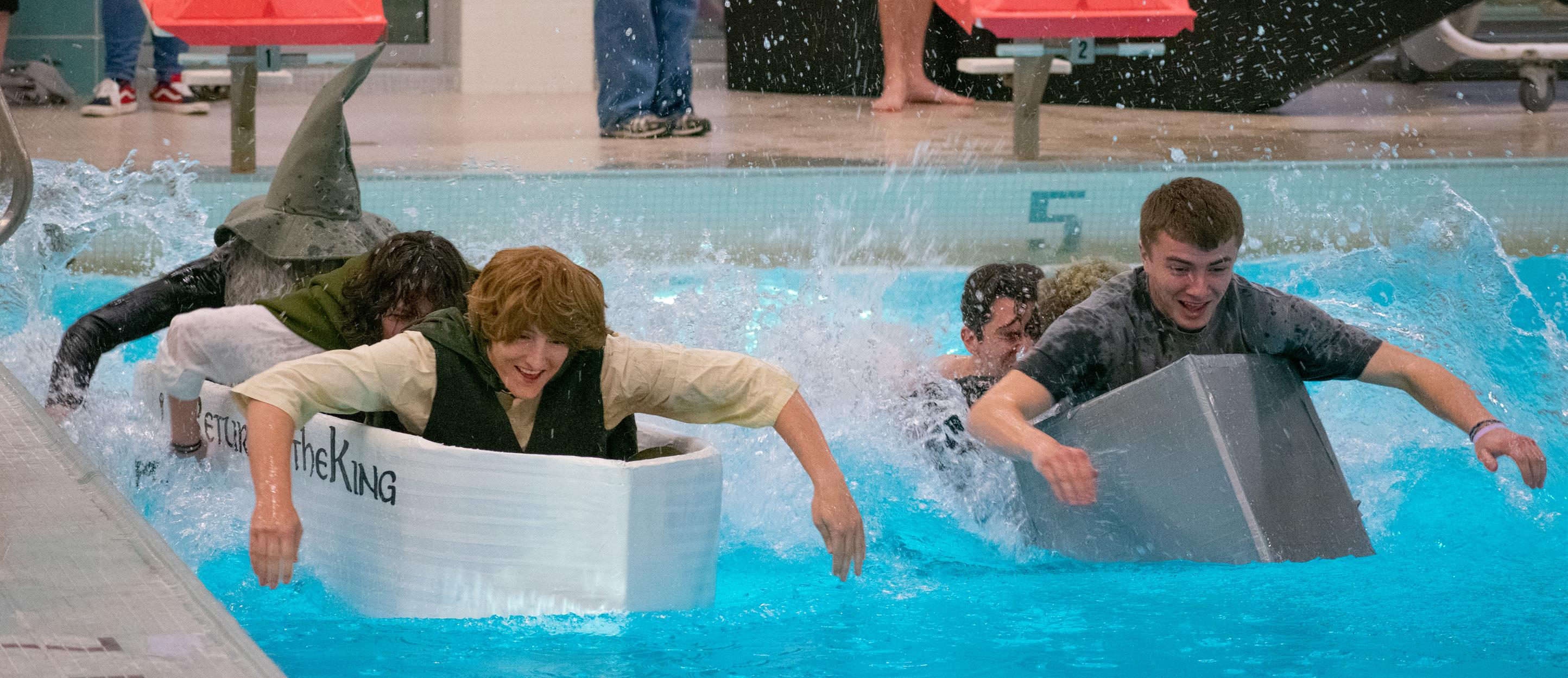
Boats ranged from carefully measured rectangular builds to more experimental shapes. One team even dressed as “The Lord of the Rings” characters as they raced. Some teams prioritized structure. Others gambled on speed.
Many of them sank.
Cardboard, even reinforced with generous layers of duct tape, eventually gives in to water. Several boats made it only partway across the pool before softening and folding inward. Others held together long enough to post competitive times.
Nathan Flake, a sophomore majoring in mechanical engineering, returned to the race this year after nearly winning last year with a boat he described as “really bad.”
“It almost fell apart, but despite that, we actually did really well in the race,” Flake said. “We took second, just by a few seconds.”
Flake and his teammates spent about five hours building
their boat on the Friday evening before the race. Learning from last year, Flake said they kept the design simple.
“We decided on a basic design,” Flake said. “I mean, it works with real boats, so it should work with a cardboard one.”
Last year’s race focused largely on bragging rights, but this year’s competition added small prizes, raising the stakes.
Beyond prizes, Flake said events like the cardboard boat race help change perceptions about engineering.


Dylan Moore is a junior majoring in political science and minoring in anticipatory intelligence and Russian. He always loves going on outdoor adventures and cooking.
PHOTO BY Elise Gottling
Participants of the cardboard boat race compete at the HPER on Feb. 25.
USU launches studentled night sky monitoring
By Emma Barker STATESMAN REPORTER
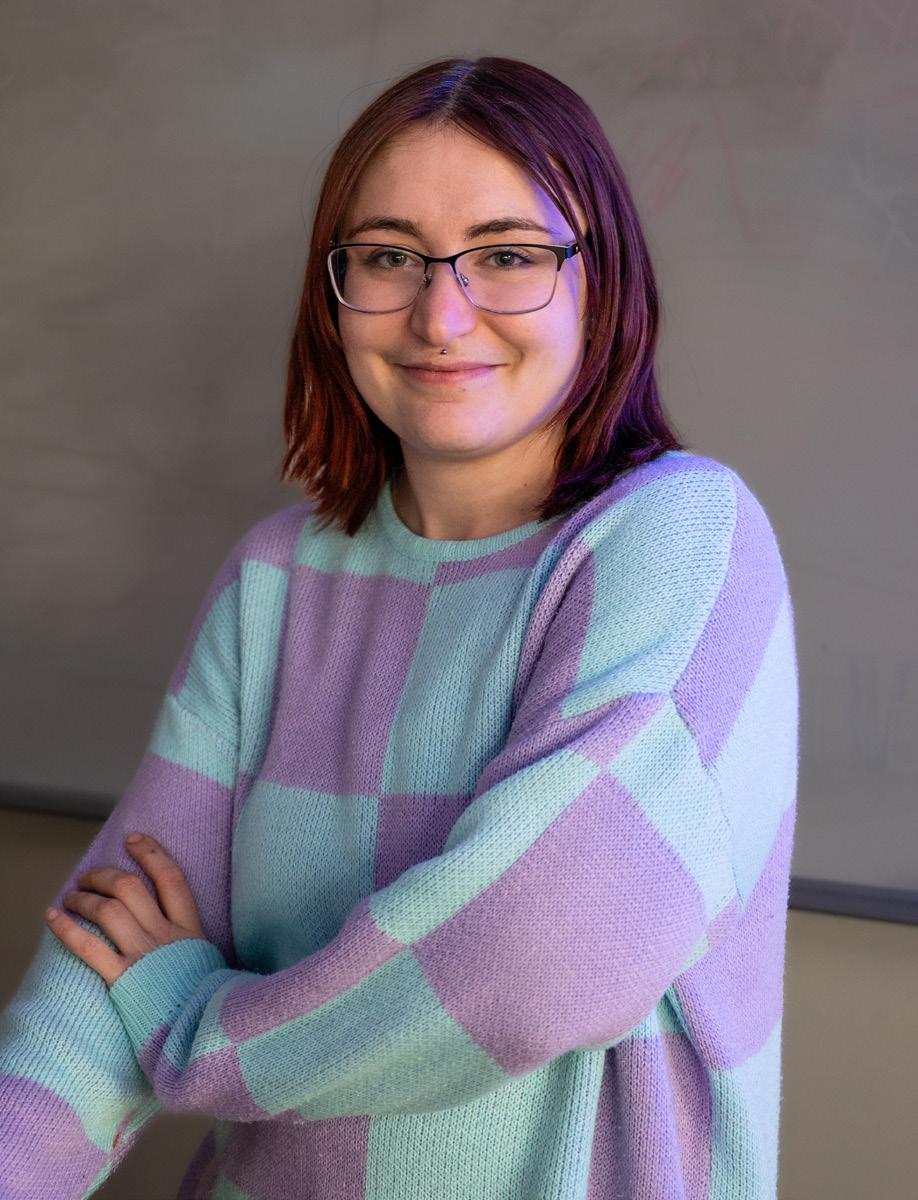
Ashley Starr spent last summer creating pamphlets for Golden Spike National Historical Park’s dark sky certification. This semester, she is bringing that expertise home to Logan.
Starr, a sophomore wildlife ecology and management major, is working with Utah State University’s Wildlife Society chapter. The initiative, led by students, will train volunteers to measure sky brightness across Cache Valley. They plan to this four times per year, collecting data to influence local lighting policy, according to Starr.
“Light pollution is not just a human issue. It’s also a wildlife issue,” Starr said. “It messes with nocturnal signals and breeding habits.”
The sky monitoring program materialized from Starr’s internship at the park, where she developed educational materials about light pollution’s impact on dark skies and conducted lighting audits.
Starr worked with the National Audubon Society during the same period, where she monitored snowy plovers at the Great Salt Lake. When she mentioned her interest in dark skies, Audubon staff told her about their citizen science light pollution monitoring programs in St. George, Salt Lake City and Ogden.
“I wanted to do something that was an event for

Berryman [Institute] within the Wildlife Society,” Starr said. “I asked them if they were willing to do it up in Logan.”
Audubon agreed. The program will also partner with Gilmore Sanctuary, Audubon’s local facility, to implement the dark skies monitoring protocol. It has already proven successful in other Utah communities. Volunteers will visit assigned areas across Cache Valley once per season — fall, winter, spring and summer — using sky quality meters to measure light pollution. The $155 worth of equipment measures artificial light radiating into the evening sky.
Teams will collect on specified nights, spending roughly two hours checking three to five locations worth monitoring. The compiled data will be available for students working on geographic information system projects, city officials considering lighting ordinances or conservation groups tracking impacts on the environment.

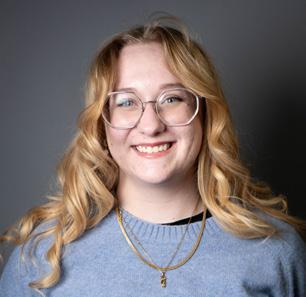
Emma Barker is double-majoring in journalism & communications and sociology. When she’s not reporting, she enjoys spending time with her dog and husband, thrifting and attempting to keep her sourdough starter alive.

“Night Owl Radio” has a little bit of everything, but rock, metal and post punk are played the most. Each playlist has songs ranging from the 1970s to today. If you want to listen to some cool music, tune in Wednesdays at 8-9 p.m. on Aggie Radio 92.3 FM.






When You Don’t See Me Sisters of Mercy

Fly Super Glide Rickshaw Billie’s Burger Patrol

One Million Rocket

When I Come Around Green Day

Whissendine Crippled Black Phoenix

PHOTOS BY Rylee Patterson
Ashley Starr, organizer of the night sky monitoring program infomational meeting, poses for a photo on Feb. 25.
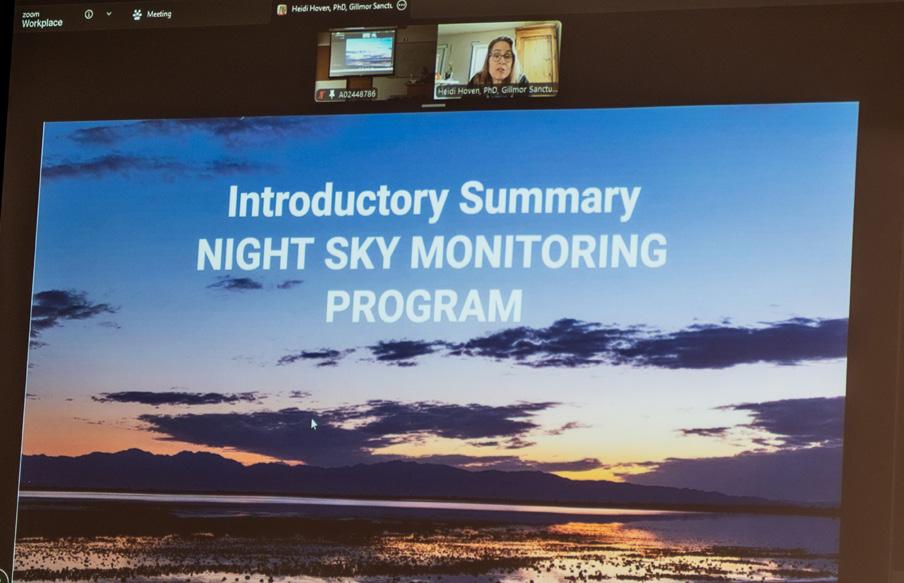
The presentation showed at the night sky monitoring program informational meeting, presented by Heidi Hoven, a guest speaker from the Gillmor eSanctuary, as seen on Feb. 25.
The Bull, the myth, the legend: Clark
By Essence Barnes STATESMAN SENIOR REPORTER
The identity of the man behind the Big Blue mask has been a Utah State University mystery for decades, but Aggies don’t have to wonder anymore, as Big Blue was revealed on Feb. 28 as student-athlete and soon-to-be graduate Clark Croshaw. “It’s really exciting, and it doesn’t happen often, mostly because it’s kind of rare,” said Morgan Watts, head coach of the USU Spirit Squad. “For a Blue to have the honor to do his reveal, or beheading, he needs to be a four-year member of the spirit squad.”
Croshaw served as Big Blue throughout the entirety of his college experience despite having never considered becoming a mascot before.
“Both my parents are Aggies, so from when I was in middle school, Utah State was the plan,” Croshaw said. “My parents were always like, ‘You could be Big Blue,’ and I kind of brushed it off. At the time, I wasn’t even a cheerleader yet.”
After training to be a cheerleader and making the USU Spirit Squad, the opportunity to be Big Blue fell into Croshaw’s lap unexpectedly during a basketball game his first year.
“The other Big Blue had something happen where he wasn’t able to finish the basketball game, so they came and pulled me off the line, and they’re like, ‘Hey, we need a Blue. Do you want to do it?’ and I was like, ‘Yes, I do,’” Croshaw said.
From then on, Croshaw was asked to fill in as Big Blue until he was officially awarded the spot his sophomore year.
“I don’t think it was something he was planning on, but he was so good,” Watts said. “Clark filled in, he stepped up and he became one of the best Big Blues I’ve ever had spontaneously.”
Croshaw said one of his favorite parts of being Big Blue was it allowed him to be the biggest hype man in the room.
“As soon as I put on that suit, every single person in the [Dee Glen Smith] Spectrum is, like, my best friend, you know. They want pictures with me. They’re handing me, like, six-week-old babies,” Croshaw said. “It’s the ultimate way to experience a sporting event.”
Aside from interacting with students, Croshaw said he also loved interacting with kids.
“To the kids, you’re like an actual superhero,” Croshaw said. “It’s like if Iron Man walked into the room. They care that much.”
Croshaw said while the opportunity to be Big Blue is an honorable one, it is also a taxing one.
“I could have nothing going on all day. I’m doing great,
PHOTO BY Jack Burton
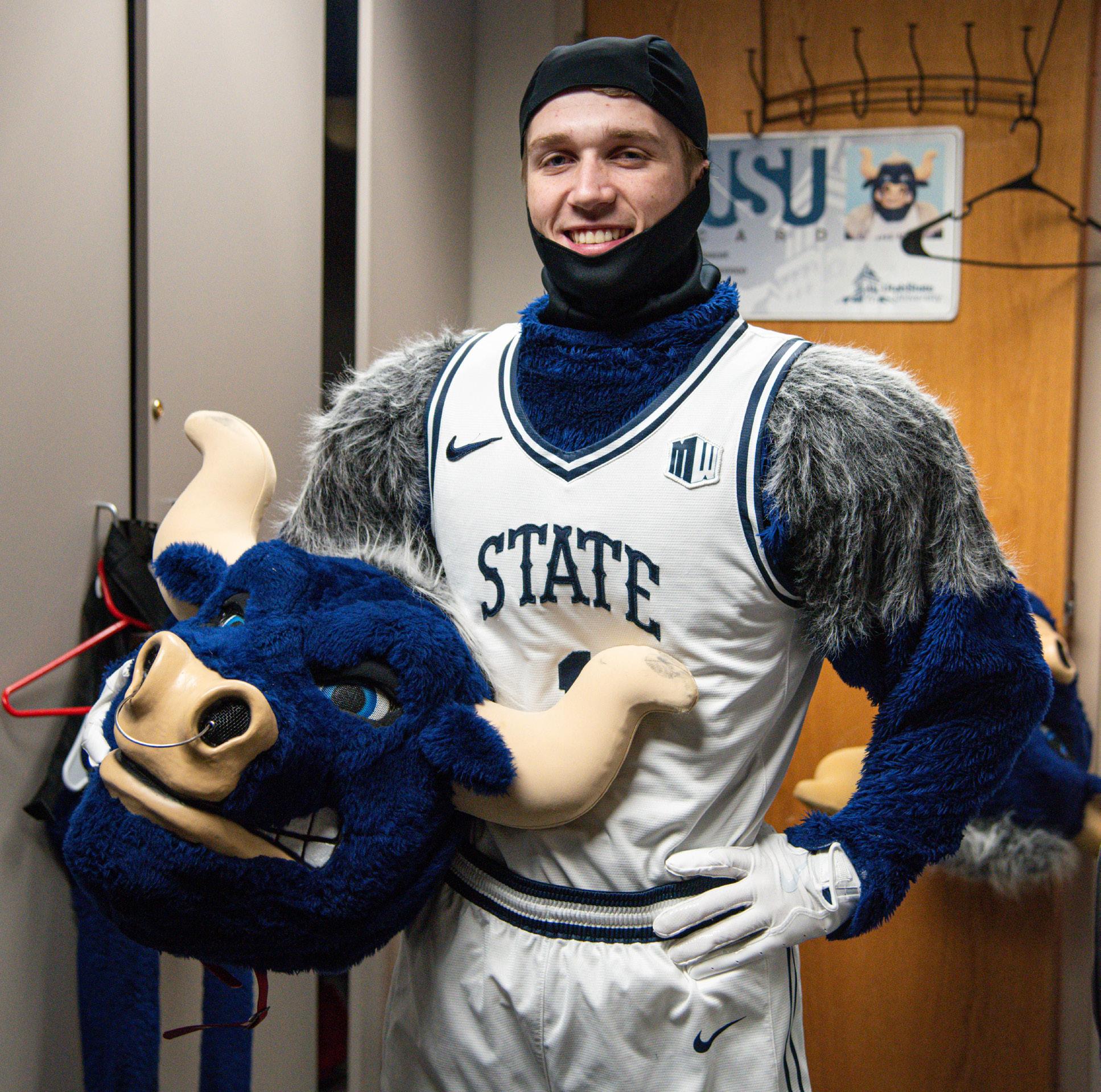
Clark Croshaw poses for a photo in the Big Blue costume in the Big Blue changing room inside the Dee Glen Smith Spectrum on Feb. 10.
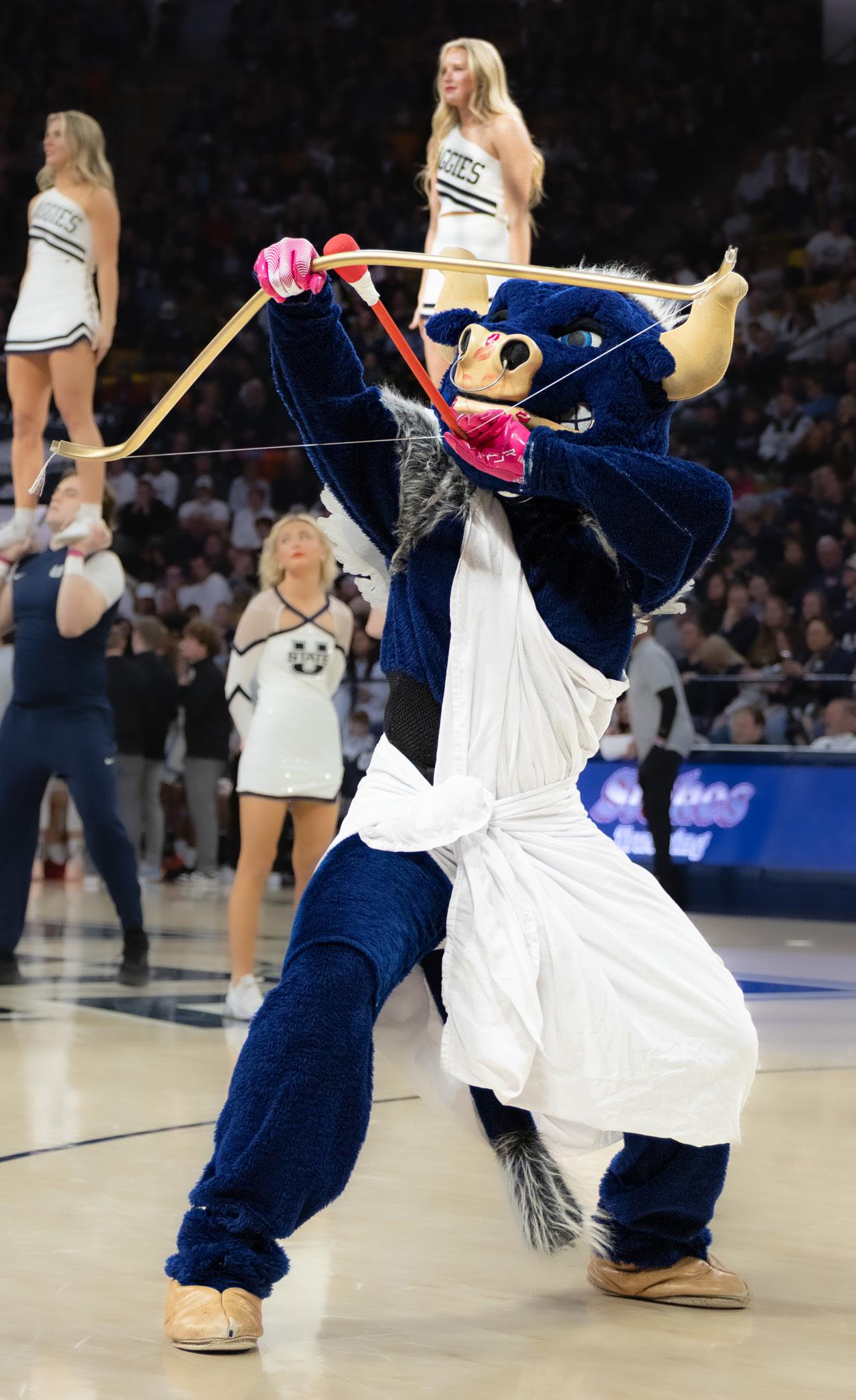
PHOTO BY Sydnie Fonoti Big Blue dresses up as Cupid at the Dee Glen Smith Spectrum on Feb.14.
Clark Croshaw revealed as Big Blue
I’m feeling great and a two-hour, two-and-a-half-hour, basketball game will put me on my butt,” Croshaw said. “I think that’s not something that I even could have prepared for until I had to just do it.”
Despite the weight, heat and reduced visibility inside the suit, Watts said she knew Croshaw would be able to handle it.
“He’s really athletic and is highly trained in gymnastics, and he was just kind of the hype, really happy, go-to
guy,” Watts said. “He was raised as a hard worker, and I can tell by being his coach because when something needs done, he gets it done.”
As he looks back on his experience from inside the suit, Croshaw said the emotion he feels most often is gratitude.
“It’s so special to get to do what I do, and it just means so much to people,” Croshaw said. “I wish I could say that it means more to me than it does other people, but I really don’t think it does.”
For Croshaw, Big Blue is defined very little by who’s actually in the suit and more by what he represents.
“I could never make Big Blue what he is, you know. That’s everyone else’s job,” Croshaw said. “My job is to do flips off the scoreboard and throw things at the other team’s fans, and if I just did that as me, it wouldn’t mean anything. I get to embody everyone’s excitement about the game at once.”
As he looks forward to life after college, Croshaw said he will likely put his mascot career to rest to focus on his job and family.
“It gets to be a really great memory. I’ll never not think about my time in school and not think about some aspect of being Big Blue,” Croshaw said. “I’m already married, and I’m going to have kids. I could leave the
things that I loved during college in college, move on and still honor the fact that they meant a lot to me.”
Watts said she hopes Croshaw gets the acknowledgement he deserves for exceeding in a job where his hard work often went unrecognized.
“Clark’s personality has brought so much energy and positivity and laughter, and I’m just really going to miss the silliness and spontaneity that he would bring to any event or practice,” Watts said. “There’s so much passion behind the suit, and I just want him to feel the love and appreciation from USU.”


Essence Barnes is a third-year student majoring in journalism who enjoys reading, writing and storytelling.
— essence.barnes@usu.edu
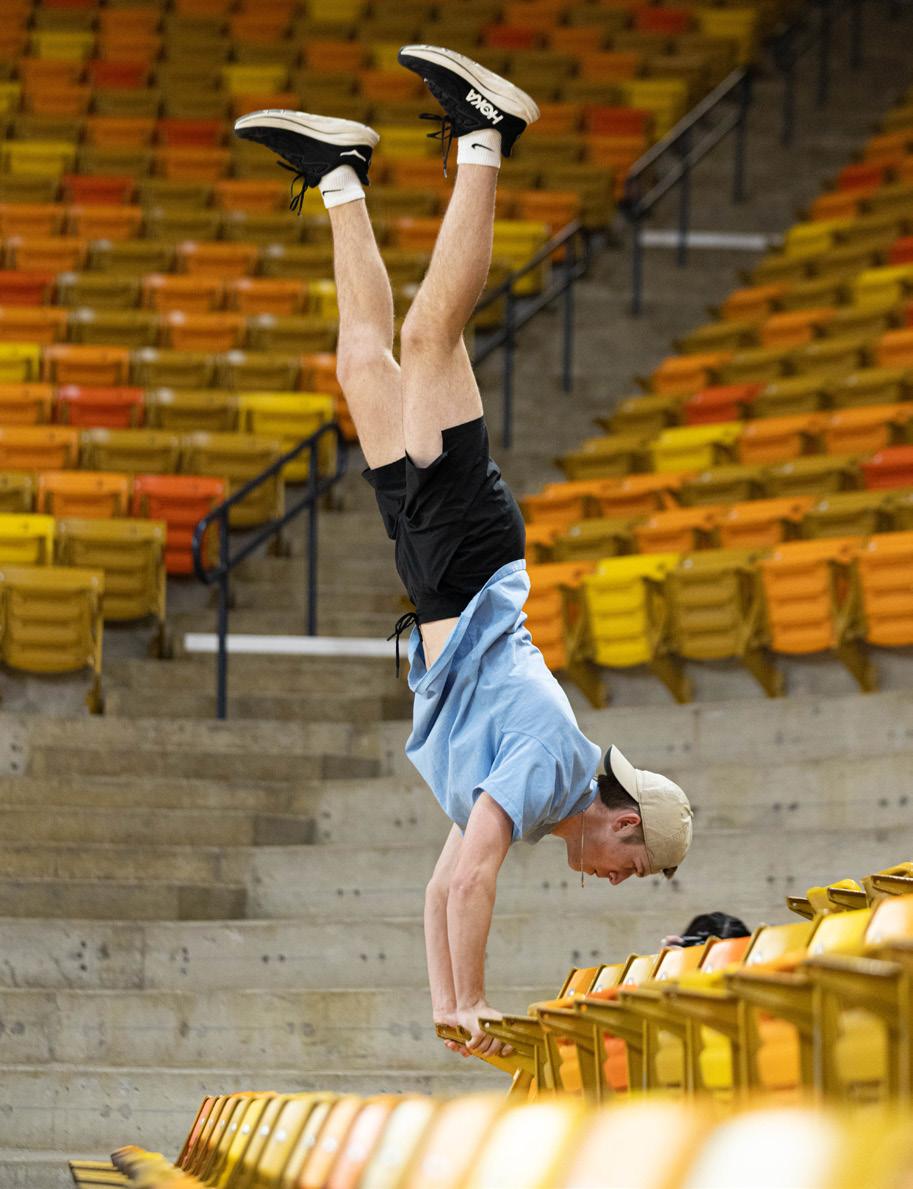
PHOTO BY Dane Johnson
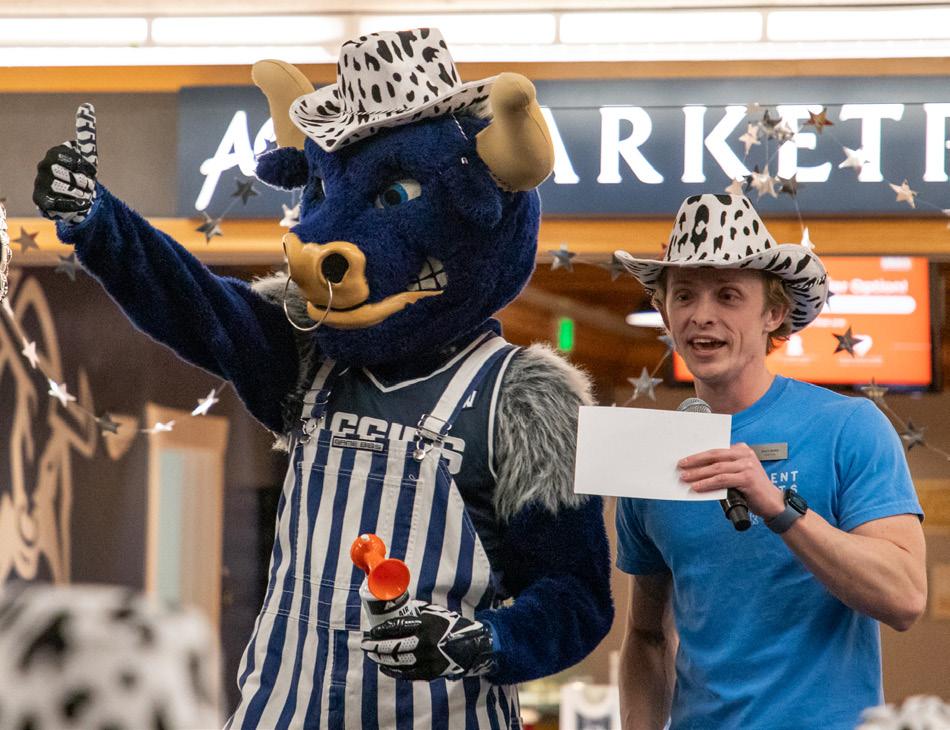
Big Blue, left, gives a speech interpreted by Blue Crew member Zach Bone in the TSC on March 6, 2024.
PHOTO BY Dane Johnson
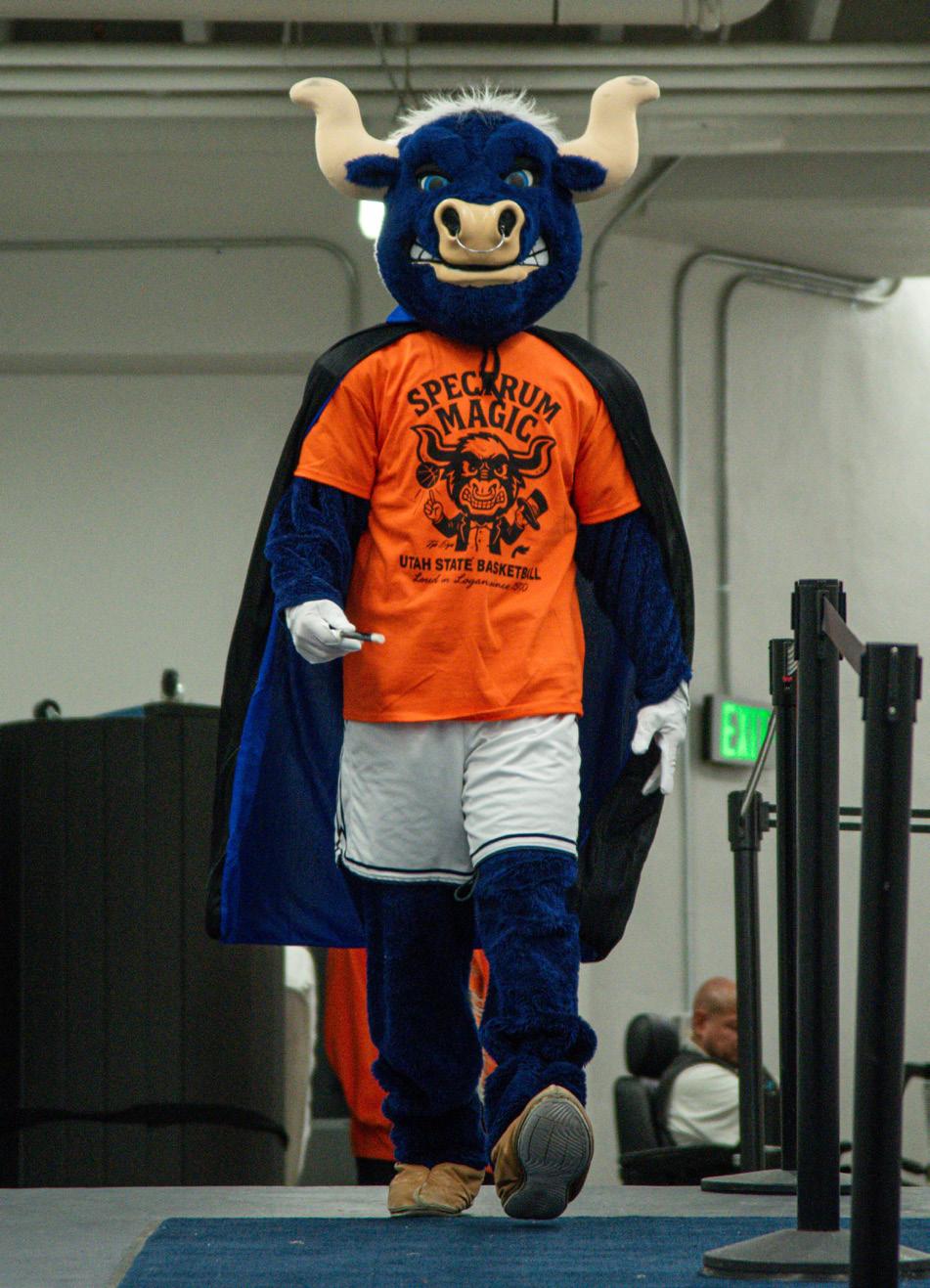
Big Blue walks down the tunnel of the Dee Glen Smith Spectrum prior to the Spectrum Magic Men’s Basketball game on Feb. 10.
PHOTO BY Hadley Sintay
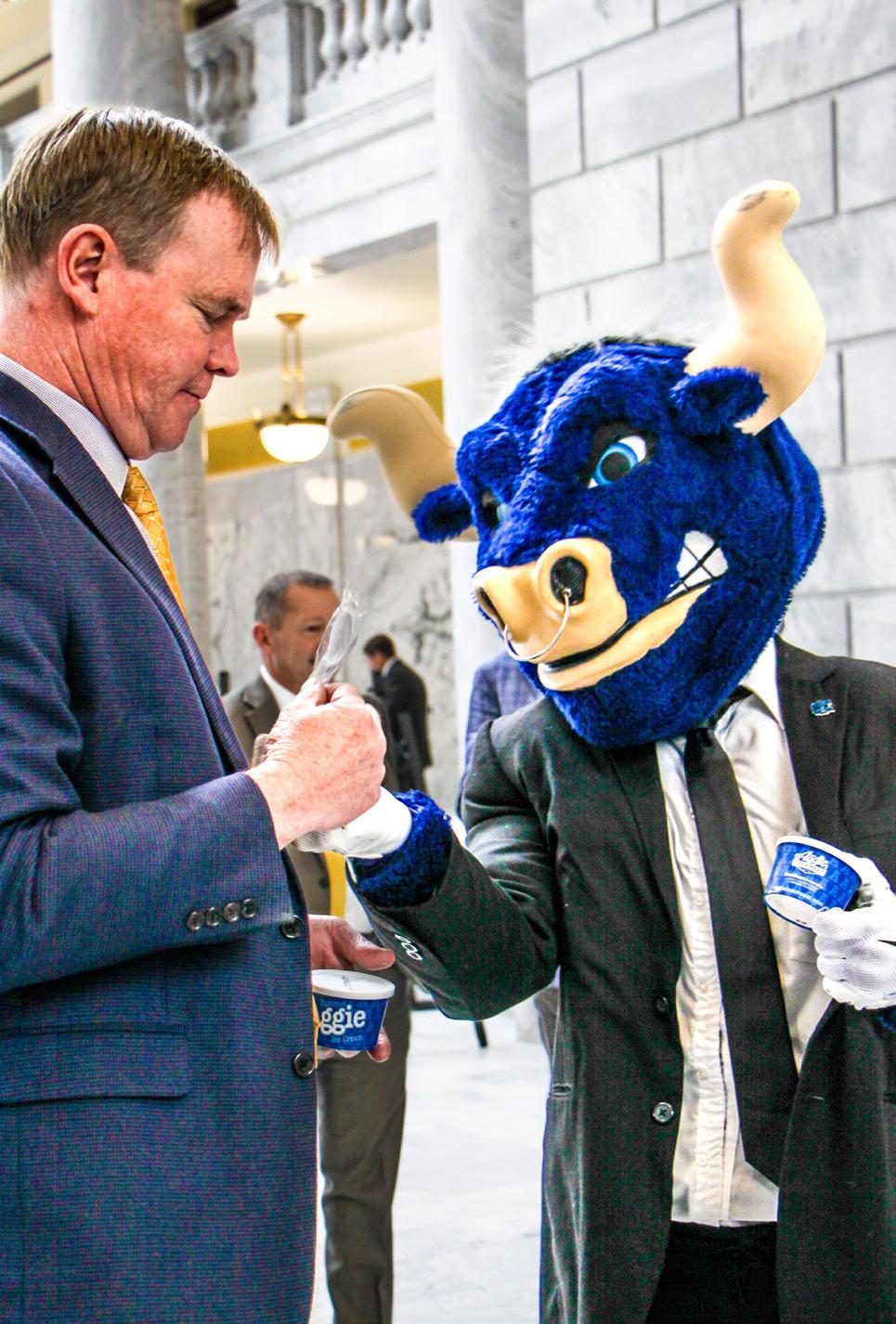
Big Blue hands out Aggie Ice Cream at the Utah State Capitol building during the annual Aggie Ice Cream Day on Feb. 19.
PHOTO BY Jack Burton Clark Croshaw warms up in the Dee Glen Smith Spectrum on Feb. 10.
Aggies launch homemade paper rockets with Engineers Without Borders
By Essence Barnes STATESMAN SENIOR REPORTER

Grab some of these ingredients at SNAC!
Ingredients:
1 can (15oz) chickpeas
¼ cup creamy peanut butter
3 Tbsp honey or maple syrup
1 tsp vanilla extract
¼ tsp ground cinnamon
⅛ tsp salt
¼ cup water
Instructions:
Add the chickpeas, peanut butter, honey/maple syrup, vanilla extract, ground cinnamon, and salt to a food processor
Process until smooth, scraping down the sides with a rubber spatula as needed. Add water as needed until the hummus reaches your desired consistency
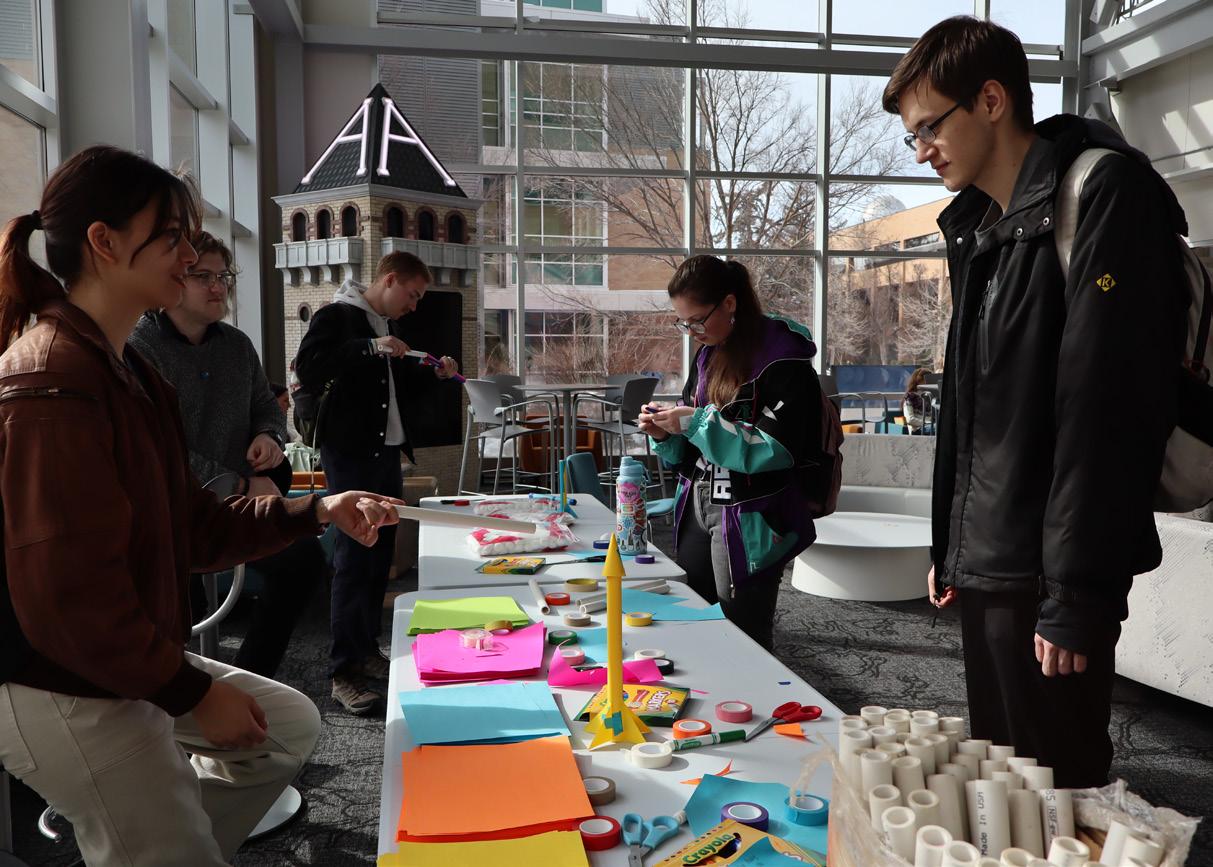
The high-pitched squeal of an air compressor echoed across the Utah State University Engineering Quad on Feb. 23 as students and staff launched colorful paper rockets into the air. The event, put on by USU’s chapter of Engineers Without Borders, or EWB, kicked off the celebration of National Engineers Week on Logan campus.
With guidance from members of the EWB club, event attendees designed their own foot-long rockets out of PVC pipe, colored paper and tape before putting their durability and efficiency to the test on the launcher.
“I’ve been into model rockets for years, but it’s such an expensive hobby,” said Nathan Housley, an engineering student at the event. “I think this is kind of a cool, entry-level model rocket opportunity.”
Abby Barton, president of the USU EWB, said the inspiration behind and the purpose of this event was simple: to have fun.
“Engineers can have fun, you know, and they don’t have to just work, work, work all the time,” Barton said. “We just wanted to give back
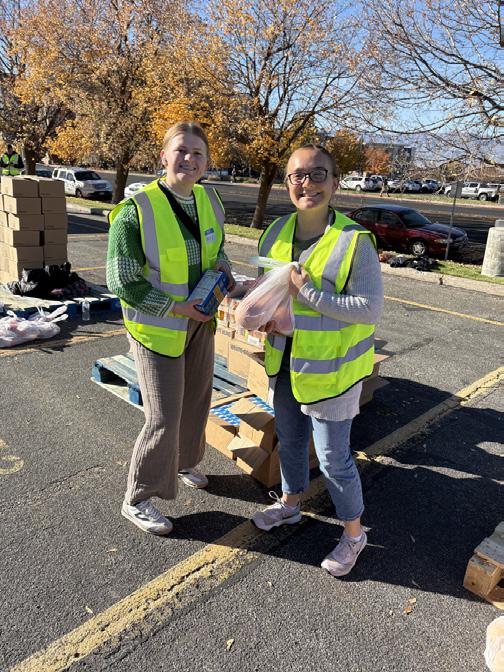
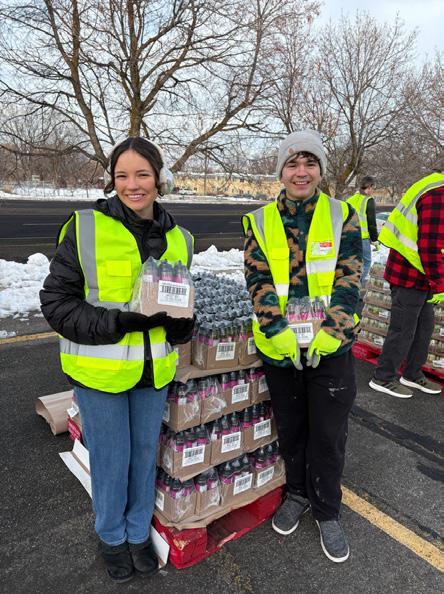
Volunteer at the Mobile Food Pantr y!
Going to be in Logan during spring break and need something to do? Why not give back to your community by volunteering at the Mobile Food Pantry?
Join us on March 10 from 8:30-11am in the Maverik Stadium parking lot! Volunteers help load food into cars, direct traffic, and sign in patrons Sign up by scanning the QR code below! th


to the college and host something fun for them too.”
The event allowed attendees to get hands-on with a simplified version of engineering that is creative and affordable.
“I think events like these are important because they allow people to do fun things outside of class,” said Emilie Caldwell, vice president of EWB. “This gives people opportunities to socialize and network in a more casual setting and to have fun and let off some steam.”
While not every rocket made it off of the launcher and into the sky, attendees said they enjoyed the social and accessible aspects of the event.
— essence.barnes@usu.edu
Some SNAC Stats
During the past year, SNAC has seen a significant increase in number of visits and students using SNAC. From 2024-2025, SNAC saw a 19.8% increase in students served, with over 36,500 visits in 2025, supporting 5,984 individual students - nearly 29% of the USU student body! SNAC frequently distributes more than 30,000 pounds of food each month, helping meet the needs of thousands of Aggies
In addition to distributing food, SNAC serves as a leader in food recovery efforts. With 14+ on- and offcampus businesses participating in food recovery efforts in 2025, SNAC saved over 38,700 pounds of food from the landfill and instead placed it in the hands of hungry students!
Beyond food access, SNAC is a hub for student engagement, education, and research Volunteers spent 1,444 hours at SNAC in 2025, and SNAC has played a part in over 140 projects with students from dietetics, social work, business, journalism, and more!

Peanut Butter Hummus
PHOTO BY Essence Barnes
Students make paper rockets at the Engineers Without Borders event in the Engineering Building, as seen on Feb. 23.
Karson Templin becomes fan favorite at USU
By Mark Greenwood STATESMAN EDITOR
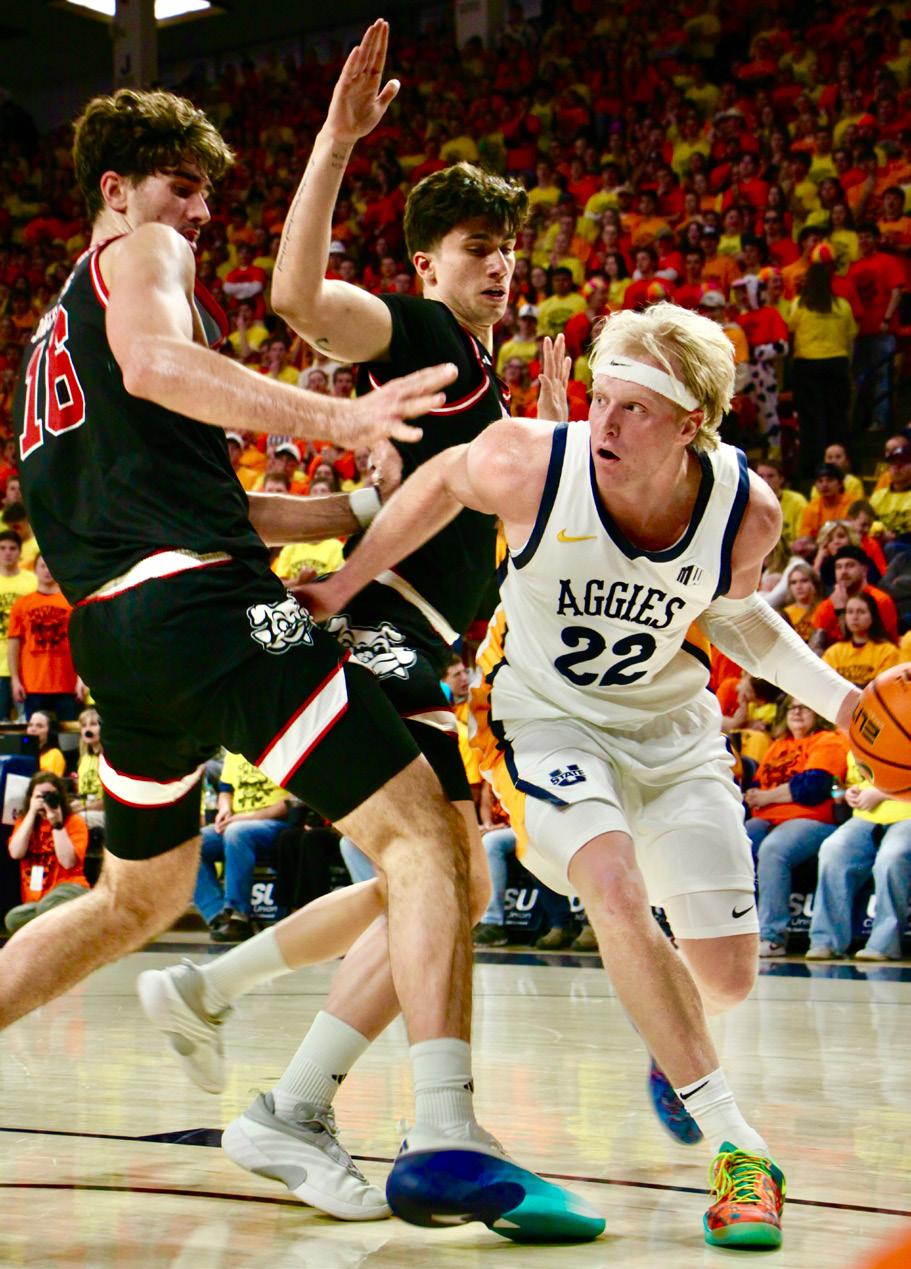
With his wavy, bouncing blonde hair held back by what has become a signature headband, junior forward Karson Templin has grown into a pivotal piece for Utah State University Men’s Basketball. In his third year with the program, Templin has not only played an important role for head coach Jerrod Calhoun’s Aggies, but he’s also become a fan favorite, as evidenced by the frequent, rhythmic chanting of his name by the HURD when he’s on the floor.
“I don’t really remember when the chant started, but I remember my freshman year, I didn’t play a ton. I played a little bit, but they had a little Karson Templin fan club, and they were all wearing wigs and had a sign,” Templin said. “That was a pretty surreal moment.”
That strong culture and bond between fans and players is part of what lured Templin to Logan in the first place.
“The culture of Utah State is just so good,” Templin said. Templin, a native of Fairview, Texas, originally committed to former USU head coach Ryan Odom in high school. Odom then left for Virginia Commonwealth University before Templin arrived on campus, leaving Danny Sprinkle at the helm to welcome him.
Even as the coaching carousel fired up again a year later when Sprinkle left for the University of Washington, Templin wasn’t fazed.
“I knew the fans and the guys who stayed around were going to be great, and so just knowing I was going to a winning program regardless of the coach,” Templin said.
“I didn’t know much about coach Sprinkle but just had the
confidence in Utah State as a school and a program, and it’s an amazing place. Logan’s great.”
This commitment to the program rather than any one coach is in part due to the relationship Templin has built with Mason Falslev. Falslev, a Cache Valley native, was involved in Templin’s recruitment to USU and has since played a role in keeping Templin around.
“We kind of clicked as soon as we met. He’s a really nice guy and a lot of fun, so I think that you can relate to anyone on any level, and since coming here, we’ve gotten pretty tight,” Templin said. “Me and Mason always talk, especially whenever the coaching rumors circulate. We’re like, ‘Hey, if you stay, I’m staying.’”
Though both players are juniors, Falslev is several years older than Templin, as Falslev went on a mission for the Church of Jesus Christ of Latter-day Saints out of high school and redshirted his freshman year. Partially because of that age gap, Templin considers Falslev a mentor and role model.
Recently, Falslev’s influence on Templin has extended beyond the hardwood.
“He loves it out here, and he’s begging me to find a girl from Cache Valley,” Templin said.
Standing at 6 feet and 9 inches, a height listing he thinks is generous, Templin is considered undersized for the position he plays. Many of the top forwards and centers in the Mountain West Conference have several inches on him, which can make battling them in the paint a difficult task.
Despite the size difference, Templin frequently tries to outperform bigger bodies through executing the intangibles.
“I’ve always been looked at as an underdog. I’m going to give everything I have on the court every night to help my team win,” Templin said. “Being undersized — you have to do the little things. You have to play harder, move a little faster than the big guys.”
In addition to trying to out-work the competition, Templin said he relies on another key factor to advance his game: the guidance of former Aggie Great Osobor. Osobor was a member of Utah State’s 2023-24 Mountain West champion team and was named the Mountain West Player of the Year for that season.
Templin was Osobor’s backup as a true freshman and credits Osobor for advancing his skillset in a number of ways.
“He kind of just showed me what it was like to be a college basketball player and work hard every day, and you have to take care of yourself and maintain a level of confidence,” Templin said.
Even since that Aggie team, the two have remained close, talking or texting several times per week.
“He’s just given me a lot of advice on things I need to do to improve my game and take my game to the next level,” Templin said.
Two years after winning the regular-season Mountain West championship and an NCAA tournament game with Osobor, Templin finds himself again in the thick of a race for a conference championship and an NCAA tournament run. This time, though, Templin is one of the top contributors for his squad — as was the case with Osobor before.
After appearing in all 34 games as a sophomore, Calhoun expected Templin to be a crucial contributor. Templin
started the first eight games of this season for the Aggies before freshman Adlan Elamin was inserted into the starting lineup, pushing Templin to one of the first off the bench. For many, this would be seen as a relegation to a lesser role. Templin, however, said he focuses on making an impact on the game in whatever way he can.
“I just kind of like being that spark plug off the bench,” Templin said. “We have probably eight or nine guys on this team who could all start at a lot of schools in the country, so it’s a lot of that. And starting or not, as long as I’m finishing games and helping the team win, I’m happy.”
As the season has grown old and the calendar gets closer to tournament time, Templin’s production has continued to improve, according to Calhoun. Templin’s experience has played a role in that uptick, but his head coach saw the potential the whole time.
“He fits our system really well. I think he’s really bought into how we play. I think he’s comfortable,” Calhoun said. “Confidence is a scary thing. When you get confidence, you’ve got to have it from your teammates, but the players have got to see it from the coach.”
About halfway through the season, Calhoun sat down with Templin and told him what the team needed from him and how he could get better in those areas.
“It wasn’t a very fun conversation. Coach said some things and motivated me in a lot of different ways, and I responded to that,” Templin said. “Credit to him. He knows how to coach me. Sometimes, I need to hear those things to get me motivated because he knows my potential more than I do. So yeah, it definitely has boosted me, and I’m glad he did that because it’s paid dividends for our team and for me.”
While Templin and the Aggies look forward to upcoming tournaments where they hope to make some noise, Templin’s experience looms large. Templin is one of five returners who played in the Mountain West and NCAA tournaments last year with Calhoun. The remaining 10 are a combination of freshmen and transfers, most of whom haven’t played in either tournament.
Templin is counting on his previous experience to help guide the Aggies to what they hope is a deep run in each.
“I’m excited to get a third crack at it, and I definitely know the type of atmosphere we’ll be playing in and how much build-up there is to that game,” Templin said. “It’s not easy playing on a big stage, and I think I’m ready for it this year more than I was last year and the year before, and hopefully I can get my teammates ready for it too.”
In the meantime, Templin, with his fan club sporting blonde wigs and headbands cheering him on, can be found diving after loose balls and sliding around the gym as several thousand students sing his name to their familiar tune.
Mark Greenwood is a junior at USU studying finance. He is an avid Los Angeles Dodgers fan and loves playing tennis.
PHOTO BY Hadley Sintay
Karson Templin, 22, looks to pass the ball in a game against Fresno State in the Dee Glen Smith Spectrum on Feb. 10.
Third annual ‘Tantrum Tracker’ raises money for Cache Community Food Pantry
By Alyssa Caywood STATESMAN REPORTER
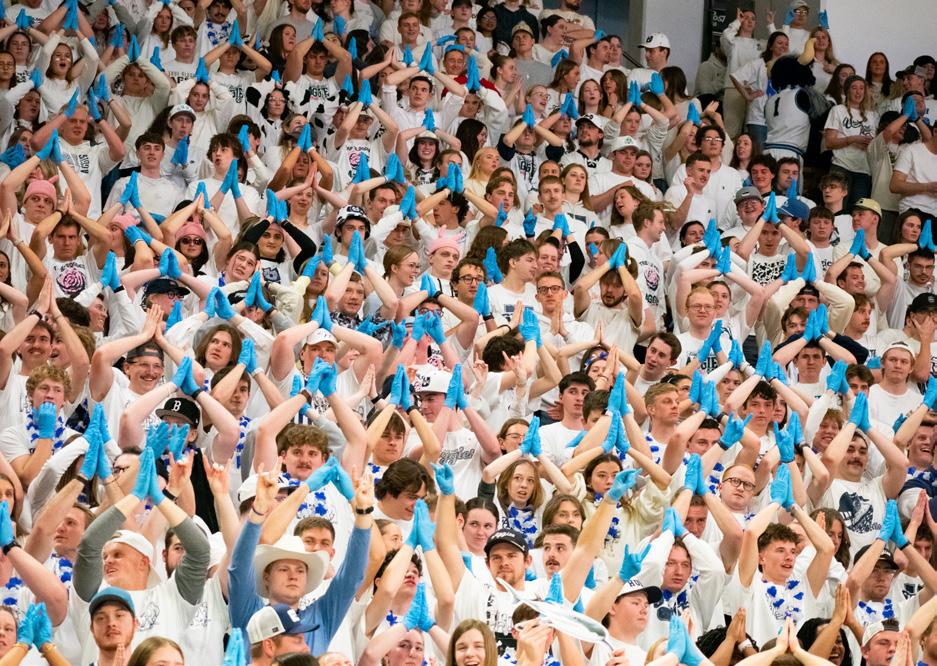
What once caused groans from the crowd instead caused an uproar of cheers. With every sideline outburst from the opposing coach, the third annual Leon Rice Tantrum Tracker Fundraiser turned “tantrums” into donation funds.
During the Utah State University men’s basketball home game against Boise State University on Feb. 18, USU’s student section, the HURD, raised over $1,500 for the Cache Community Food Pantry by tallying the number of tantrums thrown by BSU head coach Leon Rice.
A tantrum was tallied every time Rice got upset over a play and complained to the referee.
“If he’s going to throw such a fit all the time, then something good might as well come out of it,” said Natalie Baker, a sophomore studying marketing. “And
also, it’s funny.”
This tradition was started three years ago by Utah State graduate Adam Jessen when he was a student. Jessen said he was frustrated by the coach’s outbursts but came up with the idea to use them for good.
“I thought it was a really fun thing to do, and so I did it,” Jessen said.
The rules of the tracker have a tally added every time Rice complains or gets upset with the referee. Additionally, if he gets a technical, that counts as five tantrums, and if he gets ejected, that counts as 10 tantrums.
“For every tantrum that we tally, people can donate a certain amount to the Cache Valley food bank, so kind of like a fun run,” Baker said.
This year, the students tracked 35 tallies, resulting in a donation total of $1,572.38 to the food pantry, just under $45 per tantrum and over doubling the amount of last year’s donations.
Donations were made by individuals watching the game through the GoFundMe account Jessen set up for the event.
“When Adam came in this morning and gave us the check, it made my entire day,” said Matthew Whitaker, the director of the Cache Community Food Pantry. “I have never heard of something so funny in my life to raise money.”
While he has no close relation to the food pantry, Jessen finds it important to help local charities and bring good to the community. The money donated to the food pantry goes directly into aiding food-insecure families and individuals in Cache Valley.
“We can buy items for our backpack program for the children,” Whitaker said. “We can buy food items for the pantry program at the high schools. We can provide senior kits for this. We could buy foods that aren’t
donated. There are a lot of different ways we can use a donation like this, so it’s a pretty good impact for us.”
Jessen said Rice responded to the fundraiser by making a sizable donation himself to the food pantry.
“I think outside of basketball, he’s a good guy, and he’s a good sport,” Jessen said.
Jessen said he hopes to see this fundraiser continue as a tradition and to see other students take the initiative to follow through with their ideas.
“I just hope the HURD and students — they can continue to just be creative and do any dumb idea because any dumb idea can stick,” Jessen said.
Beyond sticking as a fun tradition, Jessen said this can also build up the Cache Valley community as students and community members seek ways to help each other and bring good to the community.
“I am just grateful for the community,” Whitaker said. “We cannot do what we do without support.”
water skiing.
— alyssa.caywood@usu.edu

Alyssa Caywood is a first-year student at USU studying journalism. She loves anything outdoors from backpacking to snowboarding to
PHOTO BY Elise Gottling Members of the HURD hold their hands up during a USU Men’s Basketball game against Boise State at the Dee Glen Smith Spectrum on Feb. 18.

Cardboard Boat Races
Rylee is a sophomore studying art education. She has her own photography business and has started photographing weddings this past year. When she isn’t creating, she can be found hiking, climbing, reading or doing something with friends.


Last week’s solution: