Lawmakers return $8.8M to Utah State
By Jayke Martin STATESMAN REPORTER
Utah State University has regained $8.8 million in previously withheld state funding after lawmakers signaled satisfaction with the university’s response to a legislative audit that raised concerns about governance and financial oversight.
USU President Brad L. Mortensen said he addressed lawmakers following the release of the audit.
“There were three times since the legislative audit came out that I addressed the legislature — first at the audit committee, then at the Higher Education Appropriations Subcommittee,” Mortensen said. “I had received word before that they were satisfied with our response to the audit so to try to keep my remarks to 30 seconds, and so that’s what I tried to do.”
The restored funding is part of a three-year strategic reinvestment plan. Mortensen said the university will submit its year-one report to lawmakers.
“We’ll give our year-one report this summer to the Higher Education Appropriations Subcommittee again and continue to keep them apprised as we move forward,” Mortensen said.
In response to the audit, the university implemented additional safeguards intended to strengthen oversight of spending and administrative processes. The USU Board of Trustees now reviews the USU President’s Office budget quarterly, and advance notice is required for expenditures above certain thresholds.
“One of the big findings from the audit is that oftentimes we have policies in place. We just weren’t as diligent as we should be at following those policies here in the past,” Mortensen said. “We’ve built in some checks and safeguards.”
Mortensen said there’s an emphasis on clearer communication with legislators and students to ensure spending aligns with both state expectations and campus priorities. This is a shift from former USU President Elizabeth Cantwell, where the legislative audit found procurement policies at USU were not consistently followed.
“It’s not that we can’t spend money, but we just want to make sure that we’re being transparent about it and using it for purposes that align with what the university needs,” Mortensen said.
Beyond governance changes, the reinvestment process resulted in structural shifts across campus. There were 14 academic degree programs eliminated, and colleges were consolidated to reduce administrative costs. Eight colleges were reduced to five, decreasing the number of dean’s offices and related expenses.
“The big impact on students was that there were obviously a lot of degrees that got cut,” said Max Alder, executive vice president and president-elect of USUSA. Students already enrolled in affected programs were able to finish their degrees, but new students could no longer declare those majors. University officials also reviewed certificate offerings in an effort to reduce duplication and focus resources more strategically.
“In this day and age, there’s a lot of, just, mistrust of

institutions, and colleges and universities kind of fall under that,” Mortensen said. “I feel like if we’re doing the work that advances the institution, that provides for meaningful experience for students and aligns with the policies and things of the state, then we really don’t have anything to hide.”
Alder said transparency regarding university funding and expenditures will remain important for students navigating the changes.
“I think that any student that has a reasonable enough reason to want to know should be able to find that fairly easily,” Alder said.
The university plans to measure the success of its reinvestment efforts through enrollment trends, graduation rates and student debt levels.
“At the end of the day, it really comes back to how our students feel about their university, and we want to be a university that they can be proud of,” Mortensen said.
Although the audit findings predated his presidency, Mortensen said maintaining confidence requires consistent leadership.
“I try not to take for granted the kind of trust and confidence people are showing in me because we have to make good decisions on a daily basis in order to keep that,” Mortensen said.
Since taking office, Mortensen says he has focused on addressing past audit findings while also looking ahead to campus growth and program development. Efforts to improve transparency and streamline
administrative processes have set the stage for future initiatives across academic programs and statewide campuses.
“There is so much momentum at Utah State,” Mortensen said. “I’m excited to get to work on that part of the university instead of just responding to the audit.”

Jayke Martin is a junior studying journalism with a minor in theater. She loves reading and meeting new people.
— jayke.martin@usu.edu
PHOTO BY Hadley Sintay
The Utah State Capitol building, as seen on Feb. 19.
Tanner Chase receives Aviation Week Network 20 Twenties award
By Jayke Martin STATESMAN REPORTER
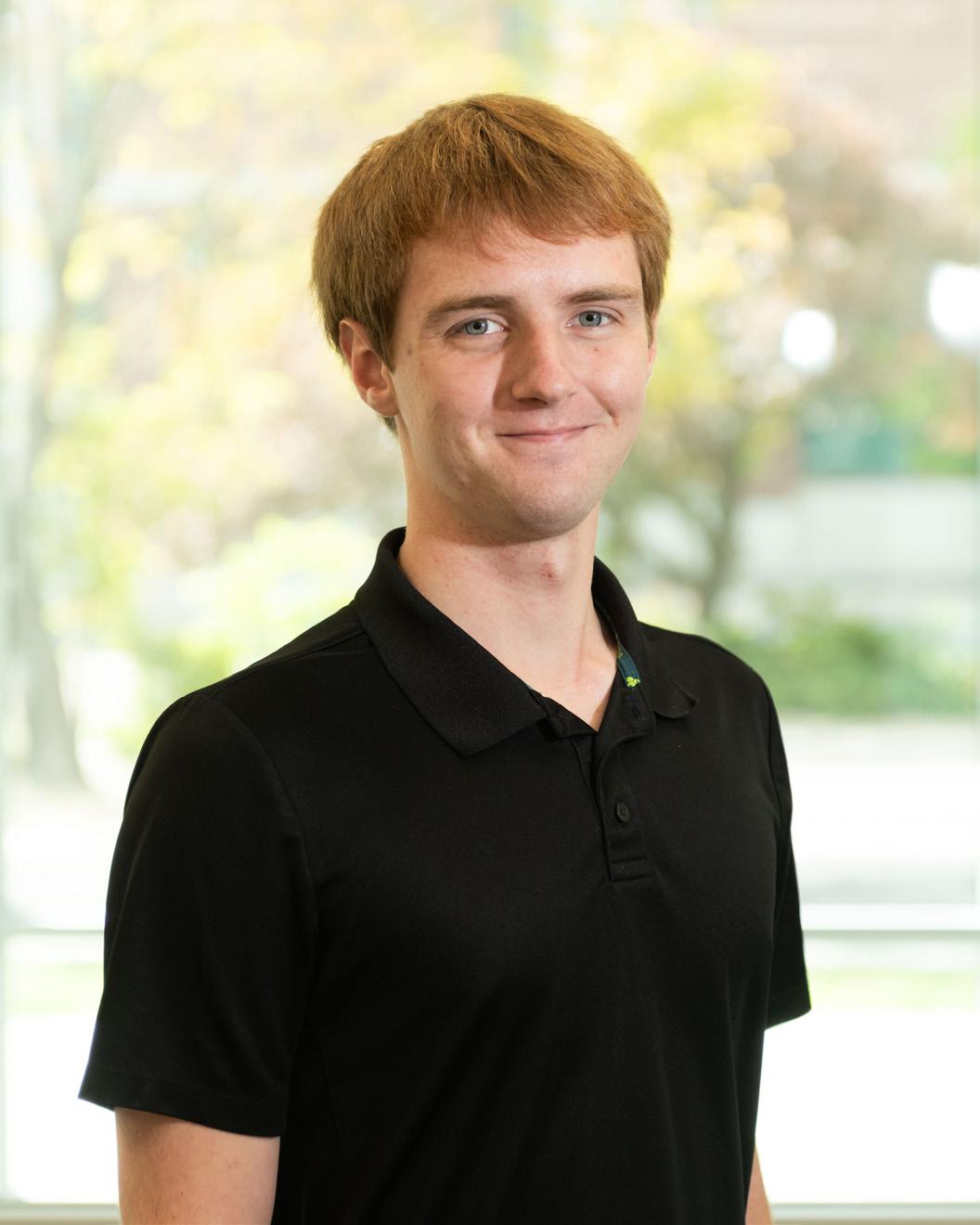
Tanner Chase, a senior majoring in computer engineering and a concurrent master’s student at Utah State University, has been named a class of 2026 recipient of the 20 Twenties award from Aviation Week Network.
The national program highlights 20 students each year whose technical achievements and leadership show strong potential to influence the future of aviation, aerospace and defense.
“The idea behind the 20 Twenties program is that Aviation Week Network is trying to identify individuals in their early twenties that they feel could potentially change the course of the aviation or aerospace defense sectors,” Chase said.
Chase said the honor reflects the collaborative nature of research and engineering work rather than a solo accomplishment.
“This recognition doesn’t feel like necessarily an individual recognition, even though it is,” Chase said. “There are a lot of people who have gotten me to the place that I am today and helped with the work that I do and moving that forward, especially my team.”
Since arriving in Logan, Chase has been involved in high-level research at the Space Dynamics Laboratory, where student engineers contribute directly to active aerospace projects.
“Some work that I’m doing at Space Dynamics Laboratory is where I work on novel techniques for advanced flight control,” Chase said.
He joined the SDL early in his college career after gaining industry experience.
“I started as a freshman, started right after I moved to Logan from the Kansas City area, where I just finished an internship with Oracle,” Chase said. “I knew they were out here. I submitted a couple of applications and was fortunate enough to be brought on and have been with them ever since.”
According to Tom Bernhardt, a program manager at SDL, Chase quickly demonstrated the technical ability to handle assignments typically reserved for more experienced engineers.
“We would give him some pretty complex tasks on par with engineers that have been with the company for three to four years or even longer, and he was very successful at completing those tasks,” Bernhardt said. “He’s only the second person that I’ve seen hired at SDL right out of high school.”
Bernhardt said Chase’s approach to engineering is defined by curiosity, discipline and collaboration.
“You have to be very curious and really dig down to the details,” Bernhardt said. “He works hard, and he’s a pleasure to be around. Everybody loves working with Tanner, and everybody wants Tanner on their team.”
The recognition also brings national attention to Utah State and its research partnerships, Bernhardt said.
“It’s great for the Space Dynamics Laboratory, but really, it’s also reflective of Utah State University,” Bernhardt said. “Even though we’re a small college up in Logan, Utah, it does show that we can compete across the nation.”
Chase said his interest in engineering continues to drive his academic and professional goals.
“Engineering is just really cool,” Chase said. “The work that I’m doing at SDL can really have an impact, particularly in the aerospace and defense sectors.”
After graduation in May, Chase will remain at the SDL in a full-time role.
“We continue to expect him to do great things for us,” Bernhardt said.
Chase said he remains focused on growth and innovation as he looks ahead.
“Right now, I think I just want to kind of keep learning, keep building these cool systems, these important systems, and keep innovating,” Chase said.
Caywood
Colvin Jayke Martin
McNeill
Moore
Nielsen Jillian Peterson
Shelite
Ferraro

PHOTO SUBMITTED BY TANNER CHASE
Tuition set to increase by 3.36%
By Jillian Peterson STATESMAN REPORTER
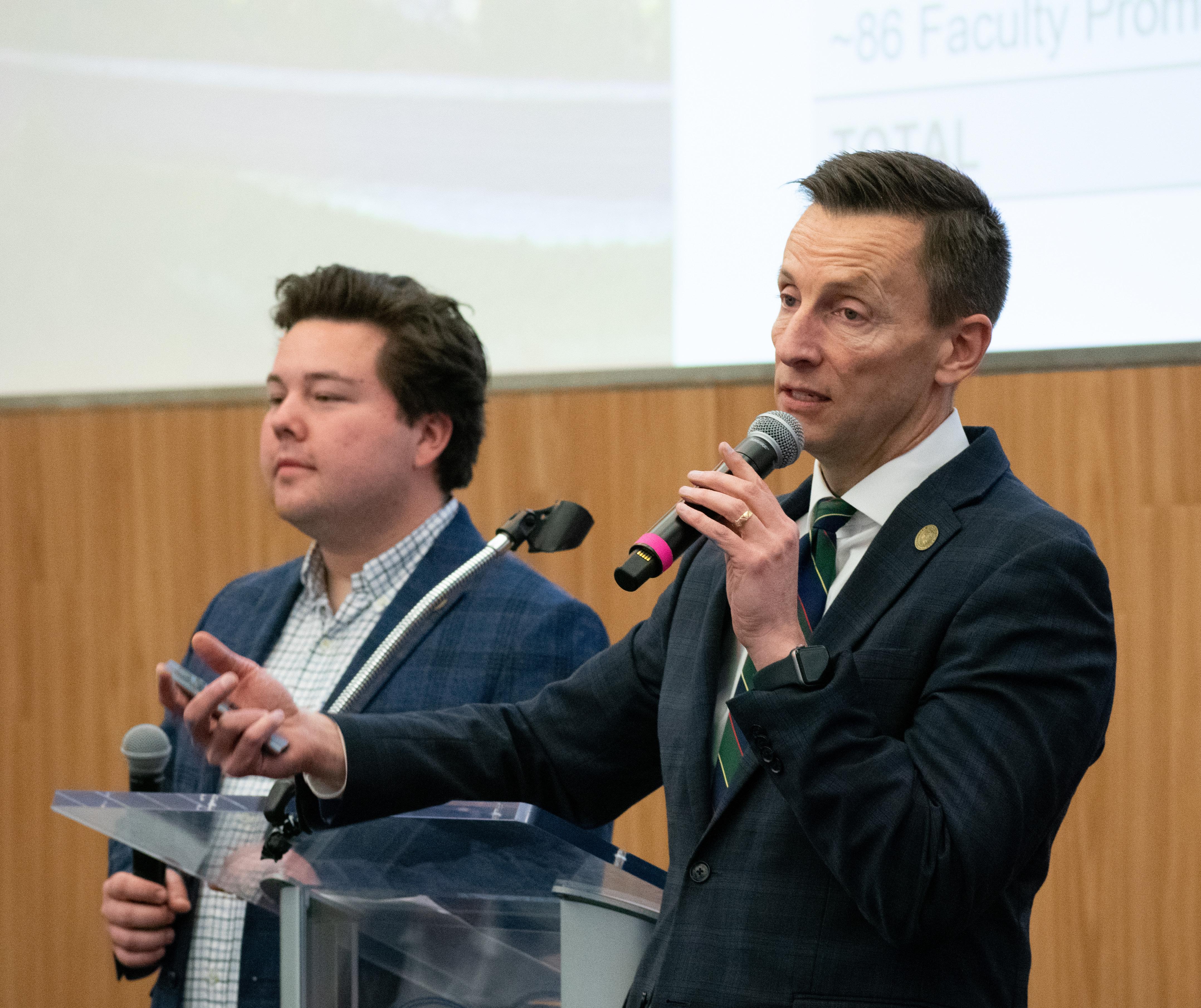
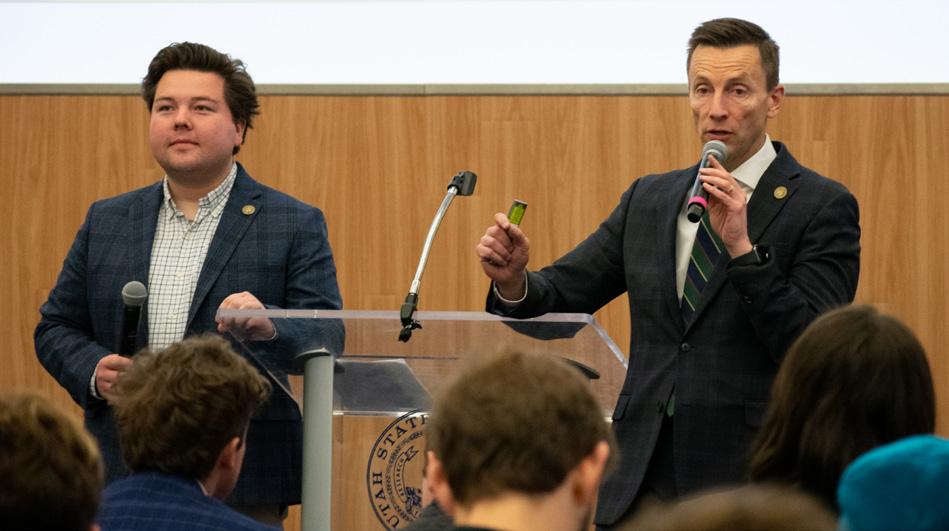
Utah State University President Brad L. Mortensen and USUSA President Brandon Sorensen announced an expected 3.36% tuition increase and a $145 student fee increase at the annual Truth-inTuition Hearing on March 2. The hearing was held in the Big Blue Room in the TSC and broadcast statewide.
The tuition increase, which will amount to $4,804,500, is for faculty salary increases, health and dental benefits, internal service funds and 86 faculty promotions.
The tuition increase rate will be the same for undergraduate, graduate and online students. However, tuition will not increase for students at specific statewide campuses with under 65 credits.
According to Mortensen, there is typically an average of a 3.1% tuition increase, with inflation increasing about 3.5% per year. This is the third year in a row tuition has increased by roughly 3%.
Some areas of tuition will remain the same in the coming year, according to Mortensen.
“In the past, the differential tuition that gets charged for a number of our programs has gone up by the percentage of the general tuition increases, but we’re not doing that this year,” Mortensen said. “The differential tuition rates will remain the same per credit hour.”
Some student fees may be moved into tuition in accordance with Utah System of Higher Education Policy R516, which is reviewed every five years. These fees include the $32.02
library fee and the $56.72 technology fee. This swap will not influence cost for students.
The proposed increase in student fees is for Aggie Shuttle, campus recreation and athletics.
The largest fee increase will be for athletics, which comes after the announcement USU will be moving to the Pac-12 on July 1.
“I know a lot of students feel like a big part of their collegiate experience is being able to participate and attend our athletic games, and we want to root for the winning team,” Mortensen said. “Unfortunately, in this environment, college athletics in 2026 just costs a lot of money. But at the same time, we know that puts a burden on all of our students who may not participate in that, so we’re trying to balance that as much as we can.”
The athletics fee is proposed to be a one-time increase that will be reevaluated next year.
According to current USUSA Executive VP and USUSA President-elect Max Alder, who chairs the USU Student Fee Board, the increase for the Aggie Shuttle is to buy new buses.
“These new buses are more expensive but are designed to last significantly longer and be much more ADA accessible,” Alder said.
The campus recreation fees, according to Alder, are to allow for more student jobs, purchase more gym equipment and offer free fitness classes.
“Right now, if you want to take a fitness class, you have to pay a small fee,” Alder said. “Because these classes are there for both the physical and mental health of students, we were more than happy to recommend this fee increase to support these programs.”

Jillian Peterson is a sophomore studying communication and media. She is a big fan of concerts, snowboarding and the Taco Bell drive-thru.
— jillian.peterson@usu.edu

February 25
Officers responded via telephone to a property damage incident at Old Main. The complainant reported graffiti on the walls of the men’s restroom on the first floor and advised that a similar incident had happened over the weekend. No witnesses or suspects are known at this time.
February 26
Upon arrival at the rock garden located north of the Aggie Parking Terrace, officers observed graffiti on the tops of the garbage cans. No footage was located of anyone tampering with garbage cans.
A note from USU Police
There has been an uptick in vandalism on campus. Repairs from vandalism cost roughly $400,000 annually. Individuals caught for graffiti in Utah face serious criminal charges and significant fines, with penalties scaling from class B misdemeanors to seconddegree felonies based on the cost of damage. Punishments include jail time (up to 15 years for major felony damage), heavy fines, restitution for cleanup costs and potentially 90% surcharges. If you have any information regarding the two noted incidents, please contact the USU Police Department at 435797-1939.
PHOTO BY Elise Gottling
USU President Brad L. Mortensen and USUSA President Brandon Sorensen speak at the Truth-in-Tuition Hearing in the Big Blue Room on March 2.
Utah Public Radio co-managers to retire this upcoming fall
By Grace Colvin STATESMAN REPORTER
For the larger part of four decades, countless Utahns have tuned in to Utah Public Radio and heard the voices of co-managers and show hosts Kerry Bringhurst and Tom Williams. Now, the pair is heading off-air and into retirement.
On Feb. 4, the Utah Public Radio team announced via their website and social media that current co-managers Bringhurst and Williams will be retiring from their positions in the fall of 2026. Bringhurst will make her final on-air appearance on Aug. 27 — which, coincidentally, is her birthday — with Williams ending his work with the company later in September. Both Utah State University graduates, the team has been working for UPR for the past several decades.
“We’re calling it the end of the Tom and Kerry show,” Bringhurst said.
According to the official press release announcing their retirement titled “Tom Williams and Kerry Bringhurst announce retirement from UPR this fall,” the pair “expanded local programs, improved broadcast services in rural communities … and earned recognition for outstanding community engagement” during their time at UPR.
In addition to managing the company, Bringhurst and Williams are also on-air personalities, hosting the “Morning Edition” and “Access Utah” programs.
Located on USU Logan campus, UPR’s reach extends beyond Cache Valley and through the entirety of Utah and parts of Idaho. Bringhurst’s and Williams’ work has garnered listeners from across the state. According to Bringhurst, she and Williams have accomplished everything they set out to do.
“Our dean at the time, who’s also our dean now, Joe Ward, had outlined objectives of what we needed to do in order to keep Utah Public Radio in operation at Utah State University,” Bringhurst said. “I felt like we had accomplished, really, what the dean had asked us to do, and I felt really good about where we were as a station.”
Bringhurst started her work with UPR after graduating from USU in journalism. After taking a 14-year hiatus to raise her family in 1993, she returned to the company full-time in 2007. Along with Williams, she was appointed co-manager in 2019. Now, as she prepares to host the “Morning Edition” for the final time, she said she looks forward to spending more time with her family.
“I’ve done what I promised to do, and I feel good about it, and I’m excited for the future,” Bringhurst said.
While Bringhurst was the first to announce her departure, Williams said he found it only natural to leave at the same time.
“We came in together,” Williams said. “I love UPR, have loved my time here, but it feels like it’s the right time to make a change and go out to new opportunities.”
Williams has been involved with UPR since the 1980s and earned a bachelor’s degree in liberal arts and an

MBA from Utah State University.
As Bringhurst and Williams prepare to step away from the program, they expressed their excitement for UPR’s growth under new management.
“As things have progressed, I think it also is making sense for the station to have somebody come in that has some fresh ideas, maybe some different connections and perspectives as far as what’s happening nationally in the media world. It’s time to take things to the next step,” Bringhurst said.
At the time of this publication, the search for a replacement manager is still underway. Bringhurst claimed the replacement will have a greater involvement with USU’s educational staff by teaching classes as well as managing the company.
However, no matter what the future holds for UPR and its future staff, Bringhurst and Williams expressed deep gratitude for their time on-air and the impact UPR has on Utah.
“When you hear from somebody in St. George or Moab or Vernal or Delta somewhere say, ‘Hey, that conversation you had, that information you shared, that meant something to me’ — that’s a good feeling, that you’ve strengthened your community in that way,” Williams said.
Bringhurst agreed with Williams.
“I’m proud of Utah Public Radio,” Bringhurst said. “What we do is important. The work that the staff does is important.”

Grace Colvin is a sophomore in the theater education program at USU. After graduation, she plans to become a middle school drama teacher. When she isn’t writing or working on a play, she loves making crafts and woodworking.
— grace.colvin@usu.edu

PHOTO BY Dane Johnson
The communications tower, located at the Utah Public Radio building on USU Logan campus, as seen on Feb. 19.
PHOTO VIA UTAH PUBLIC RADIO
Tom Williams, left, and Kerry Bringhurst.
The Utah Avalanche Center keeps people on ‘the greatest snow on Earth’
By Mia Nielsen STATESMAN REPORTER
According to forecaster Toby Weed, the goal of the Utah Avalanche Center, or UAC, is “to keep people on top of the greatest snow on Earth.”
At UAC, Weed puts out a daily avalanche forecast based on the weather, reports from backcountry skiers and infield assessments.
“If I’m not looking at avalanches, I’m digging in the snowpack with a shovel,” Weed said.
According to Weed, avalanches are very common and happen after almost every storm in the area.
“There can be hundreds from some storms, whereas other storms, like the one that we had this week, only produced a few,” Weed said on March 4.
Skiers and snowboarders use his forecast to plan their days and stay safe in the backcountry.
The forecast, which can be accessed on the UAC website or app, provides more than just a daily high or low danger level. Weed provides in-depth information about the conditions and tips for how to stay safe.
Abigail Budge is the outreach officer for the Utah State University Snow Club with backcountry ski experience. She advises new backcountry visitors to go with someone with experience, play it safe, read the forecast and take safety gear: a shovel, probe, airbag and functioning beacon.
“I always read the forecast before I go. I think a big thing too is knowing weather patterns,” Budge said. “As far as just avalanche risk and safety, we talk a lot about risk tolerance. I have a pretty low risk tolerance. If conditions are really dangerous, I stay on stuff that’s really safe, that I know is going to be safe.”
According to Budge, USU Outdoor Programs offers backcountry tours and avalanche safety training new backcountry visitors may find useful. The UAC also offers trainings.

Ethan Syphus, a senior studying mechanical engineering, took a UAC class where he learned how to rescue someone buried in an avalanche. The group went to Tibble Fork Reservoir, where instructors buried a beacon and sent students to find it.
“First, you have to find the person with your beacon, and then you have to probe. You have this, basically, tent pole that you pull out of your backpack. You put it together, and then you stick it through the snow and try and feel for the person. Once you feel them, you have to dig them out as fast as you can,” Syphus said.
According to Syphus, if the person is not reached within 10 to 15 minutes, they will suffocate under the snow.
“I would not ski with someone who had not been trained because if I’m with someone and I get stuck in an avalanche, they’re the ones that have to pull me out, so I want them to know how to do that because they’re saving my life. I’m not saving my own life,” Syphus said.
Weed said this winter has primed snow for avalanches.
“When we don’t get much snow, we don’t really have many avalanches, but the snow that’s on the ground gets really weak, and so it sets us up for increasing avalanche danger once we get snow like right now,” Weed said.
According to Budge, the arrival of snow in a dry winter presents a dangerous temptation.
“A lot of times when you get new snow, everybody’s super stoked and wants to go out and ski, but when you have big gaps between snowfall — a new storm that comes through that dumps in a lot of snow — typically then heightens the danger a lot,” Budge said. “So it’s good, especially on those days when you’re getting really
excited to go out and ski, to just make sure you evaluated your risks and are in safe terrain because those can be the funnest days, but those can also be the most dangerous days, especially with a season like this.”
According to Weed, people can stay safe in the backcountry by avoiding slopes steeper than 30 degrees and staying spread out as they travel.
“We advise people travel with a partner and that they cross a slope steeper than 30 degrees one person at a time while the rest of the group watches from a safe spot and ensure that everybody in the group has avalanche equipment — a transceiver, probe and shovel — and knows how to use it,” Weed said.
According to Weed, following these protocols saves lives.

Mia Nielsen is a sophomore studying plant science and journalism. When she’s not writing, she enjoys live music, driving up Logan Canyon and daydreaming about moving to Spain.
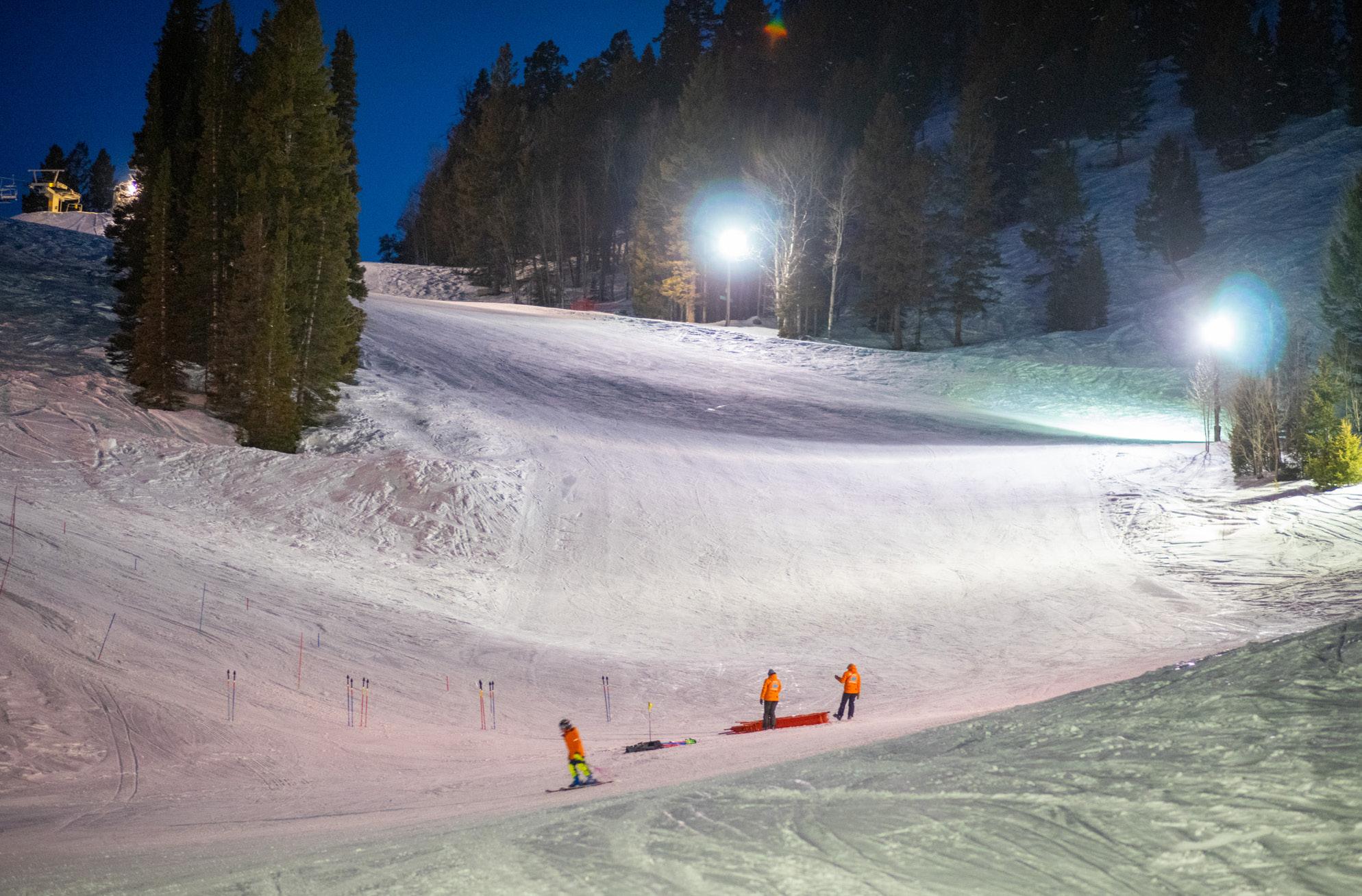
Workers do maintenance on a run at Beaver Mountain Ski Resort on March 3. PHOTOS BY Dane Johnson
A snowy mountain is seen in Logan Canyon on March 4.
Norm Jones remembered for devotion to students
By Dylan Moore STATESMAN REPORTER
Utah State University is mourning the loss of longtime history professor Norman L. Jones, known to students and colleagues simply as “Norm,” whose decades of teaching left a lasting mark on the university and the broader community, according to a former student and university faculty member.
Jones, a scholar of the English Tudor period and the history of Christianity, joined the USU History Department in 1978. According to the Utah State Today article “USU Mourns the Passing of History Professor Norman Jones,” he went on to serve in numerous leadership roles, including department head, and authored 11 books during his academic career.
F. Ross Peterson, a retired history professor who was part of the team that hired Jones, said the department knew early on they had found the right person.
“We hired Norm in part because of his expertise in the history of Christianity, as well as his ability that we had seen during his interview displays as a lecturer,” Peterson said. “We needed people that were absolutely dedicated to teaching, and he was.”
Jones earned his doctorate from the University of Cambridge and built his scholarly reputation studying early modern England, particularly the religious and political transformations under Henry VIII and his successors. However, his colleagues say his research, while significant, was never the whole story.
“I think what he’s going to be mostly remembered for is how he helped facilitate opportunity for students,” Peterson said. “The purpose of a university is to give young people the opportunity to become knowledgeable. Our job is to teach them to learn and to find what they’re passionate about. He was a master at that.”
During his years as department head, Jones advised dozens of students each year, meeting with them directly to plan courses and career paths. Peterson described him as deeply committed to the idea that universities exist first and foremost for students.
“The university exists for those students — not for you, not for me,” Peterson said. “I think that’s where he dedicated his life.”
For former student Joseph N. Anderson, now assistant director of Logan Library, Jones was the reason he chose Utah State.
As a prospective transfer student interested in British history, Anderson learned the department chair at USU had studied at Cambridge and specialized in Tudor England.
“That was a huge draw,” Anderson said. “The opportunity to come study in a department with someone who had studied over there — that was very appealing to me.”
Anderson first took Jones’ medieval civilization course in 2005 and quickly noticed his command of the material. More importantly to Anderson, Jones emphasized


The “Statesman Sports Desk” is a weekly radio show hosted by the Statesman Sports Editor Mark Greenwood and Senior Reporter Carson Frost. It covers in-depth analysis, special guests and other inside information on Aggie Radio 92.3 FM.


primary sources, the voices of people who lived during the eras being studied.
“He always emphasized original sources,” Anderson said. “We weren’t just reading what other people had said about the time period. We were reading the voices of people who were actually living during that time.”


Dylan Moore is a junior majoring in political science and minoring in anticipatory intelligence and Russian. He always loves going on outdoor adventures and cooking.

Monday, Feb. 2, 2026: Utah State Director of Athletics Cam Walker




Tuesday, Nov. 11, 2025: 18th President of Utah State University Brad L. Mortensen
Monday, Feb. 16, 2026: USU Volleyball’s new head coach Keith Smith
Monday, Nov. 3, 2025: Utah State Soccer head coach Manny Martins
Monday, Feb. 9, 2026: Utah State Gymnastics head coach Kristin White and junior gymnast Isabella Vater
STATESMAN FILE PHOTO
Norm Jones gives a lecture on the book “The Davinci Code” in 2004.






More than a game: Utah State pitcher
Emmalyn
Brinka finds home in softball
By Alyssa Caywood STATESMAN REPORTER
Beyond just a game, senior Utah State softball pitcher Emmalyn Brinka said she sees her sport as a place for commitment, community and development.
“I think it kind of bleeds into everything,” Brinka said. “I feel like softball has been the one thing that’s really kind of modeled me into the person that I am as far as discipline goes, as far as drive in the classroom and just especially with relationships.”
Brinka said she remembers the first time she ever stepped on the softball field. She had grown up trying several different sports, and one day, her dad Paul Brinka took her out to play catch.
“He went home and told my mom that we should probably find me something else to do,” Emmalyn Brinka said.
Despite the initial rough start, Brinka said her determination and hard work, along with the support of her family, helped her develop into a collegiate-level softball athlete.
Brinka and her family moved across Montana, where she joined her first travel ball team.
“She ended up playing her first year of travel ball there in Missoula, Montana, and she was hooked from there,” Paul said.
Paul said Brinka continued to work hard demonstrating grit, developing her skills and fulfilling her passion for softball.

“It turned into something that’s been really amazing for me,” Brinka said.
Brinka grew up for most of her childhood in Montana but moved around seeking out softball recruiting opportunities.
The teams she played on and the coaches she worked with each helped push her toward success alongside her own personal determination, according to Brinka.
Today, Brinka is a successful pitcher for Utah State University, but everyone has to start somewhere. For Brinka, that somewhere was in a 10U tournament in Great Falls, Montana.
“Everybody thought she should be a pitcher because she’s really tall, so she asked the coach one time if she could pitch,” Paul said.
The coach put her in to pitch. After walking 10 girls and having four or five hits off of her, the coach made the decision to move her to right field for the remainder of the game.
Once they returned to the car, Paul said Brinka looked to her parents and said she was so glad she would never have to pitch again.
“Right about two minutes later, coach walks up to my driver’s side window, has me roll down the window and looks at her and says, ‘Are you going to be ready to pitch tomorrow, too?’ And she just bucked up and said, ‘Yes, coach. I’ll do whatever you want me to,’” Paul said.
From there, she practiced pitching, improving her skills and developing into the collegiate-level athlete she is today. Now, USU Softball head coach Todd Judge calls her USU’s ace pitcher.
“There’s not a better kid in our program,” Judge said.
Brinka’s mom Becky Brinka said her daughter’s determination and discipline is what got her where she is today, but what really stands out to her is the strength Emmalyn Brinka demonstrates both on the mound and in other areas of her life.
“Her strength both physically and emotionally — she does things that just blow my mind that most people can’t do,” Becky said.
Brinka follows a regimented schedule that includes practicing softball, staying healthy, helping others, focusing on academics and spending time with those she cares about.
“I really value personal growth and continuously growing as I get older and as I become more mature,” Brinka said. “It’s kind of just always the goal to just continue to get to the highest level that I possibly can.”
Brinka said she appreciates the competitive edge and good coaching USU’s softball team has provided for her.
“We have a great community of people here at the university, as well as great coaching,” Brinka said. She said she enjoys the environment of everyone working to get better and is happy to be a part of the Aggie family.
“This team is really important to me,” Brinka said. Brinka’s drive to work hard for improvement and
appreciation for teamwork also helps her be a leader to others and encourage them to do the same, according to Paul.
“Every team that she’s ever gone to as far as travel ball, high school, she always took a leadership role,” Paul said. “Some of the proudest moments for me is when the coaches would call me and actually tell me what kind of leader she is.”
Brinka said the traits she has developed through softball help her in other areas of her life, such as academics. She is majoring in communications and minoring in sociology and real estate.
Moving around when she was growing up and looking at houses online ignited Brinka’s interest in residential real estate.
“I really do love helping people, so having the opportunity to do that and get people in their dream homes, especially families, just sounded like a lot of fun to me,” Brinka said.
Brinka said her parents’ support and kindness has been a large inspiration to her and has encouraged her to work on herself both in and out of her sport.
“The way that they pour so much of themselves into other people and they have in myself has really inspired me to just be the best person that I can possibly be, whether it’s on the field or behind closed doors,” Brinka said. “I think they’ve really inspired me to be that kind of person.”
Through drive and determination, Brinka plans on continuing to better herself. She is excited to see where the upcoming season goes and how much she and her team can accomplish.
“I hope that everything that she wants in life happens,” Becky said. “I know with her work ethic and her allbusiness lifestyle that she’ll make it happen.”

Alyssa Caywood is a first-year student at USU studying journalism. She loves anything outdoors from backpacking to snowboarding to water skiing. She loves to write and is stoked to be working with the Statesman. — alyssa.caywood@usu.edu
Emmalyn Brinka delivers a pitch in a Utah State Softball game against Abilene Christian University on Feb. 5.

By Mark Greenwood STATESMAN EDITOR
When this step-by-step series started, one of the first things that came to mind was serving a tennis ball. As an avid tennis fan, I’ve always enjoyed watching the different serve rituals of tennis players. The most notable in my mind is that of 22-time grand slam champion Rafael Nadal.
The King of Clay had a very particular service routine, adjusting his clothing and tucking his hair behind his ears and headband before tormenting his opponents.
In our latest step-by-step, Utah State Men’s Tennis player Jean-Baptiste Badon was gracious enough to teach me his service ritual, one that has propelled him to a strong start to the season at the top singles position for the Aggies.
Badon, as every tennis player I’ve met or played with, has a service routine that he follows each time he steps up to the service line.
When he gets to the line in the ad court, he first angles his foot towards the outside net post to get his alignment correct. He then will count to five, usually in the form of bouncing the ball five times, before looking over the net and to his opponent.
“Even though I might bounce the ball maybe 10 times, if I don’t count to five, I’m not ready to serve,” Badon said.
After that, he takes a deep breath, looks across at his target and starts his serve windup.
In his serve windup, he holds the ball in the middle triangle of his racquet, tosses the ball into the air and launches up into the ball. This is frequently accompanied by a verbal counting to three, one count for each of those motions.
“I don’t count out loud too often, but sometimes when I’m nervous, I will literally say ‘one, two, three,’” Badon said.
This routine does not change whether he is serving up the T, out wide, first serve or second serve.
“You want to try and do the same thing as much as you can,” Badon said. “No real changes, especially with the toss.”
The toss is something Badon emphasized several times, including on several occasions when I took over, set on imitating his service ritual. The toss, after bouncing the ball five times, needs to go straight up with no side-to-side motion.
After watching Badon serve a couple of times, I took over at the service line.
It took a couple of serves going into the net and out long with some intermittent instruction, but I was able to land a serve solidly in play.
Admittedly, I am not a true tennis beginner, with two years of high school tennis under my belt. However,

those two years of junior varsity play still has me far from an expert.
Having already conquered the serve, it was time to venture across the net to try and return the serve of the first singles server.
Watching plenty of tennis every summer on TV, one of the things that impresses me the most is the service speed from top-end tennis players. While this was prominently in my mind standing well beyond the baseline, I was still surprised by how quick the serve got to me, and it was fairly evident Badon was taking it easy.
Though it took a couple of tries and an errant backhand over the fence, Badon gave me a forehand serve I was able to get back over the net.
That would be all, however, as he proceeded to blow every other serve either right past me or in a location I couldn’t get a racquet squarely on.
While Badon still sufficiently humbled the tennis fan in me, I’m chalking it up as a win for my successful serve and one returned serve.

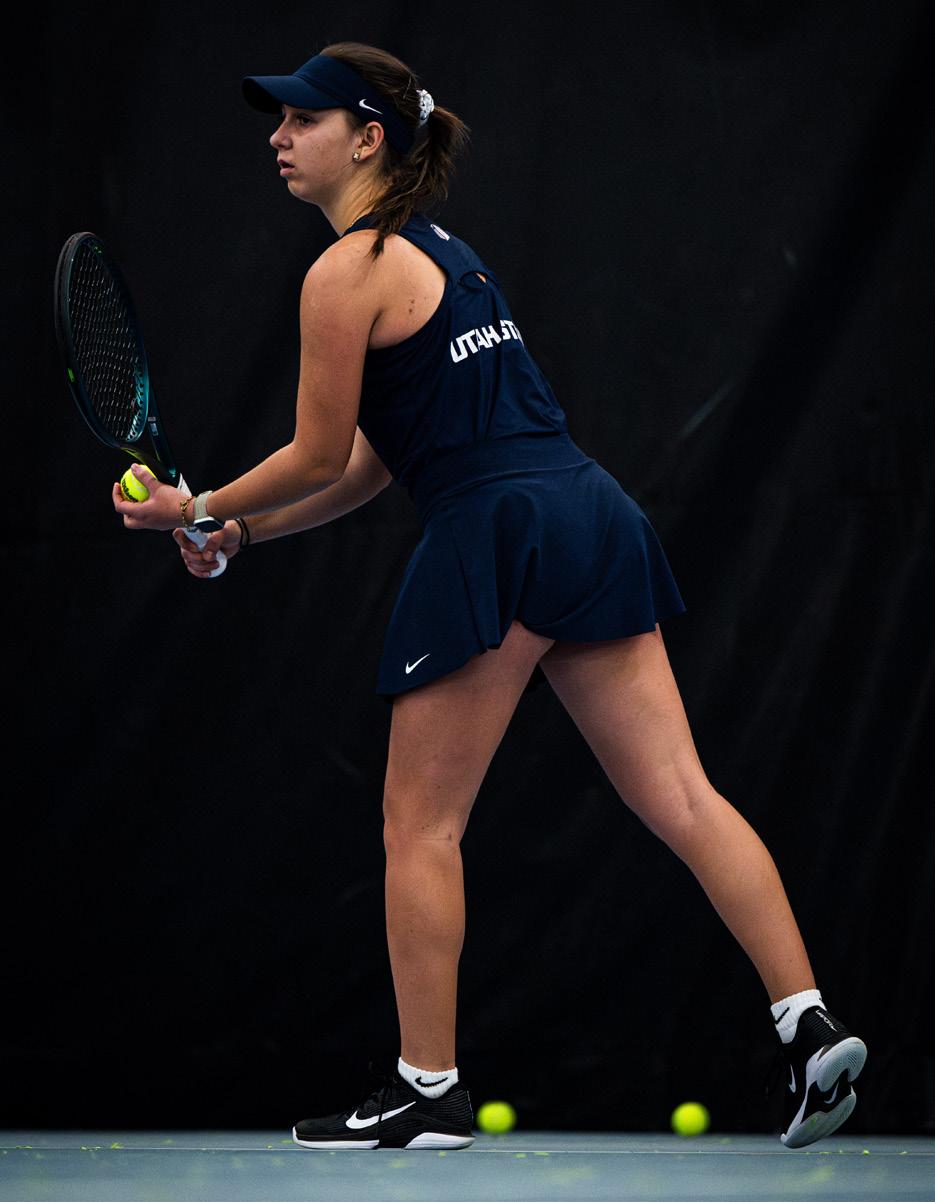
First-year Terezia Mlkva quickly emerges at No. 1 for Utah State
By Carson Frost STATESMAN SENIOR REPORTER
When Terezia Mlkva arrived at Utah State, the transition involved more than adjusting to a new team or a new level of tennis. It meant adapting to a different country, a new language and a different structure for the sport she had played most of her life.
Less than two months into the spring season, the first-year athlete from Slovakia has already emerged as one of the program’s most important players, according to Utah State Women’s Tennis head coach Veronika Golanova.
Mlkva has spent much of the year playing No. 1 singles, the position that matches each team’s top player against the opponent’s best. Through March 4, she holds an 11-9 overall singles record and a 6-3 mark in dual matches, helping Utah State build a 6-4 team record heading into conference play. Golanova said producing results in that role as a first-year is difficult because of the level of competition and the mental demands of the position.
“I believe she’s 6-3 at No. 1, which is fantastic start to her season,” Golanova said.
Mlkva’s ability to handle the spot has been a product of both her playing style and her competitive background. Golanova said Mlkva’s power and clean ball-striking allow her to control points against strong opponents.
“She has a very effortless power,” Golanova said. “She’s an amazing striker. She strikes so clean.”
Mlkva’s tennis journey began early in Slovakia. She first tried the sport as a child when a coach encouraged her parents to keep her involved after seeing her natural ability. “I started to play tennis when I was in kindergarten,” Mlkva said. “I was smaller than the net, so it was really funny.”
After briefly stepping away, she returned to the sport a few years later and never stopped playing. She eventually built a junior resume strong enough to draw interest from American college programs.
Unlike some junior players who travel constantly for tournaments, Mlkva said she did not begin competing heavily internationally until the final years of her junior career. Education remained a priority throughout that period.
“I didn’t play that much active tournaments until my last two years in juniors because for me, school was really important,” she said. “I never know if I could get injured or
something. My mom always like [the] appeal of education.” Those final junior seasons required extensive travel and support from her family.
“I’m so thankful for my parents that they went with me on this way because I was traveling a lot,” Mlkva said.
When it came time to choose a college, Mlkva focused primarily on finding a program where she felt comfortable with the coaching staff. She said her connection with Golanova stood out during the recruiting process.
“I was trying to look for coaches that I know I will click [with],” she said. “With Coach V, it clicks really fast. I feel like under her, I can become the best tennis player I can be.”
The adjustment to college tennis, however, was still significant. Unlike junior competition, where players compete almost entirely on their own, college matches combine individual play with a team-based scoring format.
That difference was one of the first things Mlkva noticed after arriving in Logan.
“College tennis is like individual sports but to the team competition, so it was really hard to just adjust,” she said.
According to Mlkva, the shift has become easier over time as she has settled into the team environment.

Frost is a
from Denver studying journalism. His family originally hails from Los Angeles, and he is a passionate fan of the Lakers and Dodgers.
— carson.frost@usu.edu

Carson
transfer student
PHOTO SUBMITTED BY USU ATHLETICS
Terezia Mlkva prepares to serve in a match against the University of Idaho on March 1.
Column: Driving us mad, parking frustrates students
By Asher Schroader STATESMAN COLUMNIST
In the 21st century, attending a university is among the most stressful decisions a young American can make, in large part due to cost. Tuition rates are three times what they were 50 years ago, and there are many associated costs that keep raising the bill.
Per Utah State University Parking & Transportation Services website, the average cost of a full-year student parking pass at USU is $190 for students who live on campus and $177 for students who commute, as of this spring. For faculty and staff, that number rises to $318. As the cost of living continues to rise, many students find it difficult to afford the cost year after year.
In an interview with The Utah Statesman, Cohen Thatcher, a junior majoring in chemistry, said they feel USU overcharges for passes, especially near Maverik Stadium.
“Given how inaccessible it can be for certain locations, as well as when they close off 90% of the stadium for games, that’s kind of a bit presumptuous of them,” Thatcher said. “There’s a lot of students that are still trying to get here, especially in the STEM community, and it’s unfair to make people pay for those passes if you’re just going to close it off for games.”
Another concern is that of safety. Many students feel uncomfortable traversing parking lots and garages due to the perceived risk of crime, either to themselves or their property, and statistics suggest their fears may be justified. According to the National Crime Victimization Survey, more than 10% of property crimes occur in parking lots,

ART BY Asher Schroader
and the FBI reported 5.7% of hate crimes happen there as well.
Michael Bailey, a senior majoring in history and linguistics, told the Statesman safety was one of his main concerns with parking at USU.
“There are students who have to go through the parking lot at night, and we had one incident — I think it was a year ago, a year and a half ago — where somebody got assaulted,” Bailey said. “I think students would be safer if there was a way to reliably transport students more
effectively, maybe not just the shuttles, but something akin to an on-campus scooter, or maybe like a panel van that has windows that people could get in.”
Difficulties aside, most students seem to want more parking. Major complaints include a lack of availability, distance from lots to campus and a perceived unreliability in other transport options, such as the Aggie Shuttle. In the future, USU should prioritize development that encourages plurality in transport, allowing and encouraging students to make it to and from class without a car.
Sawyer Berggren, a second-degree exploratory student with a focus in pre-health, said he wants city and university officials to stop prioritizing car-centric development in an interview with the Statesman.

Asher Schroader is a junior majoring in creative writing. They are passionate about their novel projects, learning French and engaging in social and political action.
— asher.schroader@usu.edu
Calling for safe elections environment at USU
Editor’s note: Guest Columns and Letter to The Editors are pubished as submitted. Submission instructions are available at usustatesman.com.
This last week USUSA elections started and finished. If you are a candidate for a position, or involved as their manager or on their campaign team, you are required to adhere to specific bylaws. Failure to adhere to these bylaws should lead to consequences. This past election, I watched members of the Sigma Phi Epsilon fraternity– including candidates that were in current positions in our USUSA student government–encourage and carry out behaviors that should be punished, yet continuously get away with. As an average student here at USU, I used to joke that members of SigEp got away with pretty much anything. After participating in this past election, I realized that this statement is not just a joke, its reality. During the
election SigEp candidates and their teams went around to on-campus housing, (illegally) knocked without permission at off-campus housing, and took phones to forcefully fill out ballots for students on campus whilst tabling and off campus at apartments(often staying at apartments until those at the door vote for them). The action of taking and touching phones by candidates and their teams without explicit consent is prohibited in the bylaws. Yet people don’t report because they’re afraid of retaliation from the candidates themselves or from the fraternity members associated with them. With these combined factors, a lot of students felt pressured to go along with the forced vote and felt uncomfortable when others–especially when those in current student government positions– filled out their ballots. Some students also reported receiving comments like “I hope you get a parking ticket”, after telling candidates and campaign teams that they voted for someone else.
We’ve let candidates and their teams play by these rules in previous years and let people say “it’s just the way to get them to vote” or “I guess they know how to play the game”, while other candidates get reported and contacted for lies and assumptions submitted to the Election Board. When some reports are seemingly ignored or dismissed without consideration but others aren’t met with disciplinary action, it upholds the idea that the bylaws only apply to some. How is anyone supposed to feel safe running or voting in an election when these are the conditions that they are met with?
Jordyn McMullin is an undergraduate student at Utah State University.

Closeups On Campus






Dane Johnson is a mechanical engineering student at USU. When not studying, he can be found exploring new places with his camera or on an evening stroll with his wife.


7 Can Taco Soup
Find most of these ingredients at SNAC!
Ingredients:
1 can black beans*
1 can pinto beans*
1 can sweet or regular corn*
1 can diced tomatoes*
1 can chicken breast, drained
1 can red or green enchilada sauce
1 can chicken broth
1 packet taco seasoning*
*look for low sodium options for a more heart-healthy meal!
Instructions:
Pour all ingredients into a large pot. Cook for about 20 minutes or until heated through Top with avocado, cheese, cilantro, tomatoes, lime wedges, chips, or plain Greek yogurt!

Last week’s solution:

Working on that project? Having a stay-cation? SNAC is here for you over spring break, March 9th-13th! Our hours are more limited, so be sure to check them before you visit. If you’re looking for something meaningful to do over the break, SNAC is hosting our once-monthly Mobile Food Pantr y This event hosts volunteers from 8:30-11am, where you’ll be assisting patrons, loading food into vehicles, directing traffic, and more. SNAC would love to have you! Find out more and sign up with the QR code below
Mobile Food Pantry

Spring Break Hours
Mon - 11am-3pm
Tues - Mobile Pantr y Only Wed - Closed Thurs - 11am-3pm Fri - 11am-3pm Sat - Closed Sun - Closed


Sudoku puzzles are provided by www.sudokuoftheday.com.
Food Recover y


Did you know SNAC participates in food recover y across Cache Valley? Food recover y is the act of repurposing food that may other wise be tossed, and redistributing it to feed people in need Currently, SNAC has 14+ on and off campus locations that donate excess foods to help feed our students This can be anything from excess breads and pastries to leftover lasagna Le Croissant, Kneaders, Bussin Bread, and Schreiber Foods are some of our most frequent off-campus donors. When The Marketplace or The Junction makes too many rolls - you know where to find them Next time you’re in SNAC, check to see which awesome donor has partnered with us to prevent food waste!

Spring Break SNAC!