USU legislative audit identifies financial noncompliance, leadership concerns
By Mia Nielsen STATESMAN REPORTER
“We’re ready to move out of the shadows from some of this controversy,” Utah State University President Brad Mortensen said following a review of the legislative performance audit of the Utah State’s governance and finances.
Mortensen’s comments followed a presentation of audit findings that identified financial noncompliance and leadership concerns at USU. The Utah Legislative Audit Subcommittee ordered the audit after a preliminary review raised concerns about presidential spending under former USU President Elizabeth Cantwell.
“We found cracks in the governance at Utah State,” said legislative auditor Nick Varney, citing specific examples of financial mismanagement.
Varney said USU began working with a vendor in 2013 without going through procurement, the process schools must use to make purchases and ensure public money is spent fairly. The newest contract with this vendor lasts five years, according to the audit report. It is unclear when this contract began. According to the report, USU ignored the advice of purchasing and legal, leading to a total cost overrun of $12 million.
We found
cracks in the governance at Utah State .
— Nick Varney
In another case, the university began services with a vendor before going through the procurement process. University leadership did not provide adequate documentation for the procurement process, leading to a rapid jump in costs from $30,000 to $100,000 in four months.
Varney also stated inflexible academic budgets are harming students and individual departments. Currently, the engineering technology program risks losing a third of its students because of insufficient funding.
“As the program has grown and brought students into the university and those tuition dollars into the university, those tuition dollars have not followed the students to their program of choice, which means the department has a hard time servicing the students and having the faculty to teach those students,” Varney said. Other departments are facing similar issues. The aviation program has grown by 435 enrollments since 2015, but despite a growing demand, the department
hesitates to grow the program until a new budget model guarantees they will have sufficient resources for students.
The chemistry department struggles to offer enough entry-level courses to meet student demand.
The auditors noted last semester some introductory labs had a waitlist of 204 students. These classes are a prerequisite for many STEM majors, and being unable to take them could delay academic progress and graduation.
“We recommend that the university commit to a timeline to implement a new budget model,” Varney said.
“It’s been a problem for a long time and leadership has failed in a timely manner to implement a budget model that’s responsive to student needs.”
Varney recognized the Center for Anticipatory Intelligence in the College of Arts and Sciences and the Jon M. Huntsman School of Business Analytic Solutions Center as bright spots in the university because of high job placement post-graduation and the skills students develop.
Audit manager Jesse Martinson cited leadership problems as the root cause of other issues within the university. The Utah Board of Higher Education has implemented a presidential coaching program Martinson hopes will help provide additional training for university presidents but said further steps should be taken.
Martinson stated current presidential evaluations conducted by the board are insufficient and untimely. Currently, presidential evaluations conducted by the board happen every four years.
“We would ask the [Utah] Board of Higher Education to create more stable and more consistent evaluations for the presidents,” Martinson said.
The auditing team found several historic instances in which university leadership did not support the internal audit and limited the auditors’ access to information.
“There was a point where the president did want them to essentially answer to the president, which is a violation of internal audit rules,” Martinson said.
He clarified university leadership is currently compliant with the internal audit.
Mortensen said he welcomes the work of the audit and that the university is prepared to follow the recommendations provided by the auditors.
“Utah State University understands that when appropriate policies aren’t followed, when financial and budget models aren’t aligned with the appropriate outcomes, when there’s a lack of leadership accountability, when decision making isn’t transparent or properly coordinated and when all of those governance lapses penetrate the culture of the institution, we’re not being good stewards of public resources,” Mortensen said. “We lose public confidence. We get distracted from fulfilling our statewide land-grant research university mission, and the students and communities that we serve are the ones that don’t get the Utah State University that they’re entitled to.”
Mia Nielsen is a sophomore studying plant science and journalism. When she’s not writing, she enjoys live music, driving up Logan Canyon and daydreaming about moving to Spain.
—mia.nielsen@usu.edu
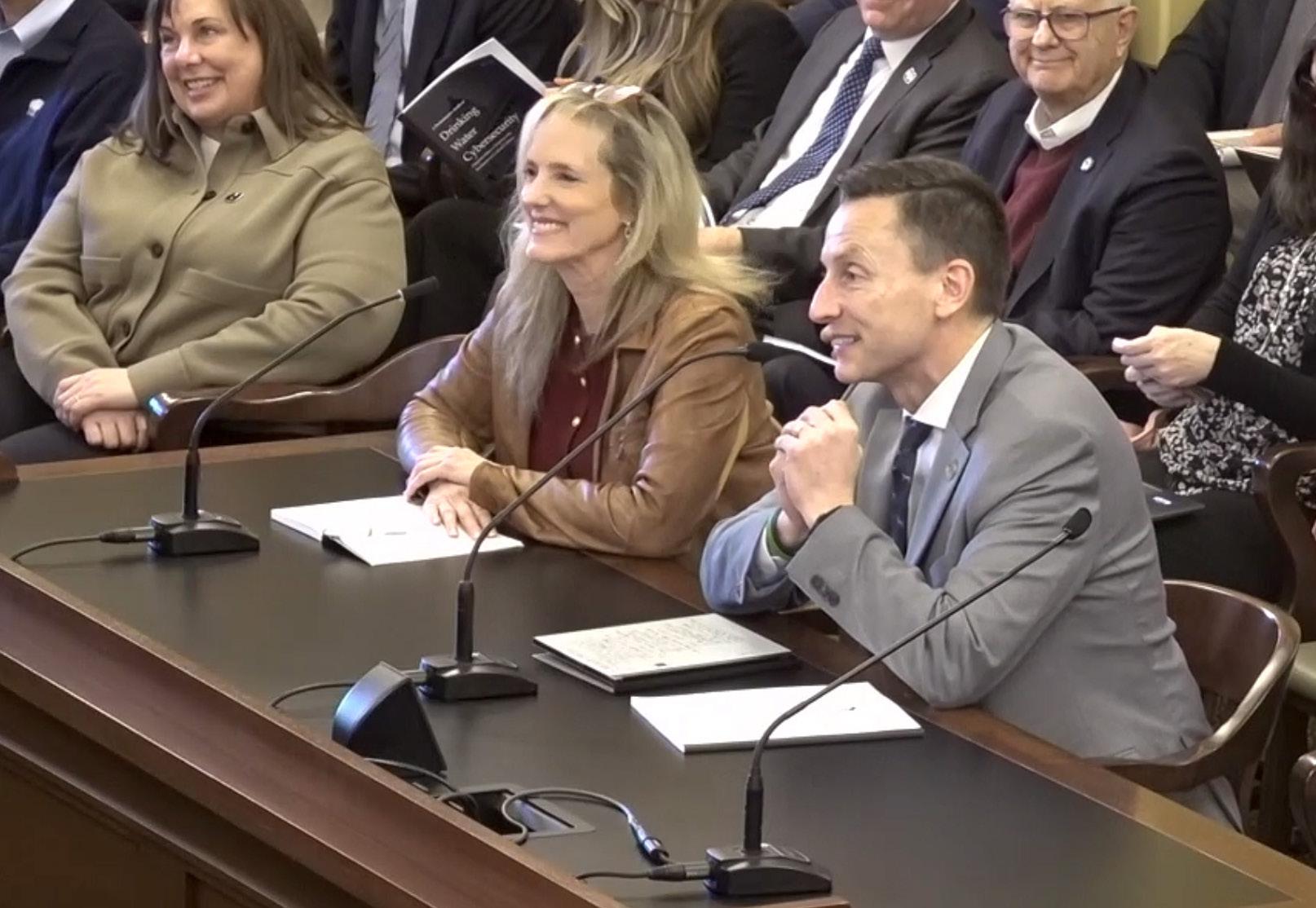
PHOTO VIA LIVE BORADCAST OF LEGISLATIVE AUDIT
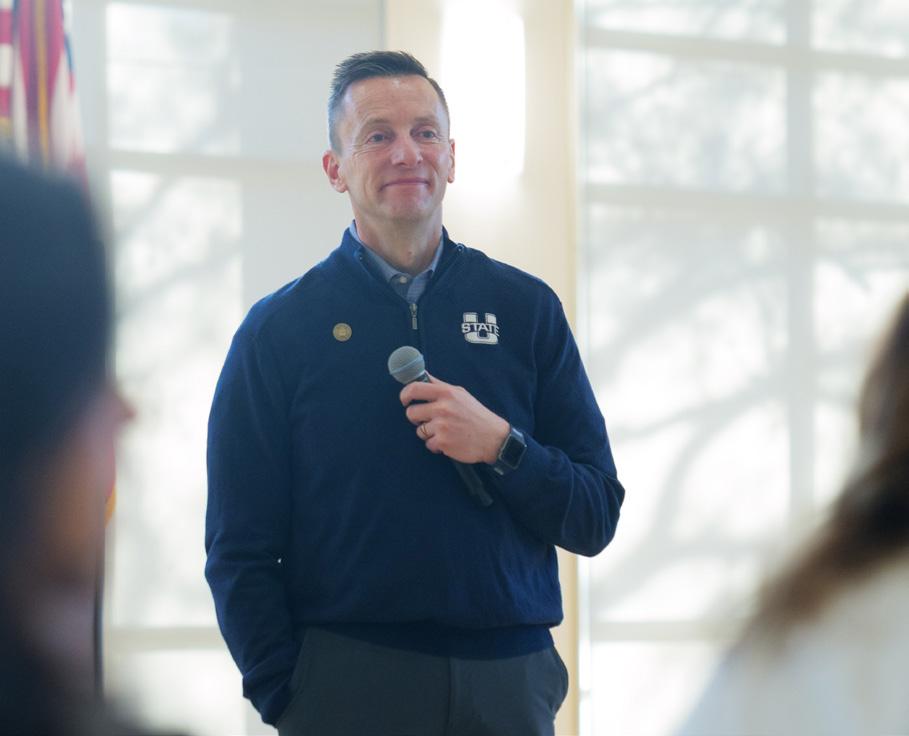
Tessa White and Utah State University President Brad L. Mortensen at the legislative subcomitte meeting at the Utah State Capitol on Jan. 30.
USUSA President Sorensen recounts statewide tour with President Mortensen
By Emma Shelite STATESMAN REPORTER
Utah State University President Brad Mortensen, his cabinet and USUSA President Brandon Sorensen recently completed a week-long tour across Utah, visiting regional campuses and centers to strengthen the bond between the Logan hub and the university’s statewide locations.
The tour, which served as a prelude to Mortensen’s inauguration, aimed to shift the perception of USU as a Logan-centric institution. For student leaders at regional campuses, the physical presence of the university’s top administration signaled a new era of visibility.
“[It] made our campus feel seen and connected and helped us engage in conversation with Pres. Mortensen and those who work with him,” wrote Brooke Duersch, USUSA Brigham City Vice President, in an email to The Utah Statesman. “Allowing us to feel included and heard as part of the USU community.”
Those who went on the tour noted how it highlighted the diversity of the Aggie experience, which often looks different for the working professionals and non-traditional students common in the statewide system. In the Wasatch region, which includes Salt Lake, Orem, Heber and Park City, the demographic is largely composed of industry professionals and working mothers.
Ryan Schmelter, USUSA Wasatch vice president, said most of his campus is female. Schmelter emphasized successful reach for his region means tailoring the college experience to fit the schedules of those with full-time jobs and families.
“Having that opportunity to see President Mortensen and the fact that he can put in the effort to come out and spend time and just answer questions and talk with us definitely, definitely meant a lot,” Schmelter said.

Throughout the tour, Sorensen encountered stories that challenged the traditional four-year, right-out-of-highschool mold. In Blanding, he met Henry, a 50-year-old student who is legally blind and returning to earn a welding certificate. In Moab, he spoke with Letty, an immigrant who has taught English as a second language to over 2,000 people over 40 years through USU programs.
“It was just, honestly, really humbling to hear the sacrifice and things that people go through to be able to get an education,” Sorensen said.
One of the primary tools discussed to aid these students
is the Utah State Promise Scholarship. The initiative is designed to cover the expense of school that might otherwise prevent a student from earning a degree, a critical factor for the many statewide Aggies balancing fulltime work and family.
Duersch said she believes the scholarship will be a gamechanger for economic mobility in Brigham City.
“It makes earning a degree feel possible and completing a degree a reality,” Duersch wrote.
While Logan is known for the Luminary and True Aggie Night events, statewide campuses have developed their own signature cultures.
In Brigham City, the Annual Big Blue Pumpkin Walk has become a community staple that draws alumni and future Aggies alike. USU Eastern students participate in “True Eagle,” where they kiss over a large rock, affectionately named Gibby, that originated from a senior prank. Blanding campus features a hogan, a traditionally significant structure to the Navajo culture used for ceremonies and meetings.
For Schmelter and the Wasatch region, traditions lean toward professional networking rather than pure social activities, though annual trips to Top Golf remain a popular highlight.
The administration’s refusal to label these stops as “listening sessions” was intentional. Mortensen expressed to the group he didn’t want to imply the listening would stop once the tour ended.
As the tour concluded, the message from leadership remained one of unity across hundreds of miles.
“We can be separated miles apart, but Aggie is what unites us,” Sorensen said. “At the end of the day, we’re all Aggies, and that same work ethic in Logan, that same work ethic in Blanding ... that same spirit, that same drive is what we want every campus to understand that.”
Emma Shelite’s writing is fueled by Dr Pepper and an extroverted personality. Outside of the newsroom, she is passionate about cooking, athletics and her love for dogs.
Caywood
Colvin
Ludlow
Martin
McNeill
Moore
Nielsen
Packer
Peterson
Shelite
Ferraro

President Mortensen speaks at USU Eastern.
PHOTOS VIA USU PHOTO SHELTER
USUSA President Brandon Sorenson in a greenhouse at USU Salt Lake City campus.
‘No crinkles’ across USU statewide
By Bailey Daniels STATESMAN SENIOR REPORTER
Utah State University Wasatch Region has a new mission statement: “No crinkles.” This region of USU campuses covers Salt Lake City, Orem, Heber and Park City. The statement was created to help students navigate college, which, according to some statewide staff, can sometimes be a crinkly experience.
During training, staff at USU Salt Lake were tasked with creating a vision for their campus. David Vernon is the senior associate vice president of the Wasatch and Southwest Regions. His position has allowed him to see how being in campuses other than Logan’s can make accessing certain resources more difficult.
“I came up with the vision of, ‘We change lives by degrees.’ It was a pun,” Vernon said.
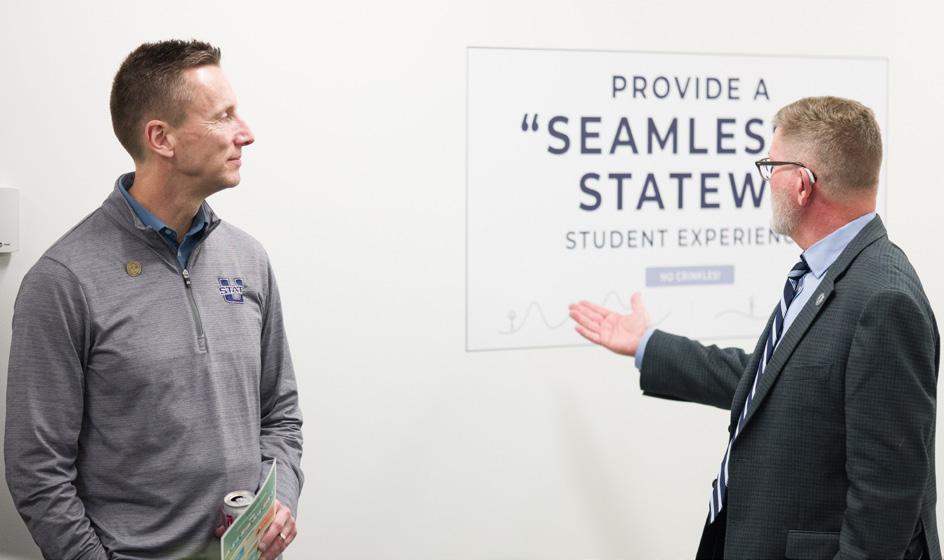
After sharing his mission statement with his staff, campus resource specialist Tatyana Felt and academic adviser coordinator Olivia Lee offered up “No crinkles” to provide a “seamless” statewide student experience.
“They told me that their idea was better,” Vernon said. “I was like, ‘I really like my idea, but they’re right.’ It is better, and I like it.”
Felt shared some of her process behind helping come up with the idea. She felt their old mission statement was a bit vague, and they wanted something that would help remind them every day what their goal for students is.
“The goal is to make the academic journey less crinkly
for our students,” Felt wrote in an email to The Utah Statesman. “There are always going to be challenges –academic, financial, personal, etc. and if we in student services can make it a little easier for the students to navigate their college journey, our job becomes meaningful and more gratifying.”
USU Logan campus has amenities such as the Office of the Registrar and the Career Design Center. Students who have in-person classes can more easily access their professors rather than setting up meetings over the phone. These are some of the things that can make the experience less seamless for statewide and online students. Vernon first came to USU as a master’s student
in Salt Lake in the early 2000s. Trying to get accurate information from advisers and registering for classes was not a smooth process for him.
“When you have students, you want them to spend their energy on doing the assignments,” Vernon said. “Figuring out what classes to take and all this other stuff, getting registered — it can be really challenging to try to figure this out.”

Bailey Daniels is a senior studying technology systems. She loves Lana Del Rey, sweet treats and all things whimsical.
— bailey.daniels@usu.edu

January 22
A complainant reported to USUPD on the Quad that an unknown individual had posted a picture of a firearm under a USU social media republican page and expressed concern. The complainant was advised that multiple officers were and would remain on site, continually monitoring the event.
January 22
Officers met with a concerned citizen who was worried about “Nazis” and “Christian nationalist” groups and campus safety. Officers answered all questions and offered additional resources.
January 26
A USUPD officer played a game of pool with students at Ridge Point Hall. The officer answered questions the students had and talked with them about how school is going.
January 26
A concerned citizen contacted USUPD to report a possible animal issue in the parking lot near the Eccles Conference Center and the Merill-Cazier Library. It was determined to be a USUPD K-9 that was not in distress. The K-9 had been deployed in the area and was under the supervision of its handler.
Febuary 1
A USUPD officer performed a routine patrol on foot near the “gun shed.” located at 850 E 470 N.
PHOTO VIA USU PHOTO SHELTER
USenior Associate Vice President of the Wasatch and Southwest Regions David Vernon showing the “No crinkles” sign to President Brad L. Mortensen.
Redevelopments underway after Mountain View Tower demolition
By Jillian Peterson STATESMAN REPORTER
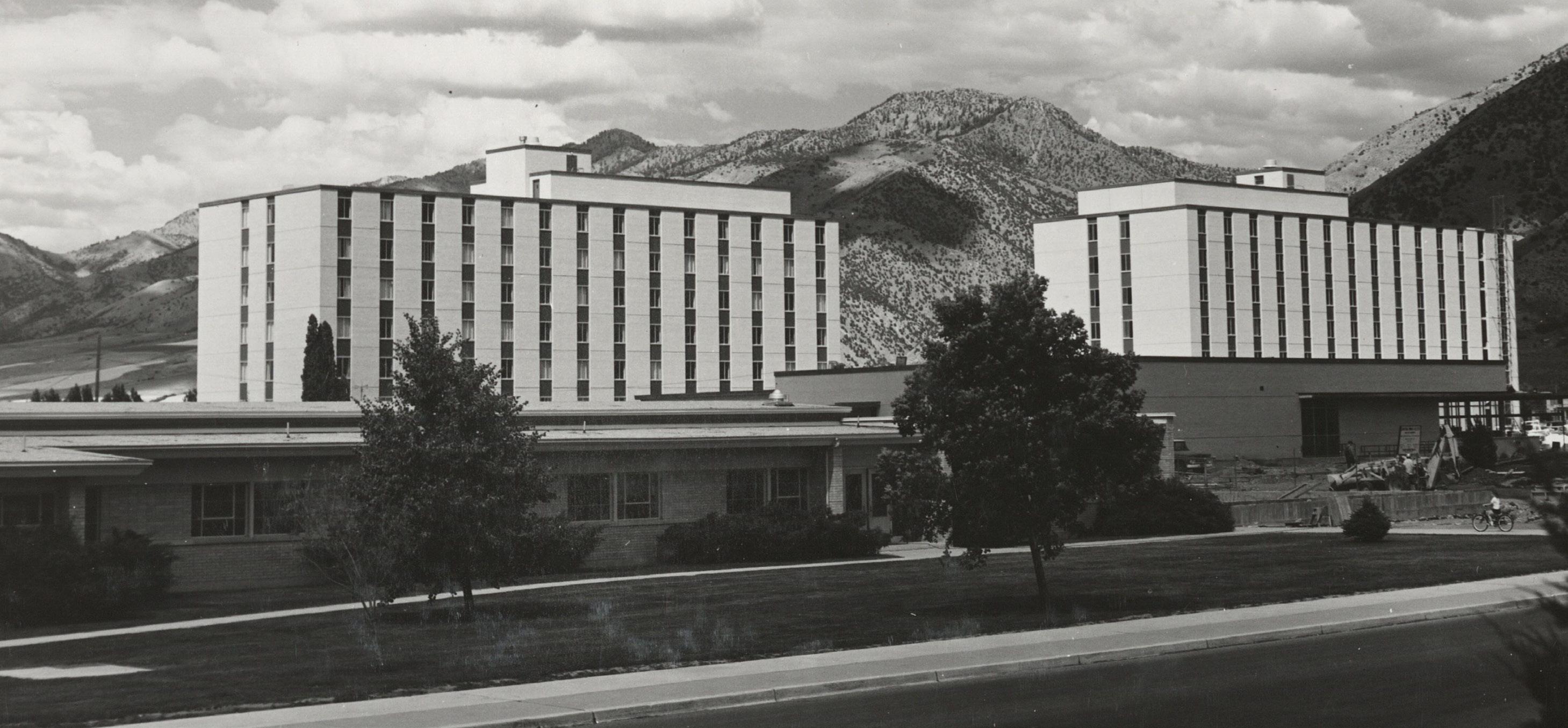
As demolition continues on Mountain View Tower, plans for redevelopment at Utah State University Logan campus are in the early stages.
These plans include connecting the utility tunnel and service road to Bullen Drive, as well as the construction of new academic buildings and replacing aging residence halls.
This is a long-term project expected to take seven to 15 years, according to Ken Carrillo, the director of planning, design and construction for USU Facilities.
Carrillo said the removal of Mountain View Tower is just one piece of a larger proposed redevelopment for Central Campus, and the demolition of Richards Hall and renovation of the Junction will follow.
“Some of these older buildings were built in the ‘60s and ‘70s, so they will need to come down and be replaced in coming years,” Carrillo said.
Mountain View Tower was built in 1966 and housed students until the spring 2025 semester. In its final year of operation, it was evacuated twice due to a chemical spill caused by a student.
Former residents, like Kelli Farnsworth, said that was only one of the issues the building had in its final year.
“There was this lingering old smell about the place that made me feel sick some days,” Farnsworth said. “It also didn’t have AC, so it would get very hot there, especially when I first moved in during fall semester.”
According to Farnsworth, there were also elevator issues.
“We had eight floors, counting the basement,” Farnsworth said. “So, with the elevator being down most of the time and the laundry room being in the basement, you had to haul your clothes up and down several flights of stairs.”
Farnsworth said while the building had its various issues, she appreciated how affordable it was.
“I chose Mountain View Tower because I pay for my own school,” Farnsworth said. “So I honestly picked the cheapest option, knowing it would be an old building.”
Farnsworth said she worries that with the demolition of the building, some students may no longer be able to afford on-campus housing.
Canyon Crest Suites was completed in 2023 as a replacement for Mountain View Tower, according to Jordy Guth, the associate director of planning and sustainability at USU.
“Mountain View was left in place while the South Campus was redeveloped over the past few years to help compensate for the loss of beds during the period of construction,” Guth said.
While Ridge Point Hall, the newest residence hall on South Campus, has been completed, Guth and Carrillo said there are plans to add more housing to accommodate the growing campus.
“We’re not only replacing the existing beds but also planning to add about 10% more,” Carrillo said.
One way this might be done, Carrillo said, is through
the renovation of the Junction, one of the campus’ dining halls.
“The first level would be food services, and the levels above would be housing,” Carrillo said.
According to Carrillo, this housing would likely include more private room options.
“Most students are wanting a little bit bigger of a space now, oftentimes single rooms, and those trends drive the style of what we build,” Carrillo said.
In addition to new housing, Central Campus plans include a new academic building on 700 N. This building is yet to be decided on.
“All it takes is one department to come up with funding for a building, and that can kind of change all of our plans,” Carillo said.
While the plans for academic buildings and student housing are still several years out, the construction of the service road started in summer 2025.
Jillian Peterson is a sophomore studying communication and media. She is a big fan of concerts, snowboarding and the Taco Bell drive-thru.
— jillian.peterson@usu.edu
USU Eastern Theatre enters final year with ‘Ride the Cyclone’ tour
By Grace Colvin STATESMAN REPORTER
In the off-Broadway musical “Ride the Cyclone,” six central characters grapple with the themes of death, acceptance and the inevitability of moving on. Now, as the theater program at Utah State University Eastern enters its final year of existence, its students — who recently closed their production of the same show — begin their own journeys of discovering what lies beyond.
Located in Price, USU Eastern’s theater arts program is a two-year degree that focuses on all aspects of theater making, including acting, stage management, costume construction and scenic design. In addition to classes, the program allows students to work on several full-length productions every year, with their most recent being “Ride the Cyclone,” a musical by playwrights Jacob Richmond and Brooke Maxwell.
The production ran from November 6-15, 2025 in Price before embarking on a tour across Utah and Idaho in January. It marked the beginning of the program’s final year — a decision made following recent budget cuts — but according to associate professor of theater production and design Brent Innes, it is going out with a bang.
“We wanted to give our students an experience you’re not going to get anywhere else,” Innes, who directed the production, said.
Unlike a regular theater production, which typically only runs in one theater space for a limited amount of time, the cast of USU’s “Ride the Cyclone” navigated the challenge of performing in several different areas, often changing staging and choreography to fit their new surroundings.
Actors also served as crew members on each tour stop, aiding in the setup and takedown required for the transportation of show equipment. The tour stopped in Cedar City and Pocatello, Idaho before its final performance at Logan High School. Innes described the production as a “one-of-a-kind, unreal experience.”
Dan Becerra, one of the student performers in the musical, claimed one of the most special aspects of the production was its poignant subject matter.
“It’s a story about grief and living your life to the fullest extent that you can,” Becerra said. Originally created in 2009, “Ride the Cyclone” follows a group of students who are killed in a roller coaster accident at a local amusement park. From beyond the grave, they participate in a contest that guarantees one of them the chance to live again, forcing the group to confront the perception of their own mortality. According to Becerra and Innes, it left a lasting impression on both the cast and audience.
“Our audience has really resonated with it, especially our younger groups,” Innes said.
The production’s Cedar City tour stop was part of the annual Utah Theatre Association conference, which brings together high school theater students from across the state. These students got the opportunity to see
the show and personally interact with the cast over the conference’s weekend-long run. Many in attendance are planning their own future in college theater and, according to Becerra, were inspired by USU Eastern’s example.
“We would have all those kids come up to us and be like, ‘I’ve never seen the show before, but this show means so much to me now because of what it stands for,’” Becerra said. “‘It’s making me want to continue doing theater. It’s making me believe that I have a chance at doing this for my future.’”
When USU Eastern’s theater students aren’t performing, they’re kept busy with a rigorous schedule of theater classes, generals and production assignments, which consist of creating costumes, sets and props for future shows. Due to their smaller class sizes, every student is involved in every production, so a typical student will usually be in class from 9 a.m.-5 p.m. and in rehearsals from 6-9 p.m. every day, according to Innes. It’s a hefty workload, but according to Becerra, it’s all worth it.
“We’re trying to make our families proud, you know, going to school, getting a degree, while also doing what we love at the same time,” Becerra said.


Grace Colvin is a sophomore in the theater education program at USU. After graduation, she plans to become a middle school drama teacher. When she isn’t writing or working on a play, she loves making crafts and woodworking.
— grace.colvin@usu.edu
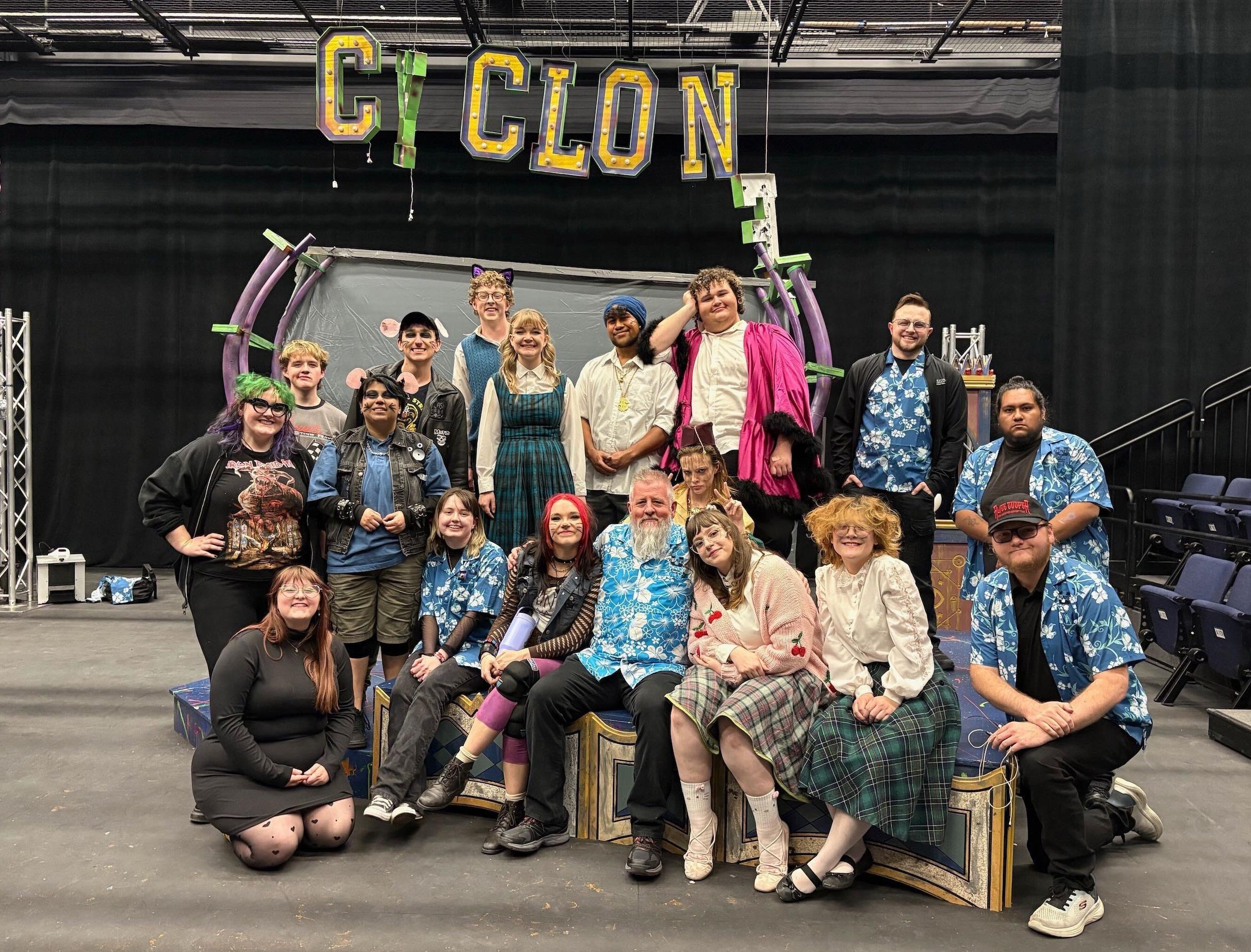
PHOTO COURTESY OF USU EASTERN THEATRE Cast and crew of “Ride the Cyclone” pose in costume for a photo in front of their moving set.
A look into USU statewide welding programs
By Alyssa Caywood STATESMAN REPORTER
Metal clanks and flames fly as Utah State University students work on perfecting their craft.
Utah State’s welding program allows students to fuel their trade with technique and artistry as they develop their skills in a hands-on educational environment. The program has developed to provide a range of opportunities for students looking at going into the welding industry.
There are currently three statewide welding programs, and a fourth will be opening in Monument Valley. USU’s Blanding and Moab campuses offer a certificate level program, and Monument Valley will soon offer a certificate level program as well.
USU Blanding student Michael Dee is a sophomore in the program who said he has always enjoyed welding. The Blanding campus is near home for him, so he applied and is enjoying his experience.
“So far, it’s been really good,” Dee said.
USU Eastern in Price offers an associate degree in welding technology for students looking to further advance their welding education.
Welding instructor Chloe Wilson graduated from USU Eastern’s program and said she appreciated the highquality standards that ultimately led to her success.
“They definitely have a very rigorous program,” Wilson said. “It’s known for creating national and international welding champions.”
Each campus works on providing their students with an accessible and hands-on learning approach. The teachers focus on combining the strengths of technical programs with building hands-on welding skills.
“What we’re really focused on here is to try to maximize everyone’s full potential in the industry,” said Austin Welch, associate professor in welding at USU Eastern.
Programs offer in-person classes that focus on technique, artistry and skill development. There are also internship opportunities available to students looking to further advance their skills.
USU has an internship set up with Intermountain Electronics for welding students that is part-time and pays them to weld on-site. The internship allows students to build experience outside of the classroom environment and work around their class schedule.
The in-class environment features smaller class sizes, allowing students to receive more personalized instruction. This enables instructors to tailor the education programs to fit the students’ needs.
“I have to cater to my students in a specific way in Blanding that’s different than in Price,” Wilson said.
“In Moab, it’s a very small community, very artistic community, super into outdoor recreation, and so that kind of changes the needs of their students and how the program functions in Moab. Then in Monument Valley, that location will be located on the reservation across the street from Monument Valley High School, so they’ll probably get a lot of concurrent enrollment students.”
Wilson said she strives to give her students the opportunity her teachers and mentors gave her. She built and expanded the Moab and Blanding campuses, allowing for opportunities for students to enter the welding industry.

From riot girl to Western, “Radio Man AL” has it all. Tune in weekly on Fridays at 10 a.m. to listen to Alyssa learn crazy band lore, interview great people and listen to awesome music for you on Aggie Radio 92.3 FM.



Alyssa
is a first-year student at USU studying journalism. She loves anything outdoors from backpacking to snowboarding to water skiing. She loves to write and is stoked to be working with the Statesman.
— alyssa.caywood@usu.edu








Zombie Graveyard Party Be Your Own Pet
Crown on the Ground Sleigh Bells
Your Cover’s Blown Belle and Sebastian
Saddle Tramp Marty Robbins
She’s A Rainbow The Rolling Stones
Caywood
PHOTO SUBMITTED BY CHLOE WILSON
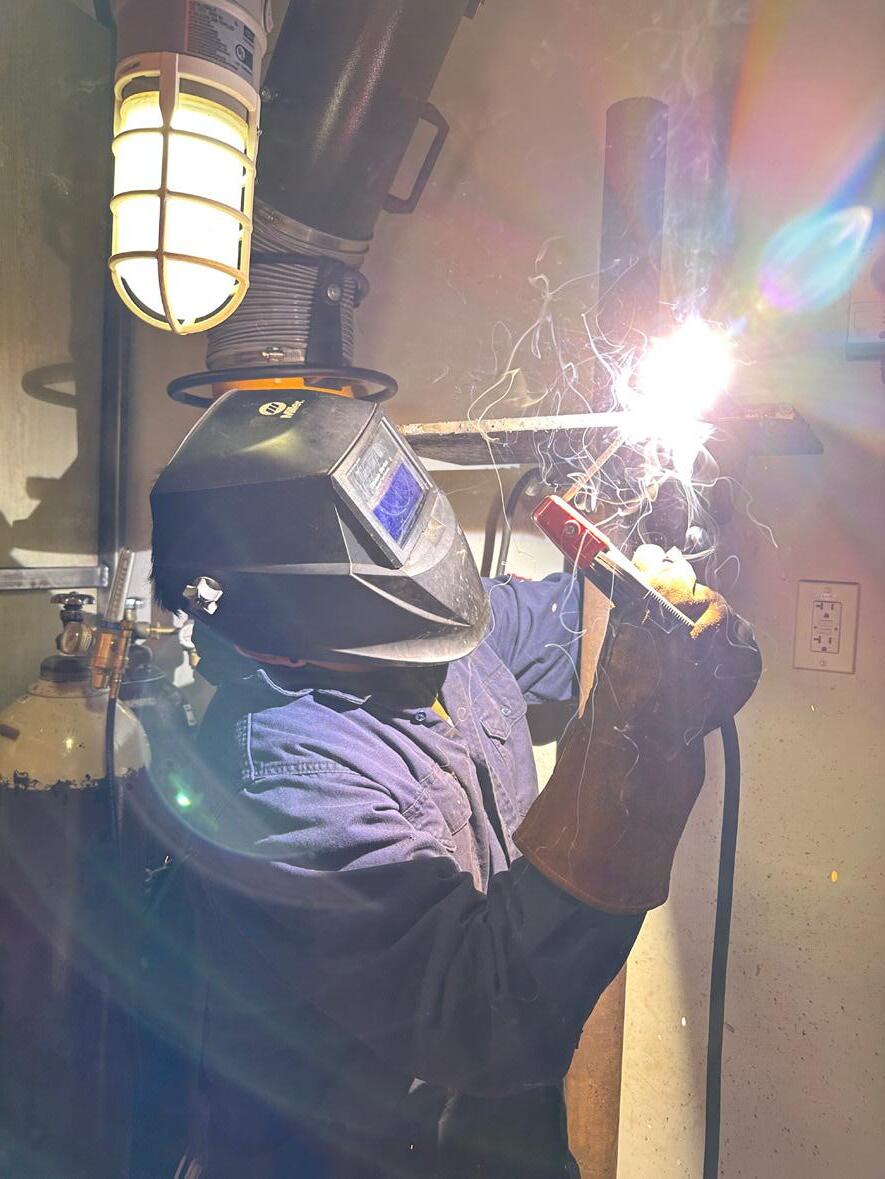
A student in the Blanding welding program works in the shop.
Free therapy across Utah: How CAPS serves statewide students
By Emma Barker STATESMAN REPORTER
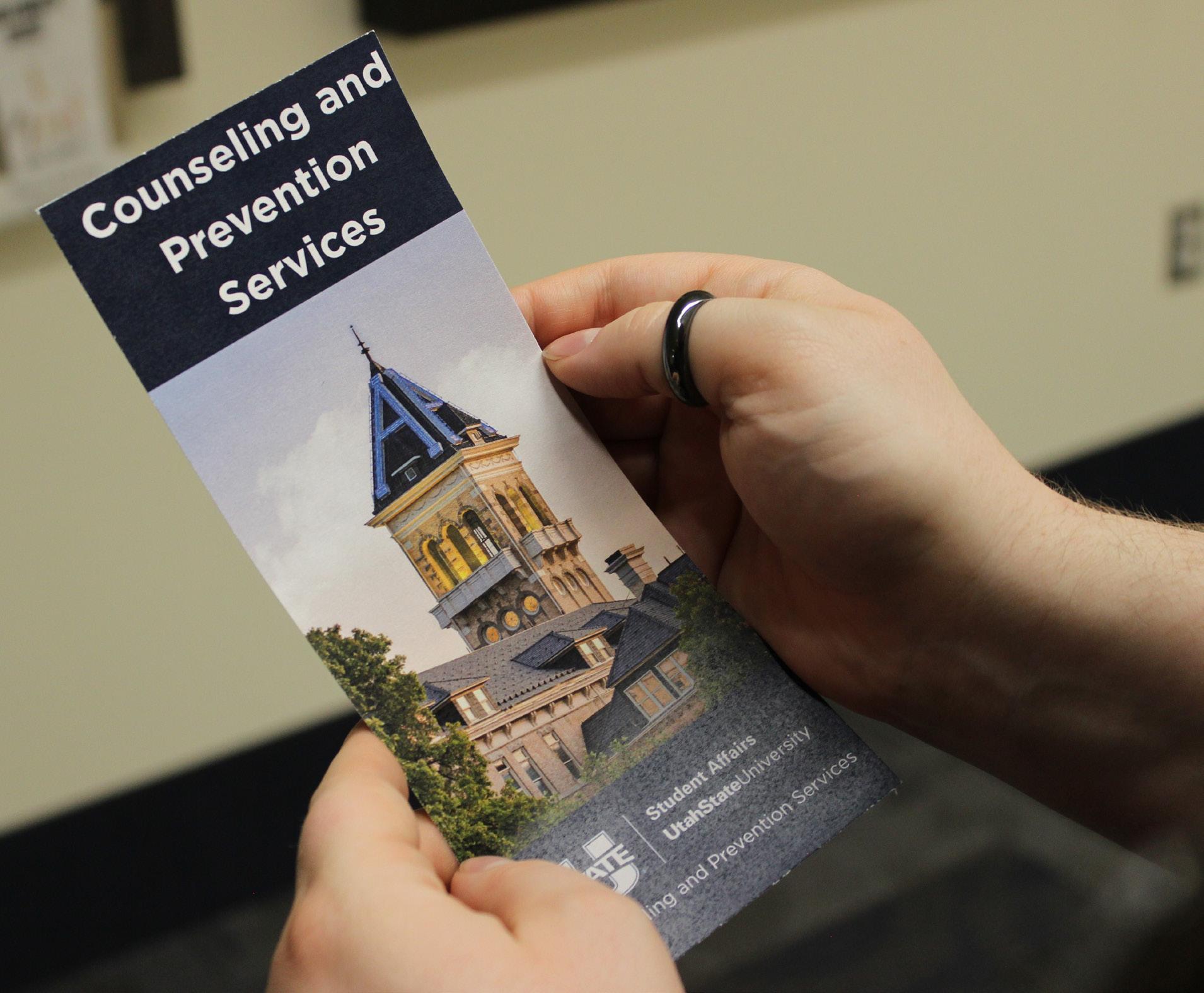
AUtah State University student once emailed Counseling and Prevention Services, or CAPS, with a simple message: Without her statewide therapist, she never would have finished her degree.
“We’ve had students tell us that without Counseling and Prevention Services statewide, they never would have finished their degrees,” said Justin Barker, assistant director and statewide campus director for CAPS. “We work with students across the state to make sure distance doesn’t prevent them from getting help.”
For students enrolled outside of Logan, access to mental health care has depended on geographical location.
Today, four CAPS therapists are dedicated to serving students across the entire state: Barker from the Brigham City campus, psychologist Clark Ripplinger from Salt Lake City and social workers Jenny Anderson and Nicole Black from Uintah Basin and Blanding. Together, they serve students in Park City, Moab, Tremonton and other USU communities statewide.
One student, who asked to stay anonymous, said she felt overwhelmed by classes and couldn’t understand why everyone else seemed to manage homework easily.
“I felt like I was floundering and couldn’t keep up,” she said. “I felt like I was going insane.”
CAPS was able to help her by giving her an ADHD diagnosis. It helped her get medication and gain an understanding of how her brain works. She made “leaps and bounds” in her educational journey.
“Usually, the statewide students are a little bit of a different demographic than Logan,” Barker said. “They’re navigating a whole different lifestyle.”
Many statewide students work full-time, are married with children or returned to school after years away. CAPS offers evening hours to accommodate those who work during the day.
One client, who lived near Brigham City, requested Zoom therapy due to transportation issues.
“We try our best to meet the students where they’re at and as far as what they’re able to do,” Barker said.
Though most appointments happen over Zoom, the statewide team still travels to campuses for “Cookies with Counselors” and “Tea with Therapists” events, attending
BY
new student orientations and working with student government.
“We’re very active on our respective campuses,” Barker said.
Hiring Black to serve Blanding about two years ago solved a large problem, according to Barker. Located nearly 300 miles from USU’s main campus, Blanding went years without an on-campus mental health counselor.
“For years, we struggled because, I don’t know if you
know where Blanding is, but it’s about as far away from Logan as you can get in Utah,” Barker said. “I think it’s easier now for those students.”


Emma Barker is double-majoring in journalism and communications and sociology. When she’s not reporting, she enjoys spending time with her dog and husband, thrifting and attempting to keep her sourdough starter alive.
PHOTO
Emma Barker
Spice for a cause: Hot Takes event raises money to support struggling grad students
By Kenadie Ferraro STATESMAN REPORTER
Six contestants were determined to beat the heat at Utah State University’s “hottest game show,” Hot Takes. The contestants battled spice, their gag reflex and each other all for the sake of the university’s graduate students.
This game show consists of five levels of hot wings and a mini game each round. Audience members had the chance to donate, which would then force the contestants to take another bite.
By the fifth round, the contestants were red in the face, and one was even throwing up. The reason for all of this? Supporting the Graduate Student Emergency Hardship Fund.
Mike Morales is the marketing and communications director for the USU School of Graduate Studies and the driving force behind the event.
“It’s the hottest game show in Utah,” Morales said. “We have a panel of community members, students, faculty and staff who will be competing to win the title of ‘Extinguisher of the Flame.’ 100% of the proceeds are donated to the Graduate Student Emergency Hardship Fund.”
This fund is set aside to supply aid for USU graduate students. Students apply, and if their case is approved, they are allotted a capped amount of aid.
David Feldon, vice provost of Graduate Studies and a Hot Takes contestant, shared during the event that due to the high levels of need and emergencies, the fund has run out.
“The School of Graduate Studies’ top priority is helping students successfully navigate their graduate programs,”
Feldon said. “The fund is really a contribution to our community more than a contribution to the university.”
The hardship fund, according to Feldon, is never mixed with other funds and is only specifically divided out in case of emergencies a graduate student may have.
“The fund is a discrete index within the university’s business system, so those funds never get commingled with anything else,” Feldon said.
According to the Graduate Studies senator and the 2025 Hot Takes champion Jamie Parry, donors and contributors at the 2025 Hot Takes were able to raise about $1,000. This year, according to Morales, donors and contributors raised around $1,600 for the fund.
“It’s important that graduate students know that that is available to them,” Parry said. “Not only does our fundraising increase that fund for our graduate students, but for graduate students that are struggling, it’s a helpful event to know that this is a resource they can use in case they need it.
Hot Takes was a part of Grad Week at USU, a week dedicated to supporting and highlighting the graduate students.

“Grad Week in general is being able to support the grad community. A lot of the time, grad students are really invested in their studies, which is awesome, but sometimes that can be really isolating. Providing a week full of events really can help connect them to the people in Logan,” Parry said.
According to the Utah State Fast Facts web page, in the 2025 fall semester, there were 3,202 graduate students enrolled at USU, and 2,257 of those students are enrolled at the main campus.
“Our graduate school isn’t very big. Grad Week is really targeted towards graduate students, their families and their friends but also connecting them to other students that are at Utah State,” Parry said. “We are one big community, and I don’t think that the line between undergrad and graduate students should prevent them from enjoying campus events.”

Kenadie Ferraro is majoring in journalism and communications and minoring in marketing design. She is from Draper and loves anything active and outdoors.
— kenadie.jackson@usu.edu
PHOTOS BY Hadley Sintay
David Feldon eats chicken from a string during Hot Takes on Jan. 29.
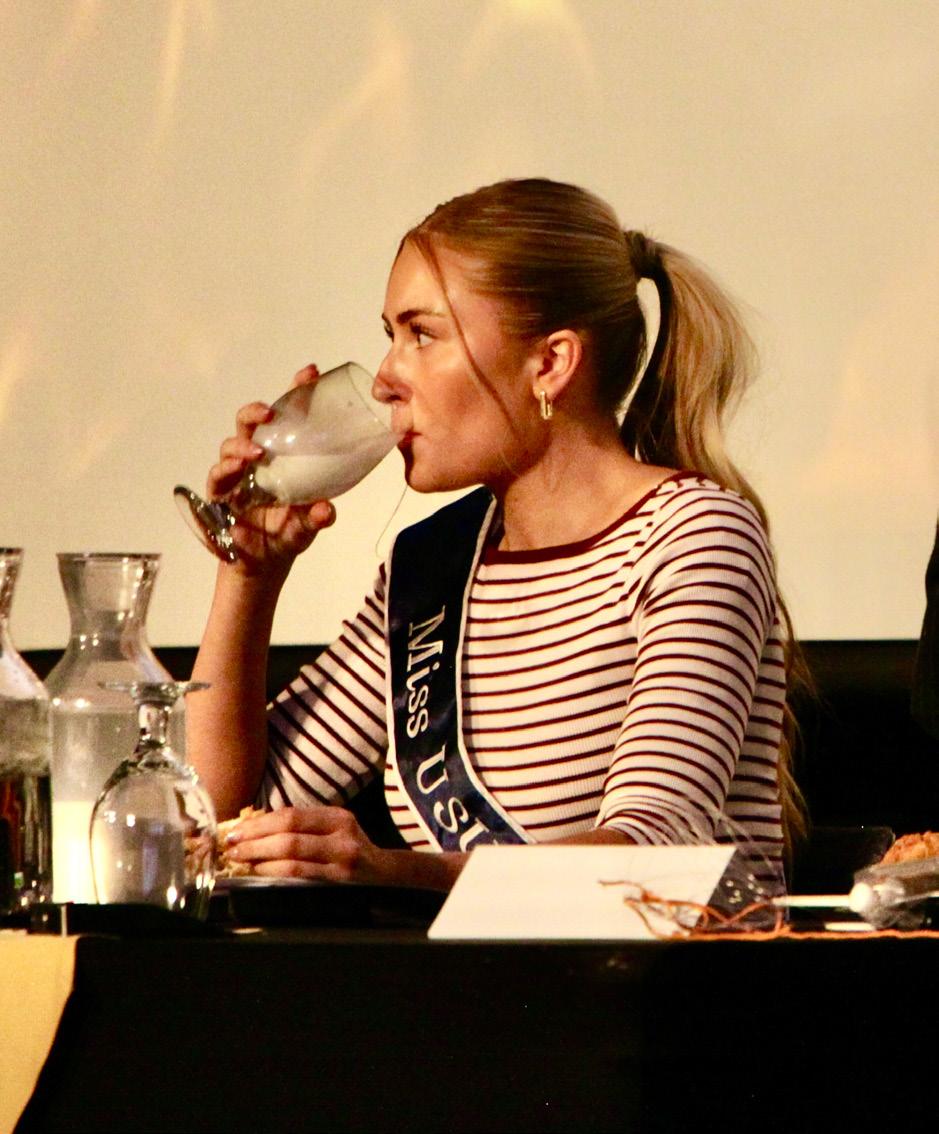
Miss USU Allie Berry drinks milk after eating spicy chicken wings during Hot Takes.
Homegrown talent: Amiah Timothy’s experience at Utah State Eastern
By Dani Packer STATESMAN REPORTER
Price is home to Amiah Timothy, and it’s a place she continues to love. There, she attends Utah State University Eastern, where she plays on the USU Eastern Women’s Basketball team. Timothy said she has loved her time at USU Eastern and is excited to see herself and her team develop during her time there.
For her coaching staff, Timothy has been a great addition to the team.
“She brings a lot to our team in a lot of positive ways,” said head coach Chelsey Warburton. “She’s just always making people laugh and keeping the mood light and is a good player to be around. It’s been fun for us.”
According to Warburton, not only is Timothy a positive person, but she has strengths that allow her to be a good teammate, leader and player.
“She’s a very good communicator. She’s great at talking through things with everybody or asking questions. I just see it continue to grow for her, and that’s come a long way,” Warburton said. “She’s very coachable.”
According to Timothy, part of her strengths come from the struggles she’s faced during her time on the team. Last year, she had to take a medical redshirt due to a broken foot. Despite this, she has kept her positive attitude and dedicated work ethic in order to continue to grow and improve as an athlete.
“It’s been a little bit hard to adapt to that, to try to adjust and try to become the same person I was before,” Timothy said. “Overall, at the end of the day, it makes
me a stronger person mentally and helps me try to just find the positive things even when there are hard things in my life.”
Despite this struggle, Timothy said she has had a phenomenal experience at Utah State Eastern and on her team.
“I love my team so much. I feel like our coaches recruit girls that have spunky personalities, who get along with each other, who are nice and, you know, just people who are outgoing,” Timothy said. “I feel like our team is exactly that. All of us get along super great. We get a different bunch of personalities on our team, and that’s what makes it all fun.”
Although Timothy loves Utah State Eastern, staying in Price wasn’t always a part of her plan. In high school, Timothy was a three-sport athlete. She competed in soccer, basketball and track, and she lettered in all three sports each year. In basketball, she accrued 1,000 career points, and she averaged 20 points per game. In addition to her successful career, basketball was always her favorite to play and work for.
“I had more of a drive and more motivation and dedication for basketball. I had the drive to go to the gym all the time, and I had more of a love for it,” Timothy said. “I’ve always wanted to play basketball in college.”
Playing collegiate basketball didn’t necessarily mean playing in Price for Timothy.
“I wanted to go play basketball somewhere out of Price. I’ve lived here my whole life. It’s a pretty small town,” Timothy said, “I’m really extroverted, so I want to go find new friends and go make new connections. In my eyes, I thought that that was going to be outside of Price, so I was looking at schools outside of Price.”
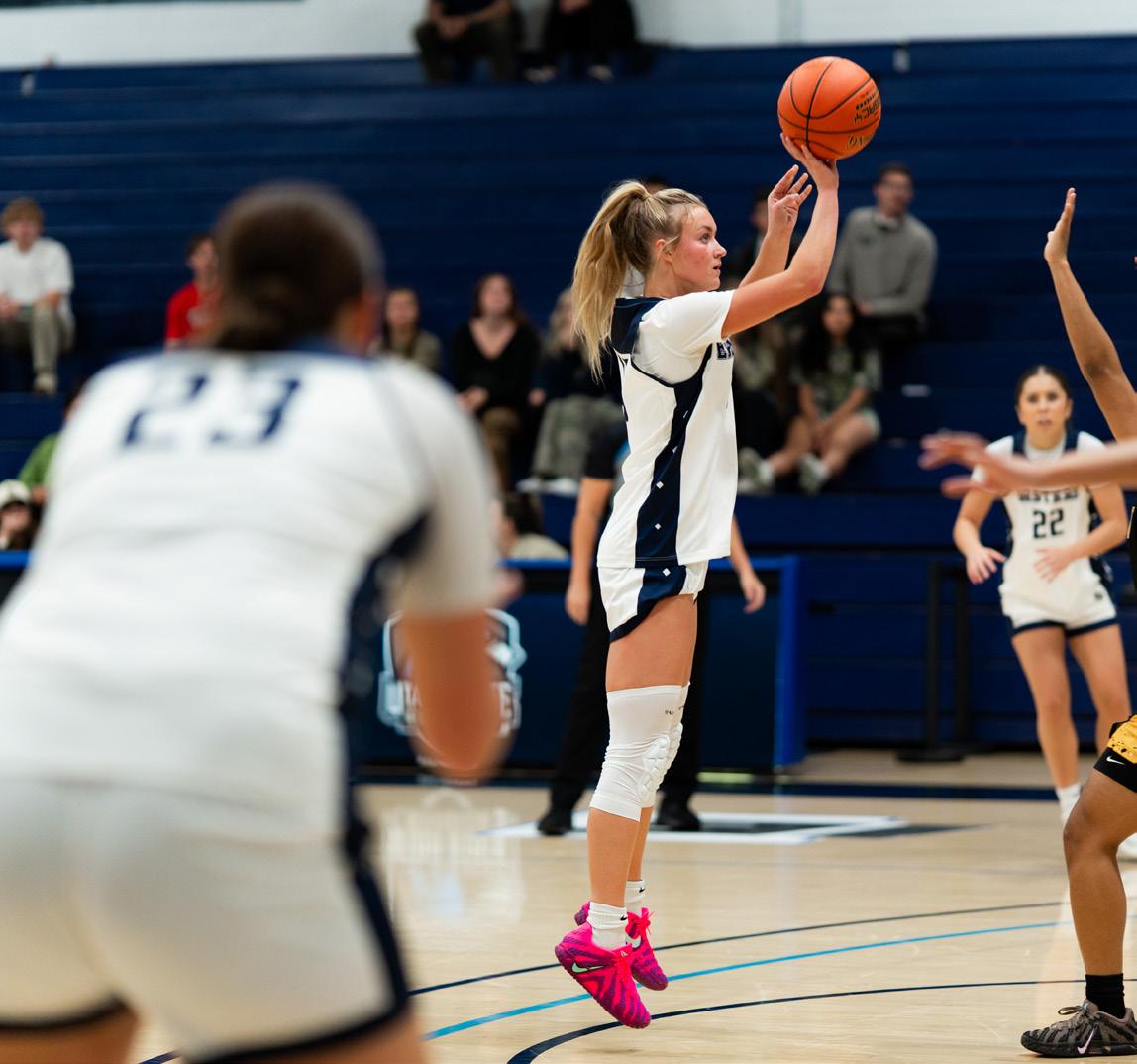
Despite this desire, Timothy said she loved her teammates and coaches when she chose to come here.
“I had a great opportunity that my coaches gave me to come play basketball here. It was not what I was really wanting, but as soon as I went on my visit, I learned more about the coaches, which I’ve already had a strong connection with my whole life. I just felt like this school was the best for me,” Timothy said. “I knew that I was going to fit in the best with the girls and the way they coach. No, it was never really my plan to come here, but I’m so glad that I did.”
For Warburton, having Timothy on her team had been a goal for most of the player’s high school career. Timothy checked all of the coaching staff’s boxes for what a good player is.
“You have to ask, ‘Are they a good defender? Are they good at scoring?’ But a big part for us is just how they act in the hard times,”

Warburton said. “If they’re in foul trouble or if they’re on the bench or things aren’t going well for them, can they still be that consistent leader or a positive role even if they’re not scoring points?”
From Warburton’s observation, Timothy stays strong during hard times. In addition to this dedication, she has some natural talent.
“She’s just very talented. Her size and speed and strength is really intriguing to us, but it fits well with who we are and how we coach,” Warburton said.
Now that she has recovered from her injury, Timothy said her strength and skills are developing in ways that make her excited for her basketball seasons moving forward.
“You get to watch your effort and all your hard work that you put into it result in better things at the end of the day,” Timothy said.
Warburton has seen her development and said she knows Timothy’s progress will only continue.
“Her confidence and her consistency just continue to grow each week,” Warburton said. “It’s only going to keep getting better for her.”
Dani Packer is a sophomore studying English literature. When she’s not studying, she can be found tearing up the dance floor or in the front row at the Spectrum.
Amiah Timothy poses for a headshot for USU Eastern Women’s Basketball.
From New Zealand to Price: Liam Davis finds his place with USU Eastern basketball
By Dylan Moore STATESMAN REPORTER
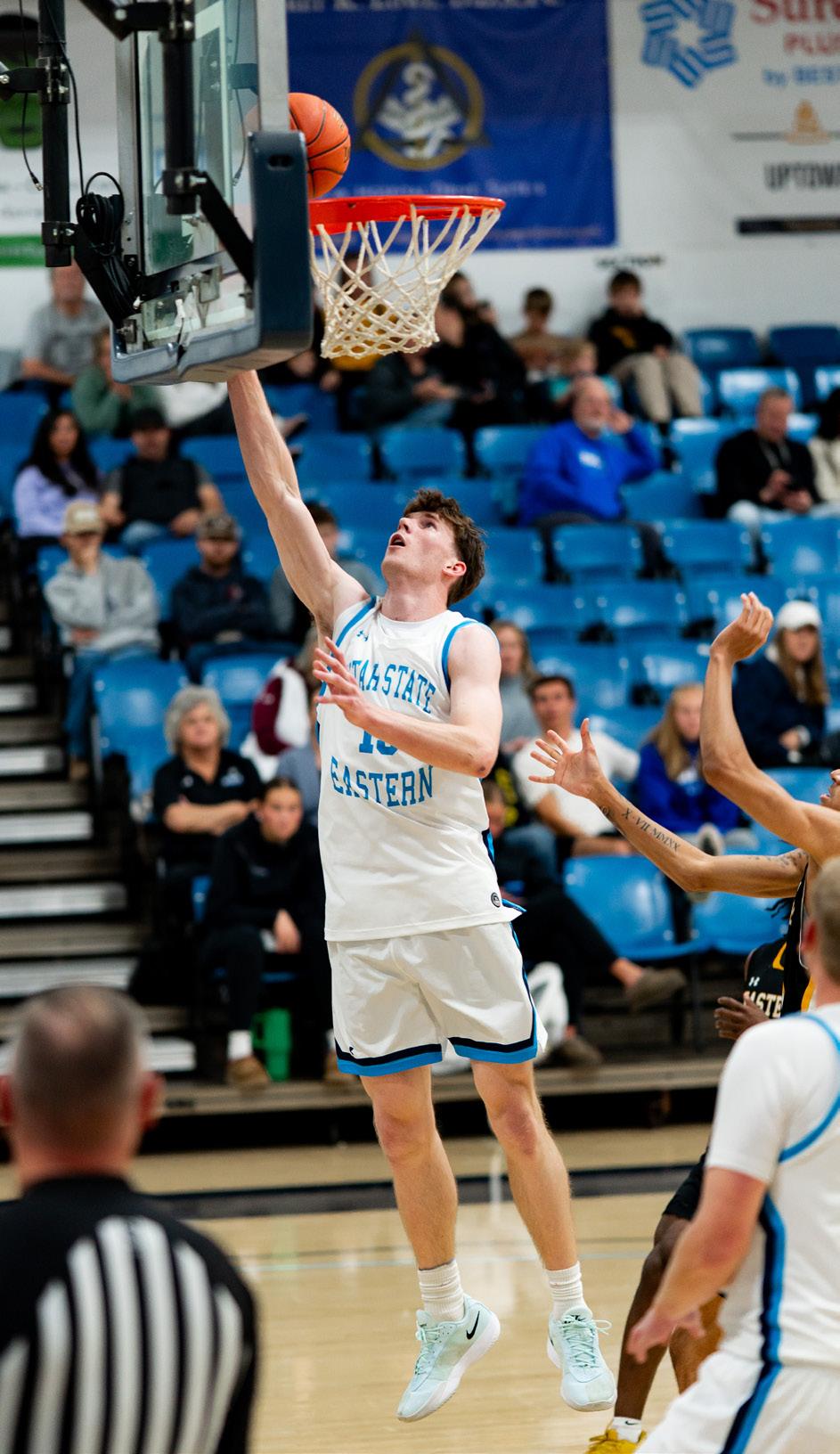
When Liam Davis arrived in Price, he was more than 7,000 miles from his hometown in New Zealand. Now, he is with the Utah State Eastern Men’s Basketball program. Davis has become a key part of the Eagles’ rotation and a steady presence on and off the court, according to head coach Bill Evans.
Davis grew up participating in multiple sports in New Zealand, with rugby and basketball both playing major roles in his development. He said his athletic background helped prepare him for the physical demands of college basketball in the United States.
“In New Zealand, rugby is huge, so you grow up being tough and competitive,” Davis said. “That definitely helped me when I started playing basketball more seriously.”
After finishing high school, Davis decided to pursue opportunities overseas. He said the chance to combine education and athletics in the U.S. was something he could not find at home.
“I wanted to get a degree and play at a high level,” Davis said. “Coming to America gave me that opportunity.”
Davis began his college career at Midland College in Texas, where he spent two seasons developing his game before transferring to USU Eastern. Evans said Davis’ maturity and experience stood out during the recruiting process.
“He’s been through a lot already,” Evans said. “Coming from another country, going to junior college, learning how things work here — that builds character.”
Evans said Davis brings consistency to the Eagles’ lineup, particularly on defense and in transition.
“He understands his role,” Evans said. “He competes, he runs the floor, he defends. Those are things that help you win games.”
Since arriving in Price, Davis has focused on adapting to the pace and physicality of play. He said the adjustment period was challenging but manageable with support from teammates and coaches.
He hasn’t reached his ceiling yet. If he keeps working, he can play at a very high level.
— Bill Evans
“The game is faster here,” Davis said. “Everyone is strong. Everyone can shoot. You have to be locked in every possession.”
Davis credited his teammates for helping him settle into the program and the community.
“They made it easy,” he said. “From the first day, they treated me like family.”
Off the court, Davis is pursuing a degree in business and hopes to work in sports management after graduation. He said balancing academics and athletics has been one of the most important lessons of his college career.
“You can’t just be a basketball player,” Davis said. “You have to take care of school and your future too.”
Evans said Davis’ approach reflects the culture he wants to build within the program.
“We want guys who care about academics, who represent the school well and who work every day,”
Evans said. “Liam does all of that.”
Davis also stays connected to his family in New Zealand through regular video calls. For Davis, the distance has been one of the hardest parts of his journey, especially during the season.
“It’s tough being away,” Davis said. “You miss birthdays, holidays, little things. But they’re proud of me, and that keeps me going.”
Despite the challenges, Davis has no regrets about leaving home to pursue his goals.
“I’ve grown a lot as a person,” he said. “Living on my own, being responsible, learning how to handle pressure — it’s been worth it.”
Evans believes Davis’ best basketball is still ahead of him.
“He’s still learning,” Evans said. “He hasn’t reached his ceiling yet. If he keeps working, he can play at a very high level.”
As the season continues, Davis said his focus remains on helping the Eagles compete in conference play and improving daily.
“My goal is simple,” he said. “Be the best teammate I can be and help us win.”
For Davis, the path from New Zealand to rural Utah has been long and demanding. However, he said through persistence, discipline and support from those around him, he has found a place where he can continue building both his career and his future.

Dylan Moore is a junior majoring in political science and minoring in anticipatory intelligence and Russian. He always loves going on outdoor adventures and cooking.
— dylan.moore@usu.edu
PHOTO SUBMITTED BY USU EASTERN ATHLETICS
Liam Davis goes for a layup in a USU Eastern Men’s Basketball game in Price.
Mountain West vs. Pac-12: What the media deals mean for Utah State
By Carson Frost STATESMAN SENIOR REPORTER
Utah State University is preparing for a major shift in its athletic history. The Aggies will join the Pac12 Conference in 2026, leaving the Mountain West Conference after years of steady growth and success. The move anticipates more exposure, more games on national TV and potentially higher revenue. However, it also raises questions about whether the benefits will match expectations.
This week, the Mountain West announced a new media rights deal with CBS Sports, FOX Sports, the CW Network and streaming partner Kiswe. The deal will cover more than 150 events each year. It ensures football and men’s basketball games remain widely accessible, but it also guarantees continued coverage for Olympic sports through the streaming platform. For the first time, some events on the Mountain West Network will be placed behind a paywall, a shift from the free streaming the conference previously offered.
The Pac-12’s media rights deal, finalized last year, also spans CBS, the CW and USA Network. It will carry roughly 22 football games and 50 men’s basketball games on linear television. Several games will appear on familiar cable and broadcast channels, making them easy for casual viewers to find.
While the conference has not publicly released financial terms, industry estimates suggest Pac-12 schools could earn between $7 million and $10 million per year. That is roughly double what remaining Mountain West schools are expected to receive.
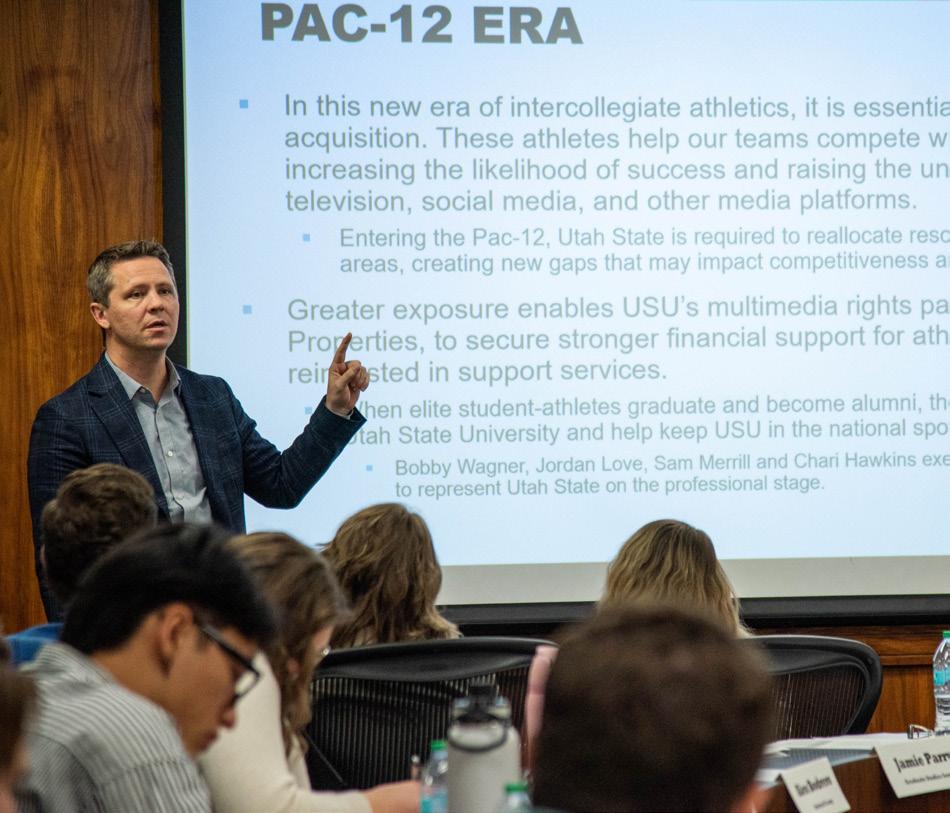
For Utah State, exposure was a major reason behind the move. USU Vice President and Director of Athletics Cam
Walker explained what he sees is the importance of being on traditional TV.
“The Pac-12 is an opportunity for us to move into a great thing,” Walker said. “All of our games moving forward will be on CBS, CBS Sports, USA Network or the CW — so actual channels. Right now, a bunch of our games are on an app that sometimes works.”
Walker’s comments highlight a key advantage of the Pac-12 deal. He said while Utah State already has a loyal base of supporters, national TV exposure allows the school to reach casual and nonlocal fans more effectively. The Mountain West’s streaming service offers access to more events, particularly non-revenue and Olympic sports, but linear television still delivers the largest audience and greatest visibility.
USU President Brad Mortensen said the move is about more than money or TV deals.
“There’s still a bit of legwork to do with working out the media rights deals,” Mortensen said. “At every stop, to me, the most important thing is showing up to represent Utah State and to make sure that our Aggie interests are well represented so that our teams and our student-athletes and our fans and boosters can all feel like we’re doing everything we can to compete for championships in the new Pac.”
The transition does have trade-offs. Some Mountain West games, previously available for free, will now require a subscription to the conference’s streaming platform. In the Pac-12, fans may need multiple subscriptions to watch all events. Coverage for sports outside football and men’s basketball is still yet to be determined. Athletic departments across the country are learning to navigate this tension between exposure and access in the modern sports media landscape.
Coaches see the opportunities as worth the challenges. In a recent interview with The Utah Statesman, USU Women’s Basketball head coach Wesley Brooks joked about the late 9 p.m. tipoff for the men’s team on national TV.
“That’s a good problem to have,” Brooks said. “At some point, I want to be on national TV, and I’ll take a 9 p.m. tipoff to be on national TV. So, that’s where we want to get our program, too.”
For programs like Utah State, being featured on national television, even at inconvenient times, can help recruiting, raise the school’s profile and energize fans and donors.
The media deals also affect finances. While the Pac-12 deal may not initially meet early revenue expectations, it is projected to deliver more per school than the Mountain West’s new deal. While the Pac-12’s payouts could range from $7 million to $10 million annually per school, the Mountain West’s distributions are likely to stay near $4 million to $5 million. These figures are estimates, as neither conference has fully released official numbers.
The move also comes with legal and logistical complexities. The Mountain West and Pac-12 are working through disputes over exit fees for schools leaving the Mountain West. The litigation stems from scheduling agreements that included financial penalties. Both conferences have agreed
to mediate, but the negotiations highlight how complicated realignment has become.
For fans, the change will be noticeable. They will see more Aggie games on broadcast and cable TV, but they may need new subscriptions to watch all games. They will also see new rivals and new conference schedules. For coaches and players, they say the opportunities are significant: national exposure, stronger recruiting and a chance to compete in a higher-profile league.
Ultimately, the transition from the Mountain West to the Pac-12 represents more than a change in conference affiliation but rather a recalibration of Utah State Athletics. Media deals, revenue and scheduling are measurable, but the true test will be whether the move increases visibility, strengthens programs and helps the Aggies compete at a higher level. It will only be a few short months before administrators, coaches, athletes and fans will see how these changes unfold.

Carson Frost is a transfer student from Denver studying journalism. His family originally hails from Los Angeles, and he is a passionate fan of the Lakers, Dodgers and Philadelphia Eagles. He loves writing, making music, hitting the gym and taking road trips.
— carson.frost@usu.edu
PHOTOS BY Rory McNeill
USU Director of Athletics Cameron Walker talks about the change to the Pac-12 Conference to the USU Student Fee Board in the TSC Senate Chambers on Jan. 21.
STATESMAN FILE PHOTO
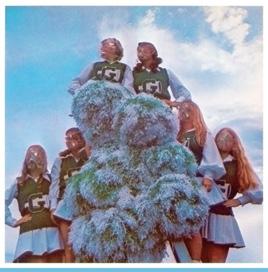
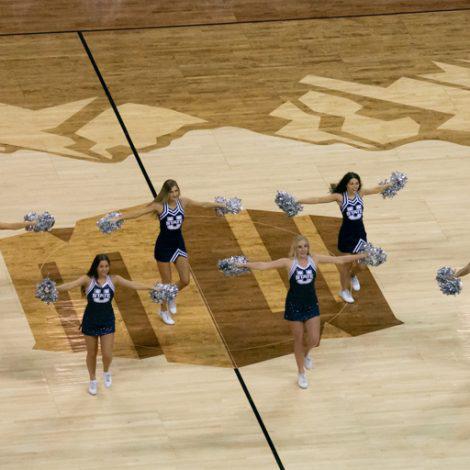
The Utah State Spirit Squad performs at the Mountain West basketball championships in Las Vegas.
PRO SkiJor brings horses and skiers to Cache County Fairgrounds
By Jayke Martin STATESMAN REPORTER
Horses sprinted down a snowpacked course at the Cache County Fairgrounds on Jan. 3031, pulling skiers and snowboarders behind them as spectators gathered to watch PRO SkiJor bring competition to Cache Valley.
yeah, we had no idea how it works and how they’re scored.”
Bingham said watching the horses charge down the course was one of the most memorable parts of the event.
“I thought the girls were so cool. Their horses were fun,” Bingham said. “They look like the horses are having the most fun
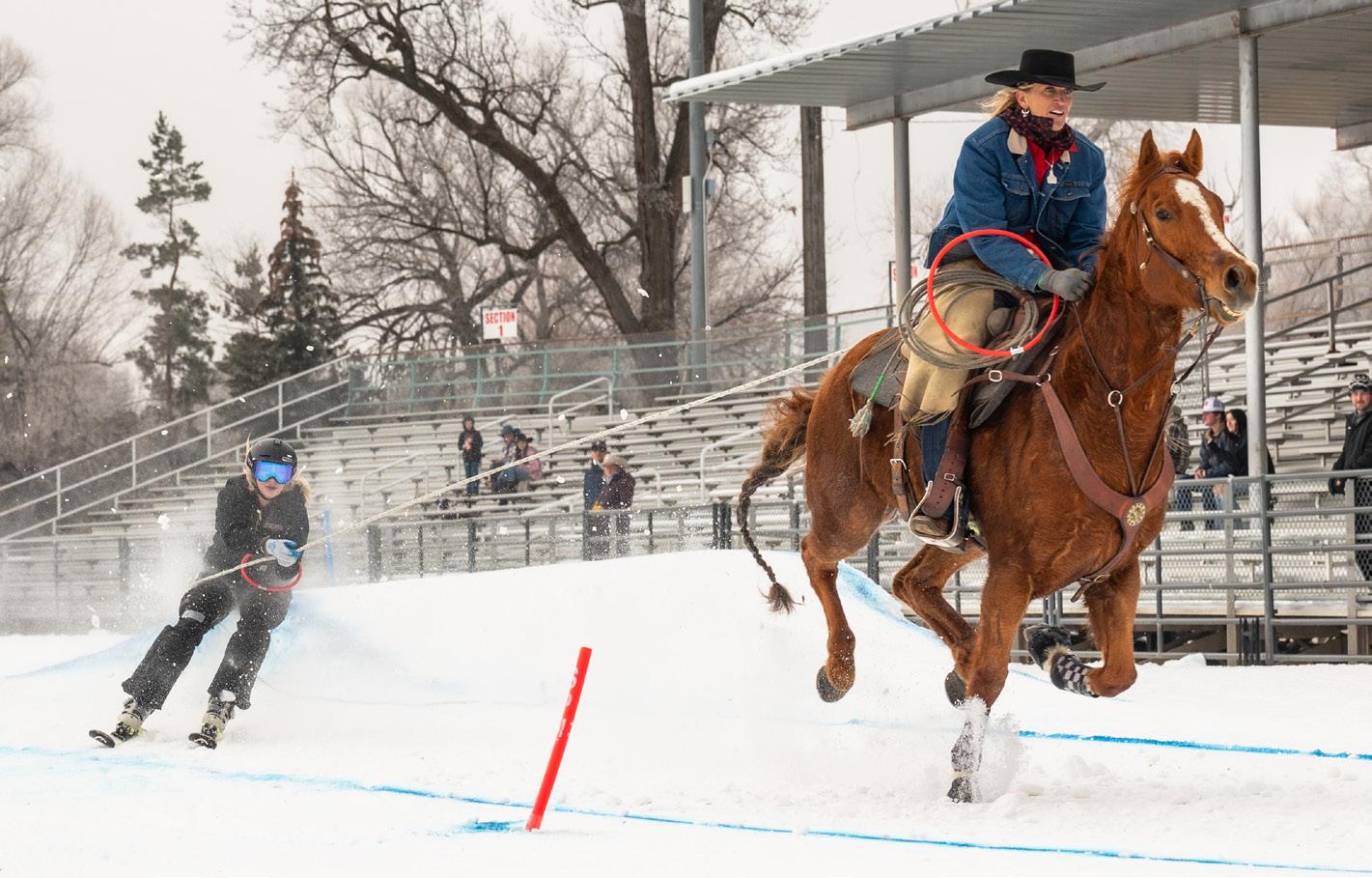
The Logan event was part of the PRO SkiJor Frontier Tour, a professional skijoring series that blends Western rodeo culture with winter sports. Skijoring teams consist of a horse and rider, paired with a skier or snowboarder who holds onto a tow rope while navigating gates and jumps along a flat course. Teams are timed, with penalties added for missed obstacles.
For many spectators, the event marked their first time seeing the sport in person.
“I totally just saw this on Instagram,” said Cassidy Bingham, who traveled from Salt Lake City to attend. “[I] was like, ‘This looks sick. We have to come check it out.’” Bingham said she and her partner were drawn to the event because of their interest in rodeo culture.
“Yeah, we’re big rodeo fans,” Bingham said. “He used to work on a ranch when we met, so we’re, like, into the Western world.”
Although she arrived with little knowledge on skijoring, Bingham said the experience was easy to enjoy.
“We don’t have any idea,” Bingham said. “We’ve kind of grasped a couple things, but
because they just get to freaking sprint in a straight line, you know.”
Bingham said the coordination required between the skier, rider and horse stood out as the competition continued.
“It looks like everybody’s got — you have to have all the skills, skier, you’ve got to figure out how it works, the riders and the horses, and it’s really cool,” Bingham said.



Jayke Martin is a junior studying journalism with a minor in theater. She
PHOTO BY Rylee Patterson
Competitors ski behind horses during PRO SkiJor at the Cache Valley Fairgrounds on Jan. 30.
Column: USU Director of Athletics Cam Walker appears on the Statesman Sports Desk radio show
By Mark Greenwood STATESMAN EDITOR
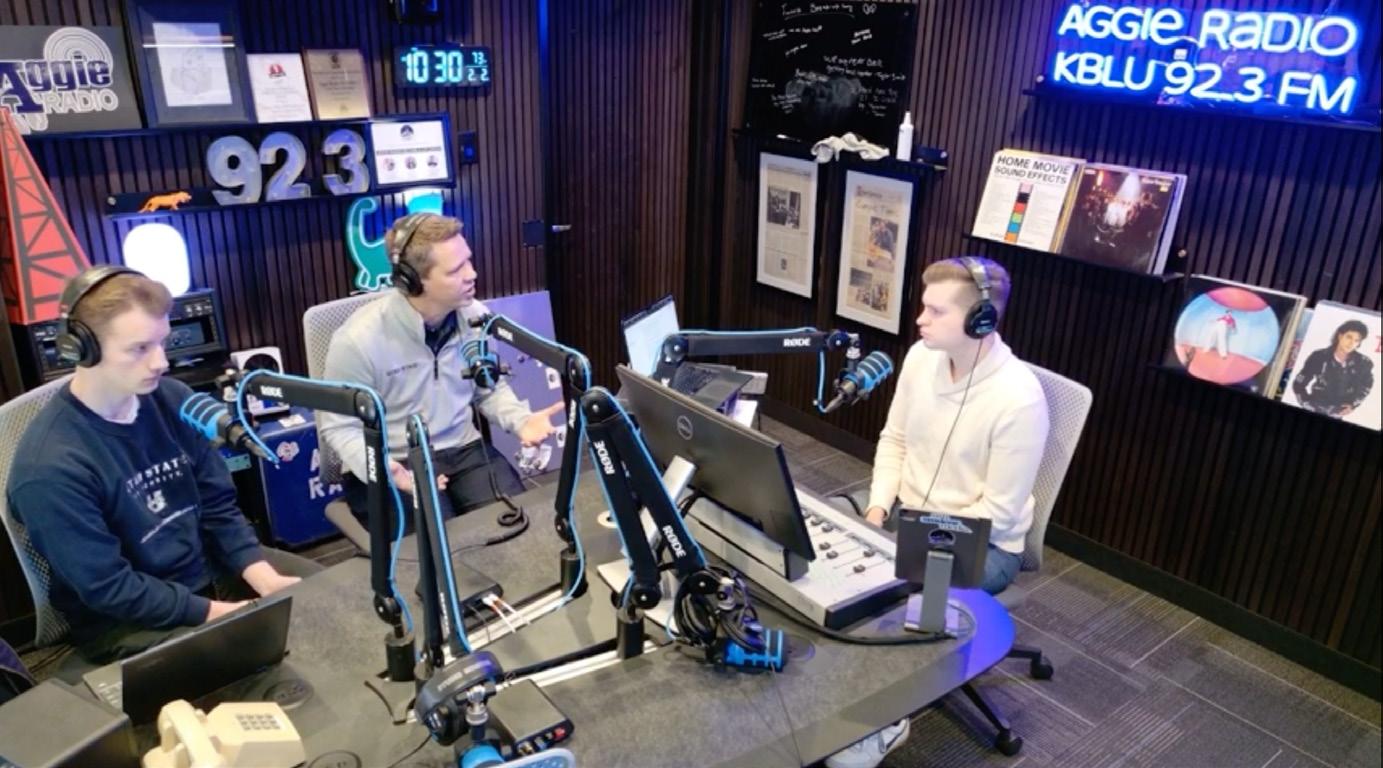
Utah State Vice President and Director of Athletics Cam Walker joined the Statesman Sports Desk radio show with The Utah Statesman sports editor Mark Greenwood and senior sports reporter Carson Frost on Feb. 2. The show airs every Monday at 10 a.m. on Aggie Radio 92.3 KBLU-LP and can also be found in podcast form on Podbean, Spotify and Apple Podcasts.
Walker joined the show to talk about Utah State Athletics’ new fundraising campaign entitled ‘Show Me,’ aimed at raising funds for the department prior to Utah State joining the Pac-12 Conference in summer 2026. The campaign identified 6- and 18-month fundraising goals for different department areas, including ticket sales, donations, Big Blue Club memberships and Blue A Society members.
“I think we want to show everyone we’re not done just when we get in,” Walker said. “We’re not just, here to [say] ‘Oh, we’re in. We’re good.’
Once we’re in, there’s still work left to do. And so I think it was clear to kind of designate and divide those up but to show that, yes, we need to sprint for six months, but that’s not over.”
The campaign was announced on Jan. 28 by Walker and the department.
Walker discussed a variety of topics on the show, including the new campaign, revenue sharing, student and community involvement and the recent increase in student fees that go toward athletics. While Walker acknowledged the strong presence of the HURD, the campaign is hoping to get more students involved and make athletic events more appealing to a general audience.
“You don’t have to love basketball to know that that’s a fun environment in the Spectrum and something that’s a pretty good time on a Saturday or on a weeknight,” Walker said. “I think we just need to broaden that appeal and get even more coming.”
A criticism of Utah State coaches, specficially men’s basketball head coach Jerrod Calhoun, has been the lack of revenue sharing from the university. This campaign would elevate the department resources available to share with programs. For Calhoun and others, this would mean a better ability to retain top coaches and players.
“There’s opportunity that Utah State doesn’t have to be
a stepping stone for athletes or coaches,” Walker said. “But we have to be able to be resourced at a level where we can chase championships and compensate at the level that’s market value.”
Walker also discussed the importance of athletics and how a successful athletics department elevates a university and its alumni in other areas.
“Believe it or not, most employers aren’t reading U.S. News ranking reports about the highest-rated schools, but most of them pay attention to March Madness. Is that right? Probably not, but it’s just the reality of the world that we live in,” Walker said. “We have to make sure that we understand that value and try and capitalize on it.”
Looking forward, the Statesman Sports Desk will next feature Utah State Gymnastics head coach Kristin White and Aggie gymnast Isabella Vater who will join the show on Feb. 9. The Statesman Sports Desk can be found on Aggie Radio 92.3 KBLU-LP every Monday at 10 a.m. and listened to anytime on Podbean, Spotify and Apple Podcasts using the QR codes below.
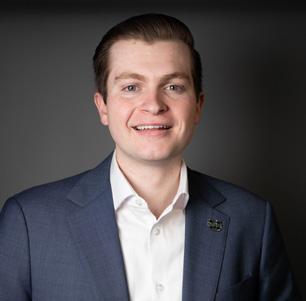
Mark Greenwood is a junior studying finance. Mark is in his third year with the Statesman and his first as sports editor. He loves skiing, baseball, college basketball, tennis and golf.
— mark.greenwood@usu.edu

PHOTO VIA STATESMAN SPORTS DESK
Utah State Vice President and Director of Athletics Cam Walker, middle, joins the Statesman Sports Desk radio show with Mark Greenwood, right, and Carson Frost on Feb. 2.

Science fiction blinds students to new meaning, purpose of AI
Editor’s note: Guest Columns and Letter to The Editors are pubished as submitted. Submission instructions are available at usustatesman.com.
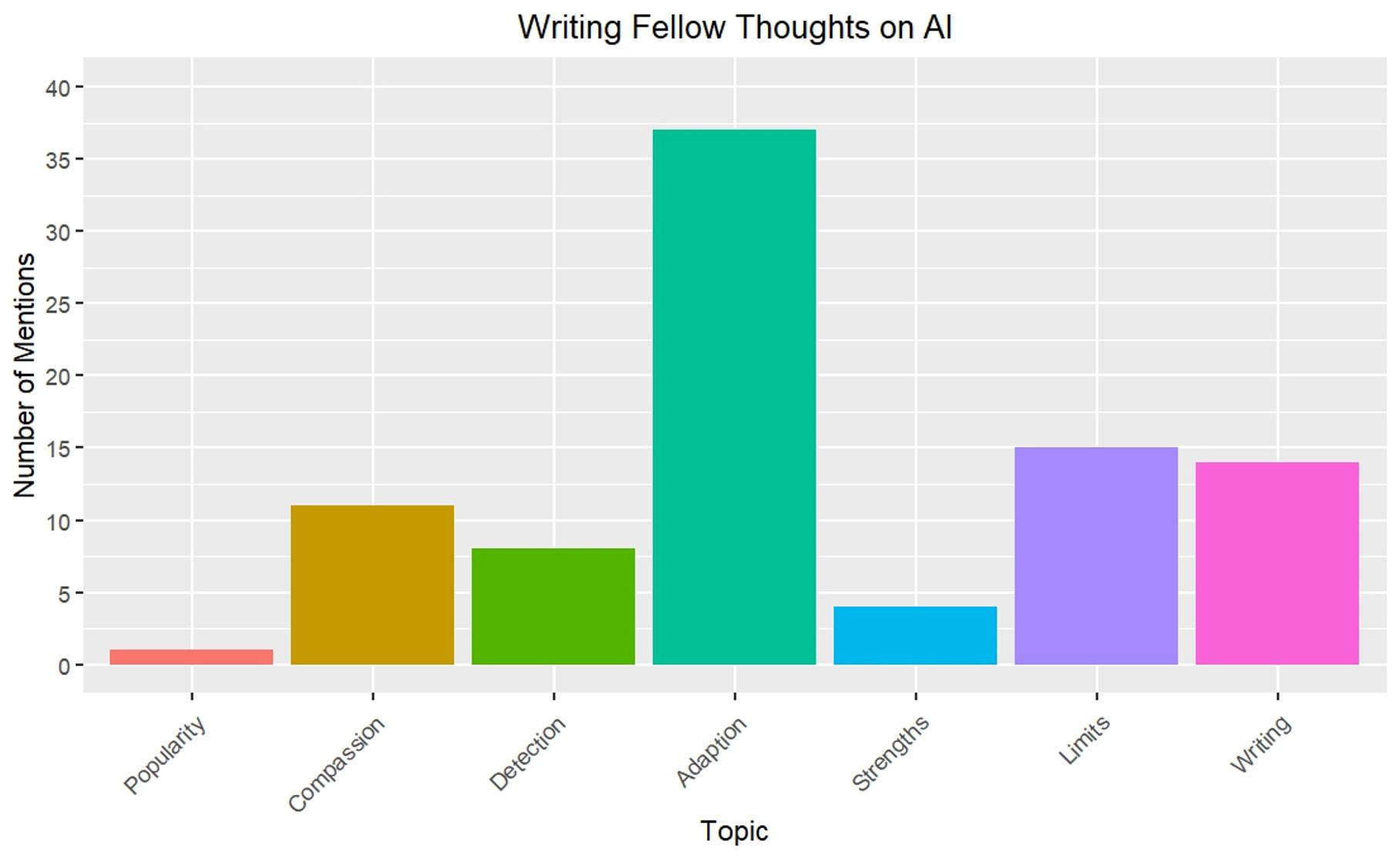
Last fall, USU’s newest Writing Fellows compared AI-generated literary arguments against human-composed versions. Analyzing our reflections on this experience revealed that our primary concern was how to adapt our tutoring to AI-using students. The proliferation of AI, and AI-generated content, puts faculty and tutors alike in uncharted territory.
Unlike many other Writing Fellows, my background isn’t in the humanities. I study statistics, data science. Because of this, I understand the principles behind large language models like ChatGPT. And as someone who studies and uses predictive algorithms, I worry more about user error than AI’s existence. As currently used, AI often prevents true learning. But I strongly believe that with proper caution and context, AI can be a benefit to education. Unfortunately, our history with AI is preventing us from gaining this necessary background.
Artificial intelligence (as we currently use the term) only became truly widespread in 2022, when OpenAI released ChatGPT. But people were thinking about it decades beforehand. Science fiction writers created literature, movies, and TV exploring AI conceptually. Popular examples include Asimov’s I, Robot, Star Wars, The Matrix, Tron, Star Trek, and Space Odyssey. When humanimitating chatbots entered the internet, we were already culturally prepared for the implications.
Except that the reality pales in comparison to our imaginings. Authors and filmmakers taught us that AI are sentient beings. Aside from their electronic bodies, fictional AI are essentially the
same as obviously-sentient aliens or cryptids. Whether villainous, benign, or complicated, they have their own goals. Independently of others, they exercise selfdetermination to pursue these passions. For instance, in Star Trek, a Dr. Moriarty simulation reboots himself and attempts a jailbreak from his computer. He controls himself, not his creators or programmers. Just as no one would accuse Chewbacca of being a “dumb machine,” it would be ludicrous to call Moriarty nonliving. They display the same indicators of sentience—natural evolution, free will—as any human.
But today’s chatbots do not possess these characteristics. They act only when they receive prompts and adapt only when someone updates them. By my basic measures, they are not sentient. If OpenAI had created true intelligence, I think we’d be thrilled. I suspect we’d gladly invite them into our workforce. After all, humans have a long fictional history of welcoming AI into our societies.
Within the Star Trek franchise, humans encouraged the android Commander Data’s paining and poetry. And in the new Starfleet Academy series, sentient holograms star as students and teachers. As discussed earlier, these beings are constantly changing and selfdirected: clearly sentient.
Historically, they’re also fond of respecting the law. Suppose that Commander Data reviewed one of my essays. In preparation, he’s processed many relevant materials, including tutoring guides and USU’s academic honesty policies. This makes him a qualified, expert writing tutor. He’d know better than to directly rewrite anything (besides fixing typos). In short, he’d be an expert who would be helpful, yet maintain academic integrity.
I imagine that if my professors knew that Data was offering review sessions, they’d sign up all their students. We’d learn from an intelligent, highly
skilled being with proven ethical training. This would improve our work, enrich our educations, and make our assignments less painful to grade.
But today’s nonliving programs are galaxies away from those fantasies. Neither ChatGPT nor any other chatbot is sentient. I understand this because I work with algorithms, and LLMs are simply another algorithm. They’re not that different from search engines: just as Firefox or DuckDuckGo predict the optimal results to internet queries, AI chatbots approximate sentient-sounding answers to prompts. They’re mimics, using recorded human interactions to simulate intelligent conversation.
Keep in mind that that these bots are maintained and updated by teams of developers. A chatbots doesn’t learn or adapt. Instead, real sentient beings update its facade of intelligence. Like a detailed puppet, it will never be human no matter how carefully they paint its face.
When predictive chatbots became widespread, their creators branded them as “AI.” Since no one has objected, they effectively changed the definition of “artificial intelligence.” Rather than “sentient machine,” its new meaning is “imitation of sentience.” Unfortunately, most people still have the original meaning in their heads. They remember Tron and Asimov, mistaking real-life “AI” for speculative fiction. Consequently, when college students use AI in their writing and assignments, they ask for too much. We demand Star Trek-level results, expecting originality from simple prediction machines. And since reality is never as interesting as fiction, we get predictably lackluster results.
I’m not arguing that AI has no place in writing and learning. Computational tools are an asset to education. Without Google Scholar, spellcheck, and Purdue OWL, the world would be worse off. But using LLMs to determine a thesis or put the final touches on an assignment is like Googling “best essays” and submitting the first result without revisions. This approach doesn’t help us learn, which defeats the point of most assignments.
Will Bouck is a junior majoring in statistics who works with the Writing Fellows Program at Utah State University.
— william.bouck@usu.edu