
By Jayke Martin STATESMAN REPORTER
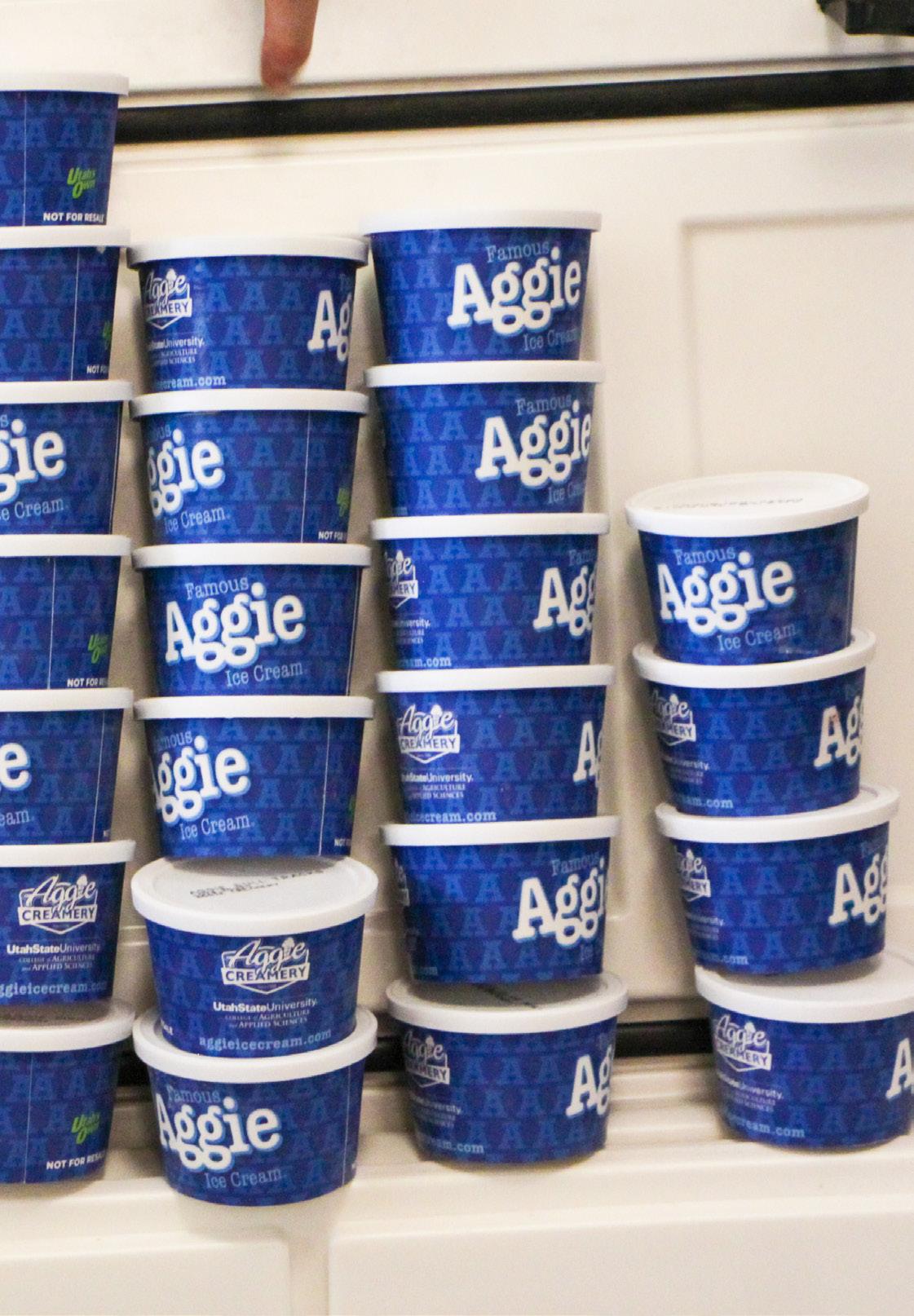
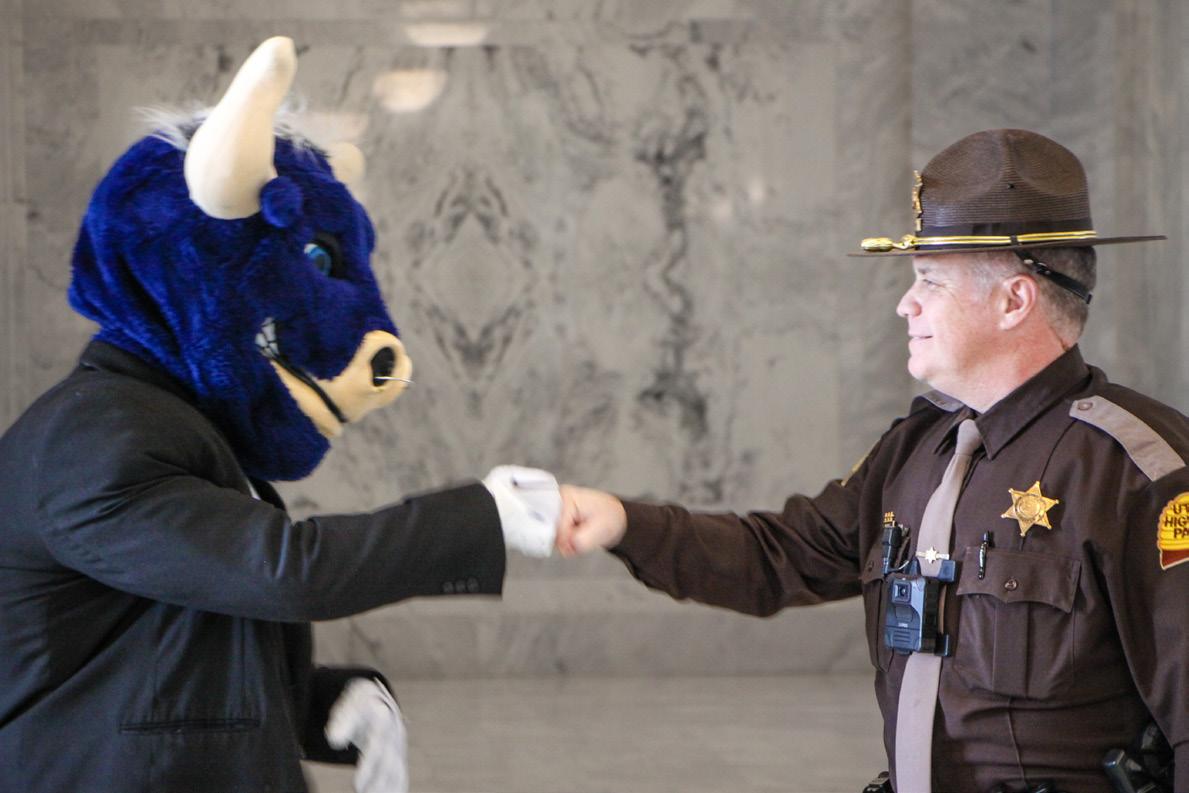
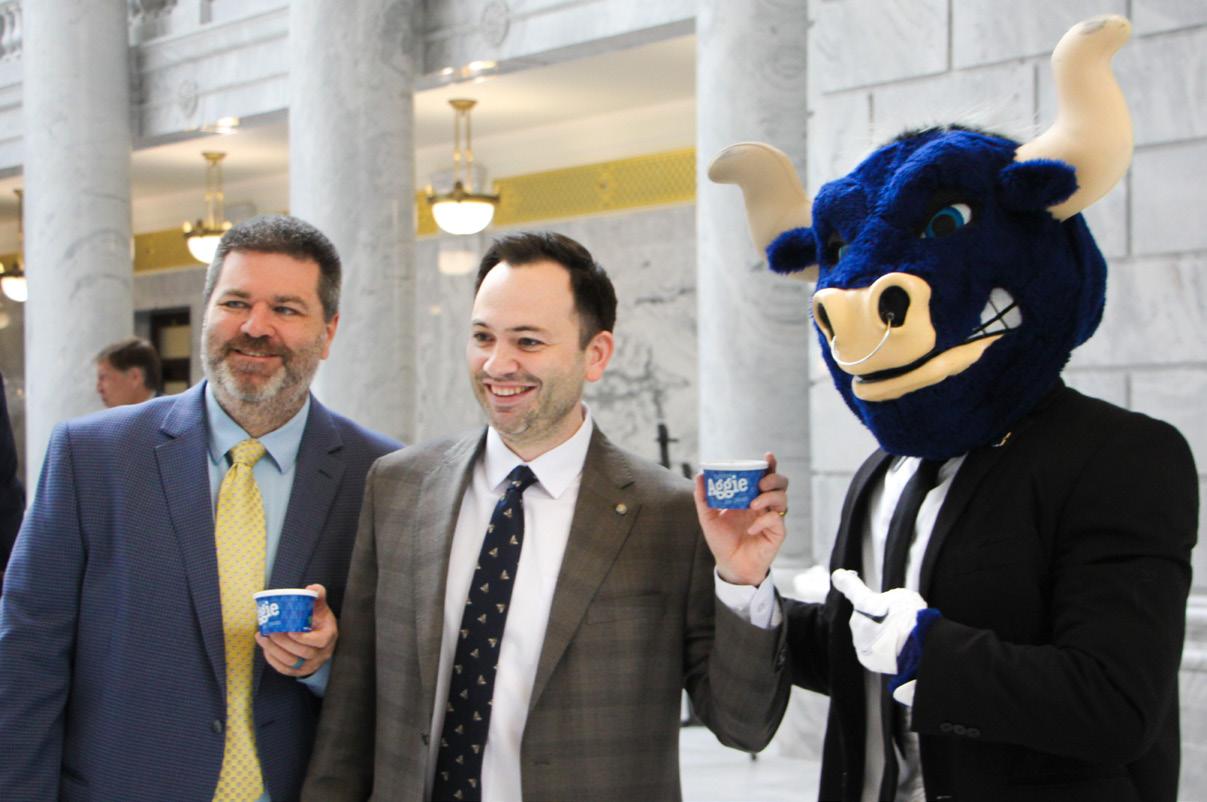
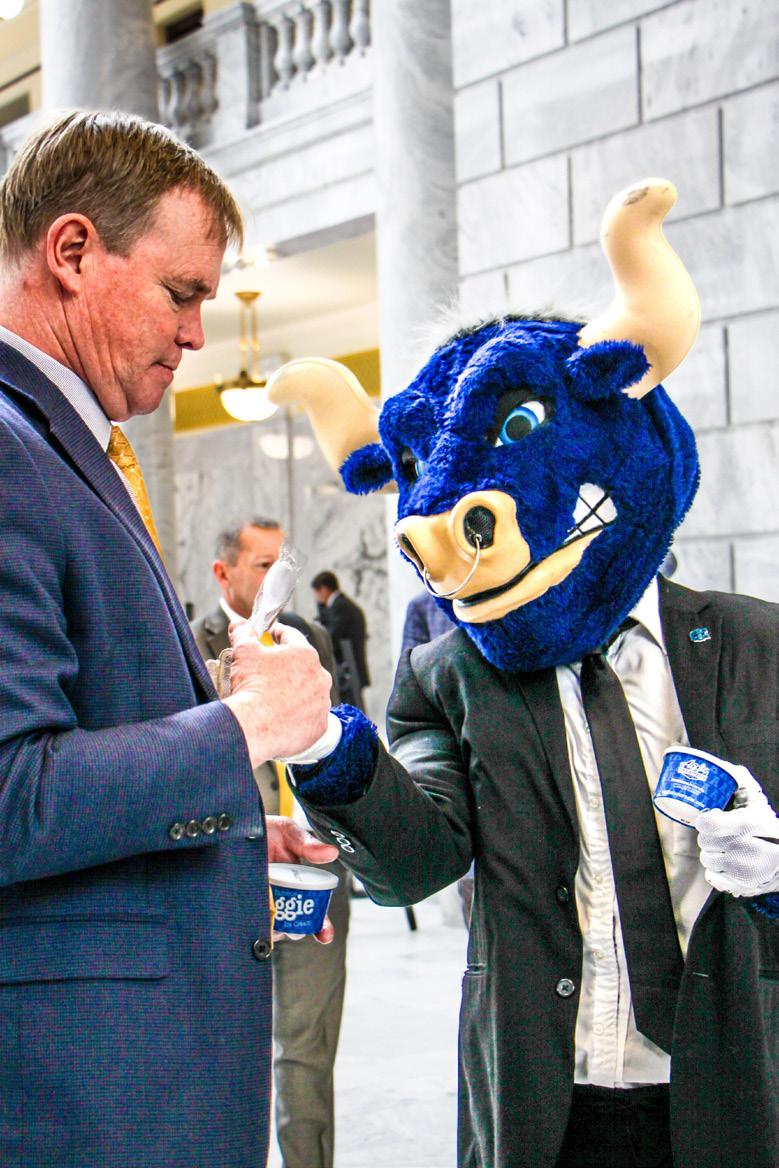
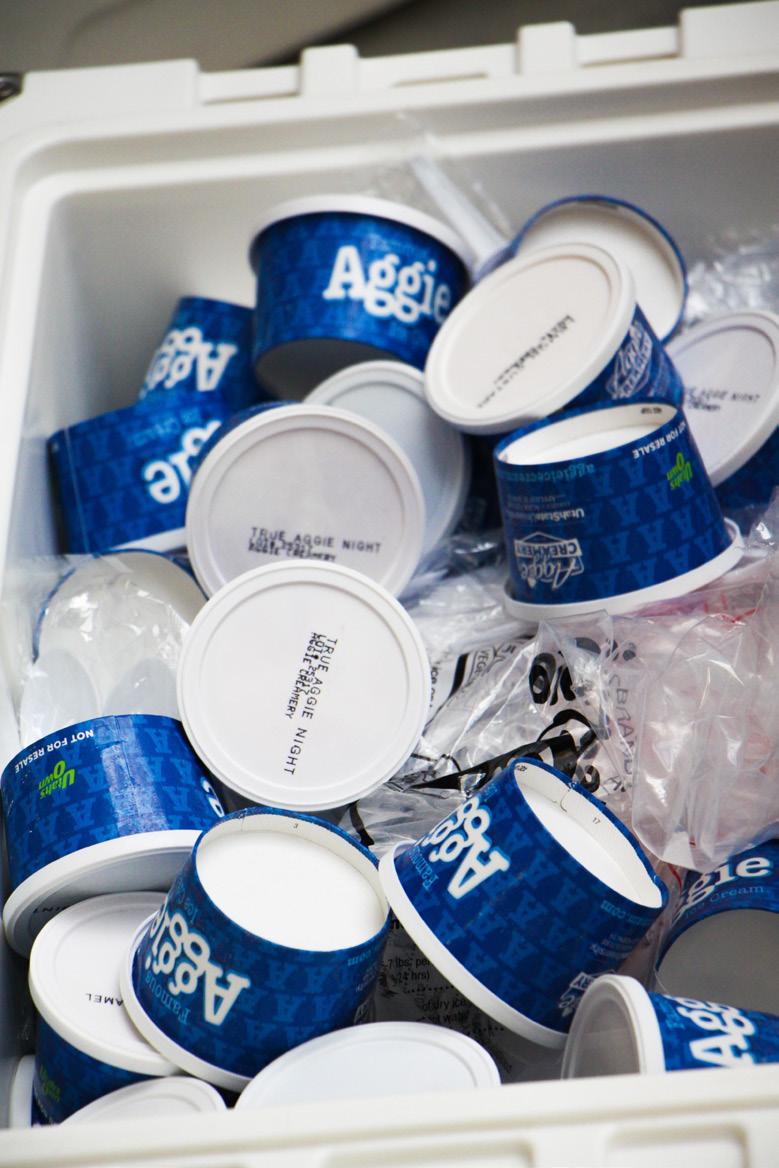
Lawmakers stepped out of committee hearings Feb. 19 during the legislative session to see coolers of Aggie Blue Mint and Bull Tracks ice cream carried by smiling Utah State University students through the halls of the Utah State Capitol Building.
Aggie Ice Cream Day, an annual tradition during the legislative session, brings USU students face-to-face with senators, representatives and executive staff through Aggie Ice Cream.
“Aggie Ice Cream Day is arguably the best day on the [Capitol] Hill,” said USUSA President Brandon Sorensen. “As soon as the session starts, elected officials are asking and marking their calendars for it.”
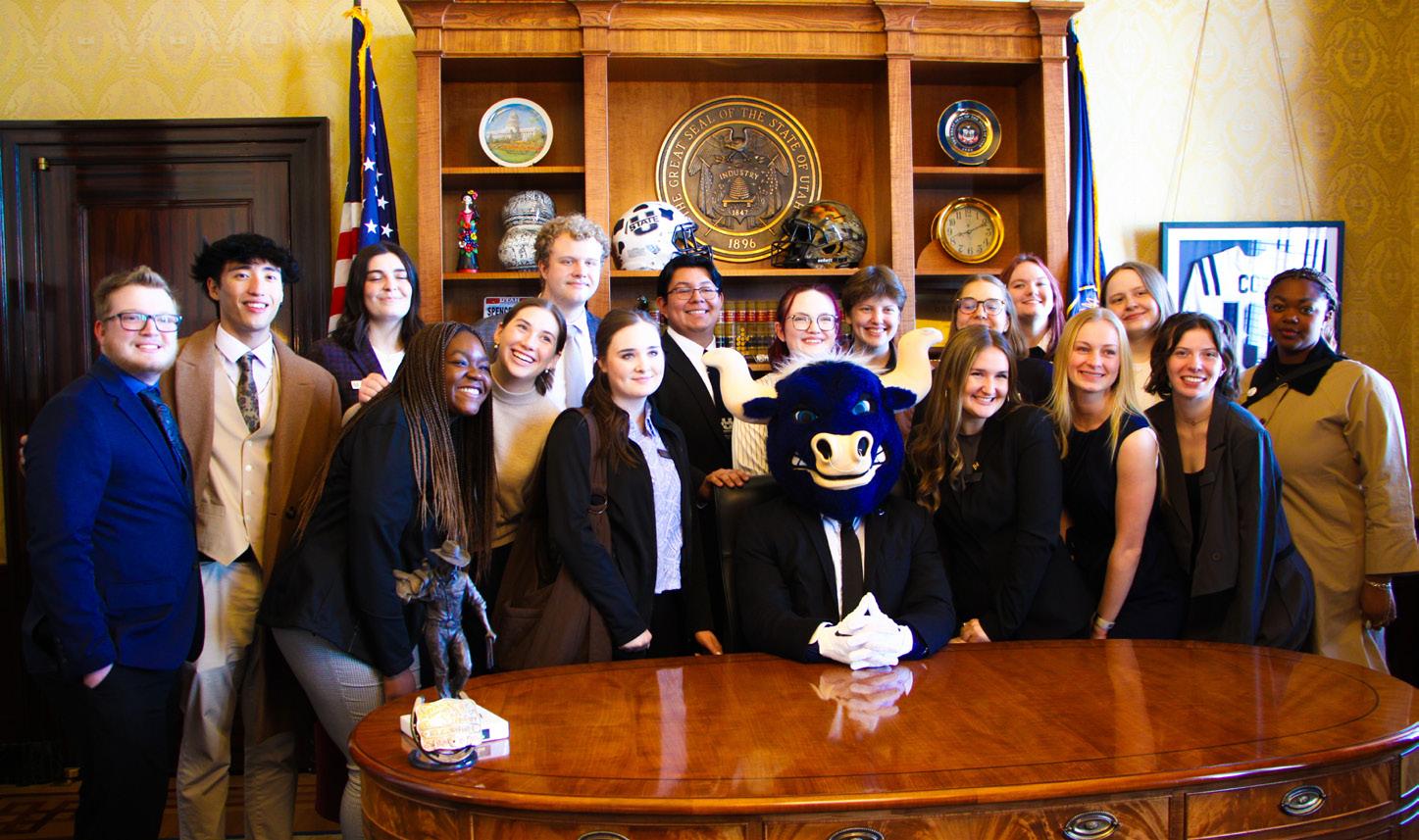
Members of USUSA and the Government Relations Council spent the day walking from office to office throughout the capitol building, delivering ice cream and introducing themselves to lawmakers.
“A lot of universities will set up in the rotunda and have people come to them,” Sorensen said. “We want to go to our elected officials, meet them where they’re at, hand them Aggie Ice Cream and have the opportunity to talk about Utah State.”
Devin Wiser, vice president of government and external affairs at USU, said the tradition has become a highlight of the 45-day legislative session.
Beyond free ice cream, Wiser said the day puts students at the center of conversations about higher education funding and policy.
“They get to come up here and tell their own stories,” Wiser said. “They’re all so impactful and unique that it really moves the legislators.”
Wiser said the goal is for lawmakers to see firsthand how higher education shapes students’ lives.
“I want them to see the effect higher education has on individual students and how their lives can change because of it,” Wiser said. “If they can get even a taste of that along with the taste of the ice cream, that’s a huge win.”
For students like Maddie Widman, a member of the GRC, the day also highlights the university’s agricultural roots.
“We’re an agriculture school,” Widman said. “So, bringing our dairy products to the senate shows that we’re still here as a community.”
Widman said students hope to strengthen relationships with lawmakers while showing they are invested in the legislative process.
“Students care about what’s happening in the legislature, and we want to be involved as much as we can,” Widman said. “I hope they see that we’re a tight-knit community. We care about our agriculture, and we care a lot about Aggie Ice Cream.”
University leaders said the event also reinforces USU’s statewide mission as Utah’s land-grant institution.
Neil Abercrombie, senior adviser to Gov. Spencer Cox and a former USU government relations director, told students their presence carries weight.
“I could speak until I was blue in the face about why lawmakers should invest in Utah State, but when we brought students to Capitol Hill, they were inspired by your story, what you were studying, where you’re from,” Abercrombie said. “You really showcase what Utah State is all about.”
Brad L. Mortensen, president of Utah State University, said the university has felt strong legislative support this session.
“It’s really important to be part of the process,” Mortensen said. “You’re helping us expand our statewide reach and improve our civic engagement.”
As the session enters its final stretch, Wiser
said the arrival of students changes the atmosphere in the capitol’s corridors.
“There’s definitely a lowering of the temperature and not just because we’re serving ice cream,” Wiser said. “Students create an element of fun and joy in the capitol.” By the end of the afternoon, students finished their rounds through the capitol, wrapping up a day of meetings and conversations with lawmakers.
“Ultimately, we have the best ice cream in the state of Utah,” Sorensen said.

Jayke Martin is a junior studying journalism with a minor in theater. She loves reading and meeting new people.

We’re excited to announce that Utah State University Engineers Week, E-Week, is this week, Feb. 23–27! Hosted through a collaborative effort between the Engineering Student Council, the Office of the Dean and the College of Engineering student clubs, this annual celebration highlights the creativity, impact and community of engineering.
USU’s Engineers Week aligns with the National Society of Professional Engineers’ Engineers Week, a nationwide celebration that honors the power of engineering and the people behind it. Founded by NSPE in 1951, Engineers Week brings together engineers, students and communities across the country to recognize how engineering shapes our world, inspires future innovators and strengthens professional connections. Throughout the week, we’ll be hosting a variety of hands-on activities, competitions and social events, and everyone is welcome to attend!
Monday- 2/23
• Lunch and Linger: 3rd Floor ENGR Study Lounge, 11:30 a.m. to 1:30 p.m.
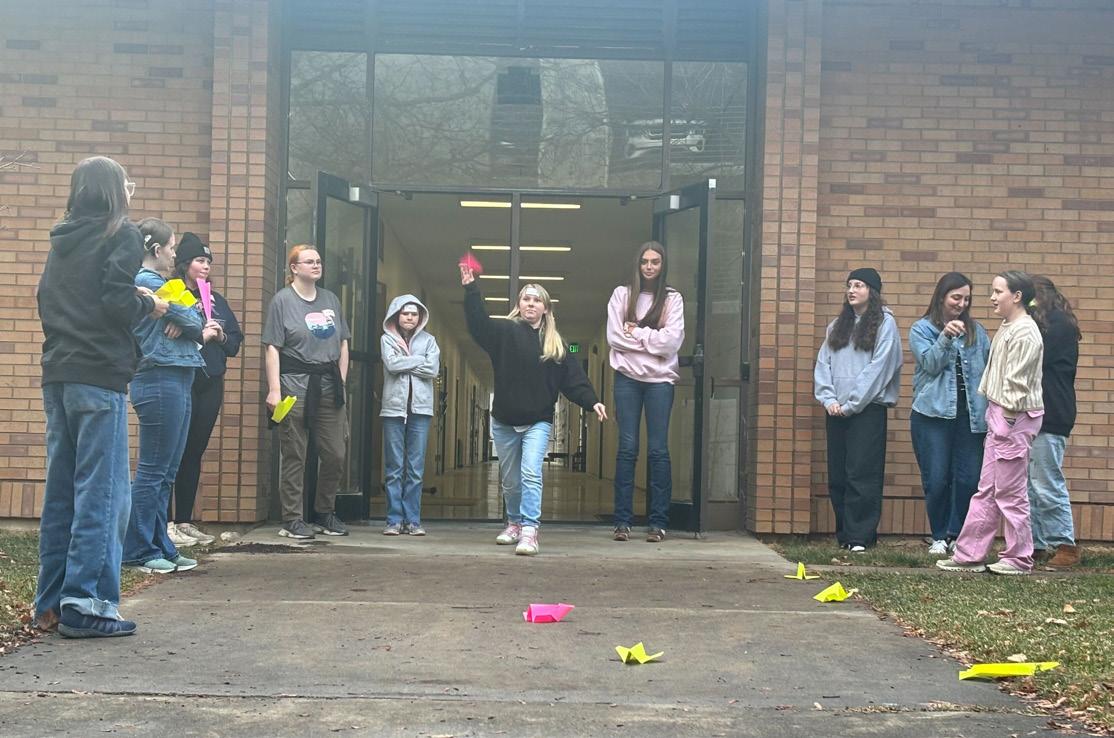
• Paper Rockets: Engineering Quad, 2-4 p.m.
• Astronaut Scholarship Foundation Award Event: ENGR 103, 5-7 p.m.
Tuesday- 2/24
• Calculator Quick Draw: ENGR Atrium, 10 a.m. to 12 p.m.
• Pinewood Derby: ENGR Atrium, 1-4 p.m.
• Concrete Workshop: Tech 110, 4-6 p.m.
Wednesday- 2/25
• Breakfast Snacks: 3rd Floor ENGR Study Lounge, 8-9:30 a.m.
• Pipe Cleaner Structures: ENGR Atrium, 10:30 a.m. to 12:30 p.m.
• Beta Bowl: 3rd Floor ENGR Study Lounge, 1-5 p.m.
• Cardboard Boat Races: HPER Pool, 5:30-7 p.m.
Thursday- 2/26
• Egg Drop: ENGR Atrium, 10:30 a.m. to 12:30 p.m.
• Paper Airplane Competition: Engineering Quad, 2-4 p.m.
• Community Night: TSC Lounge, 6-8 p.m.
• Talent Show: TSC Ballroom, 6-8 p.m.
Friday- 2/27
• Soldering Workshop: ENGR Atrium, 12-3 p.m.
• Awards Banquet: TSC Ballroom, 6-8 p.m. Dessert and a dance will follow the banquet.
Along with a full schedule of events, Engineers Week will also include a canned food fundraiser sponsored by SNAC, approximately half-off pricing on the Marv’N’Joe sandwich throughout the week and the sale of exclusive 2026 Engineers Week T-shirts designed by one of our engineering students.
It will be a busy and engaging week, and we’re excited to highlight the creativity and impact of engineering. All are encouraged to participate and help celebrate Engineers Week at USU.
Hope to see you there!
Senator Shelton
Frost
Barker
Alyssa Caywood Grace Colvin
Jayke Martin Rory McNeill Dylan Moore Mia Nielsen
Dani Packer
Jillian Peterson Emma Shelite
Kenadie Ferraro
newspaper for Utah State University since 1902. Reporting online 24/7. Printed weekly during the school year.
Fonoti
Sintay
Utah Statesman, February 23, 2026
— engrsenator.ususa@usu.edu

By Jayke Martin STATESMAN REPORTER
Abill moving through the Utah Legislature would require public universities to provide accommodations for students whose coursework conflicts with their religious or sincerely held conscience beliefs.
Michael Petersen, the bill’s sponsor, said the idea for House Bill 204, “Higher Education Student Belief Accommodation,” came from a personal experience involving his daughter.
“A year or so ago, my daughter called me, just finishing her master’s at a school outside of our state,” Petersen said. “She called and said, ‘Hey, Dad, I’ve got an assignment. I’m supposed to write a letter to my legislator advocating on behalf of LGBT policy.’”
Petersen said that kind of assignment crosses a line.
“That’s compelling someone to speak,” Petersen said. “We have a First Amendment on purpose.”
The bill would require universities to excuse participation, offer alternative deadlines or provide alternative assignments when coursework violates a student’s conscience. Petersen emphasized the bill does not allow students to avoid required learning outcomes.
“We’re not trying to change what a student learns and can do,” Petersen said. “We don’t want to change the nature — the essential nature — the objectives or the standards of the class.”
According to Petersen, universities would have a neutral arbiter to review accommodation requests.
“The first line is the professor,” Petersen said. “If the professor says, ‘Sorry, you’re out of luck,’ then it goes to that

neutral arbiter.”
Petersen said he fears students would misunderstand the bill’s purpose and use the it to avoid coursework
“It’s not about getting out of learning new things,” Petersen said. “It’s about having to do things that violate your conscience.”
Eliza Rosenberg, a lecturer in world religions and biblical studies at Utah State University, said discussions about religious conscience protections are rooted in longstanding legal and historical traditions.
“In the U.S., obviously, freedom of religion is an important value,” Rosenberg said. “To be clear, I think it’s a very good thing.”
Rosenberg noted questions about belief accommodations are not new to higher education and are already addressed
through existing university policies.
“The university, in its code, already has principles about coursework and assignments that conflict with assisting with the students’ sincerely held beliefs,” Rosenberg said. “There is already a process.”
Rosenberg said any policy can be applied incorrectly, but she does not expect that to be common.
“The overwhelming majority of USU students are here because they want to learn,” Rosenberg said. “The university is very committed to academic rigor under all circumstances.”
Rosenberg also said discomfort can be part of the learning process, particularly in courses that examine belief systems.
“It’s normal to feel discomfort at some point,” Rosenberg said. “This is critical inquiry into religion.”
As HB204 continues through the Utah Legislature, Petersen said the bill is not intended to benefit one political group over another.
“This is not about right and left or Republican, Democrat,” Petersen said. “Professors should not require a student to advocate on either side.”
Petersen added exposure to ideas should not require compelled speech.
“You want to learn about these things, be exposed to these things, but you shouldn’t compel someone in public to make a statement that violates their conscience,” Petersen said.

February 13
An officer responded to a suspicious vehicle at the blue lot/gold toaster. The complainant reported a vehicle that’s been parked in this lot for four days. The complainant was concerned about the owner and felt it was strange it hadn’t moved in days. Upon arrival on scene, an officer observed the inside of the vehicle and did not find anything suspicious. The vehicle obtained a permit to park in the blue parking lot. The officer made contact with the complainant and advised the person who owns the vehicle has a permit to park in the parking lot.
An officer responded to a call of a suspicious bag on the fourth floor of the Merrill-Cazier Library. Upon arrival, the officer observed a table with personal items and nearby, a small brown paper bag. The officer identified the contents and verified it was food items. The officer was able to identify and contact the owner of the property and advised them where they could retrieve their belongings.
16
An officer was flagged down in the parking lot of In-N-Out Burger by three students. The officer answered questions about the differences between campus police versus local police.
By Bailey Daniels STATESMAN SENIOR REPORTER
Each year, the Utah State University Student Association is given $200,000 for facility enhancements. Students and faculty are encouraged to submit requests for improvements or additions to amenities across USU Logan campus. After applications close, the Student Facilities Enhancement Committee, made up of USUSA members, will look through these requests and allocate funds where they deem necessary.
On Feb. 11, the committee met in the TSC Senate Chambers. The committee consisted of Brinley Rhodes, Kaylee Shelton, Kevin Webb, J.J. Watts, Jamie Parry, Halle Hart and Kennedy Thurgood and was chaired by current USUSA Executive Vice President Max Alder. Also present was Joseph Beck, USU Facilities project manager, and classroom support manager Clay Davis. At the beginning of the meeting, Beck explained the history of facility enhancements at USU.
“This originated because we didn’t have funds for furnishings on campus. The furniture was outdated and uncomfortable,” Beck said. “Starting a number of years ago, we were giving $200,000 in a pot for faculty and students to request things.”
This year, there were 15 requests submitted by students and staff. The requests were voted on and ranked by the committee from most to least important.
“If we were to award full funding to all of the requests, we don’t have enough money for that in the budget,” Alder said. “So ultimately, some of these will either have to be partially funded or not funded at all.”
Four of the requests submitted were from Tara Gibbons, a USU classroom support specialist. All of her requests were unanimously approved.
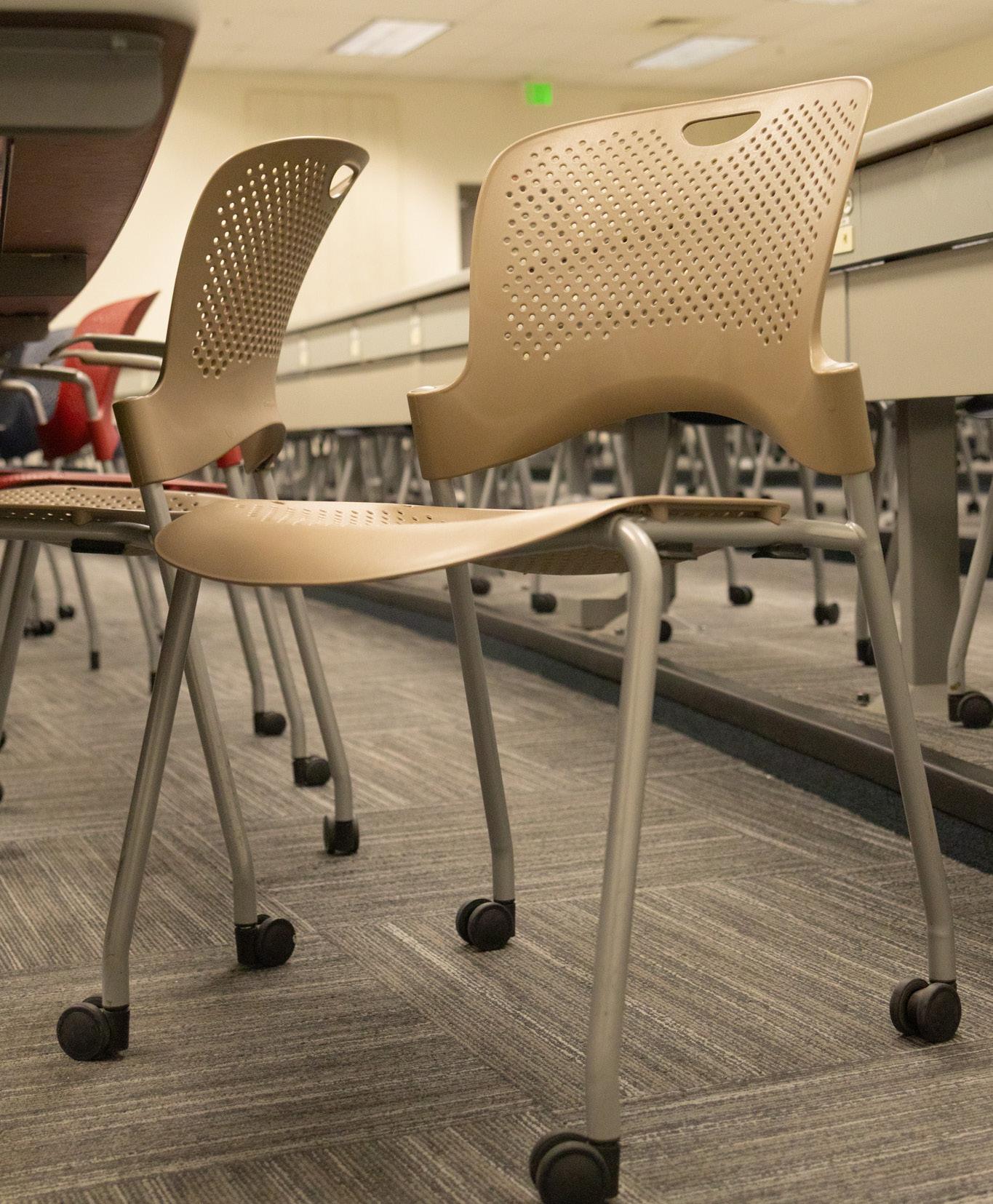
Her first request was for a new projector screen in the Biology and Natural Resources Building room 314 for $1,803.80. Next, she requested new chairs for the Richard and Moonyeen Anderson Engineering Building room 101, as many of the chairs were outdated and broken. This was given $45,595.
Gibbons’ last two requests were for new projector screens in ENGR rooms 104, 106, 201, 202, 203, 204 and 205 for a total of $12,626.60 and new chairs in the HPER for $6,435.
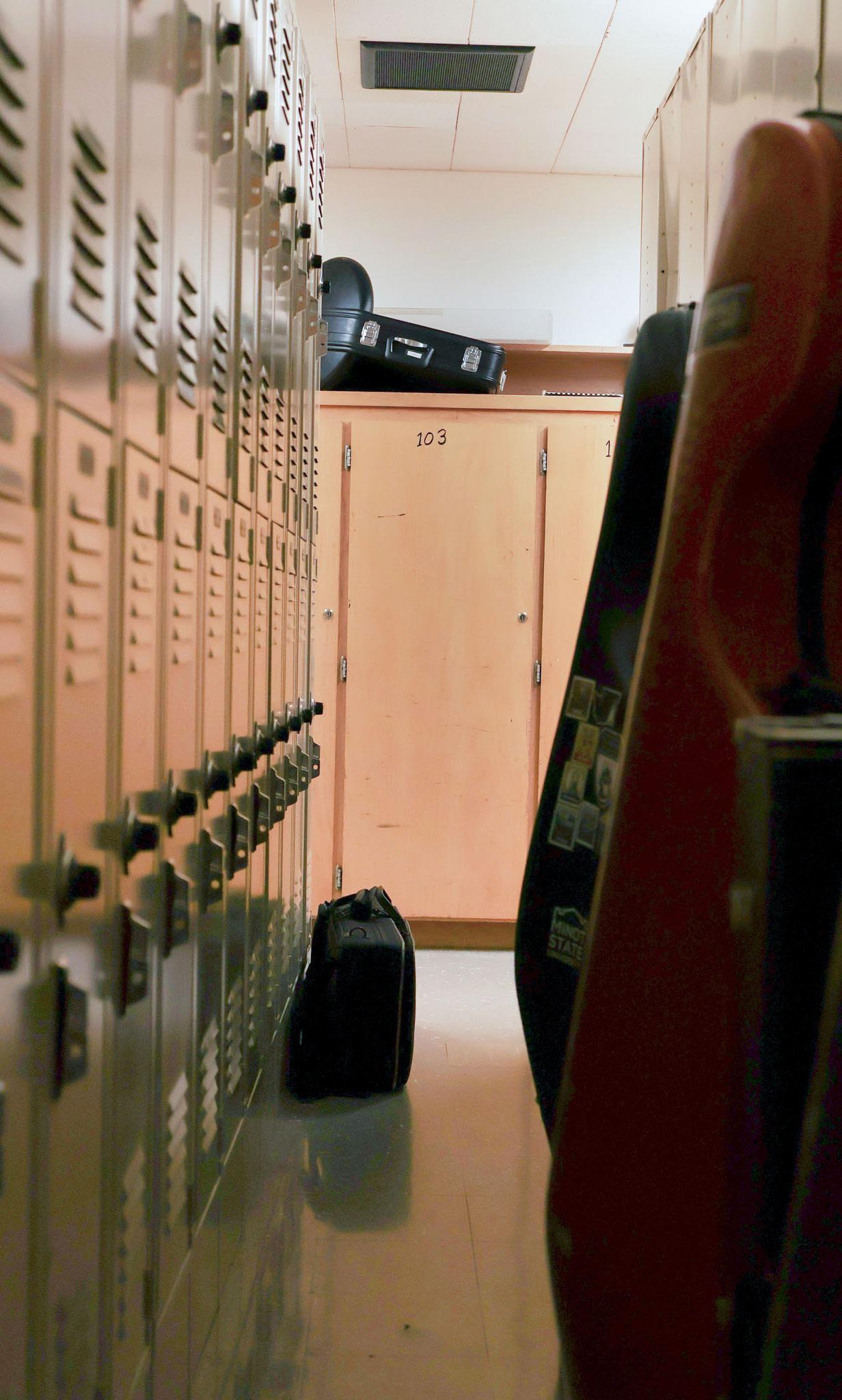
An improvement for the Daryl Chase Fine Arts Center was submitted by music professor and interim department head Kevin Olson. Olson was looking to refurbish the instrument locker room, writing that a lot of lockers won’t open, many no longer have keys and there aren’t enough for each student.
Although Beck mentioned this could be difficult to implement depending on the size of the locker units requested, the committee approved this request for $30,000.
A large project totaling $63,820.90 was requested by landscape architecture associate professor Ole Sleipness. The request was for a pollinator garden to go between the FAC and Fine Arts Visual Building. The garden was meant not only to help pollinators but also to use less water than the turf grass present on campus.
“I think that Utah State was putting forth an effort pre-COVID on making things more sustainable, but I haven’t really seen that lately,” Parry said. “I think this is a really cool idea, but it does seem like an extra versus some of the other things requested, like seating.”
Beck also mentioned his admiration for the project but brought up concerns with the upkeep of the garden. Once the students who helped create the idea graduate and leave it behind, it will become the responsibility of his team. He also brought up $63,820.90 likely wouldn’t be enough.
After being tabled to the end of the meeting, the committee decided to give $25,000 to aid in the design process and make a more solid plan for the future.
Kai Li Tullis, a program assistant for the USU Heravi Peace Institute, and Colin Hastings, the USUSA student advocate vice president, made a request for benches to be placed at bus stops along Aggie Boulevard.
The request stated $5,000 was allotted for this last year, but it is not enough, and no move has been made to get the benches installed.
“USU Facilities is in the middle of a redesign of Aggie Boulevard,” Beck said. “It will be a large construction project for bus turnouts and those kinds of things. I haven’t seen the design enough to know if there are benches included.”
Beck agreed it would be nice to have more benches along the street, but with the changes coming to the road in the next few years, he was not confident they should make plans to install benches before then. The votes were mixed, and the request for $10,200 was not passed.
In the end, about $183,000 was funded, leaving about $16,000. Any leftover money can be used next year.

Bailey Daniels is a senior studying technology systems. She loves Lana Del Rey, sweet treats and all things whimsical.
— bailey.daniels@usu.edu
By Emma Barker STATESMAN REPORTER
The group that fills the Mehdi Heravi Global Teaching and Learning Center every Thursday in February includes professors of veterinary medicine, sociology and English. What brings them together is a book. Faculty don’t usually sit beside students as equals. At Utah State University’s African American Read-In, that’s exactly the point.
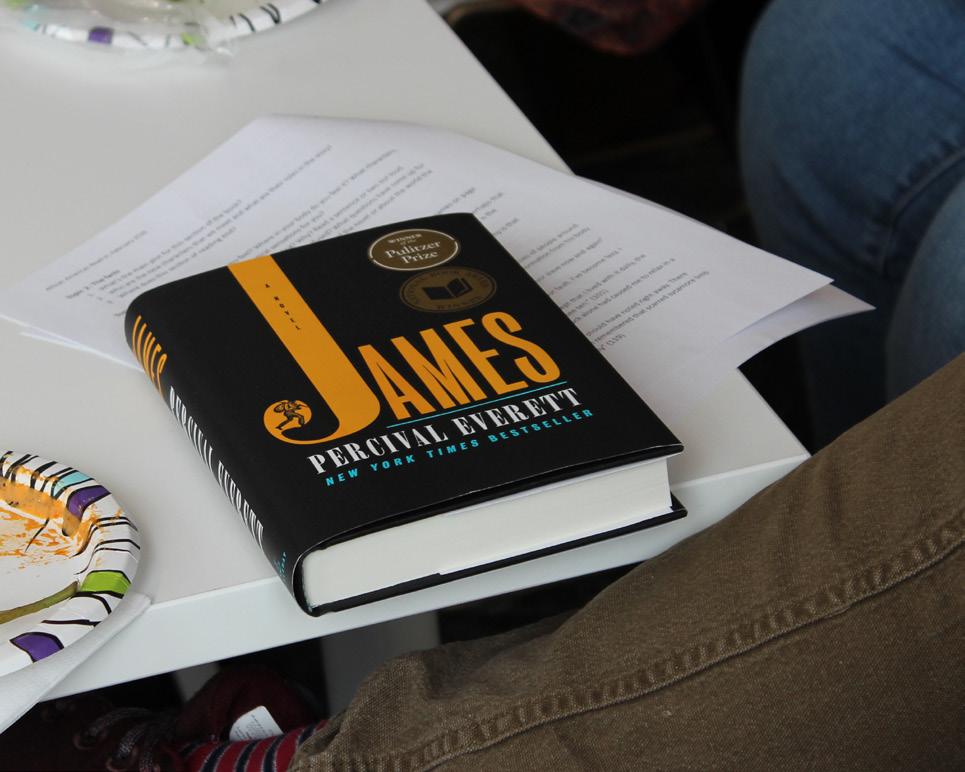
Members of the Utah State University English Department have gathered faculty, students and staff alike to read and discuss African American literature together. This year’s choice is Percival Everett’s “James,” a retelling of Mark Twain’s “The Adventures of Huckleberry Finn” from Jim’s perspective, which won the National Book Award in 2024.
“It’s not set in our contemporary time, but it is incredibly relevant to what’s going on now,” said Adena RiveraDundas, assistant professor of English at USU and event organizer. “And it’s a fun book to read.”
The African American Read-In started three years ago when Rivera-Dundas and senior lecturer of English Cree Taylor were both teaching “Sing, Unburied, Sing” by Jesmyn Ward. They decided to bring the book to the USU community. The following year, the group read James Baldwin’s “Giovanni’s Room.” Each book has been carefully selected for its literary merit and ability to spark deep, meaningful conversations, according to RiveraDundas.
“The emphasis has been on either older or newer classics of American literature that are excellent works and have messaging that sparks interesting conversation,” RiveraDundas said.
According to the reading group, “James” has felt timely. The novel follows Jim, called James in Everett’s novel, the enslaved man from Twain’s original, and reframes a highly debated text in American education.
“Having a read-in specific to African American literature ensures that there is a voice and a perspective that we at USU are honoring and remaining accountable to,” Rivera-Dundas said.
Twain’s “Huckleberry Finn” has long been criticized for its racist portrayal of Jim despite abolitionist intentions.
According to Rivera-Dundas, Everett’s retelling humanizes a character the original dehumanized.
“If we’re going to teach ‘Huckleberry Finn’ in schools, having a counter-narrative can be really helpful so it’s not the one story that exists,” Rivera-Dundas said.
Due to the book’s language, the group established “norms” at the start, including an agreement not to read slurs aloud, even though some appear in the text. A librarian in attendance raised connections to banned books, their debates and the current political climate. This sparked one of the session’s open conversations the group tries to facilitate.
The Feb. 12 session drew faculty and staff from English, sociology, veterinary medicine and advising, filling the Mehdi Heravi Global Teaching and Learning Center with an open, unhurried discussion, according to Rivera-
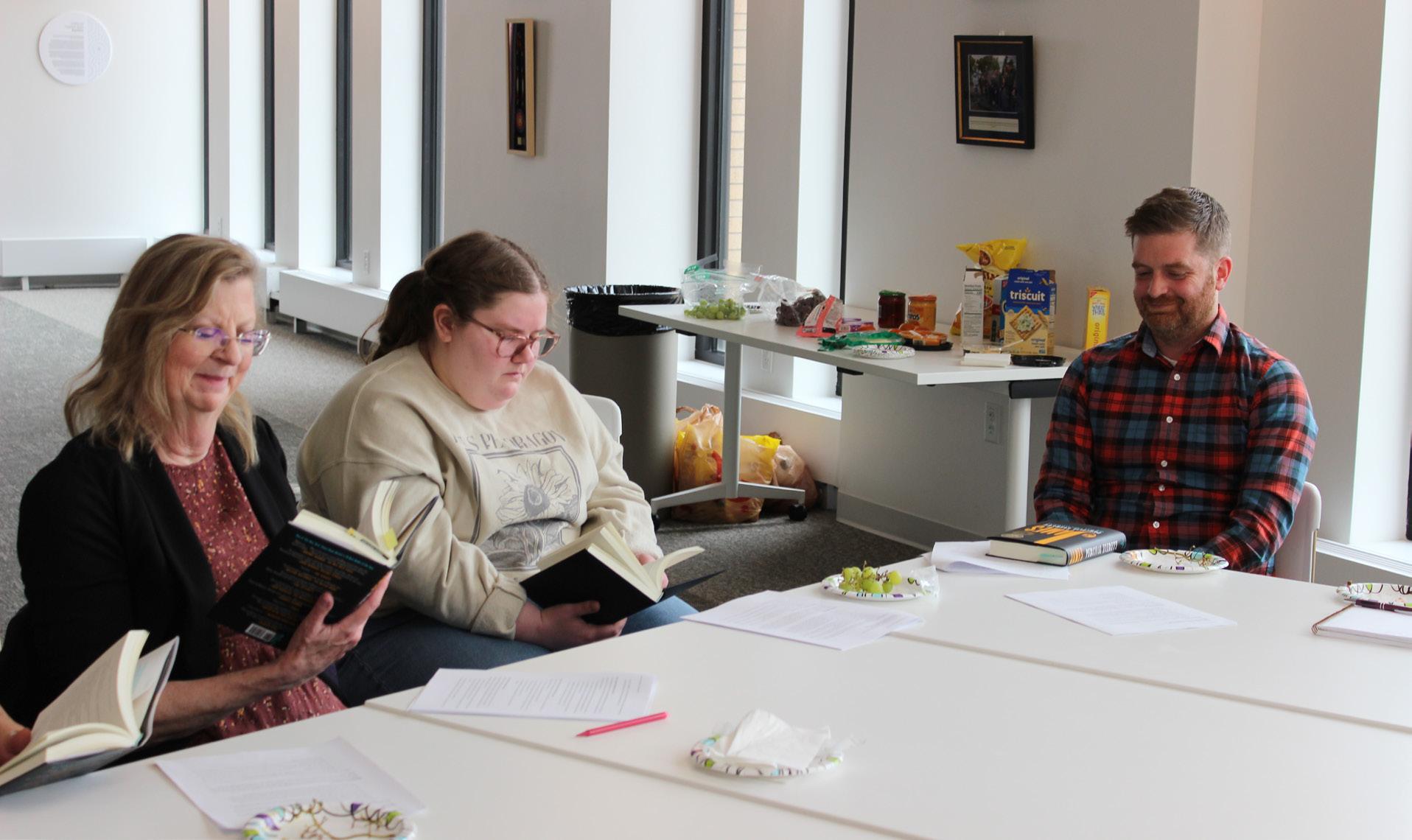
Dundas. When silence fell in the room, no one rushed to try to fill it.
Christy Glass, a sociology professor who has attended the read-in since the first year at USU, said the event is unlike anything else on campus.
“There are no other opportunities for me to sit in a group of staff and students — people I’ve never met — and have a book bring us together,” Glass said. “Each year, we build this little community.”
Glass made sure to mention Rivera-Dundas’ guided reading approach and how it transformed how she engages with literature.
“[Rivera-Dundas] taught me how to read,” Glass said. “She taught me to slow down and pay attention to how what I’m reading makes me feel. It’s changed what books I read, and it’s changed how I read them.”


Emma Barker is double-majoring in journalism and communications and sociology. When she’s not reporting, she enjoys spending time with her dog and husband, thrifting and attempting to keep her sourdough starter alive.
By Mia Nielsen STATESMAN REPORTER
After school, a group of middle and high school students returns to the classroom to dissect the physics of flight. They’re a part of Aviation4Girls, a six-week program led by Utah State University’s Wings in Aviation chapter designed to give girls aged 12 to 18 hands-on experience and teach them about life in the cockpit.
“We’re just giving them a slight introduction into different parts of the aviation field and career — giving them experiences to see if they actually like it,” said Leah Schmid, a sophomore studying aviation management and chapter leader.
According to Schmid, at Aviation4Girls, the goal isn’t just to talk about flying but to get comfortable with the equipment that makes it happen. The program offers a comprehensive introduction, acquainting the participants with the language of aviation, the world of unmanned aerial systems, maintenance and flight planning. The girls fly small drones, get hands-on maintenance experience and step into a few of the USU’s aviation simulators, including the air traffic control, Beoing 737 jet and Redbird simulators.
“When I was younger, I loved aviation. I thought it was so cool, but it was very out of reach for me. I didn’t ever see myself truly going into it because I never had any experiences or anyone around me telling me, ‘Yeah, you can do that,’” Schmid said. “I think just letting young girls specifically know that it is within reach and that they are very capable of doing it and that it’s a place they are welcome is so important because I didn’t have that growing up.”
Without that experience and support, Schmid said jumping into the field was a huge step outside of her comfort zone. She added certain stereotypes may also make it harder for women to break into the field. These can include the common belief aviation is unrealistic for women with families. She said many women may be scared to enter the field because of these standards and because it is a male-dominated field.
Amy Monson, an aviation technology professional practice assistant professor at USU, said she believes a major barrier to entry into aviation is a lack of representation.
“I think that it’s not necessarily harder for them to break into, but it’s one of those things where they don’t see people that look like them flying airplanes, so they don’t necessarily even think that it’s an option for them, even though it obviously is,” Monson said. Monson said the program has been around for about 10 years, and while it’s hard to quantify the
impact, many students who participate in their youth programs — summer camps or Aviation4Girls — have returned to Utah State as students.
“We’ve actually got a picture of one of our current students when she was probably 10 years old, and now she’s in our maintenance program, so she went through the same class or the same course 10 years ago,” Monson said.
Baron Wesemann, associate department head of the aviation technology program, interacted with that student when she took part in the program 10 years ago.
“I was walking through the aviation lab last Wednesday, and one of our students turns around, and she goes, ‘Is that you, Baron? You took me up in an airplane 10 years ago,’” Wesemann said. “The very first year that we did this event, she came to our program, and it put something in her mind, and now she’s a student here at Utah State because of this.”


studying plant science and journalism. When she’s not writing, she enjoys live music, driving up Logan Canyon and daydreaming about moving to Spain.


On “Two Blonde Chicks,” Jillian and Leia play recent finds, discuss current happenings and host blind dates on air! Tune in on Mondays at 7 p.m. on Aggie Radio 92.3 FM.










By Dylan Moore STATESMAN REPORTER
Utah high school students took on air quality challenges this year — not through science labs or policy debates but through marketing campaigns designed to change behavior and spark conversation.
The Utah High School Clean Air Marketing Contest invites students to create advertising campaigns that encourage cleaner air practices. The annual contest culminated in an awards ceremony that showcased student posters aimed to draw attention to clean air. The program asks students to approach air quality from a communications perspective. Participants designed posters aimed at influencing everyday decisions, such as reducing vehicle idling or promoting alternative transportation.


the state. Teachers incorporate the competition into marketing and business classes, giving students a structured way to apply concepts they are learning.
“Students are incredibly creative,” Stafford said. “They come up with messages and visuals that resonate with their peers in ways adults sometimes can’t.”
At the awards ceremony, many of the finalist posters were showcased and judges’ comments were read aloud. Many projects focused on practical steps individuals can take, emphasizing small actions can collectively make a difference.
Brad L. Mortensen, president of Utah State and a guest judge for the contest, said the quality of the student work stood out.
a message and present it effectively. Those are skills that will serve them well in any field.”
Organizers emphasized the contest is designed to be accessible to a wide range of students. While some participants have prior experience in marketing or graphic design, others are encountering these concepts for the first time.
Stafford said diversity of backgrounds strengthens the program.
Edwin Stafford, one of the contest organizers and a marketing professor at Utah State, said the goal is to connect classroom learning with real-world impact.
“We want students to see that marketing can be used for social good,” Stafford said. “They’re not just selling products. They’re thinking about how to change behaviors in ways that improve air quality for their communities.”
According to Stafford, the contest has grown steadily since its inception, drawing entries from schools across
“The level of thought and effort these students put into their campaigns is impressive,” Mortensen said. “They’re tackling a complex issue and finding ways to communicate it clearly and persuasively.”
Mortensen said competitions like this reinforce the university’s broader mission to serve communities across Utah. By engaging high school students early, the program helps build awareness of environmental challenges while developing communication skills.
“This is about education and engagement,” he said. “Students are learning how to research a problem, craft


Moore is a junior majoring in political science and minoring in anticipatory intelligence and Russian. He always loves going on outdoor adventures and cooking.
By Kenadie Ferraro STATESMAN REPORTER
At one point in time, an eight-year-old girl picked up a basketball. Seven years later, a 15-year-old girl decided she had to play Division I basketball. Now, Jamisyn Heaton is finishing her last season with Utah State University’s Women’s Basketball after achieving her childhood goal.
“Something that you need to know about Jamisyn is if you tell her she can’t do something, she’ll say, ‘Watch,’” Amber Heaton, Jamisyn’s mom, said.
Jamisyn Heaton started her basketball journey when she was eight years old. According to Heaton, she had been around basketball her whole life and was always competitive. While attending Lehi High School, Heaton was awarded the 2022 Utah 5A Player of the Year.
“Even though I got that award, I felt like if I didn’t have my team, if I didn’t have my coaches, I definitely would not have been where I was at, because I was just enjoying what I was doing,” Heaton said.
Her father Rick Heaton described her senior year as “magical in so many ways.” He expressed his excitement for his daughter and said he remembers exactly where he was when he found out Heaton received the award.
“Her team was in the state championship semifinals every year of her high school career, and they just couldn’t get past it. Their senior year, they did. Everybody thought they were going to win state, not just us,” Rick said. “Jamisyn and the other best player on the team got really sick. This whole magical season and career at that point came short, and they were actually close to winning. That was really, really tough for her, and then when she won that award. I think it was a bit of a silver lining.”
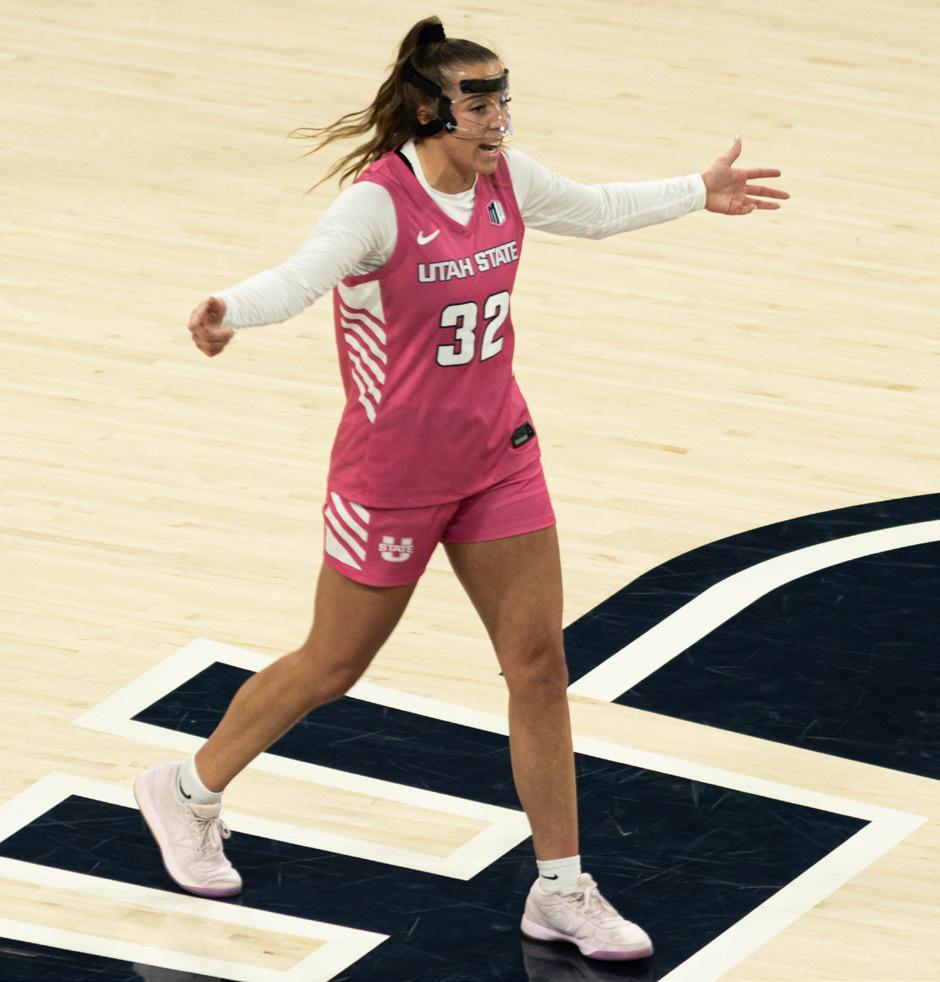
Right out of high school, Heaton did not receive a Division I offer. Instead, she played for the Colorado Mesa University Mavericks. After a season there, she transferred to the College of Southern Idaho and was a Golden Eagle.
“I heard that coach [Wesley Brooks] had just gotten hired here, and I had a few offers from other D1’s around Utah and in this conference as well,” Heaton said. “Coach Wes had gotten on a phone call with me, and something about it just seemed right to me. Being close to my family as well — I knew this is where I wanted to be.”
Wesley Brooks has been the head women’s basketball coach at USU since the 2024-25 season. According to Brooks, Heaton is a foundational player for their team.
“Jamisyn has been a blessing to coach,” Brooks said. “I am just so proud of her and her tremendous growth over the last two years. She’s become a stalwart for us — a leader for us.”
Heaton is a team captain. She is expected to be a leader on and off the court, and according to Brooks, she is “unbelievable” in her capabilities to do so.
“Her character is unbelievable. Her leadership is unbelievable. She leads vocally, and she leads by example. Vocally, she’ll hold our team accountable. We all have shared goals and dreams and aspirations of where we want to go,” Brooks said. “She’s done everything on and off the court to be a leader, and that’s why everybody respects her and has the utmost, utmost respect for her.”
Heaton’s teammate Elise Livingston said she recognizes her friend’s leadership.
“Me and Jamisyn are really close on and off the court. I think she brings a lot of intensity, leadership and competitiveness, which is what you need from a leader,” Livingston said. “I would say Jamisyn is feisty and intense in a good way. She’s really competitive and tries her hardest on every single play.”
Heaton attributes her progress and motivation in sports to her family, crediting them for helping her through every transfer and every game.
“I cannot give my family enough credit. They have been there for me through tears and happiness and sadness, all the above, anger, everything, and so without their push, and without their motivation, I would definitely not be where I’m at,” Heaton said. “Having my family push me so hard made me never want to quit. I’ve never gone through a game without thinking about them, looking up and seeing them or getting a text from them. Having my family behind me is the coolest thing ever. It’s hard to not play for them.”
Heaton’s parents have shown their support for her throughout all her college years.
“We’re pretty lucky. Both of us have jobs that allow us to travel a little bit and be present for our kids,” Amber said. “We know this doesn’t last forever, and we just told ourselves that our kid is in this and we want to make sure we’re a part of it.”
Amber said through every transfer, she and Rick were supportive of their daughter.
“She had a dream that she wanted to play at a D1 level, collegiate level,” Amber said.
Heaton has worn the numbers 32 and 44 throughout her basketball career. She said the number 32 is for her dad and the number 44 is for her mom.
“That’s pretty cool that your kids think that much of you and want to try to be like you,” Rick said. “We haven’t ever really talked about it, so it’s pretty cool that she’s worn both.”
Basketball has been a constant in Heaton’s life. According to Amber, it has inspired Heaton to grow individually and to also become a role model for others.
“Jamisyn called me and said, ‘Mom, the coolest thing just happened.’ She was walking out of practice, and she heard the two little boys say, ‘That’s Jamisyn Heaton.’ To her, that is so cool because she still gets starstruck over players out of respect for their ability to play a sport,” Amber said. “For her to have kids do that to her was really cool. That describes her as a D1 athlete — just wanting to be that person for kids that they look up to.”
Heaton’s character is talked highly about between her coach, teammates and her parents, according to Rick.
“As an athlete, she’s fierce. As a daughter, she is loving. She’s such a family person as well. As a person, she is determined,” Rick said.
Heaton is described as tough and competitive, and according to Rick, these qualities are evident on the court, a presence that has been worked for through her years of training.
“When you watch Jamisyn, you recognize that she works her tail off and she’s tough and she’s gritty. Sometimes those emotions, that toughness and that fight, can be mistaken for ornery, and as people get to know her off the court, they see just how much she’s loved her experience at Utah State,” Rick said. “She couldn’t be more happy, and people have been so good to her. She’d love to give everybody a big hug for all of their support and being there through the years.”

Kenadie Ferraro is majoring in journalism and communications and minoring in marketing design. Kenadie is from Draper and loves anything active and outdoors.
— kenadie.ferraro@usu.edu
By Alyssa Caywood STATESMAN REPORTER
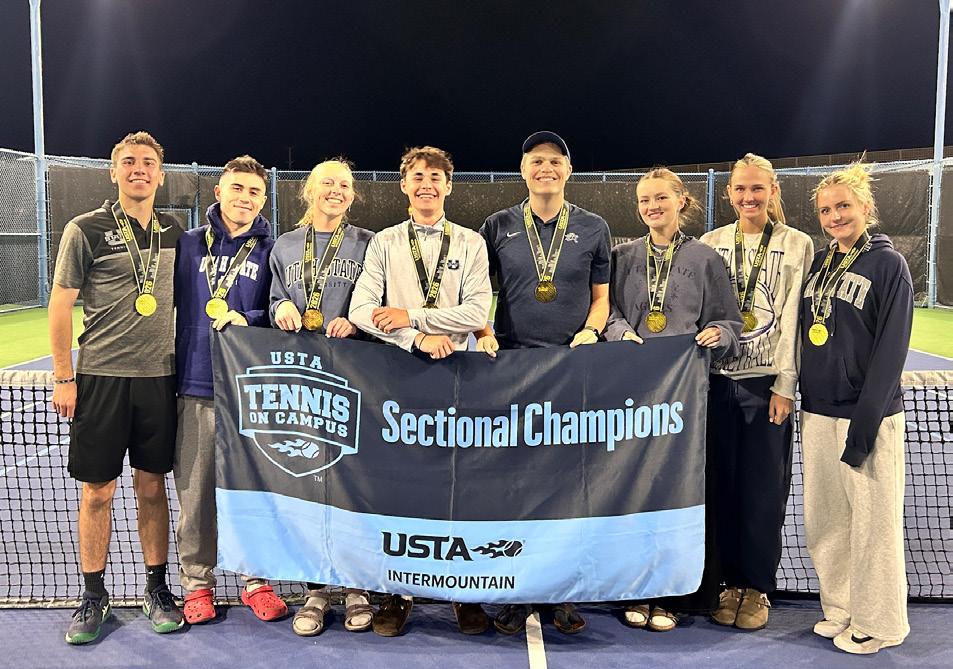
The Utah State University Tennis Club went undefeated in their sectionals tournament on Feb. 15-16 in Las Vegas, bringing home a victory and advancing to nationals.
“We just went in and were kind of a dark horse. We all played really well,” said senior Alice Wilkinson.
Utah State set the tone early during pool play, opening with a strong victory in a cumulative team score of 26–18 over the University of Denver.
Elle Falslev and Wilkinson secured the first win for the Aggies in the female doubles match, finishing with a score of 6-5(4). Maximo Lawlor and Joseph Murray followed with a performance in the male doubles match, winning 6-4.
Hailey Miner represented the Aggies in the female singles match with a victory of 6-3. Jakob Fankhauser played in the male singles and lost with an ending score of 2-6. Thatcher Ellis and Bailey Huebner swept their competition in the mixed doubles match with an ending score of 6-0. The Aggies followed that performance with a statement
win against University of Nevada Las Vegas, scoring 30–1 as a team.
“We definitely struggled the least against them,” Murray said. “That was a really good match to just go out and just play solid tennis — not really have to do anything too risky.”
The Aggies furthered their success by defeating Colorado State University’s B team with a total team score of 29–11.
Falslev and Wilkinson started in the female doubles competition, falling 5-6(3). Lawlor and Murray then followed, winning 6-0 in the male doubles division.
Miner in the female singles division and Fankhauser in the male singles divisions both demonstrated dominance, winning with scores of 6-1 and 6-3 respectively.
Ellis and Huebner won the mixed doubles match for the Aggies, securing a perfect pool record and strong positioning heading into bracket play.
In the quarterfinals, Utah State faced the University of Wyoming and delivered another victory with 30–11.
Falslev and Wilkinson secured another win with a match score of 6-3 in the female doubles division. Lawlor and Murray in the male doubles division were victorious with a match score of 6-1.
Miner won her match in the female singles division with a score of 6-1, and Fankauser won his in the male singles division with a score of 6-2. Ellis and Huebner scored 6-4, securing the win in the mixed doubles division and leading to the Aggies’ advance to the semifinals.
In the semifinal matchup, the Aggies faced University of Colorado Boulder. Utah State battled through a tightly contested game, winning three of the six matches and ultimately emerging with a hard-fought 25–22 win.
“That was definitely our hardest match by far,” Murray said.
Murray said Miner, a first-year student, delivered a strong performance against CU Boulder with a match score of 6(4)-5 by a tiebreaker point in the female singles division.
“That was an incredible win for our team,” Murray said. “It was really incredible watching her play at such a high level.”
In the championship match, Utah State squared off against
in-state rival University of Utah. The Aggies delivered a dominant 30–15 victory to cap off their undefeated tournament run.
Falslev and Wilkinson secured the first win with a match score of 6-3 in the female doubles division followed by another win for the Aggies in Lawlor and Murray with 6-1 in the male doubles division.
Miner and Fankhauser demonstrated strength in the female and male singles divisions, both coming out on top with scores of 6-3 and 6-3. Ellis and Huebner brought in the victory for the Aggies with a tiebreaker point, winning the mixed doubles match with a score of 6(4)-5.
“It went pretty well,” Fankhauser said. “Utah State wasn’t expected to do as well as they did, which was good so we could just kind of play and not really have any expectations over us.”
For Murray, the team has a solid lineup featuring several new players and first-year students this year.
“They’ve really elevated our level and made us upperclassmen really want to do better,” Murray said.
Murray said the team members plan to continue their hard work as they prepare for their advancement to nationals in April.
“I love this club. I love putting everything into it,” Murray said.
Nationals will be held April 16-18 in Washington, D.C. “The job’s not done,” Fankhauser said.

Alyssa Caywood is a first-year student at USU studying journalism. She loves anything outdoors from backpacking to snowboarding to water skiing.
— alyssa.caywood@usu.edu


By Dani Packer STATESMAN REPORTER
Utah State University Track and Field’s Landon Bott competed at the Roman Ruiz Speed and Power Invitational hosted by Utah State Athletics on Jan. 30. At this meet, Bott broke the Utah State University 800-meter race record. This record had previously been held by Olympian and NCAA champion Mark Enyeart, who set it in 1977. The previous record was 1:48.10, and Botts’ record-breaking time was 1:47.79.
For Bott and head coach Artie Gulden, this record break came as a welcome surprise. Bott and Gulden were both focused on getting Bott to nationals.
“The goal was to try and get an indoor nationals qualifying time,” Bott said. “When I came across the line, I wasn’t even thinking about the record at all, so I didn’t even — like, it took me probably a minute and a half to even realize that I broke it.”
Gulden and Bott were both excited about this record despite not anticipating it.
“We were just looking for him to get a good race that would put him in the mix to get to NCAAs, and he exceeded expectations,” Gulden said. “I think that one of the real joys of coaching is when kids not only accomplish their goals but go beyond what I even think that they can do in a race.”
On Feb. 14, Bott broke his own record at the Tyson Invitational in Fayetteville, Arkansas. At this meet, his time was 1:47.55, scraping 0.24 seconds off his last record.
Going into the race, Bott was excited about the possibility of getting another personal record, or PR, and breaking the record for
a second time.
“Going into the second meet, I felt way more confident knowing that I’ve been able to run that fast,” Bott said. “I got put against some top-end collegiate athletes. So, I was going to the front, and I was racing as hard as I could. I know I can beat these guys. They don’t have anything on me after how well I ran here at the Fieldhouse.”
While his coach is excited about this achievement, Gulden’s and Bott’s goals have always been focused elsewhere.
“I figured that he would have a good shot at breaking his own school record again, but really, the objective for that meet was to get him on the NCAA track and get him in a race where he would have to deal with the physicality of an 800 and all of those things,” Gulden said.
Gulden said he wants Bott to deal with high-stress meets to further develop his grit and determination in races.
“That was really the objective of having him go to Arkansas to race this past weekend, just to experience that — getting pushed around and having to react to that,” Gulden said.
Bott said he is consistently working on his mental toughness to improve his performance moving forward.
“Mental capacity has a lot to do with racing during all my workouts. I imagine myself at a certain stadium, so I’ll imagine myself at nationals.” Bott said. “When the when the race actually does come, I’ve played through it hundreds of times in my head, and so it feels so natural just to have it happen.”


Dani Packer is a sophomore studying English literature. When she’s not studying, she can be found tearing up the dance floor or in the front row at the Spectrum.

On any typical afternoon at Utah State University’s Student Nutrition Access Center, or SNAC, it’s common to see a line forming about an hour and a half before the doors even open. That line is often 5060 students long. Instead of grocery carts, students carry backpacks as they move between refrigerators and shelves, picking up essential groceries to help them get through their next exam, project, athletic event or assignment. The vibe at SNAC is always positive, but the space has become strained.
SNAC was designed years ago to serve a fraction of the students who rely on it today. SNAC moved to its current location in 2018 and served 1,447 students across 5,478 visits that year. This academic year, one in four students enrolled at the Logan campus has already visited SNAC. September alone surpassed all of 2018’s totals with 5,952 visits from 2,786 students. October surpassed 2018’s marks again, as SNAC served 2,543 students in 5,497 trips through the pantry. Rising housing costs and inflation have reshaped the landscape of college hunger. What was once an occasional safety net has become a weekly necessity for hundreds of students. The pantry has expanded its services
to include nutrition education, fresh produce, dairy items and products for students with dietary restrictions. SNAC also launched a monthly mobile distribution at Maverik Stadium available to any Utah resident. SNAC has accomplished all of this and more within the same space.
The result is a logistical Rubik’s Cube: always moving and shifting, hoping that eventually everything lines up. Increased physical space would allow SNAC to accommodate larger donations from community partners, which could contribute to reducing the frequency of shortages by allowing SNAC to build a larger inventory going into busy periods. Since July 1, 2025, the start of USU’s current fiscal year, the pantry has distributed a total of 214,867 pounds of food, averaging 6,714.6 pounds per week. SNAC has faced challenges in securing additional donations due to limited storage capacity. Most importantly, it would let students feel comfortable when they shop without feeling like they are competing for space.
Research shows food security can affect academic success as much as any textbook or lecture. When students skip meals, they miss opportunities to study, participate in clubs and attend athletics and other events. A student fac-
ing food insecurity is 40% less likely to graduate. Providing students with food security is an investment in retention and higher GPAs across the university. SNAC has proven it can meet this challenge with compassion and creativity, but compassion requires capacity.
SNAC has always benefited from an amazing university community always ready to rally behind the pantry with food drives and volunteer hours. Now, SNAC needs the next level of support: a physical space that matches the scale of the problem it is solving. Expanding the pantry is not just another project. It is an investment in healthier, more successful Aggies and a stronger USU.
Until that happens, the line will keep forming earlier and earlier outside a space that has become too small for the size of the need and too important to ignore.
Jonathon Walters is the SNAC program coordinator at Utah State University.
— jonathon.walters@usu.edu
By Hazel Harris-Staples STATESMAN EDITOR
Ihad the opportunity to watch the Utah State University Theatre Arts Department’s production of “The Merry Wives of Windsor” on the second night of the performance. A lesser-known Shakespearean work, this play was changed by the theater department into something I won’t soon forget. From adding in a choreographed dance to Michael Jackson’s hit “Thriller” to building a fat suit for Sir John Falstaff, I find myself thinking about this play at least once a day — and not just to mull over the line from the Host of the Garter Inn: “Boys of art, I have deceived you both.”
I’m going to be frank. I was pretty confused about what was really going on at the beginning of the play. It’s no secret Shakespearean English is often a little harder to understand, but I really started getting into this play when I heard Master Doctor Caius, played by Jonah Newton, make a “6-7” joke. I could, verifiably, be heard snorting backstage and for me, it really only went uphill from there.
While this play was set in Windsor, England in the early 1400s during the reign of King Henry IV, the theater department, under the direction of Leslie Brott, transformed this
set into a diner scene from the 1950s. The story follows two different romantic pursuits: that of young Anne Page, played by Belle Francom, and that of her mother and her mother’s friend, Mistresses Page and Ford, played by Sydney Rhine and Ariana Whatcott, respectively.
Here’s what I’ll say: If you liked the love triangles in “The Summer I Turned Pretty” and “My Life with the Walter Boys,” you also should try getting into the Falstaff x Mistress Ford x Mistress Page dynamic. Basically, a man named Sir John Falstaff rolls into town, broke as a joke. He comes up with

this clever idea that instead of, say, getting a job, he could just date two wealthy men’s wives in the hope to get their money instead.
Mistresses Page and Ford, the Merry Wives of Windsor, if you would, team up against Falstaff in a duo that gives off the same vibes as me and my best friend Ella trying to convince my husband Ike he should take us for a sweet treat it’s chaotic, he never thinks it’s a great idea and we always get what we want in the end!

Hazel Harris-Staples is a junior studying photography, art history and entrepreneurship. She enjoys supporting the arts and eating food with hatch green chiles in it.





Feb. 26 is Student Press Freedom Day, and to celebrate the student journalists within USU and the greater campus community, the Editorial Board encourages Utah State University students to reflect on what it means to have a free press fostered through education. The Utah Statesman is proud to be an organization independent of the university that strives to report ethically on the campus community. Every day, we see our student journalists at The Utah Statesman show up and write because it’s what our community needs and they have a passion for spreading information. This is what it means to be the student voice on campus.
Journalism is a crucial component of democracy that provides the public with accessible information and upholds accountability within leadership at all levels. The press helps give a voice to communities and when done correctly,
can fight the spread of misinformation. It takes not only journalists but also students, educators and community members to advocate for freedom of the press. Conversations surrounding student journalism can strengthen the field, which is in need of protection and public support.
Support student journalists in the community, even in small ways, by learning more about freedom of the press and exploring your local district’s unique policies. In the true spirit of journalism, spreading the word can be extremely beneficial to the cause. Write an opinion column for your local newspapers, post about student journalism on social media or find a meaningful way to engage with USU Student Media.
To learn more about Student Freedom Press Day, visit studentpressfreedom.org.
— The Editorial Board


Sudoku puzzles are provided by www.sudokuoftheday.com.