

Meet the Candidates USUSA President

Tell us the elevator pitch of your campaign…
Serving as the vice president, I’ve had the opportunity to work very closely with the president over the last school year, and I’ve learned all about the position. My campaign is built on keeping students informed about decisions coming from the Board of Higher Education and the state legislature, growing the Aggie family with the alumni association and building connections between students and university leadership.
The USUSA president represents all of USU statewide. That is almost 30,000 Aggies. How will you represent and advocate for each of those individuals?
As the executive vice president, I’ve had the opportunity to serve on the Statewide Executive Council with the president and work with our amazing statewide officers on every campus. Enabling them to do their great work is the best way to get in touch with students that I don’t see every day, but visiting the campuses is something I would like to make a priority.
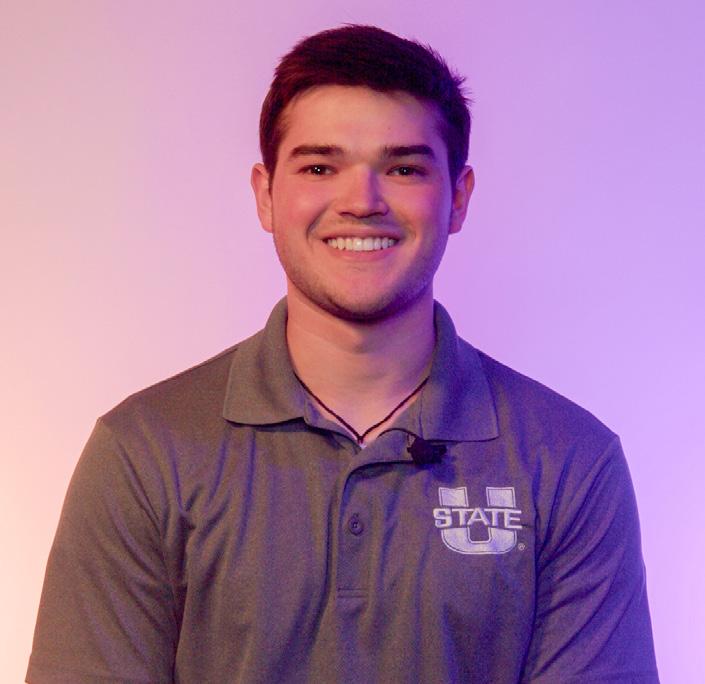
Tell us the elevator pitch of your campaign…
The elevator pitch for my campaign is that the campus is full of passion. I mean, every department, every major — we all have different desires and different interests, but we all have one purpose. It’s to learn, to grow and to experience USU, to have good times, so my personal focus as president will be the rights and life of the student that I’ll protect: our drive for education and our ability to learn in an environment that is conducive to it. So, as budget cuts or as other events, colleges coming together and departments changing, we can have that common goal and purpose of learning, growing and becoming better equipped for the world and life ahead.
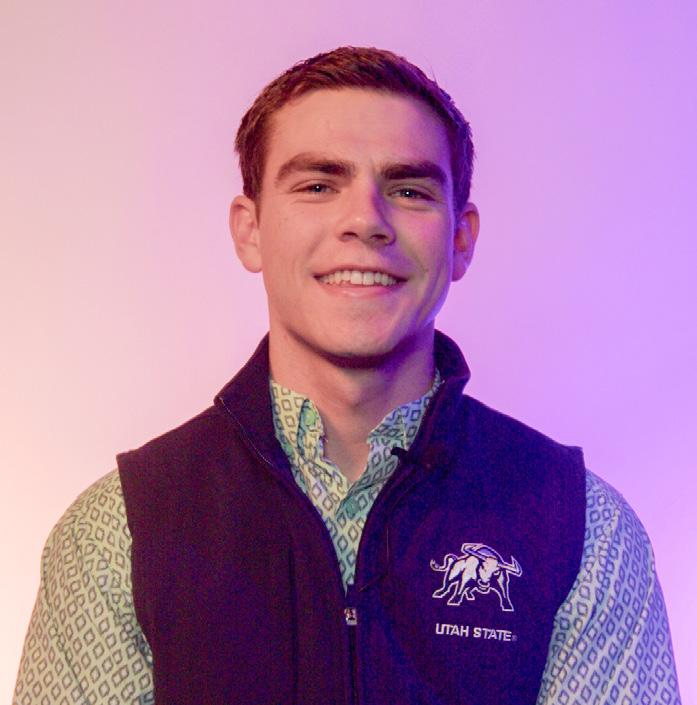
Tell us the elevator pitch of your campaign…
What would my elevator pitch for my campaign be? I’m standing on the foundation that Utah State has always stood on — of the small-town values, of the great programs, of being hands-on. I’m trying to defend those as we expand Utah State University. I’m also standing on the platform of transparency, making sure that we are being diligent to wisely use the funding that we are allocated.
The USUSA president represents all of USU statewide. That is almost 30,000 Aggies. How will you represent and advocate for each of those individuals?
So, if you didn’t know, Utah State has about 30,000 students, and the campuses are statewide, so with that, there’s kind of a lot of responsibility falling upon those that connect the campuses. Me personally — I’m from the College of Agriculture and Natural Resources. That brings with it a wider range of campuses. Almost half of our students, or maybe even more than that, are from these satellite campuses. With that, I’ve had the opportunity to interact with them and to go explore their campuses, their backyards and their studies. Most of our research students and those involved in the applied sciences are in those areas. I think that as a president, you have to be familiar with them, and you have to be able to reach them where they are. That’s what I would bring to
The USUSA president represents all of USU statewide. That is almost 30,000 Aggies. How will you represent and advocate for each of those individuals?
I would advocate for the students across the state of Utah at Utah State University by making sure that everybody is included in a fair budget, that funds are allocated properly and that we’re standing on the values that make Utah State great. I love Utah State because of the handson atmosphere. I love it because of the connections that it provides. I want to make sure that students across the state have those opportunities as well.
If the USUSA president got to make their own Aggie Ice Cream flavor, what would you call it and what flavor would it be?
If I can make my own ice cream flavor, it has to be light blue, and here’s the name. Are you ready? “Cool as Ice,” and as the name suggests, this ice cream is fresh and minty.
the table — is that I’m able to do that, that I’ve done it and that I enjoyed it. It’s really fun being able to reach out to them and get to know them better.
If the USUSA president got to make their own Aggie Ice Cream flavor, what would you call it and what flavor would it be?
If the USUSA student president could make their own Aggie Ice Cream flavor, it’d be really hard for me to do anything other than Bull Tracks because that’s obviously the best, but I’d probably do something with chocolate peanut butter. Maybe I’d add caramel because caramel is also pretty good, so — oh, you know what? I’ll take five, alright, probably do like caramel, pretzel, chocolate and peanut butter because peanut butter is OG, so that’s probably the flavor I’d choose.
If the USUSA president got to make their own Aggie Ice Cream flavor, what would you call it and what flavor would it be?
If the student body president could create one new Aggie Ice Cream flavor, I would choose Aggie Pride Pistachio. I’m a big pistachio ice cream guy, and I don’t feel like it gets enough love.
Max Alder
Kapp McCallister
Carston Smith
Student Advocate Vice President


In your words, what is the role of the student advocate?
The student advocate is entirely a student-centered position. It’s very much a service leadership position and one where students should always be at the center of it. It’s all about advocating but not the advocacy that’s like, “Tell me, and I’ll go tell somebody else.” It’s, “Here’s the microphone. What resources can I get to support you and get you where you want to be?”
How will you advocate for USU’s 30,000 different students?
I think it’s really important to have open and collaborative methods of communication with all of the different vice presidents across Utah, making sure that their students are heard, making sure that they are being adequately represented at the federal level when we are going and lobbying for changes there, as well as at the university level, making sure that the changes that we are making here also impact them in a fair and equitable way.
If you were President Mortensen for a day, what would you spend the day doing and why?
I would, for sure, have to sign an email off lowercase “brad.” That’s the only thing I can think of. I would also probably go through the course catalog and see which one has the most interesting class, and then I would go and sit in there and then write up an email and sign it “best regards, lowercase b.r.a.d.”
In your words, what is the role of the student advocate?
The student advocate position is kind of a background one. We work a lot with legislation. We work a lot with MyVoices, the student complaint system. We work a lot with our judicial system and elections here. It doesn’t have quite the glitz or glamor of events or the title of president, but it’s one that’s purely about the students and doing the hard work so that they don’t have to
How will you advocate for USU’s 30,000 different students?
First, we need to remember statewide. About half of our students are statewide or online, and we need to make sure that they’re in any conversation we’re having about students, whether they be non-traditional or up here in Logan. Second, we need to continue expanding the MyVoice program. We’re up 30% in MyVoices this year over last year, which I’m very proud of, and something we need to continue. Third, we need to change our forms of communication and our channels that we’re reaching out to students with. Any student can ignore an email, but if we’re going to classes and telling them things that they need to know, that’s a completely different thing and way more likely to be effective.
If you were President Mortensen for a day, what would you spend the day doing and why?
The very first thing I would do is use the bidet. That is a major bucket list item for me. The second thing I’d do, whether we need to burn it down or find different funding — we need to get a new TSC. This one is not student-focused. It has way too many offices in it compared to other universities’ student centers. We need somewhere that students can go and relax and not worry about the stresses of being a student for a day.
Barker Alyssa Caywood
Colvin
Ludlow Jayke Martin
McNeill Dylan Moore
Nielsen
Packer Jillian Peterson Emma Shelite
Ferraro

Shai Spangler
Colin Hastings
Logan Vice President
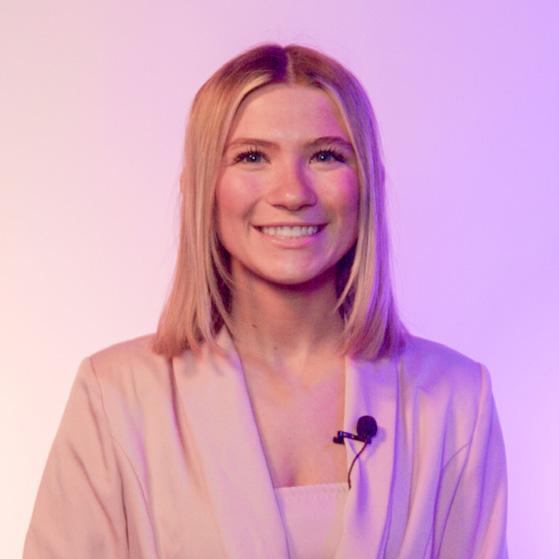



Summarize your campaign and why you wanted to run for Logan VP. VP, for me — it’s about the Aggie connection.
I believe that the students should have a Logan VP that wants to be involved and connected with the other students. For me, that means whether students feel safe on campus, to be seen, felt and heard.
What are the current biggest threats to Logan campus safety?
One of the biggest threats to Logan campus safety is at night when there’s not enough light by the crosswalks. Students don’t feel safe enough when they’re walking home from their classes, and that shouldn’t be the case. Students should feel like they’re not going to be getting hit by a car, but also, their pathways should be lit.
What is your favorite spot to study on campus?
My favorite place to study on campus probably, if I want to be social, the Huntsman, but if I’m needing to lock in, probably the pods of the library.
Summarize your campaign and why you want to run for Logan VP
I want to make Logan campus a more inclusive and accessible place to be so that everyone who decides to spend their college experience here feels like this is where they belong. The reason that I wanted to run for Logan VP is because of the leadership opportunities that it offers with the Aggie Blue Leadership Conference that I’ve participated in as a participant my freshman year and then on the committee for the last two years, as well as the safety walk that Logan VP conducts to make sure that all of campus is accessible.
Summarize your campaign and why you wanted to run for Logan VP.
To summarize my campaign, it all boils down to one word, and that’s ask. It’s accessibility, safety and keeping students first. And really, my main motivation for running for Logan VP is to bring a new perspective to USUSA and get the students here on the ground at Logan into decision making all across Logan campus.
What are the current biggest threats to Logan campus safety?
The biggest threats to Logan campus safety right now, as cheesy as it is, is hatred and an attitude of defensiveness that makes other people the enemy. I think if there was more of a community of love and acceptance, we wouldn’t really have as many problems as we do. There are also more physical things, like when the weather gets really stormy or icy — we need to be careful about those things. Things like the stairs that we have, we tend to have a lot of slips and falls. So that’s something physical, but I think a lot of it is mindset and mental.
What are the current biggest threats to Logan campus safety?
In my opinion, the biggest threats to Logan campus safety, and one of my main campaign points is having clarity in emergencies and also ample lighting all across campus. We’ve done great improvements all across Utah State to improve our lighting, but there are some areas that are off-campus but adjacent to campus that are still unsafe, and one of my goals is to work directly with Logan City Hall to fix those unsafe areas.
What is your favorite spot to study on campus?
My favorite spot to study on campus really depends on the season when it’s warm outside. I love going out to Old Main. Sometimes, I’ll go to the Quad. I love, love being outside and just finding a nice spot, but I would also say that in the winter or the colder months, I will go to the natural resources center because they have a waterfall, and I like hearing something in the background while I’m studying. So that place, and then there’s also one place in the music part of the FAC where there’s all the practice rooms, and I like hearing all the wonderful music students playing and rehearsing while I study.
What is your favorite spot to study on campus?
My favorite spot on campus to study has got to be in the new Ridge Point building. There is this little chair up on the very top sixth floor, and it overlooks Hello Walk and the library, and I can see all the way to Old Main. It’s a scenic view that distracts me from my studying most of the time, but it’s a good little spot.
Summarize your campaign and why you wanted to run for Logan VP.
The biggest thing that I’m running on is going to be transparency with both student leaders and with school administration to help make sure that students are well-informed of everything that’s going on around them. I feel as though, sometimes, it’s hard as a student to know everything that is happening, and I feel like I as a potential Logan vice president candidate, can help kind of bridge that gap.
What are the current biggest threats to Logan campus safety?
I think the biggest threat to Logan campus safety is one area that is not necessarily lit. There’s a few that come to mind where — there’s a spot, kind of out by Aggie Village, kind of by the Student Living Center, where there’s a stretch of land, where there’s a stretch of road that doesn’t have any crosswalks on it for a while there. I personally have seen people trying to cross that busy intersection and basically have to be like dodging cars almost and kind of waiting for a long time there. As well as other spots, like, there’s this spot, kind
of around Old Main, where it isn’t lit up the best either, which I feel like there could be just like some improvement with that.
What is your favorite spot to study on campus?
I have to say, one of my favorite spots to study on campus has got to be the business building. I know I’m a kinesiology major, but I’ve had several classes there, and I really just like the glass and being able to kind of overlook a few things. I think it’s really cool.
Kylie Back
Es Barnes
AJ Brannan
Will Hull
Athletics & Campus Recreation Executive Director
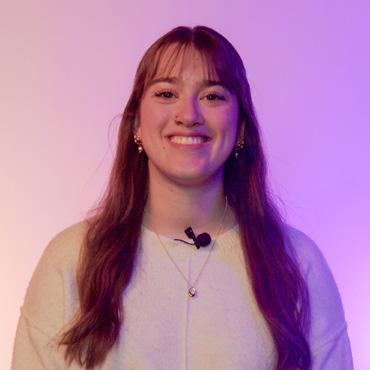

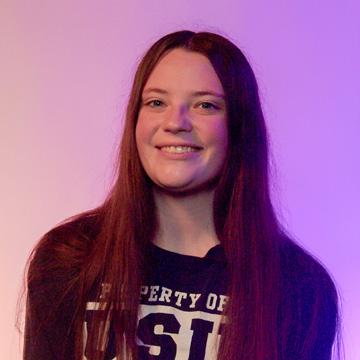
How does campus recreation contribute to the mental health of campus overall?
Campus recreation, in my opinion, contributes to the overall health of every student because our campus recreation programs provide so much support in so many different areas for students. For example, intramural sports, nutrition help, any sort of wellness — that all falls under campus recreation, and all of those are super important for student health.
How does campus recreation contribute to the mental health of the campus overall?
I think it really provides an opportunity to get students both outdoors but also connected with their students through intramurals and campus rec. We have a very new building with brand-new facilities, and it’s a great place — very positive environment to connect with other students.
How does campus recreation contribute to the mental health of the campus overall?
For me, I think that campus recreation really helps people just have more fun at college. I know that sometimes a lot of people think that it’s all about just getting good grades and doing well, but for me, being sporty or doing sports and having recreation helps me just have fun while enjoying school life.
If the university chose to sanction another sport, what would it be and why?
If USU were to sanction another sport, I think that they would sanction hockey. I think that hockey has become really popular in Utah the last couple years, especially with the Mammoth coming to Salt Lake, and so that would be a really fun one to see our students support more.
If the university chose to sanction another sport, what would it be and why?
Okay, if Utah State could sanction other sport for both men and women, I would choose rugby. I’ve met our club rugby team. They’re extremely passionate. They’re also pretty good. We compete very well with the U and BYU, and I think those are our two main competitors, so go Aggies.
If the university chose to sanction another sport, what would it be and why?
I think for me, if there was another sport, I would probably say maybe skateboarding or something. I know there’s a lot of kids on campus with skateboards or longboards. Maybe they would get into that.
Clubs & Organizations Executive Director

How will you advocate for the unique needs of each different USUSA club and organization?
To advocate for the needs of each unique USUSA club, I think it really comes down to communication. Each club is unique in the sense of what they’re trying to do, who they work with. As clubs director, what I’m really hoping to do is to make the process of creating a club and for clubs to receive help even more simplified, making sure that they have a voice and that their needs and wants are met.
What is the biggest challenge to current clubs on campus at USU?
I think one of the biggest challenges for clubs right now at Utah State is the amount of uncertainty. Right now, because of HB262, we’ve had a lot of clubs move over. There’s been a lot of merging since the Inclusion Center was dissolved. Having that feedback and that platform for clubs to get that help and being able to create standardized ways of communication between the clubs and official organizations at Utah State is super important — so just making sure that there is less confusion and that they do feel like they have a place here.

How will you advocate for the unique needs of each different USUSA club and organization?
Each club has specific needs. My hope is to advocate for them individually by currently meeting with each club individually through direct support as part of my campaign platform, and also receiving feedback during and after club meetings that we have every month, usually.
What is the biggest challenge to current clubs on campus at USU?
One of the greatest challenges that, while meeting with club presidents in a couple of months, is I’ve noticed that funding for events on campus has been a really big difficulty for them, specifically when getting food for these events so they can have outreach. The other one is also marketing. It seems like having a club Instagram would be very helpful for advocating for their events and such.
Editor’s note: Candidate Jamison Louviere was contacted by The Utah Statesman with a request to interview and did not respond.
Caleb Burns
Mikenna Slater
Natalie Baker
Mia Bean Luke Christner
Executive Vice President Student Events Executive Director

As chair of the Academic Senate, how do you plan to manage the needs of each respective college?
I plan to take care of the needs for each college by meeting with each senator regularly and discussing how their councils are doing with the colleges. Some of the college’s councils are combining, and so we want to make sure that each voice is represented equally, and so it’s important that we consider each of their situations and what they’re dealing with. So, I hope to make sure that as these college councils combine, we make sure that each voice is represented equally and then we take care of their needs.
What is the biggest challenge facing USU colleges right now?
The biggest challenge facing USU colleges right now is students wanting to know that their leaders are looking out for them. It’s important to know that our leadership here at the university is looking out for us and that they care for each of our needs. And so, it’s important, as important for us as student government members, to convey that information to our students. So, as the executive vice president, I hope to convey the information from our higher-up leadership to our respective students so they know that they’re fighting for us with all the things that are going on right now.
What is the most underrated part of going to USU?
The most underrated part of USU is the amount of fun opportunities that are just in Cache Valley. I think about Main Street and how we have so many fun things, like the Utah Theatre, lots of food options and lots of opportunities just to have a fun time with friends. We also have a beautiful lake that we can travel to whenever we want. And as well, we have so many opportunities to become friends with people here, and that’s what makes us different here.

Why are student events important, and what do they mean to you?
Why are student events important, and what do they mean to me? Student events cultivate a sense of community. Like the “Hobama” fanbase, not only do they cultivate purpose and also community, they create a sense of friendship. For me, student events have created a place I can call home and also irreplaceable memories.
How will you create a fun and safe atmosphere at the various events on campus?
I plan on creating a fun and safe environment at the various events on campus by ensuring that student events are zebralicious by centering empathy, sustainability and community. We can ensure that not only everyone can have fun but everyone can show up as their best selves.
What, if any, is a new event idea you have for next year?
I would like to do a minion event. To quote King Bob, “banana.” This event would feature various activities such as a banana eating contest, a 24-hour minion dance and more.
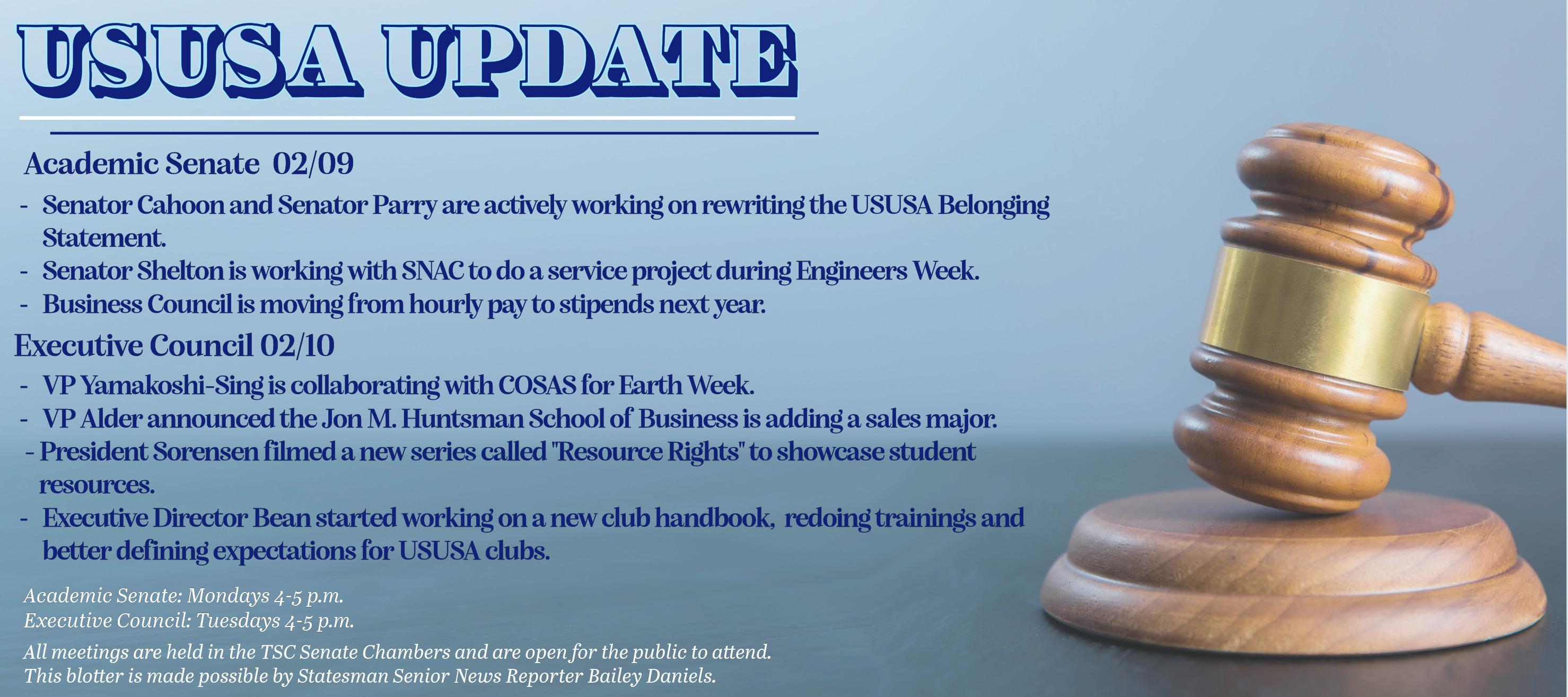
J.J. Watts
Creed Jones
Celebrating 100 years of Black History Month
By Essence Barnes STATESMAN SENIOR REPORTER
For many students and staff at Utah State University, Black History Month isn’t just a holiday. It’s a chance to build community, celebrate culture and reflect on the impact of Black history in the United States.
Throughout February, the USU Black Student Union, in collaboration with the Center for Community, will host events highlighting the art, music and storytelling that emerged from pivotal moments throughout Black History to celebrate the 100th year of Black History Month.
“Our biggest goal is just creating a sense of community,” said Lexi Blackwell, vice president of BSU.
“Especially where we attend a predominantly white institute, there’s not a lot of places where you could feel, I guess, at home, or necessarily comfortable. We want to make Black Student Union a place where you can feel like you’re at home.”
Blackwell said she sees BSU as more than just an organization but as a support system. Whether students need help navigating classes or simply finding someone who understands their experiences, she said the group strives to lift Aggies up in any way they can.
“I love knowing that I have a place that I can go to — a place where I can be myself, and a place where I feel the most comfortable I’ve ever felt.” Blackwell said.
One of this month’s featured events run by the BSU is “Soul Food: 1940s Night in Harlem.” According to Blackwell, this event draws inspiration from the Harlem Renaissance, a cultural movement that reshaped American art, literature and music.
“We chose the theme 1940s Harlem, specifically because of the Harlem Renaissance and how that had a huge effect on Black culture and the jazz movement,” Blackwell said. “It was a very pinnacle time in Black history, and it still has effects to this day on music and culture and even outfits and art.”
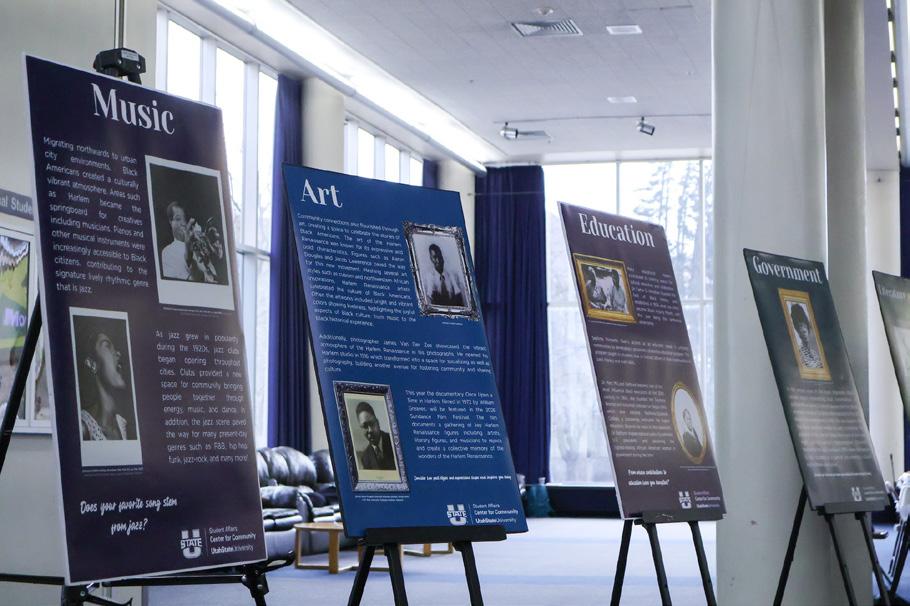
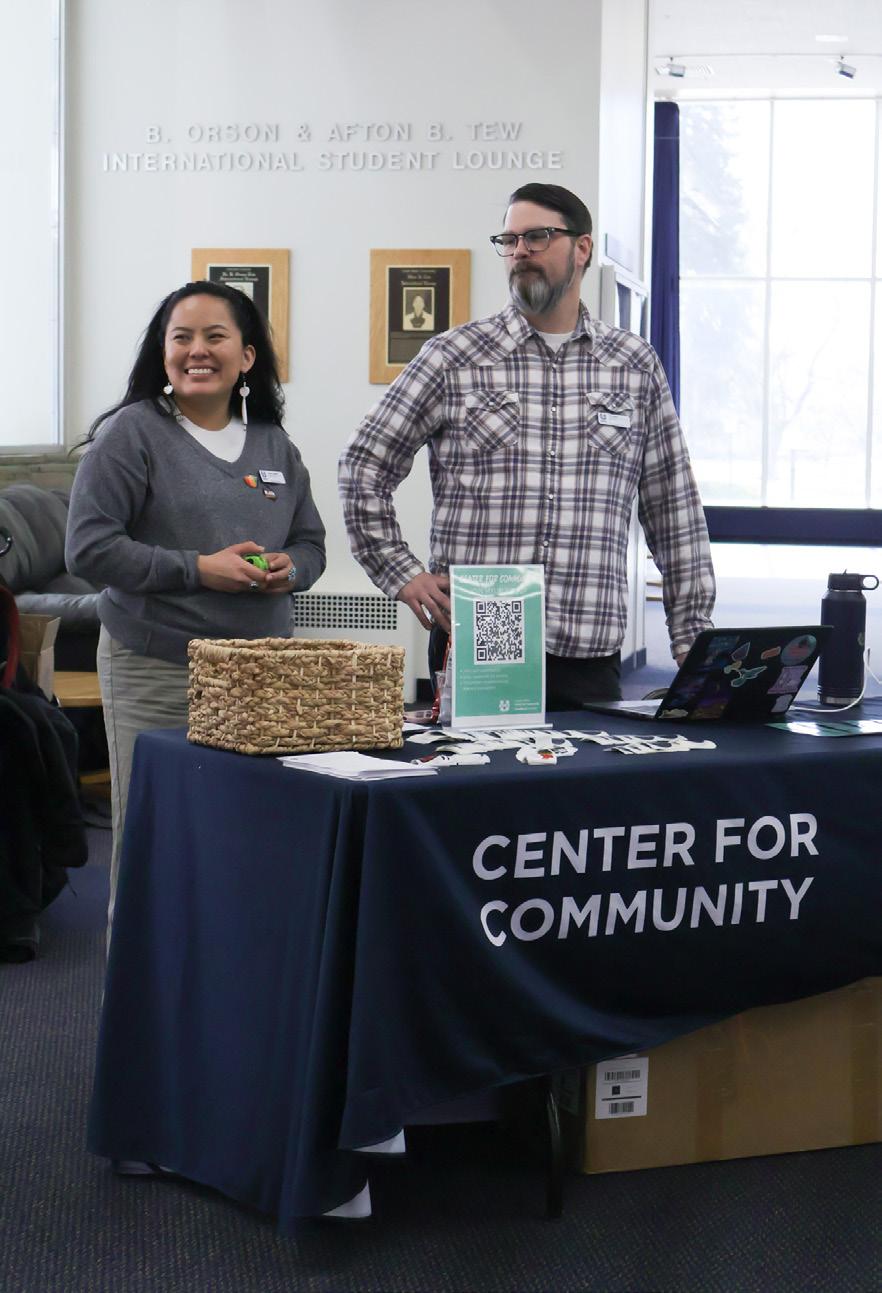
This celebration will include live performers, interactive games like Kahoot and educational opportunities designed to connect past and present. Organizers hope attendees leave with a deeper understanding of how Black history continues to shape everyday life.






Soul Lam Plearn
The Petch Phin Thong Band
Essence Barnes is a third-year student majoring in journalism who enjoys reading, writing and storytelling.
Members of the Center for Community run a booth at the Black History Month celebration in the TSC.
PHOTOS BY Sydnie Fonoti Displays at the Black History Month celebration in the TSC on Feb. 11.
Cold water, warm cause: Community plunges into fundraiser for clean water in Ghana

By Dylan Moore STATESMAN REPORTER
Volunteers gathered around a steel dumpster on an early Saturday morning to clear a thin layer of ice from water that had been filled overnight using a nearby fire hydrant. By 10 a.m., the container was ready, and participants in swimsuits and costumes began lining up to jump in, kicking off the second annual Cache Valley Polar Dumpster Plunge fundraiser. The event, held from 10 a.m. to 2 p.m. on Feb. 7, brought together residents from across Cache Valley to raise money for clean water projects in Ghana. Hosted by the nonprofit Water Impact Network, or WIN, the fundraiser asked participants to donate $10 to plunge into cold water, with proceeds supporting the construction of two water wells in rural villages.
Organizers set a goal of $8,000, or $4,000 per well. By the end of the event, dozens of participants had taken part, putting the fundraiser on pace to reach that target.
David Clyde, co-founder of WIN and one of the event organizers, said the idea behind the fundraiser was to create an engaging way for people to connect with the organization’s mission.
“We wanted something that would bring the community together and help people understand what we’re working toward,” Clyde said. “It’s a simple way for people to give and be part of something bigger.”
City crews filled the dumpster the night before the event, allowing the water to cool naturally overnight. Although a thin layer of ice formed by morning, volunteers removed it before the plunge began. Last year, 2 inches of ice had to be cleared before participants could plunge in the dumpster.
A donated dumpster served as the centerpiece of the fundraiser. After participants completed their plunge, they were encouraged to warm up in a mobile sauna parked nearby or enjoy hot chocolate and donuts provided by volunteers.
Clyde said those amenities were included to make the experience more inviting, especially for first-time participants.
“We know it’s uncomfortable,” he said. “We try to make sure people feel supported and taken care of once they’re out of the water.”
The event drew a wide range of participants, including families, students and local residents. Many embraced the playful atmosphere by wearing costumes and bringing props.
One participant arrived wearing a ghillie suit and using a pink flamingo inflatable.
Another attendee, dressed as Kevin Malone from “The Office,” pretended to slip and fall into the water in a reenactment of the character’s famous chili scene, drawing laughter from the crowd.
Abbie Woolsey, who helped organize and participated in the event, said the costumes helped create a relaxed environment.
“It makes it more fun and less intimidating,” Woolsey said. “People feel more comfortable when everyone is laughing and supporting each other.”
Woolsey said she became involved with WIN after learning about its work in Ghana and wanted to help spread awareness on campus.
“A lot of people don’t think about where their water
comes from,” she said. “This helps show how important clean water is and how much of a difference even small donations can make.”
According to organizers, the two wells funded by the fundraiser will provide reliable access to clean drinking water for villages who currently rely on unsafe sources. WIN works with local partners in Ghana to oversee construction and maintenance.
Clyde said sustainability is a key focus of the organization’s work.
“We’re not just building something and leaving,” he said. “We’re working with communities to make sure these wells can be used and maintained long-term.”
Throughout the four-hour event, volunteers directed participants, collected donations and managed the warming area. Some attendees chose to donate without plunging, contributing online or in person.
Woolsey said she was encouraged by the turnout and community response.
“It shows that people here really care,” she said. “They’re willing to be uncomfortable for a few seconds to help someone else.”
Clyde said organizers hope to continue growing the fundraiser in future years.
“Our goal is to make this a tradition,” he said. “Each year, we want more people involved and more support for clean water projects.”


Dylan Moore is a junior majoring in political science and minoring in anticipatory intelligence and Russian. He always loves going on outdoor adventures and cooking.
— dylan.moore@usu.edu
PHOTOS BY Elise Gottling Adam Paul participates in the polar plunge dressed as Kevin Malone from “The Office” on Feb. 7.
Rubber ducks float in the water for the polar plunge.
A new avenue to develop film in Logan
By Mia Nielsen STATESMAN REPORTER
Ageneration spoiled by digital immediacy is suddenly itching to wait. Though most people leave the house with a quality phone camera in their pocket, many artists, like local photographer Jason Haywood, are returning to the basics.
Haywood shoots mostly with film and helps process other photographers’ film in his own darkroom. He recently installed a drop box in Caffe Ibis where customers can leave a roll of film, pay via Venmo and get their pictures back a few days later.
Haywood initially purchased film development equipment to simplify his own photography process, but when he made a post offering to develop film for people in the area, he said the response was immediate.
Haywood has been shooting film for almost 10 years.
“When I was maybe 16, I got my grandpa’s camera, and I just thought it looked cool. Just an old film camera from, like, the ‘50s, and I started taking pictures of my girlfriend,” Haywood said. “I was just taking tons of photos of her. I didn’t really know how film worked, but it felt so cool to mess with something so old and have something so modern come out of it.”
For Haywood, one of film’s main appeals, especially in the era of AI and digital ease, is that it’s limited.
“You can take out your phone and just take a million pictures within an hour, but film there’s only so much of, which I think adds to the beautiful artistic process. It’s finite. There’s friction between you and the finished product,” Haywood said.
Film photography captures images by exposing the film strip to light through the open camera lens. An inverse image or negative is recorded on the strip, and the picture is made visible through chemical development in a dark room. For Haywood, these extra steps aren’t inefficient

— they’re what make the medium great. He compared the process of shooting and developing film to the handdrawn animation styles still practiced by certain studios. Since opening the drop box a few weeks ago, Haywood has seen a big boost in business. He plans to take a trip out of the country to purchase new development equipment and hopes to rent a property to expand his film lab and photo studio, potentially with the owner of local outdoor consignment shop Naomi Market.
“That’s the dream goal,” Haywood said. “But for now, it’s just, get more film and get more people shooting film.”
Haywood said while interest in film photography has grown significantly, not having a local film developer was a significant obstacle for Logan photographers.
Hannah Wetzel, a barista at Caffe Ibis, shared those concerns, saying they were worried about using a retailer like Walmart to develop their photos.
“I had a disposable camera that I used for my birthday because my friend got it for me, and it’s been sitting in my like on my nightstand for forever,” Wetzel said.
Wetzel had heard stories about low-quality development or people that never got their film back from large retailers like Walmart and didn’t want to lose their photos.
“I’ve always wanted to do more film, but it’s just really hard to get it developed. I was like, ‘I’ll just stick with my digital if it’s that much effort,’” Wetzel said.
Wetzel got their photos back from the drop box today.
“He did incredible work,” Wetzel said. “People have the opportunity to stop and to chat with him when they pick it up. I just think spaces like that are so important, and I’m glad that I work in one.”
Riggs Stewart, director of Caffe Ibis, explained why they chose to work with Haywood.
“It’s just a fun thing for the cafe to support as many artists as we can,” Stewart said.
Stewart said the cafe is a center point.
“I’ve already got the customers. I already have the foot traffic, so I just want to add more availability for artists to show off their stuff,” Stewart said. “People don’t just want coffee. They don’t want just a snack. They want to have an atmosphere, and they want to see and view things that are handmade.”
The cafe displays art from local artists on the walls and is always looking for new ways to support local artists without creating an overly competitive environment, according to Stewart.


Mia Nielsen is a sophomore studying plant science and journalism. When she’s not writing, she enjoys live music, driving up Logan Canyon and daydreaming about moving to Spain.
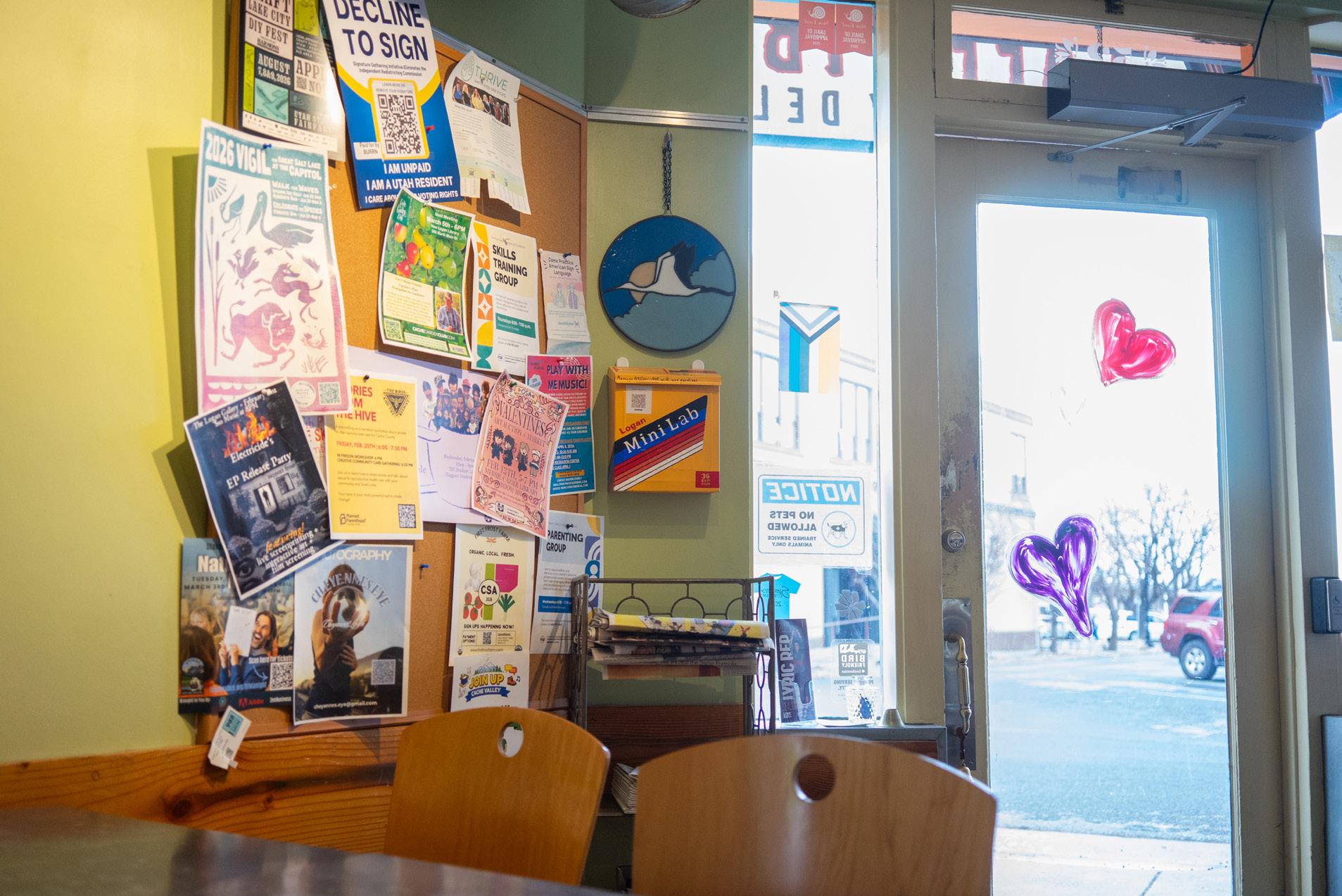
A bulletin board is seen inside Caffe Ibis.
PHOTOS BY Dane Johnson
A camera film drop box is seen inside Caffe Ibis on Feb. 12.
Collaboration takes center stage as Art Song Competition awards scholarship money
By Emma Barker STATESMAN REPORTER
The sounds of singers warming up their voices drifted into the lobby of the Russell/Wanlass Performance Hall before Utah State University’s Art Song Competition, where both vocalists and pianists competed for six scholarships in a collaboration between the USU Music Department’s voice and piano areas.
The competition, held on Feb. 9, struck a shift in the music department’s traditional aria competition to focus on art song: vocal pieces that combine poetry and piano in a classical shared performance.
Auriana Smith, a first-year vocal performance major, won $500 for her performance of “Après un rêve” by Gabriel Fauré, a French art song about longing for a wisp in time or a vanished dream. Ginny Bastian, a sophomore pianist, won $500 for her accompaniment of “Verborgenheit” by Hugo Wolf.
Second and third places also were awarded scholarships in both voice and piano categories.
“I honestly feel so surprised,” Smith said after the results were announced. “It’s so nice to notice all the hard work that you’re doing.”
The performance competition was a collaboration between both USU’s voice and piano departments with both matching scholarship funds.
“Because of the collaborative nature of art song between the singer and the pianist, we’ve been working very closely with the piano department this year,” said Thomas Glenn, area coordinator and assistant professor in voice at USU.
Performing pieces in French, German and English, seven singers competed. Staff pianist Dallas Aksoy accompanied four singers who didn’t have their own collaborative pianists, while three student pianists competed alongside their vocal partners.
Not only did they award a first, second and third in both vocal and pianist categories, but an audience favorite was also awarded. Smith won audience favorite along with first place in the vocal category.
“I just love listening to everybody’s repertoire,” Smith said. “That’s the biggest prize for me just seeing everybody sharing their talents.”
Art song is different from opera in its intimacy. Instead of arias extracted from larger operatic works, art songs are freestanding pieces that set famous poems, specifically ones from the 19th century, to music for voice and piano.

“Any time someone is standing in front of you singing is an event where they show vulnerability,” Glenn said. “In that moment, they have a choice to either be scared, nervous, afraid or to share the deepest feelings of their heart, and if they choose the latter, it deeply affects the audience.”

Emma Barker is doublemajoring in journalism and communications and sociology. When she’s not reporting, she enjoys spending time with her dog and husband, thrifting and attempting to keep her sourdough starter alive.
PHOTOS BY Sydnie Fonoti
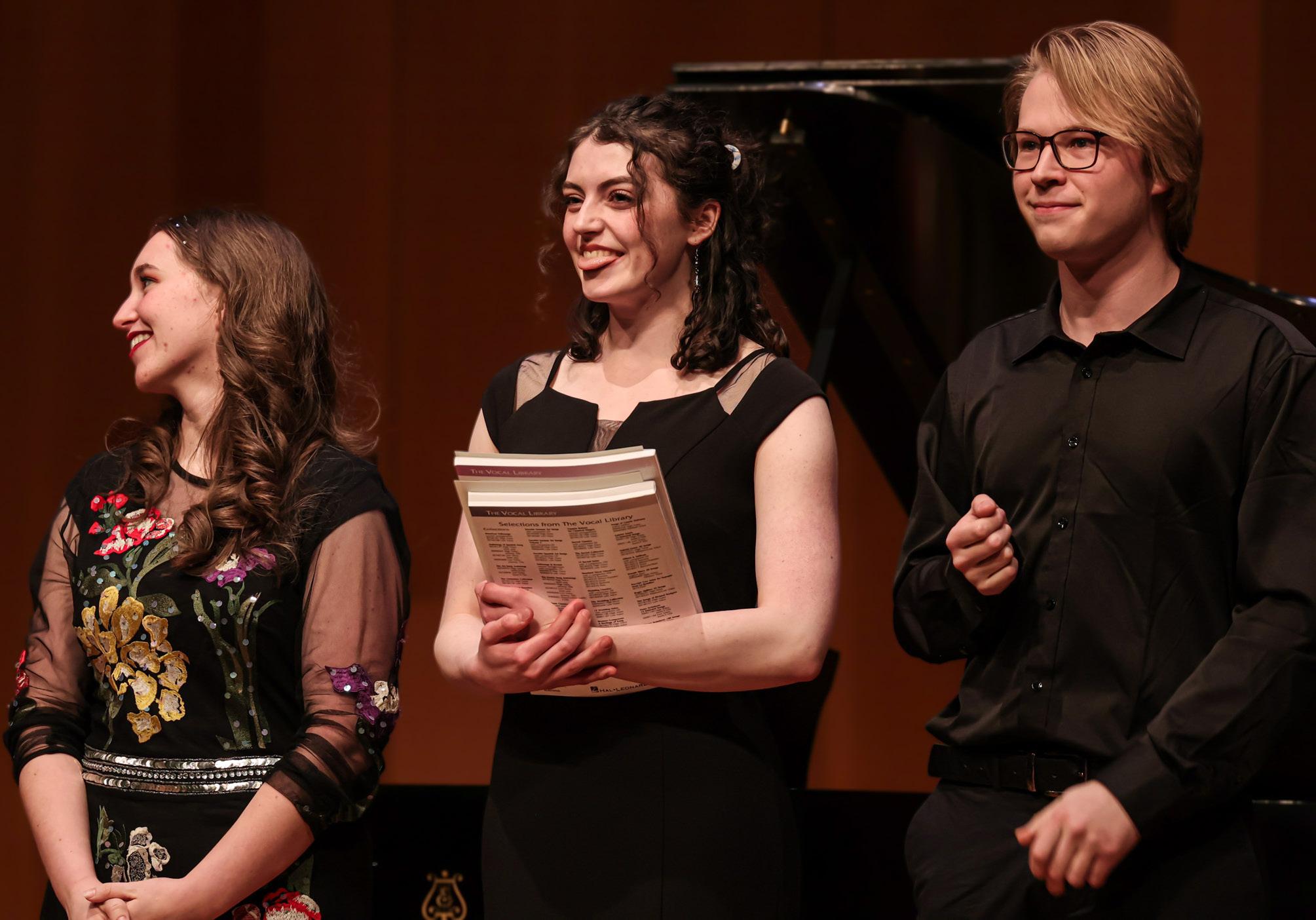
Auriana Smith wins first place in both the voice and audience choice categories at the Russell/ Wanlass Performance Hall on Feb. 9.
Auriana Smith performs “Après un rêve” by Gabriel Fauré.
Olivia Orengo’s growth, versatility paying dividends for USU Gymnastics
By Alyssa Caywood STATESMAN REPORTER
It all began when young USU gymnast Olivia Orengo saw a gymnastics commercial on TV that lit a spark of interest. She enrolled in her first gymnastics class, and what started as curiosity quickly turned into passion, eventually shaping her path as a collegiate-level gymnast. Orengo remembers looking up to older gymnasts and feeling inspired to do her best and keep working hard at her sport.
Now, she has gone from looking up to the older girls in her gym to being one of the older girls young gymnasts can look up to. Her journey has come full circle as she now serves as both a key competitor and a role model.
“I feel like that’s just kind of inspiring, to stay in the sport and be a leader for the little girls,” Orengo said. Her leadership extends beyond inspiring young gymnasts to work hard. Orengo shows dedication to her sport while taking the initiative to lead and support and uplift those around her, according to USU head gymnastics coach Kristin White.
“She’s definitely taken a leadership role on this team,” White said.
That role did not come without challenges. Like many athletes, Orengo faced challenges early on that tested her confidence and love for gymnastics.
“I quit because I was too scared of the coaches,” Orengo said. “I got back into it after a year or two.”
After taking a brief time away from the sport, she returned through a club gymnastics program in Illinois, where her confidence began to grow. Seeking stronger opportunities, Orengo later moved to Minnesota to continue to develop her skills and grow as an athlete.
Her dedication paid off. Orengo competed successfully throughout high school, scoring well in competitions and becoming a four-time national qualifier.
To Orengo, gymnastics is a great way to athletically improve as an individual while working with a team for a common goal. Each competitor is in charge of their own performance, but it is balanced with the support and motivation from teammates.
“Your friends push you,” Orengo said. “It’s a great way to work hard at something on your own but also with a group of people.”

More than just competition, gymnastics has also provided Orengo with personal growth, structure and a sense of community. The relationships formed in the gym have played a major role in her overall experience as an athlete.
“My team and teammates throughout the years — that’s where most of my friends are from,” Orengo said.
Her outgoing and confident personality is evident both in practice and during meets, where she brings energy and composure to the competition floor.
“She’s one of the funniest athletes that I’ve ever met,” White said. “She’s got this really cool, calm and collected attitude, which I think really benefits our team.”
Orengo competes as an all-around athlete and contributes across all four apparatuses. She has recorded a career-high all-around score of 39.050 and is a reliable asset to her team.
“She’s a very consistent athlete,” White said.
While Orengo did not always expect to be competing in all four events at the collegiate level, she values the opportunity she has to contribute to her team as an allaround competitor.
“If I’m not doing all four events, I don’t feel completed,” Orengo said.
Each event has unique skills that go into it, and Orengo’s favorite event changes based on the skills she is working on.
Bars was not always Orengo’s best event during her club career but has become one of her favorites.
“It’s just the most satisfying thing to stick a routine and score high,” Orengo said.
She also loves competing on the floor apparatus where she can showcase her tumbling skills and personality through her music and her routine.
“Floor is fun because of the dance, and I know I’m going to hit it when I go out there,” Orengo said.
After a successful first year, White said Orengo has continued to excel throughout her college career, showing steady growth as both an athlete and as a leader. Orengo’s consistency in the gym and competitive mindset have helped her earn trust from her coaches and teammates, making her a reliable presence in the competition lineups, according to White.
“This season, you’re starting to see her confidence and her personality come out more,” White said.
Orengo’s routines this year are showing strength and precision. She is continuing to refine her skills and performances while embracing a larger role within the team.
“We’re incredibly lucky to have her be a part of our Aggie family,” White said. “She’s been a tremendous asset — looking forward to the rest of her future.”
Alyssa Caywood is a first-year student at USU studying journalism. She loves anything outdoors from backpacking to snowboarding to water skiing.
— alyssa.caywood@usu.edu
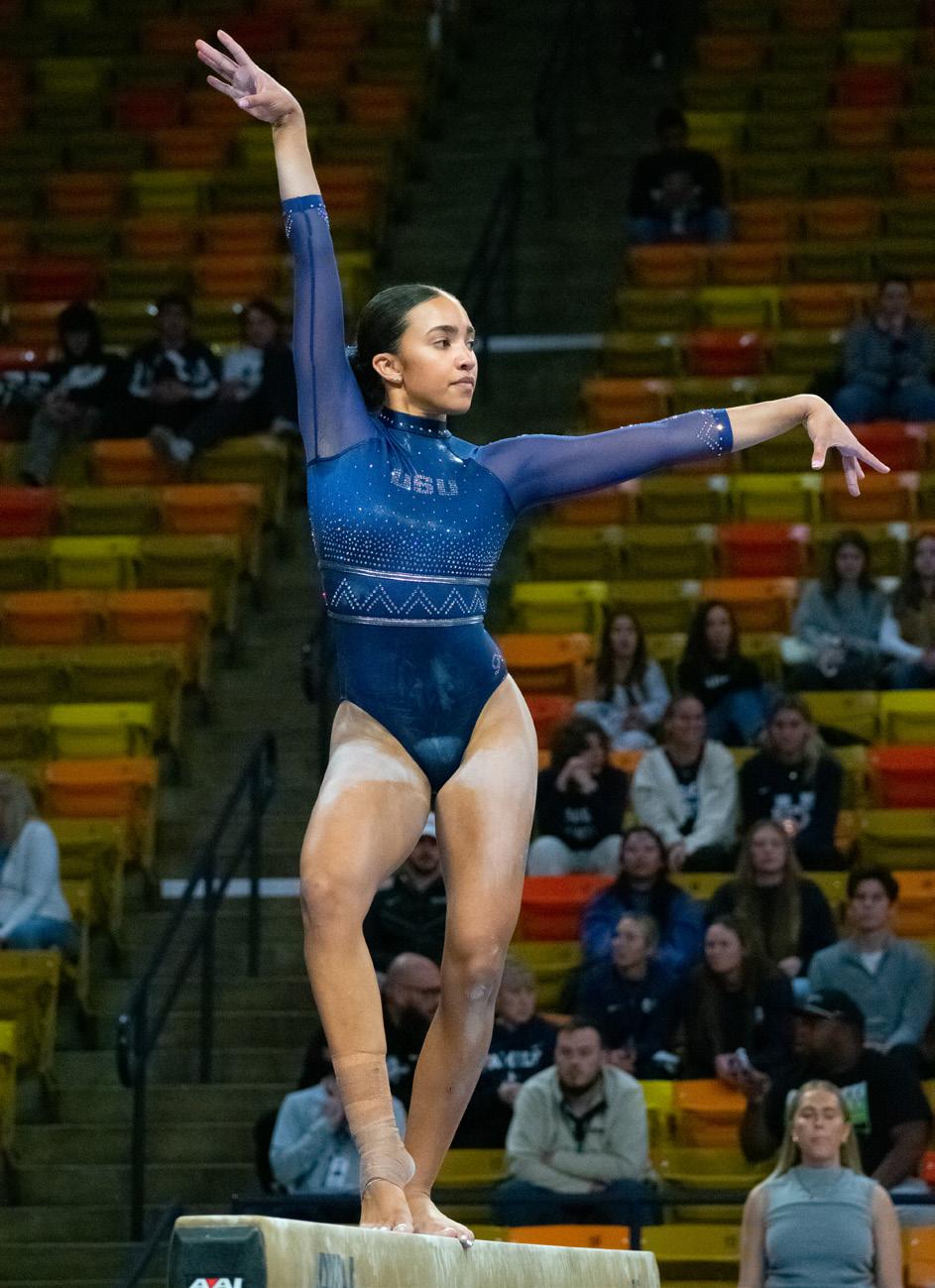
PHOTO BY Elise Gottling Olivia Orengo performs on the balance beam during a meet at the Dee Glen Smith Spectrum on Feb. 9.
PHOTO BY Jack Burton
USU Gymnastics head coach Kristin White, right, talks to Olivia Orengo before her routine on the beam on Jan. 10, 2025.
Garry Clark’s patient, persistent path to Utah State

His sister Lauren Young noticed it too. A few visits to Logan were enough to convince her Utah State was different.
“The games, the crowd, everything is fantastic,” Young said. “From the slow pace of life to the mountains, it’s completely different from Corpus Christi.”
Clark’s path to Utah State wasn’t simple. In fact, it rarely has been.
Out of high school, Clark didn’t have Division I offers waiting. A COVID-altered senior year added even more uncertainty, forcing him into a year of prep basketball before he eventually landed at the junior college level. From there, he worked his way up to Corpus Christi and finally to the Mountain West.
“If I can do it, anybody can do it,” Clark said. “I didn’t have any special advantages. I’m not the most athletic player or anything, but if you have the motivation and the determination, you can do it.”
Foul trouble has limited his minutes at times, something Calhoun has openly acknowledged.
“Garry’s used to staying on the block, playing against kids his size,” Calhoun said. “He’s got to be a little creative. But the thing that I love about Garry is he’s really learning the game and expanding his game, and he really loves it.”
Clark has taken that challenge head-on, breaking down film with his father and focusing on defensive discipline.
“I’ve got to quit playing with my hands,” Clark said. “I’m undersized, so I can’t out-physical a lot of guys. I’ve got to move my feet more.”
Young has noticed the same thing from afar.
“It’s containing that excitement,” she said. “We don’t make those silly fouls and can stay on the floor longer.”
Off the court, Clark’s story took an unexpected turn when his sister wrote a children’s book about his journey. “Then There Was Garry: A Basketball Story” was born from Young’s work as a teacher in St. Louis, along with her desire to give kids a real example of persistence.
By Carson Frost STATESMAN SENIOR REPORTER
On most days around Logan, Garry Clark blends in easily. He’s usually quiet. Laid back. Often on his phone — not scrolling social media but playing chess.
“Yeah, if anybody sees me around town on my phone, I’m probably playing chess,” Clark said with a smile. It’s fitting. Clark’s basketball career has unfolded less like a straight-line sprint and more like a long, patient march — full of adjustments, sacrifices and moves made with the future in mind. Now, in his final year of college basketball, those years of preparation have brought him to Utah State. For Clark, the transition to Utah State has been about more than basketball. After spending the previous two seasons at Texas A&M-Corpus Christi, where he was the top scorer in front of modest crowds, stepping into the Dee Glen Smith Spectrum felt different immediately.
“They’ve opened me here with open arms, and it’s been some of the best moments of my life,” Clark said. “Basketballwise, I’m playing in the most packed arenas every night, and here in Logan is special. My last two years, I hadn’t had that, so being able to get here and experience that my last year in college basketball means a lot.”
The Spectrum atmosphere was one of the first things that caught Clark’s attention during the transfer process. When Utah State coaches reached out last summer, Clark did his homework. He watched games and noticed the crowds. He listened closely when head coach Jerrod Calhoun laid out what the program stood for.
“It was just something that’s hard to turn down, especially coming from the conference I was in,” he said. “Just seeing the building packed like that and everybody screaming — that is something that drew my attention immediately.”
For Young, watching that journey unfold was equal parts pride and patience. Being 13 years older than her brother, she often filled a parental role growing up, emphasizing academics, discipline and consistency just as much as basketball.
“Stopping or quitting was never an option for him,” Young said. “If something got in the way, he figured out how to get around it or go through it.”
Those lessons carried into Clark’s college career, where he’s had to constantly adjust to new roles. On certain teams, he’s been the go-to scorer. On others, he’s been a role player fighting for minutes. Each stop required honesty — with coaches, teammates and himself.
“Every situation is different,” Clark said. “You have to be open-minded. Even here, where I’m more of a role player, just being able to accept that and grow in that position has helped me grow as a man.”
That adaptability has made him a natural fit in Calhoun’s system, which values depth, flexibility and matchup-based rotations.
“Garry Clark is kind of a sneaky type of guy,” Calhoun said. “He’s very, very strong. He’s stronger than he looks.”
Clark wasted little time making an impression this season. Coming off the bench, he provided physicality, scoring and rebounding, quickly earning national attention as one of the Mountain West’s most effective reserve bigs. Through 10 nonconference games, he averaged 10.5 points and 7.8 rebounds per game.
“The start I got off to was very important for me this year, and it’s momentum that I’m trying to keep rolling to finish off the season,” Clark said.
Utah State guard MJ Collins Jr. has seen Clark’s impact firsthand.
“Garry is a powerhouse down low,” Collins Jr. said. “It gives everybody else open threes. We feel like we have two of the best bigs in the conference in [Karson Templin] and Garry.”
But conference play has brought new challenges. The Mountain West is deep, physical and loaded with size, and the 6-foot-9 Clark often finds himself battling bigger bodies.
“Garry was the motivation for that book,” Young said. “I wanted other children to see that if you work hard and stick the course, you can achieve great things.”
Clark contributed with plenty of ideas and feedback, watching his life turn into illustrated pages. The message is simple: Success doesn’t have to be immediate to be real.
“That’s really what we were trying to show,” Clark said. “Anything is possible.”
Utah State’s season hasn’t been perfect, and Clark is quick to say that’s the point.
“You really find out who you are when you go through adversity,” he said. “Nothing is going to be given to us.”
Still, moments like his key minutes in a comeback win over Colorado State and a productive 13-point, 5-rebound performance in 16 minutes against Wyoming remind Clark why the grind matters.
“It’s been hard for me to accept not being able to help the team as much in certain games, so just me staying levelheaded and being able to help my team get a win means a lot,” he said.
As his college career winds down, Clark isn’t looking too far ahead. He wants to stay in the game in whatever form that takes and for as long as possible.
For now, though, he’s content in Logan, playing in front of packed crowds while continuing to learn, adjust and think a few moves ahead — just like a chess match.

Carson Frost is a transfer student from Denver studying journalism. His family originally hails from Los Angeles, and he is a passionate fan of the Lakers, Dodgers and Philadelphia Eagles.
PHOTO BY Dane Johnson Utah State forward Garry Clark is seen during the Utah State vs. UNLV basketball game in the Dee Glen Smith Spectrum on Jan. 20.
Spectrum South: The HURD fundraises for Mountain West basketball tournament
By Dani Packer STATESMAN REPORTER
Every year, the Mountain West Conference basketball championships takes place in Las Vegas. In years past, the Mountain West gave each school in the conference 100 tickets for each school’s student section. In recent years, the 100 tickets have not been enough for Utah State University’s student section the HURD. The HURD has had an average of 500 students go to the tournament and has needed to fundraise in order to financially support the students in the student section.
This year, the conference has not extended their offer for student tickets. USUSA Athletics & Campus Recreation Executive Director Ben Burdette was not aware of this change when he was elected to office.
“We’ve known for a couple months now,” Burdette said. “We’re not sure why, but this year, no schools will receive 100 free tickets from the conference, and so we’re responsible for purchasing all of them if we want to give them out to students.”
Because of this lack of tickets, the HURD Committee is fighting to get more fundraising done to get students to the championships.
“We obviously have very high attendance in Vegas based on previous tournaments, and so we’re doing our best so we can provide that experience for students,” Burdette said. “I’m sad because the students make or break the tournament atmosphere, and in the past, we’ve seen how students support their teams. I was obviously disappointed, but I think it fired us up as a HURD Committee even more to be able to fundraise — to show the conference that no matter free tickets or not, students are going to show.”
Many students love going to the tournament every year. With the men’s basketball team’s record this year, many students are excited about going.
“I want to go to Vegas for a few reasons. It’s fun to travel with your team. Going to away-style games is always fun
to show that we have that community outside of just our home arena,” said first-year student Cal Talabot. “It’d be fun to travel as a HURD, as a family, and to go support us in an area that might be unfamiliar or really intense to support our team.”
These students wanting to go to the tournament are not happy about the change. Between costs of travel, housing, food and tickets, students are worried they cannot afford the expenses of the championships.
“The travel down is not a light drive. It’s pretty consuming when it comes to gas and other things,” Talabot said.
Many students struggle with finances, and the $35 ticket per session is not a feasible purchase. Between potentially three sessions for the conference tournament, each student would end up paying about $105 dollars in tickets alone.
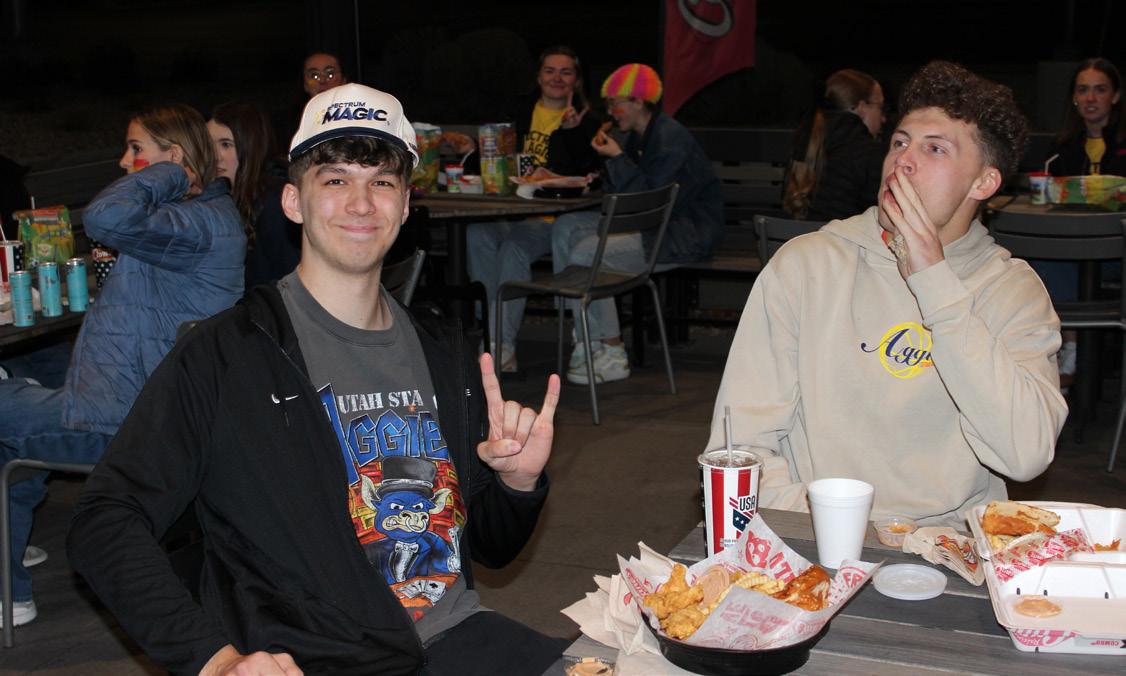
To help fundraise for student tickets, the HURD has put their plans into action. On Feb. 10, the HURD Committee had a Spirit Night in collaboration with Raising Cane’s Chicken Fingers. The event ran from 4 p.m. to midnight at the restaurant in Logan and became an exciting student environment following the game. The committee had multiple giveaways, including Minky Couture blankets, a Blackstone grill and Aggie swag. Many members of the men’s basketball team and community showed up to show their support to the many students in attendance.
The HURD’s plans don’t stop there.
“Obviously, we want to do a lot of the same things that we did last year because we did a ton of fundraising for tickets last year. So, a lot of that includes reaching out to businesses,” said Natalie Baker, HURD Committee member.
“A lot of people are willing to donate, especially if they’re USU alumni. Also, we offer the ability to put their logo on our Vegas T-shirts if they donate a certain amount.”
Baker said the HURD is hopeful through their fundraising and dedicated work, students will be able to come to Las Vegas for the tournament.
“It was the highlight of my year last year,” Baker said. “I don’t think that there’s a better way for students here at Utah State to really picture and visualize the really awesome community that is being an Aggie.”
Dani Packer is a sophomore studying English literature. When she’s not studying, she can be found tearing up the dance floor.
— dani.packer@usu.edu

PHOTO BY Dani Packer
Utah State Men’s Basketball players Tucker Anderson, left, and Mason Falslev eat at the HURD fundraiser at Raising Cane’s on Feb. 10.
Keith Smith takes over Utah State Volleyball with winning expectations
By Carson Frost STATESMAN SENIOR REPORTER
When Keith Smith accepted the Utah State Volleyball head coaching position in January, he knew he wasn’t stepping into a rebuild. Instead, he was inheriting a program fresh off one of the most successful seasons in school history — and one with expectations to keep winning.
Smith discussed that challenge and his first impressions of Utah State during a recent appearance on “The Statesman Sports Desk,” the Aggie Radio 92.3 KBLU-LP weekly sports talk show hosted by The Utah Statesman. After spending most of his life on the West Coast and coaching stops across the country — and even overseas — Smith said Logan has quickly stood out.
“I’ve lived in eight states and coached all over,” Smith said. “This is a really special place. There’s a genuine care for people here, and there’s also a passion for sports across every program, not just football or basketball.”
Smith, who played collegiately at Grand Canyon University and later professionally in the Netherlands, transitioned into coaching after a career-ending injury. His coaching resume includes stints at University of Providence, Grand Canyon, Auburn University and Texas Christian University, along with nearly a decade of experience in the USA Volleyball national team development program.
USU Vice President and Director of Athletics Cam Walker explained Smith’s professional experience was a highlight in bringing him to Logan.
“He’s a proven recruiter with a strong track record of developing players. From the start of the hiring process, his professionalism and expertise were evident,” Walker said at the time of Smith’s hire. “His background with USA Volleyball will be invaluable as the program works to reach the next level.”
That wide-ranging background, Smith said, has shaped how he approaches his first head coaching role.
“You’re really an educator as a coach,” Smith said. “Every athlete is at a different point in their
development. The job is figuring out where they are and helping them take the next step.”
Smith is taking over a Utah State program that went 18-0 in Mountain West play last season, won its first NCAA tournament match since 2001 and reached as high as No. 3 nationally in winning streak length. While he didn’t closely follow the Aggies throughout the entire season due to his responsibilities at TCU, Smith said Utah State caught his attention during the NCAA tournament.
“That was a high-level team,” Smith said. “Watching them in the tournament — that’s the standard we’re trying to build toward every year.”
Smith also credited former head coach Rob Neilson, now at Brigham Young University, for building a foundation that made Utah State attractive.
“What Rob and his staff did here is special,” Smith said. “The culture, the expectations, the investment in winning — all of that matters.”
Despite the coaching change, Utah State retained much of its roster, including reigning Mountain West Player of the Year and All-American setter Kaylie Kofe, first-year standout middle blocker Lauren Larkin and libero Kendel Thompson. Smith said continuity is unusual but critical.
“Having a setter like Kaylie gives you a chance to win at a really high level,” Smith said. “She can dictate the game, and that allows us to do a lot of things offensively.”
Utah State did lose several key contributors to graduation and the transfer portal, but Smith
emphasized the program is focused on retooling rather than rebuilding. He noted the addition of transfer Olivia Ruy and an incoming recruiting class he described as one of the best outside the power conferences. Stylistically, Smith said the Aggies will look familiar but faster.
“We’re not changing much,” Smith said. “We’re pushing the tempo and seeing how fast we can play.” Off the court, Smith said Logan has been an easy place for his family to settle in, particularly with its access to the outdoors. An avid golfer and self-described “lake person in training,” Smith said Bear Lake is already on his list.
Smith’s full interview aired on “The Statesman Sports Desk,” which runs live every Monday at 10 a.m. on Aggie Radio and is available on Podbean, Spotify and Apple Podcasts.
— carson.frost@usu.edu

PHOTO BY Hadley Sintay
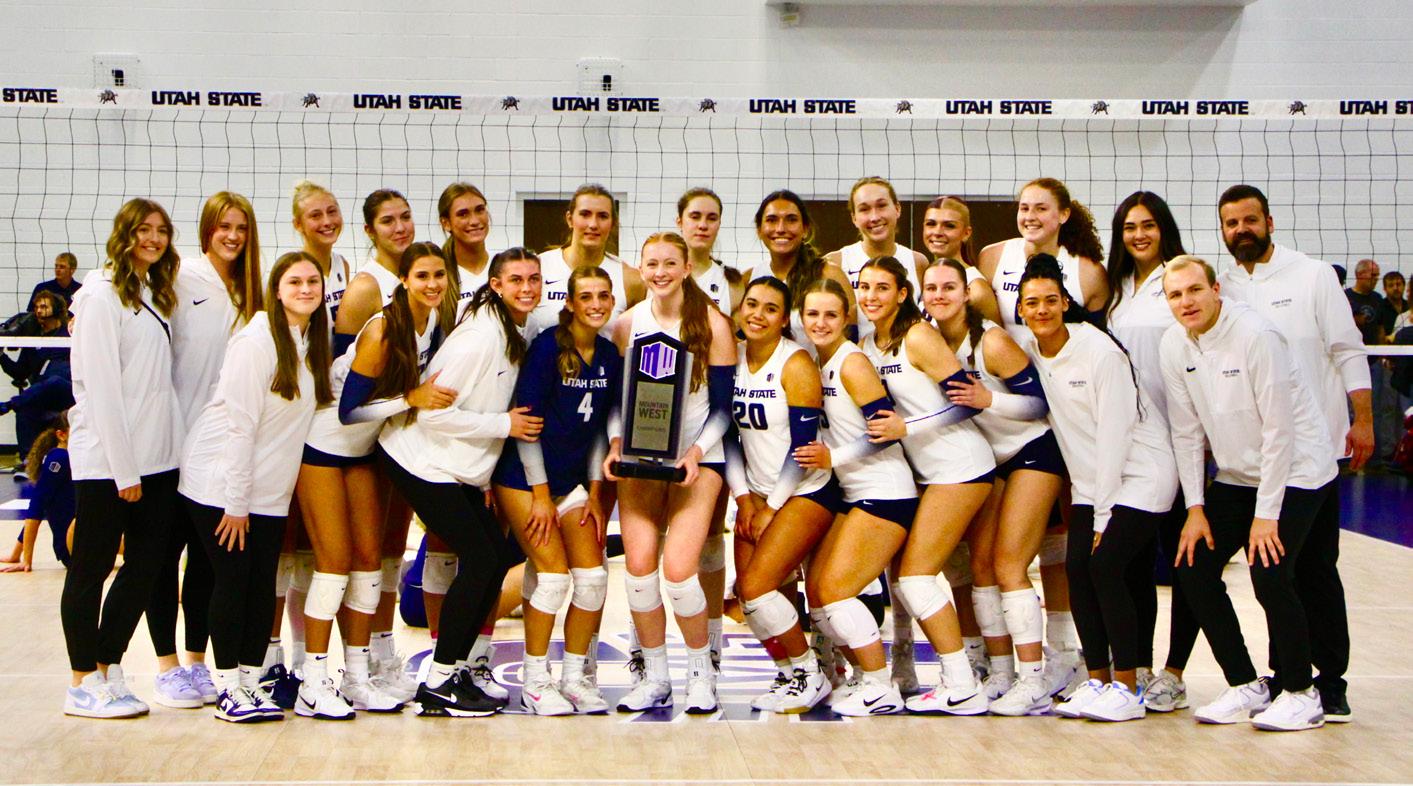
The Utah State Volleyball team celebrates after winning the Mountain West championship trophy on Nov. 22, 2025.


Dear Shrink Wrap,

Wrap Shrink
This column offers general mental health information and is not a substitute for professional counseling. Students in crisis or seeking professional support are encouraged to contact USU Counseling and Prevention Services (CAPS) at 435-797-1012, visit TSC 306, or access after-hours crisis support by calling or texting 988.
I’m worried about a close friend who has been struggling with their mental health. They don’t want professional help, and I feel responsibility as their main source of support. I care about them, but it’s starting to take a toll on me. What do I do?
Dear Aggie,
It’s clear how much you care about your friend, and it’s also clear you’re reaching your limits. You don’t have to choose between being a good friend and taking care of yourself. Both matter and impact each other.
First, remember this: You can care deeply without becoming someone’s only support. Your role is to care and empower, not


Ask what feels helpful to them right now. This supports their autonomy and keeps you from guessing or over-functioning. You can offer ideas, but it’s not your job to figure out what they need or make decisions for them.
Sharing specific resources, like USU, CAPS or USU CARE office, is meaningful, even if they don’t follow through. If your friend chooses not to seek help, you don’t have to make up for that gap. Their mental health ultimately belongs to them.
At the same time, boundaries are essential — for you and for the friendship.
Pay attention to signs like resentment, exhaustion or avoidance — these usually mean a boundary is needed.
Decide what you can and can’t do — including “just not right now.” You don’t owe detailed explanations.
Saying no doesn’t make you a bad friend. Counterintuitively, people who say no when they need to are often trusted more because their yes means something.
When possible, pair a no with an alternative: “I can’t do that, but I could do this.”
About safety:
Don’t promise secrecy around safety concerns. You can promise only involving people who need to know, but safety comes first.
If you’re worried about immediate danger, involve professionals: 988, 911 or campus supports. Even professionals do not manage crises alone. Take care of yourself.
Maintain healthy sleep, nutrition, movement, connection and things that bring you joy.
Your friend’s emotions and outcomes are not your responsibility to control or fix.
If you’re unsure what to do, never worry alone. Reach out to CAPS, the USU CARE office, SafeUT or 988. Getting support for yourself is not a betrayal of your friend — it’s part of caring wisely.
— USU Counseling and Prevention Services

Listening, validating feelings and trying to understand your friend’s experience does help, even if you can’t fix anything.
Grilled Cheese and Tomato Soup
Find most of these ingredients at SNAC!
Create mental boundaries, times when you set worries down, during class, work or rest. Simple rituals, like writing worries down or taking a breath before tasks can help you mentally step back.
SNAC Needs More Space



Grilled Cheese
Ingredients:
2 slices of bread
Any type of cheese
Butter or mayo
Instructions:
Spread one side of each slice of bread with butter or mayo and place bread butter-side down on a skillet on medium heat
Add cheese and top with other slice of bread
Toast each side for 1-2 minutes or until cheese is melted and bread is golden brown
Tomato Soup
Ingredients:
2 Tbsp olive oil
1 medium onion, diced
2 minced garlic cloves
2 cans diced tomatoes
1 cup broth
Instructions:
Heat olive oil in a pot over medium heat, add onion and cook until translucent
Add garlic and cook for 1 minute, then pour in canned tomatoes and broth.
Let simmer for 15 minutes
Blend soup until smooth
Optional: top with heavy cream or fresh basil and season with salt and pepper.
SNAC has seen a large increase in number of visits this school year As a result, our shelves may look a bit more empty Here’s the catch - We often have the opportunity to get more food ,and just don’t have the space to store it.
We would love to be able to carr y a heavier inventor y to support our increased demand, but we can’t fit anything else into our space! Space is the hardest thing to acquire here at the university, even if currently it may be unused or under utilized
Talking about our need for space increases the odds of it reaching the right ears. Help SNAC do what we do best - and tell ever yone you know how much you love SNAC!
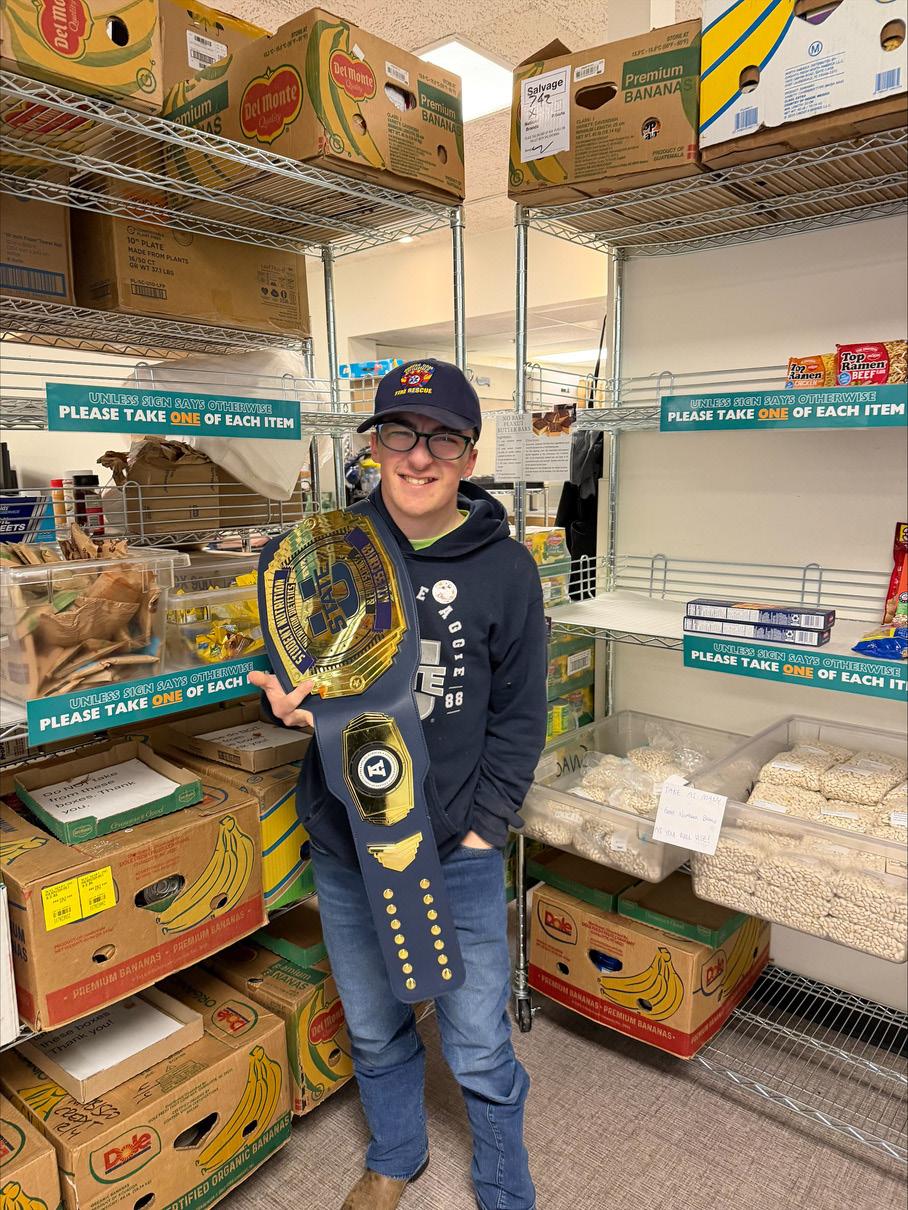
Meet Taggart, SNAC’s new intern from the Employability Clinic! Taggart works at SNAC in the afternoons and has been a great help with repackaging food and keeping our shelves stocked. Come say hi and get a signature Taggart fist bump next time you come to SNAC!


Old Main In Detail
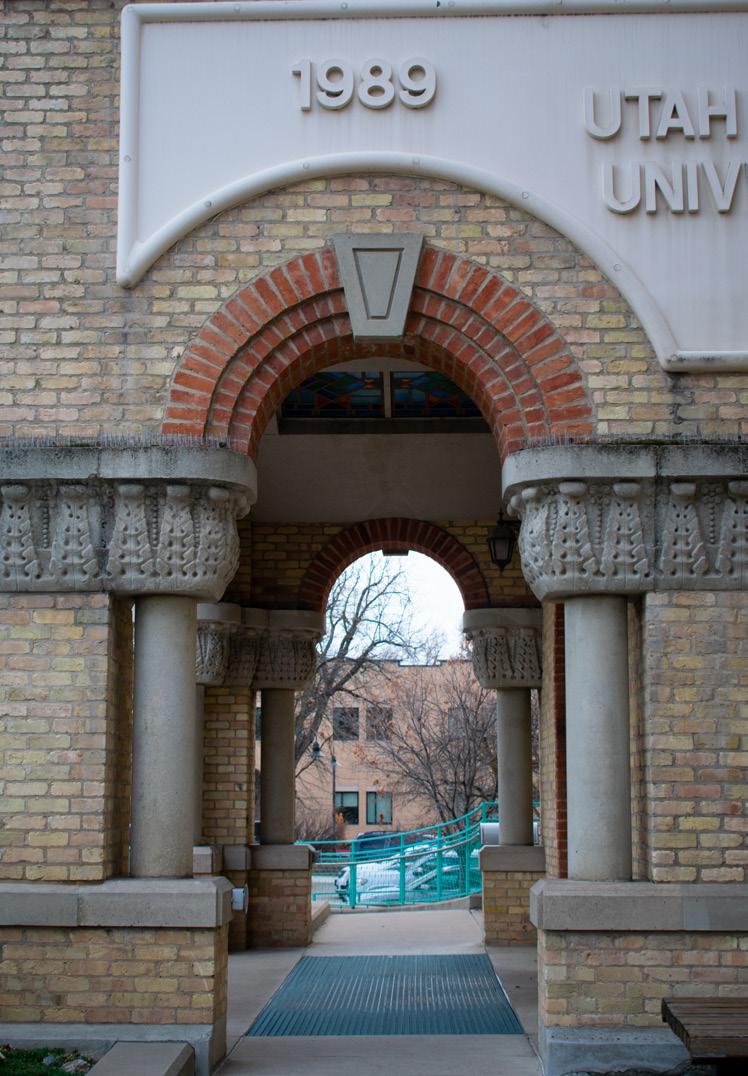



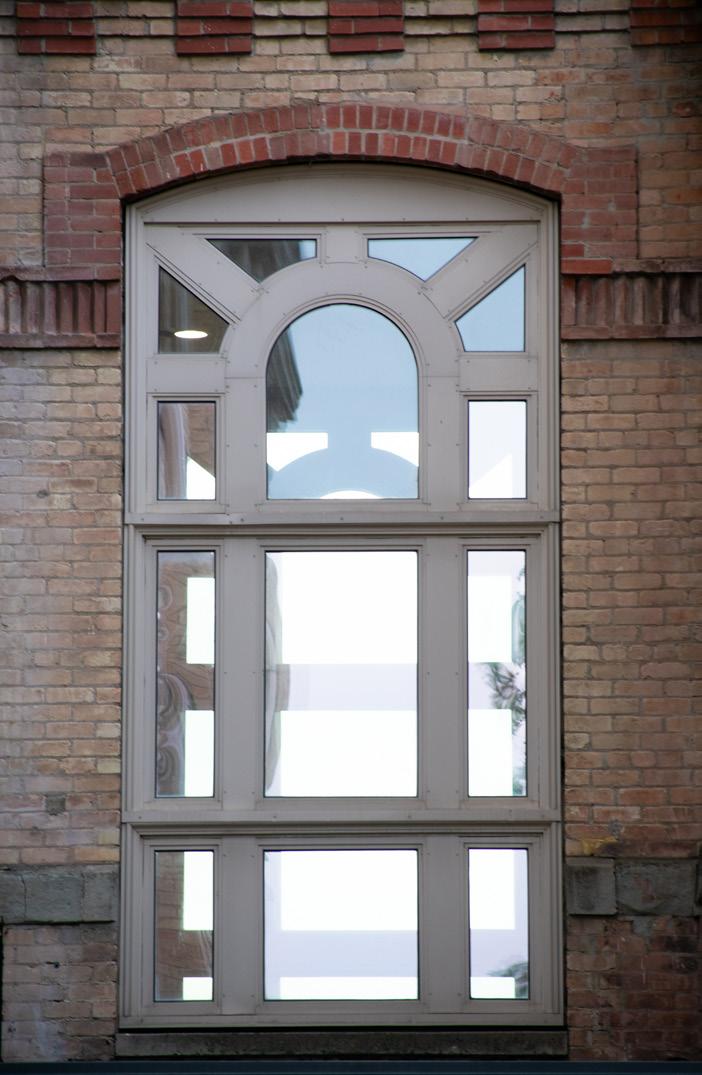


Elise Gottling is a sophomore studying outdoor product design who also loves being behind the camera. When she’s not taking photos, she can be found hiking, enjoying the outdoors or trying to amp up her guitar skills.