

Aviation Week takes off on Logan campus
By Jayke Martin STATESMAN REPORTER
At Utah State University, Aviation Technology Aviation Week offers students and the community a chance to explore one of the university’s fastestgrowing programs.
“Aviation Week is a way to showcase aviation at USU: how it started in 1939 with maintenance and how much it’s grown since then,” said Michael Logan, aviation marketing, outreach, and recruiting coordinator.
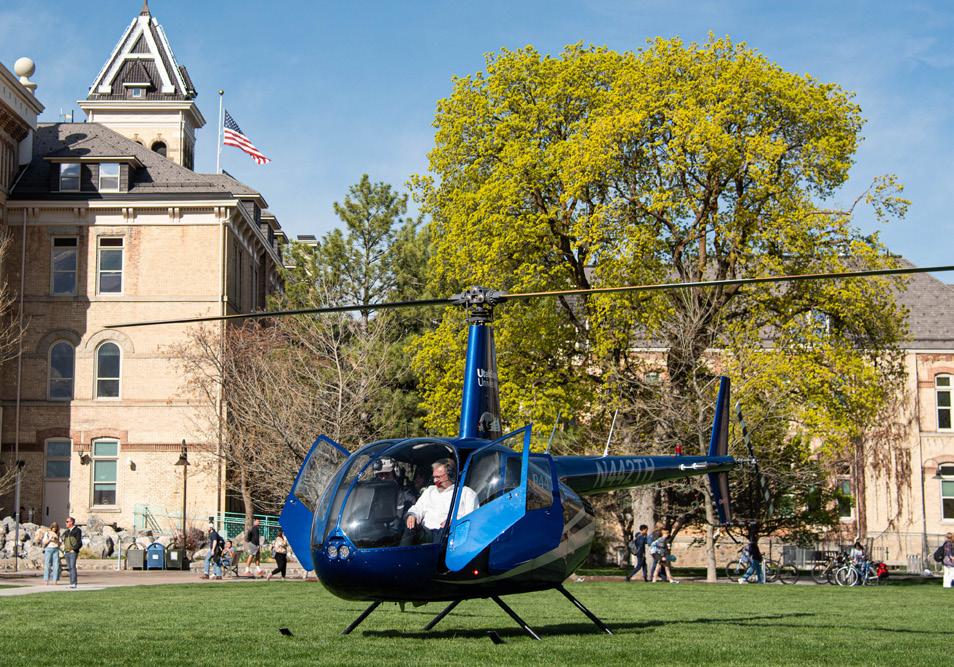
The weeklong event featured a range of activities designed to highlight aviation education, including a helicopter landing on the Quad, drone demonstrations, simulator tours and a career conference connecting students with industry professionals.
“We’re showcasing all of our programs: fixed-wing training, helicopters, maintenance, air traffic control, management, drones and our jet training program,” Logan said.
The idea for the week originated from a need to raise awareness about a program that has existed for decades but is still unfamiliar to many students and community members.
“Everywhere I went, people would say, ‘Utah State has an aviation program? Is that new?’ And I’d say, ‘No, it’s been here since 1939,’” said Baron Wesemann, aviation technology associate department head. “We created it as a way to showcase what we do.”
Since its creation, both Aviation Week and the aviation program itself have grown significantly.
“We now have over 800 students in the program,” Wesemann said.
Logan noted that demand continues to rise, particularly for flight training.
The week begins with one of its most visible and popular events.
“We kick things off Monday with a helicopter landing on the Quad,” Logan said. “Students can meet the pilots and learn about the program.”
Other highlights included Drone Day, where students demonstrate unmanned aerial systems and showcase their technical skills, as well as a career conference that helped prepare students for entering the workforce.
“Wednesday is a career conference where students meet industry professionals and do mock interviews with airline representatives,” Logan said.
Advancements in technology have also played a major role in the program’s development. During the week, visitors explored high-tech training tools used by students.
“Our fixed-wing program alone has over 600 students, and it’s full,” Logan said.
Events throughout the week are designed not only to inform but also to give students real-world experience in leadership and organization.
“First and foremost, I want our students to learn leadership, project planning and organization,” Wesemann said. “You’ll see students running these events.”
“We now have a 737 simulator and a new air traffic control simulator. It’s amazing technology,” Wesemann said.
Wesemann emphasized that aviation extends far beyond piloting aircraft, offering a wide range of career opportunities.
“Aviation isn’t just flying. It includes drones, maintenance, air traffic control and so many other fields,” Wesemann said.
Students trained in these areas are already finding careers in emerging industries.
“Our students are working for companies like Amazon Prime Air doing drone delivery, inspections and aerial photography,” Wesemann said.
In addition to showcasing student work and career pathways, the week also aimed to inspire future students. This year’s featured speaker was Jessica Cox, the world’s first armless pilot.
“She talks about ‘thinking outside the shoe’ — finding ways to solve problems differently,” Wesemann said.
Organizers said the event serves as both a recruitment tool and a way to build community awareness.
“A lot of people don’t even realize Utah State has an aviation program,” Logan said. “This is one way we get the word out.”
For Wesemann, the impact of the week goes beyond awareness or enrollment numbers. He said the experience can shape students’ confidence and outlook, regardless of whether they pursue aviation careers.
“Even if aviation isn’t their path, they learn they can do hard things,” Wesemann said.
While Aviation Week lasts only a few days, faculty stress that opportunities to explore aviation are available year-round through tours, camps and handson experiences.
“You don’t really understand aviation until you experience it, whether that’s in a simulator or in an aircraft,” Wesemann said. “That can be life changing.”

Jayke Martin is a junior studying journalism with a minor in theater. She loves reading and meeting new people.
PHOTOS BY Jack Burton
A helicopter lands on the Quad for Aviation Week on March 30.
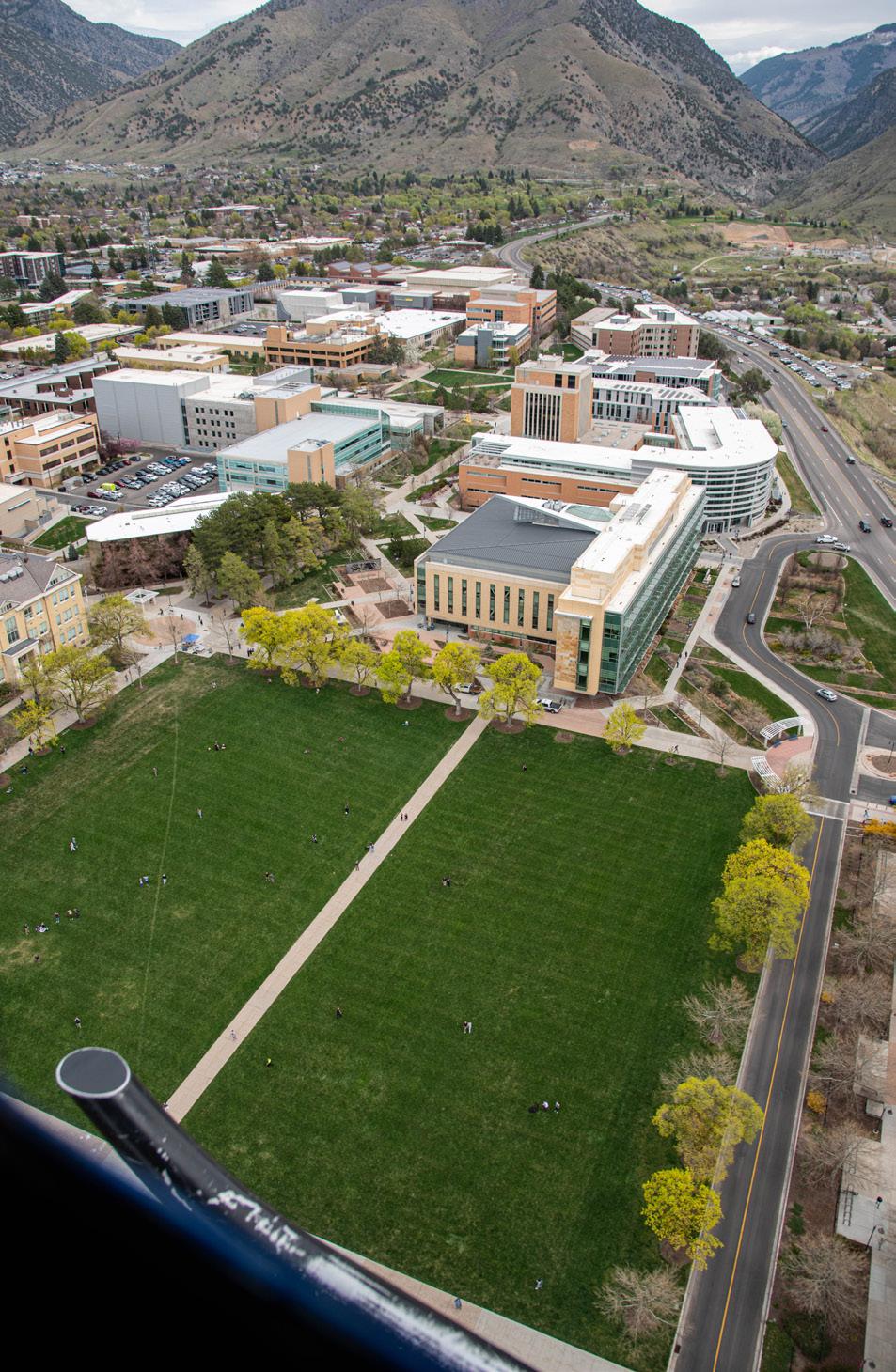
The Quad is seen from a helicopter flown by assistant helicopter chief/flight manager Tyler Knudsen on March 30.
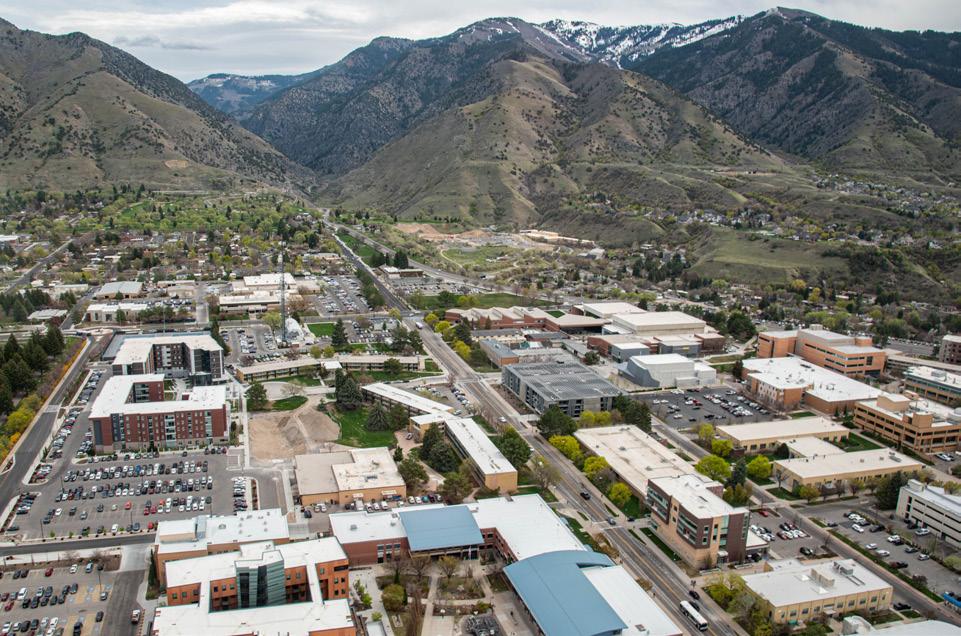
USU Logan campus is seen from a helicopter.
QANR appoints first official dean
By Emma Barker STATESMAN REPORTER
Derek McLean has been appointed as the first permanent dean of the Utah State University S.J. & Jessie E. Quinney College of Agriculture & Natural Resources following a nationwide search.
McLean, who currently serves as dean of the Agricultural Research Division at the University of Nebraska-Lincoln, starts July 1. He succeeds interim dean Grant Cardon, who has led the college since its formation in July 2025. McLean’s background includes a senior science adviser position at the National Institutes of Health, where he coordinated research funding and policy across more than 20 institutes, as well as senior director of collaborative research for Phibro Animal Health Corporation and a decade as a faculty member at Washington State University. He currently holds a doctorate in animal sciences from Oregon State University. The Utah Statesman reached out to McLean for comment.
“The future dean won’t be available to talk to the media about USU until he begins on July 1,” said Amanda DeRito, a USU spokesperson.
“Dr. McLean brings a remarkable record of strategic leadership across higher education, federal agencies and industry,” said Larry Smith, USU provost, in the university announcement about the new dean. “Throughout his career, he has demonstrated a deep commitment to student and faculty success, research excellence and the public good.”
Cardon, a soil scientist who has been on the USU faculty for 21 years, said he came into the interim role without a plan for how the new college should be structured.
“My approach was, ‘Don’t come into it with any kind of preconceived notion,’” Cardon said. “Let’s go through and start doing some grassroots surveys of the faculty and the staff — spend a lot of time talking and gathering input.”
Smith mentioned Cardon was deliberately chosen for the role because of his deep familiarity with both former colleges.
“He wasn’t just a placeholder — he was a builder,” Smith said. “He understands the faculty perspective, the research engine and the classroom experience equally well.”
The college spent six months gathering faculty and staff input before making any decisions about structure.
“Most of the professors realize ... the potential synergies there,” Cardon said. “All through my career, soil is under everything, whether it be an agricultural field or forest.”
McLean was selected for his vast network of experience and commitment to students and faculty, according to Smith.
Not all students were following the leadership change.
Gwen Bassett, a senior majoring in environmental science and sustainability, said they had heard about the appointment but didn’t know many details.
“I had some idea that a new dean had been appointed for the college just because of the merger, but I hadn’t heard much about it, and I don’t know who it is, exactly,” Bassett said.
Bassett said they hope McLean prioritizes listening to students above all else.
“I would really like to see a smooth transition as we merge these two very different colleges,” Bassett said. They added that they want to see advocacy for the natural resources side of the college.
“I would really like to see some responsibility and accountability because we’ve had a history in the past of administration in our school not showing that,” Bassett said.
Bassett also expressed concern about preserving the distinct identities of both colleges.
“Agriculture and natural resources often have different values and really are different colleges in many ways,” Bassett said. “I think it’s important for us to find the in-between but also to keep the integral pieces of that.”


Emma Barker is double-majoring in journalism and communication and sociology. When she’s not reporting, she enjoys spending time with her dog and husband, thrifting and attempting to keep her sourdough starter alive. — emma.barker@usu.edu
Barker Alyssa Caywood
Colvin Jayke Martin
McNeill
Moore
Nielsen
Peterson
Shelite
Ferraro

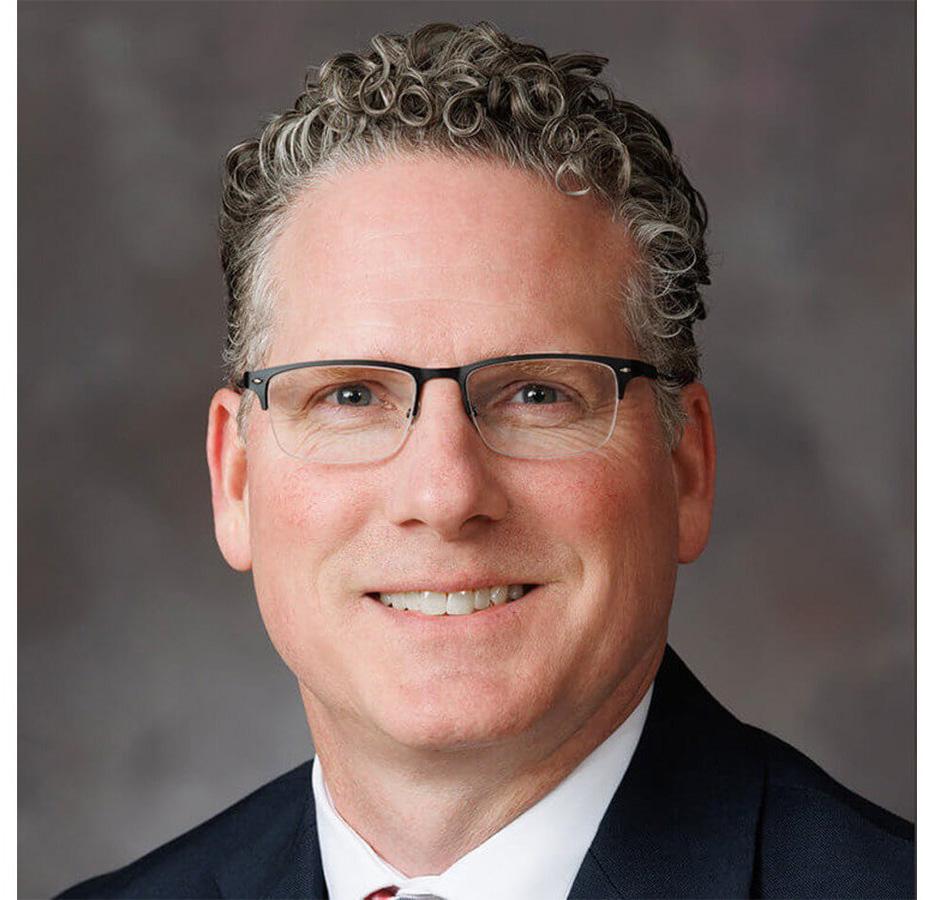
HEADSHOT SUBMITTED BY DEREK MCLEAN
Former engineering dean Jagath Kaluarachchi remembered for vision, mentorship and service
By Dylan Moore STATESMAN REPORTER
Former Utah State University College of Engineering
Dean Jagath Kaluarachchi died from cancer on March 17 after a life of service to students.
According to colleagues, his decades of leadership, research and mentorship shaped the college and the students who passed through it. Kaluarachchi served in multiple roles at the university including professor, associate dean and dean. Colleagues and family members said his impact extended far beyond administrative titles, leaving a legacy defined by both innovation and people.
According to his son Rumal Kaluarachchi, USU was central to his father’s life.
“Utah State was his whole life,” Rumal said. “That was his bread and butter.”
Jagath Kaluarachchi spent years balancing teaching, research and administrative work, often traveling internationally for projects while maintaining a strong presence with his family. Rumal described him as a constant, steady figure in the background of family life. “He didn’t slow down for anything,” Rumal said. Born in Sri Lanka, Kaluarachchi’s academic journey took him across the world before arriving in the United States, where he earned a doctorate degree at Virginia Polytechnic Institute and State University and eventually
joined Utah State’s faculty. That global perspective, his son explained, shaped the way he approached both engineering and people.
“He had a very strong grasp of people from different backgrounds,” Rumal said. “As long as everyone was
speaking the same engineering language, everyone was able to contribute in an impactful way.”
According to his son, Kaluarachchi emphasized a foundational principle of engineering, which was the importance of understanding theory before application. It was a lesson he passed on not only to his students but also to his own children.
“If you understand the theory extremely well, then the applications are kind of just what you fit theory to,” Rumal said.

Dylan Moore is a junior majoring in political science and minoring in anticipatory intelligence and Russian. He always loves going on outdoor adventures and cooking.
— dylan.moore@usu.edu

March 19
USUDPS officers particpated with sixth-grade students and teachers in the March Madness NCAA basketball tournament. They helped with score keeping and cheering.
March 20
USUDPS officers participated in a community engagement event at the LLC. They spoke with a group of 10 students about the recent surge in alcohol and drugs on campus.
March 20
Officers were dispatched to a suspicious person call located near the LLC between building A and B in the grass area working out. Complainant described the individual as an adult male possibly in his 40s and possibly on drugs playing music and wearing a tank top, shorts with workout gloves.
Upon arrival, officers found an individual that fit the description provided and asked him what was going on. The individual, who later identified himself, apologized for causing any alarm, thanked the officers, gathered his belongings and left the area on foot.
No crime was committed.
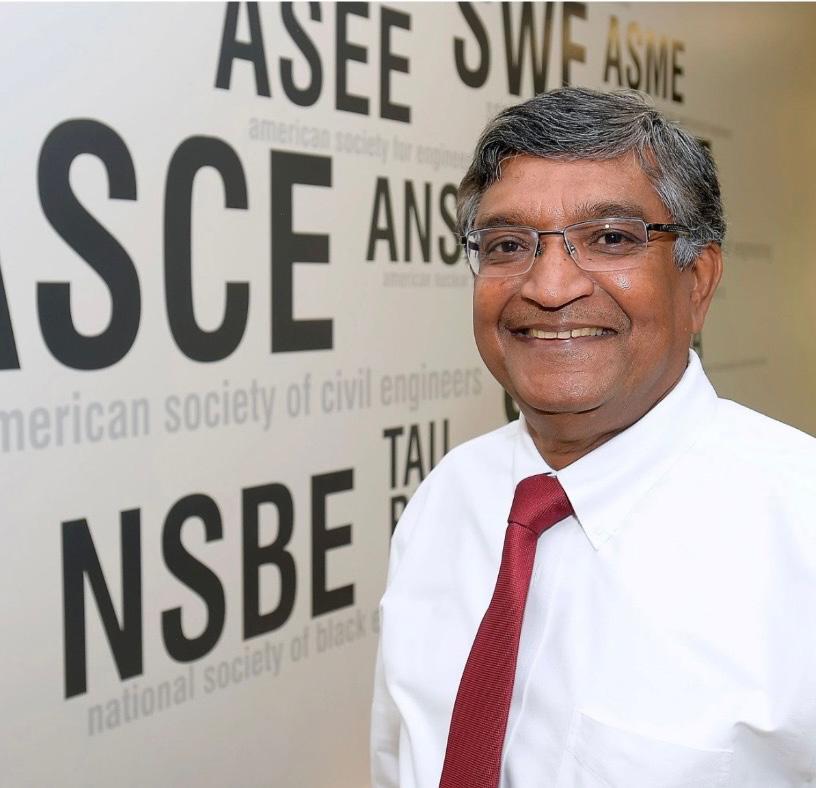
PHOTO SUBMITTED BY RUMAL KALUARACHCHI Jagath Kaluarachchi, former engineering dean, stands for a photo in the Richard and Moonyeen Anderson Engineering Building.


USU’s 48th annual pow wow brings community together
By Jayke Martin STATESMAN REPORTER
Drums, dancing and tradition filled the George Nelson Fieldhouse at Utah State University on March 28 as the 48th annual Echoing Traditional Ways Pow Wow returned, continuing a decades-long tradition celebrating Indigenous American culture, community and heritage.
“This is the 48th annual pow wow,” said Faustine Saganey, the program coordinator for the USU Center for Community, which organized the event. “It started with a Native student group who wanted to bring a pow wow to campus, and it’s been held here ever since.”
After years of cancellations, including during the coronavirus pandemic, organizers said the event continues to hold special significance.
“We really want to emphasize that this pow wow is the community because we’re nothing without our community,” Saganey said.
The pow wow brings together students, staff and local participants to celebrate Indigenous American culture. Shelly Ortiz, the executive director of the Center for Community, highlighted the event’s broader purpose.
“We’re creating shared celebrations of heritage and experiences, opening up opportunities for all students to engage,” Ortiz said.
This year, more than 150 people helped bring the event together, including volunteers and cultural leaders known as head staff. The head man, head woman, drum groups and master of ceremonies guided the cultural elements, from dances and songs to ceremonial rituals.
One of the most significant moments, according to Saganey, was the grand entry, marking the official start of the pow wow.
“Grand entry is when we’re calling on our ancestors, asking for blessings for the people, the dancers and the space,” Saganey said.
Attendees experienced a full day of traditional and community-centered activities, including dance competitions, cultural performances and interactive events such as the potato dance and twostep. Vendors were also present offering Native-made goods and traditional foods, including Navajo tacos and roast mutton.
“We want students to leave feeling like they learned something and like they
have a community they can come back to,” Saganey said. “It’s about sharing culture but also making it accessible, fun and engaging for everyone.”
The event also highlighted student leadership through the role of Miss Native American USU, who served as the head woman and represented the values and focus of the pow wow.
“Our Miss Native serves as head woman. The head woman and the head man are the two people who represent the pow wow itself, and they are the people who will kind of show what the event will be centered around,” Saganey said.
For Saganey, the pow wow represents more than a single day; it is about building connections that last beyond the event.
“There’s a lot of thought and a lot of love put into this,” Saganey said.
Saganey described the planning process as collaborative, noting that students, staff and community members all contribute to making the pow wow possible.
“We’ve made it so that there’s no entrance fee. Other events, we try to make highly accessible so students can actually engage,” Ortiz said.
The pow wow at USU continues to honor decades of Indigenous traditions while engaging the campus and local community. Both Saganey and Ortiz hope attendees left with a deeper understanding of Indigenous culture and a sense of connection to the community.
“This is really centered around the community,” Saganey said. “It’s created this space that’s way more than what we imagined.”
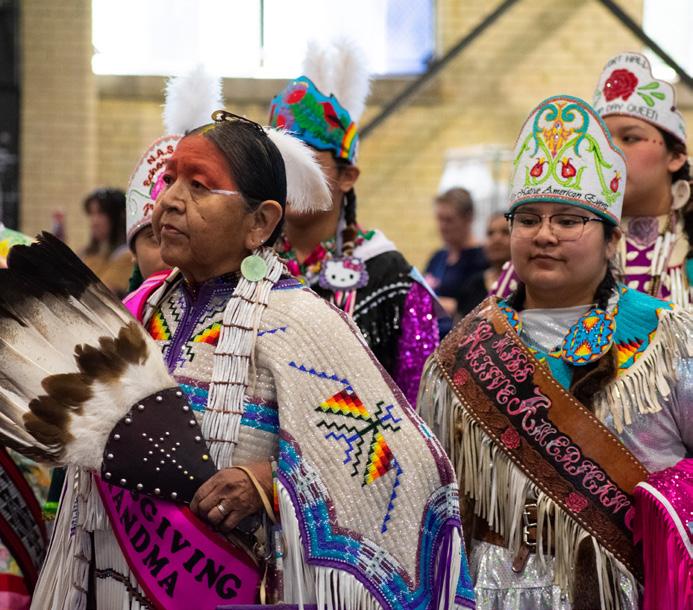
PHOTO BY Elise Gottling Dancers perform at the Utah State University Echoing Traditional Ways Pow Wow on March 28.
Research Week returns with events, exhibits and workshops
By Essence Barnes STATESMAN SENIOR REPORTER
Utah State University’s Research Week returns to campus this week, providing new opportunities for students, staff and faculty to get involved and see how research shapes everything from science labs to the arts.
From April 6-10, the USU Office of Research, in coordination with departments across campus, will host events, exhibits, workshops, performances and research showcases.
“Overall, Research Week is … a celebration of research, and we want it to also be a recognition of the researchers themselves — the humans behind the work,” said Thomas Sorenson, the communications specialist for the office. “In large part, that is trying to create opportunities for the people, and part of it is showcasing the work.”
While the foundational core of Research Week hasn’t changed, Sorenson said his department has made efforts this year to make it bigger and more collaborative than ever before.
“We made a big effort to source other opportunities around campus and add them to our calendar,” said Nathan Stucki, the director of research communications for the office. “The calendar is much more extensive this year than previous because it has events included there that are not primarily sponsored by the Office of Research.”
To help achieve this goal, the office opened its events calendar to the public and allowed campus and local groups to add events to the week’s festivities.
Some of the departments and sponsors new to this year’s week include the College of Arts & Sciences, the Jon M. Huntsman School of Business and the Department of Environment and Society.
“We think of research so often as lab coats and microscopes and stuff, and it’s so much more broad than that,” Sorenson said. “This feels like the first time, at least since I’ve been here, that it feels like we can truly say that we’re hitting the breadth of research at this university.”
Some of the unique events planned for the week include a performance of “The Abduction from the Seraglio” by USU Opera Theatre students, the Entrepreneurship Leadership Series Shark Tank Night and the ENVS Graduate Student Pre-Project Research Symposium.
“The humanities tend to get lost in the conversation about research,” Sorenson said. “We think it’s really, really critical to remember the human side of the world and the human side of research outcomes, and we have wanted an opportunity to promote that better, and we finally figured out a way to do it.”
Another new aspect of the week is the inclusion of offcampus events. One of these is a presentation at the Logan Library titled “What Disney Didn’t Tell You — A Tour of the Original Grimm Fairy Tales: An Aggie Talks Event.”

Essence Barnes is a third-year student majoring in journalism who enjoys reading, writing and storytelling.
— essence.barnes@usu.edu

STATESMAN FILE PHOTO
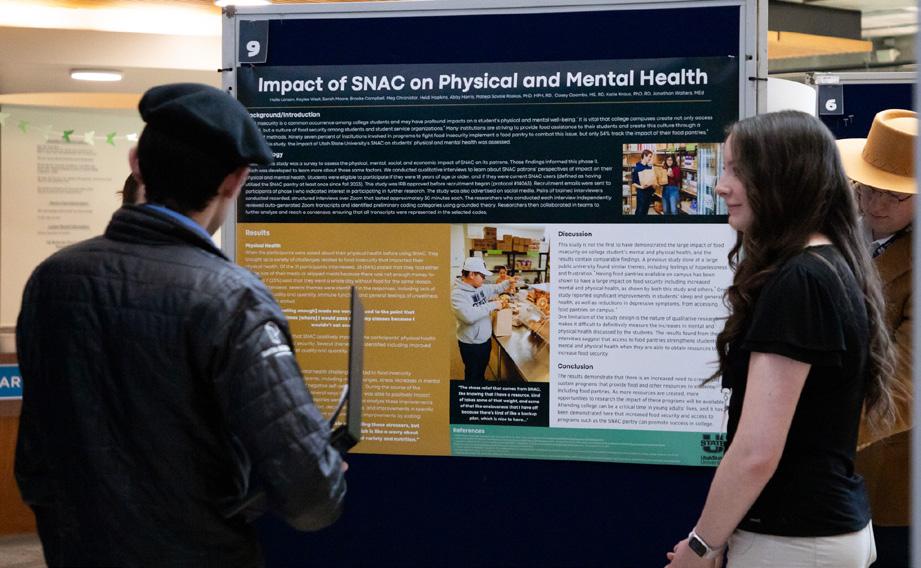
Students present posters during Research Week in the Merrill-Cazier Library on April 10, 2024.
Socks and survival: Humans vs. Zombies
By Rory McNeill STATESMAN SENIOR REPORTER
For those who have spent any time on Utah State University Logan campus during March 23-27, they certainly came across dozens of students sporting bright orange bandanas on their arms or heads.
All of these students were part of USU’s semiannual Humans vs. Zombies game, a massive game of tag with other objectives to complete along the way.
“Humans vs. Zombies is a 15-year-old USU tradition. It’s a week-long, campus-wide game of zombie infection tag. We start with just one zombie, and the infection slowly spreads throughout the week,” said Anna Tuite, president of the Humans vs. Zombies club. “Humans vs. Zombies took the United States by storm in the early 2000s. There used to be hundreds of campuses that would play, and now we are one of only a handful left.”
While at the surface level the game appears to simply be a big game of tag, there are many objectives and goals for players to accomplish throughout the week. These objectives aim to make the game more interesting and create a story for each of the week’s events.
“We have two types of play: day play, which is between classes and other things during your day on campus, and night missions. Day play can be really stressful, and so personally, I really like it. I think it’s very fun to chase people between classes or get chased by zombies between classes,” Tuite said. “Night missions are where a lot of the action happens. We gather as many people as we can at Old Main, and we give each team tasks and specific things to do that further the story that we’re telling throughout the week.”

Humans are not completely hopeless as they traverse between classes. They can “stun” the zombies by throwing balled-up socks at them, and the zombies are then required to wait 15 minutes until they can return to the game.
For some players, the goal is to stay alive the entire week, while others enjoy participating in the hunt throughout the game. For this reason, various awards are given out to players for different accomplishments on both sides of the game, such as the Star Human and Star Zombie, which are given to the best player of each team during the nightly challenges. Two of the most coveted awards include the Golden Socks and Gamemaker awards.
“Golden Socks is an award that you can achieve by going on every night mission and surviving until Friday. That also means finishing the objective and being present in the game,” said Lissette Lyautey, member of the club’s presidency. “The Gamemaker pin is where us as harbingers come together and have a discussion on who really made the game. It’s someone who jumps in feet first and is just really excited to play and adds to the experience for everyone involved, someone who truly is the heart of the game.”
At its peak, the game had more than 1,000 participants. This year’s game only about 80 participants. While the games each semester are the highlights of the year for the club, the group strives to foster an active community throughout the year.
“The game is our big thing, but we do have smaller events throughout the semester. Some of the big hitters are the Halloween party and Valentine’s events, as well as other general hangouts,” Lyautey said.
The club invites everyone to come out and join the game next fall. Regardless of major, year or background, the club is an opportunity to have some fun and nerd out about zombies with friends. For anyone interested in the club, it has an active page on MyUSU and Discord.

Rory McNeill is a sophomore from Rocklin, California studying mechanical engineering. He loves Aggie sports, skiing, golf and writing music. — rory.mcneill@usu.edu


Join us for End of Year Bash — featuring these bands live in concert — on April 10, from 6-10 p.m. in the TSC Lounges and Ballroom.





Lorraine The Moonspinners

JUGS
The Jugs

Virginia is for Lovers Charity Kiss

GAMETIME Bad Luck Brigade

Breakfast in Bed
The Last Wild Buffalo

PHOTO BY Rory McNeill
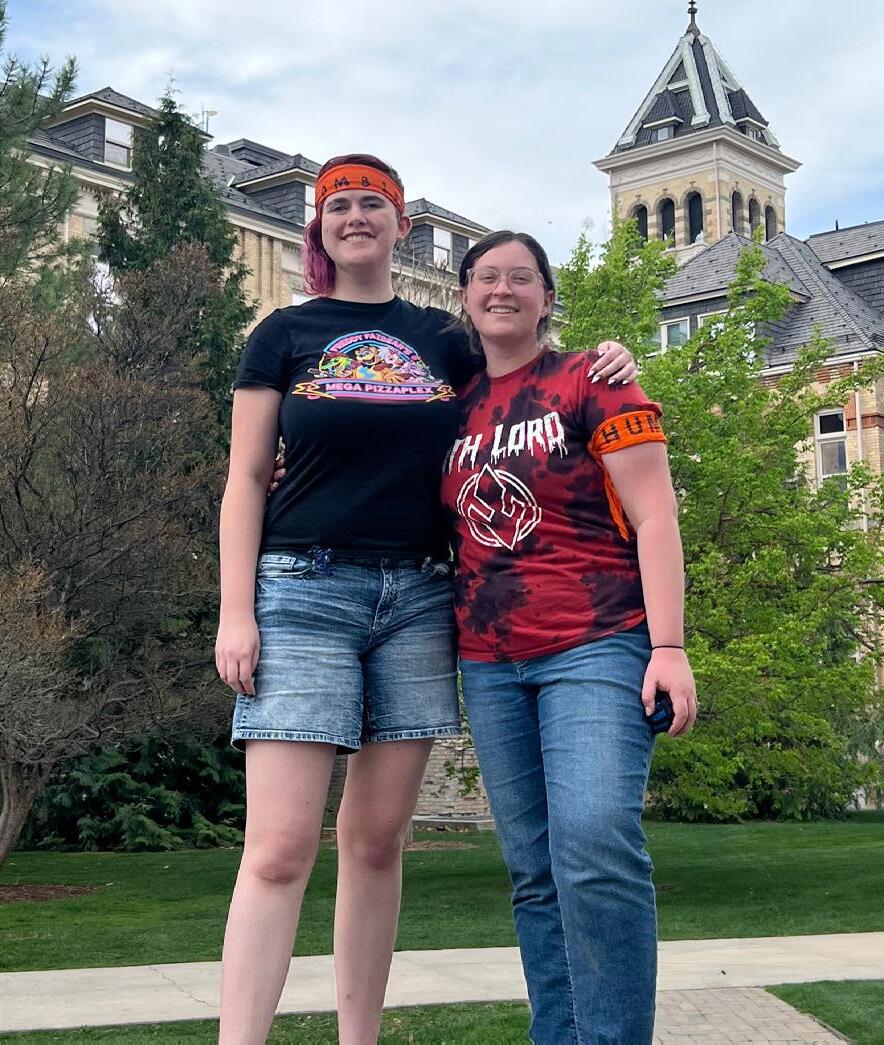
Anna Tuite and Lissette Lyautey pose with their zombie and human bandanas on March 30.
PHOTO ILLUSTRATION BY Rory McNeill
Meet the bands performing at Logan City
By Dylan Moore STATESMAN REPORTER
Aformer Logan resident is returning to her roots with a growing music project that blends Western influence with modern indie sound.
Saemore, the stage name of artist Sadie Mortensen, has spent the past year building a band, releasing music and performing across Utah. Now, she and her band are preparing for an upcoming appearance at Logan City Limits, bringing her music back to the community where she got her start.
Mortensen primarily sings and writes the band’s music, occasionally playing guitar. She said the project began in 2024 after years of wanting to move beyond cover songs and create something original. “I had a band in high school, and I just loved it so much, but we played covers, and I wanted to do originals,” Mortensen said. “I was like, ‘You know what, I’m just going to do it and put this together’ because I’ve been wanting to do it for too long now.”
Saemore currently performs with a five-piece band that includes drums, bass, guitar and pedal steel.
Mortensen said she assembled the group through connections and persistence, meeting musicians through friends and her time working at a guitar store.
“I do all the management and the booking and everything,” Mortensen said. “So, I’m kind of wearing many hats, but yeah, it’s the five of us, and it works well.”
— dylan.moore@usu.edu

Saemore Hatchback
By Jillian Peterson STATESMAN REPORTER
Hatchback, a Logan-based folk at Aggie Radio 92.3 KBLU-LP’s highlighting local artists.
The band was formed at Utah State members are currently students or “Nate [Ahlstrom] and I have been the fall of 2022, but then Alex [McCain] our first show as Hatchback here in Brady, a guitarist in the band. “Then and we played together with the complete 2025.”
The first concert with all four members opening of the Carolyn & Kem Building.
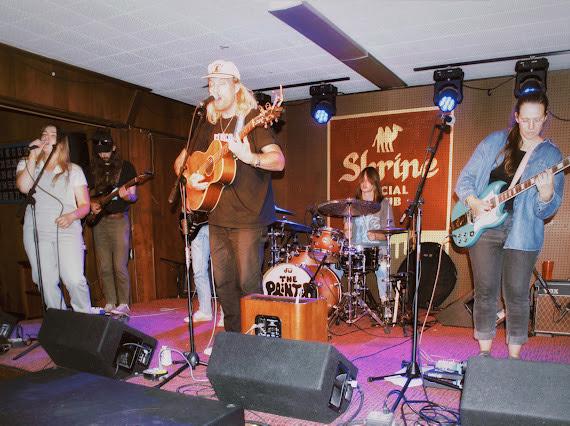
The Painted Roses
By Hazel Harris-Staples STATESMAN REPORTER
Abandwho got its start in Logan is returning this year for the annual Logan City Limits concert. The Painted Roses find their sound somewhere within alternative country and folk-psych rock and roll to blend twang, haze and rock into something uniquely their own.
The Painted Roses formed in 2018 while band member Cole Stocker was in the last year of his undergrad at Utah State.
“I had a lot of songs that I’ve been writing and really wanted to start performing. I had a friend at the time that wanted to do the same, and so we got some gigs at Jack’s Pizza and the Factory and kind of started playing a lot of covers to people that were too drunk to be listening to music, probably,” Stocker said.
The band has grown and changed in the eight years since its founding but has kept a core group of members from its early days.
Now consisting of Stocker on guitar, Abby Lee on keys and vocals, Lucas Nivison playing bass, Allie Harris singing and playing the guitar, Alex Schneider on guitar and Ari Calles playing drums, the band make music about identity and the introspection of early adulthood.
“It’s kind of like that 20-, 30-something confusion of like, ‘Who am I and where do I belong?’” Stocker said. “That’s coming out a lot more, a lot of listlessness, maybe a little bit of nostalgia, but it’s definitely a lot less heartbreak songs and a lot more about heartbreak — it’s about the philosophy behind that.”
Those emotions are reflected in the band’s sound, which blends elements of folk, country and psychedelic rock.
“There’s a lot of harmonies. We have a few rock solos here and there. There’s a lot of acoustic moments. So, it’s kind of that mixture of things,” Lee said.
Lee talked about where the band takes inspiration from, including names like Fleetwood Mac and Pink Floyd alongside newer artists like Sierra Ferrell and Adrianne Lenker.
“We kind of do incorporate a little bit of the Pink Floyd psychedelic kind of vibes in our more recent songs. I would say we’ve got a little more atmospheric,” Lee said.
“We all moved to Logan for school, for us, where folk music started for Alex McCain said he joined the band season early.
“I hurt my knee and had gotten surgery, playing instruments, and that is when we started hanging out. I told them I started playing banjo on top of their from there,” McCain said.
While Hatchback is based in Utah, band traveling through Alaska.
“We lived in Ketchikan [Alaska], and down the island the whole summer,”
McCain said this is where most of Hatchback’s first album is called “Best more than 20,000 streams on Spotify.
“It’s kind of like mountain music for Hatchback plans to release their months. During a backyard concert played a few of these new songs.
— jillian.peterson@usu.edu

The Painted Roses
Limits, a concert celebrating local music
folk band, is scheduled to perform KBLU-LP’s Logan City Limits — a show
State University, where each of the alumni.
been playing concerts together since [McCain] joined our band, and we had Logan on April 1, 2024,” said Jack “Then Chet [Germer] joined last fall, complete four members on Sept. 16,
members took place at the grand Gardner Learning & Leadership
school, and so this is kind of a home base a lot of us,” Brady said. band after an injury ended his rugby surgery, so I was out for rugby. I liked when I met Nate and Jack, and then them I knew how to play the banjo, so their guitars, and it kind of took off
Utah, they spent their first summer as a
and we played a lot of shows up and summer,” McCain said.
the debut album was written.
“Best of Me,” and the title track has Spotify. for city slickers,” McCain said. sophomore album in the next few concert in Logan on March 28, the band


Sky Olson & The Valley
By Jayke Martin STATESMAN REPORTER
When Sky Olson first started playing music, it didn’t feel like something he chose.
“My parents are both musicians,” Olson said. “My dad’s a music professor at USU [Utah State University], and my mom is a piano teacher, so music was sort of something that definitely didn’t feel like my own.”
That changed when he first picked up a guitar.
“I was able to kind of put my own stamp on it,” Olson said. Now, Olson fronts Sky Olson & The Valley, one of five local acts set to perform at Logan City Limits on April 11 at the Carol and Jim Laub Plaza. The event, hosted by Aggie Radio 92.3 KBLU-LP, highlights Logan-based artists and the city’s evolving music scene.
Olson began writing songs about five years ago and quickly found early success, winning a weekly round of the John Lennon Songwriting Contest. Most recently, his song “Sandcastles” earned the contest’s grand prize.
“That gave me kind of the motivation to keep doing it,” Olson said. “I definitely would have never expected to be doing this.”
While Olson’s music started as a solo effort, the current lineup of The Valley formed through connections within Logan’s music community.
Guitarist Chris Williams said he first met Olson as a student at Utah State University.
“I was moving into my dorm and checking out my guitar locker on campus, and he was rehearsing in one of the rooms with this little trio,” Williams said.
By Malory Rau STATESMAN REPORTER
Music resonates with me so much because you can tell things through music, like you realize things through song that you might not realize if they were told to you,” said singersongwriter Kinley Hess, also known by her stage name KIN.
Hess is a senior studying music education with a choral emphasis. She is opening this year’s Logan City Limits music festival after many performances on campus throughout her time at Utah State University, including in this year’s Aggie Voice.
“Aggie Voice was really cool but also intimidating because I was like, ‘Wow, I have this three-minute window to show them what I can do,’” Hess said. “Also, being in a competition setting, that’s a lot different than just performing for a gig where it’s like, you already have the job, you don’t have anything to prove. But it was also such a beautiful opportunity because it showed me just how great the community at Utah State is.”
Hess performs original songs as well as occasional covers of pop music. She said she finds music is a constant in her life, even when it varies in genre.
“I’m performing pop music, but my education is the classical side and more like operatic training,” Hess said. “It’s been cool to see how they’re still very different genre-wise, but they both still tell such incredible stories.”

Utah State hires Ben Jacobson as new men’s basketball head coach
By Mark Greenwood STATESMAN EDITOR
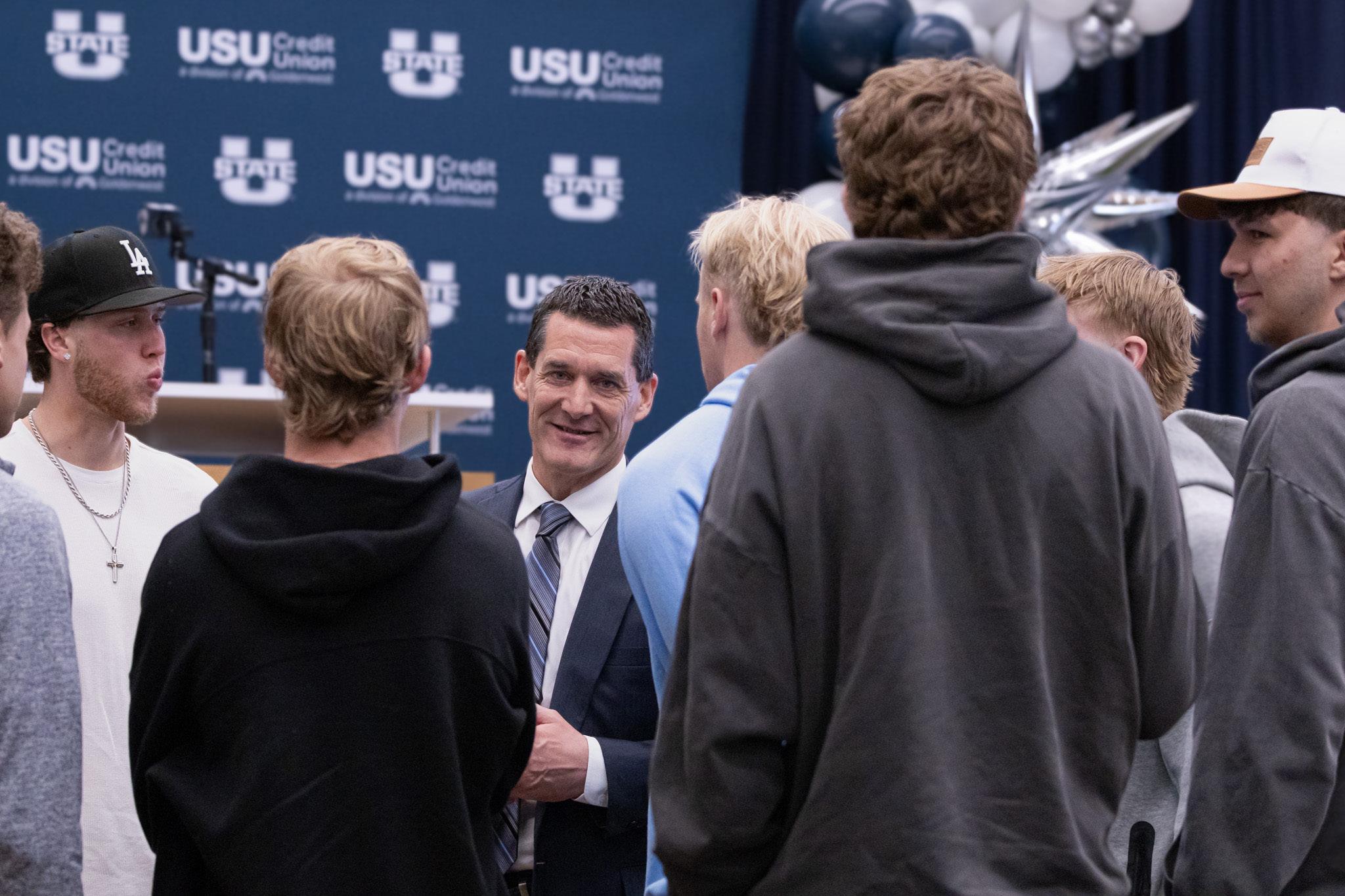
For the fifth time in the last seven years, Utah State will have a new head men’s basketball coach next season. Ben Jacobson, after being officially announced as the new head man on March 30, was introduced on the morning of March 31 in the West Stadium Center at Maverik Stadium.
Jacobson was introduced by USU President Brad L. Mortensen and Vice President and Director of Athletics Cameron Walker.
“Today is not just about a new head coach. It’s about the next chapter of Utah State basketball,” Walker said. “That next chapter will be built on the same things that have always made this program strong.”
Jacobson takes over as the 23rd head coach in Utah State Men’s Basketball history, taking over for former head coach Jerrod Calhoun, who left for the University of Cincinnati on March 24.
Jacobson comes to Logan after over 20 years as the head coach at the University of Northern Iowa, where he posted an overall record of 397-259. Jacobson led the Panthers to five NCAA tournament appearances, with a tournament record of 4-5 and one Sweet 16 appearance in 2010.
Jacobson was also named the Missouri Valley Conference Men’s Basketball Coach of the Year five times during his tenure at UNI.
“He’ll be a great ambassador for the university overall and help us continue to have winning basketball teams and to really represent the university well,” Mortensen said. “I think Ben Jacobson is very well positioned to do that for us.”
Jacobson spoke initially of the importance of relationships in basketball and how building relationships is one of the most important jobs of a coach.
“This isn’t about offense and defense, and this is about relationships and building those and having them be in a place where you’re able to accomplish special things,” Jacobson said. “We’re going to build relationships that extend far beyond hoops.”
Jacobson also spoke of the importance of the players, speaking directly to those who were in attendance.
“Programs only thrive with leadership by the players and player-led programs. This is your program. I’m here to help you,” Jacobson said. “I cannot wait to get to this afternoon and the reason being that we get to get together. We get to get together and sit down and start going on this thing.”
Players in attendance included Mason Falslev, Karson Templin, Jordy Barnes, Zach Keller, Luke Kearney, Brayden Boe and Tucker Anderson.
As many of those players weigh potential future options, including whether or not to stay at Utah State, Jacobson hopes to keep them around as long as possible.
“The most important thing with our basketball program is these players feeling great about continuing to be at Utah State,” Jacobson said. “We’ll get that started this afternoon.”
Jacobson has a history of keeping players in his program, as 11 players from his 2024-25 team stuck around for his 2025-26 NCAA tournament team.
“That has been our formula. That has been the way I approach things,” Jacobson said. “I hope and I think they can get a little bit of a feel for how I’m wired. Finding out what it is that they want and what it is that I can do to help them — that’s where it’ll start.”

Utah State’s most recent NCAA tournament trip ended in the Round of 32 for the second time in the last three years. While the Aggies have made the Big Dance in each of the last four years, a program record, they’re still eyeing that elusive third round.
“That first weekend in the NCAA tournament — that’s special. But there’s a next weekend, and there’s a next weekend after that,” Jacobson said. “Fortunate to have been there as a head coach and want to do that together. There’s a ton of excitement in that.”
Calhoun came to Utah State without an NCAA tournament appearance as a head coach. Jacobson comes with extensive experience and has advanced to that second weekend, which is what USU has identified as the next step for the program.
Utah State’s previous new head coaching hires are typically younger, newer head coaches that are still on their way up in their careers. That is part of the reason they haven’t had a coach longer than three consecutive years since Stew Morrill.
Jacobson breaks that pattern as a 55-year-old who’s been a head coach for over two decades, doing so at just one institution.
“He’s had success, and then he’s figured out how to do it again and figured out how to do it again after some years that weren’t as successful,” Mortensen said. “I think that appealed to us as much as anything.”
“When you look at those teams that do it, they’ve done it through sustained success, and that’s really hard when you’re hitting the reboot button every two to three years and sometimes after one year,” Walker said. “As we try and elevate this program, getting an experienced leader — he’s very accomplished, has done incredible things, has been to where we want to go — but to be able to have some trust that he’s going to sustain that for a while was important as part of this decision.”

Mark Greenwood is a senior at USU studying finance. He is an avid Los Angeles Dodgers fan and loves playing tennis and skiing.
PHOTOS BY Sydnie Fonoti
Newly appointed head coach Ben Jacobson speaks to members of the men’s basketball team at West Stadium Center on March 31.
Ben Jacobson, center, poses with Cameron Walker, left, and Brad L. Mortensen at the West Stadium Center.


USU Athletics partners with Homecrowd app
By Jillian Peterson STATESMAN REPORTER
With the coming transition into the Pac-12 Conference, Utah State University Athletics has incorporated a new fundraising strategy: partnering with an app called Homecrowd. Homecrowd allows fans to link their debit or credit card to the app and pick which team they would like to support. As the user makes purchases with companies that have partnered with the app, a small percentage of the money spent will go to their team.
According to Eric Mika, one of the app’s founders, these partnerships include gas stations, grocery stores, online shopping and restaurants.
“The modern fan is feeling like they can’t be connected to their team unless they spend tons of money because nowadays, it feels like there is an immense pressure from schools to raise money,” Mika said.
Mika said this app can help bridge that gap.
“It doesn’t cost the consumer anything. It doesn’t cost the athletic department anything, but as long as you use that card to make purchases, an incremental revenue comes back to athletics,” said Carter Young, deputy athletics director and chief revenue officer for Utah State Athletics.
Young said the app is still in its early stages, but he is hopeful it will be fully launched in coming months.
“If the app works really well, we are hopeful it could generate $50,000 to $100,000 a year, but it could take us a few years to get to that point,” Young said.
During the initial soft-launch, Mika said one user spent about $70 at Old Navy and Gap.
“I’m sure they were buying clothes for their kids or something, but it made Utah State two bucks,” Mika said.
While $2 may not seem like a lot, Mika said it all adds up.
“You consider how many Utah State fans there are, and $2 from a couple transactions that happen all the time with a fan base where there’s hundreds of thousands of fans, community members and alumni, then $2 from something like that becomes really, really powerful,” Mika said.
Young said fans will also benefit from using the app.
“As you make purchases, you will receive points on the site,” Young said. “The more points you have, the more giveaway items you can win.”
On the app, the giveaway items listed include gameday apparel, sideline tickets and access to watch a practice.
For one giveaway, Mika said four people won front row tickets to a Utah Jazz game with the opportunity to meet Sam Merrill after the game.
The app was originally promoted on the jumbotron in the Dee Glen Smith Spectrum during the USU Men’s Basketball game against the University of New Mexico.
“If you signed up, you had the chance to win a trip to the Mountain West tournament,” Young said.
According to Young, four people won tickets, airfare and hotel accommodations for the tournament.
During that initial pushout, Young said Utah State received 1,000 app sign-ups. Utah State was the first university to partner with Homecrowd. However, Mika said other universities will soon be announced, including two Big 12, a Big East and a Mountain West school.
In addition to this partnership, Utah State Athletics is using other fundraising campaigns.
“The ‘Show Me’ initiative came out of a couple of months ago,” Young said. “It’s really an overall modernization of athletics in general, but there is a big fundraising component to it.”
The athletics department has also been focusing on increasing membership in the Big Blue Club, which requires a $50 donation a year.


is a sophomore studying communication and media. She is a big fan of concerts, snowboarding and the Taco Bell drive-thru.
Jillian Peterson
USHE board trims Utah State athletics fee increase, approves smaller one-year bump
By Carson Frost STATESMAN SENIOR REPORTER
Utah State University’s push for a significant increase in student athletics fees was scaled back on March 27 as the Utah Board of Higher Education approved a smaller, one-year increase of about $9.91 after raising concerns about cost, equity and the longterm sustainability of college athletics funding.
University leaders argued the increase was critical to support Utah State’s move to the Pac-12 in July and to preserve free student access to games. But after nearly an hour of discussion, the board rejected a much larger proposal of $29.72 as approved by the USU Student Fee Board, and instead adopted the commissioner’s more conservative recommendation.
The decision highlights a growing tension at Utah State: how to fund a more competitive athletics program in a power conference environment without increasing the financial burden on students or relying on a model state leaders openly questioned as “unsustainable.”
Utah State President Brad L. Mortensen, USUSA President Brandon Sorensen and Board of Trustees Chair Tessa White presented the proposal, defending a broader tuition and fee package for the 2026-27 academic year. While most of the proposal moved forward without issue, athletics quickly became the focal point.
Utah System of Higher Education Deputy Commissioner Nate Talley outlined the original request, which included a $59.44 increase in athletics fees — a roughly
25.78% jump — alongside a $20.92 increase for USU Campus Recreation, both the total increase over two semesters.
Board members instead approved a significantly smaller increase, ultimately landing at about $9.91, while also scaling back the campus recreation request to align more closely with other institutions.
Throughout the discussion, Utah State leaders emphasized the athletics increase was intended as a temporary measure, a one-year bridge as the university builds out new revenue streams tied to its move into the Pac-12.
“We know that we need to do a pretty big transformation with athletics,” White said. “We’re trying to keep the plane flying while we rebuild it. And so, a one-year, one-time fee increase would give us the time that we need to do that.”
Mortensen echoed that approach, pointing to efforts to expand revenue through ticketing, sponsorships, concerts and other uses of athletic facilities. He acknowledged Utah State currently relies heavily on institutional support — roughly $22 million — to fund athletics and said the university is working to reduce that reliance over time.
“That’s been the model of how USU has funded athletics for a long time,” Mortensen said. “That’s one of the things that we’re charging our athletic director to look at. It might not be like a direct state subsidy ... but it is university funds that could be used for other things.”
That admission became a focal point for the board.
Members questioned whether it was appropriate to ask students to contribute more when such a large portion of the athletics budget is already supported by university funds. Board member Steve Neeleman described the current system bluntly.
“I’ve been fairly vocal about my concern that the current athletic model is unsustainable,” Neeleman said. “All of this is just band-aids on a gushing wound. I wish that we could come up with a better solution long-term to make these programs sustainable financially.”
That concern extended beyond Utah State. Board members repeatedly referenced broader state and national trends, including conference realignment and rising costs, as evidence that the current college athletics model may
not be viable long term. Along with Utah State’s move to the Pac-12, Southern Utah University and Utah Tech University are in the process of joining the Big Sky, while Utah Valley University is set to move to the Big West.
The idea that this was a “one-time” increase also drew skepticism. Board members pushed back on whether increases like this ever truly disappear, warning that similar requests are likely to return.
“I don’t think the NCAA has done their job honestly providing insight,” Neeleman said. “It does sound like the Utah State team has done some good due diligence with the survey and speaking to what is important to the students up there. But I’m just telling you, we’re going to be back here every single year having the same discussion unless we fix this model.” drew nearly 5,000 responses in less than 24 hours, with about 95% supporting the athletics fee increase to preserve free student ticketing.



Carson Frost is a transfer student from Denver studying journalism. He originally hails from Los Angeles, and he is a passionate fan of the Lakers and Dodgers.
— carson.frost@usu.edu

PHOTO BY Jack Burton
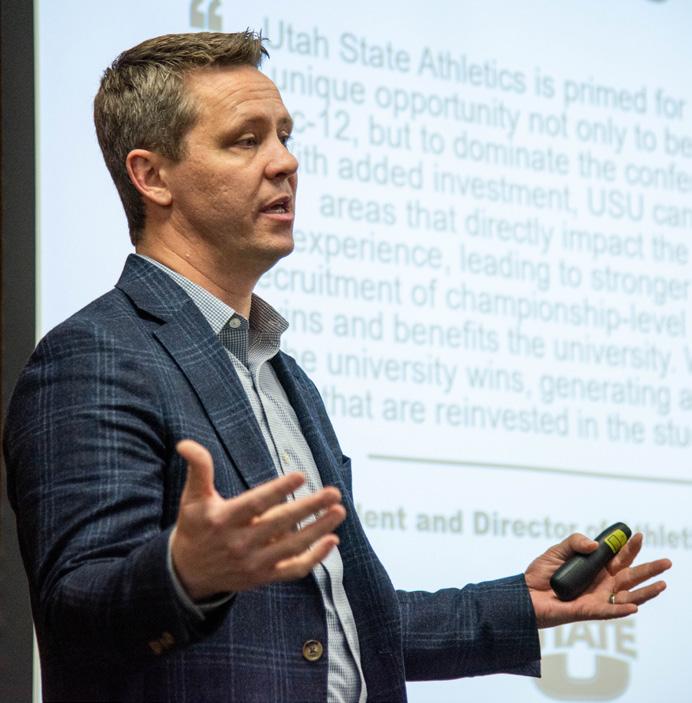
USU Athletics Director Cameron Walker proposes an increase to the athletics student fee to the Student Fee Board in the TSC Senate Chambers on Jan. 21.

Catch up with USU Softball catcher Grace Matej
By Grace Colvin STATESMAN REPORTER
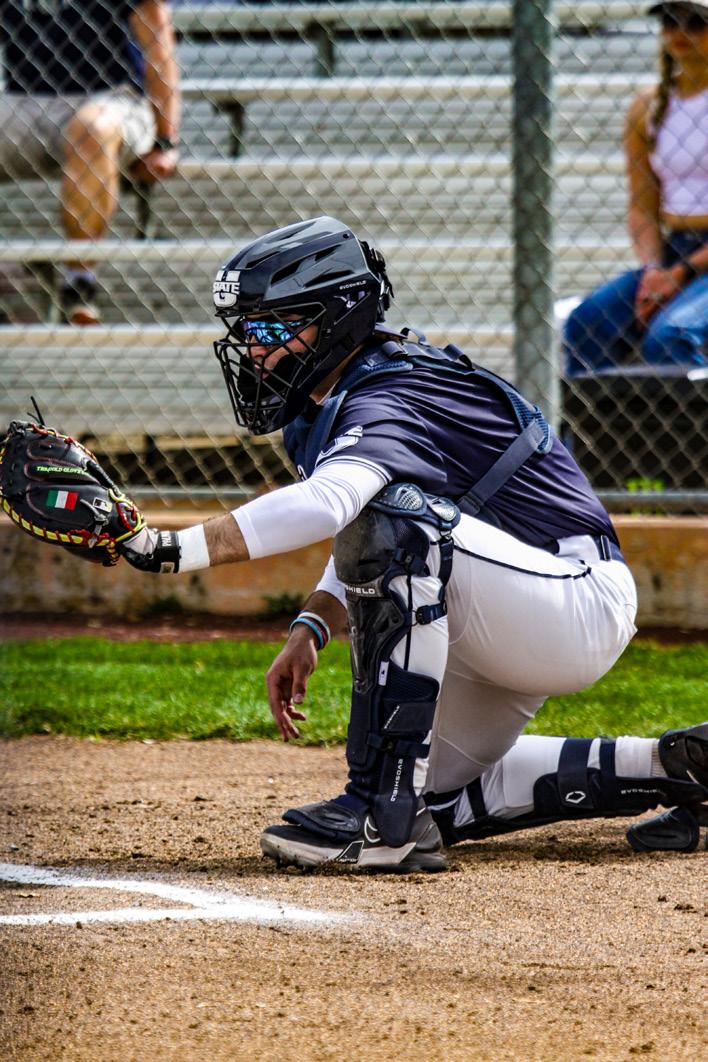
When student-athlete Grace Matej started softball in elementary school, it was just a fun way to hang out with friends. Now, as she enters her final season on the Utah State University Softball team, it’s become much, much more.
A senior at USU, Matej grew up in Sacramento, where she graduated from Vista del Lago High School before enrolling at USU on a softball scholarship. She has competed on the team since her freshman year and is currently playing as catcher/ designated player for the 2026 season.
She held a 2024 batting average of .405, with 36 runs and 10 home runs in 2025. She also holds the titles of Mountain West Scholar-Athlete for 2023, 2024 and 2025; Academic All-Mountain West for 2023, 2024 and 2025; and Mountain West Player of the Week in 2025.
Matej began her softball career at six years old, joining a recreational league in her hometown because her best friend was also playing.
“I wanted to hang out with her, and then it just kind of took off from there,” Matej said in an interview with The Utah Statesman.
The sport continued to be a large part of her life as she grew up, and although she also participated in other sports, such as her high school track team, softball has always been special to her because of the collaborative nature and sense of camaraderie with her teammates.
“I have 23 other girls that are my best friends,” Matej said. “With track, it’s kind of your own individual sport, and you have teammates, but it’s not really the same. With softball, even if you’re having a good day and the rest of your team is having a bad day, it doesn’t matter — you have to be a team player, and I really love that. I love my teammates.”
As a student-athlete, Matej’s daily routine is a mix of classes, practices and traveling for games. A typical day in the life on the team starts bright and early at 6 a.m. with an hour of team weight training exercises. Next, she heads to her morning classes. Matej currently majors in international studies, according to her roster, and is minoring in anticipatory intelligence.
Once classes are over, it’s time for practice, where Matej typically spends about three hours working with the team to prepare for games. Sprinkled throughout this schedule
are homework, games and traveling to outof-state events.
“It’s pretty busy, but it’s worth it,” Matej said.
A busy schedule isn’t the only challenge student-athletes face. According to Matej, one of the hardest parts of playing on the team is navigating the mental toll of competition.
“It’s definitely hard to always be in a ‘100% go’ mindset,” Matej said. “I think with softball, you fail so much, and so not overthinking and staying out of your head is a really big part of it, and relying on your teammates to pick you up during those times is a big, big thing.”
However, despite all the challenges, Matej believes the good moments far outweigh the bad. According to Matej, some recent highlights of her time on the field include the team’s walk-off in their March 2026 game against Nevada, as well as their participation in the Mountain West Conference, which was a first for the team.


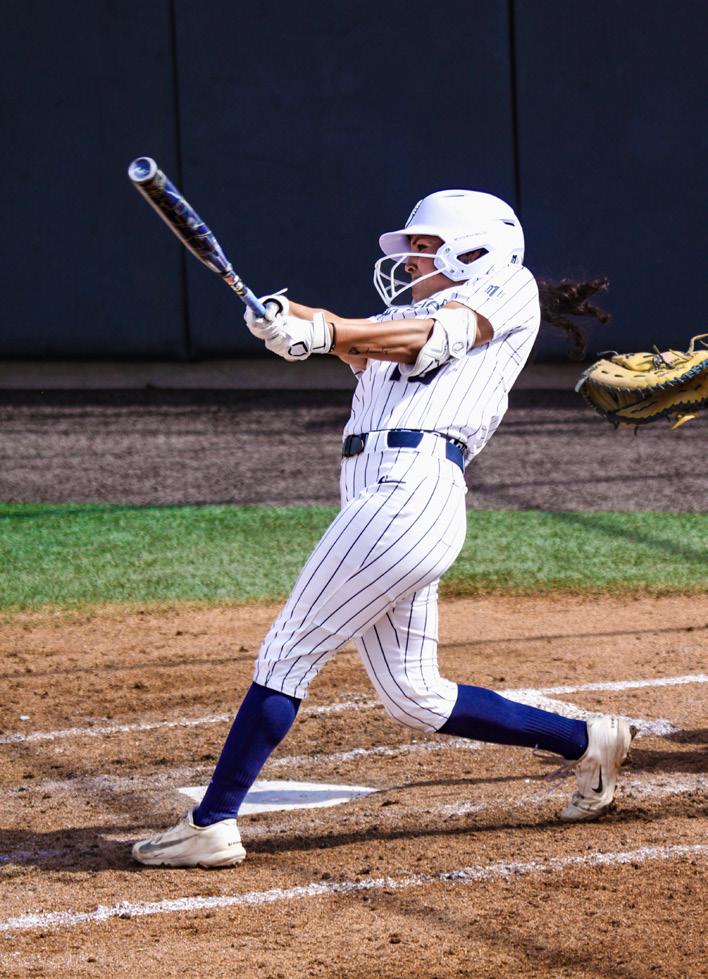
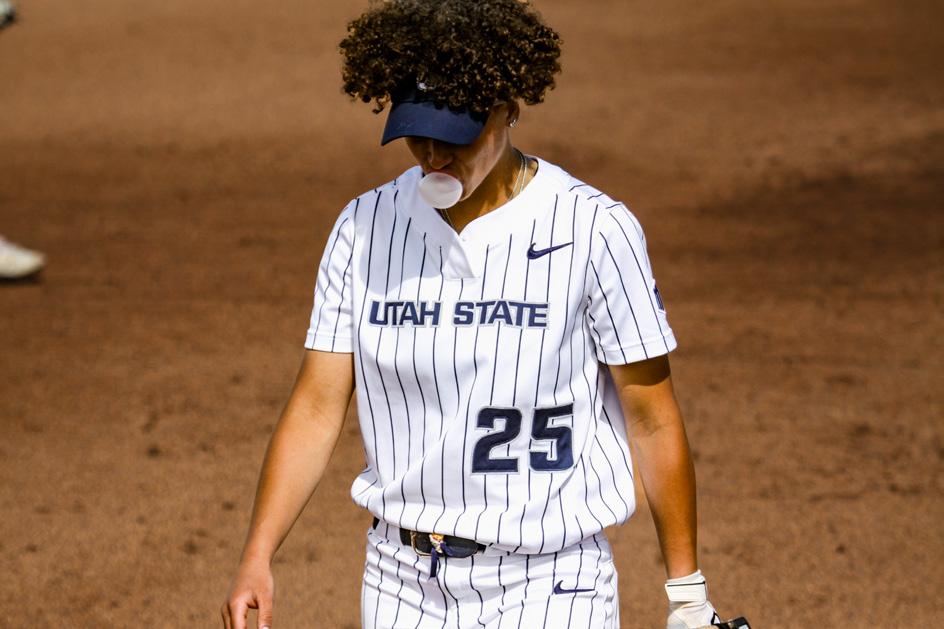
PHOTO BY Hadley Sintay
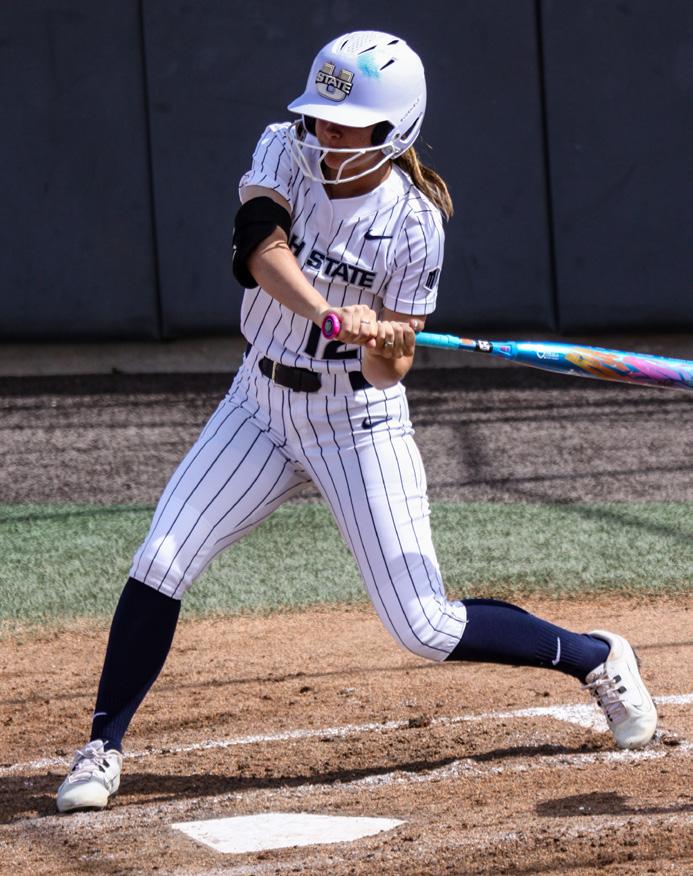
Grace Matej swings during a game versus Nevada on March 21 at the LaRee & LeGrand Johnson Field.
Grace Colvin is a sophomore in the theater education program at USU.





Hadley Sintay is a sophomore studying journalism. When she’s not taking pictures, she enjoys writing music, traveling and cheering on USU Athletics.