
Construction continues to impact roadways throughout Cache Valley
By Dylan Moore STATESMAN REPORTER
Drivers across Cache Valley are navigating a wave of construction projects this spring with major work underway in Sardine Canyon, along Main Street and on state Route 30. While the projects are expected to improve infrastructure and safety, they are already creating noticeable delays for commuters.
The most immediate impact is in the canyon near Mantua, where traffic has been reduced to one lane in each direction. According to Utah Department of Transportation communications manager Mitch Shaw, the work was not planned.
“What’s going on right now in Sardine Canyon is it’s essentially an emergency repair work,” Shaw said.
The issue stems from a failed culvert beneath U.S. Highway 89/91. A culvert is a structure or pipe that allows water to flow underneath a roadway. The damage required urgent attention to avoid more serious consequences, such as the road being washed away.
“The risk you run not getting in there and repairing something like that is that you could basically have a pretty bad failure of the road,” Shaw said.
Construction began in late March and is expected to wrap up by the end of April if conditions allow.
For students like Genevieve Cannon, who explained that she drives through the canyon to go home to Ogden two to four times a month, the delays are already noticeable.
She mentioned the construction has slowed traffic but not always because of the work itself.
“It’s more the way that people drive through it,” Cannon said.
She described congestion caused by drivers staying in the left lane too long and bottlenecks forming when traffic merges.
“People drive in the left lane for all up until the construction, and so you can’t pass them because then you get a blockade,” Cannon said.
In some cases, she said confusion around lane changes has created safety concerns.
“My little sister almost got in a wreck because somebody was driving on the wrong side of the barrels,” Cannon said.
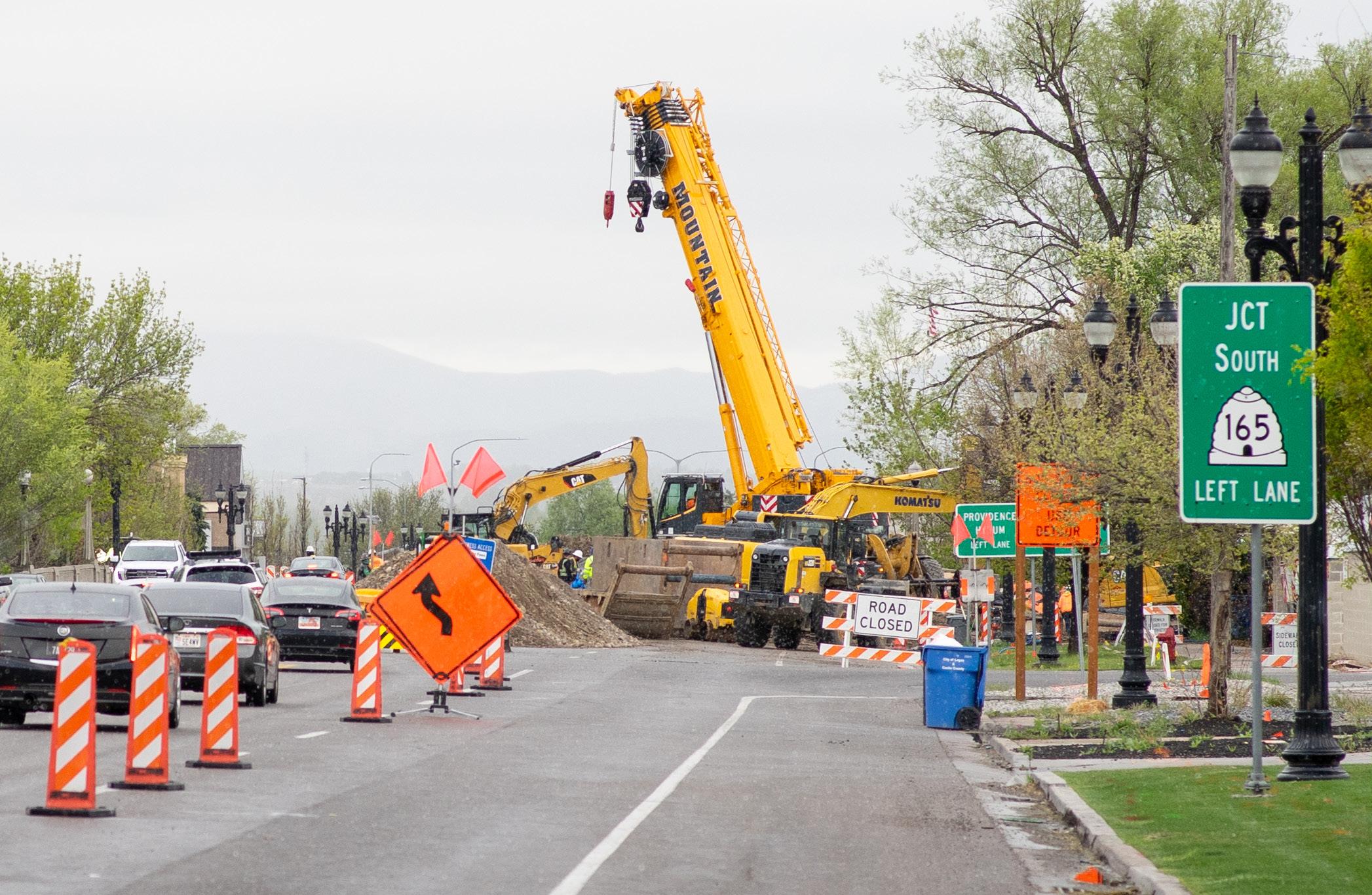
Closer to campus, construction near 600 S. Main St. is also affecting traffic. The project will build a pedestrian undercrossing to connect the Logan River Trail without requiring pedestrians to cross the busy roadway.
The project has reduced traffic to one lane in each direction between 450 South and 700 South.
“We do expect some delays there, especially during peak commute hours,” Shaw said.
The undercrossing project is valued at approximately $10.4 million and has been a long-requested addition for the city aimed at improving pedestrian safety and traffic flow.
Cannon said while the construction can be inconvenient, it has been manageable compared to other areas.
“The construction there isn’t that bad,” Cannon said.
A larger, long-term project is underway on state Route 30, also known as 200 North, where crews are widening the roadway and upgrading infrastructure from state
Route 23 to 1000 West. The project began preparation work in 2023 and is expected to be completed by fall 2026. The work includes road widening, bridge and utility improvements and new pedestrian infrastructure.
“We’re essentially improving that road to help improve safety and just to accommodate the growth that’s happening,” Shaw said.
The project carries a price tag of about $90 million and is funded by UDOT.
While the combination of projects has created frustration for some drivers, transportation officials say the long-term benefits will outweigh the short-term inconvenience.
“It’s kind of a temporary pain for a longer-term gain,” Shaw said.
For Cannon, the experience has already changed how she plans her trips.
“I oftentimes will put it into maps just to get a better idea of my ETA,” Cannon said.

Dylan Moore is a junior majoring in political science and minoring in anticipatory intelligence and Russian. He always loves going on outdoor adventures and cooking.
— dylan.moore@usu.edu
PHOTOS BY Dane Johnson
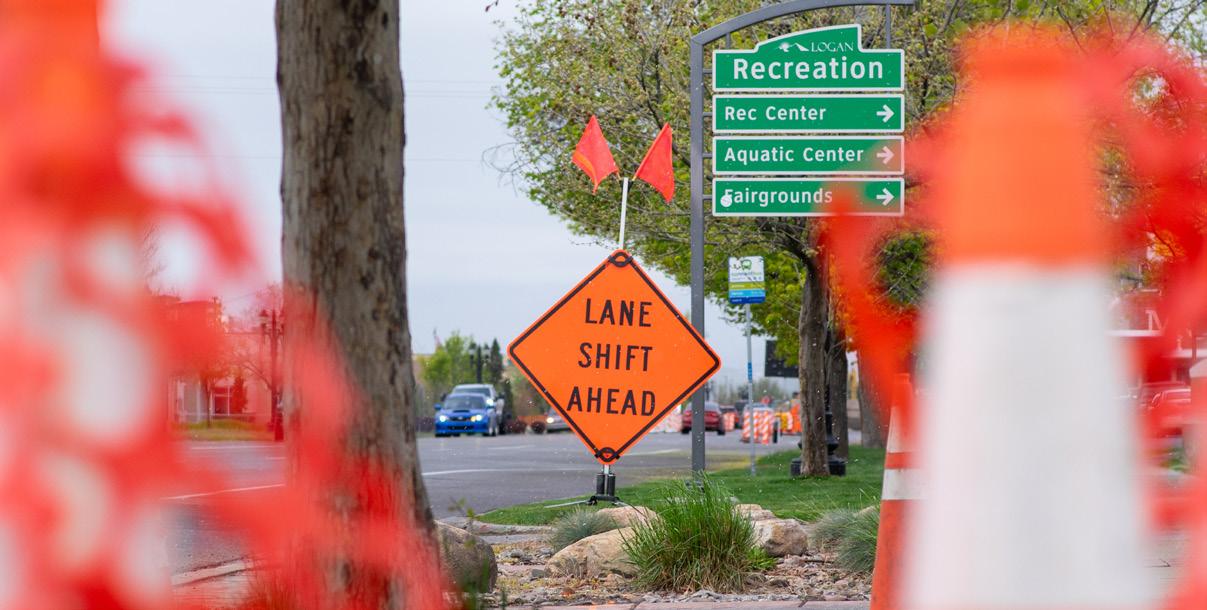
A sign signaling a lane shift due to construction is seen on the side of Main Street on April 16.
Future Engineers build combat bots
By Mia Nielsen STATESMAN REPORTER
Mr. Chomp,” “The Darkest Fire,” “a volcano named Pom-pain” and other robots designed by K-12 students went head-to-head at Utah State University’s Future Engineers Battle Bot Design Competition.
According to Dallin Treasure-Areno, vice president for the combat robotics subgroup of the USU Robotics Club, representatives from the club visited K-12 classes across Cache Valley, inviting students to design their own battle bot. Of the designs, 14 were chosen and converted into real combat robots.
“My idea was that it would be fun to take a crayon drawing of the fire breathing dragon, unicorn thing, and to make a robot out of it,” Treasure-Areno said.
According to Treasure-Areno, the goal was to get kids excited about engineering.
“We just want to show them that any of them can be an engineer, and it’s really achievable. It’s not just doing math — it’s solving problems, and you can have a lot of fun with it too,” Treasure-Areno said.
London Little is a local seventh grade student whose design was recreated by a member of combat robotics.
“We had watched a couple episodes of ‘BattleBots,’ and I knew what it was, and I thought it was super cool that I could design my own bot. I was really excited when I got in,” London said.
Her robot “Sweet and Sour” included pink bows that also functioned as spikes on the wheels and an internal Bluetooth speaker that played Taylor Swift songs during the fights.
“I wanted it to be super girly,” London said.
Other designs included robots inspired by dinosaurs, leprechauns and dancers.
Treasure-Areno brought second grader Ethan Mueller’s design “Mr. Cheese” to life.
Ethan based his design, a spinning blade that looks like a cheese slice, on a previous “BattleBots” first-place winner.
“I like to create stuff just for fun,” Ethan said. “I took that design, and I repeated it into a different subject.”
Treasure-Areno said the kids weren’t allowed to see their robots until the day of the competition, and he was excited to see their reactions.
Ethan Jones is a member of the club who helped bring a robot called “Pot of Gold” to life.
“I think it’s just so fun — the theme of the robot and just sticking with that and trying to make it able to fight,” Jones said.
According to Treasure-Areno, the team competes in the same sport as players from Amazon’s “BattleBots” TV show but on a smaller scale — with 1- to 3-pound robots instead of 250-pound bots.
The robots fight in an 64-square-foot arena surrounded by nearly bullet-proof glass for three minutes. Bots are classified by weight, and designers have to follow certain rules, like weapons have to be completely 3D printed. Bots are “knocked-out” if they can no longer move. Otherwise, judges determined the winner based on damage, control and aggression.
“You couldn’t just have a bot that ping pong balls around the arena randomly, but you also can’t be avoiding conflict,” Treasure-Areno said. “You’ve got to put on a good show for the audience too with aggression and obviously damaging your opponent so even if it’s not a knockout, enough points can go towards you to get a win.”
The 14 bots fought in a double elimination tournament, and both the college and K-12 student designers won prizes based on wins in the arena and design.
According to Treasure-Areno, engineering can be a competitive field. This sort of hands-on experience gives engineers an edge.
“It can separate you from somebody with straight A’s if you’ve actually found out the hard way when it comes to making things,” Treasure-Areno said.
According to Treasure-Areno, members of the club get hands-on experience with material analysis, designing for experience, solid works, electronics and mechanics.
He said people in the industry are looking to hire engineers that have the technical intuition that only comes from trying, failing and trying again.
“My main interest is medical devices, but bioengineering is just so broad that I wanted to make sure I got some experience with a little bit more of a mechanical emphasis,” Treasure-Areno said.
USU combat robotics meets every Tuesday at 5 p.m. in the Richard and Moonyeen Anderson Engineering Building room 009.
“Anybody can do this. I’ve seen tournaments where there’s people that are ranked third nationwide, and they lose a fight to an eight-year-old,” Treasure-Areno said.
Mia Nielsen is a sophomore studying plant science and journalism. When she’s not writing, she enjoys live music, driving up Logan Canyon and daydreaming about moving to Spain.
Essence Barnes
Bailey Daniels Carson Frost
Emma Barker
Alyssa Caywood
Grace Colvin
Jayke Martin
Rory McNeill
Dylan Moore Mia Nielsen
Jillian Peterson
Emma Shelite
Kenadie Ferraro Senior
Fonoti
Gottling
Sintay

PHOTO BY Elise Gottling
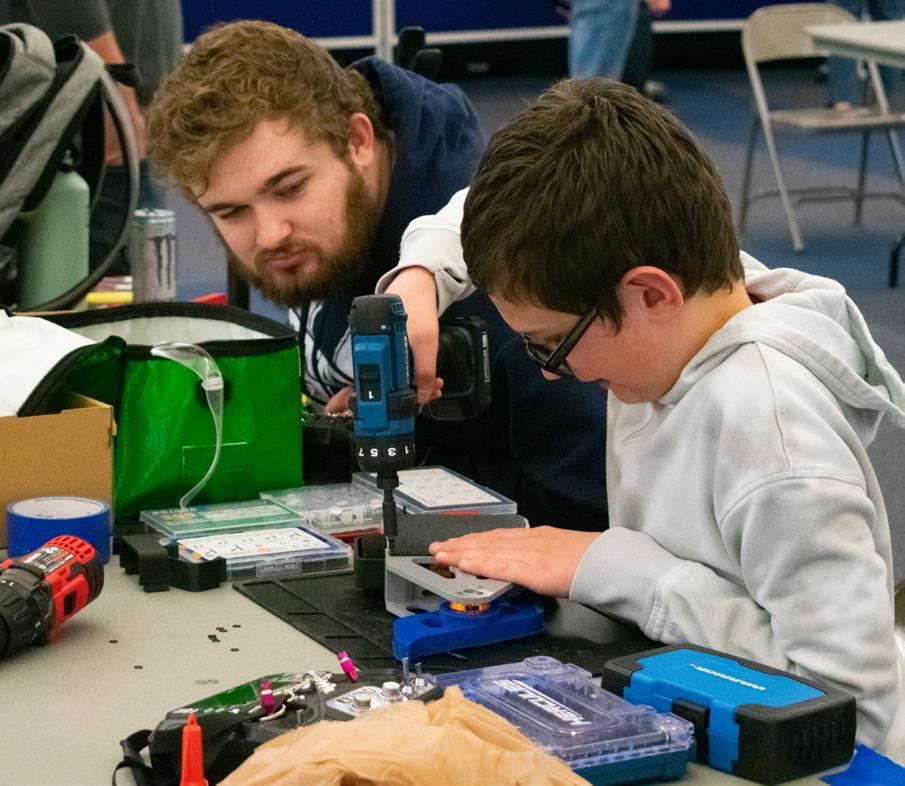
Regan Batchelor and Truman Taylor work on a battle bot during the Future Engineers Battle Bot Design Competition in the TSC on April 11.
News Release: Committee co-chairs post new statement on voting in USUSA Elections
The Utah State University Student Association released a statement on April 15 regarding the most recent USUSA Elections season. The statement was released via Instagram stories and addressed both proxy voting and concurrent enrollment students. The statement was written by the current and incoming elections co-chairs.
The statement noted that in this year’s elections, 113 concurrent enrollment students voted. These students were able to vote because they are recognized as USUSA members due to their “active registrations as reflected in Banner.”
According to the statement, “Students who wish to see a change in the definition of USUSA membership can work with their elected officers to pursue that change.”
It also acknowledged proxy voting, which is when someone else uses a student’s device and casts their vote for them. This practice is forbidden according to the USUSA bylaws, but many witnesses and firsthand testimonies admit it is still a common practice during elections.
“Language will be added to clarify what proxy voting is, including the touching of devices of others by a candidate or team member,” the statement read. “We also recognize that it can be hard to provide evidence and prove that this occurred and going forward, we will continue working on our processes with the goal of making it easier to address and review potential bylaw violations.”
The Utah Statesman encourages student feedback on all university affairs, including USUSA Elections. USUSA provided a survey following the release of this statement, which can be found at usu.co1.qualtrics.com/ jfe/form/SV_25nSCLfE5K5zaYK. Students are also encouraged to utilize the MyVoice program, which can be accessed through the MyUSU app and website, to be catalysts for change on campus.
“We appreciate the students who have given input during this process,” the statement read. “We are working to make sure that future elections are as transparent, fair, and accountable as possible.”
— news@usustatesman.com

March 31
A concerned citizen reported a dog loose in the area of the Utah Water Research Laboratory. It was described to be black and white, possibly a border collie. USUPD officers drove the area around the lab and did not locate a dog matching the description in the area.
April 1
K-9 Explosive Detection Dog Wolverine performed a sweep for the scheduled Turning Point USA event at the Quad.
A note from USU Police
Thefts increase during the spring semester as more people are riding bikes. High-value bikes and e-bikes are often targeted for theft. To better prevent bike theft use a U-lock rather than a cable lock, as cable locks are easily cut. Ensure the frame and wheels are locked to a secure, fixed object. Register and take a photo of the bike and keep a record of the serial number. An unsecured bike can be stolen in seconds. Take the time, every time you leave your bike, to secure it.
PHOTO BY Dane Johnson
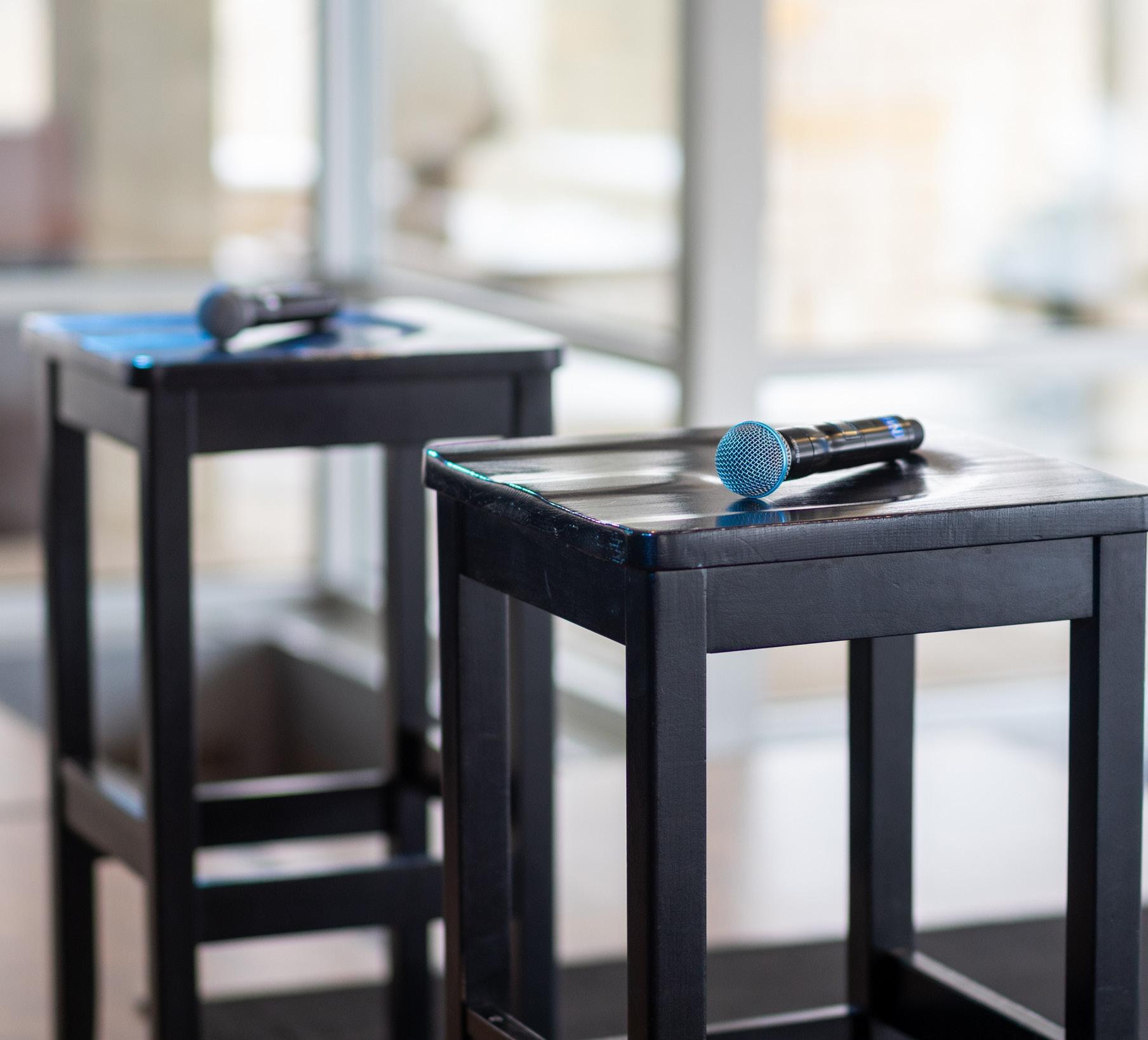
Microphones and stools sit for the Logan Executive Council candidates in the TSC Hub on March 4, 2024.
Earth Week celebration returns to campus
By Essence Barnes STATESMAN SENIOR REPORTER
Utah State University honored Earth Day with a 10-day celebration that invited students to get outside, give back and reconnect with the environment.
From April 13–23, the annual series brought together the USU Christensen Office of Service & Sustainability and other campus organizations to host a mix of returning favorites and new events, all centered on community involvement and environmental awareness. Marcy Smith, the student sustainability engagement lead for COSAS, said it is her job to put together the activities.
“We just generally tried to plan a variety of types of events,” Smith said. “Some of them are more like making a craft, some of them are more service and some of them are more like, just be outside and look at nature.”
Some events held last year, like the “Bike to Breakfast” ride-along and the “Beeswax Wraps” craft day, were held again, but this year, Smith and the Earth Week committee wanted to put a greater emphasis on collaboration with the campus community.
“I know there’s a lot of great clubs and organizations already on campus that are already doing really great sustainability, nature-related events,” Smith said. “We were like, ‘Okay, great. You guys plan your event, and then we’ll incorporate it into our Earth Week marketing and spread the word.’”
COSAS collaborated with birdwatchers, the USU Yoga Club and the USU Student Organization for Society and Natural Resources, or SOSNR, to host some new
events, like the “Birdwatching Walk,” “Earth Yoga” and a “Tribute to the Earth Concert.”
SOSNR’s “Tribute to the Earth Concert” had live music, food trucks and student art vendors. The club’s founders echoed the sentiment that community was a main focus of the event.
“We can kind of get stuck focused on, like, individual action, and we can’t do these events by ourselves,” said SOSNR co-founder Marie Wood. “I think that it creates positivity and hope when we see that other people care about something we care about.”
SOSNR was renewed last semester by Wood and Mya Karbasi. The club helps students connect with and get involved in climate activism and environmental policy.
“There’s a lot of inherent desire in a lot of people our age to help out with environmental stuff, but they don’t necessarily know how to do that,” Wood said. “We wanted to have a club that helped connect [students] to those opportunities.”
For Karbasi, events put on by SOSNR and COSAS can act as gateways to help get students more involved in their interests.
“You can go out and take action on things that you feel strongly about, and all you need is a little push from someone,” Karbasi said. “It can help bring people who wouldn’t otherwise come to these events and might realize that they actually are interested.”
Smith said introducing students to new ways of thinking was another important consideration when planning the events.
“They give students ideas about how to be creative or how to be more sustainable when it comes to how they interact with the environment,” Smith said.
To do this, they held events like the “Sew & Swap,” where students learned to upcycle old clothes, and the “Beeswax Wraps” event, where students learned how to make reusable alternatives to plastic wrap or Ziploc bags.
“A lot of our events are not necessarily trying to just teach you a lesson,” Smith said. “It’s more about having a space where students can come and meet other people who are also passionate about environmental issues.”
Event attendees shared similar thoughts.
“Sometimes, you feel isolated in your passion for the environment, I guess I would say,” said Anna Hansen, a junior studying forest ecology. “I think it’s awesome to meet a bunch of like-minded people.”
Overall, Smith said the week was intended to celebrate the planet and teach each other how to be better members of it.
“I think just generally, it is important to talk about sustainability and protecting the environment and just having discourse about that,” Smith said. “I think being more connected with and more aware of the people you’re around and the places you’re in can help you to be more sustainable and just have a better life overall.”
Whether through crafting, gardening or birdwatching, the week offered students a chance to engage with sustainability in ways that felt personal and approachable.
“I feel like the best way to promote hope is by planting that seed in someone and being like, ‘It’s literally in you,’” Karbasi said. “‘It’s just what you want to do with it.’”
Essence Barnes is a third-year student majoring in journalism who enjoys reading, writing and storytelling.
PHOTOS BY Sydnie Fonoti
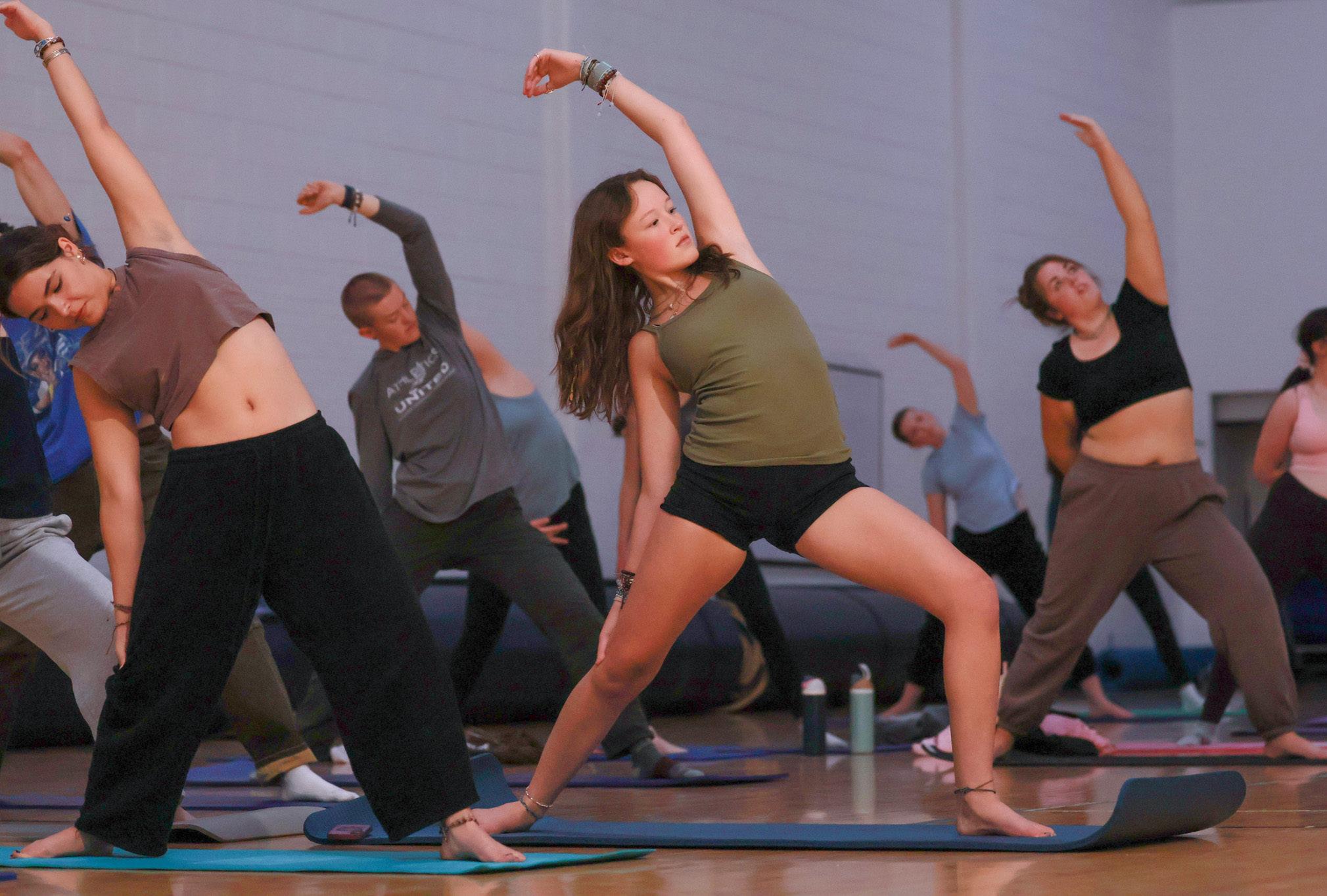
Students stretch at “Earth Yoga” at the HPER on April 15.
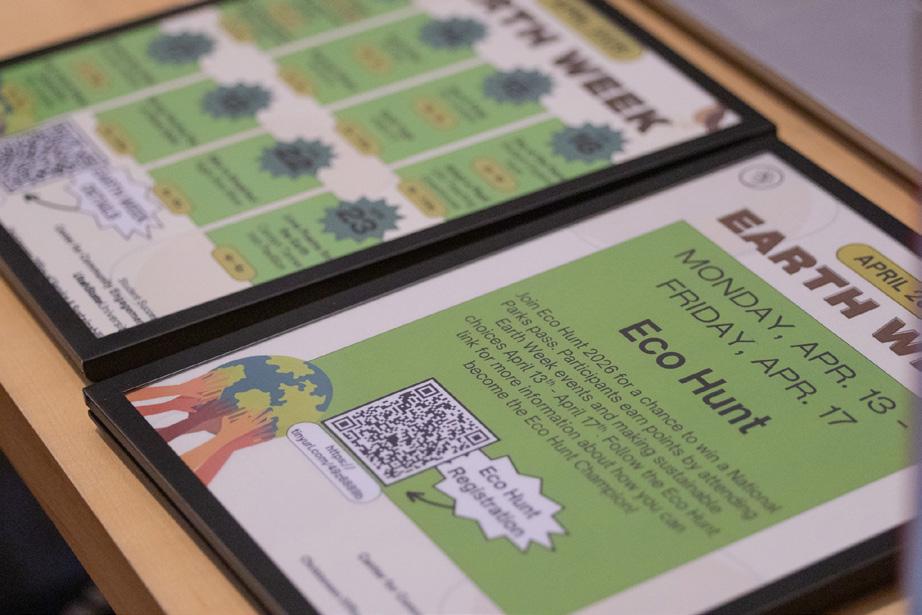
Earth Week event schedules are seen on April 15.
‘Bringing War Home’ project preserves personal war stories through artifacts
By Jayke Martin STATESMAN REPORTER
Aproject at Utah State University is preserving personal stories of war by documenting artifacts and the memories connected to them.
The project “Bringing War Home” invites community members to share objects related to wartime experiences and record the stories behind them. Instead of collecting the items, researchers photograph the artifacts and archive the stories in a digital database.
The project is co-directed by Molly Boeka Cannon, assistant professor of anthropology at USU, and USU professor of history, culture and ideas Susan Grayzel. Cannon said the project focuses on documenting both the objects and the personal meaning attached to them.
“We didn’t take the objects, but we just documented the objects and their stories, which was the really important part — not just the objects themselves but what they mean to everybody,” Cannon said.
The idea for the project grew out of a mini roadshow event connected to a class about the end of World War
I. Community members brought artifacts and shared their stories, revealing a strong interest in preserving personal histories.
“We had such a great experience, and the community was really engaged and interested, so we thought, ‘Well, there’s real interest here,’” Cannon said.
With funding from the National Endowment for the Humanities, the team expanded the project into a statewide initiative. Between 2022-24, organizers hosted 11 roadshow events across Utah, where people could bring in war-related artifacts and share their stories.
The project has documented more than 260 objects and stories from participants. The information is preserved in a digital archive and will also appear in a traveling exhibition, visiting museums around the state.
“It’s a different set of stories, working with military families and veterans, that I haven’t had much experience with before,” Cannon said. “Still, it’s been just incredibly rewarding and a great experience to connect our students.”
Cannon said the exhibit is meant to help visitors recognize how personal stories connect to larger historical experiences.
“I hope what they take away is that they can see their connection to this history — that this is a collective history,” Cannon said. “We all have these family stories that are important for us to understand the American experience.”
Students at Utah State have also played a major role in organizing the project and documenting artifacts.
Jayne Anderson, a senior anthropology major, became involved through a museum studies course connected to the project.
“We learned about how to make an exhibit in general, then how to make an event of bringing people in with objects,” Anderson said. “Then we learned how to take photographs of the objects, record stories about the objects and put them together for people to see.”
Anderson said some of the most powerful artifacts she’s seen are personal letters written during wartime.
“Some of my very favorites have been letters that people have sent,” Anderson said. “Reading those words and seeing the dates really kind of puts you into that area of, ‘Oh, people are timeless.’”
Anderson said many participants appreciate having a space where they can share stories connected to wartime experiences and document them.
“The reaction from the community has been very positive,” Anderson said. “A lot of them have felt more comfortable speaking about it with us.”
Anderson described hearing those stories as “heartbreakingly beautiful,” saying many participants had not previously shared their experiences publicly.
The project has also created unexpected connections between people.
While presenting this research, Anderson showed a photograph of her grandfather from his time in the military. Another veteran recognized the battalion and shared memories of serving in the same area.
“This man was able to give us a little bit more of, ‘Oh yeah, your grandfather was an amazing man. This is what I remember of him,’” Anderson said.
For Cannon, moments like these highlight the importance of preserving personal stories.
“It’s really about what it means to be a human during conflict,” Cannon said. “What does that mean for families as well as those who are serving on the front lines?”
Jayke Martin is a junior studying journalism with a minor in theater. She loves reading and meeting new people.
— jayke.martin@usu.edu
PHOTOS BY Rylee Patterson
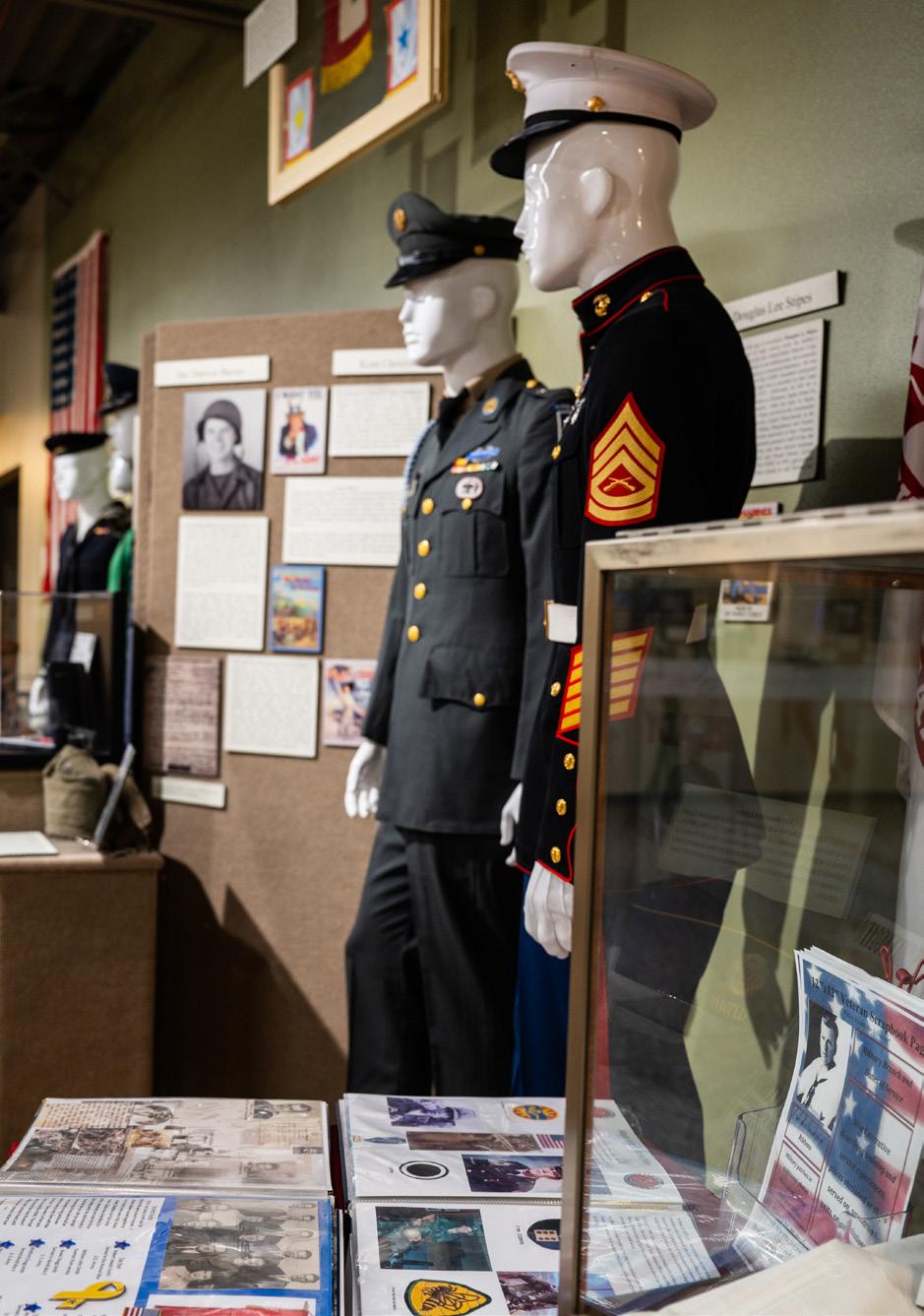
The “Bringing War Home” exhibit in the Hyrum City museum is seen on April 15.
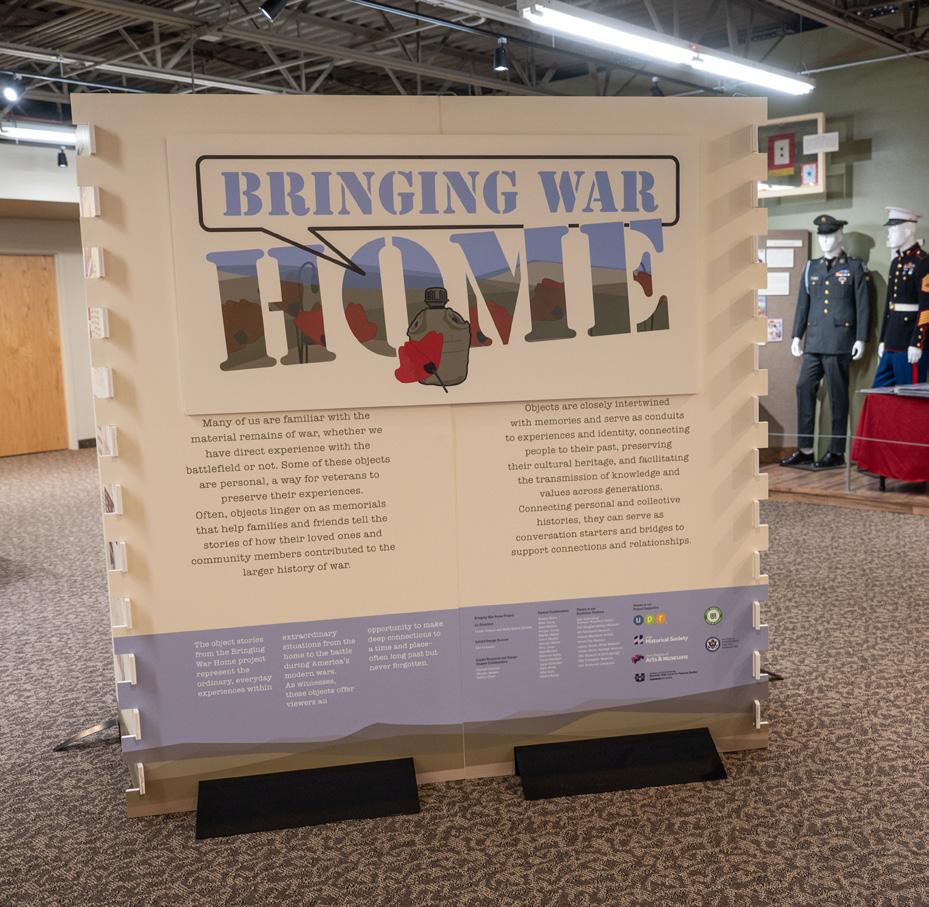
The entrance sign to the “Bringing War Home” exhibit in the Hyrum City museum is seen on April 15.
Biology Undergraduate Student Association hosts tours
By Alyssa Caywood STATESMAN REPORTER
Students, staff and community members stepped beyond the classroom during a “Behind the Scenes Biology Tour” event, where hands-on tours introduced participants to research spaces on Utah State University Logan campus, like the greenhouse, insect archives and cadaver lab.
The tours took place from April 6-9 and were available to anyone interested in taking a closer look at the USU Department of Biology facilities.
Insect archive tours were available on April 6, herbarium and insect tours were available on April 7, greenhouse tours were available on April 8 and cadaver lab tours were available on April 9.
The event was organized by the USU Biology Undergraduate Student Association. Sadie Bivens, BUSA president, helped lead the effort with the goal of extending opportunities to those interested in biology, specifically those looking to pursue a degree in biology.
I finally got to satisfy my curiosity.
—
Casey Allen
“We wanted to gear it more towards biology students,” Bivens said. “There’s a lot of different aspects of biology and research that could be applicable to students that might not be as well known, especially to our younger people in the degree.”
Along with young students, the tours were available to students, staff members and community members who were curious about USU’s biology program.
“They can go, and they can just be curious,” Bivens said. “You don’t know what you don’t know.” USU alum and staff assistant for the USU Institute for Disability Research, Policy & Practice Casey Allen attended the cadaver lab on April 9 to learn more about it.
“I was a student here a long time ago, and I’d always heard about this existing on campus, and I have never been,” Allen said. “I finally got to satisfy my curiosity.”
Allen described the cadaver lab as less intimidating than expected, though still memorable.
“I didn’t like the smell,” Allen said. “It smelled terrible, and it wasn’t as graphic or gruesome as I had expected, so it was visually manageable.”
Andy Anderson, principal lecturer and prehealth adviser in biology at USU, said the cadaver lab has long served as a powerful educational tool.
Anderson said exposure to real human anatomy can serve several purposes, including a level of understanding of the human body that cannot be replicated by textbook learning.
“Seeing the cadavers brings the textbook to life,” Anderson said. “When you actually hold a brain or hold a heart or put your fingers through the valves of the heart or inflate a lung, that brings it to life.”
The cadaver lab and the other tour activities allowed for individuals to immerse themselves in the biology world and to understand the labs, greenhouse and insect archives on a deeper level.
According to Bivens, the goal of events like these is not only to inform but to inspire. She encouraged students to take advantage of opportunities early in their academic journeys.
“Get as involved as you can with the biology department as soon as you can,” Bivens said. “You might find something more specific that you’re interested in.”
Although attendance varied across tours, Bivens said the event successfully reached participants at different levels of experience and interest.
“We’d love to have more involvement,” she said. “I do think that people really enjoyed it, and I hope we can make it even bigger and better next year.”
Allen echoed that sentiment, encouraging others to step outside their comfort zones.
“This is not within my world,” Allen said. “It’s not something I know about, which was part of the reason I wanted to come. I hope more people use opportunities like this in the future.”
Alyssa Caywood is a first-year student at USU studying journalism. She loves anything outdoors from backpacking to snowboarding to water skiing. She loves to write and is stoked to be working with the Statesman.
— alyssa.caywood@usu.edu


Max, Eva and Nate are the three best friends that anyone could ever have. While it’s time for Eva and Nate to move on, what they’ve helped build isn’t going anywhere. Godspeed, Aggie Radio.










on You
Love Song for Someone Labi Siffre
Forecasting team puts USU on national stage
By Kenadie Ferraro STATESMAN REPORTER
Every two weeks, a new city. Every day, a new forecast. For the Utah State University forecasting team, that challenge led to a top 20 national ranking.
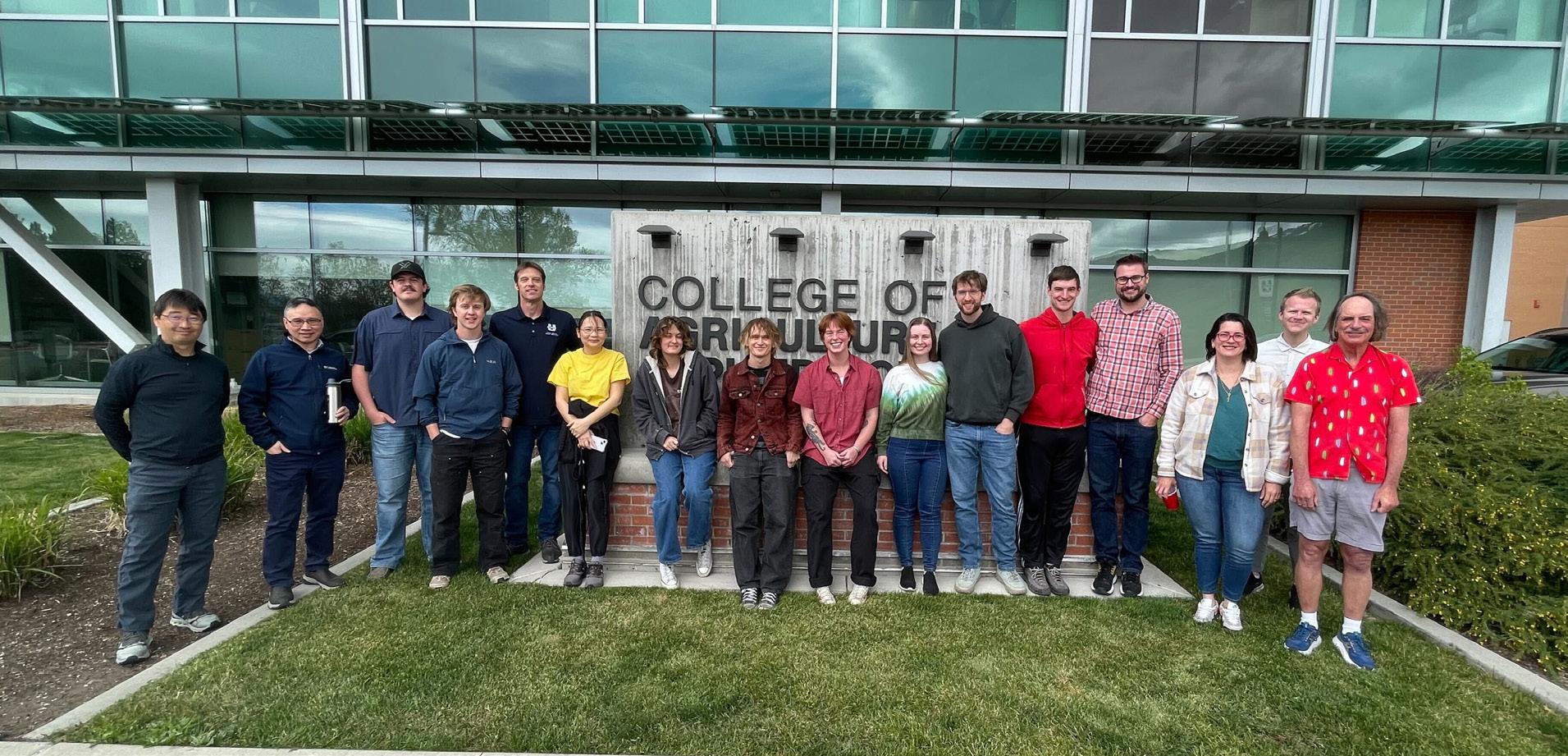
The USU team placed No. 16 nationwide for its forecasting skills. Jon Meyer, an assistant research professor with the university, aids and advises the students who compete in the forecasting challenges.
“The Weather Challenge is a national forecasting contest that has existed for 21 years now,” Meyer said. “The idea is to give students an experience of operational forecasting.”
Meyer commended three students for their efforts in this year’s competitions: Catherine Smith, Bradley Vernon and Tim Wright.
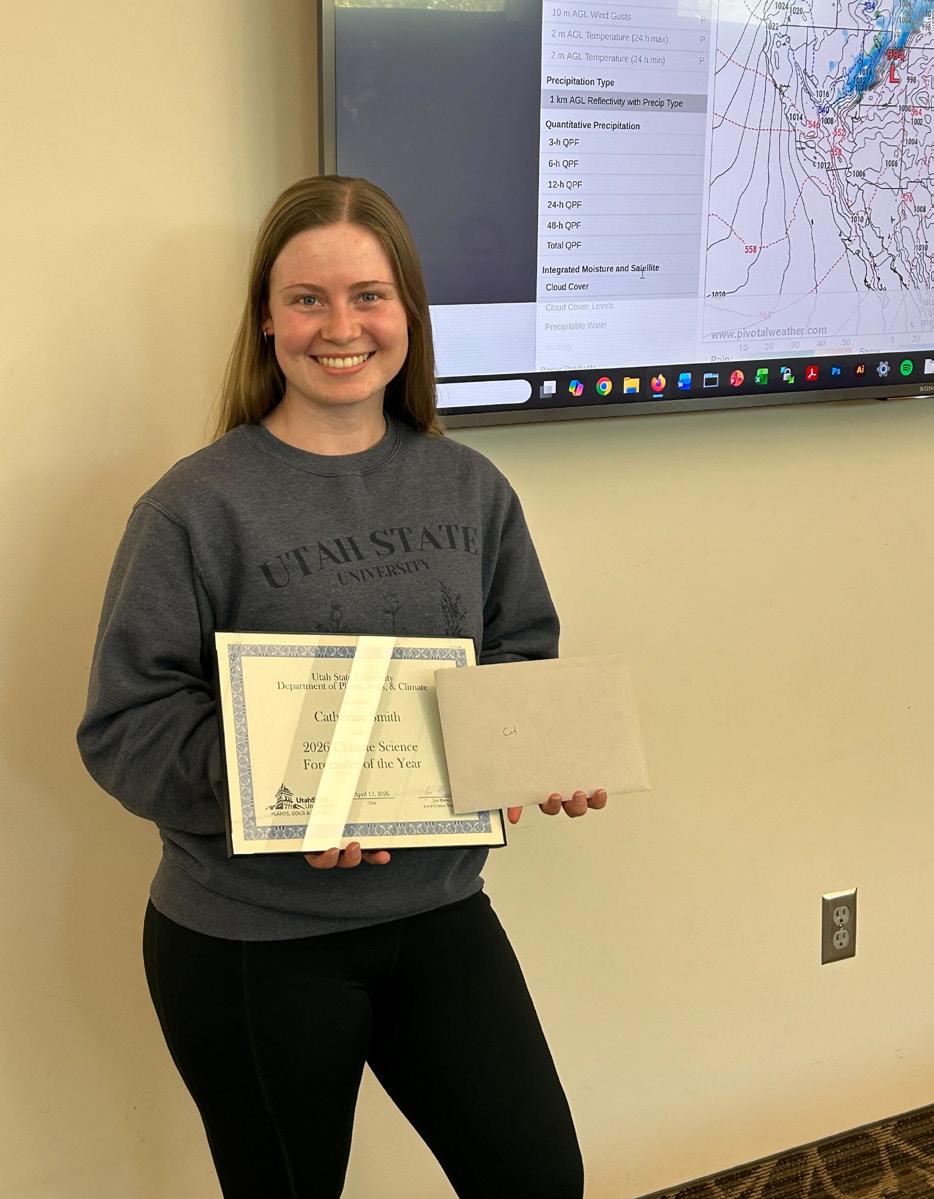
Smith is a senior undergraduate pursuing a degree in climate science. She was awarded the USU Forecaster of the Year award in 2025. This is the second year she has led the climate science program’s ranking.
“Every city has its own challenge, its own little unique aspects about it, which makes forecasting completely different everywhere you go,” Smith said. “You have to be in tune with model biases because they all have them. You have to figure out the topography of the area, where the station itself is located, because that all influences what the station records.”
Smith sees value in the intricacies of forecasting and wants to pursue a career in that field.
“There are 15,000 elements that we’re trying to consider, and even just a few of them doing the opposite of what we thought they were going to do could change the forecast completely,” Smith said. “I like the intricacy of it all — just trying to understand a system that is so much bigger than ourselves and yet plays such a big role in our day-to-day lives as well.”
In his first year pursuing a doctorate, Vernon is also studying climate science. This year on the forecasting team, he was the first and only USU student to be a city winner for the competitions.
During the forecasting contests, participants are expected to forecast a new city every two weeks, four days per week. Vernon won the Juneau, Alaska challenge. In this competition, he used an AI software he personally developed for the first time.
“I was very excited with how the model was working. It’s a pretty simple model. It’s a neural network that uses existing forecast information, which then gives you the information that you want for the competition,” Vernon said. “I think a lot of people misunderstand AI. It’s not like I went out and asked ChatGPT. It was just a simple model that I built, but it was fun to mess around with that.”
Wright is a coach and a competitor for the forecasting team. He is a doctoral candidate in the process of finalizing his dissertation, also focusing on climate science. For Wright, his interest in climate science started back home in California.
“It all started back when I was a kid growing up in California,” Wright said. “There was a strong El Nino, and we had a lot of big storms, lots of flooding, and it really made an impression on me — seeing people having to take a canoe to the grocery store because many things were flooded. It happens repeatedly, so it just kind of stuck.”
Wright is a leader on the team and ended up ranking in the top 5% of forecasters in the nation.
“It’s a good exercise in understanding the fundamental principles that affect the weather conditions because that’s what weather forecasters are ultimately trying to do, and this is the perfect practice for it,” Wright said. “We get a mix of understanding how the numerical weather models work, understanding how the local geographic features affect the weather and then also understanding that the sensing equipment itself may not be perfect, and we do account for that.”
Wright was full of advice to share at the weekly weather discussions the team would have in preparation for their contests. He was right alongside Meyer.
“Forecasting is not quite like riding a bike to where you can’t just pick it up randomly to be a good, responsible weather forecaster,” Meyer said. “It takes dedication to keeping your finger on the pulse of daily weather patterns, how things are changing and how the forecast models are evolving.”
Meyer shared his pride and joy in the team and the growth he has seen in the climate science program.
“We were very proud this year to finish 16th in the country as a team overall. That speaks to the dedication our students have because they are not trained operational meteorologists, but the rest of the country’s programs are primarily those types of students,” Meyer said. “I felt good about that and how well the team performed. Hopefully, this is a springboard and gains us some momentum in the program we can use to grow participation for people to have fun with it.”

Kenadie Ferraro is majoring in journalism and communications and minoring in marketing design. She is from Draper and loves anything active and outdoors.
kenadie.ferraro@usu.edu
The USU forecasting team poses for a photo in front of the College of Agriculture & Applied Sciences sign. PHOTOS SUBMITTED BY JON MEYER
Catherine Smith poses with her 2026 Forecaster of the Year award.
‘The full package’: Maria Paula Ramos Garcia does it all for USU Women’s Tennis
By Emma Shelite STATESMAN REPORTER
When Maria Paula Ramos Garcia stepped onto the courts in Logan for her first semester last spring, she wasn’t just a new face on the Utah State University Women’s Tennis roster — she was a national champion carrying the weight of high expectations and the challenge of a mid-year transition.
Ramos Garcia, a 19-year-old sophomore from Guatemala, arrived in Logan during the spring semester in 2025, a timing she admits was unconventional.
“I feel like it’s a little bit harder than starting fall because you don’t have these tournaments where you can meet the people that you are playing for a season,” Ramos Garcia said.
Despite the steep learning curve, she embraced the fresh start.
“I like it because you’re new,” she said. “You don’t know anything about anyone. You just play, you have fun, and you do what you need to do.”
Before joining the Aggies, Ramos Garcia was the topranked under-18 player in Guatemala. USU head coach
Veronika Golanova said her impressive junior career and “feistiness” made her an ideal fit for the program.
“She had the results that we were looking for, and she had the right style of play for the mountain region that we’re in,” Golanova said. The transition to Logan brought unique challenges, specifically the high altitude and indoor playing conditions.
“The ball is way faster than I’m used to,” Ramos Garcia said. “Back home, I don’t play indoors. Everything is outdoors because we don’t have snow. That was the biggest change that I had.”
Despite these adjustments, Ramos Garcia has become a cornerstone of the team. Golanova praised her development, noting her consistent performance at the No. 4 singles spot and her standout success in doubles.
“With her doubles, she’s probably our best doubles player right now. Her record is 13 and three, which doesn’t suck. It’s very good,” Golanova said.
The coach attributed this success to Ramos Garcia’s commitment both on and off the court.
“She’s one of those players who is very committed to her own development,” Golanova said. “She puts a lot of time not just on the court but off the court as well. She’s like a full package.”
For Ramos Garcia, her playing style is defined by a refusal to back down.

“I’m really consistent. If I want something, I go for it. I don’t give up,” Ramos Garcia said. “I run for every ball. I fight. I find solutions. Just be yourself — give everything on the court.”
While the distance from her family in Guatemala is difficult, Ramos Garcia stays connected through technology.
“They always watch my matches through livestream or, if not, live score. The distance is harder, of course,” Ramos Garcia said. “But having a team that supports you — it’s the best thing.”
Off the court, Ramos Garcia has found a sense of home in Logan through her teammates and the local community. Golanova described Ramos Garcia as a “perfect fit” for the team culture.
“Super sweet, very outgoing,” Golanova said. “She’s one of those players that we’re building the program around.”
As the season progresses, Ramos Garcia remains focused on the team’s collective success.
“I’m really proud of the team this year. We’re doing amazing, and I’m excited for the next matches,” Ramos Garcia said.
Emma Shelite is a senior pursuing a bachelor’s degree in communications and journalism. Her writing is fueled by Dr Pepper and an extroverted personality. Outside of the newsroom, she is passionate about cooking, athletics and her love for dogs.
— emma.shelite@usu.edu
PHOTOS BY Sydnie Fonoti
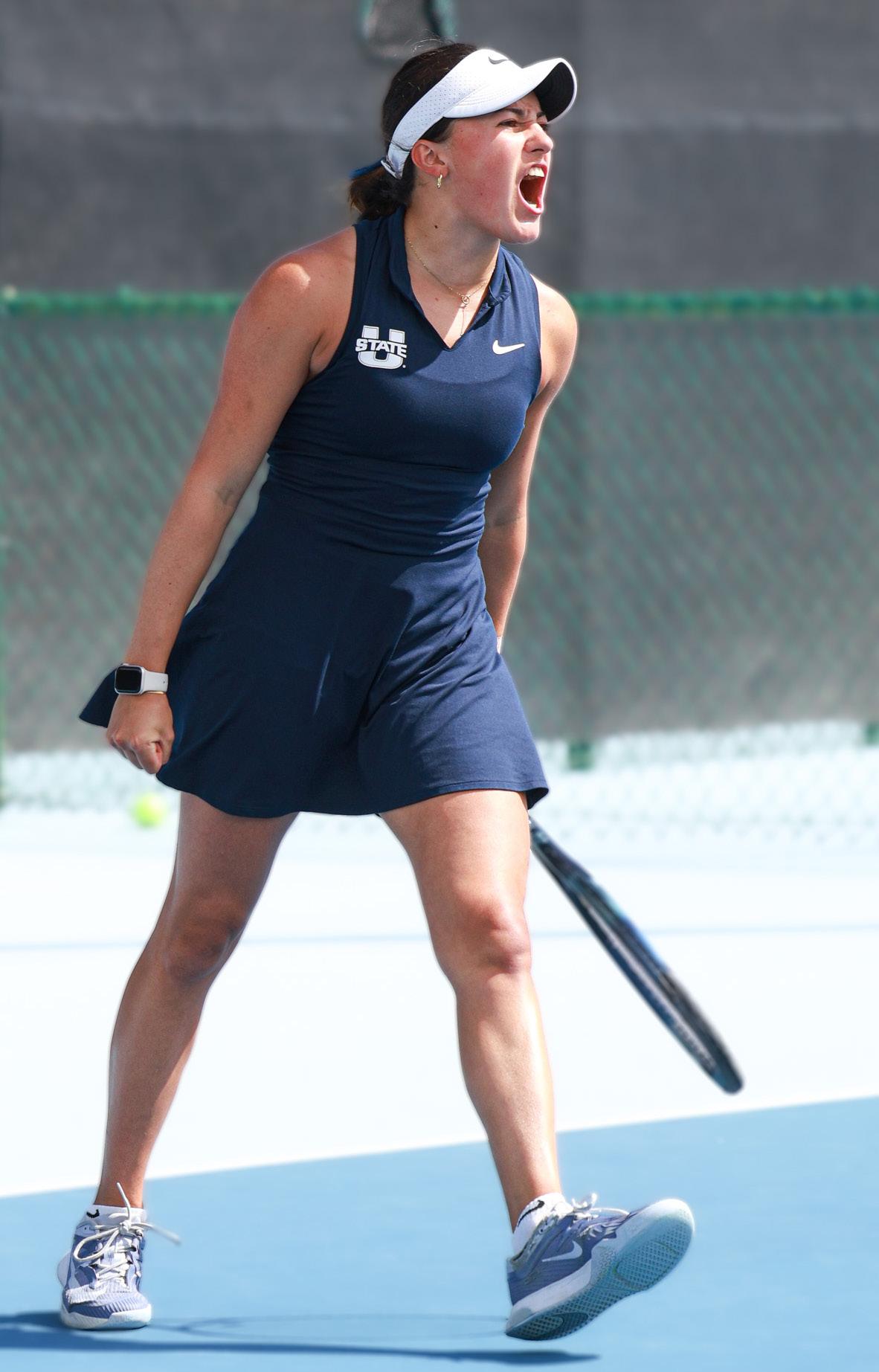
Maria Paula Ramos Garcia celebrates after a point against Air Force at the Sports Academy & Racquet Club on April 12.
Maria Paula Ramos Garcia prepares for a backhand shot in a match against Air Force at the Sports Academy & Racquet Club on April 12.
Utah State Athletics announces changes to seating in Spectrum
By Mark Greenwood STATESMAN EDITOR
Utah State University announced changes to the seating chart in the Dee Glen Smith Spectrum on April 13, including changes to the seats occupied by the Utah State student section the HURD. The announcement comes after prior speculations and rumors have circulated about moving the HURD, including potentially splitting it up.
“In partnership with HURD leadership, we reviewed and evaluated multiple options to adjust the seating map at the Dee Glen Smith Spectrum, helping create a new atmosphere that enhances fan experiences and provides additional season-ticket and premium opportunities while ensuring our passionate students remain together and their seats are not reduced,” said USU Vice President and Director of Athletics Cam Walker in a statement. “I’m grateful to everyone involved for their collaboration and effort to make a decision to benefit the future of Utah State basketball as we integrate into the new Pac-12.”
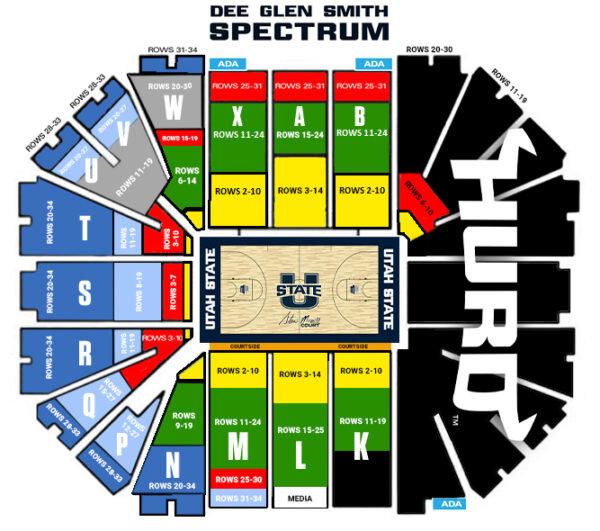
In previous years, the HURD has occupied sections F through L and part of section M, which spans from behind the south basket to just beyond midcourt across from the team benches. Now, students will fill sections C through J, making a straight line of students from
the baseline extended, and overflowing into the top of section K. The first 10 rows of sections C and D will remain public seating to comply with Pac-12 guidelines.
The move is to allow additional courtside seats in section K, previously occupied by the students, similar to the courtside seats in section M that were added prior to last season. The media, previously located at the front of section L, will also be relocated to the top rows to allow for additional courtside seats. This move is just the latest in the revenue-generating arms race that has become college athletics.
The primary downside for students is the reduction in front row seats, as the HURD will lose the front row of section K. However, the change increases the total number of seats allocated for students.
“The HURD has established itself as one of the premier student sections in college athletics, setting the standard for energy, unity, and impact. The tradition we’ve built is special, and at its heart are the students. We appreciate Utah State Athletics leadership for working with us and keeping students involved throughout this process,” HURD leadership said in a written statement. “While change isn’t easy, this new layout adds more seats for students, creating even more opportunities to be part of the game day experience. As we move into the Pac-12,
we’re confident the HURD will remain elite, rise to every moment and continue to set the standard.”
As Utah State prepares to transition to the Pac-12, it has repeatedly emphasized its intention to explore all possible revenue-generating opportunities. That effort has recently included the launch of the “Show Me” initiative in January and an increase in student fees for athletics.
“Utah State will never be the most well-funded athletic program in the Pac-12,” said President Brad L. Mortensen after the hiring of USU Men’s Basketball coach Ben Jacobson. “But we’re going to look at all of the sources that we have and figure out how to optimize those.”
For Utah State Athletics, that could come in a variety of ways, including the addition of more premium courtside seats in the Spectrum.
“We’ll figure out what can we do a little bit differently with how we use our venues in addition to athletics events. How do we gain more philanthropic support? How do we work with corporate sponsors in more creative ways?” Mortensen said. “There’s a lot of examples about that happening right now, and we’ll continue to try to leverage all those resources.”
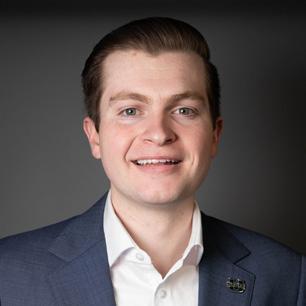
After the announcement, USUSA Athletics & Campus Recreation Executive Director Ben Burdette joined “The Statesman Sports Desk” on Aggie Radio 92.3 KBLU-LP to discuss the change. A part of Burdette’s responsibilities
PHOTO BY Hadley Sintay
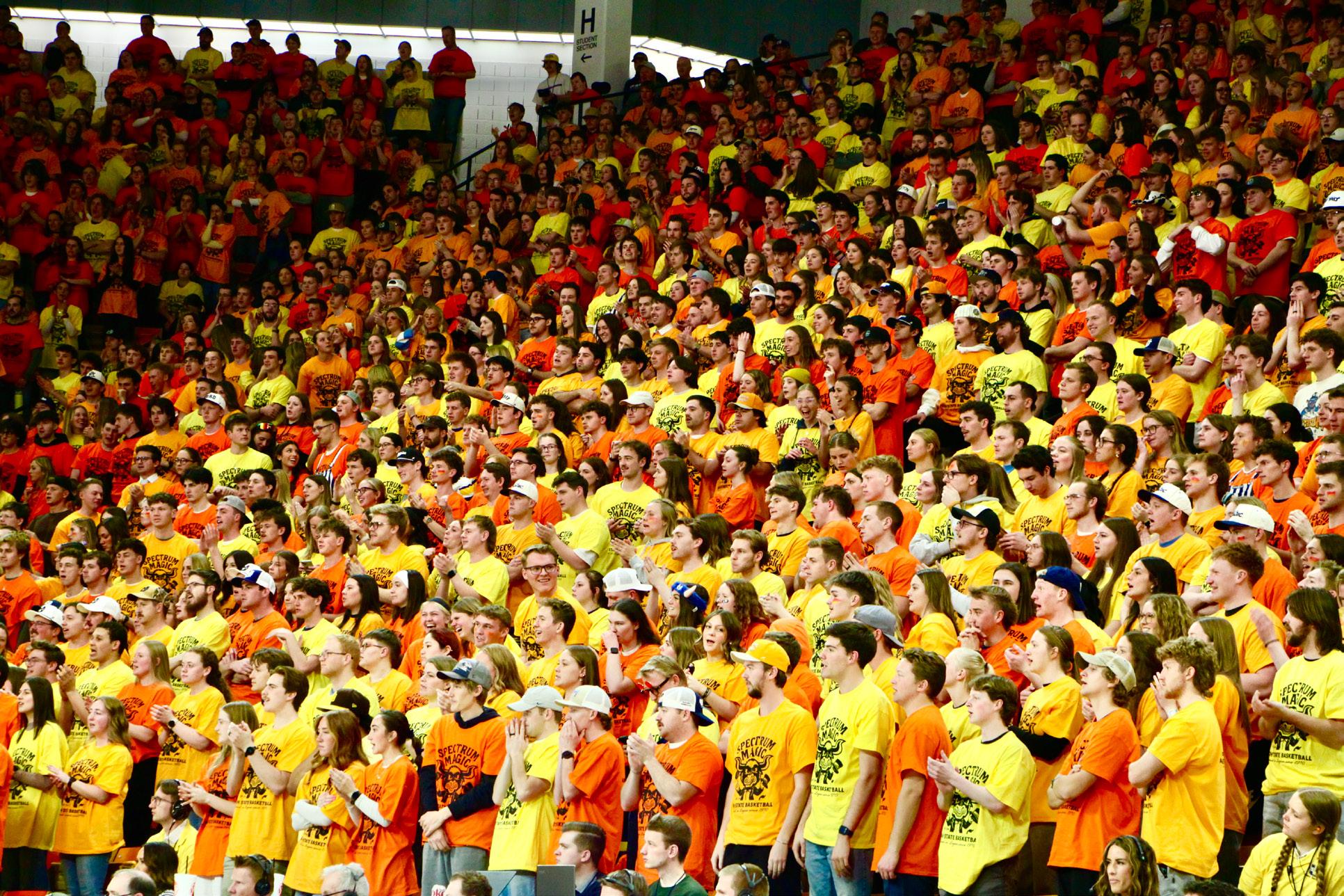
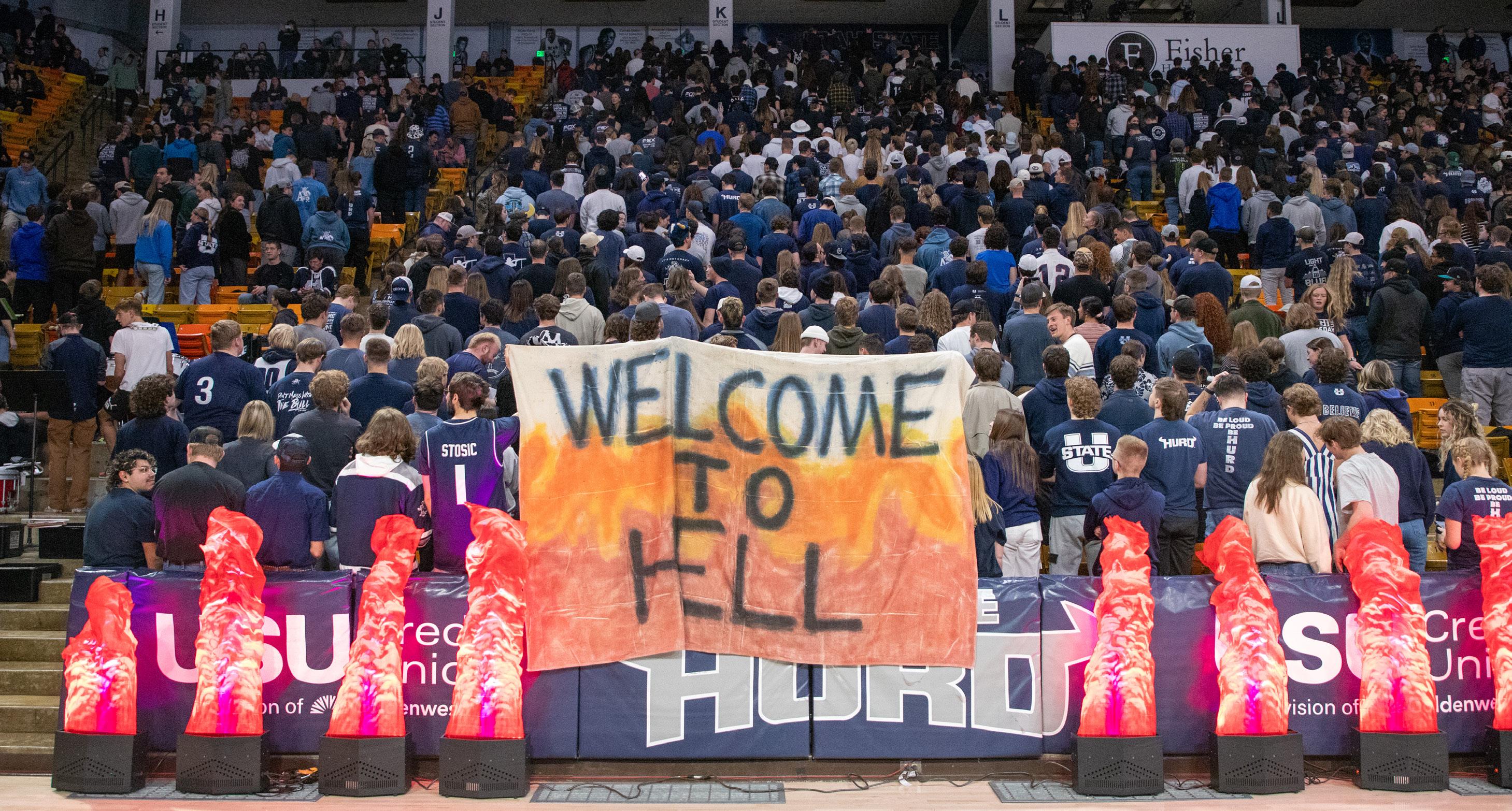
The HURD cheers during the annual Spectrum Magic game in the Dee Glen Smith Spectrum on Feb. 10.
PHOTO BY Sydnie Fonoti
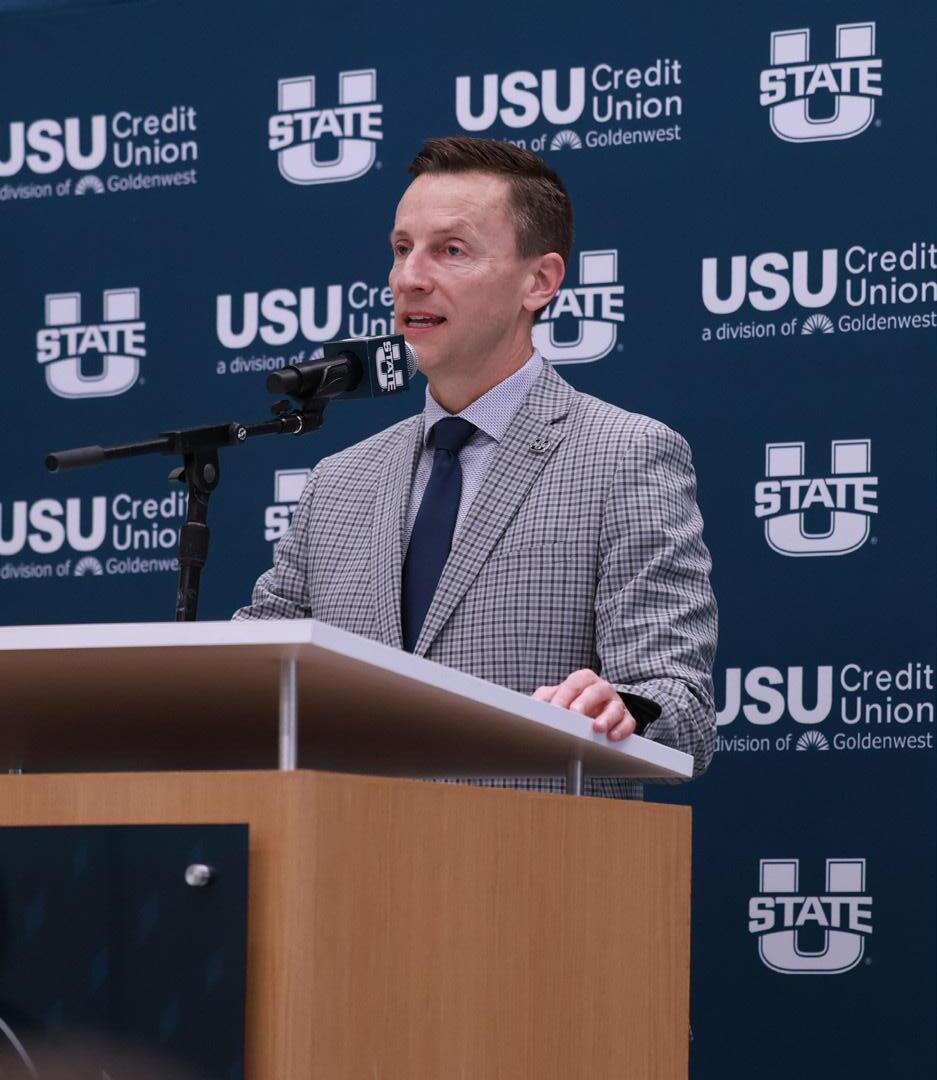
Utah State University President Brad L. Mortensen speaks at an introductory press conference for new men’s basketball head coach Ben Jacobson at the West Stadium Center at Maverik Stadium on March 31.
includes overseeing the HURD and included discussion with Utah State Athletics about the seating changes.
“The athletics department approached the HURD a while ago and was like, ‘Hey, we’re exploring options to increase revenue,’ and, obviously, with the student section taking up as much space as it does in the Spectrum, it was their first target,” Burdette said. “We’re
very grateful that they involved us in the process. We’ve seen in previous years under other administration where they don’t involve us, and it goes poorly, so we’re very glad that they involved us.”
According to Burdette, the decision ultimately came down to splitting the HURD into two separate sections, one under each basket, or moving them like they did. For Burdette and USUSA leadership, splitting the students was viewed as the worst option.
“[The change] I think is a lot better than splitting,” Burdette said. “Change is hard, and it’ll be interesting to see how it plays out in the upcoming season, but I think it was best-case scenario with the options that were presented.”
Burdette also said remaining the same was never an option, as the priority was opening up sideline seats to increase revenue through premium seating.
This announcement comes shortly after the initial student fee increase was reduced by the Utah State Board of Higher Education, a decrease Burdette said affected the decision to change seating.
“It would’ve been a different story had the Board of Higher Education allocated our athletics fee a little differently,” Burdette said. “That changed the amount of revenue that they were going to get from students, and so after that revenue source fell through, they needed to open up different options, which ultimately came down to the student section.”
While the announcement has been met by mixed reviews and sentiments from students and fans, the pursuit of additional revenue affects more than just men’s basketball. Non-revenue sports rely on revenue generated by men’s basketball and football to subsidize operations and now to subsidize athlete compensation. The full interview with Burdette can be found online at usustatesman.com or on Aggie Radio on Podbean, Spotify and Apple Music.

Mark Greenwood is a senior at USU studying finance. He is an avid Los Angeles Dodgers fan and loves golf, skiing and playing tennis.
PHOTO BY Dane Johnson
The HURD displays a welcome message to the opposing team as Fresno State’s starting players are presented in the Dee Glen Smith Spectrum on Jan. 4, 2025.
PHOTO COURTESY OF USU ATHLETICS
Utah State Athletics announces changes to seating within the Dee Glen Smith Spectrum on April 13.
Utah State Men’s Tennis completes undefeated conference season with win over Boise State
By Mark Greenwood STATESMAN EDITOR
Utah State University Men’s Tennis claimed an outright regular-season conference championship on April 11 following a 4-2 win over conference foe Boise State University.
After dropping the doubles point to open the match, the Aggies swept the top four singles points, dropping the fifth singles point during that time, to defeat the Broncos.
“As a team, we’ve been grinding every single day, and coach has been holding us accountable, so we haven’t been able to get better without his without his tutorage, without his guidance,” said Jean-Baptiste Badon, a senior on the team. “Just like trying to do my best for the team, and just super, super excited that I was able to come through when it counted.”
With the win, Utah State caps off an undefeated conference season and undefeated home slate, doing both for the first time since 2018. It is also the second regular-season title in the last three years for the program.
“The level of this conference is, I think, the highest it’s been in my seven years in the conference,” said head coach Aaron Paajanen. “So, for them to do what they did, not lose a conference match, it’s incredible. So, I’m happy for them.” Utah State came into the day riding strong doubles play throughout the season, winning the doubles point in 12 straight matches. That point was led by the second doubles duo of Badon and Dmitri Goubin, who has not lost together this season.
At the top spot was the pairing of Xavier Calvelo and Jakub Medved, with Roman Venger and Eliot Nobel at the third position.
Calvelo and Medved got off to a rough start, quickly finding themselves down 4-1, a hole they were unable to climb out of, despite fighting back to make it 5-4 before ultimately falling 6-4.
Venger and Nobel started slow, trailing 2-1, before ripping off five straight games to win 6-2. Badon and Goubin battled to a 4-4 tie, but two strong games from the Broncos gave them the doubles point after a 6-4 win at the second doubles position.
“I don’t think our doubles was very good at all today, and maybe we needed that,” Paajanen said. “Maybe that’s going to motivate us to improve on a few things that I think we need to improve on.”
The doubles matches weren’t without some drama, as the matches started on the outdoor courts before rain forced the matches indoors on the back half of each match.
The Aggies found themselves trailing 1-0 at the start of singles play, something they’re not used to. It took three tight matches and one 6-3, 6-2 dominant win from Calvelo for them to prevail.
At the top spot, Badon started slow, finding himself in a 4-1 deficit early despite two break opportunities at 40 all. Badon battled to a 6-3 first set loss before coming alive in the second set and cruising to a 6-0 win, setting up a winnertake-all third set.
“For me, it’s going to be about how can I raise my level when it’s actually needed, and how can I raise it and keep it there for the rest of the match?” Badon said. “I know coach knows how to do that, so I’m not going to worry about it for next week.”
The third set saw each server hold serve until Badon led 5-4, where he surged to a break to win the match 3-6, 6-0, 6-4.
“My confidence was steadily rising throughout the third. It was just a matter of time,” Badon said.
At the second third spot, Venger battled in the first set and got out to a 5-4 lead in the first set, serving for the set. He was broken, tying the set at five, before falling behind 6-5. Venger held serve to six-all before battling to a 7-5 tiebreak win.
Venger dropped the second set 4-6 but dominated the third set 6-1 to win the match, which would ultimately seal the match for the Aggies overall.
“It was really mentally challenging. The match was really high-level. He played good. I played good. So, it was super tough,” Venger said. “Didn’t go as well in the second set, but third set, I’m really happy with my game, was locked in the entire set.”
The fourth singles position was Nobel, who battled to a tight 6-4, 7-5 victory. The first set was tied at four before Nobel held serve and broke serve to take the first set. The second set was the same story but was tied at five before Nobel’s surge.
The lone singles loss came in the fifth position, which wrapped up quickly with a 6-3, 6-1 win for Boise State just minutes before Venger ended the match.
Calvelo was the only Aggie to cruise through his match, with every other Utah State win coming in a tight match.
“It was an opportunity to prove to ourselves that even under different, unusual circumstances, we can still get the job done,”
— mark.greenwood@usu.edu
PHOTO BY Sydnie Fonoti
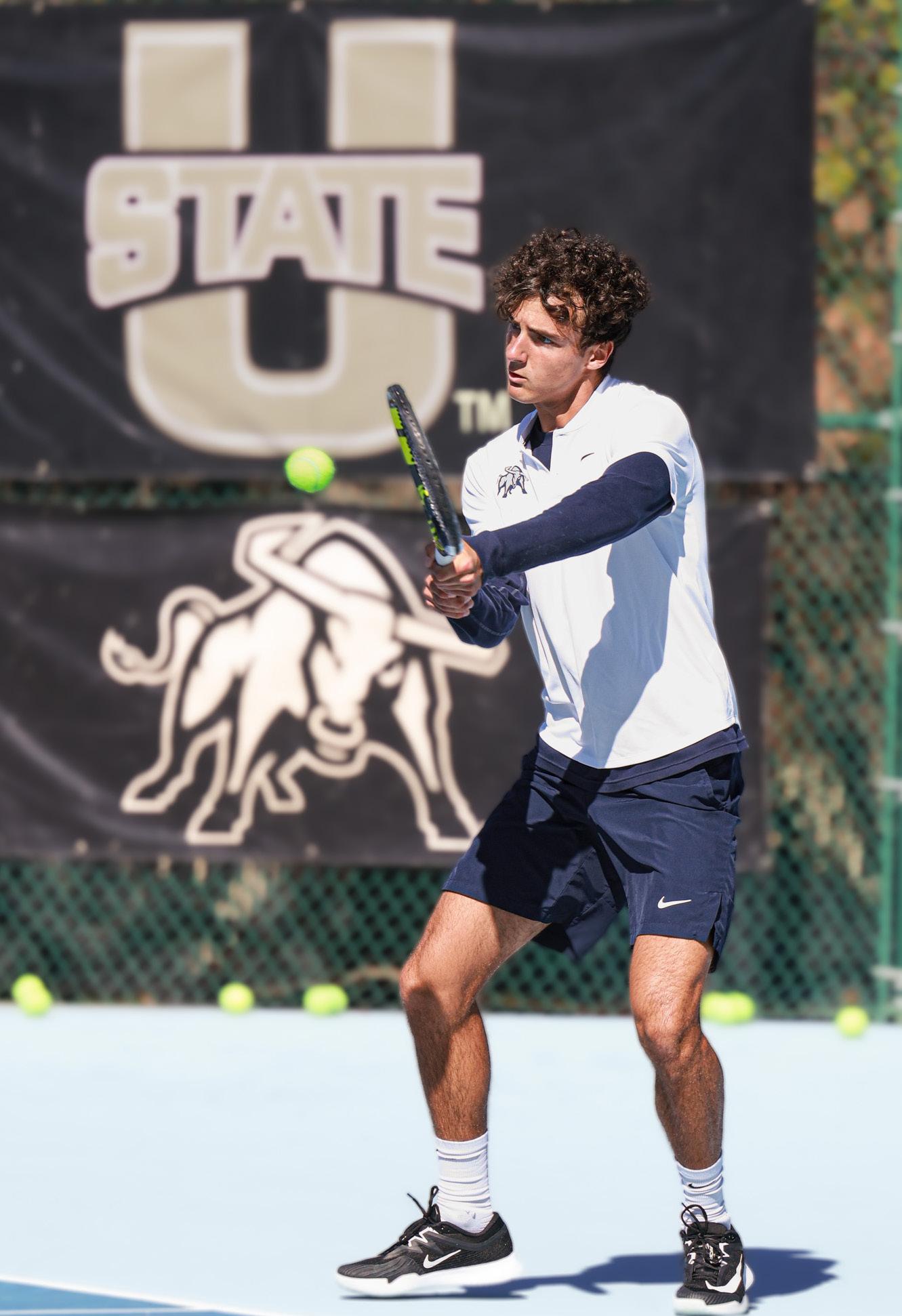
Roman Venger hits a backhand shot in a match versus GCU on April 4.
Column: Photography still matters 200 years later
By Hazel Harris-Staples STATESMAN EDITOR
Approximately 200 years ago, a man named Joseph Nicéphore Niépce created what is widely considered the first photograph — an image etched on a pewter plate. This would widely change how people see the world for years to come.
Niépce created this photo using a camera obscura — an early type of camera that uses a dark box or room to project an inverted and reversed image through a small hole or lens — and a polished pewter plate coated in bitumen of Judea, which is an asphalt derivative of petroleum. He used a long exposure, around eight hours, and when he came back for the day, he had created “View from the Window at Le Gras.”
When Niépce created that first photograph, it was novel. In the two centuries since that first image, photography has evolved through processes like daguerreotype, cyanotype, wet plate collodion and film, before arriving at the digital systems we rely on now.
We’ve come a long way since 1826 — or 1827, depending on who you ask. Now, we all carry cameras in our back pockets. Hundreds of photos can be taken in a matter of minutes. Last weekend, when I was out with friends, I had four different cameras in my purse — but still didn’t take any photo I felt was aesthetic enough to post online. The technology has changed dramatically, but the reason behind why we take the photos has not.
This raises the question: With the sheer number of photos being made every day, why does photography as a concept and art form still matter?
For me I think the answer lies in a simple truth: A photo is proof that something existed. #PicsOrItDidntHappen.
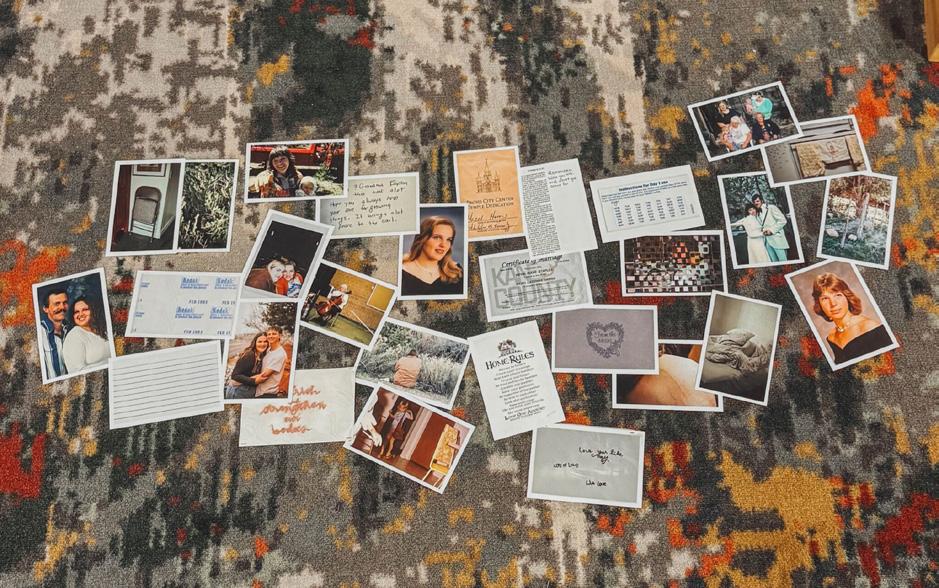
I’m pursuing a BFA in photography, and much of my work currently lies at the intersection of identity — particularly as women. Working within my family archive, I have recently been looking back over photos of my mother, grandmother and myself in an attempt to process the ways my life looks different from theirs. I am the first in my family to attend university — the first to leave the small town in Southern Utah, where my family still lives. The life I am building looks
different from the lives my mother and grandmother lived at my age — and maybe even different from what they may have imagined for me.
The images I work with — both in the archive and in what I make now — don’t resolve that tension, but they do make it visible. These images show that my life is still connected to Sally Brinkerhoff’s and Joeie Harris’, even though my path leads a different direction. The photographs from the past remind me that their choices are just as valid as mine and that our choices have impacts far beyond our own lives. The photographs I make now prove that my choices matter in the same way — not because my choices are better than theirs but because they are connected to them. This is why photography still matters. Even 200 years after “View from the Window at Le Gras,” photography is no longer novel, but it gives us a way to document and process the things going on around us — to understand where we came from and where we could go moving forward.
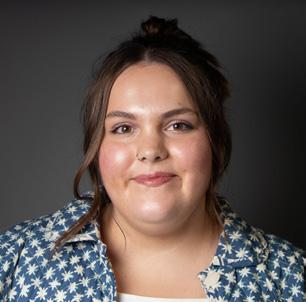
Hazel Harris-Staples is a junior studying photography, art history and entreprenuership. She is passionate about Lightroom Classic, matte photo paper and the incredible USU photo program.
— hazel.harris@usu.edu
PHOTO SUBMITTED BY Hazel Harris-Staples
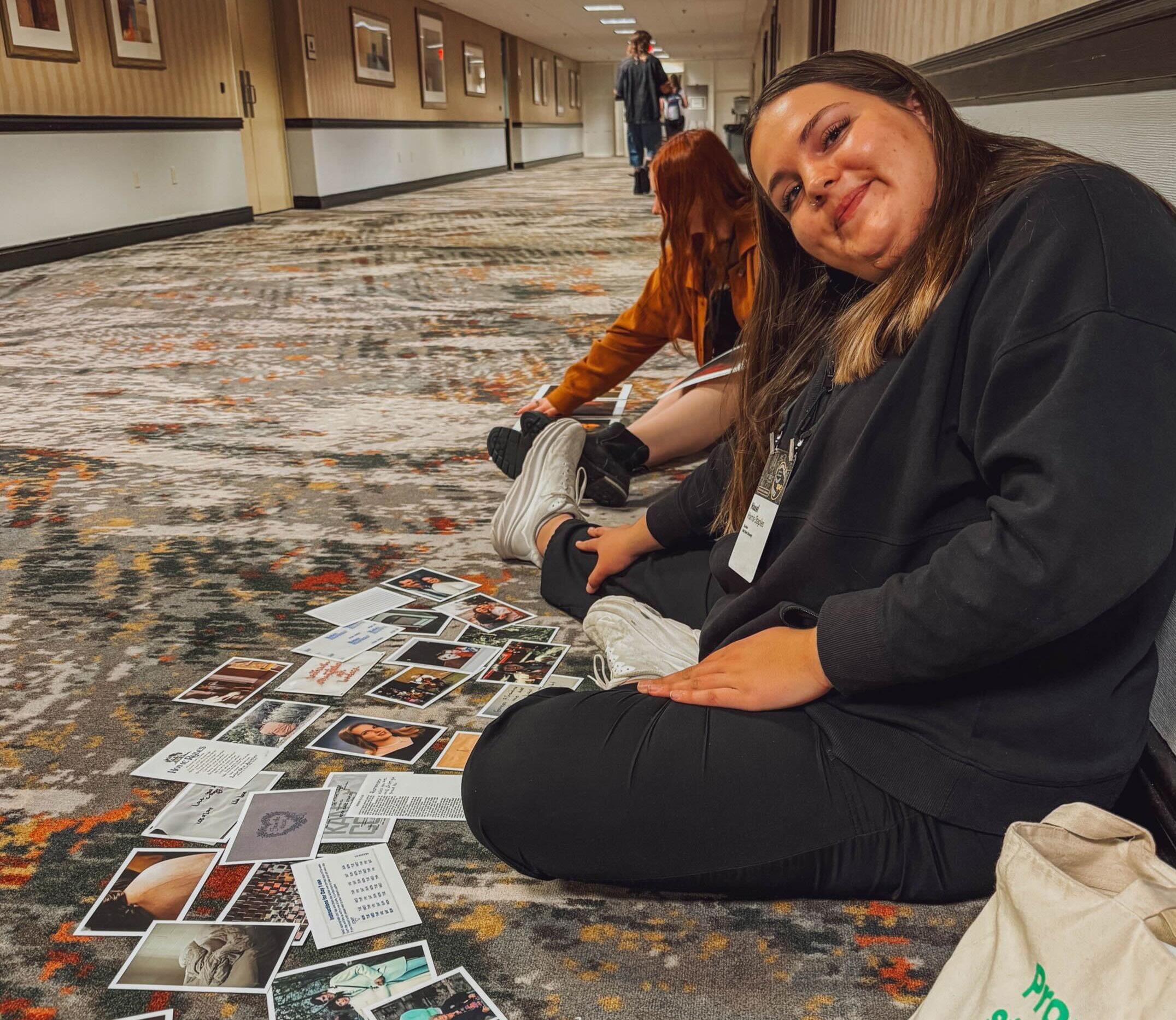
Hazel Harris-Staples poses with her current project on the floor of the Courtland Grand Hotel in Atlanta on March 20.
PHOTO BY Hazel Harris-Staples
Hazel Harris-Staples’ work in progress “to nourish and strengthen our bodies” is seen on March 20.

Working the Show


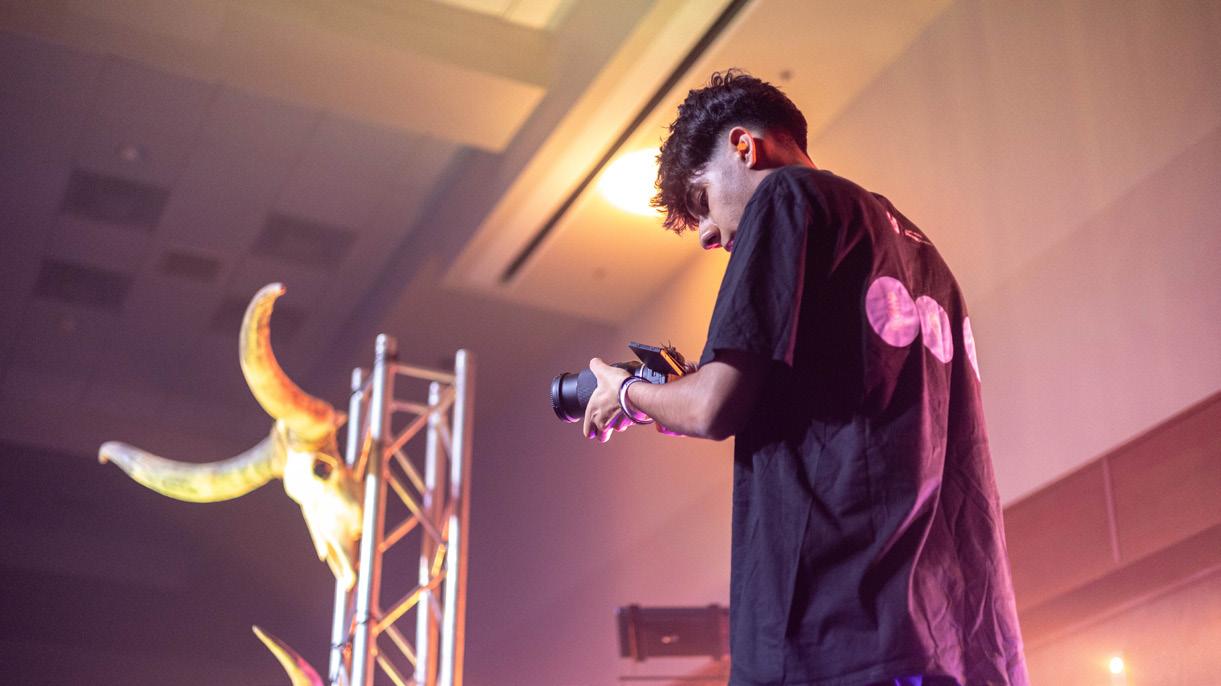

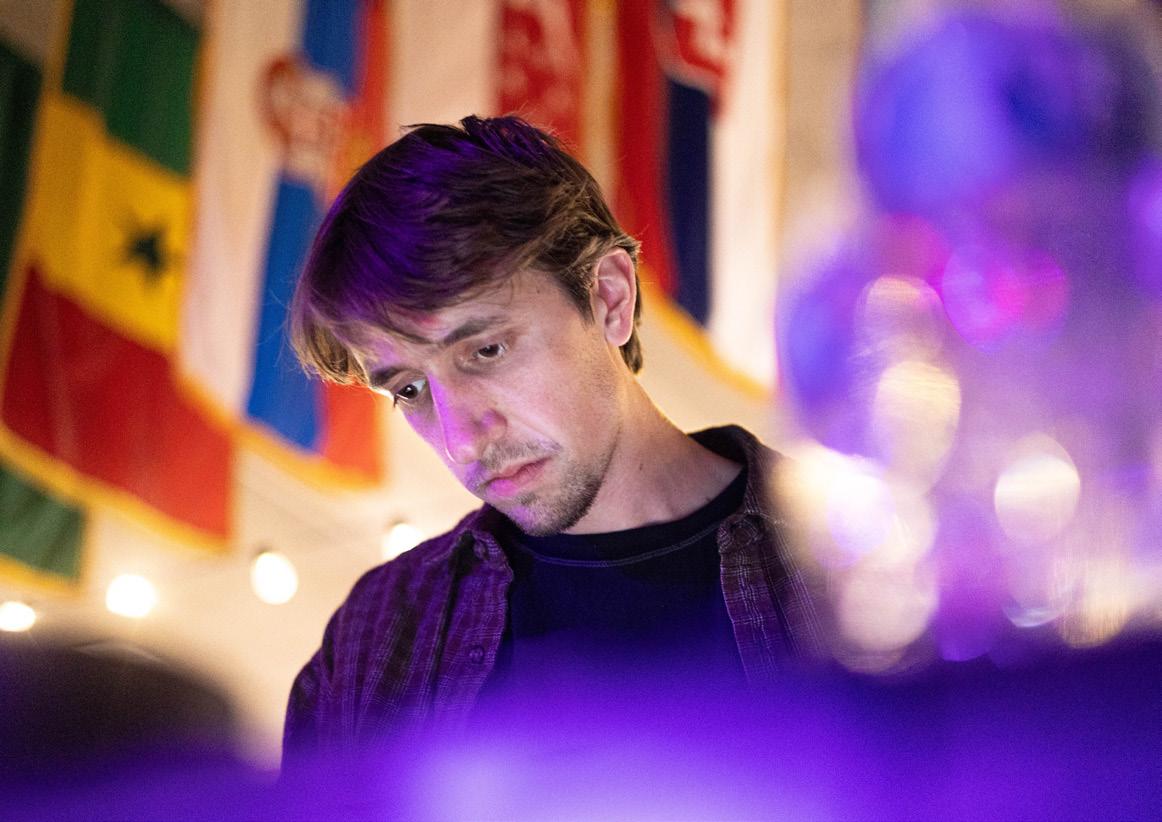
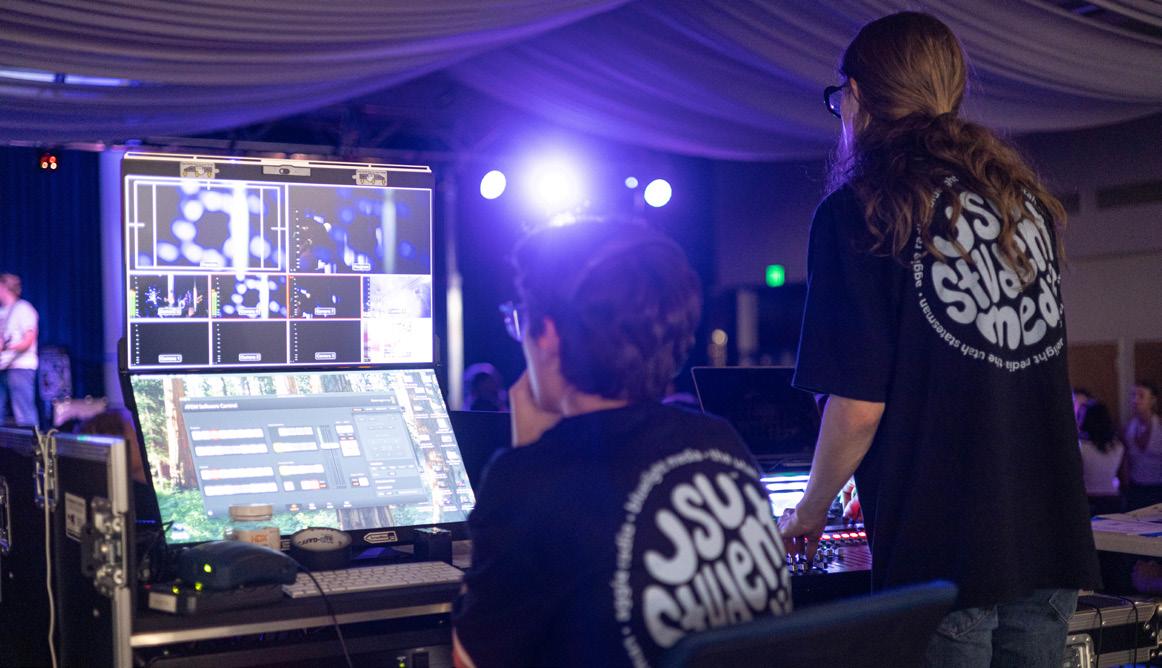


Jack Burton likes music, spaghetti, art and photography. Despite his venturing spirit and desire to run away from modern society, he has opted into the digital age — turning his hobbies into a career.
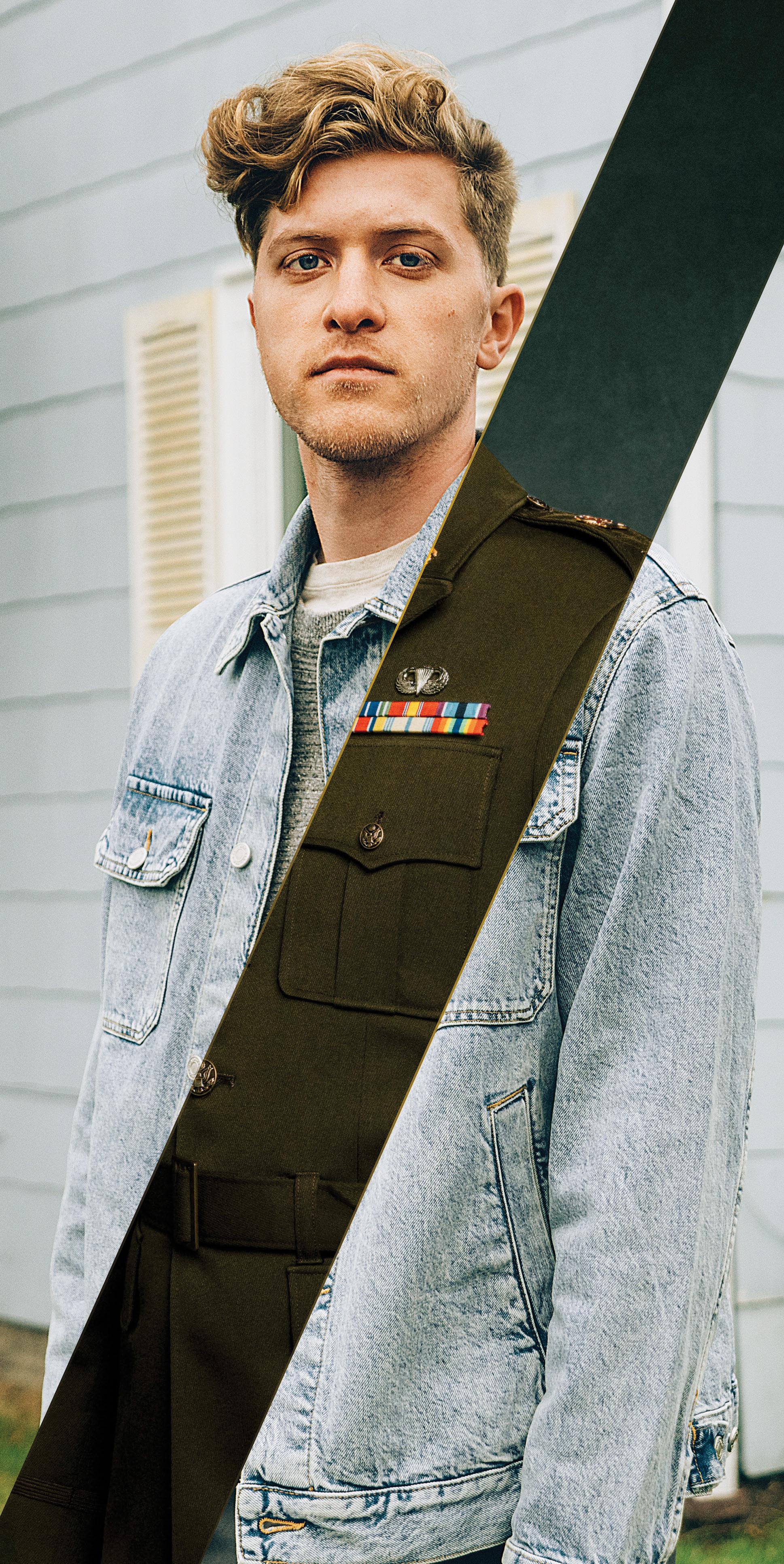


www.sudokuoftheday.com.





PHOTOS BY Elise Gottling and Hadley Sintay