

By Malory Rau STATESMAN EDITOR
Spencer Wilkinson and Shai Spangler entered this academic year excited for new leadership opportunities as executive directors on the Utah State University Government Relations Council. However, in March, they both decided to resign one month premature to the end of the academic year.
Aside from Spangler and Wilkinson, four other GRC members have formally resigned as of April 9.
Wilkinson was the events director of the GRC and claimed there were many failures in the leadership of the executive directors.
“At the beginning of the year, the directors all sat down, and we outlined our goals for the year,” Wilkinson said. “We outlined our four pillars. I can confidently say I don't remember what any of these pillars are, and I think that's a really negative thing.”
Spangler noted that even though Wilkinson was the events director, he never planned an event during his time with the GRC.
Spangler was the director of government affairs and ran against current Student Advocate Vice President Colin Hastings in the most recent USUSA Elections. Spangler lost to Hastings, who was reelected for a second year.
The student advocate VP chairs the GRC and serves as a member of the USUSA Executive Leadership Board.
During the election cycle, Spangler cited incidents of bullying and bickering without specifics. Hastings claimed he was unaware of such incidents.
“Neither myself, my advisor, or our department received any reports of bullying, unpleasantness, or bickering until these resignations,” Hastings wrote in an email to The Utah Statesman. “Reports of bullying were also only raised in two resignations, and no specific instances were ever provided.”
Spangler said she stands by her loss and is not seeking a revote or recount.
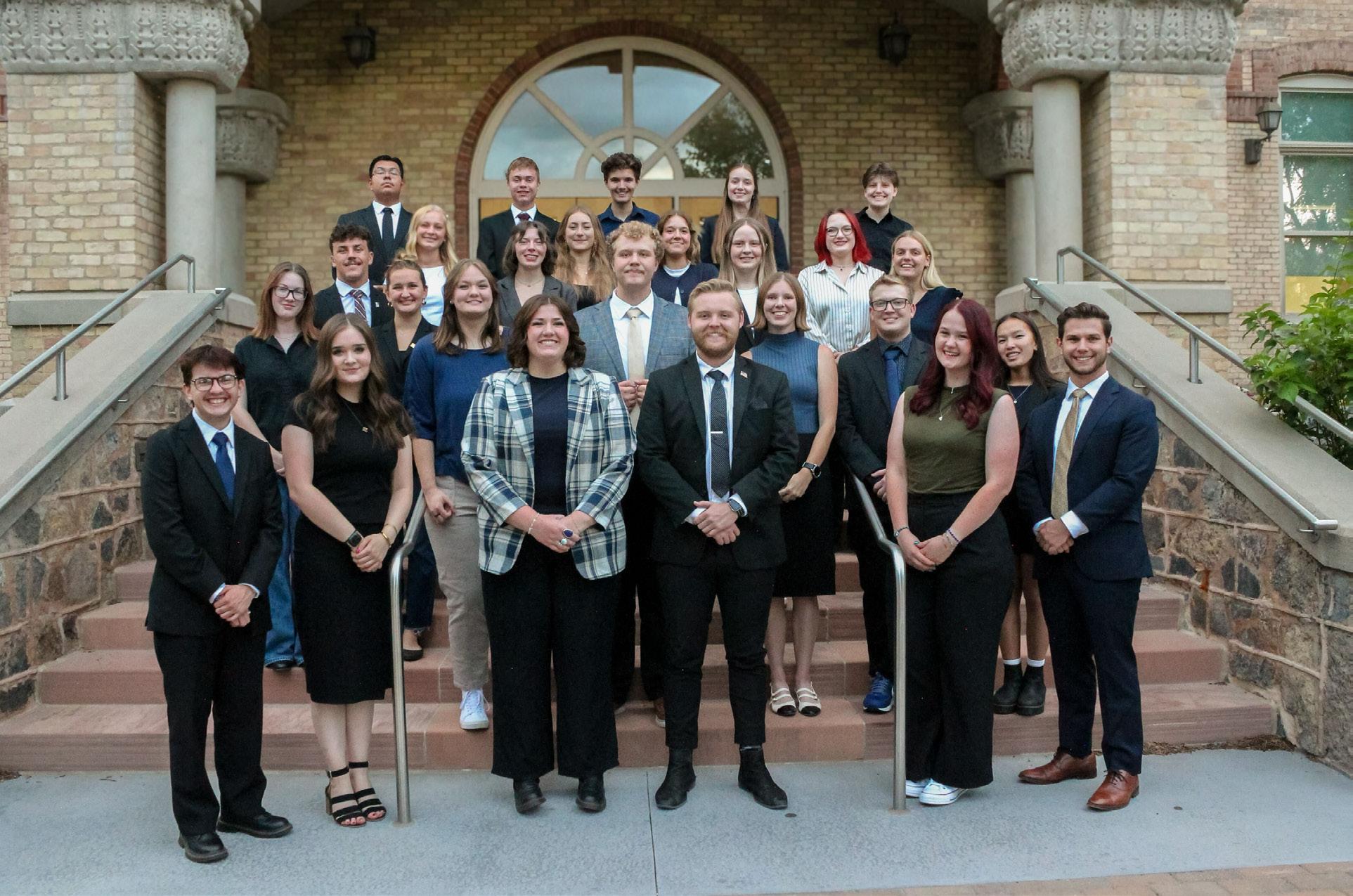
in agreement that their decision to leave was sperate of elections.
“Take away the events of election season and keep the way that Colin has acted before then and after then — I would still leave,” Wilkinson said.
Spangler went on to discuss roles and duties of the GRC that were not event-specific that she felt the council had failed at this year.
The best part about democracy is that people get to choose.
— Shai Spangler
“I understand that it probably, from an outside perspective, looks like I'm just being a bad sport about it, but genuinely, like, it's an election, and the best part about democracy is that people get to choose, and he gets another chance to serve the student body, and that's incredible,” Spangler said.
Despite what both Spangler and Wilkinson would claim to be a tumultuous elections season, they both are
“I had a whole plan of things that we were we needed to do for legislative tracking and making sure that the Utah State student body was civically informed,” Spangler said. “The city has been reaching out repeatedly, being like, ‘Hey, we need people to come down to downtown. We need to have events. We need to be doing things.’ And that will get mentioned, and then it would never happen.”
Both former directors said another reason for their premature departure was the absence of executive meetings since November.
“I felt as though the Executive meetings had become redundant, and business was conducted more efficiently among the entirety of our council, where we could have input from all of our members,” Hastings wrote.
Hastings disagreed with the comments of his former directors and said he instead feels the GRC amassed great success this year.
“My council accomplished all the major objectives we are set to do, including Gripe Nights, with the next being April 19th, the second ever Aggies Vote Week, and a successful Aggie Ice Cream Day on the Hill. Working with my council, we also submitted multiple Facility Enhancement Requests, and researched and made headway on possible solutions to parking problems across campus,” Hastings wrote. “We pushed USUSA legislation that would have created a new senator, and polled students on a variety of issues. However, I am not perfect, and there is more to do, and better ways to do it. Next year we are restructuring and shifting the focus of the GRC to be less of the Student Advocates committee, and a body focused on purely civil education and engagement.”

Malory Rau is senior graduating in journalism with a double minor in marketing and film studies. Her takeaways from her time at USU include her love for Aggie Radio, the IEEE and her many Sardine Canyon surival stories.
By Dylan Moore STATESMAN REPORTER
For decades, students filing into political science classrooms at Utah State University came to know one constant: Michael Lyons at the front of the room, ready to challenge them to think more deeply about government and civic life.
Lyons, a longtime professor of political science who began teaching at USU in 1978, died this semester, leaving behind generations of students and colleagues who said his presence defined the department. Though he officially retired in 2024, Lyons returned almost immediately to continue teaching, a decision that reflected his commitment to the classroom.
At the time of his death, Lyons was teaching one course, which the department plans to complete for the semester.
Steve Sharp, an instructor in the USU Department of Political Science, shared an office with Lyons and said his colleague’s dedication to teaching never faded.
“He just loved being here,” Sharp said. “Even after retiring, he came right back because he cared about the students and the work.”
Sharp first encountered Lyons as a student in his congressional simulation class, years before becoming his colleague. That experience, he said, left a lasting impression.
“That class was one of the most impactful things I did as a student,” Sharp said. “It showed me what politics looked like in practice, not just in theory.”
Sharp described Lyons as steady, thoughtful and consistently engaged with both students and faculty.
“You’d hear him talking with students all the time,” Sharp said. “He was always available — always willing to help.”
Damon Cann, a professor of political science, explained that Lyons’ influence extended across the department, particularly through his teaching style and institutional memory.
“He had been here so long that he was part of the foundation of the department,” Cann said. “He understood how things worked, and he cared about maintaining what made the program strong.”
Cann said Lyons balanced high expectations with an approachable demeanor, creating an environment where students felt both challenged and supported.
“He wanted students to take the material seriously, but he also wanted them to succeed and feel like they belonged in the conversation,” Cann said. For students, Lyons’ impact often went beyond coursework.
“He’s prepared leaders that are all over, in state government, both in administration and in actual office, and in Washington,” Cann said.
Frankie Meehan, a former teaching assistant for Lyons, said his classes emphasized real-world application and critical thinking.
Meehan explained how Lyons helped with her law school application and wrote her a letter of recommendation.
Meehan spoke about how working as his teaching

assistant gave insight into Lyons’ commitment behind the scenes.
“He put a lot of effort into making sure students were getting something meaningful out of the class,” Meehan said.
Abbi Zaugg, a current teaching assistant, said Lyons created a classroom environment where students felt comfortable participating, even when topics were complex.
“He made it feel like your ideas mattered,” Zaugg said. “That made a big difference for a lot of students.”
Zaugg noted Lyons’ teaching style encouraged students to think independently while still providing guidance.
“He would challenge you — but in a way that made you want to improve,” Zaugg said.
Colleagues said that balance of rigor and support defined Lyons’ career. Over more than four decades, he taught thousands of students, many of whom went on to careers in law, public service and government.
Lyons taught at USU while both current USU President Brad L. Mortensen and Utah Gov. Spencer Cox went through the department.


Dylan Moore is a junior majoring in political science and minoring in anticipatory intelligence and Russian. He always loves going on outdoor adventures and cooking.
— dylan.moore@usu.edu
Alyssa Caywood Grace Colvin
Jayke Martin Rory McNeill Dylan Moore
Nielsen Jillian Peterson
Shelite Kenadie Ferraro

By Jillian Peterson STATESMAN REPORTER
Anew USUSA resolution could formally establish Aggie Meal Share as a recognized program at Utah State University.
For several years, USU Dining Services has facilitated an informal end-of-semester meal donation initiative where students with a meal plan can donate up to five of their unused meals, which can be used to support other USU students in need.
The monetary value of those five meals is transferred to the organization hosting the program that year, explained Alan Andersen, executive director of dining services. In previous years, these organizations have included the Student Nutrition Access Center, also known as SNAC, the Val R. Christensen Service Center and Swipe Out Hunger. “It’s not our program, so we don’t dictate what they do with the money. We are just willing to support what they’re trying to do,” Andersen said.
In a previous year, Andersen said more than $8,000 was given to the Val R. Christensen Service Center from students donating a few of their extra meal swipes. According to USUSA President Brandon Sorenson the money can be converted to dining hall meal vouchers for students struggling with food insecurity.
Sorensen said he hopes this resolution will make this program more official and long-lasting.
“The program is already there, but there’s not a lot of structure to it or awareness of it right now,” Sorensen said.
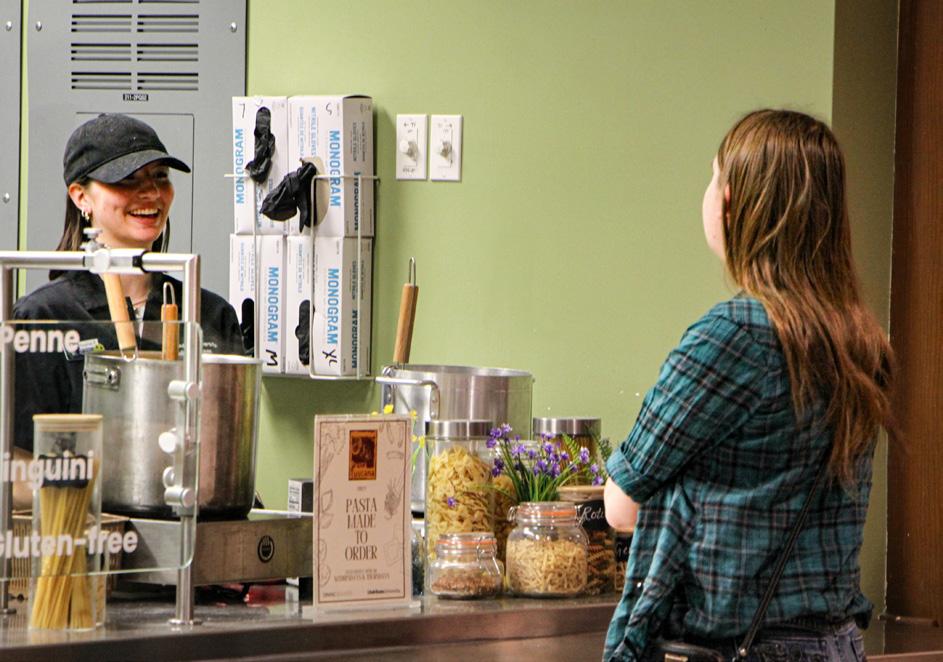
Sorensen said he wants USUSA to work with dining services to promote the program more. One suggestion he had was to display posters by the entrances of the two dining halls, the Aggie Marketplace and the Junction.
“There’s so many people that I think this could be beneficial for, but they just don’t know it’s there,” Sorensen said.
According to Sorensen, other universities — like Boise State University and Idaho State University — have successfully established similar programs.
“There’s students with extra meal swipes that just essentially go to waste, but they could really be put to a better use,” Sorensen said.
Andersen mentioned many meal swipes end up unused.
“One of the meal plans has 110 meals a semester, which amounts to about six meals a week,” Andersen said. “The average student only ends up using about four meals in a week.”
According to Andersen, these unused meals are factored in when determining meal plan pricing.
“Since we know students aren’t going to eat all of their meals, we’re able to make the plans cheaper,” he said.
Andersen said dining services is willing to support the program when organizations ask them to.
USUSA College of Engineering Senator Kaylee Shelton said she knew she wanted to be a co-sponsor of this resolution.
“Food is a huge portion of making sure students are successful in their lives, especially in academics,” Shelton said.
According to Shelton, many students struggle with food insecurity, and this is one way students can help each other without spending additional money.
“I think that it’s so important to be looking out for your fellow students because it just builds a better community,” Shelton said.

Jillian Peterson is a sophomore studying communication and media. She is a big fan of concerts, snowboarding and the Taco Bell drive-thru.
— jillian.peterson@usu.edu

By Dylan Moore STATESMAN REPORTER
Anew veterinary medical education building at Utah State University’s Logan campus is set to open in June, marking a major step in the expansion of the university’s veterinary program and its ability to train more veterinarians in Utah.
The 106,000-square-foot facility, located on the north end of campus, is part of a broader shift from a partnership-based program to a full four-year Doctor of Veterinary Medicine offered entirely at USU. The building was approved by the Utah Legislature in 2022 alongside the creation of the standalone College of Veterinary Medicine.
Dirk Vanderwall, dean of the college, said the new building allows the program to significantly increase enrollment and improve hands-on training opportunities.
“We’re excited to be moving to that brand-new facility in June,” Vanderwall said.
The building represents a $78 million investment and is designed specifically for veterinary medical education. It will allow the college to grow its class size from previous cohorts of about 30 students to 80 students per class, split evenly between Utah residents and non-residents.
Before the expansion, students participated in a “2+2” program in partnership with Washington State University, completing two years at USU before finishing their degree in Pullman, Washington. That
partnership will continue through 2028 for current students, but new cohorts are now enrolled in the full four-year program in Logan.
Vanderwall explained the increased capacity comes in response to a growing demand for veterinarians both in Utah and nationwide.
“There’s still a dramatic demand, a huge demand, for more veterinarians in Utah and really across the country,” Vanderwall said.
The new facility includes a range of specialized spaces aimed at improving student training. These include clinical skills labs, mock exam rooms with observation areas, an anatomy lab and a surgical suite. The building will also house dog and cat holding areas used for spay and neuter procedures in partnership with local shelters and humane societies.

Students will spend most of their time in the new building, where classrooms and labs are designed to support a more flexible and interactive curriculum. Vanderwall said the updated layout will allow students to move between lectures, labs and clinical training throughout the day rather than remaining in a single classroom.
In addition to academic and clinical spaces, the building includes areas focused on student well-

being. A wellness center staffed through Counseling and Prevention Services will provide mental health resources tailored to the demands of the veterinary program.
Keri Shoemaker, financial officer for the college, said the project has required close coordination between multiple groups throughout construction.
“There’s a big coordination effort that is occurring,” Shoemaker said.
Weekly meetings with contractors, designers and university officials have guided decisions ranging from lab layouts to furniture placement. Shoemaker said input from faculty has played a key role in shaping the building’s design.
“They’re being very, very good about asking our input on it because we’re the ones that are going to be using the space,” Shoemaker said.
The majority of funding for the building came from the state of Utah, with additional contributions from the college. Shoemaker said the building is fully paid for as the project nears completion.
Looking ahead, university officials expect the new facility to strengthen both education and community engagement. While the building will primarily support student training, it will also create opportunities for collaboration with local organizations and expand research capabilities.
“I would like to see it as community outreach as well,” Shoemaker said.
A full cohort of 80 students is expected to enter this fall. With the building opening this summer, the college is preparing for its next phase of growth as it works toward graduating its first full in-state class in the coming years.

By Jayke Martin
STATESMAN REPORTER
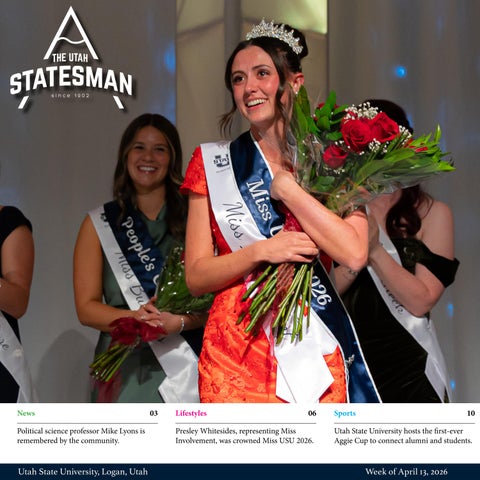
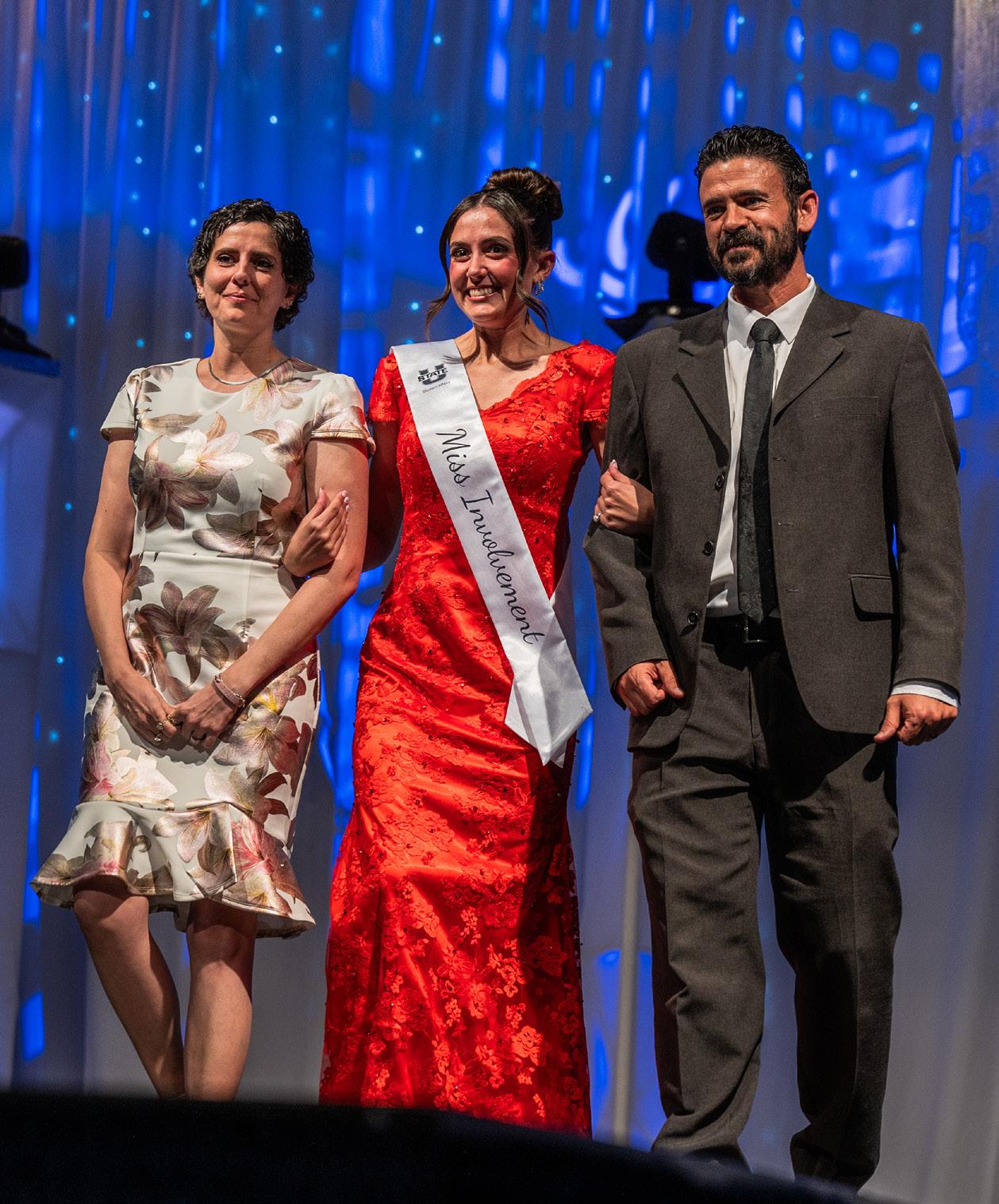
Presley Whitesides, representing Miss Involvement, was crowned Miss USU on April 7 during Utah State University’s annual Miss USU Pageant, held at 7 p.m. in the Evan N. Stevenson ballroom in the TSC. The pageant featured a mix of talent performances, on-stage questions and interviews, with contestants representing various campus organizations. Highlights included a vocal performance by Miss Art Sahalie Nelson of “Life on Mars?” by David Bowie, a dance and DJ routine from Miss Business Carly Veile and a flute performance by Miss Greek Shailynn Spangler. Other awards presented included Miss Congeniality, given to Miss Education & Human Services Berkeley Pitcher, and the People’s Choice Award, awarded to
Veile. Miss Student Alumni Association Eliza Thaxton was named second attendant, and Miss Athlete Natalie Hartley was first attendant.
Whitesides, a junior studying public relations, is involved in the Stephen R. Covey Leadership Center, serves as a university ambassador, participates in the Public Relations Student Society of America and has served on the USUSA Traditions Committee.
“It had always been a bucket list item,” Whitesides said about the pageant. “I’m someone who loves being on this stage. I just love performing.”
Whitesides said part of why she applied this year was that it was her final opportunity to compete.
“Even if I hadn’t won, this experience and the girls were phenomenal,” Whitesides said. “I just haven’t had an experience like it here at Utah State.”
Her talent performance combined singing and dancing. As a singer-songwriter, she created and mixed her music track herself and enlisted friends to help choreograph the dance.
“My best friend is on Dance Co, and I asked her and a couple of my other best friends, ‘Would you teach me how to dance?’” Whitesides said. “I don’t dance by trade. I wouldn’t say I’m technically great at it.”
She explained the biggest challenge of the evening was both singing and dancing simultaneously.
“They were teaching me hip-hop, and it’s hard hitting, and you’re moving your body, and you’re like, ‘Wait, I need to take a breath here,’” Whitesides said. “They were just incredible. We rehearsed weekly for the past two months.”
One of Whitesides’ favorite moments was the question portion of the pageant.
“I love storytelling. I was like, ‘Okay, I’m going to tell a story, and it’s either going to land or it’s not what they’re looking for, and that’s okay,’” Whitesides said. “Luckily, it was something they enjoyed and resonated with.”
Spangler also shared her experience in the pageant.
“Truthfully, I did it for the lore,” Spangler said. “I applied, interviewed and was chosen as Miss Greek, and now I’m here.”
Spangler said preparing for her talent performance and stepping on stage were both exciting and intimidating.
“I’m just an anxious person, so I was scared about a lot of it,” Spangler said. “But it’s so fun, even if you don’t win, to go on stage and celebrate everything you represent.”
Both contestants emphasized the importance of connection and support, saying the other contestants were part of what made the experience so meaningful.

Jayke Martin is a junior studying journalism with a minor in theater. She loves reading and meeting new people.
— jayke.martin@usu.edu
By Alyssa Caywood STATESMAN REPORTER
Community members gathered at the Utah Theatre to immerse themselves in the Utah State University Opera Theatre performance from April 3-11.
“I was in awe at the notes they hit,” said USU junior Mallory Grunander.
“The talent is insane.”
Utah State’s Opera Theatre students worked hard on their performance of Wolfgang Amadeus Mozart’s “The Abduction from the Seraglio” under the direction of Dallas Aksoy alongside the USU Symphony Orchestra to create a memorable experience for audience members.

The opera was written just before Mozart’s more widely recognized opera, “The Magic Flute.”
“This is a lesser-known Mozart opera,” said Kate Haycock, a student performer who played Constanza in the production. “The music is incredible, and my castmates are so incredibly talented.”
Opera students had the opportunity to work with other university departments to prepare and perform the show for USU and Cache Valley community members.
“We’ve been preparing since about beginning- to mid-January,” Haycock “We’ve gotten to collaborate with our symphony orchestra, which doesn’t always happen, so it’s been a real pleasure.”
Audience members valued the talent and musicality the live orchestra brought to the performance.
“The orchestra behind it was insane, too,” Grunander said. “It was really, really cool.”
The show was performed four times, each time delivering an entertaining experience for the attending audience. The show provided a comedic and dramatic storyline told with musicality and song.
“I just really enjoyed the humor of the show,” said USU junior Liza Sorensen. “I wasn’t expecting it to be as funny as it was, but I feel like the actors did a really good job at making their characters funny and enjoyable.”
Beyond its humor, the opera explores contrasting portrayals of love through its characters. Haycock said the production presented both playful and deeply devoted relationships.
“One couple is more comedic. They’re kind of snarky with each other and sarcastic, but they still love each other,” Haycock said. “That’s contrasted with Constanza and Belmonte, who have this really tender love and are willing to die for each other.”
The storyline brought entertainment through its
comedy, romance and tension, but a lot of time and effort went into preparing the details of the set and clothing of the characters, which tied the performance together, according to Haycock.
“I think that our set design and our costume design are stunning,” Haycock said.
The students’ efforts did not go unnoticed by the audience. USU senior Grace Packer said above all, the performers’ technical skills and attention to detail stood out most.
“In every note that they were singing, you could hear the hours of practice they put into it,” Packer said. “It was very well done, and I thought the costuming was just perfect. I loved all the details.”
Alyssa Caywood is a first-year student at USU studying journalism. She loves anything outdoors from backpacking to snowboarding to water skiing. She loves to write and is stoked to be working with the Statesman.


Eva Uribe is a senior and the music manager for Aggie Radio whose favorite part about the station is working to create enjoyable shows for the community. You can listen to the music Eva picks for the station at 92.3 FM.












SAAVI and CAPSA that assist survivors of sexual assault.
SAAVI, or the Sexual Assault and Anti-Violence Information Office, is a confidential, on-campus resource at USU that provides students and staff impacted by interpersonal violence with free support, advocacy and traumainformed counseling.
“SAAVI has what’s called the ‘survivor fund,’ and it is a fund that exists solely based off of donations,” said Ashleigh Totten, outreach and education coordinator and victim advocate for SAAVI. “A huge portion of those donations actually come from Alpha Chi and their fundraisers throughout the year.”
This year, AXO combined Denim Day with their Waffle Wednesday ice cream event to bring a more relaxed atmosphere to a serious conversation.
“There are so many young men and young women who have suffered from this and don’t feel able to speak out, and this is an issue that is especially present in college, unfortunately,” Clark said. “I think it’s really important to bring awareness to it and to hold events that make people feel more comfortable about such a serious topic.”
Two other chapter sororities on campus also make strides to host events and activities that support their own philanthropic causes.
Kappa Delta, or KD, collects donations for children and family-based charities during its Shamrock Week at the beginning of April.
“80% of our funds go towards The Family Place, and then 20% of our funds go towards PCAA, which is Prevent Child Abuse America,” said Cameron Carnes, the philanthropy marketing chair for KD. “Our philanthropy is very near and dear to every single member’s heart. It’s basically like the backing of everything we do.”
Sigma Alpha, or SA, is a professional agricultural sorority. Its philanthropy centers around promoting agriculture in the classroom.
By Essence Barnes STATESMAN SENIOR REPORTER
Wearing denim took on a deeper meaning at Utah State University as students and locals joined the Alpha Chi Omega sorority, or AXO, in recognizing Denim Day and raising awareness about sexual assault.
The sorority-led event was held at the beginning of Sexual Assault Awareness Month on April 1. By encouraging participation and providing a safe space, the sisters of AXO sought to spark conversation and increase awareness on campus.
AXO vice president of philanthropy Lily Clark said this event is at the heart of her sorority’s mission.
“Our philanthropy is domestic violence awareness and sexual assault awareness,” Clark said.
Denim Day is an annual, worldwide campaign that encourages participants to support survivors, protest victim-blaming and educate against myths surrounding sexual violence by wearing denim.
“In the ‘90s, there was unfortunately an Italian court case where a woman was raped, and they said that because she was wearing tight jeans, it was consensual,” Clark said. “So now, to bring awareness and to fight for survivors, there is Denim Day.”
For a $6 entry fee, attendees could enjoy unlimited ice cream cones while supporting local organizations like
“Sexual assault is such a heavy topic, and people are very hesitant to even talk about our philanthropy or feel comfortable bringing things up,” Clark said. “We want the community members to feel like we support survivors, we accept you here, you’re able to come here and feel comfortable.”
According to Clark, the event was able to raise over $1,000, a contribution Totten said can have an incredible impact.
“That survivor fund allows us to help out in immediate times of need,” Totten said. “Every single case is different, and being able to have that fund allows us to help temporarily with some of those immediate basic needs.”
Some of the basic needs SAAVI can help survivors meet include housing, food, transportation and childcare. SAAVI can also help clients with things like setting boundaries and building healthy relationships.
“We work with people over such a wide spectrum of harm,” Totten said. “We offer a lot more than just helping survivors of sexual violence; although, that is very important and a big part of what we do.”
SAAVI and CAPSA tabled at the event, answering questions and sharing information.
“Having events like this lets us have a fun interaction with students,” Totten said. “It allows students to engage with us in a way that maybe doesn’t seem as scary as stopping by our office.”
Clark said she was happy the event not only raised funds but also encouraged conversations about consent and support while providing a safe space for survivors and allies.
“Our sisters promote agricultural awareness by speaking in classrooms and supporting local farming communities,” wrote Rylie Byington, the president of SA, in a message to The Utah Statesman. “For us in sigma alpha it is also an opportunity to encourage and support women pursuing careers in agriculture, helping build a more inclusive and innovative future.”


Essence Barnes is a third-year student majoring in journalism who enjoys reading, writing and storytelling.
— essence.barnes@usu.edu

By Mia Nielsen STATESMAN REPORTER
Roman Venger said he can’t remember his life without tennis. Venger started playing at age six, joined the Ukrainian National Team at 14 and is in his second season playing for Utah State University.
His next goal is a professional ranking, and according to USU Men’s Tennis head coach Aaron Paajanen, he’s close.
“I think he’s got a good shot at it this summer,” Paajanen said.
According to Paajanen, only one USU player, Jakub Medved, currently holds an Association of Tennis Professionals world ranking. These rankings determine which players qualify for professional matches and seed players in tournaments.
“It’s not something that’s easy to do, but it’s something that’s definitely possible for him,” Paajanen said of Venger.
Venger said he’s training as hard as he can to prepare and that practicing and competing on a collegiate level has helped him grow as an athlete.
“I will go back home in summer and just try to compete as much as I can,” Venger said.
Paajanen said despite obvious talent from the start, Venger has grown significantly during his time at Utah
State from his serve to his ability to keep up with the pace of college tennis.
“The exciting thing as a coach is being able to help somebody develop and remembering where they were when they got here and where they’re at now,” Paajanen said.
Paajanen said his goal for his players is improvement on and off the court.
For Venger, Paajanen’s advice to stay focused and ready on and off the court has been instrumental in helping him navigate the demands of collegiate tennis. Beyond practicing, competing and traveling for the tennis team, Venger is also studying finance.
“I feel like everyone can get lost sometimes, but you need to know why you’re doing it and why it’s important for you,” Venger said. “I would say my goal keeps me motivated.”
Venger said his goal for the last 15 years has been to play professionally.
As a teenager, he represented Ukraine, where he said he played against the best junior players from around the world. At Utah State, he’s learned to play with a team.
Eliot Nobel has played as Venger’s doubles partner for the last seven matches of the season. According to Nobel, Venger wasn’t previously on the doubles lineup but requested to play doubles so he could contribute more to the team.
“He went to Aaron’s office and then just asked if he could play doubles,” Nobel said. “He asked if me and him could play because he thought that we were a good fit.”
In a recent match against Grand Canyon University, Nobel and Venger won their match 6-4, helping clinch a share of the Mountain West Conference title.
Nobel attributes their success to on-court chemistry, two years on the same team and their shared European background.
“We always have a lot of fun when we go out and play matches,” Nobel said.
Nobel said they have the same goals on the court and that playing with Venger helps to alleviate pre-game nerves.
“I usually get very nervous during the matches or especially before the matches,” Nobel said. “He calms me down a little bit and makes me think that this is just a tennis match. It’s not the end of the world if it doesn’t go our way.”
For Venger, that sense of camaraderie is a welcome change from junior tennis.
“It’s my first time playing college tennis,” Venger said. “All my life, I’ve been doing it alone, and here with the team, with all of my teammates, it’s so much more fun. It’s more competitive.”
Paajanen said Venger’s value extends beyond strong forehands and backhands. His teammates trust him.
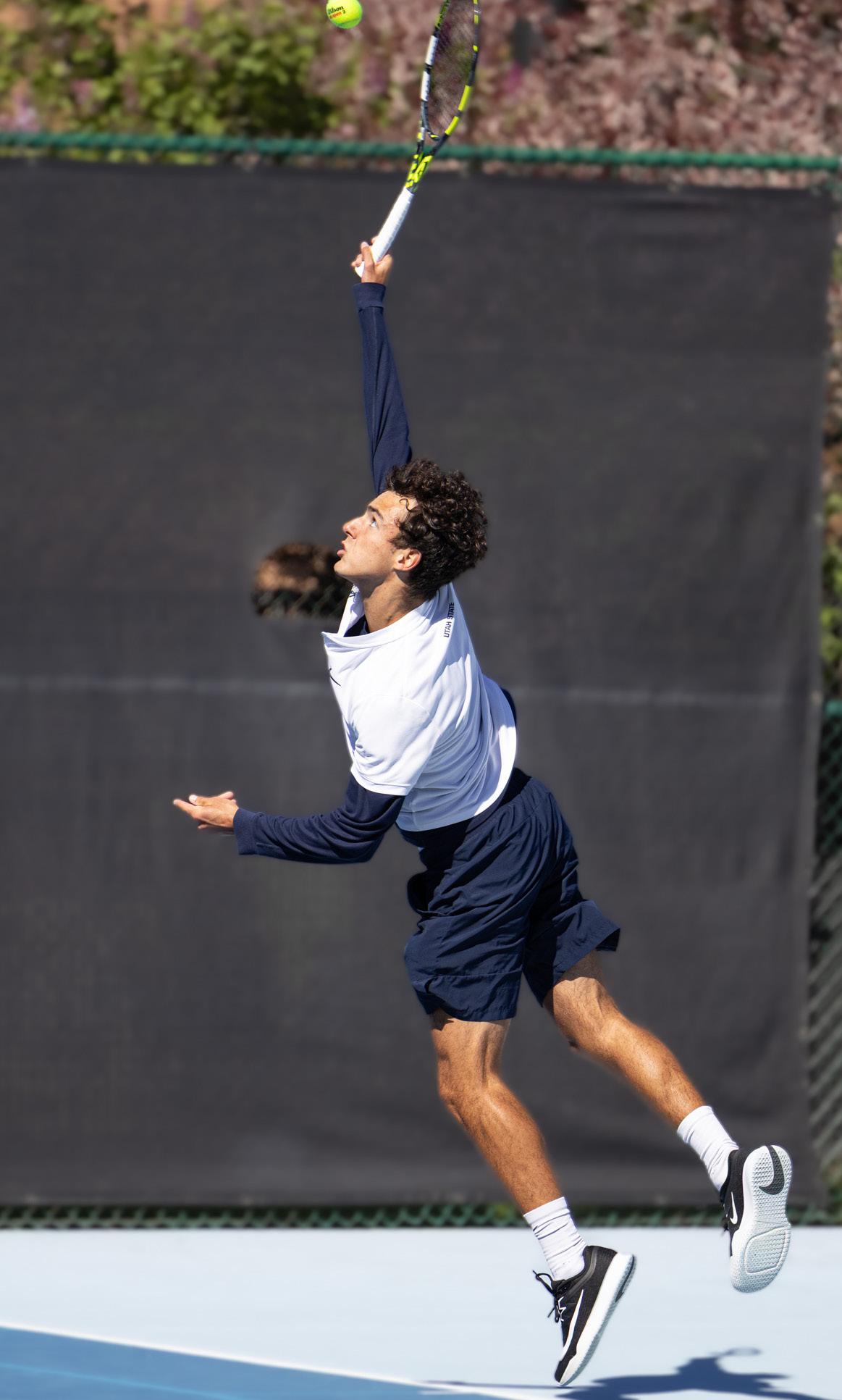
“I think the guys know that they can rely on him to get us a point,” Paajanen said.
In a game where only four points are needed to win a match, Paajanen said this reliability is important.
“When you win alone, it feels good, but when you win as a team, it feels so much better,” Venger said.

Mia Nielsen is a sophomore studying plant science and journalism. When she’s not writing, she enjoys live music, driving up Logan Canyon and daydreaming about moving to Spain.
— mia.nielsen@usu.edu
By Rory McNeill STATESMAN REPORTER
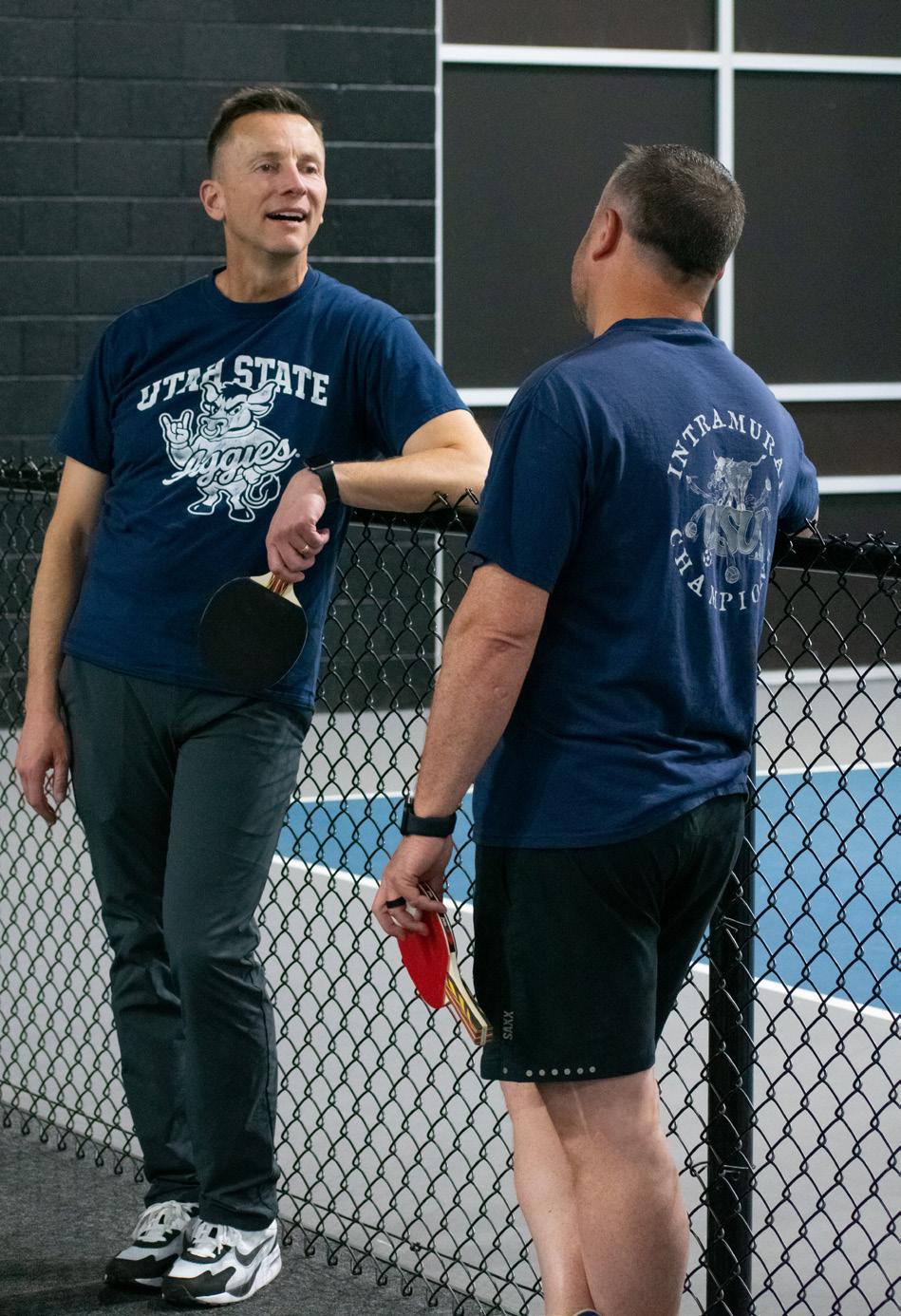
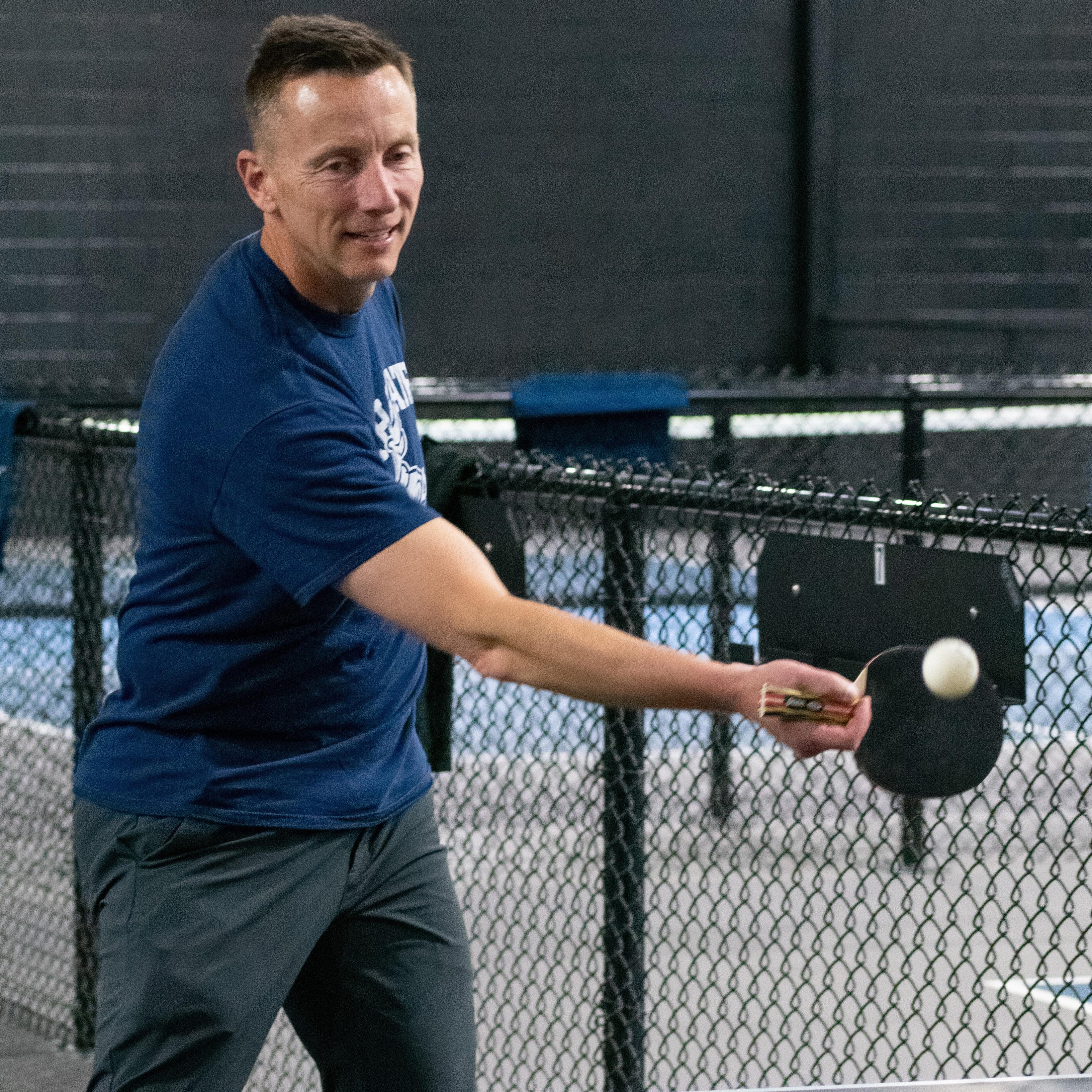
Utah State University recently held its first-ever Aggie Cup, a pickleball tournament for both current USU students and Aggie alumni. With two different tournaments with various skill levels and an opportunity to play ping pong with USU President Brad L. Mortensen, the Aggie Cup was full of activities for students to meet alumni in Cache Valley.
The event was hosted by the USU Alumni Association on April 8. Whitney Boudrero, senior director for alumni engagement, shared about how often Cache Valley gets forgotten about when it comes to hosting alumni activities, despite the fact it has one of the highest concentrations of USU alumni.
“We’re always looking for fun ways to engage our alumni. We’ve held pickleball events in Vegas before, so we just started kicking around the idea of how much fun it would be to do one in Logan,” Boudrero said. “We’re always looking for different ways to reach different groups of people, and we figured pickleball is something that people get pretty passionate about — kind of like a golf tournament but pickleball style.”
While the pickleball tournaments, featuring a partnership with local company Holbrook Pickleball, were the highlight for the majority of attendees, the alumni association wanted to allow students to connect with alumni. With alumni donors in attendance, students had opportunities to make connections.
The alumni association invited alumni to attend and recruited the USU Pickleball Club to help get students in attendance as well. Combined, they were able to fill up both tournaments with 16 teams in each tournament. Some attendees were veterans of the local pickleball scene, while others were playing in a competitive scene for the first time.
“The tournament has been super fun. This is my first tournament ever, so at first, it was super nerve-racking, but then I remembered how I play, and I was able to play better,” said senior Lily Hufford. “We’ve only won
about half our games, but it’s been a lot of fun. I feel like we’ve had some really good games to play in.”
Along with the pickleball tournaments, USU President Mortensen attended the event between tournaments to play ping pong with the students and alumni present.
Boudrero said one of the main goals of the event was to have fun, so she asked Mortensen if he would be
interested in playing pickleball. He responded that he was good at ping pong.
“We got everything planned with the Picklr. We discovered they had two ping pong tables and decided ping pong would be a lot of fun,” Boudrero said. “I think it shows our new leadership is really trying to be genuine, authentic, and connect with people. So, we thought that ping pong with the president would be a fun way for that to happen.”
The Aggie Cup served as more than just a day of competition but as an opportunity for students and alumni to connect and share their Aggie spirit. Boudrero said the alumni association hopes the Aggie Cup can become a regular event, helping to continue to grow the connection between the students and the alumni in Cache Valley.

Rory McNeill is a sophomore from Rocklin, California studying mechanical engineering. He loves Aggie sports, skiing, golf and writing music.
— rory.mcneill@usu.edu
By Emma Barker STATESMAN REPORTER
Three games in three days and one red-eye flight. For the Utah State University Men’s Lacrosse club team, a spring trip to Boston was never just about wins and losses.
The Aggies went 1-2 against Bridgewater State University, the University of Dayton and the University of Rhode Island, but head coach Matt Taylor said the scoreline wasn’t the point.
“Going to Boston is great. We get an opportunity to fly together — to travel together,” Taylor said. “The boys are going to talk about it for years.”
The trip had been years in the making. Club president Braden Hamblin, a junior biology major, said it came out of a relationship with the East Coast opponents the Aggies had played at neutral sites. When the previous coach scheduled the game and then stepped down, Hamblin and Taylor decided to see it through despite it being Taylor’s first season leading the program.
“We just kind of scrambled to make adjustments and somehow made it work,” Hamblin said.
The team arrived on March 6 via a red-eye flight with little sleep and lost their first game. They bounced back the next day against Bridgewater State, a fight Taylor said stood out as one of their best performances all season. The finale went to their opponents, which Taylor said was the strongest team all weekend.
Hamblin said the losses were easier to brush off given the context. USU lost eight of 10 starters from last year’s roster and returned with 28 first-year players on a roughly 40-man team.
“I think it was really an identifier of who we are and who we can become,” Hamblin said.
Taylor pointed to defender Zach Davis as a standout player, calling him a warrior who played nearly the
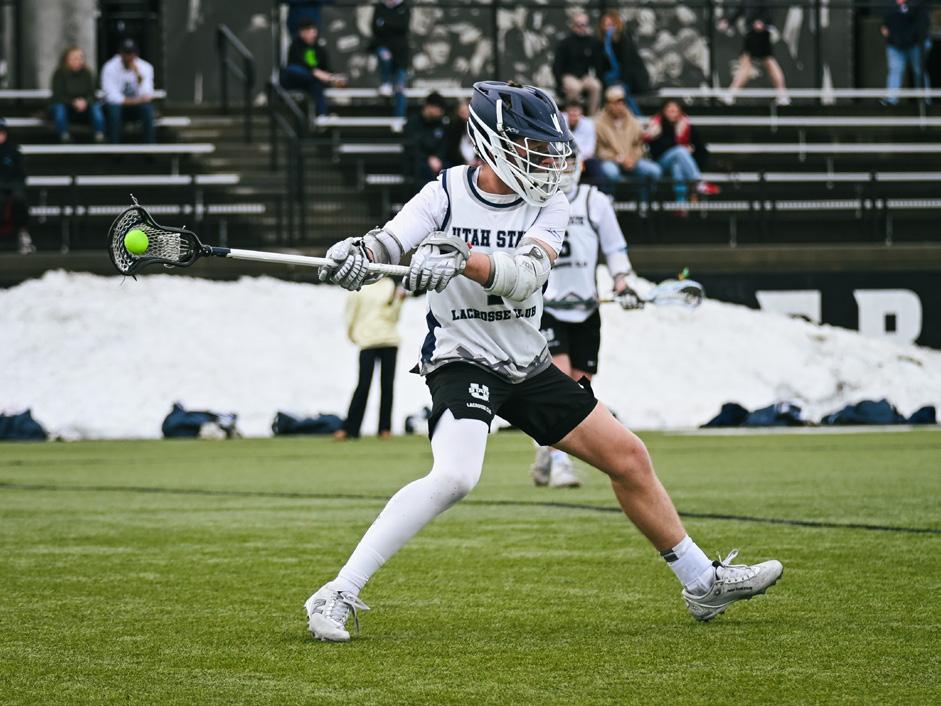
entirety of all the games. Hamblin also highlighted firstyear student Texas Wilde, a defensive midfielder stepping into bigger shoes than most first-years.
“He is learning very quickly,” Hamblin said.
Beyond the scoreboard, the trip gave players a view into the culture of lacrosse on the East Coast, where the sport gained popularity. Utah only sanctioned lacrosse in high schools about five years ago. The Aggies played one game inside Providence College’s stadium — a Division I varsity facility.
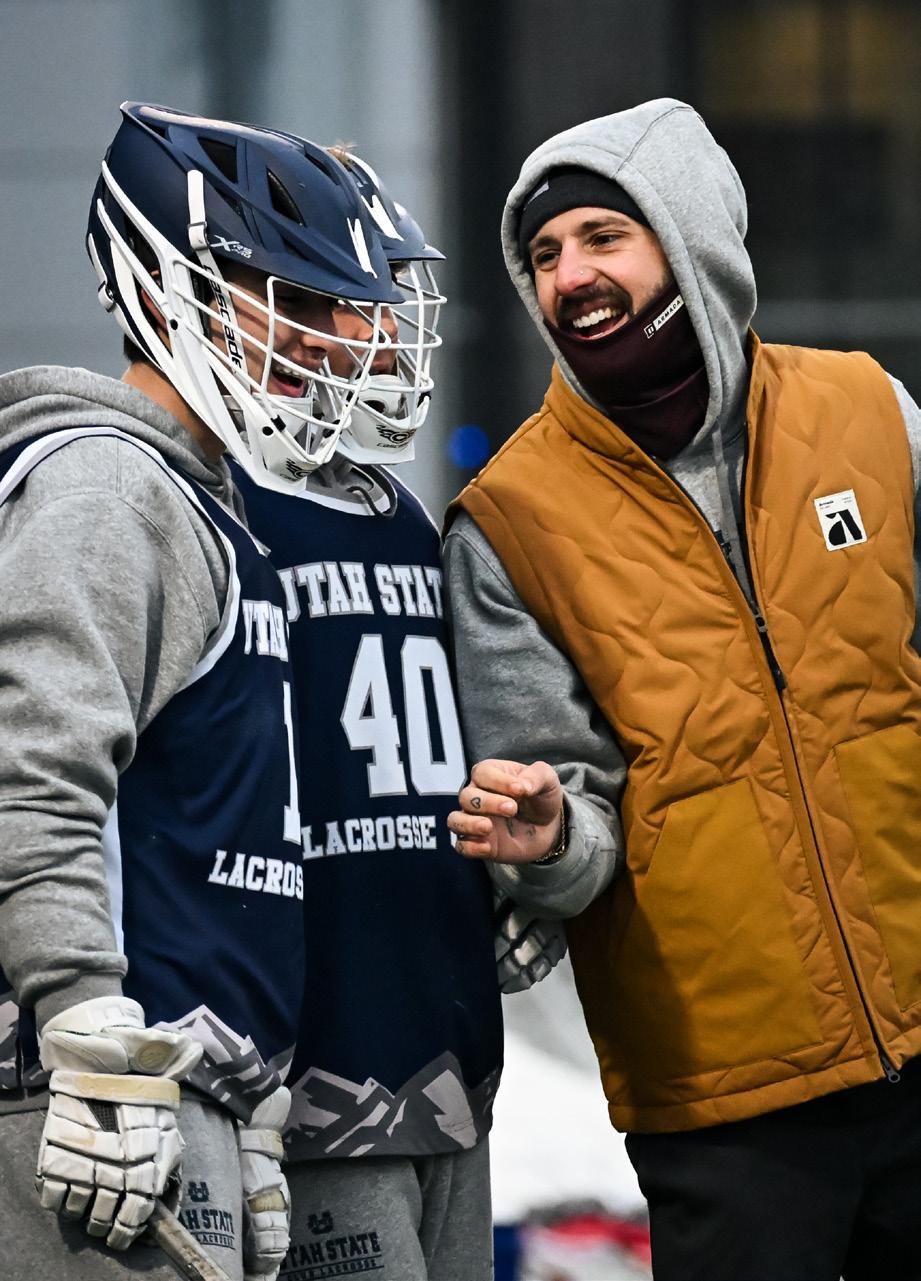
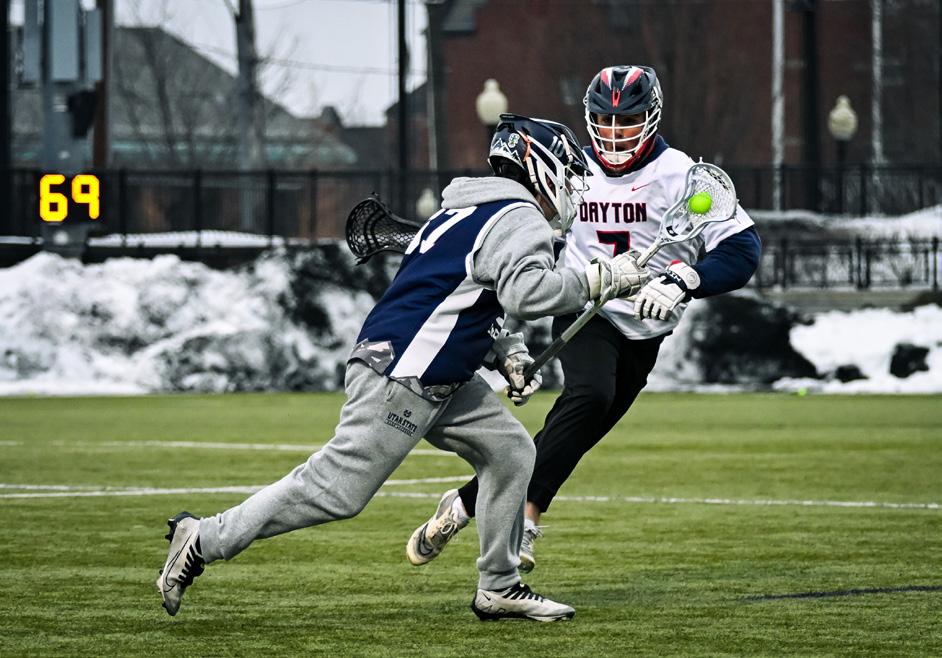
According to Hamblin, the team piled into six minivans, navigated Boston’s intense traffic and spent a free night exploring downtown. There, they spent time together and visited a chapel tied to the Boston Tea Party.
“We have a bunch of different personalities, a bunch of people who have different ways they live,” Taylor said. “But they all seem to really enjoy having fun together.”
According to Taylor, roughly half of the team lives with at least one other lacrosse player. This closeness, he said, carries directly onto the field.
“That bond, that tight-knit community — that’s what keeps you coming back and working harder for those guys,” Taylor said.
Like all USU club sports, the team is entirely self-funded. The trip was covered mostly through player dues, with donations from some local businesses connected with players’ families filling the rest of the gaps. Not everyone could afford to go, something Hamblin said he hopes to change in future trips.
“Coach has a wonderful vision for the team, and that is one day every player could go,” Hamblin said.
With graduation on the horizon, the roster will lose only four or five players at the season’s end. The team has already signed up for a tournament in Puerto Rico next year. The long-term goal is a national championship.
Hamblin said the biggest culture gap he noticed wasn’t just athleticism. It was game IQ, a product of stronger coaching pipelines in the East.
“Out here, just because the sport is new, you get a lot of really good volunteer dads who, unfortunately, just don’t have the knowledge of the game,” Hamblin said.
Regardless, Taylor and Hamblin both said what stuck with them most wasn’t in the competition — it was watching the team come together on and off the field.
“I’ve got the same five or six buddies that I still meet up with, and we tell the same stupid stories, but we laugh every time,” Taylor said. “That’s the type of thing we want to do for these guys.”
“Everything’s in front of us,” Taylor said. “It’s just a matter for the boys to go out there and put that extra effort in.”

Emma Barker is double-majoring in journalism and communication and sociology. When she’s not reporting, she enjoys spending time with her dog and husband, thrifting and attempting to keep her sourdough starter alive.
By Grace Colvin STATESMAN REPORTER
For the members of the Utah State University Powerlifting Club, it was time to pump some iron at nationals last week.
The club competed at the USA Powerlifting Collegiate Nationals, held from April 9-12 in New Orleans. The team left for the competition on April 7, and athletes participated in individual lifting events every day of the four-day competition.
Managed by USU Campus Recreation, the club sport aims to provide “a space for athletes at USU who specialize in squat, bench and deadlifts to come together and compete,” according to Ian Maughan, club vice president.
Maughan said anyone is welcome to join the team regardless of experience or strength level, though a fee is required to participate and compete.
According to club social officer Kate Bushnell, the group takes a more relaxed, unstructured approach to the sport, allowing its 20-30 members to set their own goals at practice and work with any program that aligns with their individual fitness goals.
Participating in competitions like nationals is not a requirement. However, Bushnell says many members find it to be a high point of the club experience — and for some, it’s their first time competing on a national level.
“It’s a big goal for a lot of powerlifters on the team. We get people who have never competed and never even powerlifted, and they hear that we’re going to collegiate nationals,” Bushnell said. “It becomes a really big motivating factor.”
As announced on the club’s Instagram page, nine Aggie athletes competed in New Orleans, including Maughan and Bushnell. Other club members who competed were Hayden Randall, McKenna Hughes, Rebekah Jardine, Zachary Edwards, Derek Hayes, Parker Williams and Charles Gardiner.
According to Maughan, each athlete competed in an individual event within their weight class, and their performance translated to “points” for the entire team’s ranking.
The club has competed in several national competitions in years past, with some of the most recent ones taking

place in Oklahoma City in 2025 and Atlanta in 2024. Maughan, who is in his fourth year of membership on the team, had high hopes for the group’s performance at nationals.
“We’ve continued to send more athletes every year,” Maughan said. “In Atlanta, I want to say we placed 183rd — something like that, really deep in the list of all the schools, and then just in this last year, we placed 23rd. So, quite a bit of improvement.”
Although the team always wants to perform well in competitions, Bushnell said she believes the most rewarding thing the club brings to campus is its strong sense of community.
“We’re all trying to get stronger, and that can be physically and mentally. It’s just a really supportive
community, and we’re all working to help each other,” Bushnell said. “I know so many of my teammates who have made so many friends from being on the team, and you just get so close in a whole different way when you’re struggling together and learning together. It’s fun.”
It’s a sentiment Maughan agreed with.
The people that stick around for a long time are the people that make friends.
— Ian Maughan
“The people that stick around for a long time are the people that make friends — the people that get really involved with the team and the community,” he said. “The powerlifting team is providing a space for people that are either former athletes or really enjoy fitness, lifting weights and getting strong — just a place for them to hang out with people that are also interested in those things.”

Grace Colvin is a sophomore in the theater education program at USU. After graduation, she plans to become a middle school drama teacher. When she isn’t writing or working on a play, she loves making crafts and woodworking.
— grace.colvin@usu.edu
— Kate Bushnell





Rylee Patterson is a sophomore studying art education. She has her own photography business and has started photographing weddings this past year. When she isn’t creating, she can be found hiking, climbing, reading or doing something with friends.


Last week’s solution:


By Elise Gottling