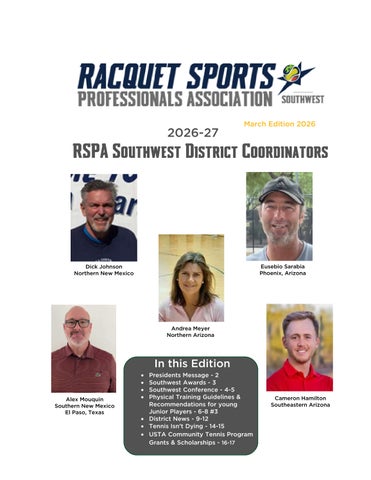
March Edition 2026
RSPA Southwest District Coordinators


In this Edition
• Presidents Message - 2
• Southwest Awards - 3
• Southwest Conference - 4-5
• Physical Training Guidelines & Recommendations for young Junior Players - 6-8 #3
• District News - 9-12
• Tennis Isn’t Dying - 14-15
• USTA Community Tennis Program Grants & Scholarships - 16-17
President’s Message
Greg Prudhomme, PhD RSPA Southwest President
Hello RSPA Southwest Pros! I hope your 2026 is off to a great start on and off the courts!
I must begin by telling you how honored I am to serve the RSPA Southwest Division as President for the next two years. Since joining the RSPA in 1993, I’ve been grateful for the education, collaboration, and opportunities I’ve benefitted from both professionally and personally. I’m very happy to have the chance to give back to an organization that has done so much for me.
As this new term begins, I want to thank our outgoing president, Suk Ong, for her leadership during the past two years. We’re grateful that she will continue to serve with us as Immediate Past President. Additionally, I speak for all of us when I thank Jack Michalko for his perennial leadership as our executive director. Our division would not be where it is today without his hard work year after year. Jack sets an outstanding example of professionalism in communication, attention to detail, and his willingness to help—among many other qualities.
As your president for the next two years, I plan to continue the work begun by previous boards and our current board in their service-oriented role as ambassadors of tennis. Building on that theme, we plan to engage with local tennis communities to provide support and promote the value of our RSPA organization and its professionals. For example, our RSPA board will host USTA adult and junior tennis tournaments to build relationships with Southwest players and increase awareness of our brand. Additionally, we will present a High School Tennis Workshop designed to help elevate high school coaching and player development while showcasing the expertise of our RSPA Southwest professionals. (Let us know if you’d like to be involved. Details to come.)
Before I conclude this message, I’d like to highlight what I believe are two of the most important RSPA benefits that have served me well in my career. First and foremost, take advantage of networking with your fellow pros. The friendships and knowledge we gain from the formal, informal, and social relationships within this organization are priceless. I cherish the many friends I’ve made in the tennis industry and specifically in the RSPA. I began my career as a former college tennis player learning “on the job” how to teach clinics, coach summer camps, and give private lessons. Thanks to the RSPA and the relationships I was able to build, I grew into a professional in the tennis industry.
The next invaluable benefit of your RSPA membership is the easy access to continuing education. Use the RSPA website, here, to access modules, seminars, and sessions to expand your tennis knowledge and earn educational credits. Resources cover technique, tactics, programming, leadership, and more. The premier educational event in the Southwest is our annual Division Conference. I highly recommend adding it to your calendar every year. This in-person conference combines oncourt educational sessions, classroom panels, networking, a vendor show, and plenty of fun. The conference committee is currently preparing an outstanding agenda for the 2026 RSPA Southwest Conference, which will take place at Paradise Valley Country Club on May 29–30. I hope to see many of you there.
There are many more benefits to being part of the RSPA, including brand partnerships, insurance coverage, and the opportunity to attend the World Conference, but the relationships and learning have always been the top benefits for me. I hope you’ve already been taking advantage of these opportunities—or that you’re ready to start this year.
I look forward to continuing to build relationships, learn, and collaborate with all of you while serving as your RSPA Southwest Division president for the next two years.
HallofFame
RSPA SOUTHWEST DIVISION HALL OF FAME
2026 Awards
The RSPA (formerly known as USPTA) Southwest Division Hall of Fame honors individuals who, through the excellence of their activities and accomplishments, have brought recognition and esteem both to themselves and to the RSPA organization.
Eligibility:
Applications must be submitted in writing to the Hall of Fame Committee. To nominate someone, CLICK HERE.
One candidate will be selected each year based on the following criteria:
Must be a member of the RSPA Southwest Division in good standing for a minimum of 10 years
Involvement in RSPA at the local, state, sectional, and/or national level
Teaching and/or coaching accomplishments
Playing accomplishments
Publications or innovations
Involvement in allied organizations and other contributions to the teaching profession and the promotion of tennis
The committee may also consider a nominee who is being honored posthumously, in addition to the one candidate selected per year.
Dear RSPA Southwest Professionals,
Please consider nominating someone for the 2026 Southwest Awards Program! To nominate someone, Click Here.
Self-nominations are welcome, but if you know someone who would be a great candidate, please don’t hesitate to nominate him or her. It’s the ultimate compliment! The division deadline for applications and nominations is Friday, April 24, 2026. If you have any questions, please don’t hesitate to contact me. Thank you for thinking of your fellow RSPA-certified teaching pros as we look for fantastic nominations!
Best wishes,
Leslie Banks – Awards Chairperson lesliealison16@gmail.com (419) 302-7663

Thursday, May 28th
2026 Southwest Conference May 29-30
Paradise Valley Country Club, Paradise Valley, AZ
Location
6-8pm RSPA Southwest Board of Directors Meeting Private Dining Room
Friday, May 29th
7am-4pm RSPA Southwest Registration Ballroom
8:30-9:00 am Cardio Feeding Competition-Karen Fleissner Stadium Court
9am-9:50 am John Perry-Thinking Out Loud:Introducing Tactical Tennis Concepts in Group and Team Settings Stadium Court
10-10:50 am Jack Broudy-Sell the Hole, Not the Drill: What’s Missing in traditional Tennis Instruction Stadium Court
11-11:50 am David Smith- Large Group On-Court Programming Stadium Court
12-1:15 pm General Membership Luncheon/National Update Ballroom Scott Burton will present the national update
1:45-2:50 pm Roundtables with Questions and small group Discussions Ballroom - Moderated by Ryan Johnson
3-3:50 pm Modern Trends in Club Culture & Hospitality
Panelists: Carol Nalevanko, Ryan Cozzetto, Scott McCulloch -Moderated by Greg Prudhomme PhD Ballroom
4-4:50 pm Kyle Whatnall-The Club Blueprint: Proven Best Practices for Running a Modern Racquet Sports Facility Ballroom
5-8 pm CourtReserve Cocktail Party & Southwest Trade Show Ballroom
Saturday, May 30th
7am-4pm RSPA SW Registration Ballroom
7-8:15am RSPA/USTA Board Breakfast Ballroom
8:30-9:20 am Ashlee Candelaria-Footwork Fundamentals Pickleball Court
9:30–10:20 am USTA Red Ball 101 Stadium Court
10:30-11:20 amScott McCulloch-Intentional Growth: Designing Racquet Sports Programs that Scale Ballroom
11:30-12:20 pmSimon Paek- Defining a GREAT Professional Ballroom
12:30-1:50 pm RSPA Southwest Awards & Hall of Fame Luncheon Ballroom
2026 Southwest Annual Conference
To Register: Click Here
Paradise Valley Country Club
Paradise Valley, AZ.
Site of the 2026 RSPA Southwest Conference


2026 RSPA Southwest Conference Hotel Information:
Hotel: Hampton Inn 10101 N. Scottsdale Road
To reserve rooms at the Hampton Inn Hotel for the Southwest Conference please CLICK HERE.
The room rate for the Southwest Conference is $124.00 a night, which includes a continental breakfast, free Wi-Fi, and free parking. This rate is only guaranteed through May 7, 2026. So make your reservations early!
Physical Training Guidelines For Players 11-18
by Doug MacCurdy


This is part 3 in a 15 article series by Doug MacCurdy! In my last article, we looked at specific types of training exercises that were age appropriate for Phase 1 (Ages 6-8) and Phase 2 (Ages 9-10). This month I will discuss physical training guidelines for players in Phase 3 (Ages 11-12), Phase 4 (Ages 13-15) and Phase 5 (Ages 16-18+).
Phase 3
Approximate Age of Players: 11-12
Name of Period: Development
Characteristic of Period: Building up training
Total Training Time: Approximately 11 - 16 hours per week
Tennis Training Time: Approximately 6 - 9 hours per week
Physical Training Time: Approximately 5 - 7 hours per week
Listed below are the physical skills most favorable to work in this age group. An A, B or C indicates the relative importance of the skill for this age group. Note that flexibility should be improved or maintained throughout the tennis career:
*Coordination A
*Agility A
*Speed A
*Tennis Technique A
*Aerobic Endurance B (15 minutes +)
*Muscular Endurance C
*Flexibility B
Methods to use:
*Introduce and use circuit training
*Introduce dynamic stretching routines
*Begin using longer runs, preferably in interesting places and on softer surfaces
*Use coordination, agility and speed drills on a daily basis, preferably before playing tennis.
*Increase the speed and complexity of the exercises used previously
*Boys and girls may prefer different types of exercises
Sample drills, games and exercises:
*Longer runs – some up to 30-35 minutes
*Throwing drills with American football to develop skills
*Continue to use other sports and cross training
*Tag type games such as cat and mouse
*Obstacle courses and climbing for balance
*Games with tennis balls
*Games emphasizing balance and recovery of balance
* Jump rope (various)
* Combinations of runs, jumps and/or throws (increased difficulty)
* High jump, long jump, vertical jumps and running and jumping
* Lunges can be introduced
* Crawling, crab-walking, rolling and somersaulting
* Agility ladder and other agility runs
* Frisbee
* Hopping drills using hoops and/or lines
* Push ups, sit ups, dips and back exercises
* Exercises with light medicine balls
* Can introduce some light dumb bells
* Exercises with Swiss balls
* Sprints
* Sprints involving decesion making
* Use static and dynamic stretching techniques
* On court movement and coordination drills
Phase 4
Approximate Age of Players: 13-15
Name of Period: Performance
Characteristic of Period: Performance training
Total Training Time: Approximately 20 hours per week
Tennis Training Time: Approximately 12 hours per week
Physical Training Time: Approximately 8 hours per week
Listed below are the physical skills most favorable to work in this age group. Note that flexibility should be improved or maintained throughout the tennis career:
* Tennis Technique A (Should be completed)
* Coordination B
* Agility A
* Speed A
* Power B
* Aerobic Endurance A
* Muscular Endurance A
* Muscular Strength B
* Flexibility B
Methods to use:
* Individual training plans should be developed for each player.
* Use circuit training.
* Use dynamic stretching routines.
* Use coordination, agility and speed drill on a daily basis, preferably before playing tennis.
* Weight training should be introduced, emphasizing muscle endurance.
* Use longer runs, preferably in interesting places and on softer surfaces.
* Introduce interval training, some of which can be done on court.
* Begin to include more power training such as light plyometrics.
* Testing should be done three times per year to monitor condition.
Sample drills, games and exercises:
* Longer runs, up to 45 minutes during preparation period, much less in pre-competitive and competitive periods
* Continue to use other sports and cross training
* Continue some coordination training both on and off the court
* Tag type games such as cat and mouse
* Jump rope (various)
* Combinations of runs, jumps and/or throws (increased difficulty)
* High jump, long jump, vertical jumps and running and jumping
* Agility ladder and other agility runs
* Hopping drills using hoops and/or lines
* Push ups, sit ups, back exercises and lunges
* Exercises with medicine balls
* Begin weight training with light weights emphasizing muscle endurance
* Exercises with Swiss balls
* Ball drop drills
* Racket quickness drills
* Use static and dynamic stretching techniques
* Speed training exercises such as running down-hill, sprint resisted work
Phase 5
Approximate Age of Players: 16-18>
Name of Period: High Performance
Characteristic of Period: High performance training
Total Training Time: Approximately 23-28 hours per week
Tennis Training Time: Approximately 15-20 hours per week
Physical Training Time: Approximately 8 hours per week
At this age all of the components of fitness are important. High intensity anaerobic training should be used.
Methods to use:
* Individual training plans should be developed for each player
* Use dynamic stretching routines
* Use coordination, agility and speed drill on a daily basis, preferably before playing tennis
* Hill sprints for speed strength, speed and power
* Fast repetitions in gym for power training
* Use plyometric training
* Use circuit training
* Weight training, emphasizing muscle endurance, strength and power depending on the period
For more details on physical training specific to our sport, recommend the book, ITF Strength and Conditioning for Tennis. High levels of fitness, including speed and strength have become a given in the professional game. A good physical development plan should be an integral part of every young player’s program.
Northern Arizona
by Andrea Meyer


Sterling Fetty, RSPA Pro from Prescott, played a key role in making the USTA’s annual High School Coaches’ Conference such an excellent prelude to the start of the high school season. Sterling recruited two Prescott professionals who have made dynamic changes in working with PHS’s sports teams: Rich Tenney, a physical therapist, and Spencer Meyer, a Licensed Professional Counselor. The two men discussed how they worked most recently with the PHS girls’ basketball team on breath control, relaxing while in a nervous, competitive state, and how to use visualization to combat negative or distracting ideas during play. The 40 coaches at the conference took away a host of usable ideas to teach young athletes, including the use of practice journals to record goals for each practice day. Sterling plans to use Tenney and Meyer’s training methods even more fully this season.
” Teaching young players how to manage pressure and govern their minds during competition and practice is so valuable. It can make a lifelong difference to kids and keep them satisfied, happy, and challenged on and off court,” Pro Andrea Meyer said, following the presentation.
In Sedona, Instructor Grace Hakopian and Elite Pro Jake Worseldine continue to enjoy robust participation in their private lessons and Live Ball sessions. Grace’s brother, George, whom she coaches, continues to go deep into ITF tournaments in California. Jake’s home base at Poco Diablo Resort was bought by new owners months ago and will take on a new name in May, Outbound Sedona. Jake will continue under the new branding, as he’s much beloved in the NAZ tennis community and recognized for the sound pedagogy and fun he brings to the court.
Elite Pro Chris Howard is soliciting favorite teaching phrases (funny and serious), from fellow area pros for an upcoming newspaper column on the things we pros say to our students to get them to perform better. Some we have offered: “My eyes are bleeding.” (from Jake), and “You’re amazing. Most people can’t eat a sucker and come to the net at the same time,” (from Andrea).
fessionals!
Northern New Mexico
by Dick Johnson
Hi! Everybody, well we are finely getting some warm weather, and the high school season is starting soon. I hope everyone had a great holiday.
The Australian Open was spectacular this year. I have a feeling that Carlos Alcaraz is going to win many, many more Grand Slams. And how about the “Joker”? He is incredible.
I am really looking forward to our Southwest RSPA Conference in May. Plan now, and let’s make this one a must-see. The networking and communication positives are a real plus, and I hope you can be there.
Amy Badger:
Typical wintry weather has been quite good to us this season. Just a handful of unplayable days. We continue to keep improving the level of awareness of our community’s newest public facility by running monthly junior tournaments, adding staff, programming, league play, hosting coaching workshops, and now beginning another wonderful high school season. To highlight, we have over 50 boys and 40 girls coming out for our varsity and JV tennis programs. We are excited for the addition of our 2nd full time staff member, Mike Smolskis, who will be taking the Level 2 certification course here at the Albuquerque Academy Racquet Center at the end of March.
We have also been named a USTA Coaching Education Center and will be
hosting four coaching workshops throughout the year. Most recently, under the auspices of our NJTL Beyond the Baseline, we held our 2nd annual Arthur Ashe Day in collaboration with Jack and Jill of America - Albuquerque Chapter and the broader community. The kids had a fantastic time experiencing multiple rotations of game-based and partner-based activities and play. It’s a great introduction to the game and to the legacy of Arthur Ashe and his contributions to tennis and civil rights.
John Damgaard:
Forked Lightning Racquet Club is up and running with over 350 listed in the member directory. Pickleball is very active, with three new instructors added to the staff.
Tennis clinics are lively at several levels and there are a couple of Padel clinics at the beginning and intermediate levels on Saturdays. Top dog has 76 participants at the 3.0/3.5 and 4.0/4.5 levels with two for the ladies and two for the men.
Neighbors will like the new sport of TYPTI on pickleball courts as it is played with a foam ball and has no sound. Google: TYPTI.com
Joe Felice:
Joe Felice is celebrating 55 Years as a RSPA Elite Professional.
20 Years as a Teaching Professional at Sierra Vista Tennis Center,
51 Years as a member of the Head/Penn Advisory Staff,
37 Years of USTA Adult League involvement as a Captain, Player, and Verifier,
19 Years with the Super Senior Tennis Program, 41 Years as a Northern New Mexico USTA Board Member,
30 Years as Tournament Director for the Sierra Vista Doubles Tournament (USTA Southwest Section 2021 Tournament of the Year)
The Super Senior 55+ Program will be starting the first week in April.
The Super Senior 55+ Program consists of six weeks of lessons twice a week, followed by six weeks of round robin play twice a week.
Southern New Mexico
& El Paso
by Alex Mouquin
Hello all from the Sun City, the beautiful El Paso, Texas. I wish everyone in our division a happy New Year.
A new year and many new opportunities from the racket sports industry for all players in West Texas and Southern New Mexico. New indoor pickleball facilities with programming and leagues, new padel clubs, and plenty of tennis events.
As a Director of Racket sports, I believe in having a professional teaching team at my club, fully certified, insured, background checked, and willing to continue their education after certification. I am happy to have a new tennis pro joining our team, Sean Handy, who has renewed his RSPA membership and is ready to serve our members to the best of his abilities. I will have a full profile on Sean and his extensive teaching journey in the next issue.
I am always proud of my team members for furthering their certification level. Two of them, Erick Torres and Katarina Sasaroga, will participate in a level 2 certification weekend shortly.
Southeastern Arizona
by Cameron Hamilton
John Perry of Reffkin Tennis Center teamed up with his player, Juan Pablo Lopez, and won their second straight USTA Adaptive Tennis National Championship in Orlando, Florida. This national tournament format pairs one player with
an intellectual disability with a partner without an intellectual disability. This team showcased incredible competitive tennis as well as outstanding teamwork.
In addition to this, Perry also hosted the 2026 All-Comers National Wheelchair Camp at Reffkin Tennis Center. This 2-day camp welcomes wheelchair
tennis players of varying levels from different states and offers specialized instruction from Perry, as well as former professional wheelchair player Jason Keatseangslip.
The Southern Arizona Academic and Tennis Academy continues doing great work serving underprivileged players learn the game and helping them hone their tennis skills. Young players are on the courts once a week through a PE program and older players are practicing 3 times a week for 2 hours at Reffkin Tennis Center.
A special thank you goes out to Tucson Racquet Club, who provided all the volunteers and players who support this event and raise money to put 1000 racquets in the hands of players who might not otherwise get the chance to play.
Phoenix, Arizona
by Eusebio Sarabia
Building More Than a Tennis Team at Cactus Shadows
When Cactus Shadows
High School found itself without a tennis coach last year, the program’s future was uncertain. What they gained with Mike Kirby was far more than someone to run drills and set lineups. They gained a mentor, a technologist, a community builder, and a coach whose philosophy reaches well beyond the baseline.
Mike didn’t set out to become a high school coach. In fact, he stepped into coaching almost by accident. While assisting a tennis pro for a local women’s league team at The Boulders Golf and Tennis community, his natural ability to teach and connect with players quickly became evident. One of the league members, whose daughter played tennis at Cactus Shadows, approached him with a simple question: Would he consider coaching the high school team? They didn’t have anyone. After speaking with the school, Mike saw an opportunity, not just to coach, but to give back. Though new to high school tennis at the time, he was no stranger to working with young athletes. Earlier in his career, he ran the Hankley Common Junior Golf Program for players aged 6–18, overseeing more than 30 juniors. That experience cemented his passion for mentorship and longterm development.
Once he accepted the coaching role at Cactus Shadows, he didn’t stop volunteering. He committed to becoming formally qualified, earning his RSPA Level One certification. For Mike, giving back meant doing it properly.
With a professional background as a former CIO of a technology company, Mike brings a unique edge to his coaching. He leverages modern tools like SportEasy to keep players and parents engaged,
streamline communication, and strengthen the sense of team connection beyond the court. This season has presented unexpected challenges. After stepping in to rescue the program last year, Mike has been navigating a physical injury that limits his mobility. Unable to move freely on court, he has adapted and found creative ways to encourage and lead. His presence remains constant, and his leadership is visible. The players see it. The parents appreciate it. And the community recognizes that what he is giving goes far beyond volunteer hours.
In an era where youth sports can sometimes feel transactional or overly competitive, Mike’s approach is refreshingly human. He didn’t step in for recognition. He didn’t step in for compensation. He stepped in because a team needed someone, and he believed he could help.
His coaching philosophy: “Team working as one, building community, learning and having fun while gaining skills” is reflected daily in his work at Cactus Shadows. He is proving that leadership isn’t about mobility or titles; it’s about commitment.
As the team heads into what promises to be an exciting tennis season, one thing is clear: regardless of wins and losses, they are already succeeding in the ways that matter most. And for Mike, that’s the real victory.


Tennis Isn’t DyingPoor Programs Are
by Andy Dowsett
Andy Dowsett is a tennis coach, educator, author,and internationally respected figure in the sport’s coaching community based in Essex, England. He has worked in tennis for over three decades, earning a reputation for developing learners and coaches with long-lasting, effective teaching methods.
Why Strong Coaching Still Grows Clubs in a Multi-Sport
World
I’ve spent years building a tennis program that actually works. Our club just hit its highest membership since 1989, and I get why people keep saying tennis is “on the way out.” You hear it everywhere. Governing bodies are hyping up padel and pickleball as if tennis needs a rescue. Clubs are jumping on anything new to boost their income. Honestly? I can’t fault them. If I ran a club, I’d want the same thing. Multiple ways to make money. Places like David Lloyd have nailed it, they offer lots of sports, keep members busy, and they’ll stick around and spend more. It just makes sense despite replacing tennis courts with padel courts. But there’s something people keep missing: Tennis isn’t dying. Lousy programs are.
A solid coach, working with a committee that actually cares, can grow a club’s income just as much as any flashy new sport.
Why Multi-Sport Models Work for Clubs
Let’s be real. Running a club can be expensive. You’ve got courts to maintain, lights to keep on, staff to pay, insurance, coaching equipment, social balls, the bills never end. When club owners look at padel or pickleball, here’s what they see:
•They use less space
•Games are quick, so more people play
•You don’t need expert coaches in my opinion
•Younger players love the trend
•More types of memberships to sell
From a business angle, it’s hard to argue. More sports means more reasons for people to join and stick around.
But here’s what a lot of club owners miss: A wellrun tennis program can be just as profitable, (maybe even more), if you build it with real structure and purpose.
The Power of Coach-Led Growth
I’ve seen it myself. When a coach has a real system, not just random lessons! Everything changes. For me, it’s the use of my own methodology in SYSTEM 9. Players know where they’re going, parents feel confident, and the club actually looks professional.
A strong program does a lot:
•Brings in new members
•Keeps current ones happy
•Naturally upsells (groups, squads, privates, camps, competitions)
•Creates a sense of community
•Builds club culture
•Delivers steady, predictable revenue
When coaching’s done right, it’s the heartbeat of the club. When it’s weak, tennis looks like it’s shrinking.
Why Clubs Grow When Coaches and Committees Work Together
The biggest growth I’ve seen hasn’t come from one coach working alone. It happens when the coach and the committee are on the same page. When they pull together:
• Marketing gets sharper
• Programs fill up
• Courts stay busy
• Members feel valued
• People talk and word spreads. This is key!
• The club feels like the place to be
That’s how we hit our highest membership since 1989. Not with gimmicks. Not by panicking. Not by ditching tennis for the next shiny thing.
Just good teamwork, a clear structure, and faith in what tennis can be when you do it right. Padel and pickleball aren’t enemies. They’re extras. They bring in people who might end up picking up a tennis racquet later. They add energy to the club. They help with revenue.
But they don’t replace tennis. They sit alongside it.
And when a club has a coach who actually builds a pathway, sparks a community, and runs a real program, tennis starts growing again.
What Clubs Should Really Learn
If you want more ways to make money, go for it. Diversify. But don’t overlook what a great tennis programme can do.
A good coach doesn’t just fill courts. They fill memberships. They fill the car park. They fill the café. They fill the whole club with life.
And when you’ve got a committee that gets how valuable coaching really is, you don’t just grow a program, you grow the whole club.
SOUTHWESTOFFICERS
President
GregPrudhommePhD602-301-1394 pruperformance@gmail.com
RegionalVP
RyanJohnson704-281-1713 m.ryanjohnson@gmail.com
VicePresident
JohnPerry520-403-8290 jptennis25@gmail.com
Secretary
LeslieBanks419-302-7663
lesliealison16@gmail.com
Treasurer
NicoleChambers928-225-9474 nchambers@fhgc.com
PastPresident SukOng602-881-0467 sukong.uspta@gmail.com
ExecutiveDirector
JackMichalko602-740-0126 jack.michalko@rspa.net
SOUTHWESTCOORDINATORS
NorthernNewMexico
DickJohnson505-507-6795 lctenniscamps@gmail.com
Phoenix EusebioSarabia310-292-2788 eusebio.sarabia@gmail.com
SoutheasternArizona
CameronHamilton480-276-1123 chamilton8815@gmail.com
NorthernArizona
AndreaMeyer928-300-4352 andreameyertennis@gmail.com
SouthernNewMexico&lPaso
AlexMouquin575-571-0389
frenchtouchtennis@hotmail.com
TennisCoachDeveloper
MikeVanZutphen480-292-2159 mikevanzu@gmail.com
PickleballCoachDeveloper
RyanJohnson704-281-1713 m.ryanjohnson@gmail.com
A Publication of the RSPA Southwest Division
Jack Michalko, editor
77 East Missouri Avenue, Suite 62, Phoenix, AZ 85012
602-740-0126 | e-mail: jack.michalko@rspa.net
The Southwest Magazine is published quarterly bythe Southwest Division of the Racquet Sports Professionals Association. The opinions expressed in the Southwest Magazineare those of the authors and not necessarily those of Southwest Magazine or the RSPA Southwest Division. Copyright© Southwest Division/ Racquet SportsProfessionals Association, Inc. 2026. All rightsreserved. Reproduction of any portion of thisnewsletter is not permitted without written permis-sion from the RSPA Southwest Division. Advertising information: All ads must be cameraready and in color if possible. Prices are per issue.