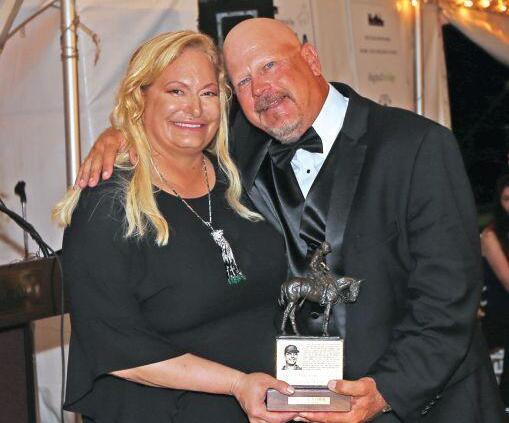
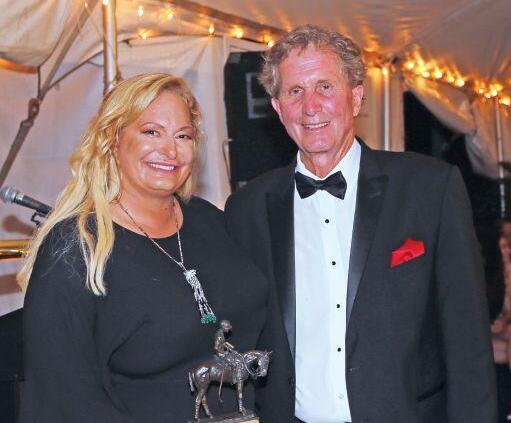
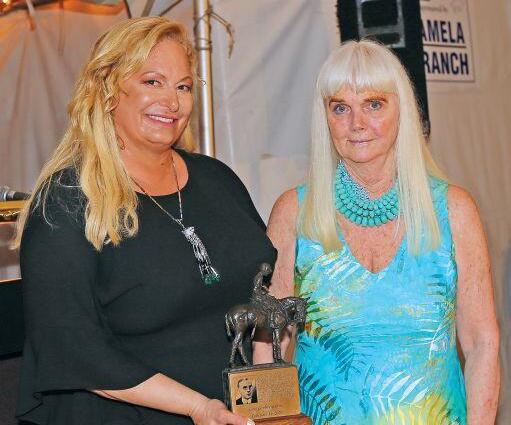
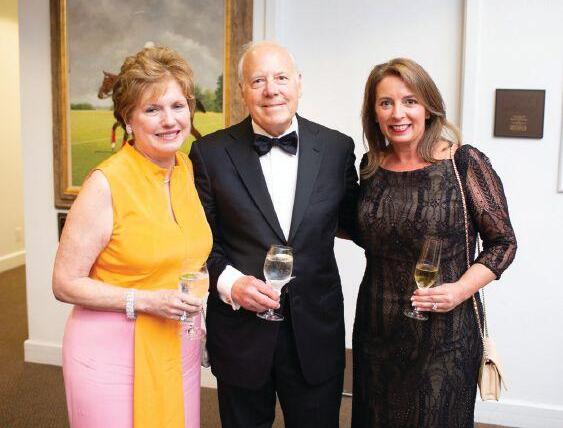
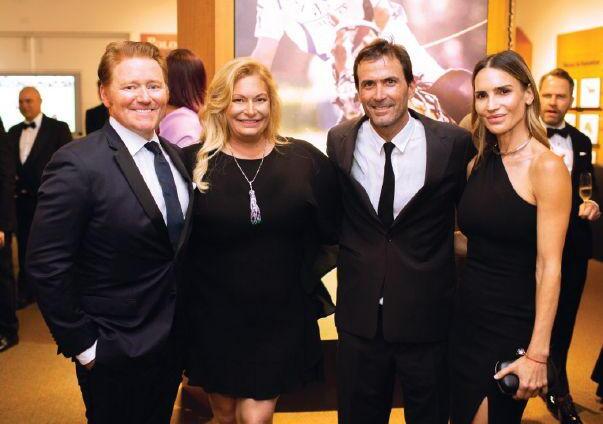
Thanks to our amazing sponsors, 10 G and buyers, spectators, and volunteer this record was the horse cloning dona the PPSG has awarded almost
oal players, and their patrons, auction item rs 2020 was a record year! Helping the PPSG a oup of Companies. T ted by the Crestview Gr To $3 million to 85 difffferent players and grooms.
THANK YOU TO OUR SPONSORS
Title Sponsor: U.S. Polo Assn.
T Teeam Sponsor: Pilot Catastrophe Services
T Teeam Sponsor: Airstream
Gl l d thi t ti it d donors chieve o date, RS Offffen ey
Best Playing Pony Sponsor: 5 Star Builders
THANK YOU TO OUR VOLUNTEE
National Anthem: T Toom Blake
Announcers: T Toony Coppola and Cody O
Umpires: ommy Biddle and Rob Y T To Yaackle
Auctioneer: T Toony Coppola ygyp
MVP Sponsor: Jetcraft
Long Shot of the Day Sponsor: Tito’’s s Handmade V Voodka
Dinner Co-Sponsors: Mark Edward Partne
Keith & Michelle Whitman
Apparel Sponsor: U.S. Polo Assn.
T Trrophy Sponsors: The Orthwein Family & Johnston Family.
e 10’ Futur ’s s Game Sponsors: Horseware, U Polo Assn., Hotels at Sea.
T Taable Favors: alton’ Lady W ’s s Gourmet Coo
Media Sponsor: Phelps Media Group
Auction Coordinator: Marlene Ashdow
Merchandise: Lou Cuthbertson / The T Ta a
Paramedic: Julie Boulanger / Rescue M
Program: Frederic Roy / The Morning L
Photography: David Lominska and Alex
Auction Committee: Marlene & Dennis , Nicole Of Simmons, Perry Palmerr, fffen
n ckeria e ine Pacheco
Keith and Michelle
Whitman
PLAYERS’ EDITION
THE OFFICIAL MONTHLY PUBLICATION OF THE UNITED STATES POLO ASSOCIATION
Editors HEATHER SMITH THOMAS, ERNESTO RODRIGUEZ, ALICE GIPPS, CHRIS ASHTON, TOM GOODSPEED
Editorial Board BOB PUETZ, TONY COPPOLA, TOM BIDDLE, DAWN WEBER, AMI SHINITZKY
Art Director DAVID BEVERAGE Prepress PUBLISHERS PRESS
Advertising & Editorial Offices
USPA Member Subscription Inquiries (800) 232-8772 OR FAX (888) 341-7410 ldolan@uspolo.org
General Subscription Inquiries 9011 LAKE WORTH RD, LAKE WORTH, FL 33467 (561) 968-5208
gwen@poloplayersedition.com
Visit us on the Web at www.poloplayersedition.com E-mail: info@poloplayersedition.com
POLO Players’ Edition (ISSN #1096-2255) is published monthly by Rizzo Management Corp. for U.S. Polo Association, 9011 Lake Worth RD, Lake Worth, FL 33467. Periodicals postage paid at West Palm Beach, FL and additional mailing offices. (USPS: 079-770).
POSTMASTER: Send address changes to Polo Players’ Edition, 9011 Lake Worth RD, Lake Worth, FL 33467.
Canada Post: Publications Mail Agreement No. 40612608. Canada Returns to be sent to Imex Global, P.O. Box 25542, London, ON N6C 6B2.
GWEN D. RIZZO
Polo Helmet Update
The USPA would like to share the following information regarding the upcoming changes to the USPA Helmet Requirements (Outdoor Rule 4 and Arena Rule 3). Beginning June 1, 2020 players participating in USPA events and club events, which include any USPA national, circuit or sanctioned tournament or league, any intercollegiate/interscholastic or National Youth Tournament Series event, as well as any clublevel game, league or tournament, will be required to wear helmets that pass the NOCSAE (National Operating Committee on Standards for Athletic Equipment) ND050 Polo Helmet Standard.
Over the past several years, the USPA Safety Committee has done extensive research on polo helmet safety and has consulted with experts in the departments of bioengineering, sports safety and liability. In the fall of 2017, the Safety Committee recommended the board adopt a rule requiring players to wear a helmet that meets the NOCSAE polo helmet standard to help to reduce the possibility of brain injury. The board recently approved the changes to the USPA rules to take effect June 1, 2020, provided that more than one helmet that meets the NOCSAE-approved polo helmet standard is available to the membership. The board will continue to monitor the availability of helmets that meet the NOCSAE standard.
Please review the following information and feel free to reach out to USPA Membership and Handicap Director Lindsay Dolan at ldolan@uspolo.org or Safety Committee Chairman Dr. Thor Norregaard at norregaardt@health.missouri.edu should you have any questions.
• NOCSAE is an independent and nonprofit standards development body that has certification standards for football, baseball, lacrosse, hockey, soccer and many other sports. They are also the only organization that has a certification standard that is specific to the sport of polo. In addition, participants in the SEI certification program must hold a valid license agreement with NOCSAE.
• In order to receive SEI (Safety Equipment Institute) Certification for ND050 polo helmets, manufacturers must pass physical testing of their product, have an on-site audit of their manufacturing facility, have an approved recall procedure and must maintain $2 million product liability insurance.
• The Virginia Tech helmet lab conducted a review of standards for evaluating helmet performance. In doing so, they compared the following standards: NOCSAE ND050, PAS 015:2001 with BSI
Kitemark, VG1 01.040-2014 with BSI Kitemark, (BS) EN 1384:2017 with CE mark, AS/NZS 3838: 2006, ASTM F1163, and Snell E2001. Following its review, the Virginia Tech helmet lab recommended the NOCSAE ND050 standard above all of the others. To review the findings, please visit the following link: uspolo.org/assets/pdf/Virginia-Tech-PoloStandards.pdf.
• Currently, the Casablanca NEU and the Charles Owen Sovereign are the only helmets that pass both the NOCSAE polo standard and the standard required by the Hurlingham Polo Association. As additional helmets that pass the NOCSAE polo standard become available, they will be added to the list of approved helmets.
• The new polo helmet mandate (2020 USPA Outdoor Rule 4 and USPA Arena Rule 3) does not take effect until June 1, 2020. However, helmet manufacturers need to have time to produce enough helmets for all USPA members. If all USPA members wait until May to order their NOCSAE helmets, the manufacturers will not have adequate time to produce them.
• Armis and Instinct do not currently produce any helmets that pass the NOCSAE ND050 standard. The USPA conducted preliminary testing in 2017, and at that time there were no helmets that passed the NOCSAE ND050 standard. In order to obtain this certification, manufacturers will need to develop new helmets or revise current helmet designs to meet the standard.
• Manufacturers may offer discounts to USPA members, youth players and for bulk orders. Please contact the manufacturers directly for additional information.
• The USPA is not directly affiliated with any helmet manufacturer and manufacturers have the ability to set their own pricing and may offer discounts.
• Generic riding helmets, which may pass other standards such as the ASTM F1163 equestrian standard, undergo a different testing protocol and must be replaced after a single impact. Notably, the NOCSAE ND050 testing is designed specifically for the sport of polo and accounts for multiple impacts, which occur from the rider falling, being struck with a mallet or ball or coming in contact with another player. It is also important to note that MIPS (Multi-Directional Impact Protection System) technology is not required for the NOCSAE ND050 standard.
• Eye protection, such as a facemask, must be deemed as an “authorized accessory” by the helmet manufacturer. If the facemask is an authorized accessory then it does not void the certification.
However, if the end user applies a facemask that is not the helmet manufacturer’s authorized accessory, then the NOCSAE/SEI certification would be void.
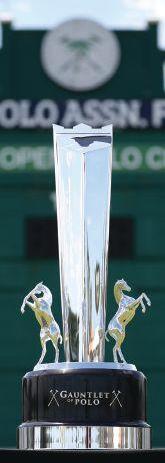
Gauntlet of Polo
The Gauntlet of Polo, a prestigious three-tournament series, featuring 14 of the world’s best polo teams, began on Feb. 5, and continues the multifaceted sponsorship that began last year between U.S. Polo Assn. and the Gauntlet of Polo. The partnership serves to increase the visibility of the U.S. Polo Assn. brand on site at Gauntlet of Polo events and in media.
The partnership sees U.S. Polo Assn. branding across the breadth of the Gauntlet of Polo, from stadium naming rights and field signage to advertising within broadcasts.
“As the official brand of the USPA, we are honored and thrilled to be serving as the main sponsor for one of the world’s most competitive polo competitions right here in Wellington, Florida,” said J. Michael Prince, president and CEO of USPA Global Licensing, the worldwide licensor of the U.S. Polo Assn. brand. “This thrilling series and the broadcast opportunities connected to it bring even more exposure both to the sport of polo and to the authentic connection between the sport and our brand. We hope that both loyal and new sports fans watching the games will also become fans of the classic, vibrant and sport-inspired style that is U.S. Polo Assn.”
The wide-ranging sponsorship provides U.S. Polo Assn. with naming rights of Field 1 at the International Polo Club Palm Beach in Wellington, Florida, site of all Gauntlet games. Additionally, U.S. Polo Assn. signage is positioned in key locations on the playing field, including the side boards, end field and goal posts. Signage is also prominently posted around the grounds, including light poles and entrance signs.
All teams competing in the Gauntlet are wearing custom-branded performance jerseys with the authentic U.S. Polo Assn. double horsemen mark. Additionally, several hundred IPC staff members will be outfitted in custom-designed polo shirts. Onsite is a U.S. Polo Assn. brand shop and a U.S. Polo Assn. pop-up shop in partnership with The Tackeria, a Wellington, Florida, tack shop that carries one of the most complete selections of equestrian equipment in the world, as well as sport-inspired apparel.
The U.S. Polo Assn. logo will be featured prominently in media, including sponsorship of the CBS Sports Sunday, April 26, airing of the U.S. Open Polo Championship at 2 p.m. ET, presented by Discover the Palm Beaches.
The Gauntlet of Polo began with the C.V. Whitney
Cup from Feb. 5-23, followed by the USPA Gold Cup from Feb. 22-March 22. The series concludes March 21-April 19 with the prestigious U.S. Open Polo Championship.
Fans can watch all three Gauntlet of Polo events in many ways:
• Live on site at the International Polo Club Palm Beach in Wellington, Florida;
• Livestreamed on Global Polo TV at GlobalPolo.com, as well as through multiple applications, such as Android, iOS, Apple TV, Roku and Amazon;
• CBS Sports will air the U.S. Open Polo Championship final, presented by Discover the Palm Beaches on Sunday, April 26 at 2 p.m. ET.
Gator Giveaway
Last year marked the first year USPA member clubs were eligible to win a John Deere TS Gator through the USPA Polo Plus Discount Program. The association offered a John Deere Grand Prize to the USPA member club with the highest cumulative discount program dollar amount spent by its members during the year. Second and third place were also eligible for prizes. In addition, all USPA members that utilized the discount program with any of the participating companies were entered into a drawing for a $500 Tackeria gift certificate.
Congratulations to the following winners:
Grand Prize John Deere TS Gator: Houston Polo Club (Houston, Texas)
Second Place: Grand Champions Polo Club (Wellington, Florida) will receive a custom 10 x 20 tent and a Yeti cooler
Third Place: Des Moines Polo Club (Norwalk, Iowa) will receive a set of custom goal posts and a box of Texas Polo balls.
$500 Tackeria Gift Certificate: Louis Berizzi Jr. of Farmer Road Polo Club, LLC (Wagener, South Carolina)
The John Deere TS Gator Giveaway, in conjunction with the USPA Polo Plus Discount Program, will continue in 2020. Visit www.uspolo.org for a full list of participating companies, including John Deere, Nationwide, Sherwin Williams, Office Depot, UPS and many more. Best of luck to all of our USPA member clubs! •
National Youth Tournament Series
team next year.
The NYTS qualifying season officially begins March 1. USPA members in good standing, born after 1/1/2001 and with a minimum of a minus-1 handicap are eligible to participate. For more information, please contact your local club or visit the uspolo.org website.
Intercollegiate Scholarships
Are you a current intercollegiate or senior interscholastic player who is planning to play on an intercollegiate polo team? Six $4,000 scholarships are available through the USPA Intercollegiate Scholarship program. Requirements can be found on uspolo.org. Applications will be accepted April 1-June 1. Contact Amy Fraser at afraser@uspolo.org for more details.
Interscholastic Varsity Letters
If you are an interscholastic player who competed in the I/I tournament season this year, along with
completing 100 hours in the saddle, participating in four I/I games, and are in good academic standing, you are eligible for an Interscholastic Varsity Letter! For more information on the program and application, please go to the interscholastic program page on uspolo.org or contact Ali Davidge at adavidge@uspolo.org.
I/I Fundraising
The Start-Up & Enhancement program is in place to help programs through providing reimbursable grants to clubs participating in the I/I program. The I/I fundraising application is open to all intercollegiate and interscholastic teams looking to hold fundraisers to support their I/I teams. If you are interested in applying for a reimbursement grant of up to $1000 in 2020, please visit the I/I webpage on uspolo.org for more details.
For more information on the I/I Start-Up & Enhancement program, please contact I/I Program Coordinator Ali Davidge at adavidge@uspolo.org.
Scholarships are available for those players planning on playing on an intercollegiate
Lucas Escobar Accelerating his career in the Gauntlet
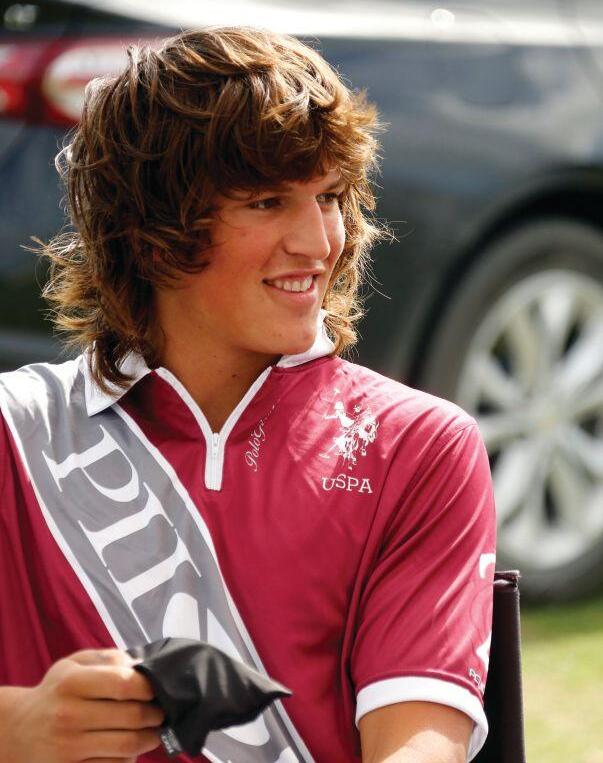
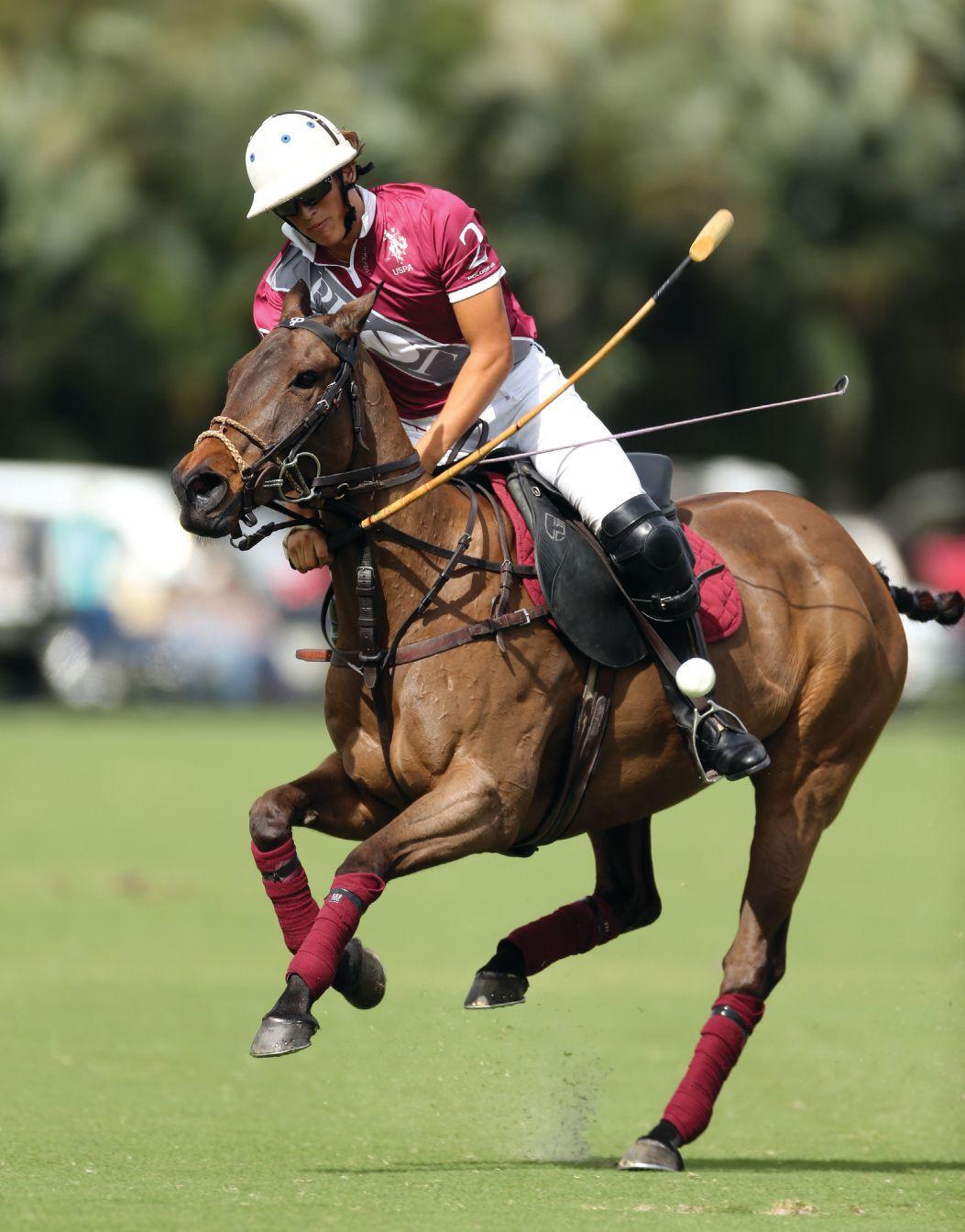
At just 17 years old, 2-goaler Lucas Escobar has assumed the most coveted position in the Gauntlet of Polo starting lineup, playing alongside Pilot’s Facundo and Gonzalito Pieres.
Claiming 16 consecutive wins for a flawless record in 2019, Pilot is the reigning Gauntlet champion, sweeping not only the three most prestigious tournament titles, but $1 million in prize money in the inaugural competition.
Playing at the 22-goal level for the first time, Escobar is no stranger to the trophy stage. His notable wins include the 2019 Silver Air Pacific Coast Open, 2019 Farmers & Merchants Bank America Cup, 2019 Junior Westchester Cup (of which he was named Most Valuable Player) and the 2017 National Youth Tournament Series Championship. His father, Luis Escobar, received his first high-goal opportunity at 15, playing with Gonzalo Pieres. Now, the third-generation polo player’s journey is taking shape with several similarities.
After hearing rumors that he might be selected for the opening on Pilot’s roster (joining Curtis Pilot and Facundo and Gonzalito Pieres), Escobar finally received the anticipated confirmation he had been hoping for in January. Having the chance to watch him play at both the International Polo Club Palm Beach (Wellington, Florida) and Santa Barbara Polo & Racquet Club (Carpinteria, California), team captain Facundo Pieres is focusing on taking his natural talent and molding it to Pilot’s style of polo.
“Lucas’ hand-eye coordination is very good and he can hit any shot,” Pieres commented. “He’s really talented with the ball, he just needs some coaching on how to take the man stronger and create more space. He’s also teachable and can take direction, which is very important for a player his age.”
Practicing with the team almost every other day leading up to the Gauntlet, Lucas is playing a string of top horses from the Ellerstina and Pilot organizations.
Naturally, following Pilot’s stellar 2019 season, there is an expectation riding on the team to perform at or even exceed the level which was set. Learning how to execute Pilot’s winning strategy, Escobar as the new member of the team will have to keep with the pace of an established and fine-tuned organization.
“I think there is a lot of pressure for guys playing at this level for the first time,” Pieres explained. “At this level, it is very competitive and every team wants to win, especially Pilot because we won the Gauntlet last year. I think Lucas will definitely feel the pressure, but we are going to try to help him use that pressure in a positive way. At his age, if a player can channel that pressure positively it’s also good for his future.”
Although he will be competing against his son in the Gauntlet, Santa Clara team captain Luis Escobar is proud of his youngest son’s achievement at such an early stage of his career.
“It’s an amazing opportunity for him to play for Pilot,” Luis Escobar said. “He’s young, but he’s got everything to play in the Gauntlet. It’s a fantastic
17-year-old
Lucas Escobar
Lucas Escobar is playing for Pilot with Curtis Pilot, Facundo Pieres and Gonzalo Pieres Jr.
opportunity for him to continue growing and maturing as a player.”
Having a close relationship with his grandson, Francisco Escobar is also looking forward to the opportunity.
“I am very proud of him because he’s not only a good player for his age, but he’s also a good student and son and that’s very important, not only in polo,” Francisco Escobar said.
Lucas is happy to see the fruits of his hard work paying off. “The only advice I have is to stay patient and keep working hard,” Lucas advised those hoping to one day earn a career-changing opportunity. “Just wait for it and the opportunity will come if you do not give up.”
Watch all Gauntlet of Polo games on Global Polo TV. Register at GlobalPolo.com for free access to the livestream.
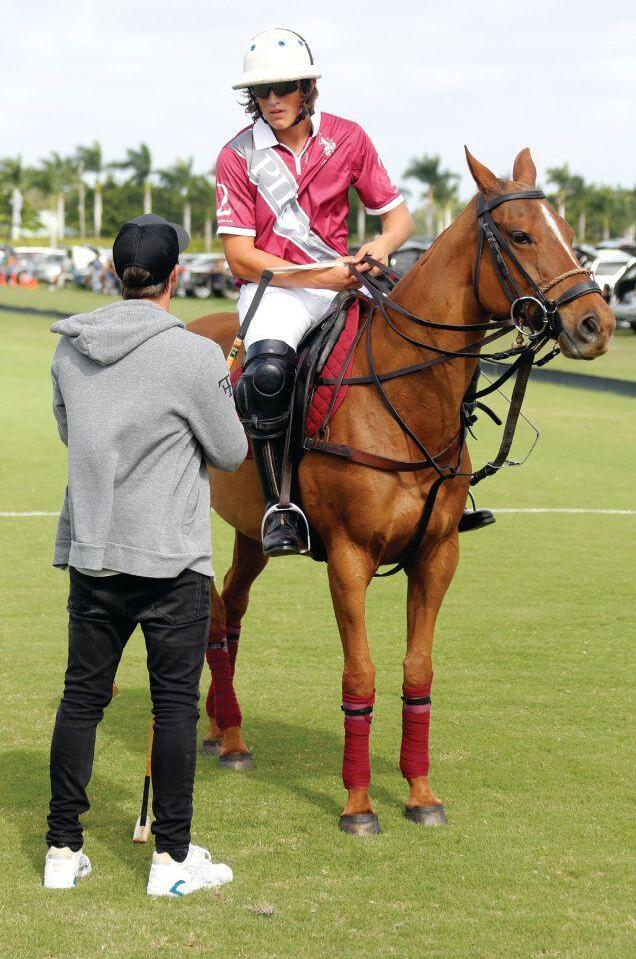
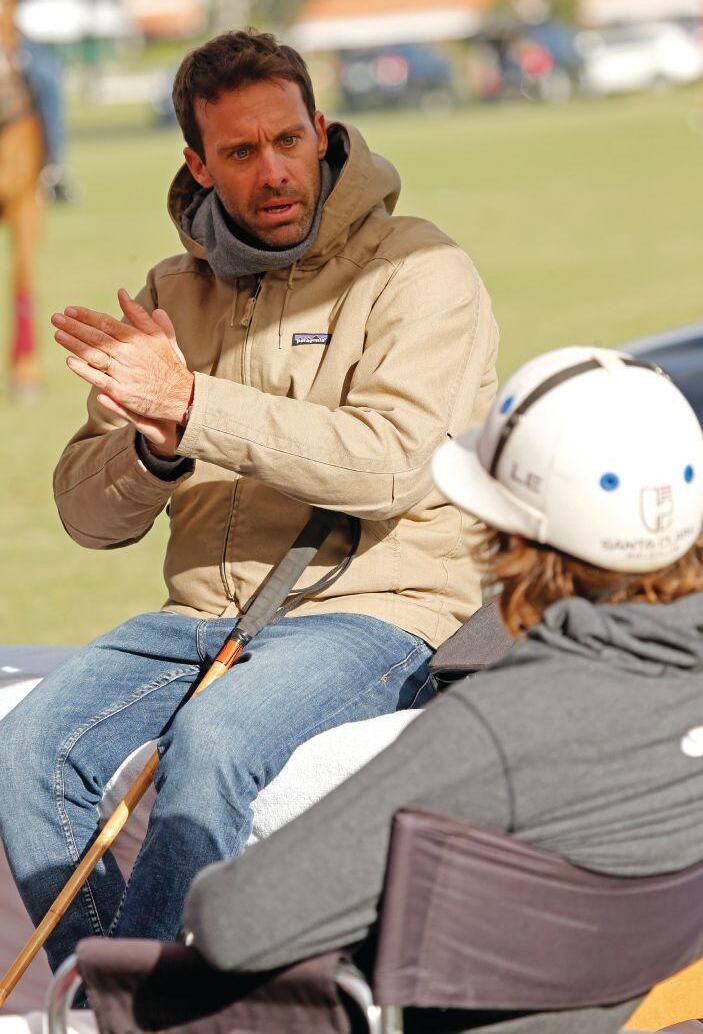
Facundo Pieres coaches Lucas Escobar on and off the field during the Ylvisaker Cup.
Gripping detail
The science of hitting in polo
by Devereux Milburn
There is an art in hitting a polo ball and it can best be acquired by study and practice. It has always been a source of wonder to me that polo players in general devote so little time to the improvement of their hitting, as it is the foundation upon which their game must be built. No matter how sound a tactician a man may be, it will avail him little unless he can hit the ball where he wishes, and with reasonable consistency with regard to length.
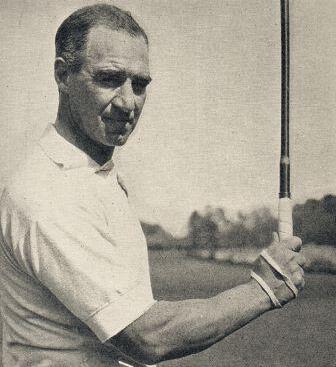
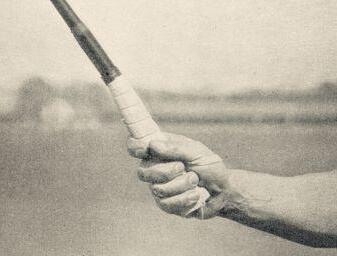
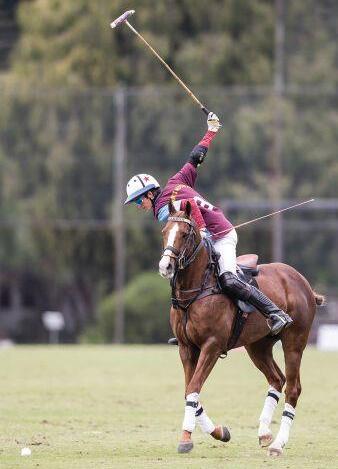
When making a backhand stroke, place the thumb down the back of the mallet handle (above). For forehand strokes, use a finger grip (below) as opposed to a palm grip.
The grip of the mallet handle is of the first importance in hitting. For the purposes of a discussion of the grip, all polo strokes may be classified as either forehand or backhand strokes.
The forehand strokes are the off-side fore shot and the near-side back shot. The backhand strokes are the near-side fore shot and the off-side back shot. For both backhand and forehand strokes, the correct grip is a finger grip as opposed to a palm grip. If the handle is gripped mainly by and in the fingers, the shaft becomes almost an exact prolongation of the wrist and forearm. This is conducive to ease and facility in hitting. A good many players thrust the handle well into the palm of the hand and wrap their fingers around it. The stick comes out of the hand at almost a right angle to the wrist and forearm, and the result is a cramped and awkward stroke. So far as polo is concerned the finger grip is unquestionably the correct one for the strokes mentioned.
In forehand strokes the balls of the first and second fingers are the driving force in the hand. In backhand strokes, the handle should be shifted slightly in the hand and the thumb extended down the back of the handle to act as a rear brace.
Another important factor in hitting is the brace from which the stroke is made. It consists in hitting from the feet in the stirrups, braced by the knees and the inside of the thighs against the saddle, and the feeling should be that of hitting from the stirrup irons rather than from the seat. The ball should be hit when it is about opposite the toe of the right foot, or a little behind the pony’s shoulder. The place
where the ball is hit with relation to the pony varies slightly, according to the direction in which it is hit, i.e., whether it is cut, pulled, or driven straight ahead, but it is a good policy to hit early rather than late. The best American players hit in this way. A player should ride with long enough stirrups so he can come up into this brace easily when he is about to hit the ball, but not so long that he cannot properly control his pony.
The third and last element of good hitting is the action of the body in making the different strokes. This varies with each particular stroke. In all strokes a player should lean out and get well over the ball when he is about to hit it. This is done by pivoting the body from the knees and waist. Lissomeness in the waist is a great asset, as it makes the process of pivoting and lean out fairly easy.
Every stroke should be carried out thoroughly so far as the action of the body is concerned. This is especially true of near-side strokes, which are inherently more difficult because they are made on the side of the pony which is not the natural hitting side. When a player is in a hitting slump, it is a pretty sure sign that there is something the matter with the technique of his stroke. A little care and practice will generally rectify it.
The off-side fore shot is the most common of all the strokes, and is used about 90% of the time, especially by the forwards. Get the right shoulder well back at the start of the stroke and follow through. It is a very common fault not to follow through, and it is a pretty sure sign that you are not doing so if you find yourself hitting your pony under the chin with the shaft of the stick at the finish of the stroke. Hold the stick in a perpendicular position until the arm is brought back to hit.
The off-side back stroke is the hardest stroke in polo. It requires perfect timing, as the direction of the ball has to be reversed. The right shoulder should be brought forward at the start, so as to get it into the stroke as much as possible.
The near-side fore shot is similar to the off-side backshot and is almost as difficult, except the speed and impetus of the pony are behind the shot so it is easier to make the ball travel. The main thing to remember about making this shot is to pivot the body and get the right shoulder well forward.
To start a near-side back stroke, lean forward and out while bracing yourself with your legs.
The near-side back shot is indispensable to the No. 3 and back, the two defensive players. It is more powerful than the offside back stroke and can be better directed. The important part of this shot is the follow through. If it is made with a proper follow through there is very little of the player in the saddle at the finish, except the knee. It must be made with confidence and a certain amount of abandon in order to be a success. The slight feeling of insecurity at the finish, when it is made with a proper follow through is the main reason why it is not properly made more often.
One other shot deserves special mention because it is so rarely made correctly, and that is the off-side fore shot underneath the pony’s neck. It is a difficult shot, especially when the pony is fully extended and is throwing his feet and legs well out in front of him. The mistakes that are commonly made in making it are hitting the ball when it is too far behind and too much to the right of the pony’s fore legs. It should be hit when it is either directly in front of or better still, slightly on the near side of the pony’s fore legs. The player should get well forward in the saddle and hit in front of his pony’s legs.
To start an off-side forward stroke, lean out with your right shoulder well back and hit from the feet in the stirrups braced by the knees.
During the downswing, the mallet head gets into the hitting position, i.e., at a right angle to the direction in which the ball is to be hit at the very last moment. Special care should be taken to carry out this idea, as it means getting the wrist into the stroke. If it is not done, the stroke is a sweep with the arms with little or no wrist work and is very apt to be somewhat ineffective.
I strongly recommend the liberal use of saddle soap on the saddle. There is nothing that can so completely rob a player of confidence in hitting as a slippery saddle and confidence is 90% of the battle. It is as easy to drive a golf ball standing on the ice with no nails in the shoes as it is to hit a polo ball off a slippery saddle.
When a man’s ponies are going nicely, and he is hitting well, the game of polo is hard to beat. When the reverse is true, there is very little joy in the life of the polo player. Therefore, time spent over the ponies and hitting is well spent, and it is wonderful what can be accomplished by a person who is neither a natural horseman nor a natural hitter. The average players takes the game of polo up fairly late in life, so chances are he does not have as natural a stroke as if he had begun when he was young all the more reason for him to work hard to perfect it. •
This article was adapted from an article by 10-goal Devereux Milburn in 1925. It is still very relevant to this day
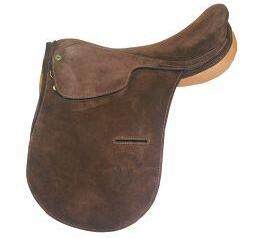
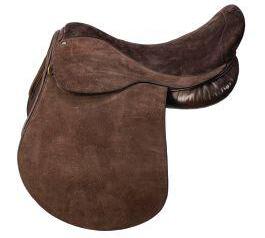
This suede saddle has a steel-reinforced tree which is lined with latex rubber panels to assure comfort and an excellent fit for both player and horse.
Danny’s Tack Shop also offers a complete line of products for all your polo needs.
70 Clinton Street • Tully, New York 13159 Phone/Fax 315-696-8036 • E-mail: dannypolo@aol.com
Marcos Heguy Saddle
Rule 22
Can you change horses in the 25 seconds after scoring a goal?
Pacific Northwest Circuit Governor Sheryl Sick has a half-goal handicap outdoors and a 2-goal handicap in the arena (3 goals for women’s handicap outdoor and 5 in the arena). She spends her summers traveling across her circuit, including Western Canada, Washington, Oregon, Utah, Idaho, Montana and Wyoming, visiting and playing at as many clubs as she can. She feels that meeting the players in her circuit personally and playing polo with them gives her a more complete understanding of the issues they face and helps her to come up with solutions that can be supported by the USPA.
Although Sheryl works for Dell Technologies as a sales executive in the complex industry of information technology, she is anything but a nerd. Actually, she is quite the weekend warrior, climbing mountains and shredding black diamond runs on her snowboard when she is not playing polo and serving the USPA. Moving around is in her blood since she became accustomed to being flexible and living a nomadic lifestyle during her childhood as a military brat. She has a palatable love for horses and the sport of polo. She has played in Canada, Argentina, Ireland,
Jamaica, New Zealand, Australia and Mexico. She takes her string of handpicked polo ponies and plays at her home club, the Seattle Polo and Equestrian Center in Enumclaw, Washington, when she is not traveling her circuit.
She played polo in college at Washington State University. Her home club boasts a pristine full-size outdoor field with supporting stabling, a polo school, turnout for visiting teams and facilities to host large events, all in a postcard-perfect setting just outside Seattle. The club hosts teams from other clubs in the circuit and sends teams to those same clubs in an effort to promote and sustain polo in the Pacific Northwest. It is truly a cooperative effort and full of old-school polo comradery. More information on the club can be found at www.seattlepoloclub.com.
Sheryl wants to know if you can use the 25 seconds you get to return to the line-up after a goal is scored to change horses. Will the umpires wait for you to change horses if you can do it and return to the lineup at the center within 25 seconds after a goal is scored?
Umpire Chad Kraml is going to answer Sheryl’s
Sheryl Sick with her string of handpicked ponies
Rule 22 e. (1)-How Play is Resumed
After a goal has been scored, except goals awarded by handicap or Penalty 1, the Umpire shall throw the ball in with the ends changed. The teams must return to the center line for the throw-in within 25 seconds after the goal was scored. If one team fails to do so without an adequate reason, to be determined by the Umpire in his or her discretion, the Umpire shall throw the ball in.
question. Chad was born and raised in Hinsdale, Illinois. He is a third generation polo player. Chad played polo as a professional for many years and held a 4-goal handicap outdoors and a 7-goal handicap indoors. He has played in Hamburg, Germany, and Kaduna, Nigeria, as well as all over the United States. Chad attended Western Kentucky University on a football scholarship and has been umpiring full time since 2006. A fun fact about Chad is that he is a classically-trained chef.
Chad’s answer: That’s great question, Sheryl. Since time limits are new this year, umpires have to struggle with the potential issues they create. One issue is directly related to your question. Do we care what the players use the 25 seconds for? We had to discuss this and try and determine what the rule is designed to accomplish. Is it designed to stop players from managing the clock and allow their team to change horses; is it as simple as just being fair to both teams and giving the umpires a benchmark for dead ball plays; or both? Is there any more to the rule ?
With a careful discussion and a couple months of experience using the new rule, we have determined the time allowed is primarily a benchmark for the umpire to use in treating both teams perfectly fair when players attempt to manage the clock. In simpler terms, yes, you can use the time however you’d like.
We didn’t see any good reason why we would interject ourselves into the time limits. It made more sense to us to just enforce the limits across the board and ignore what the players actually do with the time, even if it is to change horses. Since the time limit is the same for both teams, we are fine with just enforcing the limits as they are written. I’m sure other issues will arise they always do with new rules but we will address them one at a time. I hope that is helpful to you and remember, if you take more than 25 seconds to return to the center for the throw-in, I’m not waiting for you (it’s nothing personal).
Umpire
Chad Kraml
Peaceful approach
Horse training methods derived from Ranquel indians
Words and photos by Alice Gipps
THE SCARPATIS are a family of horse tamers from Argentina. Seeing them work will change your view about training wild horses. They make something that is believed to be difficult and dangerous so simple. Their method works with horses of any age, even traumatized and difficult ones.
Patriarch Oscar Scarpati’s connection with horses started as a child. One of 11 children, he was very
withdrawn and exhibited unusual behavior from an early age. He was subsequently diagnosed with autism at the age of 12. He didn’t speak a word for many years, however, his mother realized he was always happy and relaxed around horses so she would often leave him to watch them.
Although his mother had always taught him to be sensitive and kind towards animals, a big influence in
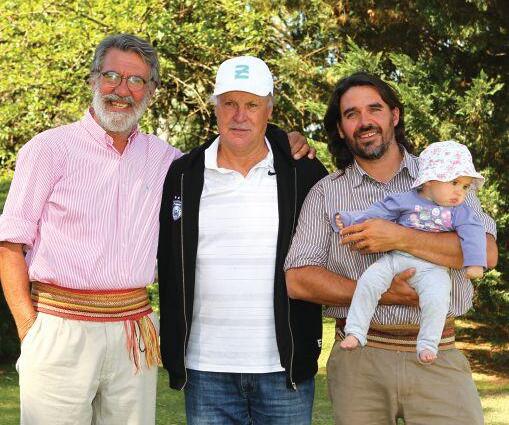
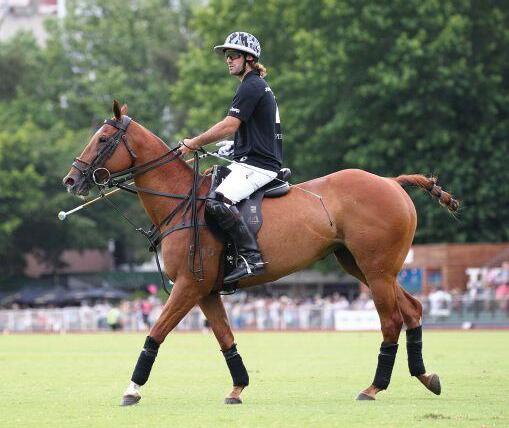
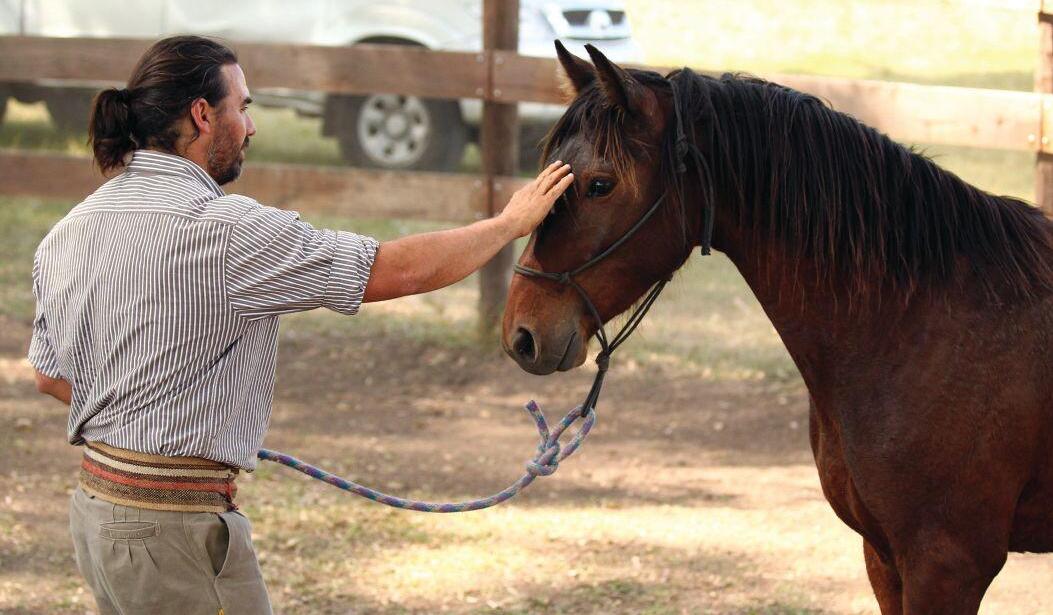
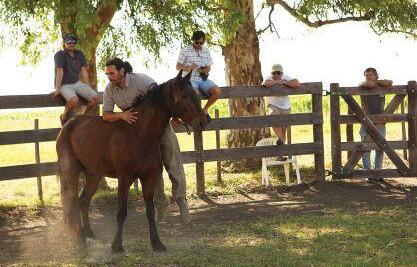
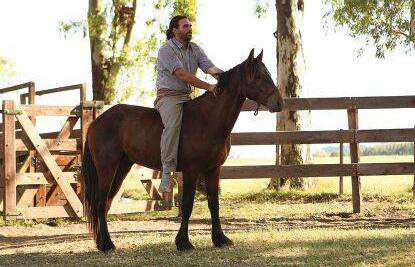
Top, left: Cristobal hangs out with La Coqueta, who he trained; Top, right: Oscar, Gonzalo Pieres Sr. and Cristobal; Bottom, right: Nico Pieres on La Coqueta in the Argentine Open; Bottom, left: Oscar and Cristobal with an Ellerstina polo pony.
his life has been an elderly gentleman called Don Cristobal Luna. He was like a grandfather and helped Oscar to come out of his shell and interact with the world around him. Luna taught him empathy towards all living animals, to understand horses have fears and how to gradually gain their trust by playing with them. Luna was 88 years old when Oscar met him, so he never had the chance to see him training horses but he spent hours listening to his stories and methods.
Step by step over the years, Oscar became an expert in horse psychology. Guided by Luna’s teachings he delved into the Ranquel Indian’s culture. The Ranquel were an indigenous tribe from the northern part of La Pampa Province, Argentina, in South America. Some Ranquel settled in the province of San Luis where the Scarpati’s have their family farm. Today the Scarpatis use the term ‘Doma India’ to define their methods, which use very alternative techniques to the traditional Argentine ways.
Oscar learned extraordinary subtle ancient techniques to train horses, using no violence, only patience, good intentions, thoughts and a deep understanding of the horses’ instincts and body language for communication. Accumulating wisdom, transmitted from generation to generation through words, deeds and example, it has turned in to his family’s philosophy for life. It combines character, personality and emotions when dealing with any living creatures around us
with the intent that love and understanding leads to happiness and harmony. He has used his knowledge to also connect with wild pumas and condors.
Oscar explains, “We can forget the animal has valid feelings too and didn’t choose to be trained. The way a trainer achieves behavior change matters, especially if we put ourselves in the animal’s place. We now know animals experience emotion much the same as humans do. We are wholly responsible for the emotions we elicit in our horses through training. To me, a trainer’s oath should be the same as a physician: First, do no harm: physically or emotionally.”
His son Cristobal has followed in his footsteps and together they perform fascinating demonstrations that are just as much about philosophy as they are horse training.
“I grew up helping my father training horses. It’s something that just happened as I grew up. He didn’t train me, I just witnessed his job. As I grew up I discovered I had something special from him,” explains Cristobal. “When I was a teenager I thought I should do something else, so I studied law at college, but I discovered that horses are the only thing that makes me really happy in life.
“When I was a kid I wanted to be rich as I watched movies, but I found that in Argentina no horse trainer was rich at that time. I was trying to be a lawyer, but later, I understood it is much more valuable to be hap-
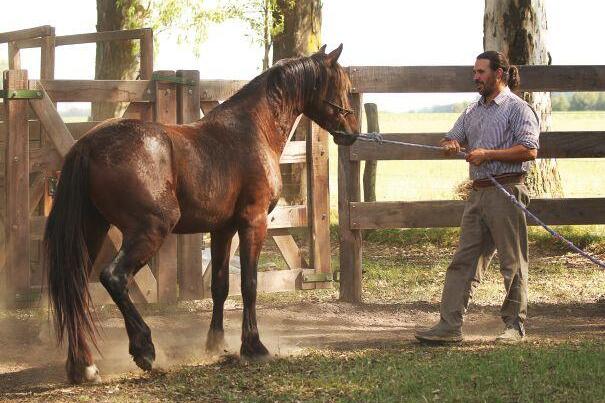
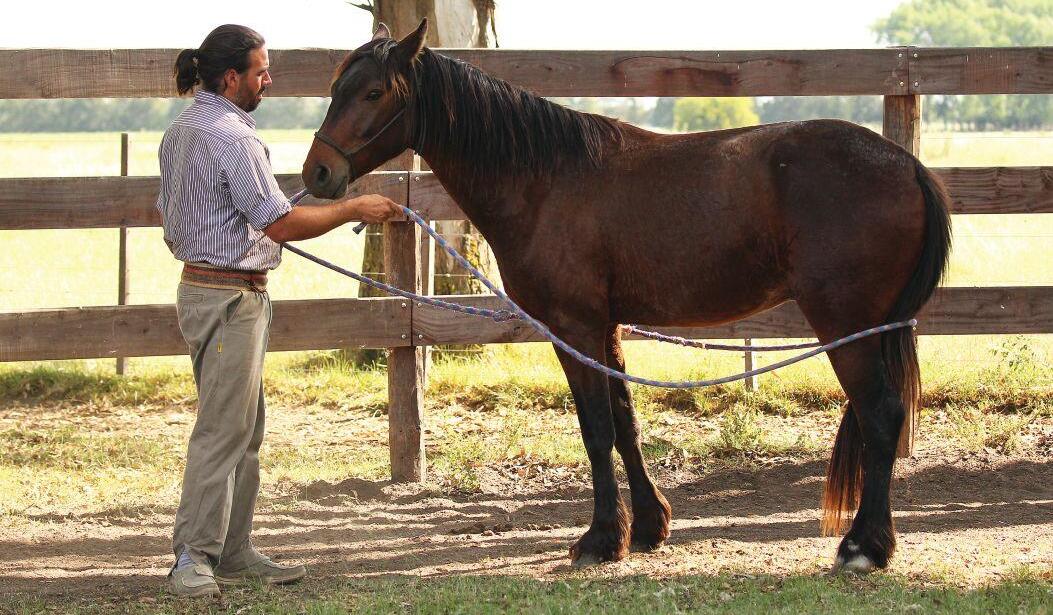
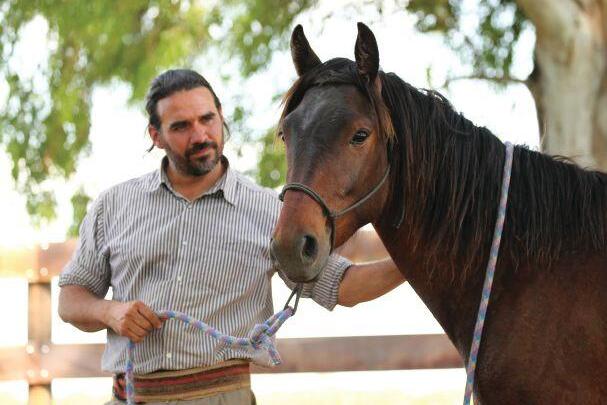
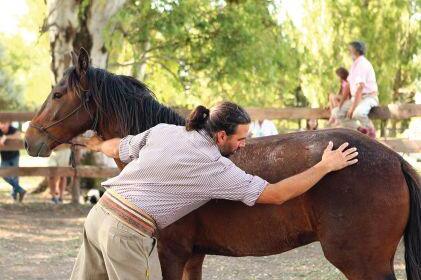
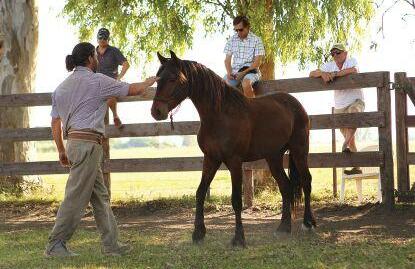
Cristobal imitates how horses interact with each other in his training. It makes the horse more open to learn.
py. When I took the way of the horses, not everything was easy. It has been hard to make the name, to make enough prestige to live from this activity, but it was easier to be happy. The whole family is involved so we are sharing so much, we travel a lot together. We’re sharing our method to train horses, we’re sharing our life,” he said.
When working with untouched horses, the Scarpatis work very fast. If the horse is young and not traumatized, they are usually riding it in the first day. “We do not recommend that for beginners, those who are learning or really professional as it’s not necessary, it’s very
risky,” said Cristobal. “Normally we only do it that fast as we are performing a demo or showing someone how to do it. We always recommend taking your time and giving the horse longer to learn.”
When doing ground work, they separate training and taming. “To start we are creating the bond as the horse is scared of people, very sensitive and ticklish to being touched.” Cristobal said. “The first step is to bring their attention to us, show them we won’t make anything bad against them. Later we touch everywhere with our hands and feet to get them accustomed to our contact.”
The goals of their method are to get closer, make contact, touch all over and make some moves.
“This may take one hour, one day, two days; it doesn’t matter but normally a person needs two hours to get close and one hour to touch everywhere. In three to four hours I can mount it,” Cristobal said.
“I am a teacher and always thinking from the student’s point of view. It doesn’t matter how much time [it takes]. Be careful, go by your emotions and learn more about yourself than about the horse. You can see it being nervous or relaxed. You can’t be confused about how you feel,” he explained. “If you are nervous, there is a 95% chance you make the horse nervous or scared. Our mission is to help people train themselves. After that, you can train a horse, a dog and other animals. In the game we play, the physical contact is very impor-
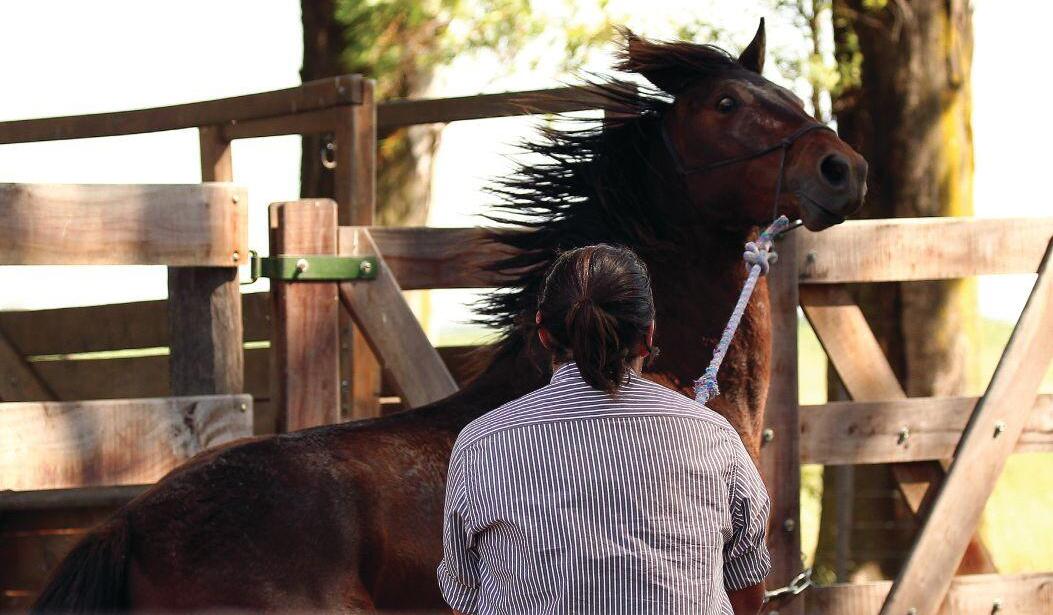
Top: An unbroke horse at the start of a clinic tries to flee rather than be touched. Above: Cristobal says the first step is to bring the horse’s attention to you.
tant. We try to imitate how horses interact with each other. You will see two colts playing, they bite the knees, the flank and the neck. We have to be in good shape to work young horses.
“Dominance is part of our job but the intention we have when we practice this is the way that they use dominance in their hierarchy. They have their own organization and when you come into their lives and act as a higher horse, they will accept and understand more of what you are trying to do. If instead, you take the role with a whip and start to give orders, push, kick or hit, they then become victims in a reality that they cannot understand. When you act as a horse, they are more open to learn and in our experience, they learn very fast.”
Cristobal started working with polo ponies 12 years ago for Ellerstina after approaching Gonzalo Pieres and convincing him to try a new method for starting their young horses . The Scarpatis wanted to show there was a quieter way to train the horses and many domadors are now following their lead. One of Nico Pieres’ best mares, Open Coqueta, which he plays in the Argentine Open, was started by the Scarpatis. Cristobal says that although they love to work on polo horses for a big organization, doing it full time is too time consuming.
Their calling in life is to educate others, spread their knowledge and show as many people as they can how to make a difference by traveling and performing courses
and demonstrations. This way they can reach far more people and ultimately help many more horses enjoy the benefits of their work.
Watching Oscar and Cristobal work with an untamed horse is something magical, an unforgettable experience, which will fill you with many emotions.
Even people attending a demonstration who know very little about horse training leave in awe and wonder at how simple it can be. You are also filled with happiness that such a worried soul can make friends with its
(continued on page 57)
Eventually, the horse allows him to get closer and touch him.
Cristobal stays relaxed and shows the horse he will not harm him.
HEAD Subhead
FOOD FOR GOOD Beach crowd buoys MLK Center
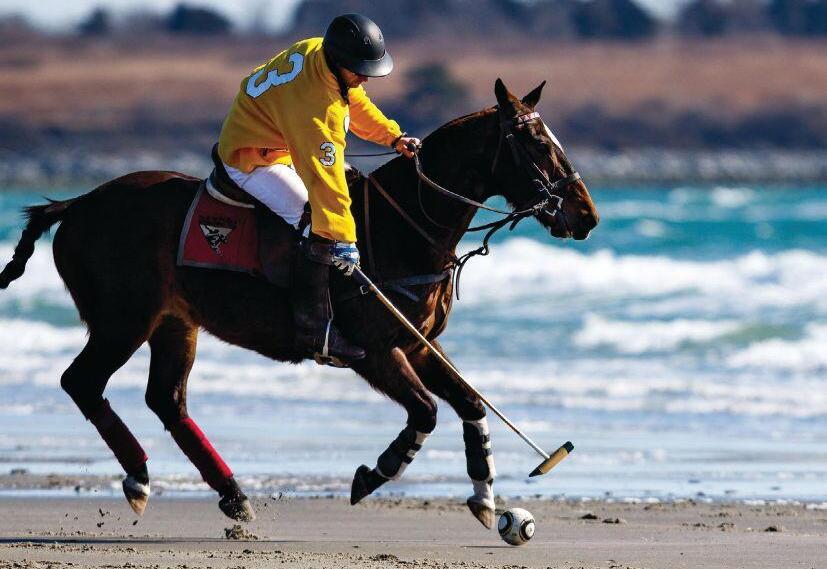
A RECORD beach crowd contributed 1,165 pounds of food and $268 in cash donations for the Dr. Martin Luther King Jr. Community Center in Newport, Rhode Island, Feb. 25. The generous crowd was attending the 9th annual Beach Polo exhibition for the closing weekend of the 32nd Newport Winter Festival.
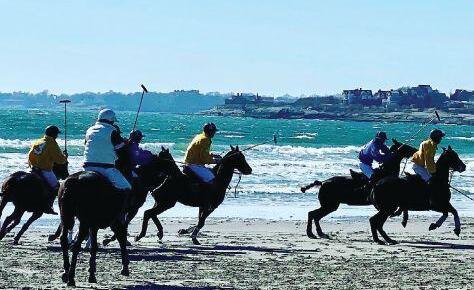
The lively two-day event pitted teams from the Newport Polo Club in four-chukker polo matches during low tide on Sachuest Beach (locally known as 2nd Beach) free of charge for over 1,000 viewers each day. Spectators responded to the call for donations with non-perishable dry-goods, toiletries and household items collected by MLK Center volunteers at the Beach Pavillion.
“Newport Polo has maintained a focus on benefitting the community since its beginning in 1992,” said Newport Polo founder and president, Dan Keating. “We are grateful to our enthusiastic audience for turning out in record numbers for Beach Polo and embracing MLK Center’s year-round hunger services, and it would not have been possible without the collaborative spirit of the Town of Middletown and Newport Winter Festival.”
Sunny and milder winter conditions helped attract the large turnout at the beach on both days, with food trucks, music and commentary adding to the ambiance, followed by hot chocolate and outdoor refreshments on the Terrace at The Chanler for the traditional après-polo celebration with the players.
JOHN LINCOURT
JOHN LINCOURT
Players enjoy playing on the beach in Newport in late February.
ON THE RAIL Polo match played at Del Mar Racetrack
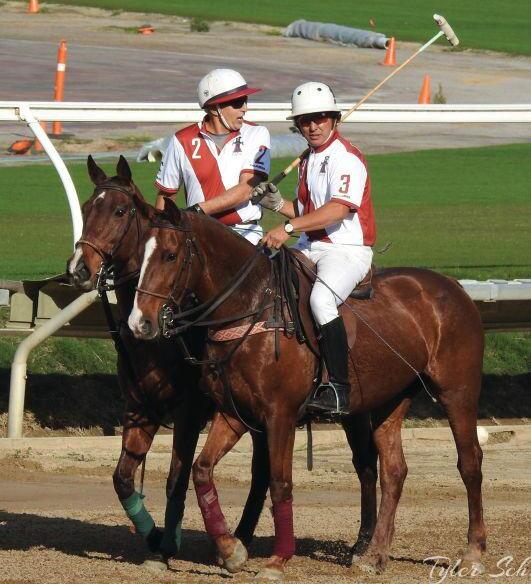
TEAMS CONVERGED at the Del Mar Racetrack in Del Mar, California, on Feb. 22, to stage a 10-goal polo match right on the track, followed by a Cuban Nights-themed concert and dance party in the Paddock, featuring the band Amistad Cubana.
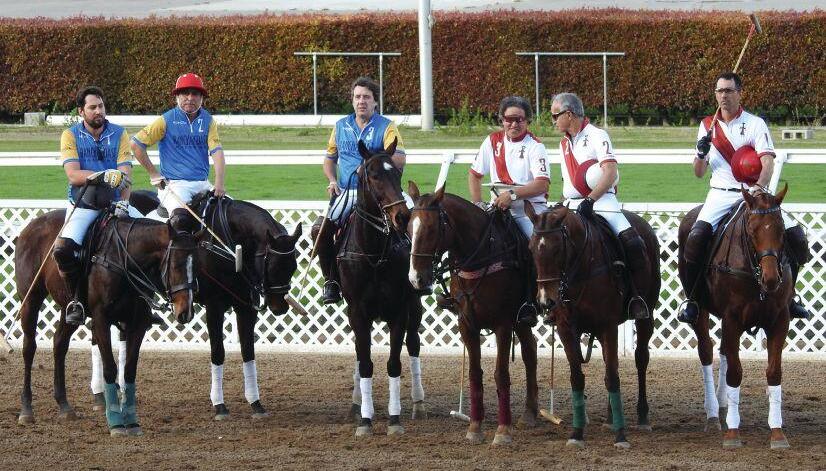
The match, featuring teams from Mexico and the U.S., was dedicated to Guillermo “Billy” Steta, president of the Mexican Polo Association for eight years until his untimely death on Nov. 1 at the age of 56. Born in Mexico City, Billy started playing polo at the Jalapa Polo Club as a 12-year-old boy. As a passionate player and an ambassador of the Federation of International Polo, he traveled the world playing and promoting international polo in countries, including Argentina, Chile Colombia, Venezuela, India, Spain, Panama, Barbados, the U.S., Canada, England and Germany. Several of the players in the Del Mar match were Billy’s close friends and teammates.
The match saw San Diego Daou Vineyards (Santiago “Topo” Mendez, Nour-Dean Anakar, Philip Ruan, Ahmed Mounkachi) narrowly edge Mexico Ranch & Coast Magazine (Miguel Gomez de Prada, German Coppel, Saul Flores, Demetrio Amaya), 12-10, in a fast, action-packed match in front of a large crowd of polo enthusiasts and social guests. After the match, guests enjoyed cocktails and dancing.
Another match is planned for April, with proceeds benefitting Helen Woodward Animal Center.
TYLER SCHUTZ
TYLER SCHUTZ
The international match, played on the racetrack in California, was dedicated to Billy Steta.
TYLER SCHUTZ
POLO CAMP
Coaching clinic held in India
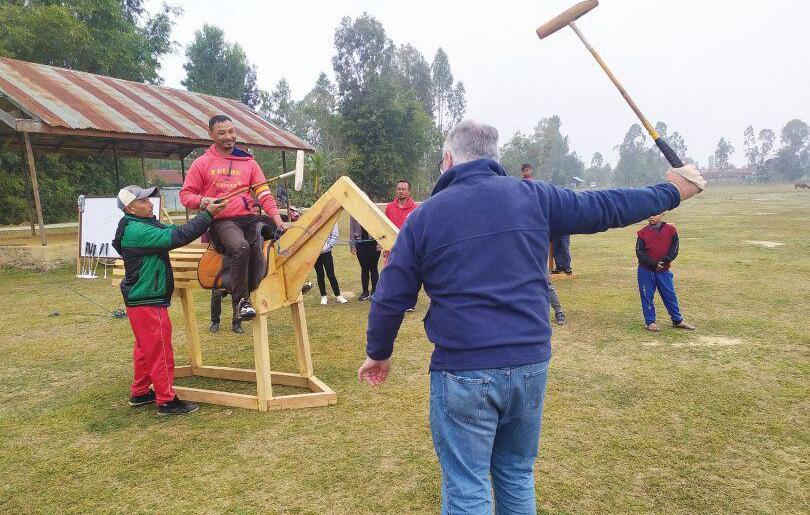
A RURAL POLO and community-based pony preservation initiative was recently started at Kumbi, a village on the shores of Loktak Lake, the largest freshwater lake in Northeast India. Ed Armstrong, of Huntre! Equine, traveled from Massachusetts to conduct a two-day coaching camp. The event was held just prior to the 5th Manipur Statehood Day Women’s Polo Tournament in Imphal, Manipur. The clinic was made possible, thanks in part to the U.S. and Argentine teams finalists in the 4th Manipur Statehood Day Women’s Polo Tournament–who donated their tournament prize money. In addition, a U.S. Polo Coaching Camp for Rural Youth was held on the heritage polo field in the village. Six youth, with riding but no polo experience, were selected for the camp. Drills included basic lessons in polo on two wooden horses built by the villages using instructions sent ahead of time by Armstrong.
There is something about riding down the street on a prancing horse that makes you feel like something, even when you ain’t a thing.
Will Rogers
ONE
ARM BANDIT
Polo club guests enjoy unique performance
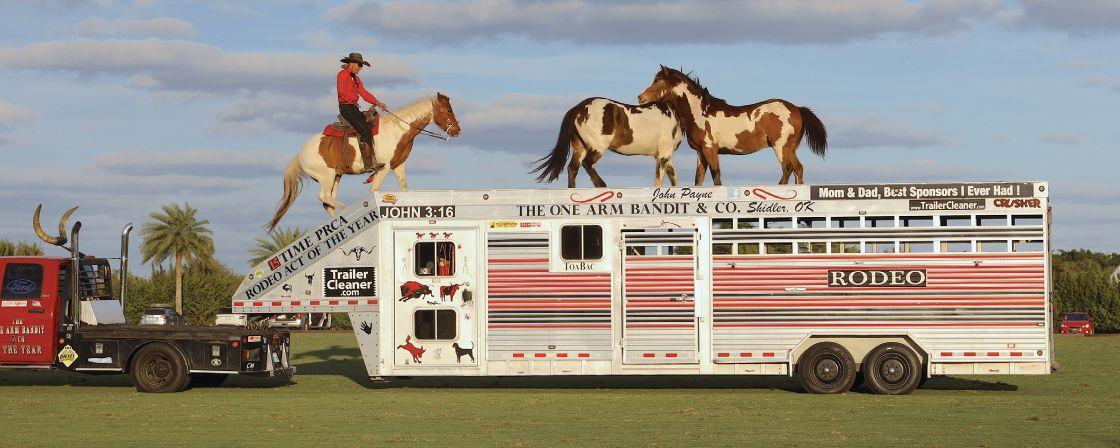
GRAND CHAMPIONS Polo Club in Wellington, Florida, had a visit from the One Arm Bandit, also known as John Payne. Payne performed a halftime show where he ran a couple of horses around his truck before they jumped onto the back of the truck and up a ramp on the nose of his trailer, until they were standing on the top of the trailer. He followed on a horse he was riding.
Payne is known for his shows around the rodeo circuit. He sometimes brings along his mule Moe, his zebra Zorro, Watusi longhorns, mustangs and even buffalo, all trained to get on top of the trailer.
He performed last summer at the Aspen Valley Polo Club in Carbondale, Colorado, with the zebra and a few horses. He rode one of his horses on the roof of the stock trailer, while a friend drove it onto the middle of the polo field. He rode the horse off the trailer to chase his other horses around the polo field before he rounded them up and followed them onto the roof of his trailer. The performance was a big hit with the polo players and he wrote on this Facebook page that he was equally impressed with the polo people.
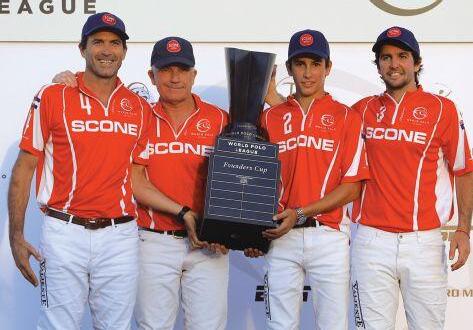
Payne threw out the ball to start the WPL Founders Cup on March 1, then performed at halftime. He has been performing on the rodeo circuit for 32 years and has been named the Professional Rodeo Cowboys Association Specialty Act of the Year 15 times, an award voted on by professional cowboys, announcers, stockmen and performers. He was also inducted into the Ellensburg Rodeo Hall of Fame in 2017. He has done up to 100 shows a year, but now at 66 years old, he tries to limit it to about 40. His adult son and daughter also perform with him sometimes.
Payne lost his arm when he was 20 after being electrocuted. He climbed a power pole to disconnect electricity to a house he was tearing down and the next thing he knew he was on the ground. He says he lost his arm and nearly his leg in the accident.
The disability doesn’t seem to have held him back one bit. Payne trains his animals, many of them extremely difficult to train. He has called buffalo the meanest critter in North America and admits they tried to kill him many times. Twice they have knocked him and his horse off the trailer roof. His mule was also difficult to train. Apparently, he wouldn’t let you catch him, bridle him, saddle him, get on him or ride him at first. Now, Payne counts on him for the most difficult tasks, like jumping off the trailer roof onto asphalt during parades and climbing the ramp when its wet. He says the mule can outwork two horses.
One Arm Bandit, John Payne, rides to the top of his trailer at Grand Champions Polo Club.
Special invite Kids travel to Argentina for playing experience
By Hayley Heatley
The Argentine Polo Association extended an invitation to three young American players to join six Argentine players and three English players for a week-long experience held in conjunction with the FIP Women’s Nations Cup. The 12 players, all age 15 or under, will mix teams throughout the week during practices in Pilar and games at Palermo.
Meet the junior players traveling to Argentina!
Summer Kneece
Age: 14; Handicap: -0.5
Aiken Polo Club
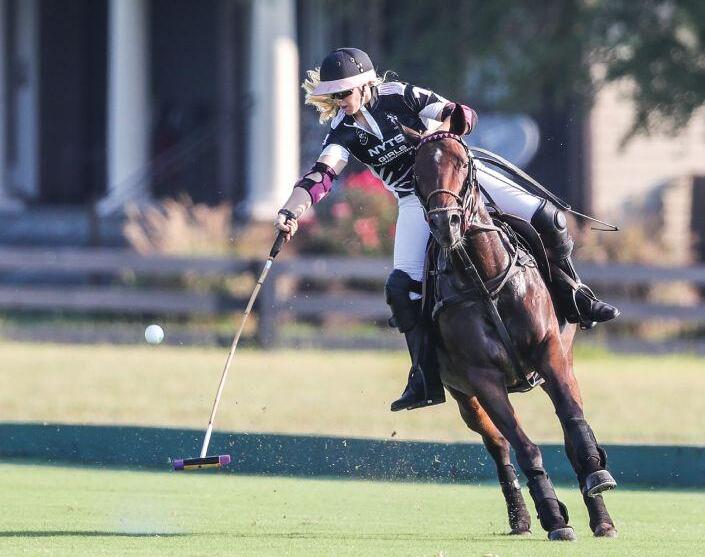
Hailing from a well-respected polo family, Summer Kneece is quickly making a name for herself in the polo world. Last year, Summer was named MVP at the Girls’ NYTS National Championship. She is a regular on the NYTS circuit and recently qualified for the National Interscholastic Championship by winning the Southeast regionals with the Aiken Youth Polo Girls’ interscholastic team.
What are you looking forward to most about the Junior Nations Cup event in Argentina?
I’m looking forward to the experience to play in a different country and play different horses and to meet new friends. I have never been to Argentina before!
What is the name of your favorite horse? Why do you like him or her?
My favorite horses is Ginger. Ginger is a 9-year-old chestnut mare Quarter Horse. She is small and very handy.
What is a funny fact about yourself?
I love the show “Friends.” I watch it everyday.
If you could create a dream vacation, where would you go and what would you do?
I would go spend the week in Hawaii, play polo and go to the beach.
Finn Secunda Age: 12; Handicap: -1
Port Mayaca Polo Club
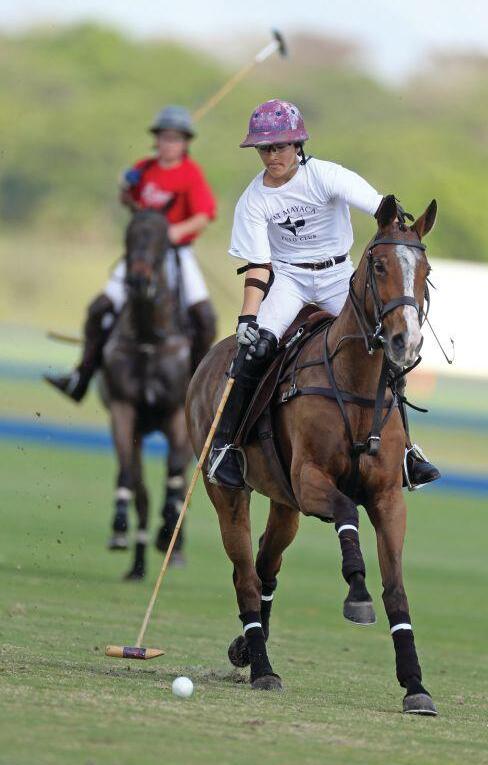
Finn Secunda, a third-generation polo player based in Florida, began playing at 5 years old. Apart from polo, he enjoys reading and science. Finn is dedicated to improving himself as a polo player. He is logging hours in the saddle, playing in the 4, 6, 8 and 10 goal at Port Mayaca, International and Vero Beach Polo Clubs.
What are you looking forward to most about the Junior Nations Cup event in Argentina?
I am looking forward to playing in Palermo most ... and eating the empanadas!
What is the name of your favorite horse? Why do you like him or her?
My favorite horse is Aixa because she is my first powerful horse. She takes me into plays quickly and bumps with no fear. She was lent to me by Juan Martin Nero.
Summer Kneece
What is a funny fact about yourself?
Two of my favorite foods are Jell-O and applesauce.
If you could create a dream vacation, where would you go and what would you do?
I would like to go to Titan, one of Jupiter’s moons because I love space. I would like to go to Titan specifically because it supposedly has a great view of Jupiter from very close up. I’d love to take a boat ride on one of its many liquid methane and ethane lakes and rivers, not to mention the low gravity.
Piers Bossom
Age: 14; Handicap: 0
Eldorado Polo Club
Piers Bossom strives to improve his game whenever possible. Based in California, he plays in the desert regularly, as well as in Santa Barbara. During the summer, Piers spends time at Memo Gracida’s ranch, learning from the former 10-goal player.
What are you looking forward to most about the Junior Nations Cup event in Argentina?
I am excited to go to Argentina for the first time and get to play on the best fields in the world.
What is the name of your favorite horse? Why do you like him or her?
[My favorite] is Greyhound because she goes anywhere and follows the ball. She takes you to plays and she gives me confidence when I get on her.
What is a funny fact about yourself?
I am quiet around new people, but once I get to know someone I joke around a lot.
If you could create a dream vacation, where would you go and what would you do?
I would go to Argentina and play polo every day, ride horses all the time and help out around the barn.
Piers Bossom
DAVID LOMINSKA/POLOGRAPHICS
Finn Secunda
Across the pond USA defends Intercollegiate Challenge Cup title
Photos by emmpix
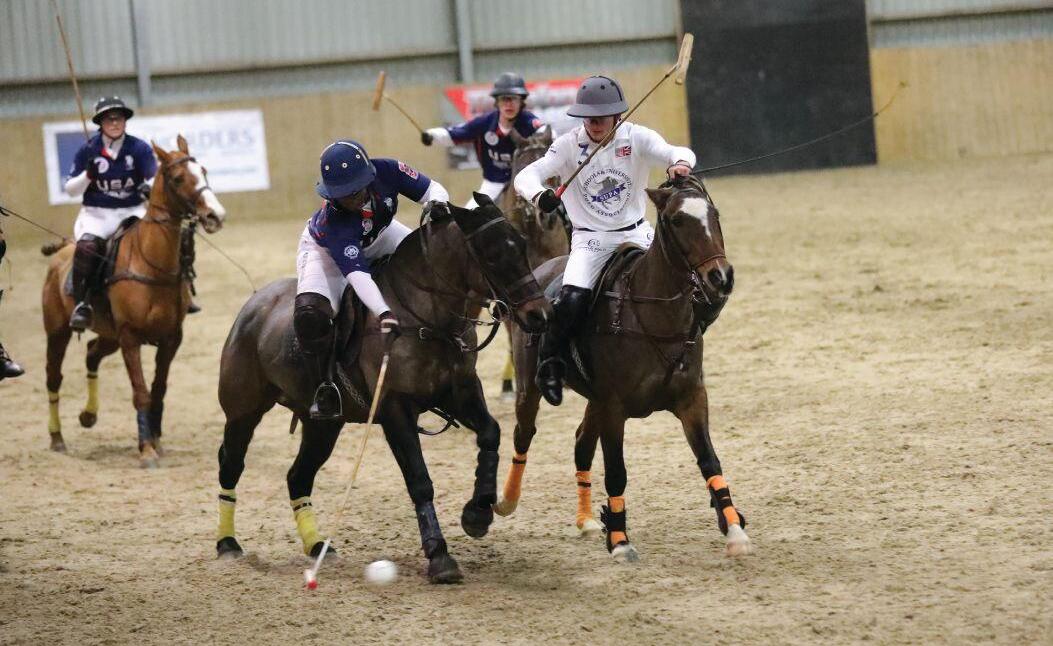
The eighth annual USA vs. Britain Intercollegiate Challenge Cup took place on Saturday, Feb. 8, at the Rugby Polo Club on Onley Grounds Farm in the United Kingdom. This year’s team, comprised of Elly Schwingel (Michigan State University), Shariah Harris (Cornell University), Molly Agee (Point Loma Nazarene University) and Fritz Felhaber (Texas A&M University), was donning official apparel sponsor U.S. Polo Assn. whites and jerseys. Heading into this year’s competition, the U.S. led 5-2 in the series.
The Schools & Universities Polo Association, which promotes and develops interscholastic and intercollegiate polo across the United Kingdom, received two goals on handicap at the onset of the game. Within a minute of play, the starting trio of Agee, Harris and Schwingel made up the difference. SUPA scored a field goal, bringing the lead to one that
Harris countered to tie the score again. USA fouling trouble earned SUPA an automatic Penalty 1 goal, giving it a slight advantage. A field goal from Agee leveled the score at 4-all, however a Penalty 2 conversion from SUPA ended the chukker, 5-4, in favor of the Brits. Playing a four-man rotation, Felhaber entered the arena in the second chukker, substituting for Agee.
USA struggled to find its groove in the second, with several bad luck shots. It was not detered, however, as the team dug deep each chukker to fight its way back. SUPA scored early in the chukker with a two pointer, and before the USA could clear the ball, SUPA added another to the tally to double up the U.S., 8-4. USA was able to add two more field goals from Felhaber and Harris to end the half trailing by two, 8-6.
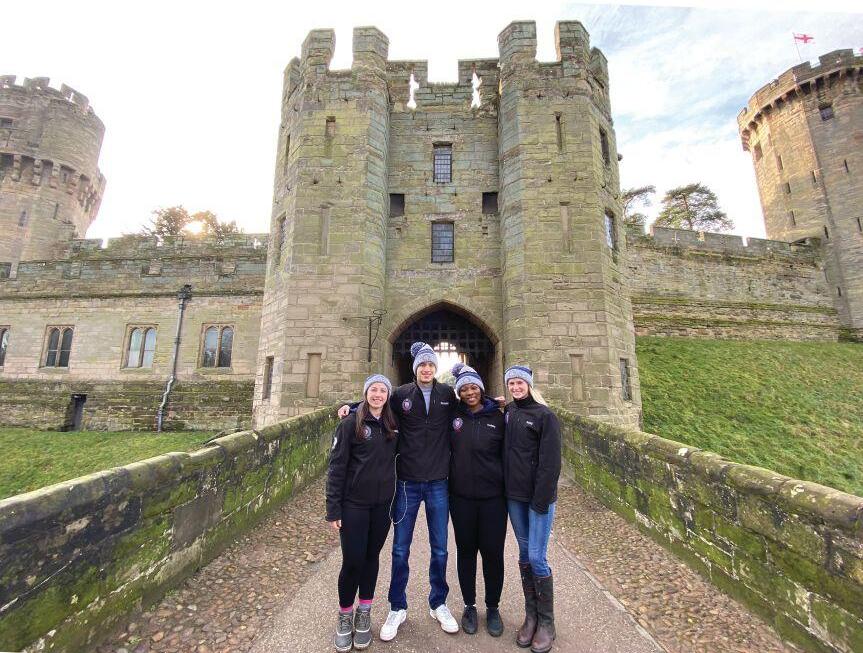
USA’s Elly Schwingel, Fritz Felhaber, Shariah Harris and Molly Agee visited the Warwick Castle.
Starting the third chukker, Agee was back in and Harris sat out. Agee wasted no time, sinking a Penalty 2, which was answered by three SUPA field goals. USA failed to reach the goal again in the chukker, sending the Americans into the final chukker trailing by four goals, 11-7.
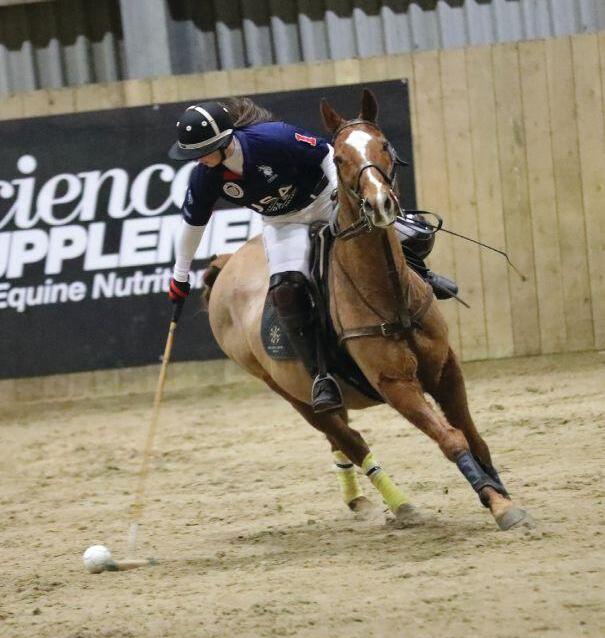
Harris came back in for the fourth chukker with Schwingel taking her turn to rotate out. A calm USA took the field and began to slowly chip away at the deficit. Agee scored on the first play, right out of the throw-in. USA was then awarded a spot hit, which proved to be the turning point of the game. Agee controlled the ball, taking it to the right wall with a defender on her hip. With one powerful neck shot she sunk a two pointer, putting USA within one.
USA conceded a Penalty 1, increasing SUPA’s lead to two. Felhaber ticked away one more, but SUPA retaliated immediately with a field goal of its own to maintain the two-goal lead, 13-11.
Still digging, Agee found the goal once from the field and once from the penalty line, tying the game, 13-all, with 2:20 left in regulation time. On fire, the U.S. took the lead for the first time off a Penalty 1 followed by a field goal from Agee with just under a minute and a half to play. Big, clear shots and solid defensive strategy kept SUPA from scoring further
USA’s Elly Schwingel.
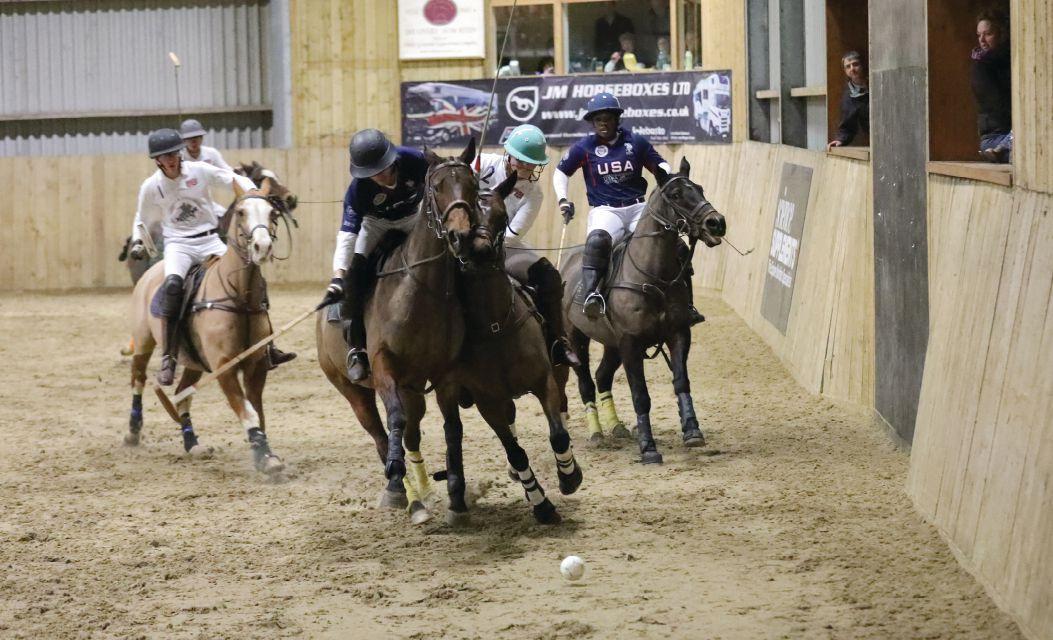
USA’s Shariah Harris powers past an opponent.
as the USA intercollegiate team was crowned champion once again, 15-13.
Molly Agee was awarded Most Valuable Player honors, contributing nine of her team’s 15 goals.
“I am extremely proud of this team,” said Amy Fraser, director of Intercollegiate/Interscholastic Polo. “It is not an easy task to play with a completely new team, on new horses, in the environment of international competition. Add to that, a four-man rotation, which involves playing with a different makeup of players in each chukker. Never once did the spirit of the team drop or their determination to win waiver when they were down. Win or loss, the biggest accomplishment this team achieved was the recognition by the horse providers in how beautifully each player rode and played their horses, showcasing the horsemanship and sportsmanship we instill in the I/I program.”
With the U.S. team now leading the series 6-2, the SUPA contingent will be looking for revenge in 2021 when the International Intercollegiate Challenge Cup returns to U.S. soil.
A huge thank you goes to SUPA organizers Nigel Mercer and Charles Betz for their terrific hospitality and the Druids Lodge Polo Club for supplying the U.S. team with an amazing string! •
Fritz Felhaber sets up just before necking the ball into the goal.
MVP Molly Agee
In the money
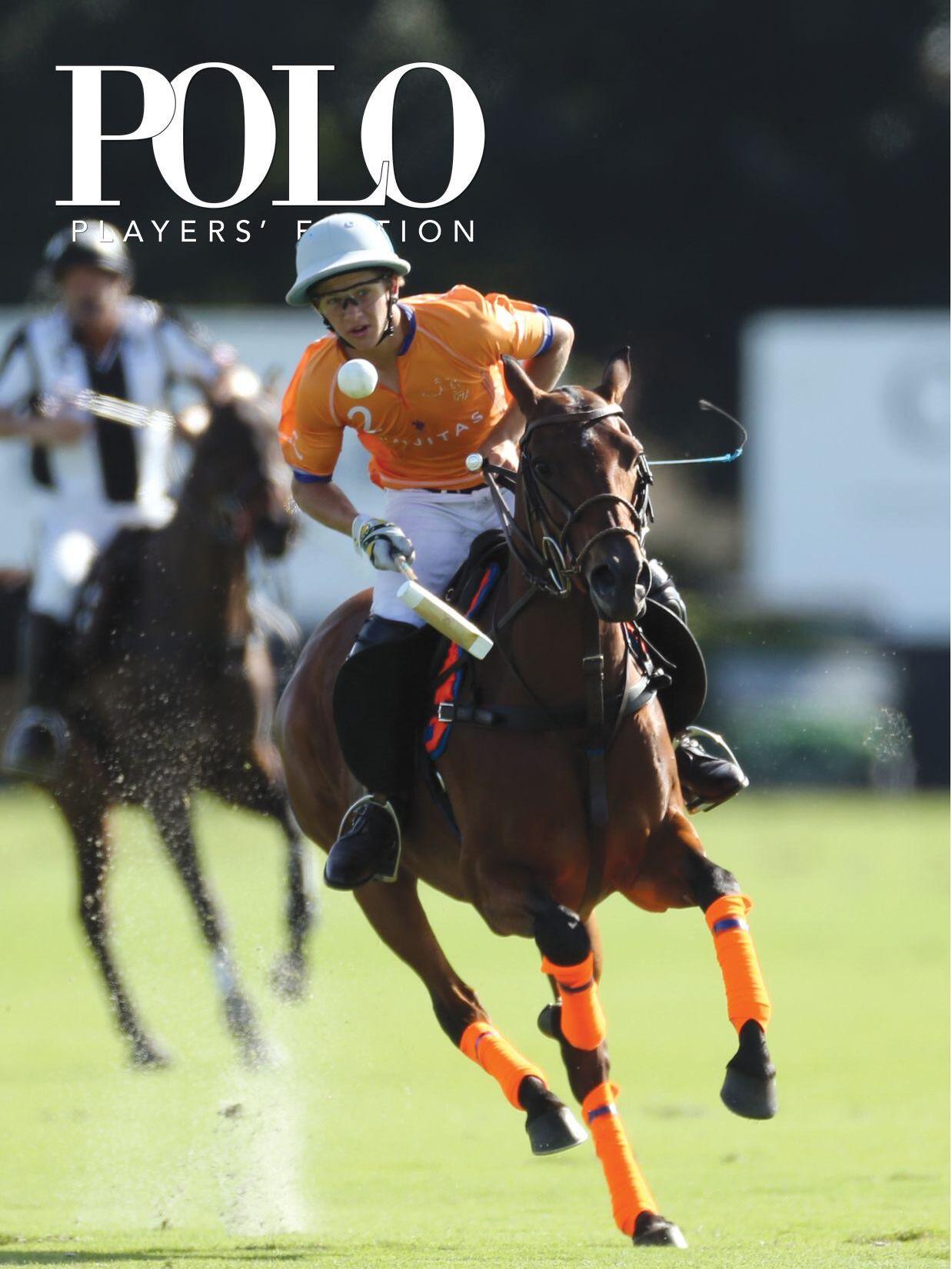
Las Monjitas wins first leg of Gauntlet
By Gwen Rizzo • Photos by David Lominska/Polographics
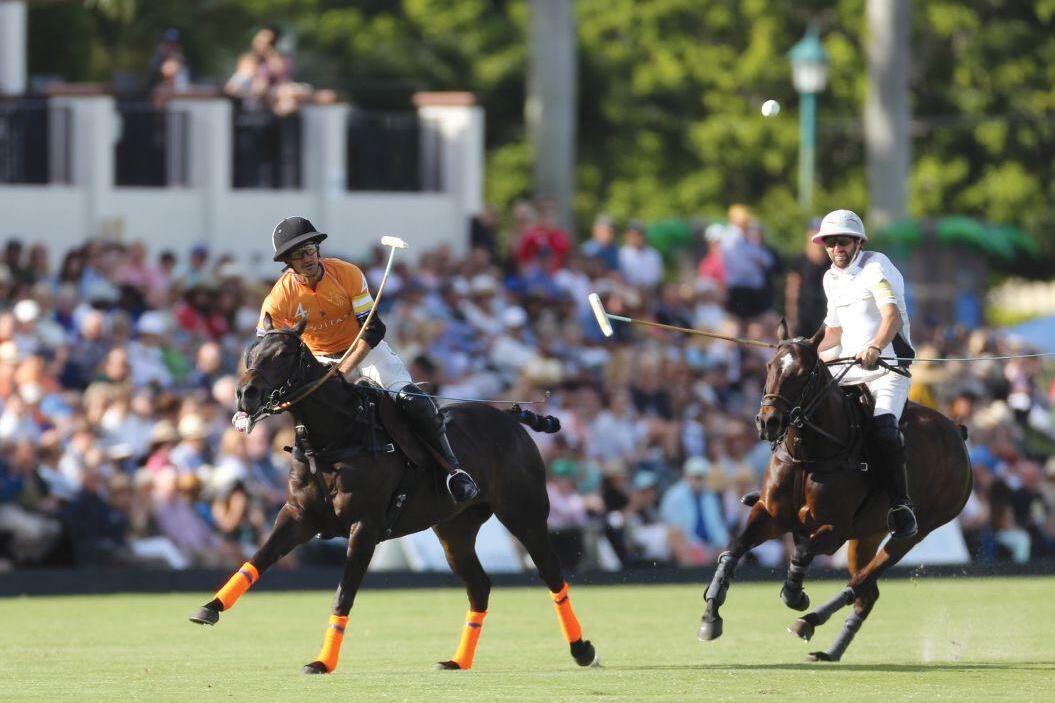
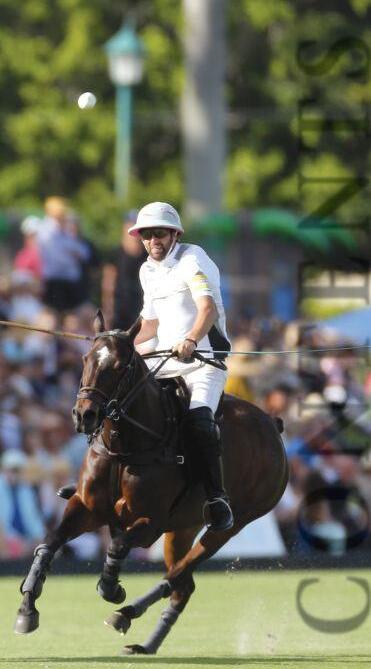
Las Monjitas’ Pelon Stirling is chased by La Indiana’s Polito Pieres in the final.
Las Monjitas was not content with settling for runner-up in last year’s C.V. Whitney Cup, falling hard to eventual Gauntlet champion Pilot, 13-6.
The team is named after patron Camilo Bautista’s wife’s family farm in Bogota, Colombia. It was a monastery in the 18th century so that is where Las Monjitas (the nuns) comes from.
This year, the team began with a new line-up after Francisco Elizalde was raised from 8 to 9. The
Columbian-born Bautista elected to keep Argentine Elizalde at his new handicap. Rounding out the international squad, 3-goal American Mackenzie Weisz took 4-goal Matt Coppola’s spot and 10-goal Uruguayan David “Pelon” Stirling took over for 10goal Hilario Ulloa.
Stirling said he didn’t receive the call to play until December, so his horses arrived late. Until they are ready, he is using horses of Adolfo Cambiaso, Michel Dorignac and Nacho Novillo Astrada.
The first leg of the Gauntlet of Polo, the C.V. Whitney Cup honors polo player Cornelius Vanderbilt “Sonny” Whitney (1899-1992), son of 10-goaler Harry Payne Whitney. An aviation-industry pioneer, he founded Pan American Airways and was the first assistant secretary to the U.S. Air Force. A 6-goaler in his prime, Whitney won the U.S. Open three times. He was also heavily involved in horseracing as a leading owner and breeder.
This year’s tournament included 14 teams (down two from last year), divided into six brackets. Brackets I and II had three teams each and played within their brackets. The remaining brackets had two teams each with Bracket III playing cross bracket with Bracket IV and Bracket V playing cross bracket with Bracket VI. Winners of Brackets I and II along with best records from Brackets III/IV and Brackets V/VI advanced to the semifinals.
Play began on Feb. 8. Las Monjitas got off to a great start, defeating Equuleus, 10-8, and Coca-Cola, 15-13, to top Bracket II. Indiana also started strong with an 11-7 defeat of Park Place and an 11-9 defeat of Cessna to top Bracket 1. Both Patagones and Postage Stamp Farm edged Old Hickory Bourbon and Daily Racing Form, tying for first place in Brackets III/IV. A shoot out put Patagones in the semis. In the last two brackets, defending champion Pilot narrowly edged Dutta Corp, 10-9, and Tonkawa, 12-11 in extra time, to advance.
The first semifinal had Las Monjitas taking on Patagones. Las Monjitas jumped out to an early 3-1
USPA Chairman Stewart Armstrong presents a saddle to MVP Francisco Elizalde.
lead, increasing the difference to three, 7-4, at the half. Las Monjitas carried the momentum into the fourth, doubling up Patagones, 8-4, before Patagones rallied in the last 14 minutes to come within one, 109. But time wasn’t on Patagones’ side and Las
Las Monjitas’ Mackenzie
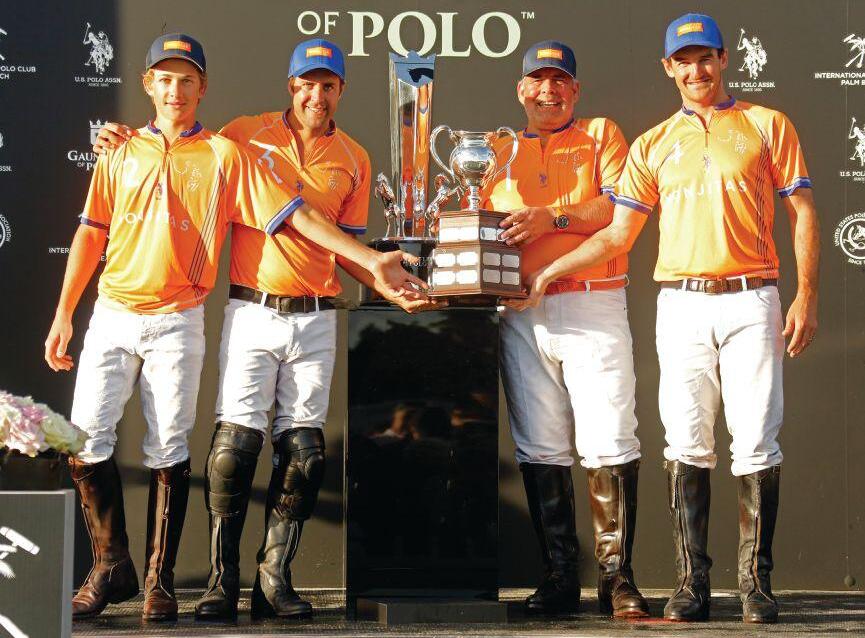
Weisz, Francisco Elizalde, Camilo Bautista and Pelon Stirling
Monjitas moved on to the final for the second year in a row.
In the second semifinal, La Indiana upset Pilot. It was a sticky, foul-riddled match with Pilot giving up an early lead, narrowly trailing, 6-5, at the half. The
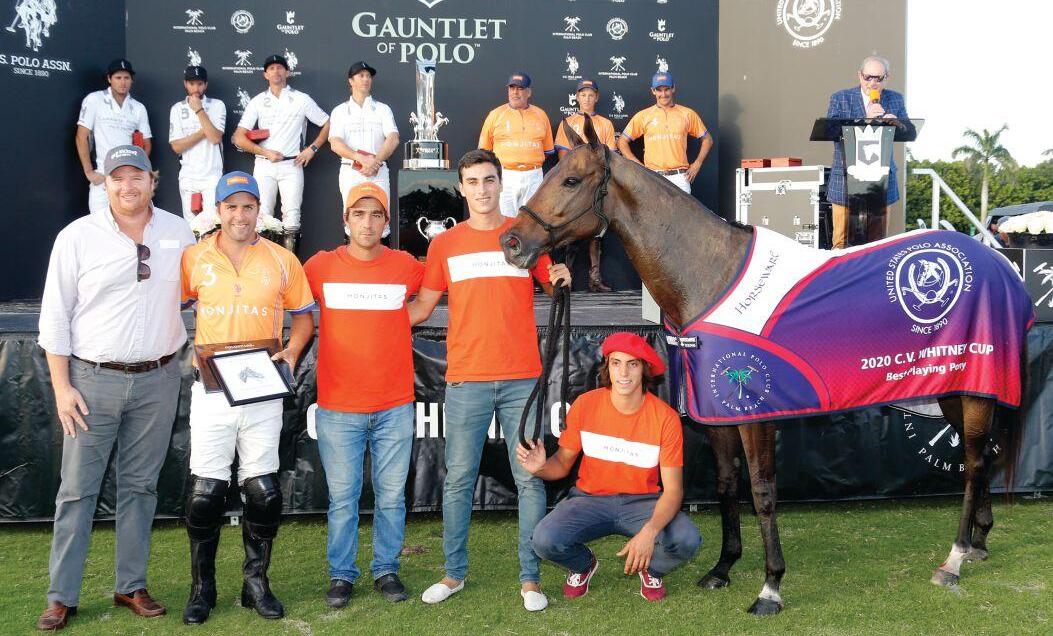
Stevie Orthwein presents Francisco Elizalde the Best Playing Pony awards for his Dolfina Molinera.
won the C.V. Whitney Cup.
teams leveled the score, 7-7, in the fourth. Jeff Hall was injured in the fifth period, and was replaced by Facundo Obregon, who made the most of the opportunity. He seemed to be everywhere and added a pair of goals to two from Polito Pieres to put La Indiana up, 11-9. The teams went back and forth in the last seven minutes, trading penalty conversions, but Pilot was unable to overcome the deficit. La Indiana advanced with the 12-10 score, taking away Pilot’s chances to repeat last year’s undefeated season and become Gauntlet champions.
After several days rest, the final was held on Feb. 23. Hall was back in the saddle for La Indiana. A calm, cool 17-year-old Mackenzie Weisz put Las Monjitas on the board in the first with a Penalty 3 conversion, the only goal of the chukker. Elizalde found the mark with a neck shot in the second but Pieres and Hall responded to level the score. Weisz put Las Monjitas ahead again early in the third, but a pair of Penalty 4 conversions from Pieres switched the lead. Elizalde sunk a Penalty 6 to tie the score, 44, at the half.
The teams continued to keep it close in the fourth with Elizalde and Hall trading goals. But, Las Monjitas owned the fifth with Elizalde scoring backto-back goals followed by a Penalty 4 conversion. Stirling, who was working hard at back and feeding long drives to his teammates, added his first goal, a Penalty 2, to put the team ahead, 9-5. Rattled, La Indiana missed a Penalty 2 and a Penalty 4 before Pieres split the uprights late in the chukker to cut the difference to three going into the final seven minutes.
Elizalde kept up the pressure, scoring from the field and sinking a Penalty 4 to put Las Monjitas comfortably ahead, 11-6, early in the chukker. La Indiana wasn’t about to concede and kept fighting. Hall found the goal and a Penalty 1 put the momentum back in La Indiana’s favor. Santiago Gomez Romero scored from the field, bringing the team within two, 11-9, with little time remaining. Just seconds on the clock, Pieres scored another but the team ran out of time and Las Monjitas took the 11-10 victory.
“Game by game we improved; we [made] a step forward, which is always very important at the beginning of the season,” explained Stirling. “We knew we had to play well because {La Indiana] was a very strong four-man team. Fran played an outstanding game, he was by far MVP ... and Mackenzie managed the pressure as well as anyone. Camillo ... played his best game of the season. Hopefully, we [will] keep going, that’s the idea.”
The win gave Las Monjitas an exclusive chance to
be this year’s Gauntlet champion. The team also was awarded with $100,000 in prize money. La Indiana didn’t go home empty-handed. New this year, instead of last year’s winner-take-all format, the runner-up went home with $25,000.
Elizalde, who scored a game-high eight goals, was MVP and his Dolfina Molinera, last year’s U.S. Open Best Playing Pony, was once again presented with the Best Playing Pony blanket.
Camillo Bautista said, “It’s nice to be back. The last [tournament] we played here was the U.S. Open final. It’s our second C.V. Whitney Cup so we are very proud. We have two very tough tournaments coming so it’s going to be fun. We are taking it one game at a time. It worked this time so hopefully it keeps working. It’s been a hard two or three weeks.”
In consolation matches, Postage Stamp Farm got the best of Cessna, 11-8, while Coca-Cola edged Park Place, 13-11. •
Dare to care
Match, auction raise record funds
Photos by Shelley Heatley
Gonzalo Pieres Jr.
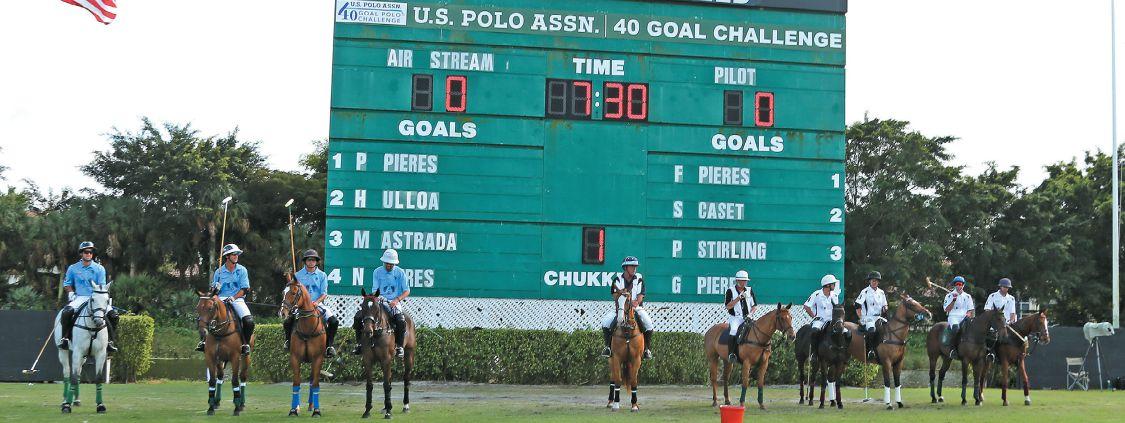
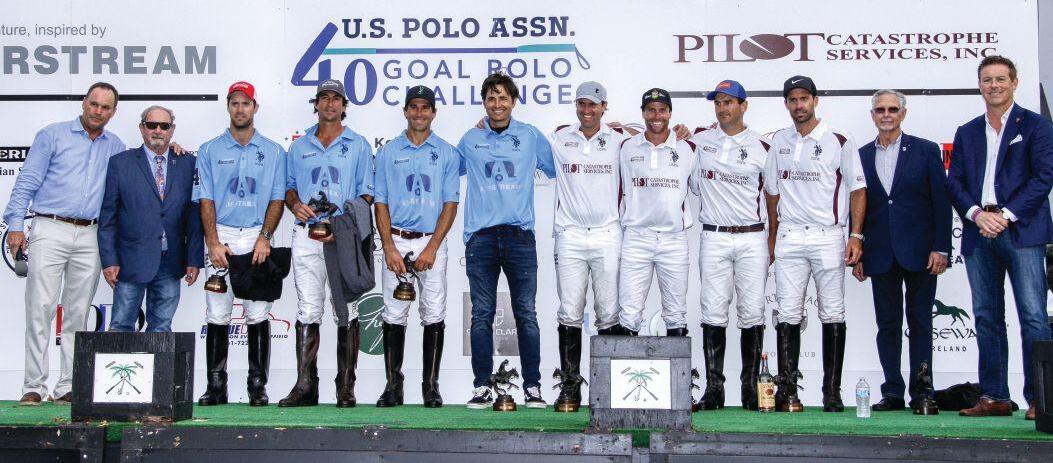
The U.S. Polo Assn. 40-Goal Polo Challenge was a huge success, raising over $425,000 for those members of the polo community who suffer a serious injury or illness. It was the most raised in any one year since its inception.
The exhibition match includes eight of the world’s best players, and is the highest-rated polo played
outside of Argentina. While it is a competitive match, it is more of a fun match. This allows the players to play some of their up-and-coming horses that have plenty of talent but may not be ready for the highpressured polo seen in the Gauntlet of Polo. Others with promising horses may offer them to the players for a chance to get their horses shown. The players
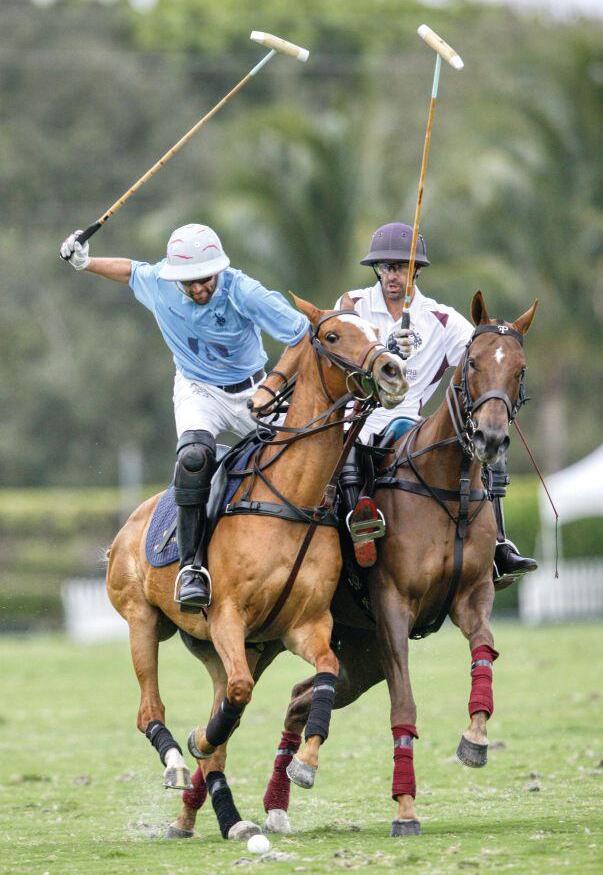
Sapo Caset, who scored the first goal of the match, is chased by Hilario Ulloa on his homebred Best Playing Pony Lavinia Coronación.
may elect to play some of their good horses if they need a fast practice for them. The lack of pressure also allows the players to takes some risks and try more difficult shots.
Played as a four-chukker match, the players are encouraged to make long drives by receiving two points for goals scored outside 80 yards. The teams were once again sponsored by Curtis Pilot’s Pilot Catastrophe Services and Peter Orthwein’s Airstream.
Played on a cloudy, windy day, the first goal was scored just two minutes into the match when Sapo
Caset sent the ball through the posts. A few minutes later, Airstream was awarded a Penalty 4 but elected to move the ball back to the 80-yard line, hoping for two points. Unfortunately, the wind took the ball and it went wide. Hilario Ulloa put Airstream on the board with a minute left on a drive downfield. Both teams shot at goal in the second chukker without luck, but Ulloa added another with a little more than a minute on the clock. Pilot had another scoreless chukker in the third, but Airstream jumped ahead 4-1 after Nico Pieres moved a Penalty 4 back to
The teams celebrate another successful year. Later, their jerseys were auctioned off to raise funds.
A Future 10s match was played prior to the main match.
the 80-yard line and scored, earning two points. Facundo Pieres drove to goal in the final seconds, dropping it a few feet in front of the goal but time ran out.
The last chukker began with a throw-in in front of the goal, but Airstream turned it the other way. Pilot rallied, taking advantage of the two-point challenge. Facundo Pieres moved back a Penalty 4 to the 80-yard line, converting it and earning two points. Two minutes later, Pelon Stirling ran down field and split the uprights with a 90-yard shot for two more points. Pilot was now ahead, 5-4. Airstream made four attempts at goal but couldn’t find the mark and Pilot took the narrow 5-4 victory.
Pelon Stirling won the Tito’s Handmade Vodka two-point shot of the day; Nico Pieres was Jetcraft MVP and Hilario Ulloa’s chestnut mare Lavinia Coronación was the 5 Star Builders Best Playing Pony. Hilario was very happy to see his mare win the award since she was bred by him and his father.
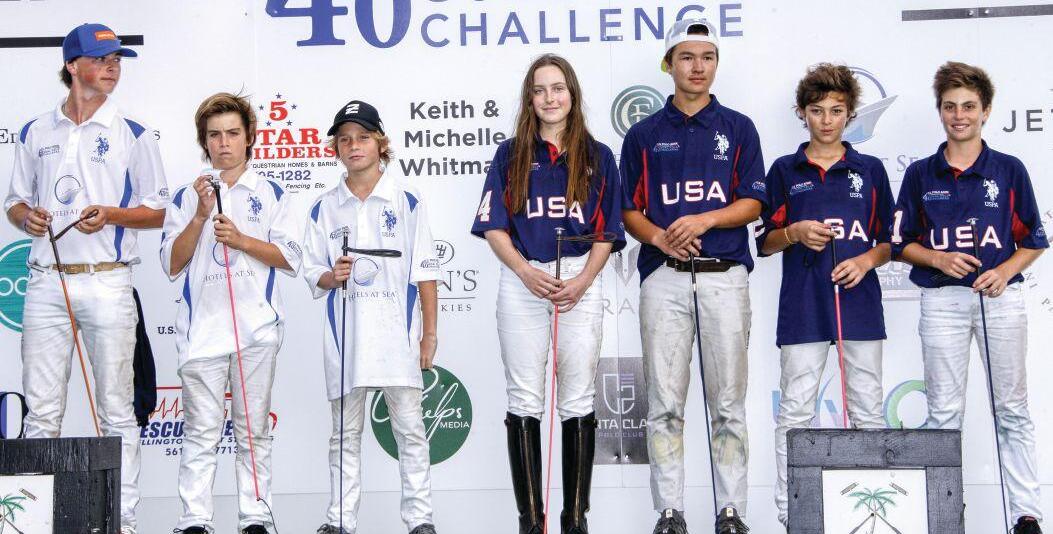
Prior to the 10-goalers taking the field, the Future 10s Match took place, featuring the children of current and former 10-goal players, as well as children of generous supporters of the PPSG. Participants in the Future 10s Match were extremely excited to be on the U.S. Polo Assn. field in front of a crowd. They put on a great show of up-and-coming talent.
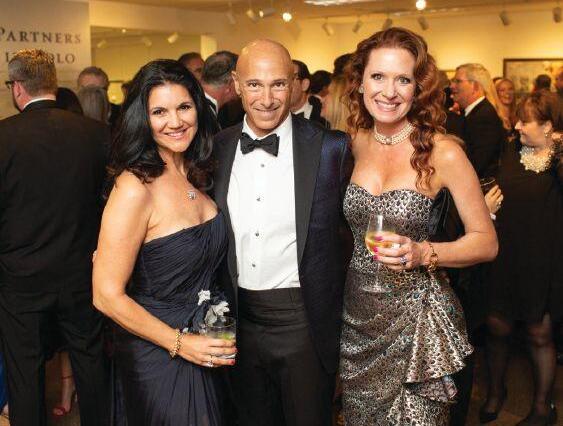
Following the 40-goal game, over 400 people attended the dinner auction, which was cosponsored by Mark Edward Partners and Keith and Michelle Whitman.
Highlights of the auction included Curtis Pilot’s winning bid of $70.000 for horse cloning donated by the Crestview Group of Companies; Don and Carol Pennycook winning an island vacation retreat at IIha do Japonês in Brazil; Facundo Pieres’ jersey raising $9,000 each from Lisa Falcone and the partnership of Mike Egan and Jim Kravitz. To sweeten the deal,
Pieres and the Pilot Catastrophe Services crew offered to play a practice with Liliana Falcone and Mike Egan while Kim Kravitz will photograph.
The biggest applause of the night went to Juli Ezcurra who auctioned his vest, which was bought by Curtis Pilot. Pilot very kindly gave Juli his vest back and then gave him his Pilot team jacket.
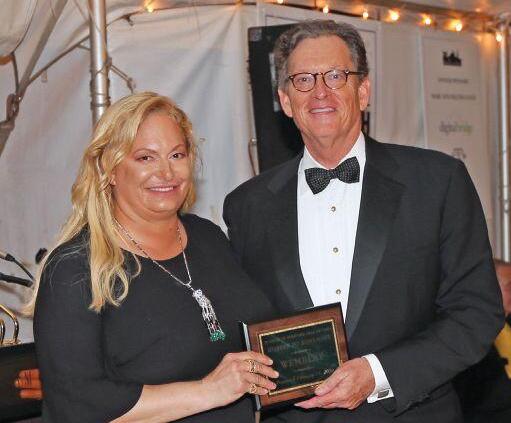
The PPSG is grateful to everyone who contributed to the event in any way, allowing it to continue to provide financial assistance to members of the polo community who have fallen ill or gotten seriously injured. Since its inception, over $2.5 million in assistance grants have been awarded to 81 different players and grooms.
If you were unable to attend the game, you can watch it online at globalpolo.com.
Facundo Pieres tries to push his cousin Polito Pieres off the ball.
St andouts
Latest Hall of Fame inductees honored
Photos by Krystal Zaskey Photography
Bob Jornayvaz accepts Wembley’s Horses to Remember award from Museum President Melissa Ganzi.
Melissa Ganzi presents Joey Casey the Hall of Fame Award.
Melissa Ganzi presents Pat Dix his Philip Iglehart award.
Wendy Sherman accepts the Philip Iglehart award for her grandfather George C. Sherman Sr.
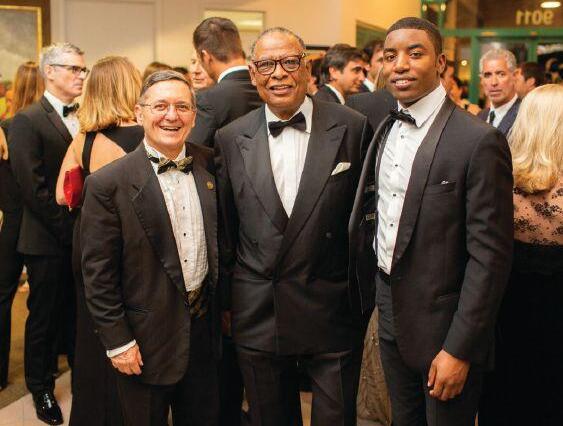
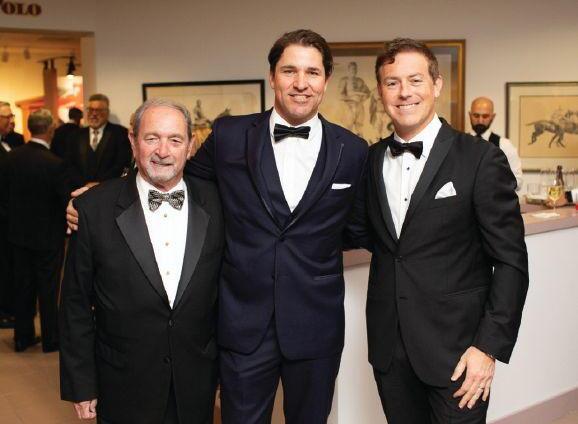
A record crowd gathered at the National Museum of Polo and Hall of Fame in Lake Worth, Florida, for the 31st Annual Hall of Fame Induction Ceremony and Gala Dinner, Feb. 14.
Those being honored included Joey Casey, Cyril Harrison, Pat Dix, George C. Sherman Sr. and horses Wembley and Gargantilla.
Attendees making their way up the red carpet, were greeted with glasses of champagne. They enjoyed a cocktail hour while strolling the museum’s exhibits and catching up with friends. After, the crowd made its way to the dining hall for a lavish three-course meal. The awards ceremony immediately followed the dinner, with inductees or a
Debby and Jack Oxley with Tracy Gudgel
Elisa Gaudet with Avery and Taryn Chapman
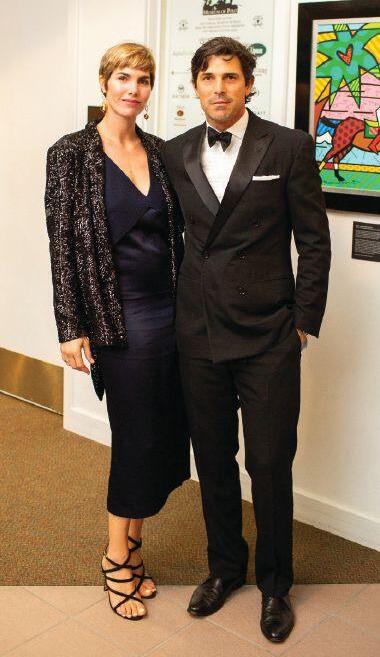
Delfina Blaquier and Nacho Figueras
family member sharing some of their most memorable moments in the sport and thanking those that made it all possible. After the awards ceremony, attendees enjoyed dancing to live music.
Starting off the award presentations, Gargantilla was honored with the Horses to Remember award.
The mare made a name for herself in the 1920s playing for Devereux Milburn.
Next, Bob Jornayvaz accepted the Horses to Remember award for Wembley. Now 26, the Thoroughbred gelding earned numerous awards over his career including several Best Playing Pony awards and the 2004 Horse of the Year, an awarded presented by this magazine.
The Philip Iglehart Award for lifetime contributions to the sport went to Pat Dix and
Diana and Kishan Khanna
Gil and Skey Johnston, Lee Harrison Child and Peter Poor. Child accepted the Hall of Fame award for her father Cyril Harrison.
Marc and Melissa Ganzi and Adolfo and Maria Cambiaso
George C. Sherman Sr. Dix was on hand to receive the award after serving the USPA for over 60 years. Wendy Sherman accepted the award for her grandfather who founded the Indoor Polo Association.
Cyril R. Harrison was posthumously honored as a Hall of Fame inductee for his revolutionary hitting style and skillful team play. He was also one of the
USPA’s first polo instructors. His daughter Lee Harrison Child was on hand to accept the award and shared several touching stories about her father.
Lastly, Joey Casey accepted the Hall of Fame award for his multiple wins in the Sunshine League, the Gold Cup and the Westchester Cup. The former 7-goal player is also a polo horse breeder and trainer.
Jeanie Miranda, Olexa Celine and Christine Martin
Mia Cambiaso and Juan Martin Zubia
Peter Rizzo, Madison Richardson and Kareem Rosser
Tony Coppola, Karl Ude-Martinez and Michael Prince
Imphal, India
5th Manipur Statehood Day Women’s Polo Tournament
By Pamela Flanagan
My passion for polo has taken me all over the world. Winston Churchill’s famous saying, “A polo handicap is a passport to the world,” has certainly held true for me. I have played in the U.S., Mexico, Argentina, China, Guatemala, Canada and most recently, on the U.S. team at the 5th Manipur Statehood Day Women’s Polo Tournament in Imphal, Manipur the northeastern edge of India.
I must say my experience in Manipur was certainly unique. Like most international tournaments, we were able to meet incredible polo women from around the world. The respective polo federations sent teams representing Argentina, Great Britain, Egypt, Indian Polo Association from New Delhi and a local Manipur team.
I had the amazing experience of playing on what is arguably the descendants of the first polo ponies, the Manipuri pony.
have, an unwavering lifelong love for horses.
I started riding when I was about 4 years old. I rode multiple times a week throughout my childhood, and then went on to boarding school at Culver Academies. Culver has several very impressive horsemanship programs, one of which is polo. I picked up polo and never turned back. I played through the USPA I/I programs throughout high school, college, and even law school. After graduating, I realized I needed horses of my own, so I decided to rescue horses in need of a second chance and turn those horses into polo ponies.
I have been drawn to horses for as long as I can remember. My mom loves horses, but no one in my immediate family had horses or rode horses. I am not entirely sure where the fascination stemmed from, but one thing is clear: I have had, and will always
Stella and Nala were my first two rescues (#RescuePonyStella #RescuePonyNala). Working with them, and watching their potential slowly emerge through their tattered exterior quickly turned me into a passionate advocate for rescue horses and horse welfare generally. Since that time, I have rescued, rehabilitated and repurposed six horses of my own, and have helped several other horse lovers do the same. I have continued to play polo around the world and at all levels. Just over two short years after rescuing Stella, I played her in the 2019 Women’s U.S. Open and won. I share all my horses’ stories on my Instagram page: @Pamela_Alina.
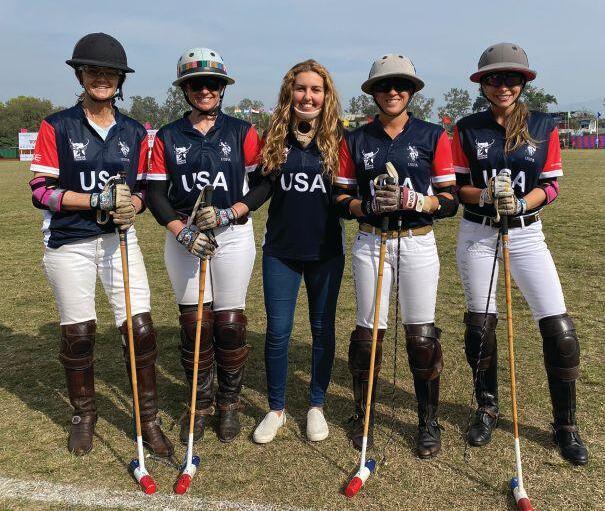
Team USA consisted of myself, Athena Malin, Alyson Poor, Bridget Sibson and Carolyn Stimmel. Stimmel, who played in the event last year, was going to help coach and serve as alternate. Ed Armstrong, co-founder of the tournament, was our coach and mentor.
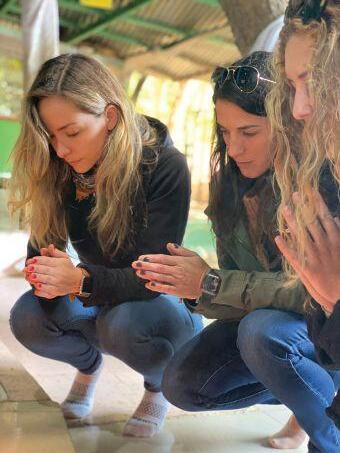
The U.S. team arrived a few days early and had a chance to meet the ponies and stick and ball. It also visited the Ima Keithel Market (mother’s market), a 500-year-old market run exclusively by women, and the Marjing Temple, the only temple for ponies.
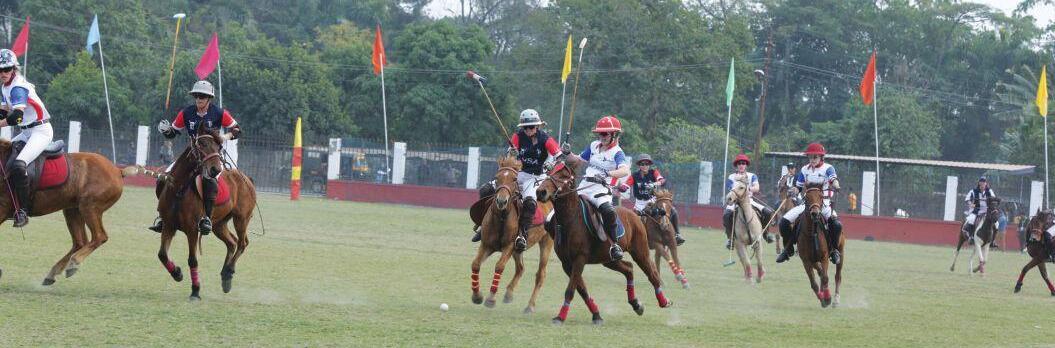
The Manipuri ponies were certainly different. These small- to medium-sized ponies are about 12 hands or smaller. Every player used mallets between 45-47 inches. Despite their size, these ponies were tough. At the end of the tournament, prizes were given to the best playing pony and the naughtiest pony. I was fortunate to have played on Thok-thak (“rascal”in Manipuri) the naughtiest pony, and I will say, it was a well-deserved award for this fiery chestnut
pony. The ponies are not exactly the fine-tuned polo ponies you find in other parts of the world, but they are not “naughty” in the traditional sense either. They may not stop quickly, or turn willingly, but they try hard. Never once did a pony kick, buck, rear or try to throw its rider. Some may have been better trained than others, but they were all well-behaved on and off the field.
The polo stadium at Mapal Kangjeibung is magnificent. Located in the center of the city, the stadium has beautifully built rows of comfortable seats on one side, and a speaker system fueled with lively commentary. On the other side of the field sat stables where the horses were kept for the duration of the tournament. The field, with the picturesque foothills of the Himalayan Mountains as a backdrop, was not regulation size, but it still seemed large enough to play a fun, open game. Since the ponies are smaller, they don’t cover nearly as much ground as a Thoroughbred might when they are running flat out, so the smaller-size field did not seem to make much of a difference in terms of play. Further, the field was flat, and well maintained, but a bit hard, so the ball traveled quite far when a player really connected. This allowed the games to open up, which made faster, more exciting matches.
To keep the tournament fair, each match was four chukkers played on a split-string format. The teams switched strings at the half of each game. Thus, every pony played two total chukkers with a rest period in between. Most horses would not have had the stamina to play two outdoor chukkers, but these ponies, even in the second half, seemed to have plenty of spirit. I was amazed at their willingness and endurance.
I was honored to be chosen as one of the players to represent the United States. I was able to get to know polo women from around the world and to bond with the other U.S. women selected for Team USA. Building these relationships is an important facet of
women’s polo. The Women’s International Polo Network was established to help promote meaningful experiences like these. So, traveling with new women from various parts of the world, also helped me bring awareness and participation to the WIPN.
Several organizations came together to make this tournament possible. Produced by Polo Yatra, the women’s polo initiative of Huntre! Equine, the tournament was organized by the All Manipur Polo Association, and presenting sponsor Manipur Tourism played host. Incredible India of the Ministry of Tourism sponsored our international travel, while the U.S. Polo Assn. provided the teams with customized jerseys and outfitted the grooms as well. A formal jersey presentation was held for all the teams.
Local players lent their ponies, and participating teams provided umpires and coaching help when needed. The group effort facilitated a fantastic turnout in the thousands. The draw and bracket configuration had the U.S. team starting by playing in the last game of the second day, while the other teams had one, and some two, games behind them. Prior to that, the U.S. players had umpired and announced games and were anxious to finally play.
Our first game was against Egypt, a new team with an impressive debut. The team quickly figured out the ponies and each other’s style of play. All the years of I/I play allowed the ladies to quickly become a cohesive team. Two minutes into the game, Malin’s pony was sideswiped, causing it to spin and Malin to fall hard, landing her in the hospital, (she is ok now). Stimmel, who arrived after an arduous 36-hour trip from Texas only an hour before the match, jumped in to finish the game. Despite the difficulties, USA prevailed, 8-1.
“Being on a completely different continent, new time zones, noisy city traffic, compromised air quality and the familiarity of the previous year’s games and trip, helped me realize I was in a familiar and foreign
USA was runner-up for the second year in a row, this year falling to Great Britain, 5-2.
Pony preservation
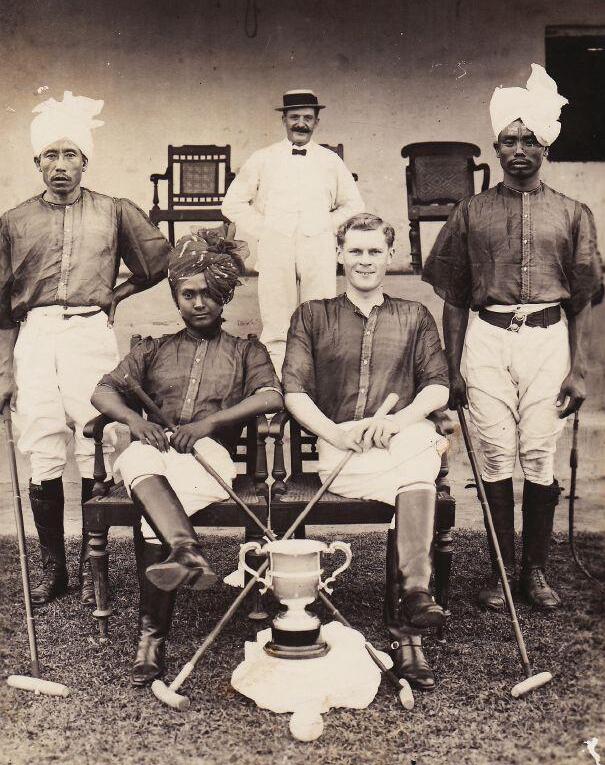
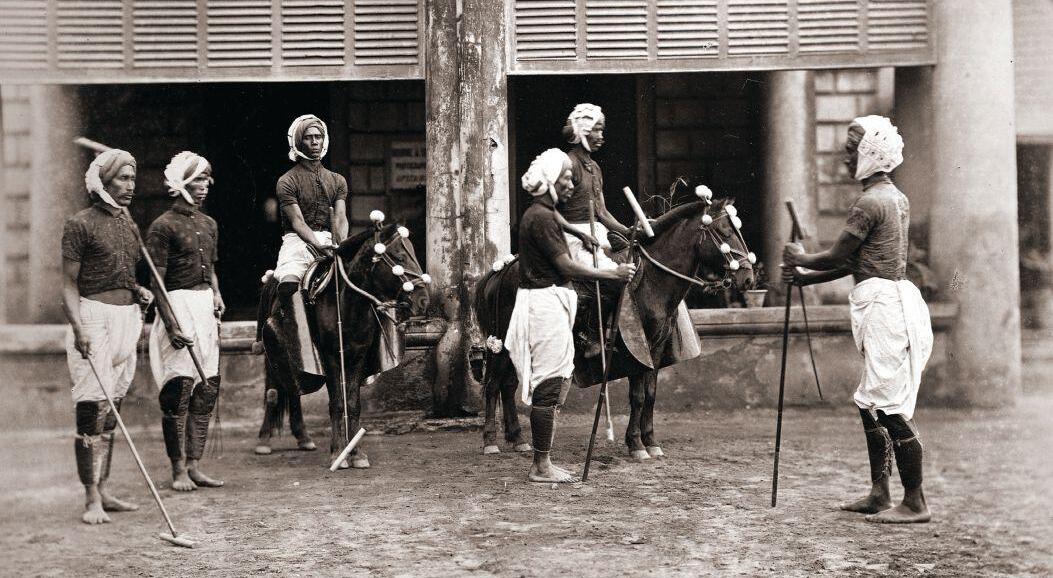
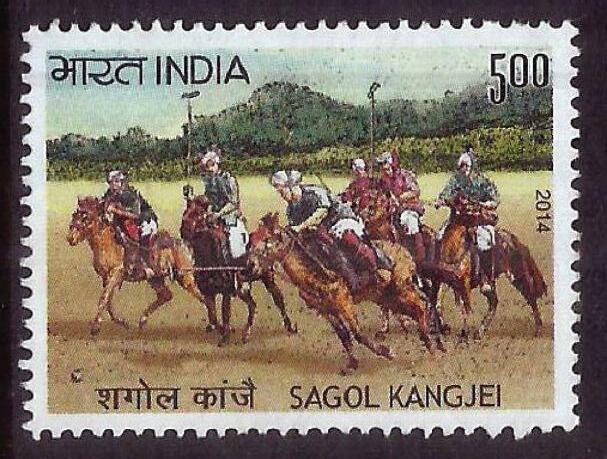
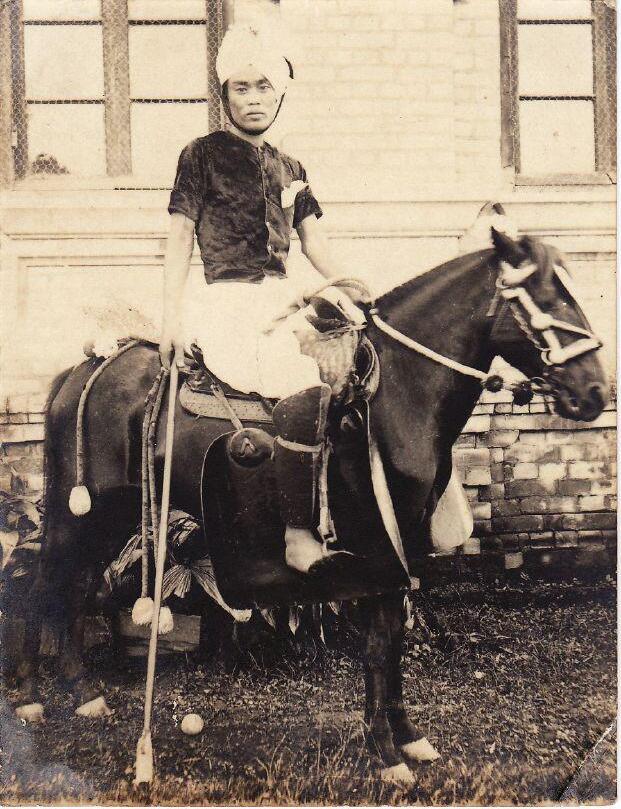
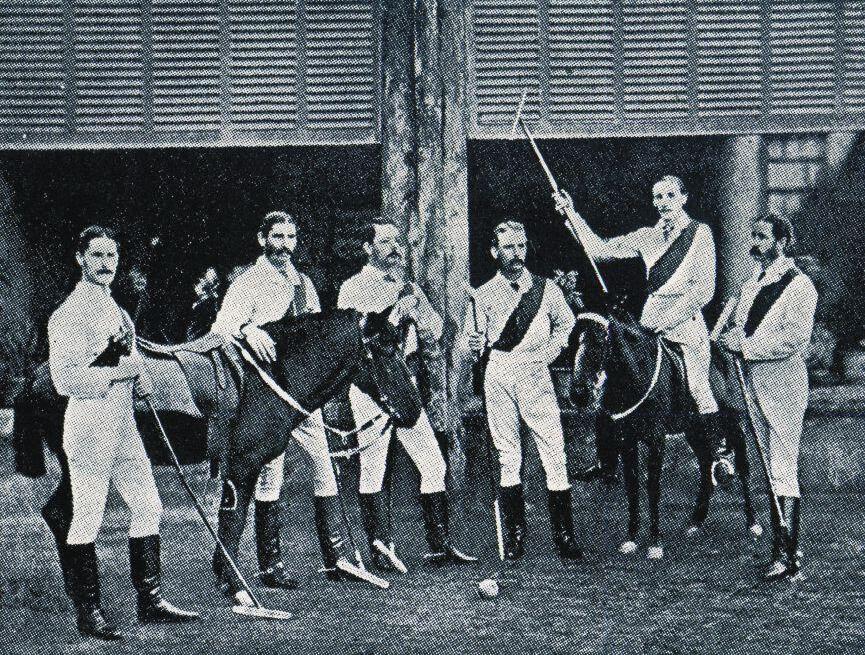
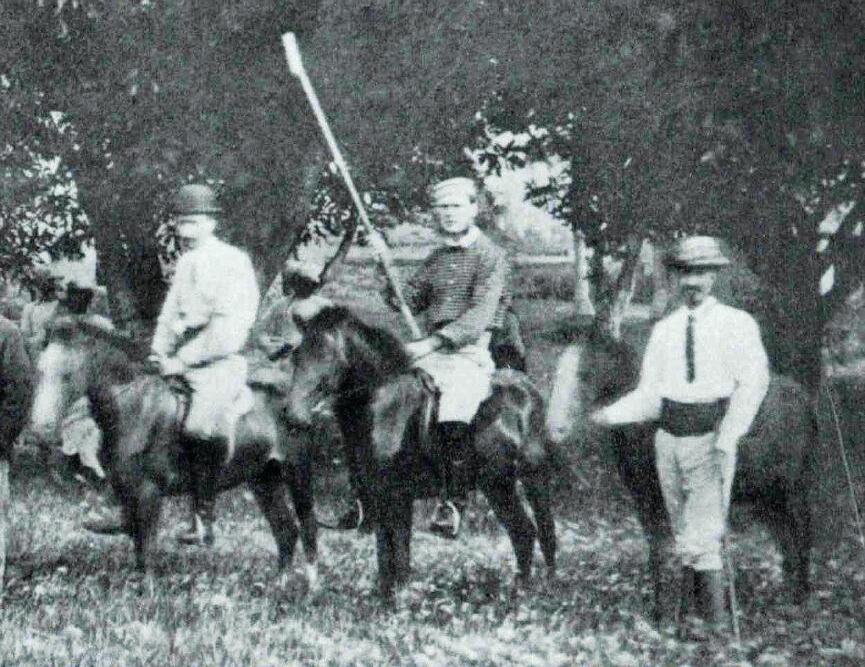
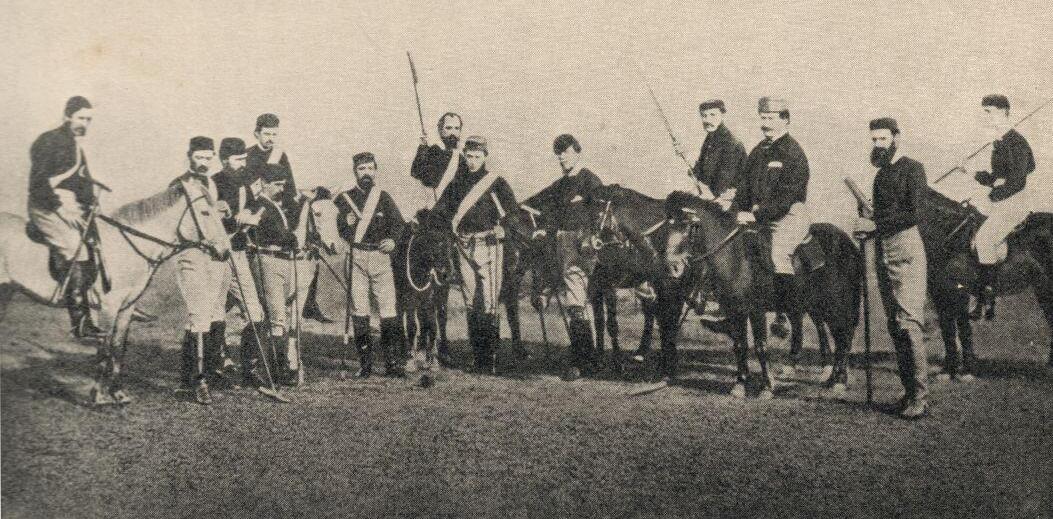
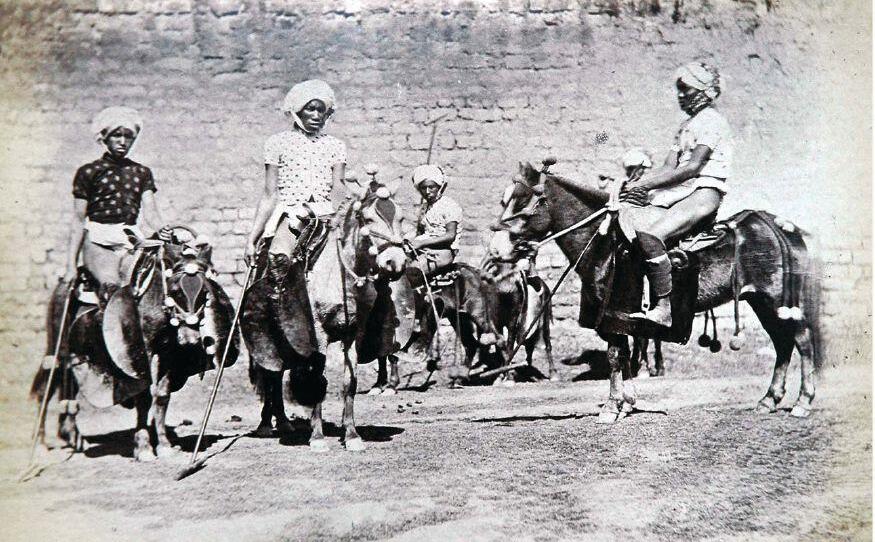
I also took time to learn more about these magnificent equine athletes. This tiny equine lays claim to be the world’s original polo pony. The modern game was said to be created by the British from the traditional game of sagol kangjei of Manipur. The UK Armed Forces Polo Association designated this Manipur tournament the official closing event of Polo150, the celebration of 150 years of polo in England.
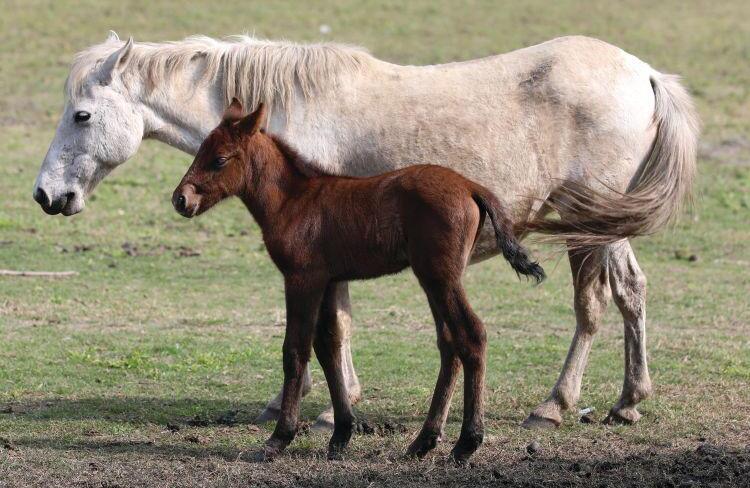
Indeed, the convention of calling all polo-playing horses “ponies” comes from this polo heritage horse. Somi Roy of Huntre! Equine, a social enterprise of sports and conservation, is a Manipuri pony advocate. He briefed me on the subject, with a focus on the ponies’ current-day plight, and his efforts to preserve the sacred pony.
In Manipur, these former cavalry ponies are sacred, and as such they are not used for work, nor slaughtered for their meat, but rather solely used for ritual and sport, more specifically polo. In fact, there is even a pony shrine dedicated to these sacred animals. Manipur is considered by many to be the birthplace of modernday polo. With such a rich history, it is important that these sacred horses are preserved for cultural and religious purposes. Just a couple of decades ago, there were thousands of these ponies scattered throughout the state of Manipur. Today, there are only 500 and the number has continued to decline, owing to the loss of their traditional pastures to urbanization.
We visited the farm where some of these ponies are bred. Despite being in the city, the farm was tucked away down a rural road, sitting in a quiet little pocket at the base of the hills. The mares with foals were kept in the large paddocks, while the studs and other horses had already left for the hillsides’ lusher grazing land. These ponies are effectively left wild except for the short period of time in which they are being ridden in polo matches or taken on religious processions.
The people of the Manipur Horse Riding and Polo Association who run the farm were passionate about their
land all in the same breath,” wrote Stimmel.
Malin was still recovering and heeded doctors orders to rest and not ride so Stimmel continued to play for the team.
Our next opponent was the local Manipur women’s team. Wow, these women were tough! The Manipuri women are fearless, determined women with a unique style of play. They put on a spectacular match, but we were lucky to come out with a 7-1 win.
Stimmel wrote, “This match was exciting, fun and challenging. The Manipur ladies’ improvement from 2019 was impressive. These ladies all played hard and
with heart. They know their way around the field and know each Manipur pony exceptionally well.”
The two wins earned us a spot in the final where we faced an 18-goal Great Britain team. Our 15-goal team knew we were in for a challenging match. Team USA held its own in the first half of the match, with the teams either tied or within a goal of each other throughout. But, the Brits took control in the third chukker and the U.S. ultimately suffered a tough 2-5 loss.
Despite the loss, spirits were high. We were all given an incredible opportunity to immerse ourselves in a
The U.S. team visited where the Manipur ponies are bred.
POLO AROUND THE GLOBE
ponies and proud of their preservation efforts. I also found Deleep Hawaibam and his team to be open to suggestions, and willing to try new things to help their breeding program continue to succeed. During our visit we spoke about implementing new systems in order to track breeding and avoid inbreeding, and about the importance of intentionally breeding their most athletic, conformationally correct, and healthy horses to create balanced, athletic and healthy offspring.
While at the breeding farm we pulled tail hairs from the horses on the property. We took these samples back to the U.S. and sent them to an equine geneticist at Texas A&M to have the DNA analyzed. Our hope is to establish a specific DNA genetic sequence for the Manipuri Pony. This would allow the State of Manipur to really know what makes their sacred ponies unique, help establish parentage for breeding purposes and ensure the sacred breed is kept pure. These fundamental elements are important in creating a foundation for the main objective: to preserve the Manipuri pony.
Another fundamental component, and the most important element required in the efforts to preserve the pony is equine welfare. After conversing with Somi, he explained the two pillars for his pony preservation project have focused on ponies, and polo. If polo continues, the ponies will have a purpose, and thus be maintained, bred and cared for. And if the ponies survive, polo will continue in Manipur.
After our conversations, Somi was turned on to the idea of adding “welfare” as an essential third pillar. The ponies cannot prosper without proper care. We have had several conversations regarding various ways to ensure pony welfare. We have discussed implementing a government-funded clinic that can help care for the ponies’ basic needs and treat injuries that may occur. We have also discussed organizing educational clinics and fundraisers to provide new or used tack and supplies.
I have created an “Amazon Wishlist” to help get some of these goals in motion. The list includes much-needed supplies that will help improve the ponies’ health, comfort and performance. My hope is that these ideas and conversations will turn into meaningful plans, which result in a happy, healthy, thriving pony population. Preserving these incredible ponies will also preserve the unique and rich culture that these sacred creatures bring to Manipur.
The Manipuri ponies allow a part of history both horse and polo history to live on. These ponies gave us polo, a sport that many of us love and cherish. It is only right that in this time of need we do our best to provide these ponies with kindness and support. It is important that we now do our part to ensure these living legacies continue to thrive.
different culture and experience the Manipuri pony.
While most of the team headed home, Stimmel and Poor joined Armstrong, Somi Roy and a member of the Egyptian team to play an indoor international ladies tournament in Hyderabad. They flew south, arriving at the charming Mrugavani Resort and Spa.
Two local Manipur ladies joined the two Americans on a team using traditional-size horses from the Hyderabad Polo and Riding Club. The ladies say they were treated like royalty with amazing accommodations and played in front of ambassadors and dignitaries sitting in the glamorous grandstand.
Stimmel enjoyed the tournament saying it was unique and special.
Carolyn Stimmel contributed to this report.
Pamela Flanagan is a polo player with a 4-goal women’s handicap. She is an attorney, a member of the USPA Women’s Handicap Committee, representative of Hawaii Polo Life, a co-founder of the Women’s International Polo Network, and a passionate advocate for rescue horses. In 2019 Pamela won the Women’s U.S. Open and was awarded the Clint Nangle Equine Welfare Award.
Pamela Flanagan, Alyson Poor and Athena Malin pray at the temple of the Manipur pony.
Pamela Flanagan with one of the Manipur ponies.
POLO REPORT
DISPATCHES FROM THE WORLD OF POLO
Crossfit’s
Crossfit El Cid kept its momentum after an undefeated run in preliminary play to capture the final of the 10-goal Mahogany Cup at Port Mayaca Polo Club in Okeechobee, Florida, March 2.
Four teams competed in the tournament played over the course of a month. Crossfit El Cid (Cecelia Cochran, Jason Wates, Pelon Escapite, Jack Whitman) started out strong with a 9-8 defeat of Horseware (Tom MacGuinness, Hugo Lloret, Trevor
Niznik, Agustin Arellano). Crossfit’s second victory was over Skaneateles (Marty Cregg, Cesar Jimenez, Joaquin Panelo, Dennys Santana), 10-6. Its final match had it downing Mt. Brilliant (Hutton Goodman, Julian Daniels, Finn Secunda, Juan Monteverde), 12-10. Horseware recovered from its first game defeat to overcome Mt. Brilliant and Skaneateles, both by 10-7. Mt. Brilliant picked up its only win over Skaneateles, 14-10.
Crossfit met Horseware in the
final. Crossfit came out firing in the first half to take a decisive lead, 8-2, at the half. Horseware came back after the half with Hugo Lloret on Best Playing Pony Trampita. The team held Crossfit scoreless, while putting one on the board. It repeated the performance in the fifth to start the last chukker trailing, 8-4. The teams traded a goal each before MVP Jack Whitman scored back-to-back goals to ensure the 11-5 victory.
In the 6-goal USPA Presidents Cup,
Cecelia Cochran keeps the ball close while Horseware’s Trevor Niznik keeps the pressure on.
POLO REPORT
four teams battled over three weeks. The final on March 1 pitted Copperline Farm (Ben Ketchum, Justin Daniels, Milo Dorignac, Gaston Lisioli) against Kyne Property Group (Martha Bennett, Emmanuel Huerta, Armando Huerta, Leo Mandelbaum). Strong defense by both teams in the first half kept the match close, 2½-1, in favor of Kyne Property Group. The second half saw Copperline Farm rally, with MVP Justin Daniels scoring two field goals and a Penalty 3 while Kyne came up empty. Copperline held the 4-2½ advantage going into the final period. Kyne was unable to make up any ground in the last seven minutes, while Gaston Lisioli found the mark to seal the victory, 5-2½.
had two penalty conversions.
Cresta Soleada repeated its first-half performance with an Arellano field goal and a pair of penalty conversions but this time San Saba failed to reach the goal, being turned away by Johnson time and again. Cresta Soleada won, 6½-3.
Gillian Johnson was named MVP and Annabelle Gundlach’s Picasa was Best Playing Pony.
Prada, owned by Orrin Ingram and played by Armando Huerta, was Best Playing Pony.
To get to the final, Copperline crushed Speedwell (Nicole Watson, Mike Egan, Marcos Onetto, Brendan Stenzel), 7-2, and edged Kyne Property Group, 8-4½, but fell to Traveller’s Rest (Tiffany Orthwein, Robert Orthwein, Mia Astrada, Miki Astrada), 3½3. Kyne topped Speedwell, 4½-4, and Traveller’s Rest, 4½-2. Speedwell downed Traveller’s Rest, 6-3½.
In the club’s annual Tabebuia
Cup, a 16-goal women’s tournament, Cresta Soleada took the title. Six teams began the event, played from March 3-7.
In the final, Cresta Soleada (Ariana Gravinese, Grace Mudra, Hope Arellano, Gillian Johnston) began with a half-goal handicap from San Saba (Annabelle Gundlach, Dawn Jones, Clarissa Echezarreta, Kendall Plank). The first half had the teams matching each other’s goals, allowing Cresta to hang on to the half-goal advantage. Plank had two tallies and Jones converted a penalty for San Saba, while Arellano scored from the field for Cresta Soleada and the team
In preliminary matches San Saba doubled up Avalon Farms/ Speedwell (Margaux Buchanan, Nicole Watson, Izzy Parsons, Alyson Poor), 5-2½, and Cresta Soleada edged BTA/The Villages (Chrys Beal, Pippa Campbell, K.C. Krueger, Paige Boone), 5-4. The last preliminary match saw Cross Fit El Cid (Cecelia Cochran, Kylie Sheehan, Courtney Flynn, Malia Bryan) slip Parrot Heads (Tiffany Orthwein, Roni Duke, Mia Novillo Astrada, Maureen Brennan), 4-3, in overtime.
The winners moved on to the semifinals and a shootout was held with the remaining teams for the fourth semifinal spot. Mia Astrada won the shootout, allowing Parrot Heads to advance. Cresta Soleada eliminated Parrot Heads, 5½-3, while San Saba eliminated Cross Fit El Cid, 4-3.
Crossfit El Cid’s Pelon Escapite, Jason Wates, Cecilia Cochran and Jack Whitman won the Mahogany Cup.
Copperline Farm’s Gaston Lisioli, Ben Ketchum, Milo Dorignac and MVP Justin Daniels won the 6-goal USPA President’s Cup.
Cresta Soleada’s Hope Arellano, Grace Mudra, Ariana Gravinese and MVP Gillian Johnston won the Tabebuia Cup.
POLO REPORT
TEN OAKS UNDEFEATED IN WOMEN’S CHALLENGE
Ten Oaks topped a three-team line up to take the Florida Circuit Women’s Challenge at Sarasota Polo Club in Sarasota, Florida, March 1.
The teams played a round robin, beginning on Friday, Feb. 28, with scores carrying over to Sunday. The opening game saw Avalon Farm (Meghan Shader, Margaux Buchanan, Kylie Sheehan, Alyson Poor) extend the half-goal handicap it received from San Saba (Dawn Jones, Kendall Plank, Taylor Scilufo, Clarissa Echezarreta), thanks to goals off the mallets of Shader and Poor in the first chukker.
Jones put San Saba on the board before long, but couldn’t get any closer, ending the first with Avalon ahead, 2½-1. A defensive battle in the second prevented either team from scoring, keeping the score, 2½-1, for Avalon.
San Saba stayed up to face Ten Oaks (Kelly Beck, Eliza Jacobellis, Izzy Parsons, Paige Boone) in the second round. Fouling in the first chukker created start-and-stop action and allowed Ten Oaks to get on the board first when Beck sunk a Penalty 3. A goal from Plank leveled the score at 1-1 before the end of the chukker.
Ten Oaks took over in the second chukker, scoring three unanswered
goals, including a pair from Boone, to end, 4-1.
Ten Oaks carried its momentum into the third round against Avalon Farm. Parsons and Jacobellis scored quick goals to counter the half-goal handicap given to Avalon. Sheehan and Shader responded in the second chukker to take the lead, but a goal by Parsons gave Ten Oaks the 3-2½ win.
With the scores carrying over on Sunday, Avalon and San Saba both needed a win in the first round. Beginning with the 2½-1 lead, Avalon took advantage of San Saba’s early foul trouble, coverting a Penalty 2 and getting a field goal from Sheehan to take a convincing lead, 4½-1. San Saba put one more on the board but it wasn’t enough and Avalon took the win.
San Saba then faced Ten Oaks, which held the 4-1 advantage at the start. San Saba missed a penalty attempt, and adding insult to injury, Boone responded with back-to-back goals. The teams traded goals in the second, ending the round with Ten Oaks ahead, 7-2.
The last round pitted Avalon Farm against Ten Oaks, which held a halfgoal lead. The winner would take the title. Ten Oaks overwhelmed Avalon in an attack led by Boone. She scored three goals added to one from Parsons in the first chukker while Avalon was silenced. Boone struck again in the sec-
ond. Avalon added one more goal before time ran out with Ten Oaks ahead, 9-3½.
“I think we played well as a team,” Parsons said of Ten Oaks. “Everyone did their job and it allowed Paige [Boone] to come through with the ball on a number of occasions to score. It was a really fun team to play with and a great tournament.”
Boone, high-scorer with eight tallies, was Most Valuable Player.
“Our team had never played together, but we were able to get a practice in last week, which helped us tremendously,” Boone said. “We were all very excited to play together for the first time and we seemed to communicate well on the field. Izzy [Parsons] and I have played against each other before so I was familiar with her style of play. It was so much fun playing together and there was definitely great chemistry on the field.”
Viru, a 12-year-old Argentine mare Boone played in the first chukker, received Best Playing Pony honors. “She’s incredibly handy with explosive power,” Boone said. “She definitely gives me confidence when I play her.”
“I think our team was led really well. Izzy [Parsons] and Paige [Boone] both made sure Kelly [Beck] and I understood our jobs and what to do in certain situations,” Jacobellis said. “Kelly was always in front of her man
Ten Oaks’ Paige Boone, Izzy Parsons, Eliza Jacobellis and Kelly Beck won the Florida Circuit Women’s Challenge in Sarasota.
MVP Paige Boone’s 12-year-old Argentine mare Viru was Best Playing Pony in the Florida Circuit Women’s Challenge.
if she was following me, which was a game changer. Our positions were always changing, but I think we did a good job adjusting when needed. We also adjusted horses on Sunday which helped us to come out on fire.”
GRACIDA WINE PREVAILS IN $100K WORLD CUP
Gracida Wine rallied in the final chukker to win the coveted $100,000 World Cup, Feb. 15, at Grand Champions Polo Club in Wellington, Florida.
In front of a good crowd, the 19goal Gracida Wine (Carlitos Gracida, Juan Monteverde, Peco Polledo, Sterling Giannico) defeated the 19-goal Dundas Polo (Santos Merlos, Isidro Strada, Salvador Lockey, Jejo Taranco), 12-7.
Tied 6-6 going into the final chukker, Gracida Wine outscored Dundas Polo, 6-1. The lead changed hands six times before Gracida Wine rallied to win its first major tournament.
“We have been working so hard. Hard work pays off,” said Carlitos Gracida, son of Hall of Famer and former 10-goaler Carlos Gracida. “This is a great way to end the tournament.”
Gracida, Monteverde and Polledo were members of the 2018 Palm Beach Illustrated champion team.
Giannico, making his winter season debut at Grand Champions, filled the vacant spot left by Tommy Collingwood who was playing at International Polo Club.
Team newcomer Sterling Giannico, who turns 27 in March, was Most Valuable Player. Evancha, played by Giannico, was Grand Champions Best Playing Pony. Vicki, played by Gracida and named after Fort Lauderdale-born Vicki Armour, was American Polo Horse Association Best Playing Pony.
The lead changed hands six times in rainy and windy conditions. The teams battled to a 2-2 tie at the end of the first chukker. Gracida Wine pulled ahead, 3-2, on Gracida’s 60-yard penalty conversion and pulled away, 5-2, on another Gracida penalty conversion before settling for a 5-3 halftime lead.
Dundas Polo started reeling them in late in the fourth chukker and scored back-to-back goals in the fifth chukker to tie the game at 6-6 before Gracida Wine’s heroics in the sixth and final chukker.
Gracida and Giannico shared scoring honors each with a game-high five goals. Monteverde and Polledo each had one goal.
In the semifinals, Dundas Polo defeated Audi, 9-7, and Gracida Wine eliminated Beverly Equestrian, 13-10.
The single-elimination, winnertake-all tournament, coming off a
year’s hiatus in 2019, is the richest prize purse offered in club history. The tournament showcased the sport and its players at every level competing for one of the richest prize purses in the nation.
Each player on the winning team received $25,000 in prize money. The six-day tournament, open to teams from 0 to 40 goals, featured 10 teams from 12 to 27 goals.
The club also hosts a monthly women’s league. Masai Palm Beach (Courtney Flynn, Alina Carta, Hope Arellano, Pamela Flanagan) won the fourth annual Sunny Hale Memorial Tournament, Feb. 26, at Santa Rita Polo Farm. Masai defeated Avalon Farm (Margaux Buchanan, Kylie Sheehan, Cecelia Cochran, Alyson Poor), 41, and San Saba (Dawn Jones, Kendall Plank, Taylor Scilufo, Clarissa Echezarreta), 3-0, in a six-chukker round robin. Avalon Farm and San Saba played to a 1-1 tie.
Seven-goal (women’s handicap) and U.S. Polo Assn. Brand Ambassador Hope Arellano, 16, was named The Tackeria MVP.
“I’m so excited. I had a really fun game,” Arellano said. “I got to play with Pamela, Alina and Courtney. We’re all great friends so it was a lot of fun.” Twelve-year-old Manucho, owned and played by Kylie Sheehan, was The Tackeria Best Playing Pony.
Gracida Wine’s Sterling Giannico, Peco Polledo, Juan Monteverde and Carlitos Gracida won the $100,000 World Cup.
Woodrow’s Chris Finley, Sterling Giannico, Agustin Arellano and Hope Arellano won the Top Pony 8-Goal. With them is John Gobin.
CHUKKER
POLO REPORT
Carta, co-founder of the women’s weekly league, was thrilled with her team and the league’s success.
“It’s great, it was fun to win,” Carta said. “Hope is fun to play with. We played as a team and opened it up. It was great team work and a good feeling.
In 8-goal competition, Woodrow rallied in the second half to capture the Top Pony 8-Goal League title, Feb. 29.
Trailing 2-1, 4-2 and 5-3 in the first three chukkers, Woodrow (Hope Arellano, Agustin Arellano, Sterling Giannico, Chris Finley) turned it around in the second half to defeat Altaris (Antonio Aguerre, Jamal Nusseibeh, Santos Merlos, Kris Kampsen), 9-8.
Sterling Giannico was named MVP to finish out an outstanding month. Trick or Treat, played by Agustin Arellano, was Best Playing Pony.
The team finished the league undefeated at 4-0. Altaris finished 2-2. During regular season league play, Woodrow defeated WPL, 10-6; Skaneateles, 9-5; and Altaris, 9-8.
“I think in the first half we were just a little anxious and nervous,” Giannico said. “We relaxed a little more and focused on the ball. We were already celebrating the goal before we even made it. We definitely changed that up in the second half and also did a little bit of changing with the man, which made a huge difference.
“We just took our time, we knew
what we had to do. I don’t know what happened in the first half, it just wasn’t us,” he said.
After a slow start in the first half, the Middleburg, Virginia-based Woodrow team shut out Altaris in the fourth and fifth chukkers and led 9-5 early in the sixth chukker. Altaris scored the last three goals of the game but ran out of time to tie it up.
Giannico and siblings Hope, 16, and Agustin Arellano, 22, each contributed three goals.
--Sharon Robb
SCONE TRIUMPHS IN FOUNDERS CUP
On a perfect day that featured sky divers, a one-armed bandit, and great polo, Scone won The Founders Cup, 11-6, over SD Farms to take the $60,000 prize money and the title. The cup is part of Wellington’s World Polo League.
To get to the final, Scone (David Paradice, Poroto Cambiaso, Deigo Cavanagh, Adolfo Cambiaso) edged Seminole Casino (Melissa Ganzi, Nic Roldan, Lucas James, Alejandro Novillo Astrada) while SD Farms (Sayyu Dantata, Guille Terrera, Santi Torres, Juan Martin Zubía) downed Valiente (Bob Jornayvaz, Gringo Colombres, Sebastian Merlos, Jejo Taranco) in semifinal play.
In the final, it was clear SD Farms had its work cut out for it as it faced the legendary Adolfo Cambiaso and his 14year-old son Poroto.
In the final, play ensued with a penalty conversion from Cavanagh to add to Scone’s three-goal handicap, putting the team out front, 4-0. With a somewhat choppy beginning, it took time for the teams to settle into a rhythm, showcasing the very best of international polo talent. Cavanagh added two more to give Scone a 6-0 advantage.
Juan Martin Zubia put SD Farms on the board, but Scone answered back. Scone kept up the pressure, halting all attempts by SD Farms to fall into a goalscoring rhythm. At the same time, Cavanagh shot through the team’s ninth goal to end the first half, 9-1.
Zubia ended the SD Farms’ drought, answering a goal from Cavanagh. The team then won the ensuing throw-in and found the goal but it was quickly answered by Adolfo Cambiaso for an 113 score. SD Farms fought hard to close the gap in the last two chukkers but time ran out with Scone ahead, 11-6.
Dolfina Antonella, played by Poroto Cambiaso, was American Polo Horse Best Playing Pony as well as tournament Best Playing Pony. The AAP Best Playing Pony went to Pintita, also played by Poroto Cambiaso. The WPL Best Playing Pony went to Dolfina Resta, played
Masai Palm Beach’s Alina Carta, MVP Hope Arellano, Courtney Flynn and Pamela Flanagan; San Saba’s Kendall Plank, Dawn Jones, Clarissa Echezarreta and Taylor Scilufo; and Avalon Farm’s Margaux Buchanan, Kylie Sheehan, Alyson Poor and Cecelia Cochran
POLO REPORT
by Juan Martin Zubia. All three ponies are owned by J5/La Dolfina breeding.
In the subsidiary Wellington Cup final, Marc Ganzi scored the game-winner for Richard Mille (Ganzi, Camilo Castagnola, Barto Castagnola, Pablo Mac Donough), allowing it to edge Casablanca (Grant Ganzi, Rodrigo Andrade, Hilario Ulloa, Juancito Bollini), 14-13. Ganzi was named MVP and Maruca, owned by Juan Martin Nero and played by Hilario Ulloa, was Best Playing Pony.
Earlier in the season, Valiente (Bob Jornayvaz, Poroto Cambiaso, Diego
Cavanagh, Adolfo Cambiaso) led for most of the game to defeat SD Farms (Sayyu Dantata, Santi Torres, Guillermo Terrera, Juan Martin Zubia), 12-10, to win the WPL All-Star Challenge. Poroto Cambiaso, the only returning player off last year’s winning team, has now won back-to-back tournament titles in the WPL.
Adolfo Cambiaso was MVP and Bravita Solita, played by Poroto Cambiaso, was APHA Best Playing Pony. Dolfina Diosa Coronado, played by Adolfo Cambiaso, was the APHA Horse of the Tournament and Argentine Horse
Breeder’s Association Best Playing Pony. The WPL Best Playing Pony was VocHo Mentelolada, played by Juan Martin Zubia.
Valiente jumped out to leads of 2-0 and 3-1 with two goals from Adolfo Cambiaso and one goal from Poroto Cambiaso in the opening chukker.
Behind Zubia’s three goals and one from Torres, SD Farms outscored Valiente, 4-1, to take a 5-4 lead after the second chukker. After that it was all Valiente keeping the upper hand and playing well enough to win. SD Farms could get no closer than two goals in the second half.
Cavanagh scored a game-high six goals. Zubia led SD Farms with five goals.
In the semifinals, SD Farms defeated Seminole Casino, 12-8, and Valiente defeated Casablanca, 9-6. Two best playing ponies were selected for the semifinal games: Dolfina Diosa Coronada for Valiente and Diana for SD Farms.
TAKES SPRECKELS
After a four-year hiatus, the historic Spreckels Cup was held at three levels (2, 6 and 12 goal) at the Eldorado Polo Club in Indio, California, from
SD Farm’s Juan Martin Zubia tries to outrun Scone’s Adolfo Cambiaso, far left, and Diego Cavanagh, second from right, in the final of the Founders Cup.
CHUKKER TV
Scone’s Adolfo Cambiaso, David Paradice, Poroto Cambiaso and Diego Cavanagh won the WPL Founders Cup.
Valiente’s Bob Jornayvaz, Diego Cavanagh, Poroto Cambiaso and Adolfo Cambiaso won the All-Star Challenge. CHUKKER
POLO REPORT
Feb. 28-March 8.
Bensoleimani.com took the 12-goal division after doubling up Highwood, 10-5 in the final.
Six teams divided into two brackets played off for the title. In Round 1, Ohana Polo (Erin Brittin, Jesse Bray, Marcos Alberdi, Bayne Bossom) defeated Twin Palms (Chris Maloney, Graham Bray, Juan Curbelo, Herndon Radcliff), 11-6; Bensoleimani.com (Ben Soleimani, Remy Du Celliee Muller, Tomas Alberdi, Gustavo Usandizaga) defeated Bush League (Ryan Robertson,
Ulysses Escapite, Pelon Escapite, Mitch Horne), 12-11; and Highwood (Ron Mathison, Jared Sheldon, Francisco Rodriguez-Mera, Marcelo Abbiati) defeated Cotterel (Jenny Luttrell-Benardoni, Francisco Benardoni, Julian Mannix, Santi Von Wernich), 9-6.
Round 2 saw Twin Palms get its first win after defeating Cotterel, 10-9; while Highwood picked up its second win, defeating Bensoleimani, 13-6. Ohana also celebrated its second win, this time over Bush League, 11-9.
Bensoleimani and Highwood moved
on to the final.
Ian Schnoebelen filled in for an injured Ben Soleimani. The first chukker ended in a tie after Sheldon and Alberdi traded goals. Highwood shot out in the second with three in a row but a Penalty 4 conversion from Alberdi kept bensoleimani.com in the game, 4-2. Alberdi scored another penalty early in the third and Usandizaga and Du Celliee Muller followed with goals of their own to take a 5-4 lead at the half.
The fourth saw Alberdi and Sheldon trade goals but Highwood was out of bullets. Bensoleimani took over as Usandizaga went on a shooting spree, counting the next four goals, while Highwood was shutout. Bensoleimani.com celebrated victory in the historic tournament, which dates back to 1909.
Chris Maloney presented the trophy and the traditional red roses to the winners. Usandizaga was MVP and Esfinge, owned by Soleimani and played by Usandizaga, was Best Playing Pony.
Eight teams divided into two brackets lined up for the 6-goal division, played as four chukkers. In Round 1, Thermal (Reg Whyte, Kaile Roos, Mariano Gutierrez, Sebastian Aycinena) defeated Buffalo/Centurions (Cheryl Schindel, Ross Adam, Joe Henderson, Peter Blake), 6-4; Pasadena/Archangel (Tom Schuerman, Jimmy Wright, Ash-
Chris Maloney presents trophies to Thermal’s Kaile Roos, Sebastian Aycinena, Mariano Gutierrez and Reg Whyte.
Chris Maloney with Bensoleimani.com’s Ian Schnoebelen, Remy Muller, Gustavo Usandizaga, Tomas Alberdi and Ben Soleimani
KERRI KERLEY
Gustavo Usandizaga tries to hit the ball out of the air while challenged by Jared Sheldon in the 12-goal Spreckels Cup.
POLO
ton Wolf, German Coppel) defeated LaSalle (Micaela Saracco, Nicolas Maciel, Lindor Novillo, Robert Gray), 83; Element 101 (Rodrigo Salinas, Mia Bray, Felipe Sordelli, Greg Hanson) defeated Blazers (Pat Powell, Kyle Fargey, Tim Rudy, Jay Elordi), 8-7; and Bush League (Ryan Robertson, Ulysses Escapite, Danny Walker, Quinn Kyle) doubled up Boss Polo (Lesley Tims, Bayne Bossom, Piers Bossom, Patrick Uretz), 8-4.
In the second round, Pasadena/ Archangel narrowly earned a spot in the final after defeating Blazers, 8-7; Thermal earned its place after defeating Bush League in a tight 7-6 match; Buffalo/Centurions defeated Boss Polo, 7-6, and LaSalle defeated Element 101, 8-7.
In the final, Thermal began with a half-goal handicap, and Gutierrez and Aycinena added to it with open-goal penalties. Wright put Pasadena/ Archangel on the board with an opengoal penalty of his own. Aycinena scored a lone goal in the second to put Thermal up, 3½-1, at the half.
Schuerman helped tick away at the deficit with the only goal of the third and another early in the fourth to bring the team within a half-goal. Gutierrez scored one more, ensuring the win.
Gutierrez was MVP and Charlotte, owned by Reg Whyte and played by Aycinena, was Best Playing Pony
Six teams divided into two brackets competed at the 2-goal level. In the first round, Alpha Omega (Eileen Duffy, Erik Wright, Malia McCoy, Cameron Smith) defeated Las Virtudes (Valentino Echezarreta, Aaram Safai, Georgia Sperling, Carly Persano), 8-4½; HYT/CPC (Alejandro Nordheimer, Hannah Taylor, Ernesto Ezcurra, Nick Fernandez/ Ricardo Caravetta) defeated K2/Desert Hay (Jenny Gonzalez, Kim Kelly, Antonio Juarez, Armando Gonzalez), 7-1½; and Breva Farms/Marco Place (James A’Court, Lesa Slaughter, Pepe Rodriguez, Adrian de Montfalcon) defeated Bitchstix (Juan Martin Gutierrez, Stephanie Davidson, Craig Russell, Kim Bergman), 7-6.
Round 2 had HYT/CPC advanced to the final after defeating Las Virtudes, 84½; Alpha Omega advanced after defeating Bitchstix, 5-2; and K2/Desert Hay got its first win after defeating Las Virtudes, 6-5½.
In the final, Ezcurra struck first, putting HYT/CPC on the board with a Penalty 4 followed by a field goal. Wright responded, converting a Penalty 4, then a Penalty 2. McCoy gave Alpha Omega the 3-2 edge after capitalizing on a perfect backhand setup from Duffy.
McCoy and Smith added to the lead before Ezcurra added another to cut the gap to two, 5-3. A Penalty 3 conversion
from Wright gave Alpha Omega a 6-3 lead at the half.
Smith added a goal early in the third, but HYT/CPC took over. Ezcurra, mounted on the eventual Best Playing Pony, converted a Penalty 2, then scored back-to-back goals. Nordheimer scored his first goal and before you knew it, the game was tied, 7-7.
The final chukker was for all the marbles. Wright converted a Penalty 2 to give Alpha Omega an early edge but Ezcurra responded with his eighth goal to knot it up again. Nordheimer came through just in the nick of time, scoring the game winner, 9-8.
Ezcurra, the game high-scorer, was MVP and his mare Eva was Best Playing Pony.
Earlier in the month, the Fish Creek Constitution Tournament was also played at three levels (12, 8 and 4 goal).
In the 12-goal division, five teams played off over two weeks. The final pitted bensoleimani.com (Ben Soleimani, Gustavo Usandizaga, Tomas Alberdi, Remy Du Celliee Muller) against Antelope (Grant Palmer, Santiago Trotz, Marcos Alberdi, Jim Wright) after overcoming Highwood (Ron Mathison, Jared Sheldon, Francisco RodriguezMera, Marcelo Abbiati), Twin Palms (Chris Maloney, Graham Bray, Juan Curbelo, Herndon Radcliff) and Cotterel Farms (Jenny Luttrell-Benardoni,
HYT/CPC’s Ricardo Caravetta, Hannah Taylor, Alejandro Nordheimer and Ernie Ezcurra won the 2-goal Spreckels Cup.
Fred Mannix presents trophies to Bensoleimani.com’s Tomy Alberdi, Tavi Usandizaga, Remy Du Celliee Muller and Ben Soleimani.
KERRI KERLEY
KERRI KERLEY
POLO REPORT
Francisco Benardoni, Julian Mannix, Santi Von Wernich).
Antelope began with a 1-goal handicap but bensoleimani.com wasted no time in overcoming it thanks to a goal from Usandizaga. Goals by Palmer and Wright (Penalty 4) put Antelope back out front, 3-1. Usandizaga and Soleimani leveled the score and brothers Marcos and Tomy Alberdi traded goals to keep it tied 4-4. The brothers swapped goals again in the second, keeping it tied, 5-5.
Tomy Alberdi put bensoleimani.com ahead with a Penalty 2, then a Penalty 4. Marcos Alberdi responded with a field goal but it was matched by Du Celliee Muller to keep bensoleimani.com ahead by two, 8-6, at the half.
Palmer scored a lone goal in the fourth to bring Antelope within one before Marcos Alberdi tied it early in the fifth. Tomy Alberdi’s Penalty 2 gave bensoleimani.com the short-lived edge. A Wright Penalty 4 conversion tied the match and he followed with back-toback goals to give Antelope a solid lead, 11-9, going into the final chukker.
Tomy Alberdi brought bensoleimani within one but time was running out. Just when it looked like Antelope would prance away with the win, Usandizaga made a run with 20 seconds on the clock to tie the match and force overtime.
Bensoleimani.com took full advantage of the opportunity, winning the opening throw-in and running directly to goal for the 12-11 win.
Usandizaga was named MVP and Trotz’s Sopressa was Best Playing Pony.
In the 8-goal division, four teams competed for the title. The teams played off in two rounds to determine the finalists. In Round 1, Antelope (Geoff Palmer, Santiago Trotz, Maco Llambias, Grant Palmer) got the best of Bush League (Virgil Kyle, Ryan Robertson, Ulysses Escapite, Shane Rice), 12-6, and Sapa (Igor Seyranov, Jesse Bray, Jimmy Wright, Erin Brittin) downed FMB (Matthew Walker, Tim Rudy, Dan Walker, Leigh Brecheen), 11-7.
The second round saw Bush League edge FMB, 8-7, while Sapa slipped Antelope, 9-7.
Sapa met Antelope in the final. The teams were closely matched in the first half, with Antelope holding a slight, 4-3, lead after three. Antelope increased the lead to two early in the fourth but Sapa rallied to knot the score at 6-6 after four.
Llambias went off his horse early in the fifth and left the game with a suspected broken arm. Marcos Alberdi substituted for him but while Antelope was adjusting to its new lineup, Sapa took advantage, slamming in three uncontested goals for a 9-6 advantage.
Antelope matched Sapa in the last period but the damage was done and Sapa had the 10-7 win.
Bray was MVP and Llambias’ Monje was Best Playing Pony.
The 4-goal had 10 tough teams divided into three brackets. Brackets I and II played cross bracket while teams in Bracket III played within the bracket. The two teams with the best records advanced to the final.
Round 1 saw Sayulita/Breva Farms (Lesa Slaughter, Julie Fernandez, Jose Rodriguez, Joe Henderson) defeat La Serena (Lars Neuman, Inaki Echezarreta, Amin Badr-Din Amin, Mariano Carbone), 9-4½; Luna (Jennifer Alexy, Diego Larregli, Ernesto Ezcurra, Hannah Taylor) defeat Thermal (Reg Whyte, Sebastian Aycinena, Kaile Roos, Jake Stimmel), 9-6; Blazers (Pat Powell, Kyle Fargey, Matthew Schwartz) defeat Bitchstix (Stephanie Davidson, Juan Martin Gutierrez, Felipe Sordelli, Kim Bergman), 9-8½; La Fortuna (Caroline Anier, Luis Saracco, Jay Elordi, Elise Bigelow) defeat Alpha Omega (Erik Wright, Eileen Duffy, Camron Smith, Leandro Flocarri), 8½-7; and Exit Consulting (Ashton Wolf, Rodrigo Salinas, Lamar Rutherford, Greg Hanson) defeat Bush League (Peter Blake, Joanie Jackson, Mitch Horne, Quinn Kyle), 7-2½.
Round 2 had Blazers defeat Bush
Sapa Polo’s Tom Schuerman, Erin Brittin, Igor Seyranov, Jesse Bray and Jimmy Wright won the Fish Creek 8 goal. Fred Mannix is center.
Fred Mannix presented trophies to Luna’s Hannah Taylor, Jennifer Alexy, Diego Larregli and Ernie Ezcurra.
KERRI KERLEY
KERRI KERLEY
POLO
League, 6-3½; La Fortuna defeat La Serena, 6-2½; Thermal defeat Alpha Omega, 7½-4; Luna defeat Sayulita/Breva Farms, 8-6; Exit Consulting Group defeat Bitchstix, 5-2½.
Luna Polo and Exit Consulting met in the final. Luna got off to a great start with Ezcurra knocking in a pair of penalties and Larregli scoring from the field for an early 3-0 lead.
A Penalty 1 early in the second put Exit on the board. Ezcurra struck again, but Wolf responded for a 4-2 Luna lead. Ezcurra scored the only goal of the third on a run from center with a broken mallet to put Luna up by three, 5-2.
Alexy and Larregli scored to increase the Luna lead to five. A goal from Salinas and a Penalty 1 cut the Exit deficit to three. The team kept fighting and Wolf cut the difference to two but time wasn’t on their side and Luna took the 7-5 win.
Ezcurra was MVP and Alexy’s Fifi was Best Playing Pony.
PARKER POLO EXCELS IN DEBII $$ TOURNEY
The Debii Dollar Memorial Women’s Tournament final was held on Valentine’s Day as part of Empire Polo Club’s (Indio, California) Friday Night Under the Lights. The tournament was found-
ed by polo pro Mike Conant to honor his wife, polo player Debii Dollar Conant, who died in 1989 in a tragic horse accident at her ranch in Los Almos, California. She was 38.
Parker Polo (Grace Parker, Carly Persano, Audrey Persano, Madelyn Cobb) met Palomar Pools (Elise Pardue, Cybel Jordan, Karen Reese, Bonnie Magill) in the final.
Reese got the scoring started with a Penalty 2, which was countered by a goal from Parker. The second chukker belonged to Parker Polo as the Persano sisters combined for three goals, including a Penalty 3, to take a 4-1 lead. Reese added another, ending the chukker with a difference of two, 4-2, at the half.
Magill scored early in the third and now just a goal separated the teams. Audrey Persano’s second Penalty 3 conversion in the third and a field goal early in the fourth doubled up Palomar’s score, 6-3. Reese managed one more goal before the game ended with Parker holding the trophies.
Susan Guggenheim won the inaugural Women’s Longevity Award. Guggenheim became a USPA member in 1985 and is an active player and sponsor. Her Ponytail Polo team has competed in the event for over 10 years. The award was presented by Tania Paneno and Lynni Hutton in memory of Kit Neacy who passed away on Feb. 2. Nea-
cy will be remembered for her passion for polo and her horses, competitive nature and comradery.
Magill received the Dorrie Forstmann Sportsmanship Award. After the tragic loss of her daughter, Margery, last August, Magill not only rallied, but threw herself into her passion for polo. She helps with the kid’s polo program, teaches riding, announces, times, scores and umpires. Magill is competing in Empire’s 1-goal league this year.
The award is named for actor and player Dorrie Forstmann, who took up the sport in 1985. She played with her team, Risky Business, until a tragic mishap left her paralyzed from the waist down in 2002. She was kicked in the back by a playful young horse in a paddock in Wyoming. She died in 2015.
In other action, the USPA Gen. George Patton tournament was played at both the 4- and 8-goal levels. In the 8 goal, five teams competed over two weeks. Empire (Rob Scapa, Robert Payne II, Rob Payne III, Russell Stimmel) and Evergreen (Tom Sprung, Carlos Galindo, Carlitos Galindo, Juan Jo Gonzalez) earned their way to the final with the best records. Spindrift (Torrey Ripinsky, John Bickford, Jason Crowder, Catlin Dix) and Santa Ynez (Gina Padilla, Mariano Gracida, Julio Gracida, Meghan Gracida) finished with 1-1 records and Ridgway Hemp (Beau Sta-
Alex Haagen III presents the Gen. Patton trophies to Empire’s Robert Payne II, Robert Payne III, Russell Stimmel and Rob Scapa.
Parker Polo’s Madelyn Cobb, Carly Persano, Grace Parker and Audrey Persano won the Debii $$ Conant Women’s Tournament.
The final saw a low-scoring first half, with Empire leading 3-1 at the end of three chukkers. Empire’s goals were off the mallets of Rob Scapa, Russell Stimmel and Robert Payne II; while Evergreen’s only goal was a Penalty 2 from Carlos Galindo.
The teams made up for the lack of scoring in the fourth with Scapa, Stimmel and Rob Payne III combining for four goals, while Galindo converted a Penalty 3 and Carlitos Galindo scored a field goal. Leading 7-3, Stimmel and Payne II stretched the lead to six, 9-3. Carlitos Galindo scored another before the chukker ended to enter the sixth behind, 9-4.
Evergreen effectively stopped Empire’s momentum in the final period, while goals by Sprung and Carlitos Galindo brought the difference to three. Time ran out with Empire ahead, 9-6.
Scapa was MVP and Carlitos Galindo’s Kahuna was Best Playing Pony.
In the 4-goal division, six teams competed over two weeks. At the end of preliminary play, Zahedi Chogan (Sy Zahedi, Meghan Gracida, Dayelle Fargey, Francisco Guinazu) and Grand Prairie Buffaloes (Ross Adams, Cheryl Schindel, Garret Smith, Joe Henderson) emerged as finalists after going undefeated. Lockton (Tim Kelly, Audrey Persano, Luis Saracco, Chino Payan) and
Hanalei Bay (Krista Bonaguidi, Alejandro Gonzalez, Taylor Freeman, Ryan Kerley) went 1-1 and Granite Bay/Archangel (Eric Hammon, German Coppel, Ashton Wolf, Alonso Andrade) and Zephyr (Elizabeth Humphreys, Lesley Tims, Valentino Echezarreta, Ignacio Saenz) ended 0-2.
In the final, Fargey struck first, adding to the half-goal handicap given to Zahedi Chogan. Smith responded for Buffaloes but Zahedi had the answer. Zahedi Chogan led 2½-1 after the first. But Zahedi Chogan was just warming up. Guinazu split the uprights in the second and a Penalty 1, followed by a goal from Zahedi put the team up 5½-1.
Buffaloes struggled to reach the goal, while Zahedi Chogan was playing like a well-oiled machine. Over the next two chukkers, Gracida and Guinazu struck twice and Fargey shot through one, all of which went unanswered, giving Zahedi Chogan a 10½-1 lead.
The fifth and final chukker saw Buffaloes rally, catching Zahedi Chogan off guard. Smith hit the mark, then Schindell drove to goal. Smith followed with another and Adams found the mark. The team cut the difference by four, 10½-5. With just seconds on the clock, Guinazu shot to goal from midfield. The ball, high in the air, soared through the posts just after the final horn. Zahedi Chogan held on to the lead for the win.
Meghan Gracida was MVP and
Guinazu’s Rosita was Best Playing Pony. Action continued with the 8-goal USPA Congressional Cup. Evergreen (Tom Sprung, Carlos Galindo, Nick Cifuni, Carlitos Galindo) met Ridgway Hemp (Beau Staley, Agustin Bottaro, Alonso Andrade, Memo Gracida) in the final. It took almost 14 minutes for the teams to find their rhythm. The teams entered the third chukker level at 1-1.
Evergreen capitalized on some costly mistakes by Ridgway, with Carlitos Galindo converting a pair of Penalty 3s added to a field goal. Gracida scored the only goal for Ridgway, leaving Evergreen ahead, 4-2. Carlitos Galindo and Gracida traded Penalty 4 conversions in the fourth to maintain the difference.
A fire was lit under Gracida in the last two chukkers, allowing Ridgway to smoke Evergreen, 8-2. Gracida counted three goals, including a Penalty 3, in the fifth, added to a goal by Andrade while Evergreen was held to a Penalty 3 conversions from Cifuni. Ridgway held a narrow 7-6 lead going into the sixth.
Gracida sunk a Penalty 2 early in the sixth, then followed it with a run to goal. Bottaro added a goal and Andrade followed with another. Evergreen finally took control of the ball and Carlos Galindo sent it through the posts but time ran out and Ridgway Hemp held the 11-7 lead.
Memo Gracida’s Ballet was named Best Playing Pony.
Ridgway Hemp’s Memo Gracida, Alonso Andrade, Agustin Bottaro ad Beau Staley won the 8-goal USPA Congressional Cup.
Zahedi Chogan’s Francisco Guinazu, Dayelle Fargey, MVP Meghan Gracida and Sy Zahedi won the 4-goal USPA Gen. George Patton.
JIM BREMNER
JIM BREMNER
(continued from page 19)
human handler as soon as it realizes no harm is to come it, and sadness, for knowing how brutally many horses are started due to lack of understanding.
Cristobal says, “It’s important to enjoy the moment with the horse, they live in the present. Once they understand with clarity they will not be hurt, they relax and have confidence in you.”
Cristobal explains that he becomes the leader the horse can count on and trust with his safety. After a while, even a completely wild horse becomes curious and confident around its new friend, wanting to be near him. That’s the moment you realize why they do what they do.
The Scarpatis are fearless as they know their method works with feral horses that many would dismiss as too dangerous to work with. This is partly why they are so successful but also they truly listen to the horse and connect mentally by imagining being in its place. This is what brings them the results that cannot be achieved by only performing routine maneuvers.
There is something deeper: Oscar’s philosophy that it takes love, commitment, respect and understanding. Horses can read your emotions and are fully aware of your intentions, so it makes all the difference whether you go out to dominate and force a situation rather than having good intentions of working together to achieve a peaceful partnership.
Their training methods can help understand and solve almost any situation that can arise when working with horses. Oscar says that in life, people are often very disconnected. You have to be in the moment when working with horses and leave all your problems outside the round pen. People often only treat the horse as a means of pleasure or a sport’s tool. If you view them with more depth you will encounter a whole new experience. When the trainer and horse make this connection, the horse will give you his all. Relaxed horses learn much faster and ultimately perform better if they trust their rider. This is the key to producing a superstar who will give you 110%. Pushing horses beyond their mental limits causes anxiety and often unnecessary problems.
The Scarpatis are already well recognized and their methods admired by other professionals. They frequently run demonstrations and courses, and although aware performing a clinic and riding in a day is not ideal, it is an excellent opportunity to show how much cooperation can be achieved between horses and humans with their methods. They also perform tricks such as those shown in the photographs with the polo ponies, to show the level of trust they put in their horses.
Their legacy is a moral commitment to educating future generations that there is a better way to train horses and how to earn the right to intervene with the life of another in a positive way. As well as learning about horses, we also learn more about ourselves. In turn, as we learn, new possibilities arise in life.
To learn more about the Scarpatis, visit their website: scarpatihorsemanship.com. •
Cristobal touches the horse with his hands all over.
If a horse is young and not traumatized, it usually can be ridden the first day. Cristobal recommends taking time and giving the horse longer to learn.
If the horse is relaxed, Cristobal can usually mount it within three or four hours.
Once the horse realizes he will not be hurt, he becomes curious and confident around you.
MARCH 21-APRIL 19
U.S. Open Polo Championship (22) IPC, Wellington, FL
MARCH 28-APRIL 18
Triple Crown of Polo (26) WPL, Wellington, FL
MARCH 29-APRIL 5
Van Conover Cup Houston, Houston, TX
MARCH 30-APRIL 5
CALENDAR
APRIL 4-5
April
Spring Classic New Orleans, Folsom, LA
APRIL 4-11
Constitution Cup (6-8) 21st Agua Alta Cup Costa Careyes, Jalisco, Mexico
APRIL 4-19
Las Acacias (4-8) Grand Champions, Wellington, FL
APRIL 6-12
National Mixed Doubles Championship WPL, Wellington, FL
APRIL 18
Fiesta Kings Cup benefit San Antonio, San Antonio, TX
APRIL 18-19
Las Vegas Polo Classic
Star Nursery Field, Las Vegas, NV
Southern Hotel Cup New Orleans, Folsom, LA
APRIL 19
St. Regis Classic Houston, Houston, TX
APRIL 19-30
Postponed
National Intercollegiate Championship Virginia Polo, Charlottesville, VA
MARCH 31-APRIL 4
WCT Finals
Grand Champions, Wellington, FL
APRIL 1-11
The Spring Fling (6)
The Black Olive (10) Shady Lady (6) Port Mayaca, Port Mayaca, FL
APRIL 1-17
Stefano Laviano Cup (4) IPC, Wellington, FL
APRIL 2-5
APRIL 7-11
Sportsmanship Cup (0-2) Costa Careyes, Jalisco, Mexico
APRIL 9-19
Pro Am Invitational Aiken, Aiken, SC
APRIL 10-12
WPL Beach Polo So. Beach at Collin Park, Miami, FL
Arena Amateur Cup (0-3) Westchester, Portsmouth, RI
APRIL 25
NYTS Prestonwood, Dallas, TX
Gay Polo League International, Wellington, FL
Postponed
APRIL 2-18
Horseware Challenge (8) IPC, Wellington, FL
APRIL 3-5
Linfoot Clinic Port Mayaca, Okeechobee, FL
APRIL 3-18
USPA George S. Patton (0-4) Season Finale (6-8) Hobe Sound, Hobe Sound, FL
APRIL 4
NYTS
Port Mayaca, Okeechobee, FL
Easter Matches New Orleans, Folsom, LA
APRIL 12
Blue Bonnet Cup Houston, Houston, TX
APRIL 13-18
Youth & Novice Polo Festival Costa Careyes, Jalisco, Mexico
APRIL 16-18
USPA Board of Governors Meeting **Held by telephone and video conferencing. No in-person meetings.
APRIL 17-18
Congressional Cup (0-4) San Antonio, San Antonio, TX
APRIL 25-26
USPA Mardi Gras Cup (2) New Orleans, Folsom, LA
Spring Fling (4) Willow Bend, Little Elm, TX
Corky Linfoot South Bay, Gilroy, CA
APRIL 26
Cowboy Cup Houston, Houston, TX
APRIL 29-MAY 17
Pete Bostwick Memorial (12) New Bridge, New Bridge, SC
APRIL 30-MAY 19
Players Cup (0-4) Officers Cup (4-8) Houston, Houston, TX
CALENDAR
APRIL 30-JUNE 21
Pro-Pool League Santa Barbara, Carpinteria, CA
MAY 1-3
Willow Bend Cup (8) Willow Bend, Little Elm, TX
MAY 1-10
Folded Hills Polo Challenge (12) Santa Barbara, Carpinteria, CA
MAY 2
Polo on the Lawn Prestonwood, Dallas, TX
Derby Day Tournament Will Rogers, Los Angeles, CA
MAY 2-3
Carpathia Cup (4) New Orleans, Folsom, LA
MAY 8-17
USPA Congressional Cup (8) Willow Bend, Little Elm, TX
MAY 9
Corporate Cup Prestonwood, Dallas, TX
MAY 9-10
Mother’s Day Matches New Orleans, Folsom, LA
MAY 13-31
Presidents Cup (4-8) New Bridge, New Bridge, SC
MAY 15-18
Joe Stahl Cup (0-4) Tinicum, Erwinna, PA
MAY 15-24
Lisle Nixon Memorial (12) Santa Barbara, Carpinteria, CA
MAY 16
Preakness Stakes Cup Prestonwood, Dallas, TX
MAY 16-17
Arena Sportsmanship Cup (0-3) Triangle Area, Hurdle Mills, NC
Justin Addison Memorial Conservation Cup New Orleans, Folsom, LA
Asado League Will Rogers, Los Angeles, CA
MAY 20-JUNE 7
Tommy Hitchcock Memorial (12) New Bridge, New Bridge, SC
MAY 22-24
Rosemary Cup (8) Willow Bend, Little Elm, TX
MAY 23
May Challenge Cup Prestonwood, Dallas, TX
MAY 23-24
Gen. George S. Patton Jr. (0-4) San Antonio, San Antonio, TX
USPA Governor’s Cup (0-2) New Orleans, Folsom, LA
MAY 23-JUNE 6
National Eight Goal (4-8) Houston, Houston, TX
MAY 27-31
White Pants Open (4-8) Mashomack, Pine Plains, NY
MAY 29-JUNE 7
Vic Graber Cup (12) Santa Barbara, Carpinteria, CA
USPA Gen. Brown Cup (8) Willow Bend, Little Elm, TX
MAY 30
Memorial Day Cup Prestonwood, Dallas, TX
MAY 30-SEPT 19
Saturday 2 Goal Mashomack, Pine Plains, NY
JRD Wellington Polo Saddle features the revolutionary light-weight Carbon Fiber saddle tree and wool-flocked panels. Crafted in English roughout leather.
Polo’s birthplace
Thoughts from Manipur as polo in England turns 150
By Rajkumar Nimai Singh, PhD
Churachand
Polo is now 150 years old in England and is flourishing there and across the world. But as the year-long Polo150 events, organized by the UK Armed Forces Polo Association, closes at the 5th Manipur Statehood Day Women’s Polo Tournament, it is faltering. Attempts are being made to revitalize the modern game in Manipur, where it was once regarded as a game for both royalty and commoner alike. This will depend on the survival of the Manipuri pony, which is facing the threat of extinction due to the loss of grazing areas to development.
Polo has also seen a glorious but little-known chapter of the game in Manipur, the game’s
birthplace. This includes, remarkably, the first Manipur team to play internationally, in 1854; the first international game in Manipur, against the British, in 1855; and the first international tournament in Cachar in 1869.
According to Kangjeirol, a treatise of sagol kangjei (called hockey-on-horseback by Capt. Pemberton in 1835), King Kangba who ruled in Manipur in the pre-Christian era, introduced the game in a simple and crude style. It started in a festival known as Ukrong Hongba, during which Kangba showed his skill at dribbling a ball of bamboo root with his walking stick on the ground. He asked his people to play the game by sitting on horseback the next day. Accordingly, nobles and common people alike, after having lunch offered by the king, changed into new clothes and came to the venue of the festival with their ponies and started playing the game as innovated by the king. The game was witnessed by Queen Leima Tanu Sana who sat under a royal canopy amidst a huge crowd. Deriving from the name of the king, the game was known as sagol kangjei (sagol for horse or pony; and kangjei meaning Kangba’s stick).
There is also an account of a sagol kangjei match between the friends of Nongda Lairen Pakhangba, who ascended the throne of Manipur in 33 CE. On the occasion of introducing his queen, Laisana to the royal crowd, a game of sagol kangjei was played with seven players a side. The names of the players who played on that occasion were Marjing, Khamlangba, Irum Ningthou, Ikop Ningthou, Irong Ningthou, Nongshaba and Pureilomba on one side; and Thangjing, Khoriphaba, Wangbaren, Yangoi Ningthou, Mayokpa, Oknaren and Loyarakpa on the other. They are all ancestors who were later deified as gods. The seven players on each team were described as pan’ngakpa (goal keeper), pallak (stopper or half back), pan’ngakchang (half-back), langjei (center forward), pallak (attacking midfielder), panjenchang (goal striker assister) and panjenba (goal striker). Despite other sources claiming that the game was popular during the reign of King Kyamba (1467-1508), the first mention of the game in the court chronicle, called the Cheitharol Kumbaba, is during the reign of King Khagemba
Maharaja
Singh, seated left, with Chief Engineer Blackie, seated right, after playing at Kangla Fort, 1930.
(1597-1552) when it records a game of sagol kangjei played in 1606.
Due to the frequent invasions of Manipur by the Burmese during the late 18th and early 19th century, many Manipuris fled to neighboring Cachar and Sylhet to the west. As a pastime, they played the game of sagol kangjei very often. When Lt. Joseph Sherer was posted to the Sylhet Light Infantry in 1854, he saw the Manipuris playing the game in the open fields of Cachar. It struck him as a game that involved courage, skill, good horsemanship and presence of mind. He, along with Capt. Robert Steward, the assistant. deputy commissioner of Cachar, and the British tea planters at Cachar, started playing the game with the Manipuris there whenever they got the opportunity. These two officers are recorded as the first Englishmen to play the game of sagol kangjei.
In 1859, Steward succeeded his predecessor as deputy commissioner of Cachar. In the meantime, Sherer became the assistant. deputy commissioner. At their initiative, the Silchar Kangjei Club, the first polo club in the world was formed in 1859. The game then reached Calcutta, the capital of British India, where the Calcutta Polo Club was established in 1862. There were no written rules of the game, so the British framed written rules and got them approved in a meeting of the Silchar Kangjei Club held in1863. These rules were subsequently revised
in 1887 at Ambala. Polo teams from Manipur were sent to Calcutta and Delhi for exhibition matches in honor of visiting royal dignitaries during the British Raj. The game of sagol kangjei spread from Manipur to Cachar in Assam first, then to Calcutta in India, to England in 1869, and then to other countries.
Manipuris played under what is known as ‘leibak macha taba’ (or in a cultured manner) and anyone who failed to play in a refined manner was
The 1876 Manipuri team poses modestly before playing for the Prince of Wales and other dignitaries in Calcutta.
A stamp honors the Manipur polo players.
ostracized. Such a person then could not even find a teammate, signaling the end of his polo-playing days.
My grandmother Rajmata Shyamasakhi said the first rule of polo was made during the reign of my grandfather Maharaja Churachand (1891-1941) when ‘sagol tuppa’ was disallowed. A polo player had died when his pony was hit on its flank by another pony. As a consequence, riding a polo pony into the flank of another pony was disallowed.
In sagol kangjei, there are no goal posts and a goal is scored if the ball simply crosses the goal line. The ball can also be held by the hand but once in hand, players of the opposing team may hit that player with their mallets. Once he lets go of the ball, he may not be touched with a mallet. There was no time limit in a game of sagol kangjei. A match is decided in advance by the number of goals to be played. If a 15goal game is agreed upon, the game will end when a combined 15 goals have been scored, like at 15-0, or 14-1, or 13-2, and so on.
The Manipuri’s love for his pony is best
exemplified by an instance recorded in Principal Heads of the History and Statistics of the Dacca Division, Calcutta, 1868, where it reads that when Prince Marjit was defeated by his brother Chourjit, he fled to Cachar, bringing with him his chestnut polo pony. The brother of the Cachar’s King Govind Chunder took a liking to the pony. He offered Marjit any price he desired but was turned down. Govind Chunder then seized the pony by force. Marjit joined forces with his younger brother Prince Gambhir Singh, together defeated Chourjit, and demanded the return of his pony from Govind Chunder. Upon being refused, Marjit and his Burmese allies attacked Cachar, and burned down Govind Chunder’s palace. All this because of a polo pony.
The Cheitharol Kumbaba is silent about sagol kangjei from 1819 until 1826. This was the period when Manipur was under Burmese occupation. On April 10, 1827, during Maharaja Gambhir Singh’s reign, the chronicle records a match between the royal family and the Angom clan, which was won by the royal family. Another entry is found during the regency of Nara Singh, that on May 24, 1838, a senior citizens’ polo match took place. There are a number of entries during the reign of Maharaja Nara Singh (1844-1850). They included a game among the princes, dark and light teams, on Feb. 28, 1847; a game on March 3, 1847, when the people defeated the princes; and on Sept. 28, 1847 between the king’s sons and his sons-in-law. In other words, after regaining Manipur from the Burmese, the game of sagol kangjei flourished once again in Manipur.
The chronicle also meticulously records that British officers in Manipur left for Cachar to play polo on Sunday, Oct. 29, 1854 and returned on Tuesday, Nov. 3, 1854. There is also a chronicle entry that on Monday, Jan. 29, 1855, there was a polo match in Imphal between Empress Victoria’s Army and the 3rd Bn. Manipur Levy, during which Jamadar Nepram of the latter suffered a head injury. This is arguably the first international polo game in Manipur.
There is also a rather humorous entry in the court chronicle. On Dec. 9, 1869, an 11-member team of Manipuri polo players comprised of Langmaithem Chandrakanti, Aheibam Madhu Singh, Konkham Kesho, Thokchom Nawang, Phurailatpam ‘the Brahmin’ Manik, Yengkhom Chaoba, Hijam Angangmacha, Shoraosam Tonkraba, the Machahal
A player shows off the traditional garb and tack of Manipuri polo. Note the large leather flap hanging from the saddle.
The 1876 Calcutta Polo Club team that faced off against the Manipuri team in an exhibition in honor of the Prince of Wales’ visit.
Lt. Sherer, far right, founder of the Calcutta Polo Club, was instrumental in popularizing Manipuri polo among English colonials in India.
During the late 18th and early 19th century, Manipuris fled to Cachar and Sylhet, where they played sagol kangjei.
(a havildar of the Voluntary Corps), Yellangbam Cheiteinya, the Hajaree (Captain of the Voluntary Corps) Yambem Pedam Singh and Shamurailatpam Kama left for Tuwa Tuli with 33 polo ponies to play against the British tea planters.
In the first match of 13 goals, the British could not score even once. So, it was replayed with the addition of three more players on the British side but they could score only two goals. The match was again
replayed with yet another two additional players on the British side that is seven players versus 12 but the British could score only one goal. On the next day, a match was played for 17 goals. The British side of nine players scored only two goals. Thus the Manipuri team won both the matches. These matches in 1869 may be called the first international matches pre-dating the first international polo cup between England and USA in 1876. •
Charter members of the Calcutta Polo Club. The club is the oldest club still in existence.