Statistical issues in survival analysis (SACE)
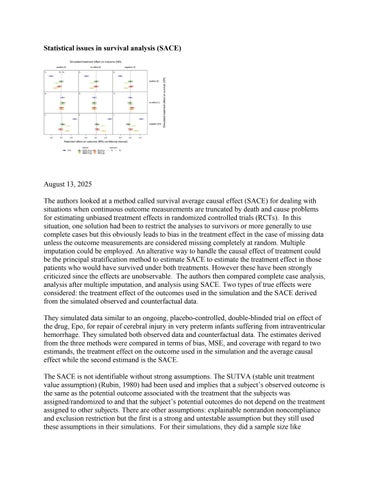
August 13, 2025 The authors looked at a method called survival average causal effect (SACE) for dealing with situations when continuous outcome measurements are truncated by death and cause problems for estimating unbiased treatment effects in randomized controlled trials (RCTs). In this situation, one solution had been to restrict the analyses to survivors or more generally to use complete cases but this obviously leads to bias in the treatment effect in the case of missing data unless the outcome measurements are considered missing completely at random. Multiple imputation could be employed. An alterative way to handle the causal effect of treatment could be the principal stratification method to estimate SACE to estimate the treatment effect in those patients who would have survived under both treatments. However these have been strongly criticized since the effects are unobservable. The authors then compared complete case analysis, analysis after multiple imputation, and analysis using SACE. Two types of true effects were considered: the treatment effect of the outcomes used in the simulation and the SACE derived from the simulated observed and counterfactual data. They simulated data similar to an ongoing, placebo-controlled, double-blinded trial on effect of the drug, Epo, for repair of cerebral injury in very preterm infants suffering from intraventricular hemorrhage. They simulated both observed data and counterfactual data. The estimates derived from the three methods were compared in terms of bias, MSE, and coverage with regard to two estimands, the treatment effect on the outcome used in the simulation and the average causal effect while the second estimand is the SACE. The SACE is not identifiable without strong assumptions. The SUTVA (stable unit treatment value assumption) (Rubin, 1980) had been used and implies that a subject’s observed outcome is the same as the potential outcome associated with the treatment that the subjects was assigned/randomized to and that the subject’s potential outcomes do not depend on the treatment assigned to other subjects. There are other assumptions: explainable nonrandon noncompliance and exclusion restriction but the first is a strong and untestable assumption but they still used these assumptions in their simulations. For their simulations, they did a sample size like