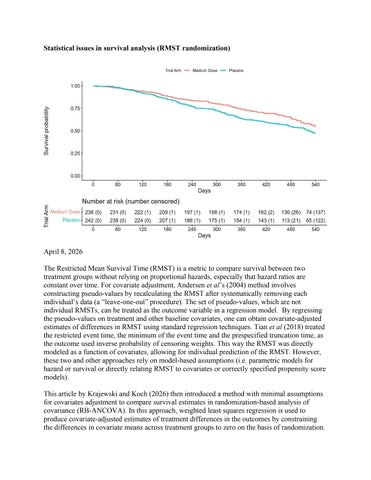
Statistical issues in survival analysis (RMST randomization)
April 8, 2026 The Restricted Mean Survival Time (RMST) is a metric to compare survival between two treatment groups without relying on proportional hazards, especially that hazard ratios are constant over time. For covariate adjustment, Andersen et al’s (2004) method involves constructing pseudo-values by recalculating the RMST after systematically removing each individual’s data (a “leave-one-out” procedure). The set of pseudo-values, which are not individual RMSTs, can be treated as the outcome variable in a regression model. By regressing the pseudo-values on treatment and other baseline covariates, one can obtain covariate-adjusted estimates of differences in RMST using standard regression techniques. Tian et al (2018) treated the restricted event time, the minimum of the event time and the prespecified truncation time, as the outcome used inverse probability of censoring weights. This way the RMST was directly modeled as a function of covariates, allowing for individual prediction of the RMST. However, these two and other approaches rely on model-based assumptions (i.e. parametric models for hazard or survival or directly relating RMST to covariates or correctly specified propensity score models). This article by Krajewski and Koch (2026) then introduced a method with minimal assumptions for covariates adjustment to compare survival estimates in randomization-based analysis of covariance (RB-ANCOVA). In this approach, weighted least squares regression is used to produce covariate-adjusted estimates of treatment differences in the outcomes by constraining the differences in covariate means across treatment groups to zero on the basis of randomization.