Statistical issues in survival analysis (Regression of censored & left-truncated data)
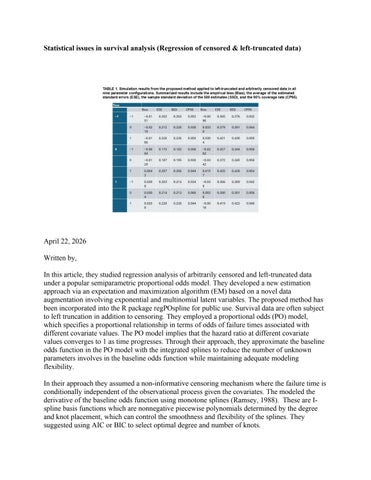
April 22, 2026 Written by, In this article, they studied regression analysis of arbitrarily censored and left-truncated data under a popular semiparametric proportional odds model. They developed a new estimation approach via an expectation and maximization algorithm (EM) based on a novel data augmentation involving exponential and multinomial latent variables. The proposed method has been incorporated into the R package regPOspline for public use. Survival data are often subject to left truncation in addition to censoring. They employed a proportional odds (PO) model, which specifies a proportional relationship in terms of odds of failure times associated with different covariate values. The PO model implies that the hazard ratio at different covariate values converges to 1 as time progresses. Through their approach, they approximate the baseline odds function in the PO model with the integrated splines to reduce the number of unknown parameters involves in the baseline odds function while maintaining adequate modeling flexibility. In their approach they assumed a non-informative censoring mechanism where the failure time is conditionally independent of the observational process given the covariates. The modeled the derivative of the baseline odds function using monotone splines (Ramsey, 1988). These are Ispline basis functions which are nonnegative piecewise polynomials determined by the degree and knot placement, which can control the smoothness and flexibility of the splines. They suggested using AIC or BIC to select optimal degree and number of knots.