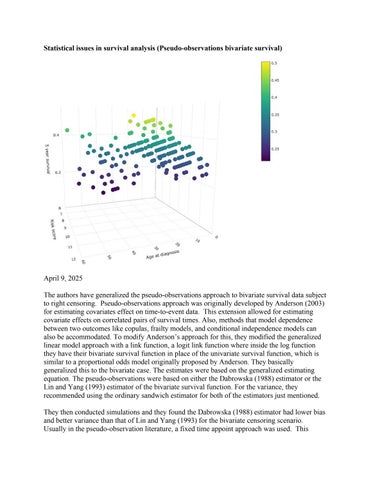
Statistical issues in survival analysis (Pseudo-observations bivariate survival)
April 9, 2025 The authors have generalized the pseudo-observations approach to bivariate survival data subject to right censoring. Pseudo-observations approach was originally developed by Anderson (2003) for estimating covariates effect on time-to-event data. This extension allowed for estimating covariate effects on correlated pairs of survival times. Also, methods that model dependence between two outcomes like copulas, frailty models, and conditional independence models can also be accommodated. To modify Anderson’s approach for this, they modified the generalized linear model approach with a link function, a logit link function where inside the log function they have their bivariate survival function in place of the univariate survival function, which is similar to a proportional odds model originally proposed by Anderson. They basically generalized this to the bivariate case. The estimates were based on the generalized estimating equation. The pseudo-observations were based on either the Dabrowska (1988) estimator or the Lin and Yang (1993) estimator of the bivariate survival function. For the variance, they recommended using the ordinary sandwich estimator for both of the estimators just mentioned. They then conducted simulations and they found the Dabrowska (1988) estimator had lower bias and better variance than that of Lin and Yang (1993) for the bivariate censoring scenario. Usually in the pseudo-observation literature, a fixed time appoint approach was used. This